in Entre deux voyages › Carnets de voyage
Six-week trip to Mexico (page 6 of 12)
Discussion started by GeorgesOZ on 2019-12-05
226 replies
This thread has been translated into English.
Six-week trip to Mexico
Greggig · 2020-03-01 · Message 101 of 227
...to pick up your Mexico travel journal, obviously! 😉
Six-week trip to Mexico
Michant · 2020-03-02 · Message 102 of 227
Hi Georges,
I’m trying to take some good photos, but just then a couple of tourists show up and plant themselves right in front of the entrance gate, staring up in awe with their giant, ridiculous khaki bush hats on full display.
Ugh, those tourist clods—what a pain! Scout’s honor, it wasn’t me blocking the gate! Though I *do* wear a "ridiculous khaki bush hat" too! 😛😏
Anyway, I’m (back from India, me too) waiting with varying levels of patience for your thoughts on Oaxaca! 😉
Six-week trip to Mexico
GeorgesOZ · 2020-03-02 · Message 103 of 227
But with a short stop in Chiapa de Corzo before getting there!
Six-week trip to Mexico
GeorgesOZ · 2020-03-05 · Message 104 of 227
Chiapa de Corzo
We find the colectivos to Chiapa de Corzo at the bus stop, right where we were dropped off from Palenque. The road to Tuxtla Gutierrez is interesting—we cross the mountains and descend almost into the plains. Chiapa is still at around 400 meters in altitude, but the climate is noticeably warmer than in SCdlC. We’re dropped off at the junction for Chiapa, or more precisely, a few hundred meters away. With the mid-morning heat, the idea of walking doesn’t exactly thrill us, but luckily, as the guidebook says, you just have to cross the road—watch out for traffic—to wait for a colectivo heading to Chiapa. Easy as pie.
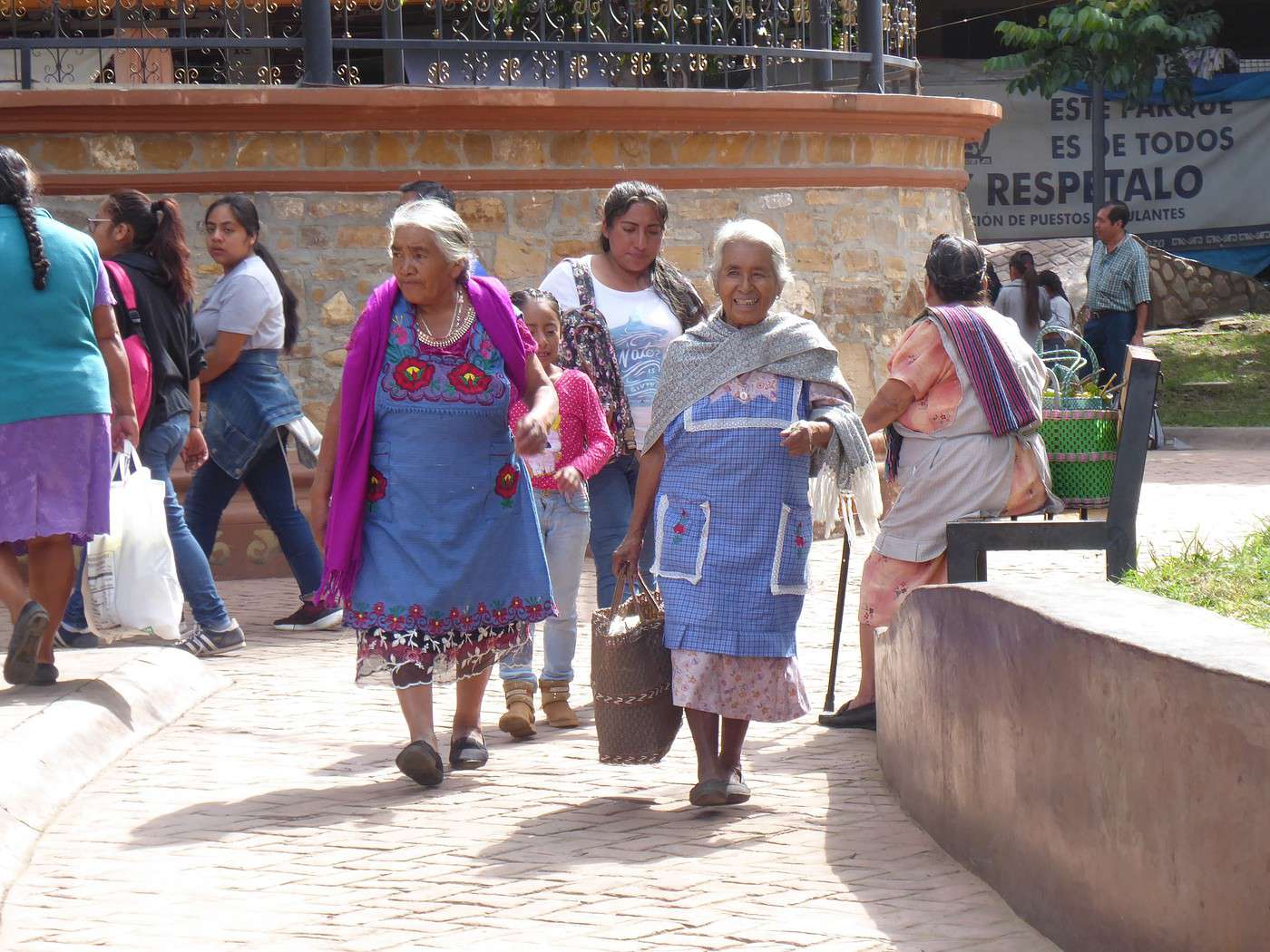
The interesting part of Chiapa is tiny. There’s, of course, the dock on the Grijalva River, which is really beautiful. But the boat ride will have to wait until tomorrow. The main central square is… large, and pretty deserted, and let’s just say it’s a bit sterile. The much-touted monument La Pila in the middle was built in 1562 in the Mudéjar style. If I understood correctly, it was a fountain, but the water isn’t running. There’s nothing like a turned-off fountain to disappoint a visitor—it’s like a waterfall that turns out to be dry after hours of hiking. So, we only stop for about ten minutes, just long enough to try out my zoom lens on two Indigenous women sitting in the square. The photos aren’t great, but they still show off those beautiful floral-themed outfits that the women love so much.
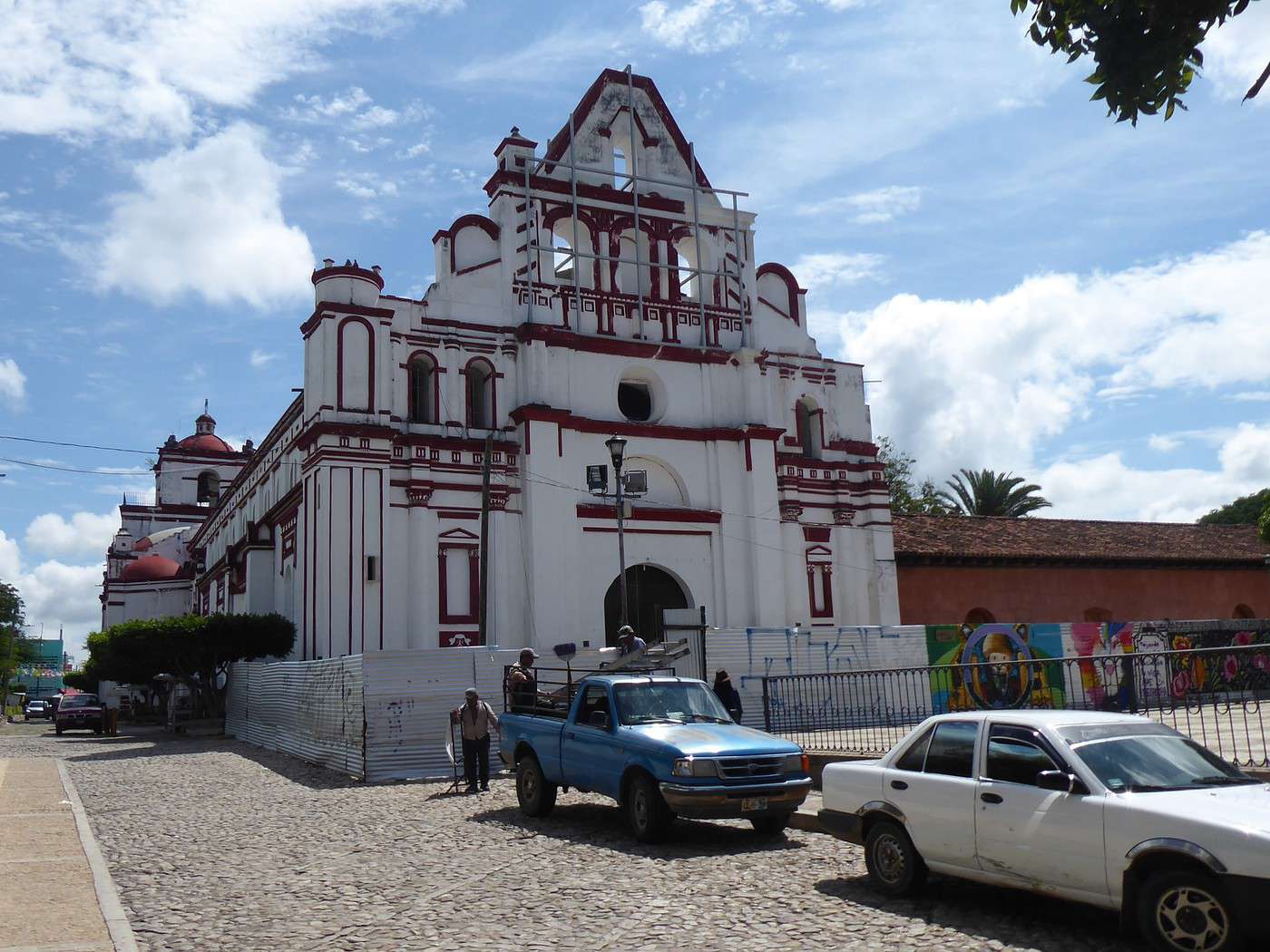
In the immediate area, there’s the covered market, which isn’t exactly thrilling and is tiny to boot, and also the Santo Domingo convent. It looks nice from the outside (photo), but no luck—it’s under repair and can’t be visited.
Since we’ve decided to do the Sumidero Canyon excursion the next morning, we’ve got a lot of time to kill, so we decide to head to the ruins about 2 km east of the central square, which shouldn’t be too much of a slog. The streets are pretty deserted; it’s already quite hot, and people are staying indoors—totally understandable. When we arrive at the Archaeological Park, bad news: we can’t go in. The women having their lunch behind the fences explain that it’s closed for repairs after an earthquake. We can just make out a few mounds that don’t seem as exciting as Teotihuacan or Palenque, but it’s worth noting that this site is *very* old. Chiapa has been occupied for at least 3,500 years and was a commercial and cultural crossroads between various Indigenous cultures—Olmec, Zoque, and Mixtec—and even farther-reaching Central American cultures.
As evening falls, we inevitably end up near the dock. There really aren’t many restaurant options. Time and the river flow quietly…
Six-week trip to Mexico
GeorgesOZ · 2020-03-08 · Message 105 of 227
Chiapa de Corzo – The Sumidero Canyon
Before diving into the new day, I’m posting two photos of Y trying on a dress last night that a Tzotzil woman was trying to sell us while we were at one of the few restaurants overlooking the river. It’s to illustrate, once again, the beauty of all the different textiles you can find in Mexico. The floral embroidery stood out beautifully against the black background of the dress 😎 (cotton or wool, I can’t remember). I have to say, we were really tempted to buy it, and at a very modest price.
Unfortunately, we thought the dress was a bit short, and the woman didn’t have any others. Looking back now and seeing the photos, it seems like a good fit, doesn’t it? Maybe we were too influenced by the justified impression that Indigenous people are often quite short… and yet Y isn’t tall! In the end, we bought a pretty blouse (with flowers, of course) for 200 pesos. Oh, and dinner cost us 415 pesos—it was fish and shrimp, and it was delicious, washed down with 2 or 3 coronas. 😛
After an early breakfast (200 pesos for two), we bought our tickets for the famous canyon excursion: 250 pesos per person, which is pretty expensive for Mexico. But we waited… and waited… and waited… An hour passed, and we were still alone, and the lancha wouldn’t leave until there were enough passengers. 🙁 There’s room for a good dozen people in there!
A foreign tourist arrived and waited with us. He’s a Franco-Spaniard from Ronda, Andalusia. We chatted about Andalusia, which we love. More tourists arrived—two or three Mexican couples from California. Still not enough to launch the lancha, and it was starting to get hot… We negotiated an extra 100 pesos each 😕 to finally start our excursion.
Maybe now’s the time to talk a little about the Grijalva River. It’s named after one of the first Spanish conquistadors, Juan de Grijalva, who, if I’m not mistaken, was one of Hernán Cortés’ companions. The local names for the river are Tabasco (or Tavasco?), like the Mexican state of the same name, but also Rio Chiapa or Rio Mezcalapa. Its source is in Guatemala. One of the restaurants at the Chiapa de Corzo dock had an interesting map of the state of Chiapas, showing how the river flows in a southeast/northwest direction, following the orientation of a mountain range crossing the border with Guatemala. The river empties into the Gulf of Mexico downstream from Villahermosa. We’d seen all that water from our plane when arriving from Mexico City… On the map, I roughly show this configuration of southern Mexico.
You might be wondering: why bore people with all these details? First, I find these details really interesting—I write based on my personal research, and if it bores readers, they can just skip to the next paragraph. Second, the Grijalva River is fundamentally important for several reasons, especially in the history of Mexico and Central America. It more or less formed a border between the Aztec Empire and Mayan territories (not to mention other Indigenous groups—this is just to keep it simple). And further back in history, it undoubtedly facilitated trade and cultural exchanges between all these regions.
Back to the canyon. We passed under the big bridge spanning the river—it’s the road to Tuxtla Gutiérrez. After a checkpoint (the entrance to the “park”), we entered the heart of the canyon, and yes, it’s impressive. The cliffs are steep on both sides and reach over 1,000 meters in height in some places! 😮😎
We stopped for a few moments on the shore to watch a family of spider monkeys, who let us photograph them peacefully. A number of birds perched on the abundant floating vegetation to fish. But there’s way more than just vegetation—it’s impossible not to notice all the trash of all kinds being carried by the river. We’re in the age of plastic, ugh… 😠
The exit of the canyon opens onto a large expanse of water, the reservoir of the Chicoasén dam. The landscape is green and pleasant to the eye. Before turning back, we made a quick stop: cold drinks were being offered from 2 or 3 boats. Given the heat, it was tempting. I got a michelada for 50 pesos (!), which I regretted a few minutes later. It’s a mix of beer and I-don’t-know-what, and it was pretty gross. 🙁 No better than the micheladas I’d tried the previous year in Colombia.
All in all, the trip lasted over 2 hours. The route was about 20-30 km. We got back to Chiapa tired from the heat. Y’s upset with me because I didn’t think to buy sunscreen, and she got a little sunburned 😊—the horror for a Thai who, like all her compatriots, is constantly worried about her skin getting darker!
In the central square, we had trouble finding space in a colectivo to Tuxtla Gutiérrez. It was noon, crowded, and the sun was blazing, I can’t even tell you! On the way: 30 pesos for both of us, and it’s only 10-12 km away. In Tuxtla, we took a taxi to cross the city (60 pesos) to the bus terminal, where we waited a few hours for our bus to Oaxaca.
Six-week trip to Mexico
GeorgesOZ · 2020-03-09 · Message 106 of 227
Oaxaca - Arrival
We had booked our bus tickets to Oaxaca at an office in SCdlC. You can find these offices in all major cities, which is handy when you're not too confident with the internet. The overnight bus cost us 1,720 pesos for two, or 40 euros per person—a significant expense, but since it's not every day, right?
All we had to do was wait at the Tuxtla terminal...
That’s where we met this Spaniard, whom we initially mistook for a Mexican. He was heading to Guadalajara to meet his Mexican girlfriend. He seemed to have some experience in the country and spoke highly of Guadalajara—authentic, with no excessive tourism. He also explained that neither he nor I were gringos but güeros (or weros). The term refers to light-skinned people (as opposed to morenos, who have darker skin) and whose hair is supposedly blond or light brown, though that second condition doesn’t seem strictly necessary in practice. Fair-skinned to begin with but with the slight tan I’ve developed after so many years in the tropics, I fit perfectly into this category and don’t stand out too much as a foreigner in the crowd.
It’s an overnight bus. Let’s hope traffic is smooth and there are no obstacles on the road. On the way from SCdlC to Chiapa de Corzo, I’d noticed signs advising brake-less vehicles to “follow the red line” on descents: “Vehículos sin frenos siguen la raya roja,” and other vehicles to yield to brake-less ones: “Cedan el paso a vehículos sin frenos.” Not exactly reassuring for travelers!
Fortunately, the ride was comfortable, and best of all, there were almost none of those dreaded “topes” that had bothered us so much between Palenque and SCdlC! Dawn found us in the last mountains before Oaxaca. A quick taxi ride, and we arrived at the hotel.
Describing Oaxaca is going to be a challenge—there’s so much to see and do! We spent several days there, so I’ll just follow the thread of some photos as I took them.
We were just a few days away from the famous Día de Muertos, and it was immediately noticeable. There were far more foreign tourists than we’d seen so far, except in Teotihuacan. The Día de Muertos in Oaxaca isn’t yet completely turned into a gringo festival, like Songkran has become a “Farang” event in Bangkok, but the trend is clear.
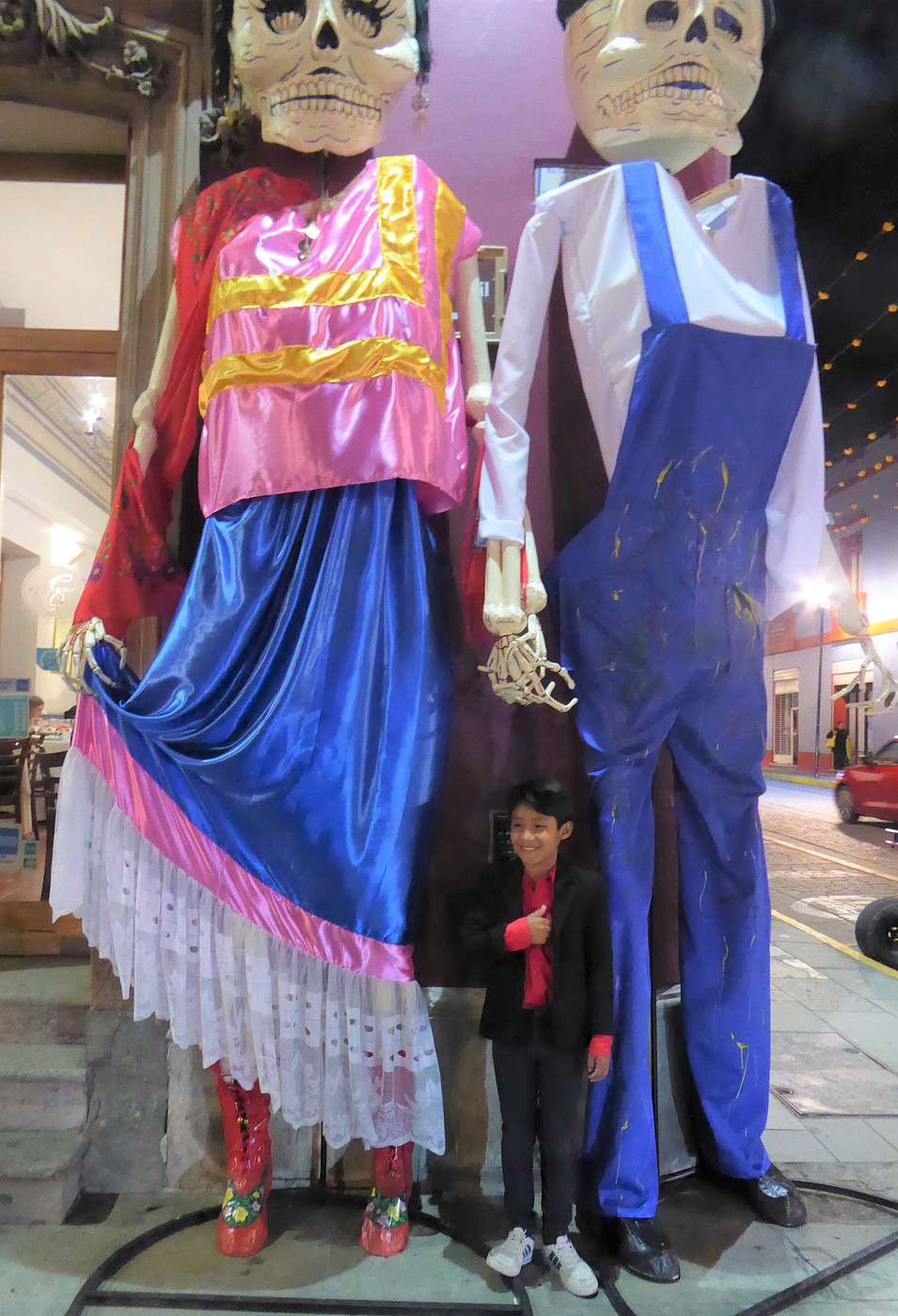
All over the city center, you could see skeletons of all kinds, often arranged in funny scenes for tourists to take souvenir photos. Crowds were everywhere—outside the cathedral (photo) and beyond.
One thing that really stands out is the vibrant artistic scene in this city. Some photos taken at the Jardín Labastida, near the Templo de Santo Domingo, show the variety of paintings and other artworks looking for buyers.
But it’s not all modern. On the sidewalk, this elderly Indigenous woman had laid out several beautifully embroidered blouses. A couple of Americans, who claimed to be experts in local Indigenous art, were amazed. They said it’s rare to find handicrafts from this particular village (San Pedro Ixtlahuaca, if I remember correctly) in the city. We just admired the quality of the work and left the Americans, who seemed determined to make a purchase.
That’s a first impression of Oaxaca. I’ll need several more pages to “soak up” all my memories of this city. See you soon for the next part!
Six-week trip to Mexico
Frmi31 · 2020-03-09 · Message 107 of 227
I brought back a lot of things from Mexico, but I never haggled because people need to make a living.
Six-week trip to Mexico
GeorgesOZ · 2020-03-10 · Message 108 of 227
I brought back a lot of things from Mexico, but I never haggled because people need to make a living
Hi Marie-Françoise,
That’s really noble of you, but it’s not necessarily the best approach either. Sure, I’m not about arguing over the last peso (or rupee, or baht, etc.). There are people who think they’re clever by haggling like crazy—I’m not one of them.
But a little negotiation, with a smile, often makes the sellers happy in many of these “exotic” countries, where prices aren’t really fixed to begin with. Haggling is completely part of the way of life there.
The key is knowing when to stop—if the other person firmly resists, for example. And you don’t haggle over small items. I’d never dream of trying to knock down the price of a kilo of mangoes I buy on the street in Mexico, India, or Thailand! But every time I take local transport, for instance, I ask the price upfront and 9 times out of 10, I try to get it lowered (often the initial price is inflated because I’m a foreigner).
I totally agree with you that people need to make a living, and I’m not stingy with those I meet. Knowing how to haggle is another matter entirely.
Six-week trip to Mexico
Frmi31 · 2020-03-10 · Message 109 of 227
It’s clear you live in Asia!
Six-week trip to Mexico
Frmi31 · 2020-03-10 · Message 110 of 227
For me living in France, Mexico isn’t exactly an "exotic" country.
Six-week trip to Mexico
GeorgesOZ · 2020-03-11 · Message 111 of 227
Oaxaca – Zaachila Market
Let’s start with a practical detail: breakfast. We tried two or three different spots and lucked out. For example, there’s Rincón del Búho on Avenida de la Independencia, 600 meters from the Zócalo and just before Nuestra Señora de la Merced. It’s super clean, the food is excellent, and the service is impeccable. For 220 pesos, we both ate our fill.
Now that we’re stuffed, it’s time to move on to the "adventure-discovery" part of our trip! By "adventure," I mean a gentle version of it, of course!
One of Oaxaca’s many draws is the number of fun little day trips you can take in the surrounding valleys. The city is surrounded by the Sierra Madre mountains, and there are three main valleys to explore, offering plenty of options.
It’s Thursday, which means it’s Zaachila Market day—a small town in the Valle Grande, south of Oaxaca. We take the local bus (9 pesos per person) for this little 15-kilometer excursion from Oaxaca. On our left, we pass the international airport. Once there, it only takes a few minutes to reach the market, and we’re greeted by a lively atmosphere.
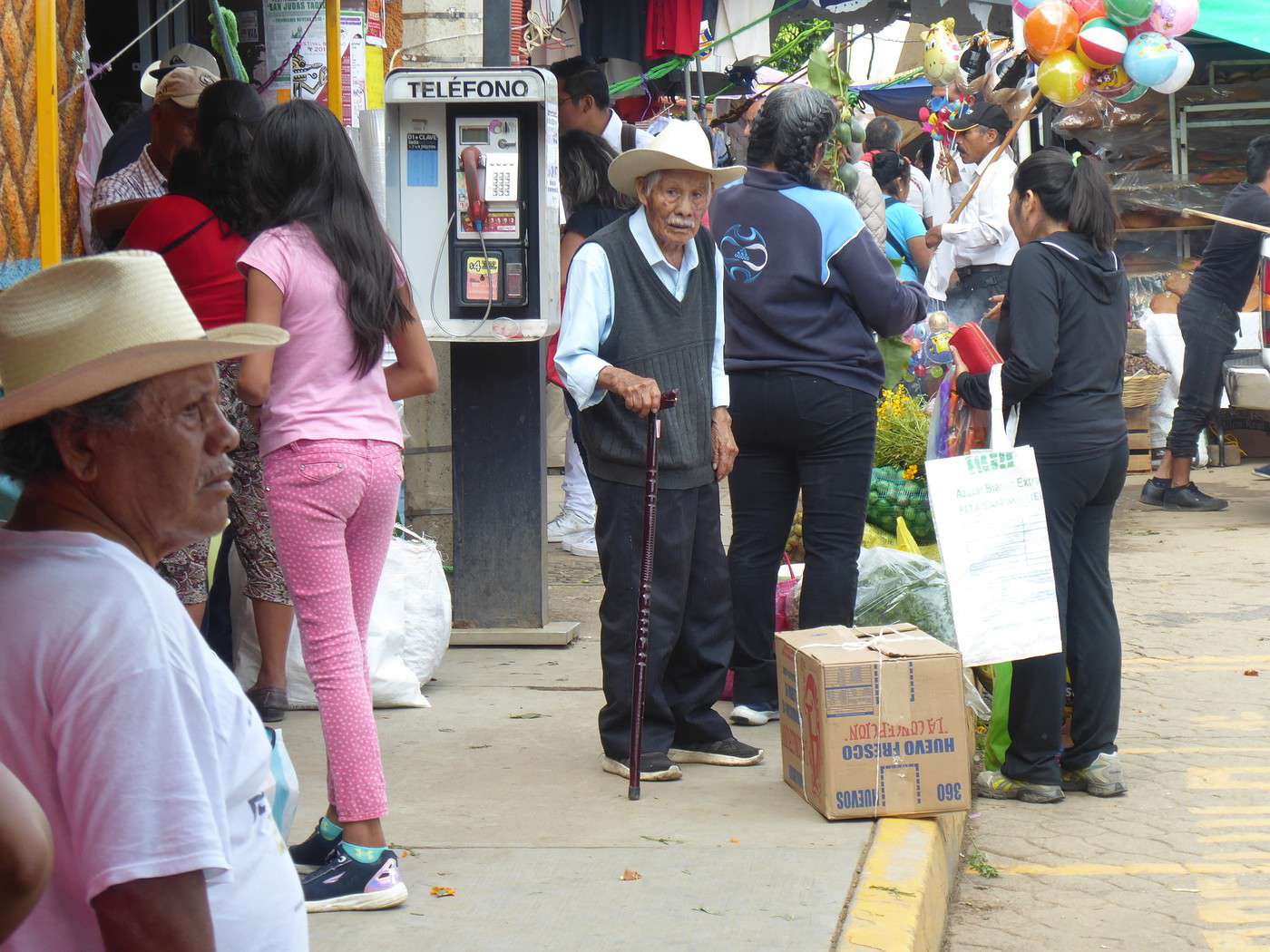
The market is centered around a small square, easily recognizable by its unique fountain: the basin is lined with bricks in geometric patterns typical of indigenous design, topped by a statue of an Indigenous man in full regalia—his headdress is quite extraordinary. We sit on one of the benches ("in Mexico, there are tons of public benches") to people-watch. I take photos of locals with striking features—men in sombreros and elderly women who could almost pass for Mediterranean grandmothers. I get the impression that the Indigenous people of the region, mostly Zapotecs if I’m not mistaken, have much lighter skin than others. Their facial features seem almost Southern European. The vibe is super friendly; people are relaxed and smiling. An elderly man sitting next to us strikes up a conversation, and we chat pleasantly until his wife arrives—a cute little grandma like the ones I used to see in the mountains of northern Italy during my childhood vacations.
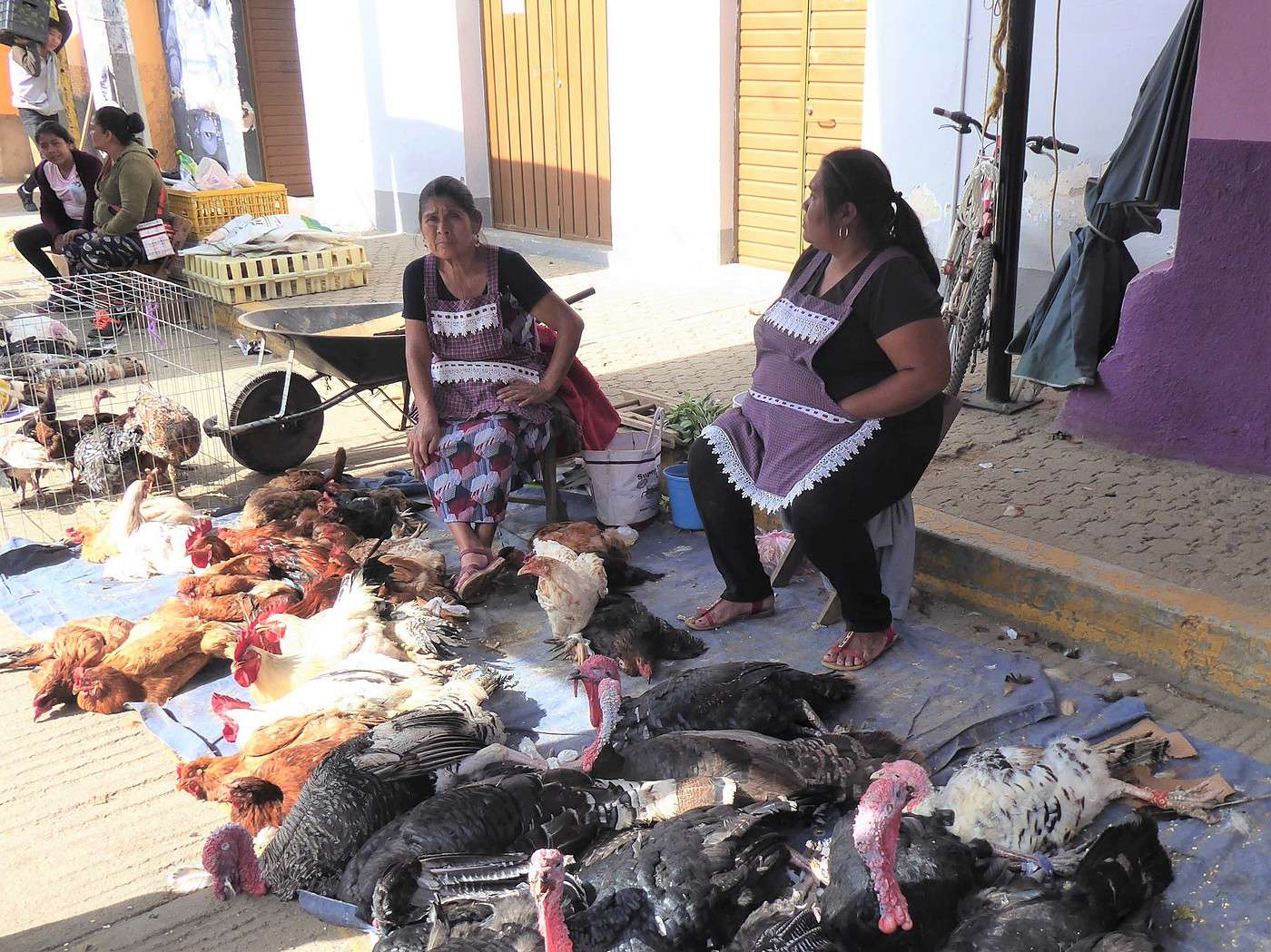
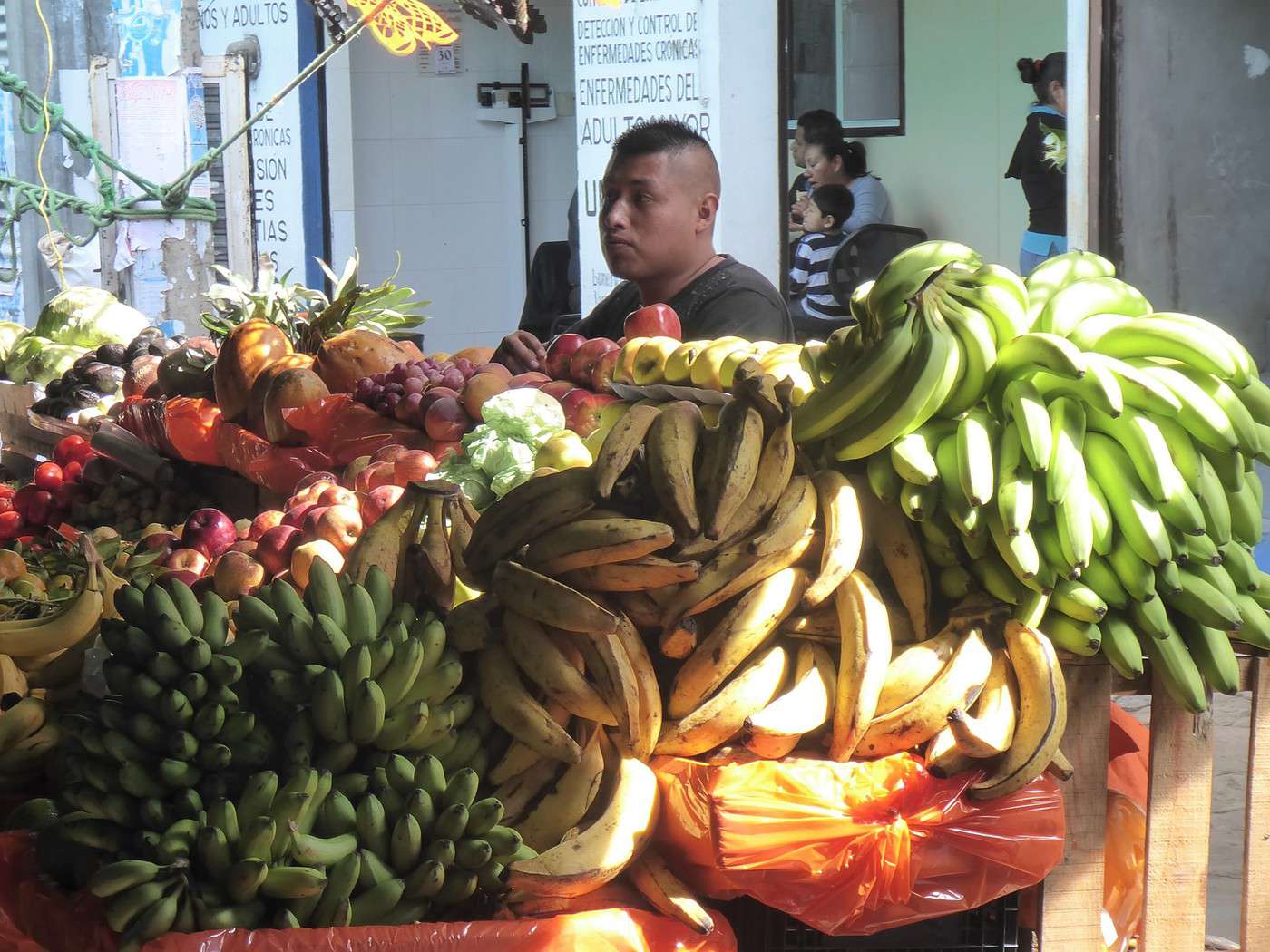
I mentioned the sombreros: there are some beautiful displays if we needed another one. But there’s everything here—turkeys, flowers, fruits—and food stalls where you can sit down to eat and have a drink. And those beautifully decorated breads? Never seen anything like them before!
After thoroughly exploring the market, we head toward Santa María Church, about a hundred meters away, up a flight of steps. No, we’re not here to visit the church (we’ve seen enough of those!), but to check out the archaeological site just a little farther. I’m well aware that Zaachila has archaeological significance—it was an important center of Zapotec culture, roughly contemporary with Monte Albán (just a few kilometers away). But to be honest, we could’ve skipped the 45-peso entry fee (per person), totaling around 4-5 €, because there’s not much to see besides a mound. The two tombs buried beneath it are open for viewing, but it only takes a minute—nothing particularly striking. Still, no regrets; we made a small donation to support the country’s heritage research and restoration efforts. Plus, the area is lush and pleasant, with beautiful cacti and flowers.
On our way back to the market, Santa María Church stands dramatically against a heavy, cloudy sky.
We take a shared taxi back to Oaxaca (17 pesos per person). That evening, we stroll near the Templo de Santo Domingo. In one of the side streets, we find a tiny little restaurant where we try tlayudas (125 pesos for two). What a discovery—delicious! 😛
A quick note on the markets around Oaxaca. Since they’re held on different days—usually just one day a week—a traveler who wanted to visit them all would need to stay in Oaxaca for a full week. Which isn’t hard to do, given how much there is to see and do in this incredible city. But of course, that’s not feasible for the "schedule-obsessed" travelers who want to "do Mexico" in 10 days…
Six-week trip to Mexico
GeorgesOZ · 2020-03-12 · Message 112 of 227
Oaxaca – The Templo de Santo Domingo de Guzmán
If there’s one must-see in Oaxaca itself, in my opinion, it’s the Templo de Santo Domingo de Guzmán. A stunning example of Mexican Baroque style, this church was founded by the Dominican order in the mid-16th century. Inside, you’re struck by the exuberance of the ornamentation, for which over 60,000 gold leaves were used. 😇 The vaults—what can I say? Just look at the photos and judge for yourselves. Personally, we found it absolutely breathtaking, mind-blowing. Yes, it’s elaborate, but what beauty, what elegance! 😎
Heading back toward the Zócalo, there are several possible routes, and every street in the center has something interesting. Here, a charming little house. There, an unusual entrance: the « Calaveras Old School », or « Skulls Old School ». The mural to the right of the door leaves no doubt about the place’s favorite theme. After a few detours, we find ourselves near the Mercado Benito Juárez. There’s a bit of chaos like in any market, but it’s far from as dirty as what you often see in India (since we’ve just come back from there).
And of course, we end up back at the Zócalo. It’s impossible to take a full photo of the square—it’s too crowded from every angle. Suffice to say that, like in almost every city I’ve seen in Mexico (and Colombia), it’s a particularly pleasant place to wander, sit (yes, yes, you already know: in Mexico, the benches tra-la-la!), and watch the world go by.
With all this, you can easily spend most of a relaxed day in Oaxaca.🙂
Six-week trip to Mexico
Michant · 2020-03-13 · Message 113 of 227
Hi there,
So, from what I’m reading, you can definitely spend a pleasant week exploring Oaxaca and its surroundings.
Between Oaxaca and Chiapas, which did you prefer?
Six-week trip to Mexico
GeorgesOZ · 2020-03-14 · Message 114 of 227
Good evening,
Reading your post, it sounds like you could have a lovely week of discoveries in Oaxaca and its surroundings.
Between Oaxaca and Chiapas, which did you prefer?
Without a doubt! I’d say going for just 3 days would be way too short, but at least it would let you: 1) explore the city (the downtown area is walkable, but you could easily spend a full day there), 2) take a day trip (a nearby market, or Mitla and Hierve el Agua), and 3) visit Monte Albán (amazing—I’d go back in a heartbeat).
But it’d be a rush. Honestly, you should plan at least 4–5 days, if not more, for the city and its surroundings.
As for choosing between Chiapas and Oaxaca, it’s tough. But if you pushed me, I’d pick Oaxaca. Why? Because there’s so much to do from one base. Sure, San Cristóbal de las Casas (SCdlC) is nice, there are indigenous markets nearby, and you can do the Sumidero Canyon as a day trip from SCdlC. But SCdlC is much smaller than Oaxaca. Plus, if you’re into archaeology, Monte Albán is right outside Oaxaca, while Palenque requires a grueling 5–6 hour trip (so it’s not a day-trip option from SCdlC).
Others will definitely have different opinions!
Six-week trip to Mexico
Frmi31 · 2020-03-14 · Message 115 of 227
I’m not interested in Colonial Mexico at all—I only love pre-Columbian civilizations and the current indigenous peoples.
Six-week trip to Mexico
Frmi31 · 2020-03-14 · Message 116 of 227
Sorry, but I don’t know how else to put it
Six-week trip to Mexico
Michant · 2020-03-14 · Message 117 of 227
Hi Georges,
Okay, Oaxaca is a go!
Since we’re neither "schedule-obsessed" (love that phrase! 😉), nor marathon sightseers, we’ll spend a week in Oaxaca—it blends colonial heritage with pre-Columbian treasures.
Thanks again for this travel journal! 🙂
Michel
Six-week trip to Mexico
Frmi31 · 2020-03-14 · Message 118 of 227
I'm used to this forum where the national sport is to humiliate others ^to shut them up
Six-week trip to Mexico
Joss34 · 2020-03-14 · Message 119 of 227
I'm used to this forum where the national sport is to humiliate others ^to shut them up
It's just that you have a habit of making condescending or completely off-topic remarks when no one asked for them. You don’t like "colonial" Mexico or Catholic churches because you're Protestant (NB: that’s a dumb argument, by the way)—that’s your choice, but honestly, we don’t really care. Also, sorry, but the Yucatán you visit is far from authentic; it’s more like a money-making machine, and to me, it’s not even really Mexico when you push it.
To get back to the author’s point, Oaxaca is *totally* worth the detour—way more than Chiapas, in my opinion.
Six-week trip to Mexico
Frmi31 · 2020-03-14 · Message 120 of 227
Everyone has their own opinions and their own vacations