in Thèmes › Croisières
Costa Concordia: the investigation (page 7 of 39)
Discussion started by Mookat on 2012-01-22
763 replies
This thread has been translated into English.
Costa Concordia: the investigation
Mondialist · 2012-01-27 · Message 121 of 764
Hello,
I guess but may be wrong that on these ships, in addition to charts, sounders, GPS, they sail with at least one radar (especially at night, near the coast), so if I'm not mistaken, it wasn't the navigation instruments that were missing to follow its route.
But what was the Officer of the watch doing?
Hi Pasan,
The radars are perfectly visible on the ships' masts.
There are at least two (one at the front, and one at the back).
J.
Costa Concordia: the investigation
Mondialist · 2012-01-27 · Message 122 of 764
The "real" was in quotes to avoid that kind of comment.
You'll find a "GPS" for just under 100 euros at the local Carrefour... (see? more quotes!!)
Good evening,
When there are transatlantic or round-the-world races (like the "Vendée Globe" or "Route du Rhum"),
I'd read that all the sailboats were equipped with Argos beacons.
It's possible that the tracking and locating system for large ships is different.
J.
Costa Concordia: the investigation
Jacmat · 2012-01-27 · Message 123 of 764
On all the cruise ships I've sailed on, I've always seen at least 3 or 4 radars. While sailing, at least 2 of them work.
And all these radars were located at the front of the ship. I've never seen any at the back.
Costa Concordia: the investigation
Charleslebon · 2012-01-28 · Message 124 of 764
You go to the market, you buy a melon, you wrap it in a newspaper, you go home, you unwrap the melon,
you put it on the table..............which side is the stem on?
And without GPS .......please! 😉
Costa Concordia: the investigation
Major72 · 2012-01-28 · Message 125 of 764
Good evening,
When there are transatlantic races or round-the-world races (like "Vendée Globe" or "Route du Rhum"),
I had read that all sailboats were equipped with Argos beacons.
It's possible that the tracking and locating system for large ships is different.
ARGOS beacons, as their name suggests, are designed to transmit at regular intervals the position of a ship, an aircraft, or other people equipped with this system (only in case of distress).
When the beacon is triggered, it emits a signal that will be picked up by a satellite whose purpose is to retransmit distress signals.
The ARGOS system listening station(s) alert the authorities that a signal has been received with certain coordinates (ship position, code allowing to know which ship (or plane) is in distress, and depending on the capabilities of these beacons, other information).
The satellite will then pass again and confirm the distress signal by indicating another position (currents, voluntarily deviated routes, or others)
This system is not a tracking system for boats in the Route du Rhum or other races.
The system on large ships is of the ARGOS type on a 406 MHz frequency.
This frequency is international and can be heard by stations equipped with decoding systems.
The system used for tracking in offshore races uses routers.
The boat is permanently connected by radio to a satellite which will retransmit to the PC of the boat's team.
It's the forecaster of the shore team who will indicate the route that seems best to him.
Moreover, on offshore racing boats, on cruise ships even merchant ships are connected to satellite phones.
In fact, these phones are just connected to a constellation of satellites to make voice calls around the world.
The cost of transmissions is quite expensive.
Another boat tracking system exists (well, several systems exist) using radio-location.
Principle: a transmitter coupled with a GPS and a modem to send frames allows tracking of boats or cars in the case of raids.
Costa Concordia: the investigation
Major72 · 2012-01-28 · Message 126 of 764
Article reprinted from a news agency dispatch
Apparently these are the Captain's remarks transcribed by someone whose identity we don't know from reading the official report.
1/ The officer on watch or the Captain realized too late how close they were to the shore to change course along the island of Giglio.
Coming hard to starboard, the stern swung out before hitting the rock, properly marked on the nautical chart.
Note that it was night at that moment, not mentioned in this passage.
2/ The engine couldn't be restarted, and only the bow thrusters allowed the captain to maneuver, and even then, I'm not sure the generators with enough power restarted after the electrical blackout.
That means that, perhaps, only the wind or the current drove the cruise ship onto the rocks.
3/ Under these circumstances, at night, evacuating 4200 people with all the lifeboats, despite the list and the panic, is rather to the credit of the Crew, who did what they had to.
Fortunately the cruise ship ran aground on the rocks, because in open water it would surely have capsized .........!!!!!
A lot of rubbish has been reported by the newspapers; we'll have to wait for the Captain's trial to know exactly how the sinking unfolded.
Costa Concordia: the investigation
Arsene83 · 2012-01-28 · Message 127 of 764
I agree with you, Major,
But before your 1, 2, 3, the disaster was already set in motion, from what I understood.
And what's most criticized about the command is the handling of the disaster; in the field you don't abandon your "men"
Especially when it comes to civilians, children, the elderly and women we're supposed to protect.
In this respect, I've spoken out about a palpable lack of ethics on Costa ships.
I've noticed for some time now the lack of solidarity between the command and customers seen as "cash cows".
Also, service staff treated like veritable modern slaves will find themselves standing with the passengers in the general every-man-for-himself.
I don't hesitate to use the words "nomenclatura" and "feudalism" in the service of the almighty dollar.
As witnessed in a recent Canal+ documentary where customer management was summed up by an executive: I quote
"you have to treat Mr. DUCON with a smile",
DUCON but with a smile... Now there's an original marketing angle.
But Mr. DUCON is me, it's you,
And indeed we find this philosophy again in the crisis:
COSTA managed the equipment as best it could, I should say, or at least the least badly,
as witnessed by the various communications with SAVONE,
leaving the rats and the "Mr. DUCONs" to their fate.
I said that with the Concordia it's an entire system that capsized; it's clear that if COSTA doesn't want to sink, decision-makers will also have to reconsider how they manage people, not just under strict law but also under natural justice.
"Right and law, these are the two forces: from their agreement comes order, from their antagonism come catastrophes."
Costa Concordia: the investigation
Arsene83 · 2012-01-28 · Message 128 of 764
Concordia was only 150 meters from the coast, according to the first evidence from the black box. An "incredibly close" distance, commented the prosecutor.
🤪🤪🤪🤪that's scary🏴☠️🏴☠️🏴☠️
"It seems that his decisions in managing the emergency did not follow Costa Crociere's procedures, which are in line with international standards"
Could someone tell us more about the evacuation and emergency management protocol?
The crew only raised the alarm an hour after the accident, having previously assured the port authority that it was only an electrical problem and that the situation was under control. The staff also took time to decide to launch the lifeboats - some of which, moreover, could not be lowered due to the ship's extreme tilt.
I'm addressing the experts
how can a ship sailing at 15 knots have a total blackout after the impact
is it the impact?
the machinery couldn't have been flooded instantly and at the same time?
PS I would really like to know a bit more about the black boxes
thanks to our experts
Costa Concordia: the investigation
Arsene83 · 2012-01-28 · Message 129 of 764
a little bump for our weekend specialists
Costa Concordia: the investigation
Mondialist · 2012-01-28 · Message 130 of 764
On every cruise ship I've sailed on, I've always seen at least 3 or 4 radars. During navigation, at least 2 of them are running.
And all these radars were located at the front of the ship. I've never seen any at the back.
Hi Jacmat,
We agree: there are AT LEAST two radars, and sometimes more.
One of these radars monitors the back of the ship, to alert the bridge if another ship or cargo ship
follows too closely.
J.
Costa Concordia: the investigation
Mondialist · 2012-01-28 · Message 131 of 764
Hi everyone,
The latest news on this shipwreck:
- The captain, questioned by the investigating judge in charge of this case, officially admitted
that he had deliberately brought his ship closer to the coast to please
one of his subordinates, a native of this island.
The rumors that Costa Cruises suggested it to him for publicity purposes
have completely fallen flat....
- an eighteenth victim has been discovered, drowned in her cabin, she's a Peruvian
chambermaid.
The staff who were resting when the ship's hull was breached, in the cabins below the
waterline, make up the vast majority of these victims.
J.
Costa Concordia: the investigation
Mondialist · 2012-01-28 · Message 132 of 764
Hi Arsène,
Yes, a widespread short circuit can happen on a ship, but ships
of this size all have backup electrical equipment, which probably
switches on automatically if the main one fails.
The Concordia's short circuit occurred when the hull first tore....
with seawater entering the compartments and causing a short circuit.
I'm surprised to read that the crew didn't raise the alarm.....etc......................
but it's not up to the crew to do that!!! it's the Captain who orders it, but he
wanted to turn back and handle it alone. Stupidly criminal.
The crew took a while to decide to launch the lifeboats............... same answer:
it's not up to the crew to decide! That's the captain's responsibility.... now
of course if he fled.................
J.
Costa Concordia: the investigation
Arsene83 · 2012-01-29 · Message 133 of 764
yes, hello everyone,
@Mondialist
With all due respect, I'm not entirely sure, unless you can provide proof, that the captain actually performed
the "turnaround" maneuver to turn back
To tell you the truth, I'm keen to learn more about this maneuver, which remains poorly explained.
Same goes for the electrical blackout system—I don't quite get it all and would like to know a bit more😉
As for the communications, I completely share your opinion—it's stupid to the point of being criminal.
Costa Concordia: the investigation
Tgvlent · 2012-01-29 · Message 134 of 764
Knowing which chart we're talking about matters little for the seabed... The seabed is surveyed "manually". Nations with a large navy all have their hydrographic service. In France it's the SHOM (Service Hydrographique et Océanographique de la Marine). Maybe the best in the world.
But given the extent to be surveyed, very many charts are not up to date, or simply not surveyed with sufficient precision. With a bit of experience, you quickly learn whether to trust certain hydrographic services or not... I won't name names...
Then, regarding the chain of command... A ship, whatever it is, civilian or military, is not a floating democracy. There is a captain. Period. If the captain gives an order to his officer of the watch, the latter must execute it or make a remark that it doesn't seem appropriate to him. In that case, either the captain withdraws his order, or he takes the maneuver himself... that doesn't mean the captain is incompetent, he may lack information that his officer of the watch, on the other hand, must have.
And yes, alarms (of measuring instruments like sonars/radars for example) get unplugged. And it happens. Otherwise when you dock, you end up deaf...
Cross checking (verifying your route with a visual measurement: taking bearings on landmarks and a GPS fix), is learned. But not always practiced (even VERY rarely). Blame the overly reduced crews. It's not necessarily their fault anyway.
If you don't do it, then you stay far from the coast...
For info, when you get the coastal skipper's license, they kindly explain to you that in the coastal zone (300m from the coast) the speed is limited to 5 knots... Which is already way too much for a 300-meter-long vessel...
So mistake, yes undeniably. But which one??
All the world's nautical charts are kept, updated and maintained by the International Hydrographic Bureau located in Monaco.
4 Quai Antoine 1er - P.O. Box 445 - MC 98011 MONACO CEDEX
Phone : (+377) 93 10 81 00
E-mail : info@ihb.mc
Website : www.iho-ohi.net/francais/accueil
The offices are closed to the public, but only visitable during "
Open House" days (of Monaco)
This service, created in 1921 by Prince Albert I, later became the International Hydrographic Organization (IHO), it is a consultative and technical intergovernmental organization.
The objectives of the IHO are:
The coordination of the activities of national hydrographic services.
The standardization of nautical charts and nautical documents.
The adoption of efficient and reliable methods to carry out and exploit hydrographic surveys.
The development of sciences relevant to the field of hydrography and techniques of descriptive oceanography.
Consequently, on all certified nautical charts you will find in the cartouche the IHO logo, namely: a marine anchor in the IHO monogram, the stock bearing the date 1921, the shank formed by the I.
This logo is accompanied by the emblems of the national services (SHOM for France, Admiralty for GB, IMRAY, etc.)
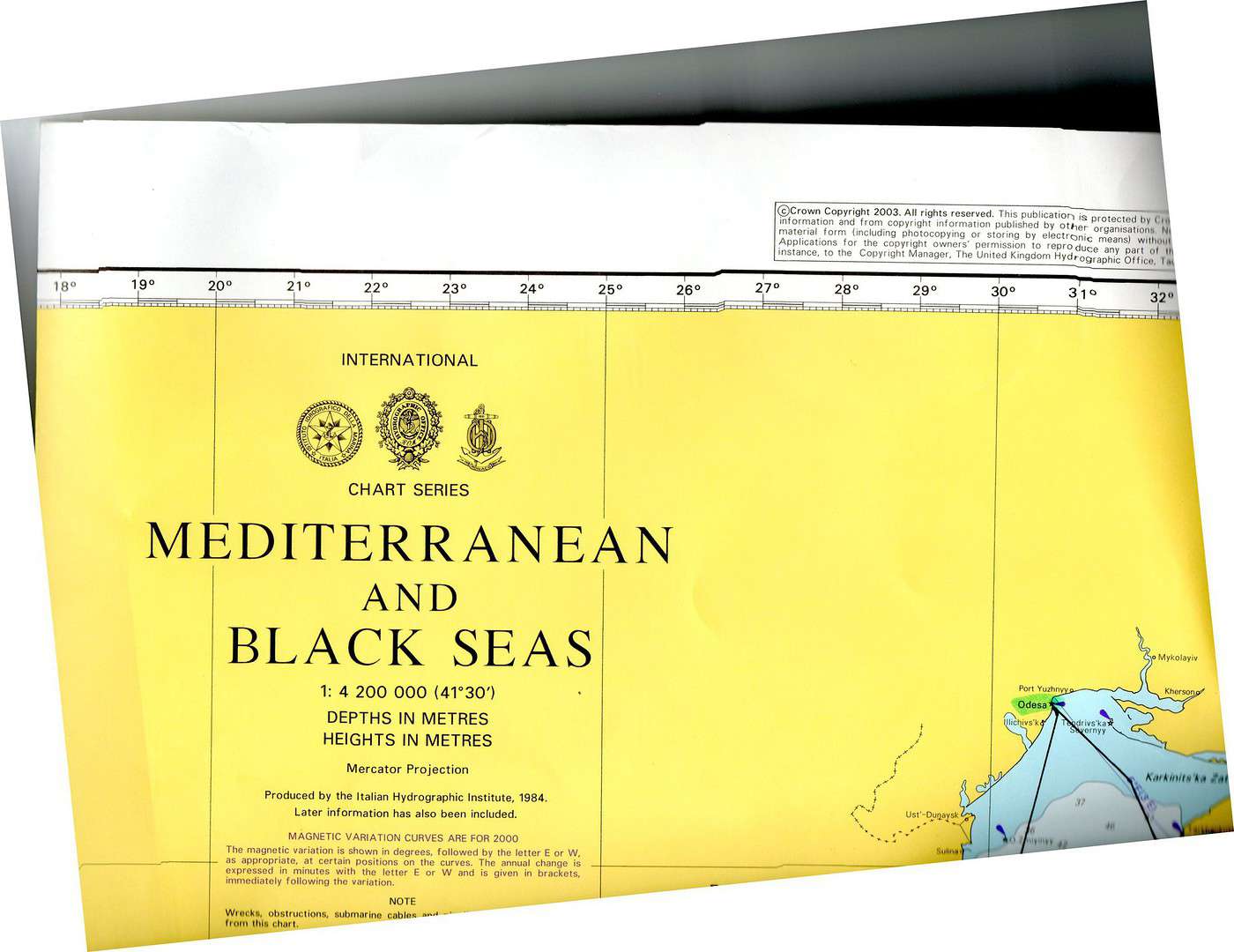
Costa Concordia: the investigation
Mondialist · 2012-01-29 · Message 135 of 764
yes, hello everyone,
@Mondialist
...../........... unless you can provide me with proof that the captain performed
the "turnaround" maneuver to turn back.
To tell you the truth, I'm keen on information about this maneuver which remains poorly explained.
Same for the electrical blackout system............./.................
I completely share your opinion, it's stupid to the point of being criminal.
Hi Arsene,
No, I don't think the Captain had his ship do a turnaround.....😉😉....
it partially "turned over" due to a simple law of physics: seawater is heavier
than the air that was in the holds.
If we refer to the charts that a participant posted (I'm not sure if it was on
this thread), we could see very clearly the ship's trajectory, which after hitting the shoals
continued on its way thanks to its momentum and perhaps the engines running at full power.
Then, we can see very easily that the boat turned back, to try to return probably
to the port of the Island, but ran aground again on the rocks that surface along this coast.
All of this is no longer disputed by anyone.
As for the short circuit, that's the account given by several survivors: there was a crash (the first one) followed
by darkness that lasted a few minutes, before the power came back on, and the announcement over the loudspeaker
"we have the situation under control... don't panic.... calmly return to your cabins".
A good quarter of an hour later, a second more violent crash, and the ship starts to list.....etc......
J.
Costa Concordia: the investigation
Arsene83 · 2012-01-30 · Message 136 of 764
Hi everyone
here's a really well-written article that gives a minute-by-minute rundown of what we know about the facts
the site is trustworthy,
http://www.meretmarine.com/article.cfm?id=118471
Costa Concordia: the investigation
Mattaf · 2012-01-30 · Message 137 of 764
Hi everyone!!
To answer your questions, when water floods the engine room, generally everything shuts down. Either there are safety circuit breakers that cut the electrical circuit, or the engines are flooded. The ship's electricity is supplied by the propulsion engines, which also run as generators. If you flood the engines (with water), it's like your scooter, it stalls...
There are emergency generators to generate the minimum electricity needed, particularly to run the helm; and on a cruise ship, to light the corridors at least to avoid panic...
And yes, at 15 knots (28 km/h) it's quite possible to flood the engine compartments, just look at the size of the tear visible in the photos (even if we have to wait for the expert report to conclude...).
From what I've read so far, the "turnaround" maneuver was carried out using the bow thrusters, powered by the emergency generators. That's at least what's being claimed for now. I don't really see how the ship could have made a U-turn by itself, knowing that at the end of its trajectory (before the "U-turn") its speed was down to just 1 knot.
Regarding radar, yes all ships have them (of this size anyway...). Talking about front and back doesn't really make sense, because they rotate 360°. It's like in the movies: the green circular screens with a bar that rotates and makes green dots appear... You have to imagine that a radar creates a "field of vision" that can be represented by a half-sphere around the ship, at the water's surface. Then, depending on the model, you'll see better and further...
Hope I've answered your questions...
Nicolas
Costa Concordia: the investigation
Arsene83 · 2012-01-30 · Message 138 of 764
Costa Concordia: the investigation
Mattaf · 2012-01-30 · Message 139 of 764
Thanks!!
and it lends even more credence to the theory of the bow thruster maneuver....
Costa Concordia: the investigation
Arsene83 · 2012-01-30 · Message 140 of 764
Thanks!!
and it further supports the theory of the bow thruster maneuver....
2 questions
1/ apparently the bow thrusters are what pushed the ship onto the shore, what would have happened if they hadn't worked?
2/ the point of running aground was to avoid capsizing, but couldn't the evacuation have happened at the same time given the very low speeds?