in Entre deux voyages › Carnets de voyage
Inside South Africa (page 9 of 11)
Discussion started by Voyajou on 2016-10-30
212 replies
This thread has been translated into English.
Inside South Africa
Voyajou · 2018-05-31 · Message 161 of 213
I assume the couple who got robbed came out of it without physical harm.
True, they’re seasoned. In this context, most of the time, if you let yourself get robbed, you’ll walk away with your life. But that’s not always the case, especially in situations without witnesses. You know it: the first victims of violence in this country are the residents of the townships.
Hope you recover soon if it’s not already old news.
I got back with a raging fever. Proof: most of the horse races scheduled in western France this May were canceled due to equine rhinopneumonitis.
Welcome back to France
Thanks to Air France’s pilots, the direct 11-hour Cape Town-Paris flight turned into a 20-hour Cape Town-Dubai-Paris detour. The delay would’ve been bearable, but it was on Emirates, one of the best airlines in the world. Except I avoid flying Gulf carriers like the plague: paying extra for oil to guys just because they’re sitting on it, only for them to turn around and screw us over? No thanks.
I’m not sure Air France will compensate me for the moral damage—otherwise incalculable.
Inside South Africa
Atila · 2018-06-01 · Message 162 of 213
I'm not sure Air France will agree to compensate me for moral damages—immeasurable as they are, anyway
You’ll have to settle for the 600 € per passenger covered by the EU regulation.
Perfect timing—it’s exactly the price of a round-trip Air France ticket to Joburg.
There’s your next trip sorted… 😉
Inside South Africa
Voyajou · 2018-10-07 · Message 163 of 213
May the reader in search of exploits, and the adventurous soul, forgive me: what follows are just tiny tales of an intermittent expat.
News from the donkeys
On either side of the historic city, to the north, a township of eight thousand inhabitants, and to the south, a refuge where around a hundred donkeys—no longer wanted or affordable for their owners—now thrive. Both share roughly the same space, a few dozen hectares, though the donkeys’ land is more fertile.
The price of donkeys has quintupled since the Chinese began using their skin in traditional medicine: the remedy is said to be a sovereign cure for insomnia. A bitter and belated revenge for an animal famed for sleeping standing up.
Recently, at an auction, the refuge—calling itself a sanctuary—stepped in to buy two hundred new residents, which, due to lack of space and resources, it now seeks to rehome. Without this intervention, the donkeys would have ended up as pet food in slaughterhouses.
It’s now possible to adopt a donkey virtually, just like sponsoring a child in poverty. I’m torn between Thyme, Rosemary, and Parsley—with names like those, they’d make a decent bobotie.
*
The Beam
At the entrance of this coffee shop, a haven on the edge of what’s left of a sea-turned-desert, a sign announces that from now on, you’ll have to sip your milkshake without a straw: « Plastic straws are the main source of ocean pollution—let’s do our part. » Here’s hoping the gesture lasts. For me, it’ll be a full English breakfast, with cutlery, please.
*
Proust the Market Gardener
I once had a house on an island, deserted in winter, where only ornamental gardens remained. Every week, a market gardener from the mainland would arrive by post, announcing himself in the villages with a booming « caaabbages, caarrooots! »—a cry that became his nickname. He was always accompanied by a young helper, who often changed. The idle islanders, hungry for gossip, drew their own conclusions.
Now, when I come here to South Africa, at the edge of a desert that feels like a sea, I never miss savoring an excellent coleslaw (shredded cabbage and carrots in sauce).
The madeleine effect is instant.
*
I Brought You...
Is it because the late spring has kept the flowers away that this tall red-haired woman, invited to dinner, brings green asparagus—thin, firm, and precious? A rare gift, grown by Sue, the guru of the Karoo. She’s made the most of the barren sand and scarce water.
Another of Sue’s quirks is raising tilapia in mountain-water pools. I hope they won’t be the next gift.
The bunch of asparagus is tied with raffia and paired with a bar of dark chocolate. What else?
*
Black Ants, Red Ants
In the middle of a moonless night, in long, silent processions, they colonized the hillside from the east, opposite the house, where the dogs wouldn’t notice them. Better equipped than others for the occasion, they didn’t even need to blacken their faces with soot. The women carried their meager bundles on their heads: a few clothes, a pot, a potjie. A child clinging to each hand, some with another on the way. The men bent under planks and sheets of corrugated iron. Others shouldered spears, picks, and hammers. All had a knife in their pocket.
By morning, the police counted four hundred.
Already, they’re digging. Already, the first posts of a new town are rising. There will be no running water, no electricity.
These settlers had the decency to settle beyond the vineyards, where the slope grows steeper and the cold sharper. Yet no floor, no bed frame will offer them horizontal nights.
The distraught winemaker watches, powerless, as a colony takes root on his ancestral land.
The age-old struggle for land, settled only by force. The law is on his side, but he hesitates. Will he call the Red Ants, these private security brigades whose members, dressed in red overalls (less messy), helmets, and armed with batons, clear squats in a matter of hours?
In the end, backed by the authorities—don’t municipalities use them too?—he gave in. The Red Ants arrived in full trucks. Helmeted, Benalla-style but in red with visors down, wielding long crowbars, protected by shields, they evicted the inhabitants from their makeshift shelters and methodically destroyed them without mercy. One carried two children in his arms as he cleared them out. They operated under police supervision, who stood back. Several occupants were arrested for resisting or throwing stones.
One of the squatters’ leaders is named Zola.
A newspaper headline reads: « The Soul of the Red Ant »
A little jazz:
www.youtube.com/watch?v=EByHobAn3hw
*
Thunder from Brest!
The evening is mild, the first spring trade wind from the Indian Ocean playing leapfrog over the mountains. Suddenly, in the distance, paired lightning flashes, long and soft, their thunder inaudible. After a few minutes, a deep, round, constant rumble reaches us.
As a child, my father taught me how to calculate the distance to a storm’s epicenter based on the time between lightning and thunder. Here, it doesn’t work. Hemisphere change? Local quirk?
The light becomes continuous, the roar grows louder: it’s a 4x4 speeding down the track.
*
“Export Quality”
This label takes on diametrically opposite meanings depending on whether it’s stamped on a product made in a rich country or a poor one. The offal of a Breton chicken labeled “export quality” would find few buyers in France but will do just fine in Africa, where, seasoned with EU subsidies, it undercuts local production. Conversely, South African fruits labeled “export quality” are the best the country has to offer.
*
The Wheat and the Tares
The track runs alongside the property for a few hundred meters, as does the small canal—a pitiful moat—bringing mountain water. This canal, poorly cemented, often cracked or collapsed, waters spontaneous flora, from palm trees to alfalfa, that wouldn’t stand a chance a root’s depth away.
Old Shaun came from far, from the township where his parents were relocated. He pulls a tiny cart with a large, still-flat sack. Armed with a small sickle, he cuts the flowering alfalfa at the base, on the peasant’s side. The sack fills quickly, a nine-minute pregnancy. The few rabbits he raises in his yard aren’t housed any worse than he is, but their sustenance is assured for days to come.
Meanwhile, in the ornamental garden that feels like an insult, alfalfa is a stubborn weed. I was born on the right side of the moat—a Mediterranean divide—I’m not proud of it.
I approach him carrying canvas bags that once held potting soil, imagining he’ll put them to better use than I ever could. I offer them, and he’s overwhelmed with thanks. To ease my discomfort, I tell him it’s not a gift: now he has to fill all those bags. We laugh.
Inside South Africa
Dolma · 2018-10-11 · Message 164 of 213
I'm neither thirsty for exploits nor in search of adventure, so there's nothing for me to forgive you for!
All I need is to read your tiny yet perfectly crafted stories to delight me and whisk me away on a journey...
Dolma
Inside South Africa
Max68 · 2018-10-11 · Message 165 of 213
Such a beautiful way with words, thank you! 🙂 😛
Inside South Africa
Zabazou · 2018-10-11 · Message 166 of 213
Finally back with these "little stories" that we love so much. They’ve been few and far between, but "shh"—I’ve got no right to complain, since I hardly post on the forum myself. Thanks again for sharing them with us.
Inside South Africa
Boulwai · 2018-10-19 · Message 167 of 213
Yes, but no.
I just got back from ten days of 2x1 (a bike for newbies), backpack on, when I think some people actually enjoy this 😉, the time to identify the breakdown (another hose story), find the part (in Durban, finally), send the payment, receive it, and install it.
In the end, the Defender fits perfectly with my idea of travel: room for the unexpected.
Hello Mr. Jean, I’m starting to think that deep down, you don’t actually mind cycling that much. After all, to do it for 10 days, there must be a little desire somewhere! You and a few others have really inspired me with some amazing places to ride, and I haven’t given up on convincing you of the joys of two wheels.
By the way, you and Michel have already shaped our next trip: Swartberg and Die Hell...
While I’m at it, here’s a little tip for MTB newbies: even with good cycling shorts, on long distances, you can sometimes get some chafing on the "thing" that sits on the saddle. Yes, at some point, you might feel like your butt’s on fire. It’s a good idea to apply a little Vaseline or something similar. But who carries a tube of Vaseline in their bag? Nobody sane. However, especially in South Africa, we all have a tube of Labello melting in the sun... and guess what, it does the trick! There’s a MacGyver tip for you 😉 After that, everyone handles the multi-use aspect of the miracle product as they see fit.
Well done on the Nissan—it’s still a solid ride. I should’ve followed my gut from the start and invested in a Japanese car instead of ending up stranded with the Discovery! But hey, it let me test the South African solidarity in the most remote parts of the country and make a few friends who are apprentice mechanics or pros at improvising in tough conditions 😉
I’m also part of the silent majority who reads your tales, so keep it up, sailor!
Finally, since I’m trying to read between the lines—and out of sheer curiosity—I’ll officially ask: are you living in South Africa? That’s one of those wishes this tadpole of a Santa never granted me.
See you soon, Mr. Jean!
Inside South Africa
Voyajou · 2018-10-26 · Message 168 of 213
You're a reader for whom words are enough on their own, who doesn't need a story for them to exist. You're a reader enchanted by their melody when they scale the notes. A poet.
Inside South Africa
Voyajou · 2018-10-26 · Message 169 of 213
You, who sometimes give me the impression of an African missing home, who tries out other places but always comes back—thanks for stopping by while you wait to head all the way south on the continent.
Inside South Africa
Voyajou · 2018-10-26 · Message 170 of 213
You see, I really can't spend my life telling stories here.
I still laugh thinking about our wild adventures on Saint Helena. The wind that blew our hats right off!
I owe you a tiny story pulled out of a hat (though it might be a bit far-fetched).
The men here, when they're farmers or bushmen, wear wide-brimmed hats made of leather or sweat-stained canvas. City guys sport branded American-style caps, while the stylish ones trust only Panama hats with their precious selves. The ladies often go bareheaded or wear wide-brimmed hats—material, shape, and colors revealing a bit of what they protect.
When they're not in charge, the men shield themselves from the relentless sun under woolen beanies. The boldest ones rock the iconic rastacap. Women in leadership sometimes wear headscarves but often go bareheaded with styled hair—unfortunately, often from the human hair trade: straight hair imported from Asia. No veils, no Chinese-style hats—yet.
At the very bottom of the ladder are the sheep, shorn of their insulating fleece at the start of summer and born nearly bald. Since no one knits them a beanie, they cluster in the bare fields, each tucking its head between another’s legs. That’s why they all face the same direction.
Inside South Africa
Voyajou · 2018-10-26 · Message 171 of 213
Your tip really caught my attention, but I’m wary of multi-purpose products. So I’ve decided not to plan any long-distance bike trips.
Do you live in South Africa?
I’m a one-third part-time traveler... 🤪
I’m also part of the silent majority who reads tales, so keep steady, sailor!
Aye, Captain!
Inside South Africa
Boulwai · 2018-10-26 · Message 172 of 213
I'm a part-time traveler... 🤪
.. And like those in showbiz, you're an artist too... in your own way😉
Inside South Africa
Rjulie95 · 2018-10-26 · Message 173 of 213
Your writing is still so beautiful—I’m learning new words just by reading you! 🙂
Did you end up going to St. Helena now that it’s connected by plane? It’s a destination that really sparks my imagination, more for what it represents than for what there is to do.
Inside South Africa
Voyajou · 2018-10-27 · Message 174 of 213
No, I haven’t been to Saint Helena, but in a discussion about the opening of the air link, Zabazou and I had a bit of a laugh about it. Even though there hasn’t been a message for a year, that thread is still at the top of the dedicated section on VF.
Here’s a bunch of words to keep you busy this weekend.
Inside South Africa
Voyajou · 2018-10-27 · Message 175 of 213
Sexism
The Pataugas is to the sand surveyor what the Land Rover is to the dune jumper. They’re from the same generation and both had disappeared—shoes first, the car three years ago.
But both are phoenixes. The shoe came back first, and the vehicle will return next year. Except the future Defender will be a plain old car, and the new Pataugas is fragile: I’ve got a home tester who wears them out in less than two years.
When it’s time to replace them, it turns out only sizes 41 and up are still in the catalog (luckily, my tester isn’t Berthe or a geisha), meaning they’re more often suited to the runner that man used to be than to Lucy’s little feet.
So, as if a bird of prey knew anything about shoemaking, we fall back on Aigle, which shamelessly copies its failing competitor. A very stylish copy, but it misses one essential point: the tread. The lugs are too deep and straight-edged, whereas the original sole had tapered ones. Pebbles get stuck in them. As a result, my tester comes back from the desert sounding like a mining truck. In ten years, I’ll have enough material to build a new house.
*
Ah! It’ll Be Fine, It’ll Be Fine, It’ll Be Fine
(Hikers are running out of steam, but they’ve got a Plan B: the bike plan. At this rate, they’ll finish the five-year term in a company car.)
Here, in the old world, walking isn’t an option for most people. They walk by default. At dawn, clad in work boots, workers trudge along the paths where a few women in pink, toned and bouncy—cute, but not always—cross their paths.
The wealthier of the poor mount old bikes, their fluttering rags their only brakes, and get overtaken by flashy athletes in tight gear, with long calves and frog thighs, pecs like wind tunnels, revving up on titanic machines.
*
Collector
Tall, with long dark hair and rebellious curls, pale blue eyes and a distant gaze, dark skin and Indo-European features—something of Henry Fonda’s son and Pocahontas combined. That’s how Ivan introduces himself, the man we’re renting unused space from while he waits for his own, where he’ll settle in the small town after coming from Cape Town.
This already vintage quadragenarian is a collector and supplies museums across the country. His specialty? The mechanical casting for film shoots—preferably motorized scrap metal.
To unwind, he competes in motocross. On the shelves, boots, suits, and helmets—one set per motorcycle brand—are neatly arranged.
When it comes to cars, he goes all out, and I’m considering either tripling the rent or demanding payment in kind.
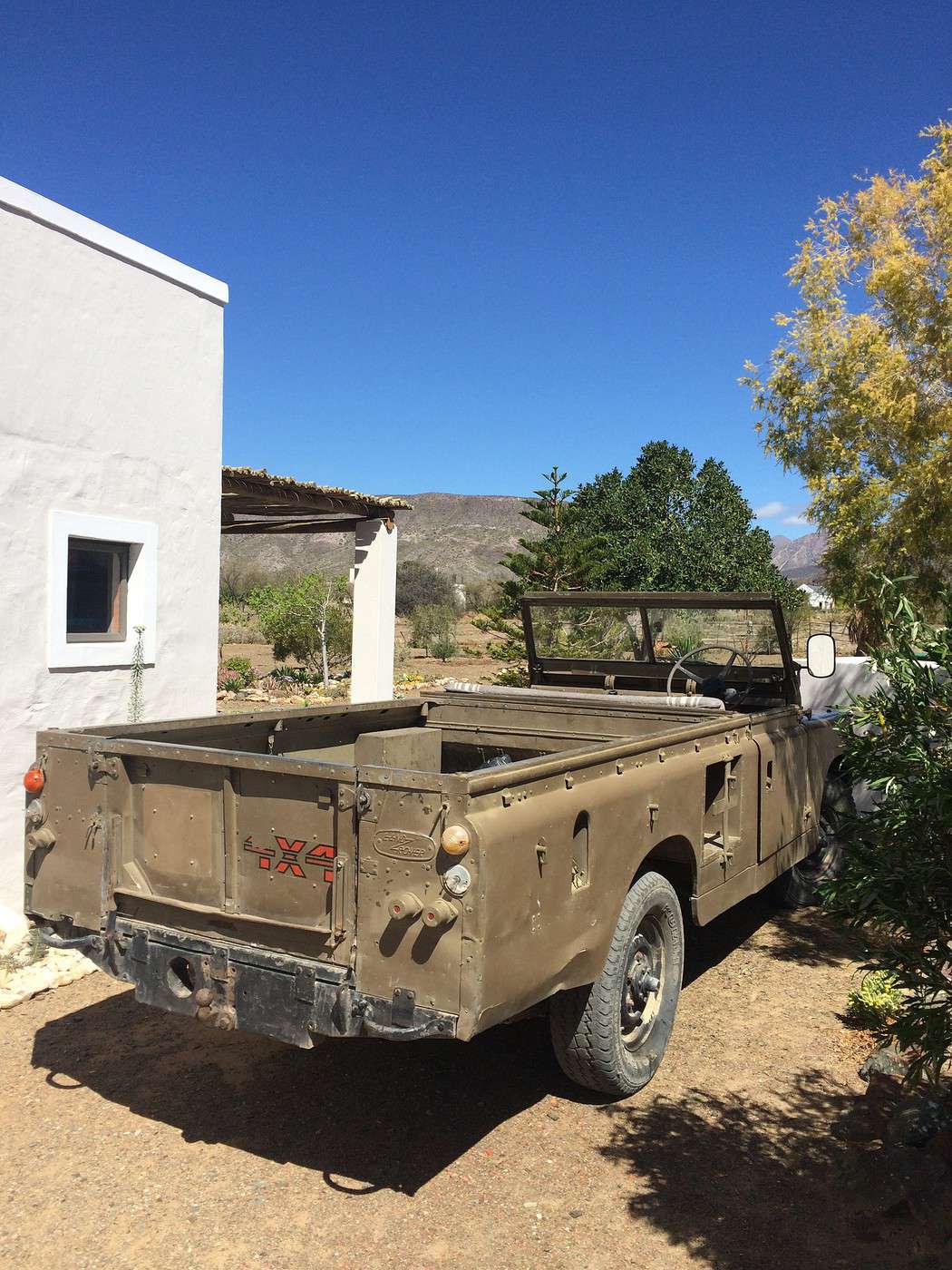
Here’s the rig he had the audacity to visit me in!

*
Camouflage
At the Blue Whale, from the narrow terrace that ends in a stern and forms a poop deck, we scan the Indian Ocean in vain for the mythical marine mammal.
The blue whale chose this color to escape the not-so-peaceful harpoons of the neighboring ocean. It’s quite effective: even the best Zeiss binoculars come up empty. No white, no gray, no hump. They’re playing hide-and-sperm-whale.
The moon was intensely present, increasing the chances of spotting a hundred-ton beauty at midnight, but can you ask everything of the moon?
*
War or Peace
A pair of pigeons in Brittany? Fine. Here, three pairs? Hello, damage. You can’t even hear yourself coo anymore, and when these critters advance, the rest of the feathered crowd takes off. Pigeons harm diversity. Almost everywhere in the world, columbids have adapted and take up a lot of space at the expense of other species—any resemblance...
Here, they’re at home. They were here before me and will still be here long after I leave. A small dozen specimens, whose social organization I struggle to decipher—it seems to shift—have claimed my property. When I ask about their rights, they coo. When I chase them with my slingshot, aiming for their knees, they squawk, fly off, and... come back. At dawn, in absolute silence and fleeting coolness, as I savor black tea and crunch on blond shortbread, they’re already at work, noisily pacing the tin roofs.
They’re at home, like stubborn nationalists.
The resistance nest is at the junction of two roofs, sheltered from the prevailing winds. Plus, it’s covered by an overhang, as if to protect against rains that no longer come.
I’ve tried everything, including the flailing scarecrow act. Nothing works, and I can’t spend my life hunting them.
Taking advantage of a long ladder that was passing by, I stuffed the budding nest (it’s spring here) with a bouquet of acacia and plump aloe ferox leaves. Go nest somewhere else!
The next day, I see my defenses have been visited, but the enemy has retreated. The day after, there’s no doubt: the lines are moving. On the third day, my camouflage is cleared away, and the wind brings it back to me like a trophy.
Later in the day, a delicate dove lands on a clothesline, calm, confident, not at all startled even though I keep my distance.
At dusk, a large hawk plays with the air currents between the mountain and the valley before diving.
In just a few hours, like in the Oval Office, hawks and doves have taken turns.
For now, I continue this petty war. Ecce homo.
*
Curriculum
This new business is trying to carve out a share of the booming local property maintenance market. After a long list of skills so varied it raises doubts, the brochure concludes with the slogan: “honesty, reliability, low prices.” If the third point is so universally trivial, the first two are less common.
Is this comparative advertising? Does it imply that established businesses are dishonest and unreliable? Can you imagine such an ad in France, where these qualities seem so natural that no one would boast about them (and yet...)? And Facebook, for example—could it even claim the first two?
*
Bagdad Café
A neighbor whose boundary for quirks is fortunately far from my terrace is passionate about local culture. Yet—maybe that’s why—he’s worked all over the world for multinationals but retired young. Among his quirks are windmills, though he’s no Don Quixote—though he’s got some of that in him.
He can’t live without having one of those Meccano-like structures in his line of sight, pumping water into tanks with the wind. He’s just put one up that serves as my weathervane and anemometer.
Those lucky enough to travel through vast, hot, and arid regions, where people still endure, can easily picture this iconic machine—like a sign for thirst, while its Dutch cousin is a sign for hunger.
*
“Jesus for All”
That’s the title of the invitation to gather at the municipal park in the evening. It’s recommended to bring your own picnic, but alcohol—reserved for the officiants—is prohibited.
Not convinced by the universal ambition, it’s an opportunity to see how it plays out in this rainbow Babel teeming with denominations.
The park is in the township, and something’s off as soon as you arrive: I recognize parked cars that don’t belong to the residents of this part of town.
Confirmation inside, with about thirty white people sitting on the ground or in their camping chairs. The Africans, whose ancestors inhabited this continent before Europeans got the travel bug, number over five hundred. If the proportion reflects the country’s, this mix—which isn’t a melting pot—isn’t so common outside big cities.
On stage, children’s choirs—cannon fodder—friendly rockers, hallelujah finales, but no sermon.
The following Saturday, members of the New Apostolic Church came from far away to sing God’s praises. About forty forty-something men form the main choir of this Christian chapel, the vast majority of whose members are African. They’ve got lungs, even if the T-shirts are a bit tight under the pecs. They sing loud and well, dancing a little with hip rolls. It’s actually quite moving.
*
Inside South Africa
Kate · 2018-10-27 · Message 176 of 213
The weight of words... from Voyou. The shock of the photos... a car 😕
Inside South Africa
Atila · 2018-10-28 · Message 177 of 213
You would’ve preferred: The shock of the photos... the rascal? 😉
Inside South Africa
Kate · 2018-10-28 · Message 178 of 213
Yes.
Inside South Africa
Voyajou · 2018-10-30 · Message 179 of 213
I really tried to stick to a proven framing technique: the three-quarter rear shot. 😛
I don’t take photos anymore (the Lumix stayed in France). Just a few quick snaps on my phone, like we’d do with a lasso.
I think I already posted a selfie in a previous travel journal (I was at the fork of a tree, in full Tarzan-doubting-himself mode).
Inside South Africa
Voyajou · 2018-11-24 · Message 180 of 213
Fairground Songs
Until now, the annual book fair was held in a historic estate, one of the most beautiful in the city. We’d wander from the gardens to the salons, canapé in hand, sitting in the shade of century-old ficus trees, and the talks took place in the small private theater.
This year, it’s happening at the fairgrounds, where just two weeks earlier livestock was auctioned off and people strolled among agricultural machinery stands.
The goal is to broaden the event’s audience.
Sure, the barbecues were overheating, along with the country bands, but despite the arrival of big-name authors—and in their wake, some lovely women—literature hasn’t exactly expanded its reach.
*
Blacksmith
Where is good, where is evil
Black as the devil
Hot as hell
Elusive
Warlord
(B. Lavilliers)
He’s only half Black, his name isn’t Smith, and yet Kashief is a blacksmith.
In the old small Catholic church, now too big for the handful of parishioners, he’s set up a hellish forge. Thick tawny leather apron, muscles bulging like a sledgehammer, he pounds a flat iron on the massive anvil when I appear at the threshold of his den. He pauses and smiles.
He sculpts scrap metal, gives his birds car-wing feathers, shapes used plowshares into flowers, and his gates look like grasses swaying in the savanna.
Kashief is Muslim, not many around here. He practices his faith as best he can and lives freely with an ivory-white weaver.
*
Hell
(Forgive me, aesthetes and romantics—it’s about cars again, but not just that)
It happened on Die Hel (Hell) track in the Black Mountains, which isn’t even a red-rated trail. A warning light came on, signaling a door wasn’t properly closed—one bump and it might’ve flown off. After checking, everything seemed fine, but the light stayed red. The infernal vibrations wore down the heavy wiper stalk, which slipped a notch, leaving the wipers stuttering under the sun. I brace myself.
A door must be open or closed. My natural intelligence sees them shut, but the artificial one insists they’re open. It controls the electric locks, but the doors must first be mechanically closed—which they are—but it refuses to acknowledge it. So, it’s impossible to lock the car, since on these models there’s not even a key-accessible lock. Only the computer can identify and locate the fault.
The nearest dealership is on the other side of the mountain. I leave as night falls, climbing as the sun sets. The dashboard thermometer drops. It hits zero just as I cross the pass and stays there for much of the descent down the south face, which never sees sunlight.
At opening time, 7:30 AM, the car is taken in, and the receptionist assures me it’ll be fixed in two hours. When I return, no mechanic has even looked at it. Another hour passes, the doors are open but still won’t close. Then they leave it there. Finally, at noon, the computer locates the issue: a simple electrical connection shaken loose by vibrations. Of course, you can only access it after dismantling this and that, but in an hour, it’s sure to be fixed.
This dealership has about ten salespeople and as many admin staff, but that day, only five mechanics. All employees are White, which is rare now—except for the two cleaning staff. When you represent such a brand, there are two ways to improve performance: hire Black mechanics or flip the sales-to-technician ratio.
I had plenty of time to shop for things to spice up my meals. Fresh fish, including an angelfish weighing nearly 3 kg—like an angel without wings, but heavier. Goat’s milk cheddar aged 18 months. Strawberries, fennel.
Plumbing fittings for irrigation.
By the end of the day, I head back through the mountains, leaving Die Hel track to my left, shaking the car to test the repair. The angelfish will end up as tartare.
Suddenly, the stereo plays Omar Sosa’s African Sunrise: my phone, charging in the glove compartment and probably craving good vibrations, puts on a show. But it’s got the time wrong.
*
US Go Home!
First, I saw her walking—sleek in indecent, unseemly tights. 1.85 m tall, 60-60-60, 52 kg when wet (though it never rains here), built like a rail, skeletal BMI, not my type. Long dark hair, closed-off face. Cheetah-slim legs, pacing the trails and streets from dawn to dusk with borrowed grace, wearing some kind of turned-fur après-ski boots. A too-visible stick insect.
Then I learned she had her eye on my house. Oh, come on!
She recently bought land nearby, bordering friends’ fields and within their line of sight. Should we fear a construction that mirrors her image?
She owns and runs a chain of yoga studios.
She’s American.
*
With Time
It’s an ancient track leading from the plateau to the river, carved by elephants that knew how to move five tons with the strength of their calves. Long after their extermination, people realized the intelligence of this path and widened it with a bulldozer. Abandoned and forgotten, all that remains is the gash on the escarpment’s flank.
We’ll have to clear a thirsty acacia felled by a gust of wind in the gorge and fill in the ravines more than once.
Springboks bolt as if a leopard were on their heels (the leopard is at the top of the food chain here), baboons watch with that falsely indifferent, slightly condescending gaze of theirs, and patient raptors circle (the prey’s a bit too big, though).
When I reach the river, I’m glad I didn’t bring a swimsuit: its bed is a thicket of fynbos, and all the way to the retention dam, we drive through the memory of a lake.
*
Lost Causes
At first, they set out to restore the Anglican church gardens, trimming and replanting, watering on Sundays. It was their temporary Eden—and temporary it was: without support, they gave up. It’s an English garden again.
She tries her hand at running the Scrabble club, which has five members: a paraplegic still grieving her late husband, playing at the speed of someone who’s lost track of time. A little lady laying down small words that rack up points. A retired diplomat placing only words as long as a speech. The club’s founder, wearing a hat that must slow his neural flow.
He exhausts himself fundraising for the township’s chess club, using his old tricks, for fewer players than there are pieces on a chessboard.
After ten years here, at seventy-five, they’re considering returning to Johannesburg.
*
Organized Fraud (Black Friday)
The country’s top furniture retailer, a bank, and an insurance company combine their expertise for an offer bundling furniture, credit, and insurance.
You covet a sofa with a cash price of 10,000 rands but can only buy it on credit. Over three years, on top of a 1,000-rand down payment, you’ll pay 627 rands per month. Nowhere does the interest rate appear (it’s too abstract for customers), but the total cost is buried in fine print: 22,572 rands. In three years, you’ll have paid 2.2 times the price of your sofa. Enough to knock you off your feet!
In this package, even if you’ve been unemployed for ages, you’re still paying job-loss insurance—just in case you find work in a country where the official unemployment rate hovers around 30%, roughly the same as the “service fees” applied to your sofa.
Even with 7% inflation, the difference is unjustifiable. Despite warnings from state agencies and media campaigns, the business continues.
P.S. An ad in a French newspaper informs me I can buy a Renault financed at 0.99% interest (clearly, the boss is locked up in Japan). Who said you only lend to the rich?
*
Expedition
With friends, we set off in a convoy (two 4x4s—one too many) toward a distant destination (a few hours’ drive on rough roads), a place where there’s nothing.
He’s obsessed with mountain biking, on a bad slope. She’s a yoga professor emerita. Two activities that instantly wear me out.
We need to be prepared and cautious.
Brainstorming, checklists, and all that. It’s serious.
I don’t go to this much trouble for three months on the road.
*
Missed Rendezvous
Tonight, the Moon rises in the northeast. It’s a host in the chalice of a pass—how do rituals begin?
We’re in the Antarctic cap; the sun, not yet set, flashes at it. The Moon blushes. It continues its course, and soon it pales.
*