2 weeks in the Cyclades
Hi everyone!
Blue skies (lots of them), whitewashed villages with steep alleyways, hundreds of churches, and... thousands of stairs? Welcome to the Cyclades! 🙂
We’d been dreaming about this for a while, but in July-August—with the crowds—no way! Now that I can travel outside school holidays, the Cyclades are back on the agenda. And so begins a loooong period of planning and second-guessing, with countless itinerary changes: the Cyclades, yes, but which ones? I was fixated on Folegandros (we won’t be going after all) and really wanted to visit Delos. So, for this first trip, it’ll be: Mykonos (and Delos)-Naxos-Amorgos-Santorini.
Saturday 24/05: Departure from Orly on a Transavia flight, arriving in Mykonos in the late afternoon. We found a hotel that offers free transfers (pretty rare and not insignificant—it’s 25 € each way for just a few kilometers 😠) and at a reasonable price (83 € per night for B&B). Time for dinner already: Greek salad and souvlaki (we’re in Greece, right?)
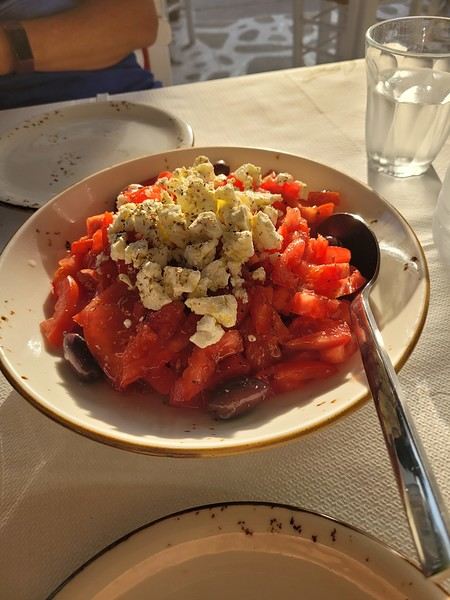 (Okay, this is actually a dakos with Naxos cheese, but I don’t have a photo of a Greek salad 😏).
Blue skies (lots of them), whitewashed villages with steep alleyways, hundreds of churches, and... thousands of stairs? Welcome to the Cyclades! 🙂
We’d been dreaming about this for a while, but in July-August—with the crowds—no way! Now that I can travel outside school holidays, the Cyclades are back on the agenda. And so begins a loooong period of planning and second-guessing, with countless itinerary changes: the Cyclades, yes, but which ones? I was fixated on Folegandros (we won’t be going after all) and really wanted to visit Delos. So, for this first trip, it’ll be: Mykonos (and Delos)-Naxos-Amorgos-Santorini.
Saturday 24/05: Departure from Orly on a Transavia flight, arriving in Mykonos in the late afternoon. We found a hotel that offers free transfers (pretty rare and not insignificant—it’s 25 € each way for just a few kilometers 😠) and at a reasonable price (83 € per night for B&B). Time for dinner already: Greek salad and souvlaki (we’re in Greece, right?)
(Okay, this is actually a dakos with Naxos cheese, but I don’t have a photo of a Greek salad 😏).
 We pick up our tickets. The boat is quite full... with lots of American tourists (we later realized they were probably from a cruise ship).


 From the top, the 360° view must be stunning in good weather, but today, it’s really very (too) gray—what a shame!


 To brighten up all this greyness, I take photos of the flowers 😏


 On land, the tourist density has really increased (it’s 3 PM) 😏
 We take a quick tour of Mykonos town and leave pretty quickly, arriving just as a few raindrops start to fall—rain that will intensify and last all evening.


 We more or less retrace the same route as yesterday but in the opposite direction.
Despite the tourist crowds, the alleys have kept their charm (though there aren’t many people around at 9:30 yet).
 Even the luxury shops have kept their local vibe 😏 (here in *Tria Pigadia* square, which means "of the 3 wells"; we spent quite some time looking for those wells before realizing they were the three white blocks topped with blue 🤪).
 Next, we head to the famous windmills:
 Then we walk down to the Alefkandra district (nicknamed "Little Venice"), a collection of 18th-century houses whose loggias open directly onto the sea. Legend has it this allowed owners to discreetly buy goods from pirates.
Nowadays, the area is filled with bars and restaurants.


 The village:


 The upper part of the village, on the other hand, is more or less abandoned,
 but some houses are still inhabited (and well-maintained).
 We head back down to start a hike we found on cycladen.be (thanks to this very comprehensive site for hikes 😉) that begins under a bridge at the bottom of the village (and it’s well-marked).
It’s a round trip leading to the Agia Kyriaki church.
It’s downhill on the way there... which means it’ll be uphill on the way back—I much prefer the opposite!
We’re getting used to the many staircases along the trails and the gates we have to open and close (there are lots of goats on the islands, as well as sheep and a few donkeys).
The path alternates between rocky, dirt trails, and nicely paved roads, offering varied and beautiful views.

 We reach a small bridge and then have to climb (a little) toward the church.


 We head back the same way (but with different views).


