This thread has been translated into English.
Question about how Kruger Park works for accommodations and visits
ReBidule27 · 2026-03-30
Hi everyone, I’m here to get some advice on visiting KRUGER Park.
From what I’ve gathered through my reading, I understand there are two ways to visit the park:
- Independently with your own vehicle
=> Do you drive all day?
- By booking with a professional
=> Safari early in the morning and late in the afternoon. But what do you do in between?
When it comes to accommodations, the options are:
- Booking in one of the park’s camps, where the lodging is basic but functional
- Booking in a private reserve, which is more comfortable but prohibitively expensive
- Booking outside the park, which means entering the park every morning. But if you want to stay for 3 days, that doesn’t seem practical to me.
Do you have any advice for accommodations?
To be honest, I’m really struggling to understand how it all works...
Thanks to everyone for your help.
Bidule 27
Question about how Kruger Park works for accommodations and visits
Attila · 2026-03-31
Hi there,
In my opinion, the best way to visit Kruger is to rent a car and stay inside the park.
Accommodations range from camping to fully equipped bungalows with a kitchen and bathroom. These aren’t dirty or run-down places—they’re equivalent to what you’d find in a 2- or 3-star establishment back home.
The lodgings are located in either village camps or much more intimate bush camps.
Village camps usually have a restaurant (nothing gourmet), a shop, and sometimes a pool. You can find all the details about the camps on Sanparks, the official site for South African public parks (that’s where you book your accommodations).
They can get quite crowded, especially Skukuza and Lower Sabie.
Intimate or bush camps consist only of accommodations (limited in number).
They’re much quieter and offer a better immersion in nature.
You’ll need to bring your own groceries to cook your meals.
A typical day in Kruger with a self-drive safari starts with waking up before dawn, a 2- to 3-hour safari, then returning to camp for breakfast and a bit of rest.
Mid-morning, you leave the camp for the next one, doing another safari along the way and stopping to picnic at one of the designated areas.
In the early afternoon, you check into your new accommodation and rest until around 4:00 PM for another safari. You return to camp before it closes, then have dinner and an early night!
For a first trip, most people focus on the southern or central parts of the park.
For a 3-night stay in village camps, Berg-en-Dal, Lower Sabie, then Pretoriuskop in the south (or Biyamiti for bush camps).
For the central part in village camps: Satara and Olifants.
For bush camps: Talamati then Balule (the latter is more rustic, with shared showers and toilets, and paraffin lamp lighting).
In a private reserve, the lodge organizes a 3-hour safari at dawn and another 3-hour one in the late afternoon.
In between, you can nap, have lunch, read, or even enjoy the pool or a massage, depending on the camp.
The private reserve option is more hit-or-miss than self-drive because it depends on the guide, the reserve, and the other guests.
It also comes down to personal preference—I personally don’t like organized trips or groups.
Everything can go smoothly if the guide is passionate, if the reserve isn’t just a hotel with a pseudo-zoo attached, and if the other participants are motivated.
Being woken up at 5:00 AM for a 5:30 AM departure is fine. But being woken at 5:00 AM only to leave at 6:30 AM because the others are lazy and more concerned with their makeup, their upcoming massage, or breakfast isn’t great...
The difference between private and self-drive safaris is also in the experience itself.
Spotting an animal on your own isn’t the same as having it pointed out to you.
(Safaris take place at dawn and late afternoon because those are the best times to see predators. During the day, they’re sleeping! Elephants, gazelles, rhinos, etc., can be seen at any time.)
Question about how Kruger Park works for accommodations and visits
ReBidule27 · 2026-03-31
Hello!
Thanks for all this information!!
Question about how Kruger Park works for accommodations and visits
Muriel18 · 2026-04-01
Hi Benoît
Agnès explained things very clearly.
I’ll just add that the Kruger camps book up quickly, especially the smaller ones (I booked at the end of January for mid-October, and all the small camps were full except Tamboti).
Happy planning
Question about how Kruger Park works for accommodations and visits
Michel85200 · 2026-04-01
Hello,
To add to the excellent information provided by Mme Attila—everything she says is true!
Just a few more details on private reserves and high-end lodging in Kruger.
In Kruger, there’s the "classic" accommodation option where you stay in the park with self-drive autonomy, plus optional game drives or walks with a park ranger (usually booked on-site).
You can also hire a private, authorized ranger for a day, for example, who’ll be your guide in an open vehicle—with or without other guests. They can even pick you up from the SANParks camp where you’re staying. It’s all about choice and budget. The upside? You don’t have to drive or manage animal encounters, and you get an open vehicle plus an experienced guide who often knows and works with their colleagues. The downside? Cost, potential other guests, and it’s not *you* making the discoveries anymore!
Then there’s the all-inclusive option in much more luxurious lodges—private concessions within the park. Here, morning and evening game drives are included, along with high-end (to extravagant) lodging and meals (ranging from restaurant-style to gourmet, depending on the place).
But beware—while the guide *might* be great (usually they are), the routes and schedules are the same as everyone else’s. I’ve had amazing wildlife experiences in the south (Shavu or Shonga camps) with a fantastic ranger who bent the rules… and a terrible one (Rhino walking safari).
And then there are the private reserves *outside* the park boundaries…
Nowadays, there’s a glut of "fake" reserves—more or less beautiful and expansive, but often more like a massive, beautiful zoo. Some are *real* wild reserves, though.
Mainly those bordering Kruger, now without fences, so animals move freely between Kruger and these areas (Timbavati, Sabie, Manyeleti, Balule).
These are concessions for various lodges, ranging from simple luxury to extravagant, with the same all-inclusive setup (game drives, walks, lodging, meals, etc.).
If you choose well and get a little lucky, this version can be *fantastic*.
My favorites:
Nkhoro’s leopards, Shindzela, Honeyguide, Ndzakha, Buffelshoek—to name just a few.
Here, rangers can go off-road at will, and you can get *very* close to lions and other wildlife. There might even be a real tracking experience…
In short:
- Classic Kruger, with or without extras
- Well-chosen *truly* wild private reserves
That’s my usual mix…
Question about how Kruger Park works for accommodations and visits
FamilleUS · 2026-04-09
The first question to ask is whether to book a reserve or not.
Kruger is bordered by lots of private reserves that offer a high-end experience with, as Agnès mentioned, a "game drive" in the morning and one in the evening.
The reserve is private, and you’re guaranteed to see animals (are they fed?), but it costs an arm and a leg compared to renting a car and exploring the park on your own.
Coming from Mlilwane, we spent 4 nights as a family in Kruger:
- Berg en Dal
- Lower Sabie
- Olifants x2
Before heading to Blyde River.
I didn’t do the "game drives" in the private reserves.
But no regrets—we loved the independence and spotting the markers (indicating animals) on the maps each morning before setting off.
Plus, with 3 kids, it was completely out of budget...
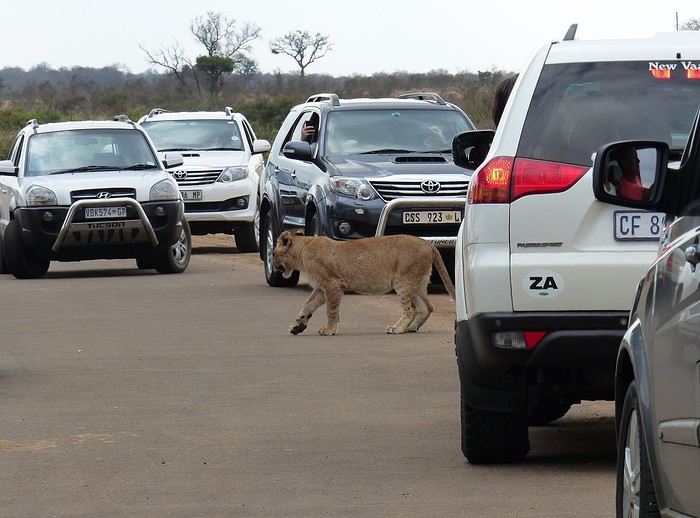
You just have to accept that there’ll be crowds on the road when you come across less "common" animals.
Question about how Kruger Park works for accommodations and visits
Michel85200 · 2026-04-14
Hi there,
Regarding the question:
is it guaranteed to see animals (are they fed?)
Unfortunately, in some cases, yes.
These aren’t the reserves directly adjacent to Kruger but in South Africa, fake "wild" reserves have sprung up like mushrooms...
How can you tell?
The basic rule is size...
For example:
on 5,000 hectares, having lions is complicated—very complicated...
A pride of lions = 1 buffalo per week = 52 buffaloes a year = enough grassy space to sustain 50 new adult buffaloes per year...