Back to the discussion

in Entre deux voyages › Carnets de voyage

16 days with family in La Gomera (Canary Islands) (page 1 of 3)

Discussion started by Pagaljavab on 2026-08-14

53 replies

This thread has been translated into English.


16 days with family in La Gomera (Canary Islands)

Pagaljavab · 2026-08-14 · Message 1 of 54

Preamble: Why La Gomera?

When we started looking for a summer destination a few months ago, our first criterion was to avoid extreme heat and heatwaves. We had already been to Norway two years ago and are considering going back in the future for other occasions. So, we had some fun asking ChatGPT which destinations enjoyed a mild climate during the summer without going too far. Among the list provided by the AI were the Canary Islands... The idea of a place we wouldn’t have thought of first, both not too far away and exotic enough, appealed to us: “Hmm, why not?”

This destination had never really attracted me, though Magali was a bit more interested. Five years earlier, COVID had caused a short break in my professional activity, and I had planned a trip because the flight price was attractive, and I was looking for a destination different from what usually appeals to me, more than out of deep interest. From a distance and with a social judgment I acknowledge (it’s not great, but it’s not completely wrong), I had the image of a destination for party-goers enjoying the sun without the slightest interest in local culture, with concrete coastlines and denatured landscapes—everything I detest the most. Still, I had done some quick research on the different islands and spotted Lanzarote for its beautiful volcanic landscapes, hiking trails, beaches, and the impression of a good balance between activity and fewer crowds than Tenerife or Gran Canaria. Then I dropped the idea of going, without ever reconsidering traveling to the Canaries...

Until now! Because we started researching the different islands of the archipelago to see which ones might appeal to us the most. It was La Gomera, the third smallest island of the archipelago, more praised for its hiking trails and preserved nature than for its beaches, away from mass tourism (fifty times fewer tourists than Tenerife) but still a bit more developed than its wild neighbor El Hierro, that caught our attention. Contrary to what might be suggested later, I’m not at all addicted to AI, but I use it from time to time to synthesize quick research or simply for experimentation. Since ChatGPT had started anticipating my tastes lately as if it had become my buddy (often successfully, sometimes off the mark), I asked which Canary Island would suit me best for a trip with my family. The tool answered first with... La Gomera. So, I tested it and teased it a bit to see if this suggestion was well-founded, as the method sometimes makes it contradict itself. But no luck: “You’d appreciate the wild nature of El Hierro, but with family, you’ll find little activity for the kids. You won’t like the touristy vibe of the big islands like Tenerife, Gran Canaria, Lanzarote, and Fuerteventura. You could consider La Palma, but it’s really La Gomera that will suit you best, based on your interests and the criteria given.” So, we dug deeper into our research and were convinced without a shadow of a doubt that this island was the one waiting for us.

Without knowing it, we had Canarians in our circle who revealed their origins when they heard about our travel plans. One from Tenerife insisted we’d be better off choosing Tenerife (obviously...) because it also has preserved spots and that La Gomera, “you can explore it in two or three days, you’ll get bored quickly...” The other, a colleague from Gran Canaria who had never visited La Gomera, still recommended it without hesitation because it turned out her parents had just gone there on vacation: they loved it and had encountered few tourists. She also tended to think this destination was usually the subject of short stays, but according to what her parents told her, taking your time there was also a great idea. However, in our research, the idea that La Gomera is an island you can explore in three or four days max kept coming up. So, we considered combining its visit with La Palma or El Hierro, the other two that caught our eye. But hopping between islands by ferry represents a significant budget for non-Canarians, even more so for a family of four. Then, scrutinizing Google Maps, it seemed obvious that two weeks were too short to discover two islands as they deserve, and that there seemed to be plenty to see in La Gomera, given its very unique culture. After all, we read that some people spend several months a year there, others never even leave... Finally, these landscapes and this atmosphere, which seemed to us a mix of Europe, North Africa, and Latin America, tempted us. So, it would be two weeks in La Gomera, deal!

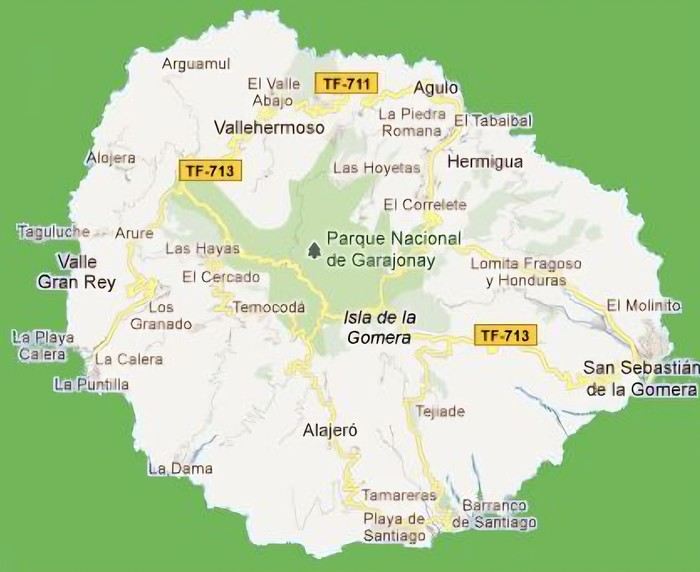
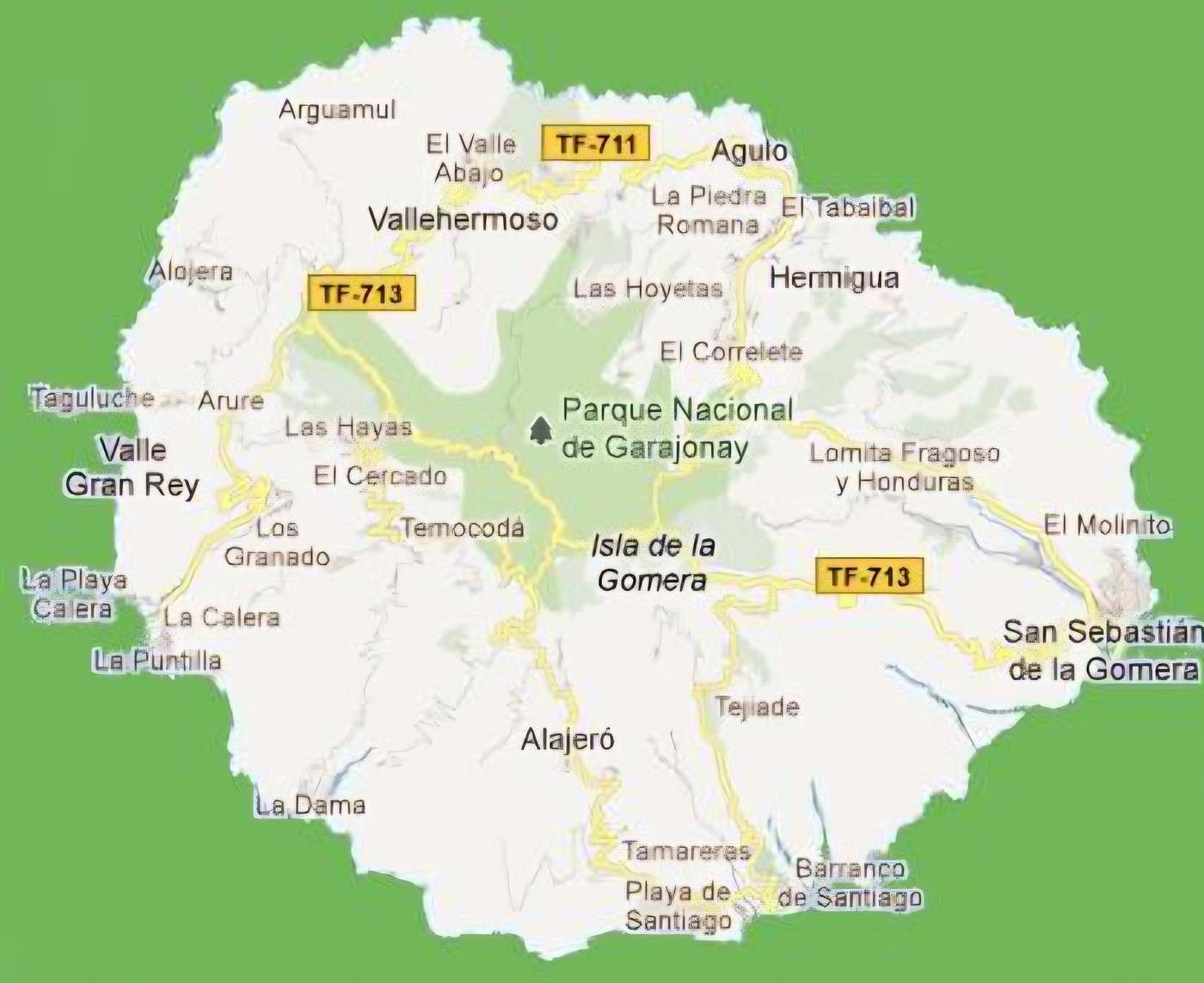
La Gomera is therefore the second... well, the third smallest island of the Canaries since La Graciosa was recently recognized as a fully inhabited island. It has the shape of a rough circle about 20 to 25 kilometers in diameter and has just over 20,000 inhabitants, half of them in its capital, San Sebastián de la Gomera, the only real town. Like its Canarian sisters, La Gomera is a volcanic formation that rose about 10 million years ago. The island is very mountainous and rugged, covered with red and black rocky landscapes. Geological activity has shaped, between the sprawling massifs that end in steep cliffs in the ocean, six coastal valleys with tropical vegetation that have favored human settlement. They divide the island like slices of a cake; from the north clockwise: the agricultural Vallehermoso, the rustic Agulo, the green, humid, and fertile Hermigua, the sunny capital San Sebastián de la Gomera, the southern and isolated Alajeró-Santiago, and the seaside Valle Gran Rey. They constitute the six municipalities (more like cantons to our French understanding) of the territory. The large solidified magma massifs that shape the heart of the island have created a large depression more protected from the sun at its center, allowing the growth of a vast laurel forest, today grouped within the Garajonay National Park, La Gomera’s green lung, which has earned it the status of a World Biosphere Reserve. Its completely European appearance contrasts sharply with the rocky and tropical landscapes of the rest of the island. Thus, the climate varies greatly from one point to another on the island: in summer, you can quickly go from a dry and sunny valley at 35°C to a humid forest area at altitude at 18°C.
La Gomera was populated late. As with the rest of the Canaries, human presence is thought to have begun about 2,000 years ago. Groups of animist Berbers, probably fleeing persecution, gradually populated the archipelago, especially the western islands and La Gomera, becoming its small aboriginal population: the Guanches (or later Gomeros). The animist and pastoral civilization of the Guanches thrived until the Spanish takeover in the 15th century, which, after a short period of harmony and mixing with the indigenous people, suddenly ended in bloodshed... La Gomera later became the “Columbus Island” after Christopher Columbus’s stopover, increasing the blending of populations. In the 20th century, many Gomeros emigrated to Cuba and other Latin American countries in search of a better life, bringing back a mix of cultures and traits quite palpable in today’s Gomeran culture. It is, however, in La Gomera that the vestiges of Guanche culture seem to have left the most traces, in the language, gastronomy, social practices... Moreover, most Gomeros, especially in remote villages, have a particular identifiable type and proudly claim their ancestral roots, even making La Gomera a bit exotic in the eyes of other Canarians.

Perhaps that’s why it has never really wanted to develop its tourist infrastructure too much. If we set aside the tourists who visit for the day by bus or boat from Tenerife on a marked itinerary (and whom we ultimately rarely encounter), La Gomera has remained a hidden gem, a destination focused on nature discovery that attracts hikers, nature-loving divers, and scientists for its fauna and flora, and to a lesser extent, beachgoers who don’t seek overly developed coastlines. Tourist activity is therefore limited. Roughly speaking, you’ll find a majority of Spaniards, including a substantial number of residents from other Canary Islands, many Germans who have a particular fondness for La Gomera and spend long stays there or own second homes, to the point that the German cultural footprint is clearly noticeable in some places (it’s said to be Angela Merkel’s favorite holiday spot), and still quite a few French. The presence of other nationalities seemed negligible to us. Most travelers come mainly for hiking, but it’s also a prime spot for whale watching. Additionally, the seaside resorts of La Gomera—San Sebastián, Santiago, and especially Valle Gran Rey—are well-known destinations for hippies, especially German ones, ranging from chic boho hippies to old-school hippies who’ve been there for decades, quite similar to those you’d meet in India in Goa, Rishikesh, or Paharganj. Thus, practices like naturism, vegetarianism, and local organic production are quite well established in some areas.

Some practical info: - The round-trip flight from Paris to Tenerife cost us 365 € per person (outbound with Transavia, return with EasyJet), including checked luggage and three seats reserved side by side. - We chose two bases to explore the island: one week in Valle Gran Rey, reputed to be the most pleasant of the three seaside resorts, and one week in Hermigua, more mountainous and close to the natural park. We booked two houses with balconies and views: the first at 120 € per night, the second at 99 €. - The round-trip ferry between Tenerife and La Gomera cost us 270 € with the company Baleària Canarias, including discounts for children aged 4 and 12, but I don’t have the exact details. It was a bit cheaper than with the other company, Fred Olsen. - Finally, we rented a car through the agency Cicar for 360 € for 16 days, which comes to 22.50 € per day. - Apart from that, we didn’t plan anything and decided the day before or even the morning of what we wanted to do. We didn’t invest in any paper guide on the Canaries, as information on La Gomera was scarce, but we used the very comprehensive site La Gomera Travel, a travel guide published by the Canary Islands Tourism Council, a real goldmine of almost exhaustive information on the island.

Alright, off we go for 16 days of adventure discovering La Gomera!


And we start the trip with music!

We start the trip with music!
16 days with family in La Gomera (Canary Islands)

Muriel18 · 2026-08-15 · Message 2 of 54

Hi Pagal

After Gran Canaria, I told myself, "No more Canary Islands! ...unless maybe La Palma or La Gomera if we don’t have a better destination idea for early spring."

So, I’m off to La Gomera! 😎

16 days with family in La Gomera (Canary Islands)

Attila · 2026-08-15 · Message 3 of 54

And we're off for an in-depth exploration of La Gomera! 🙂

16 days with family in La Gomera (Canary Islands)

Pagaljavab · 2026-08-15 · Message 4 of 54

Come on up, you all whose mixed experiences in the Canary archipelago I’ve been following! This is La Gomera, where few people venture, so there’s still plenty of space.

Attila, I can’t hide anything from you—this will indeed be an exhaustive discovery, and probably a bit *exhausting* in the English sense, just like La Gomera: rugged, steep, wild, but absolutely worth the effort 😄

16 days with family in La Gomera (Canary Islands)

Pagaljavab · 2026-08-15 · Message 5 of 54

Day 1, Tuesday, July 28: From Paris to Valle Gran Rey

After a short night, the long-awaited day has finally arrived! We’re up very early because our Paris-Tenerife flight takes off at 10 AM. We’d planned to take the metro—super convenient since it now serves our Parisian suburb and Line 14 was extended to Orly Airport. But we got a nice surprise the night before: our transit cards no longer give us a discount on the premium airport fares. That’s 14 € per person, which we find way too expensive! So, we did the math quickly: an Uber costs 32 € for all four of us, and we won’t have to lug our bags. At Orly, everything goes smoothly. Transavia is very efficient, and we take off on time. Off we go for a 4-hour flight to reach the famous Atlantic archipelago.

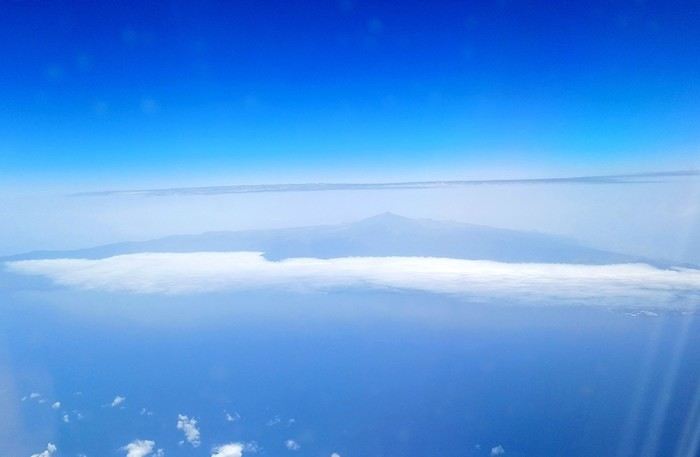
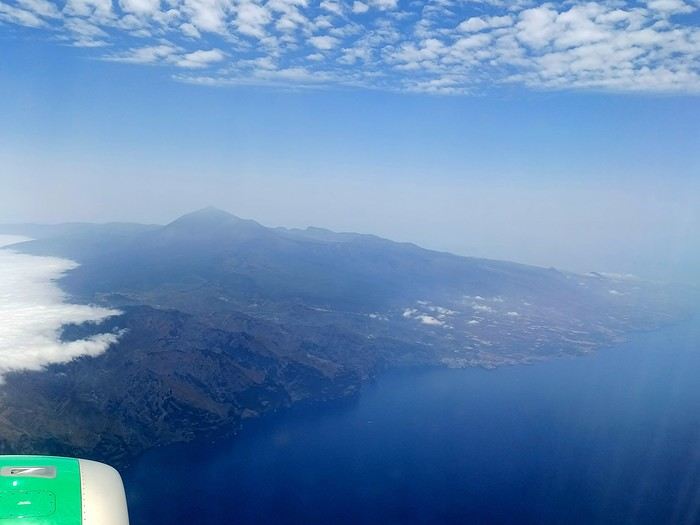
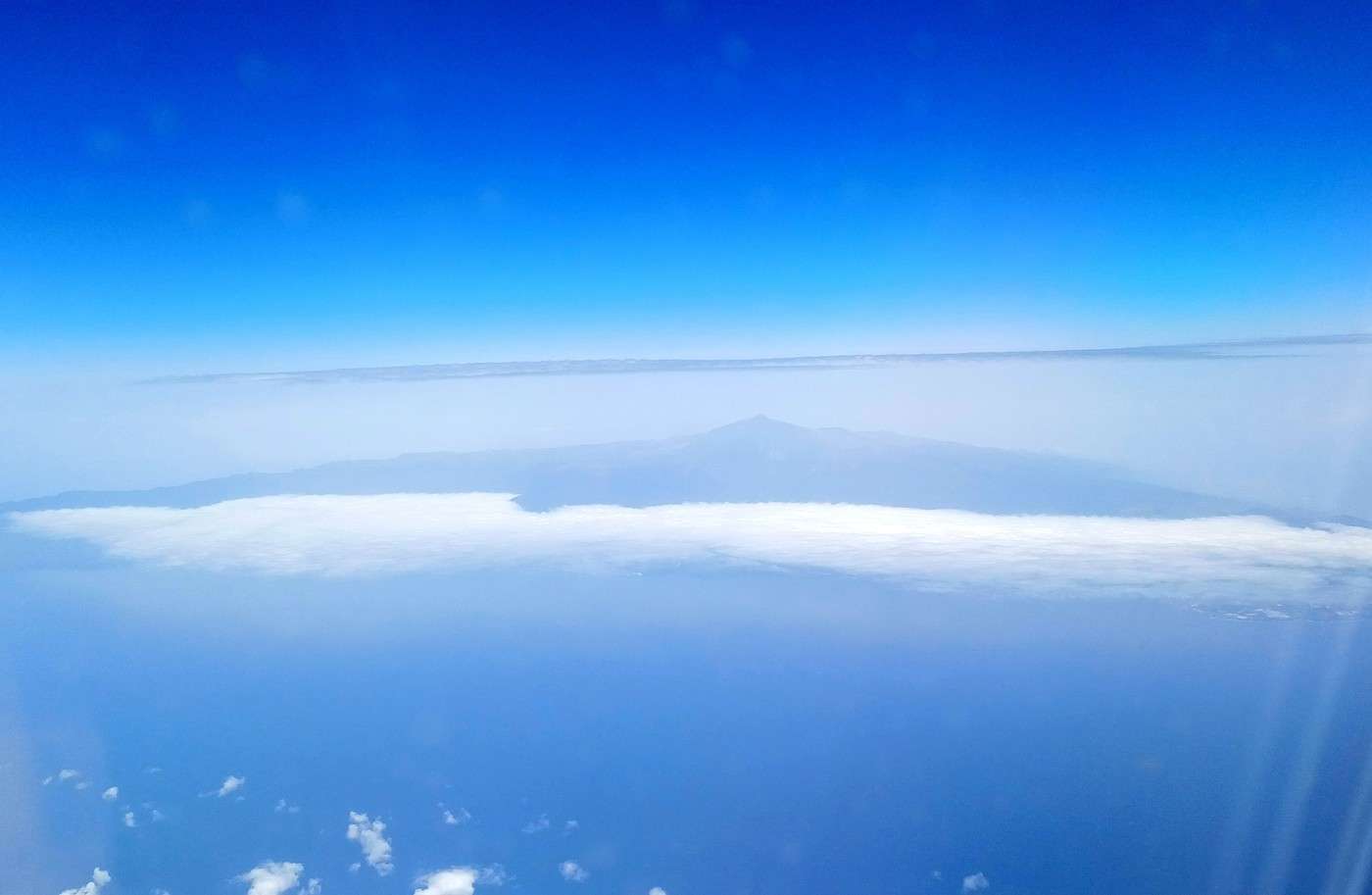
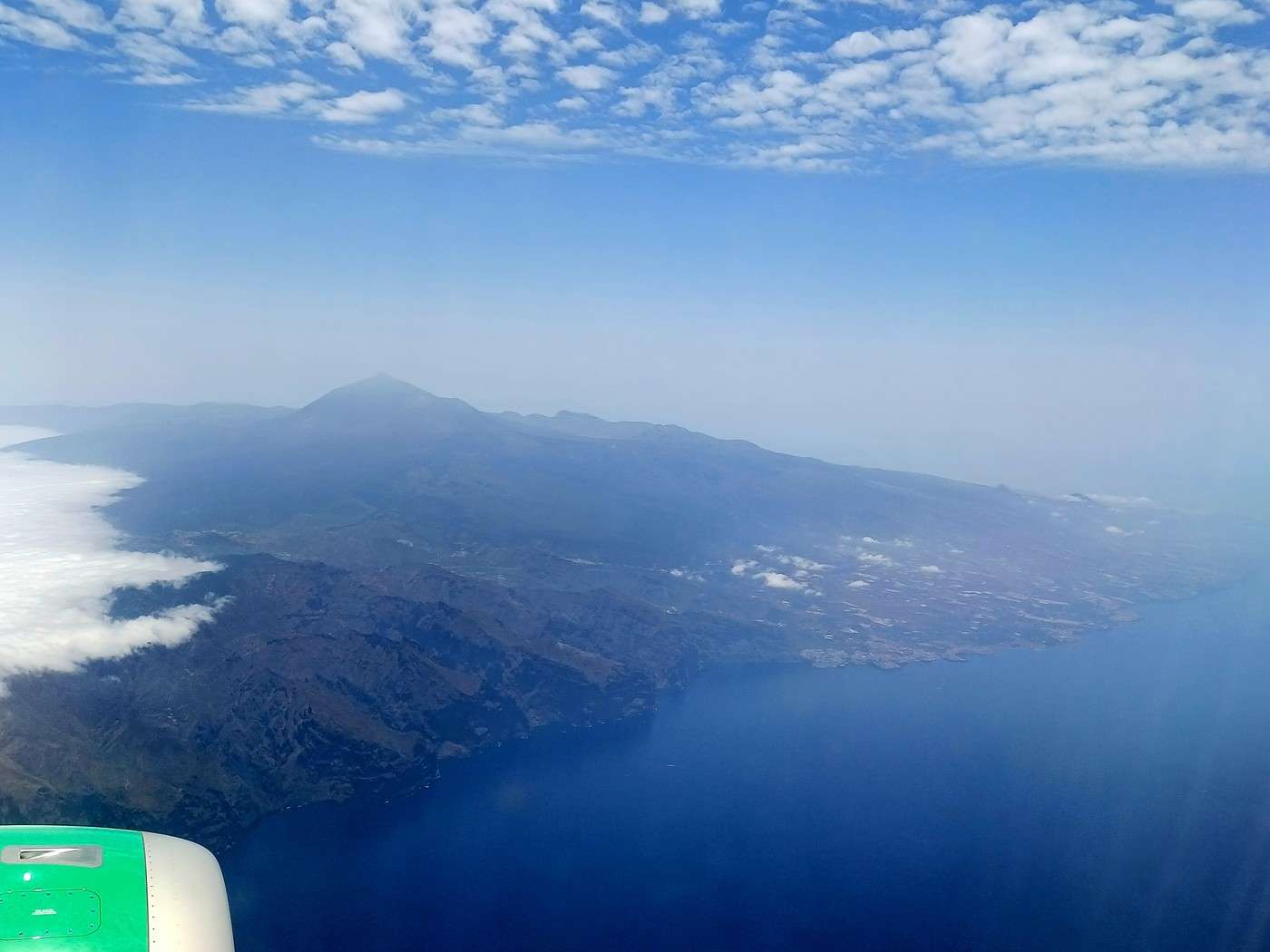
I’m traveling separately from Magali and the kids to avoid another seat-selection fee. The clear, sunny weather lets me admire the Nantes coast, Île de Ré, and Île d’Oléron from the window. A little later, after the Bay of Biscay, I spot the parched lands of Galicia, Portugal, and Lisbon before heading back over the Atlantic, far from the Moroccan coast. Then, out of nowhere, like a misty maritime mirage, the majestic Teide appears, encircled by clouds and its rugged coastline. Landing on Tenerife is quite the sight!

We’re on time, and if our suitcase doesn’t take too long to arrive, we can catch the 2 PM bus 40 to Los Cristianos, where the ferries to the western islands depart. The suspense ends—our suitcase shows up pretty quickly on the conveyor belt. We’re really happy with Transavia on this flight: affordable prices, great organization, punctual, and friendly but strict on safety. We rush out of the small Tenerife South Airport. The bus stops are right across from the exit, and with almost no wait, we hop on the number 40 (3.20 € per person, free for our 4-year-old). After a quick half-hour watching the coastline roll by—concrete buildings, red and rocky landscapes, banana trees, cacti, billboards—and always, Teide in the background, the bus drops us off at a roundabout in a somewhat artificial-looking modern neighborhood. We’ve got about a 20-minute relaxed walk under a bright, gentle sun through vacation rentals, the little touristy center packed with restaurants and shops, and the Los Cristianos beach, covered in sunbeds and packed to the brim. We finally reach the ferry terminal. Our ferry leaves at 3:30 PM, and since we’re half an hour early, we stop at Casa Playa Tenerife, a big beachside bar-restaurant where international tourists (mostly Germans) and girls in thong bikinis with everything on display parade by. It’s clear that presentation is everything here. The sight of this industrial beach in such a stunning natural setting feels like a real waste… and it confirms our choice of La Gomera even more.

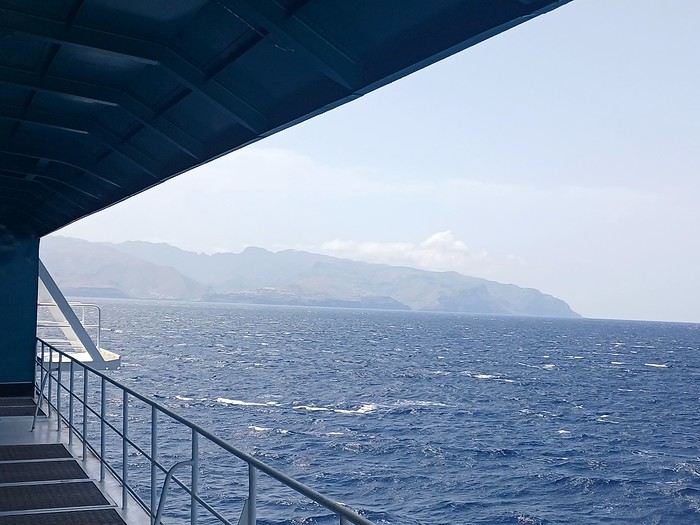
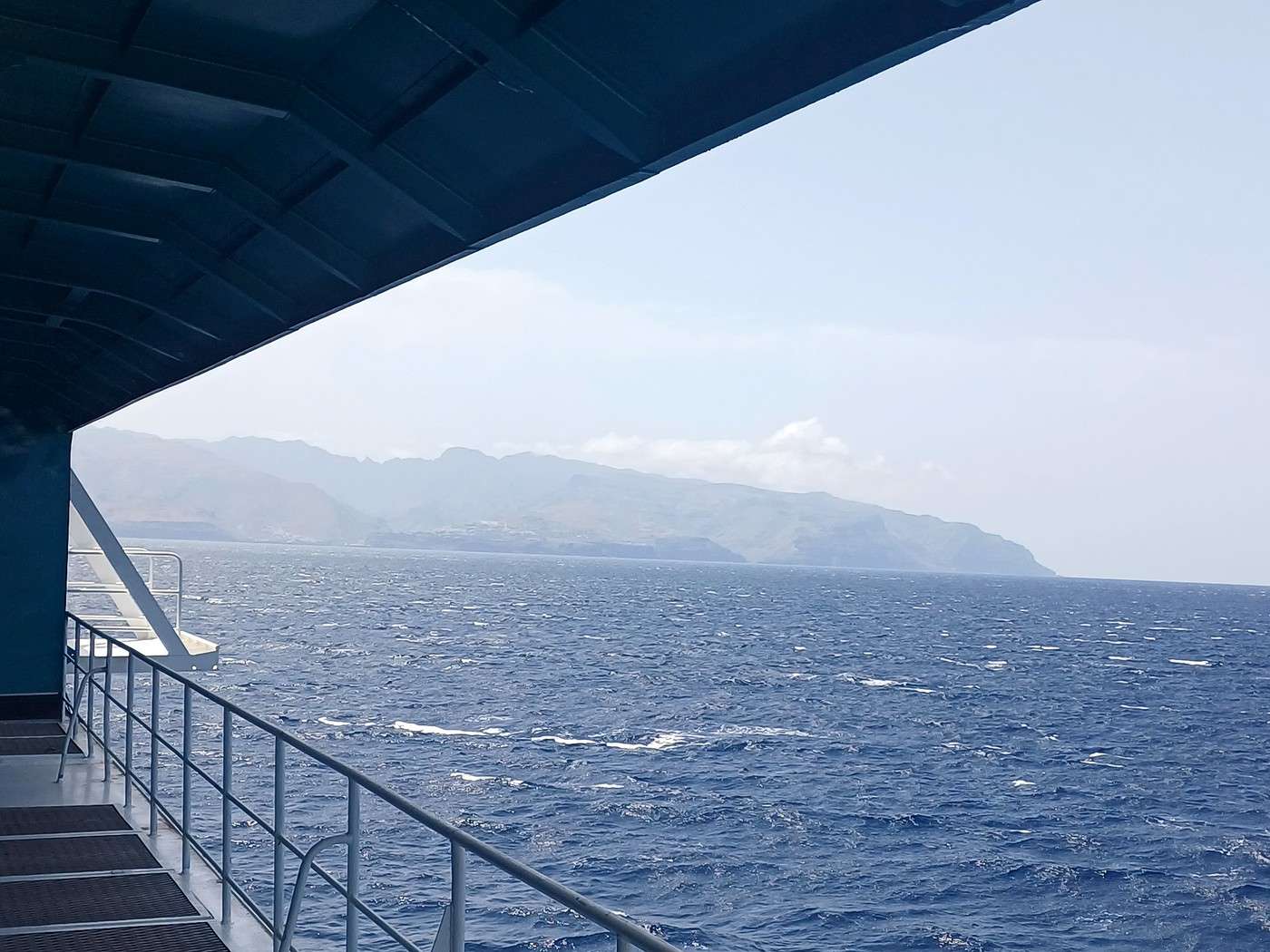
We hurry the friendly servers a bit because our order is taking too long, and time’s running out. We just manage to enjoy a nice, cold Dorada (the iconic Canary Islands beer brand) and a peach juice for the kids before we have to head to the nearby ferry terminal. We scan our e-tickets and board the *Pepita Castellvi*, a massive ferry from Baleària Canarias (which recently acquired Naviera Armas), one of the two historic companies—along with Fred Olsen—that connect the eight Canary Islands. We weren’t expecting such a giant! And yet, there are hardly any people on board—about 80% of the seats are empty. It’s probably not peak time: many tourists visit La Gomera on a day trip from Tenerife and likely take the morning ferries. The inside is super comfortable, with an affordable bar-restaurant, a play area for kids, and even the option to spend the trip on deck. Just minutes after departure, we spot dolphins jumping right by our window! I’d read that you can easily see them on this stretch between Tenerife and La Gomera, as well as whales, but we didn’t expect to see them so soon. For those of us planning a whale-watching excursion, this is a great sign. We end up spending most of the trip on deck, where the strong wind and the powerful waves the boat kicks up behind it make for a perfect attraction for the kids. With Teide now fading behind us, the Gomeran shore starts to take shape in the distance, and finally, the port of San Sebastián de La Gomera, the island’s capital, comes into view, watched over by a small statue of Christ the Redeemer atop one of the cliffs overlooking it.

The ship docks, and we rush to the Cicar agency—the most popular in the Canaries (thanks, Attila and Muriel18!), probably because it’s the cheapest with the best terms. Paperwork done in five minutes, a 40 € deposit paid, and we’re assigned a red Opel Corsa in the parking lot. Nice surprise: they told us the tank was three-quarters full, but it’s actually full—bonus! Magali takes the wheel since she’s an experienced driver, and declaring only one driver saves us money. Off we go to Valle Gran Rey, all the way on the other side of the island to the west, where our Airbnb awaits. The destination is 25 kilometers as the crow flies, which makes it seem like a half-hour trip. But this is La Gomera—so it’s 50 kilometers of winding roads avoiding the most mountainous part, meaning a 1 hour 15-minute drive. There are two routes that take about the same time. Of course, we take a wrong turn at a poorly marked hairpin bend and end up following the northern coastal route. It’s not a big deal—it only adds about 20 minutes and gives us our first taste of La Gomera’s incredible variety of landscapes.

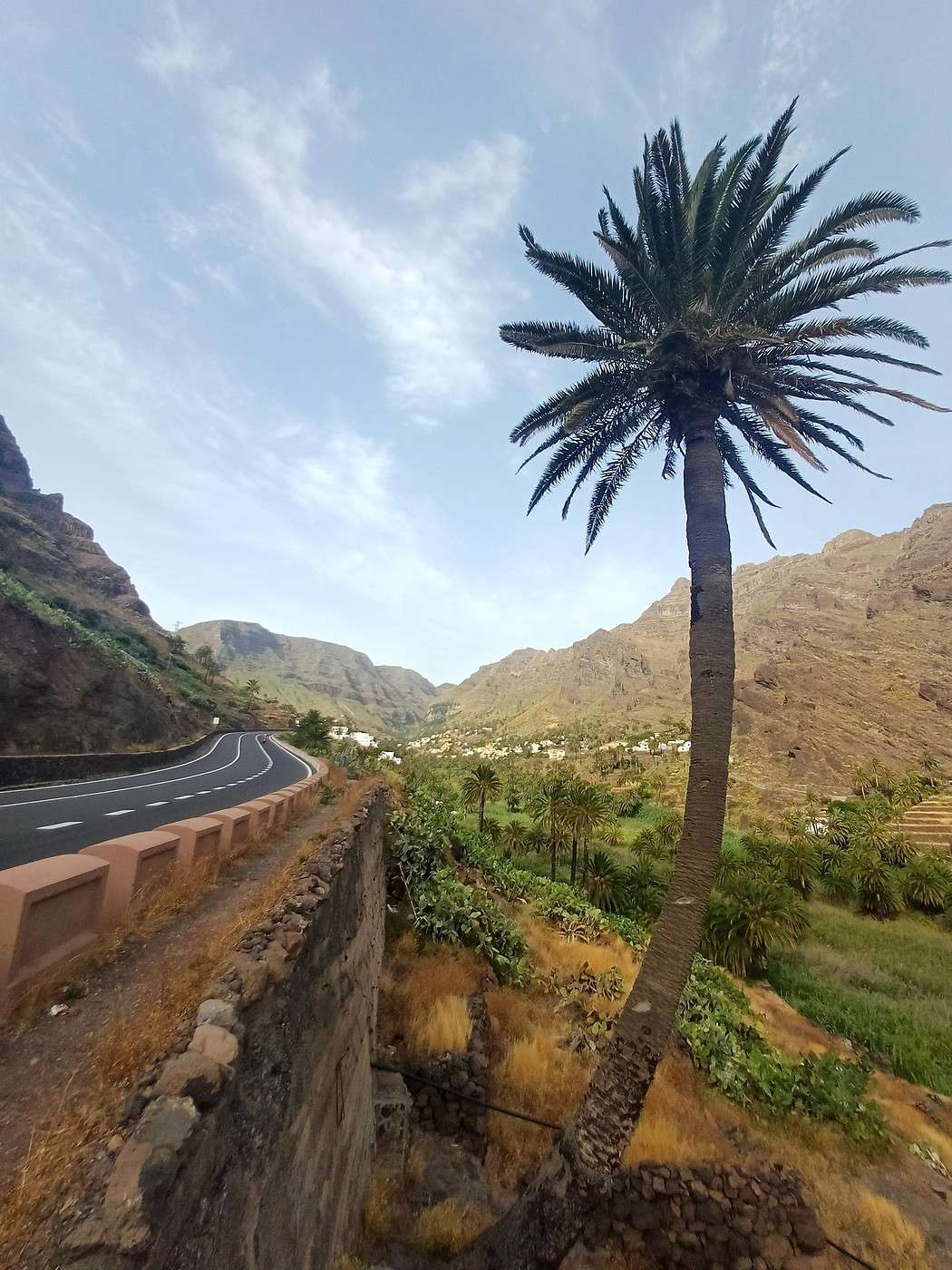
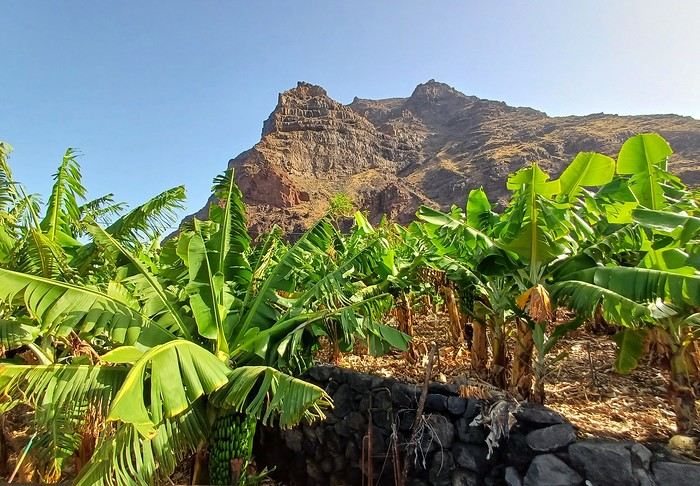
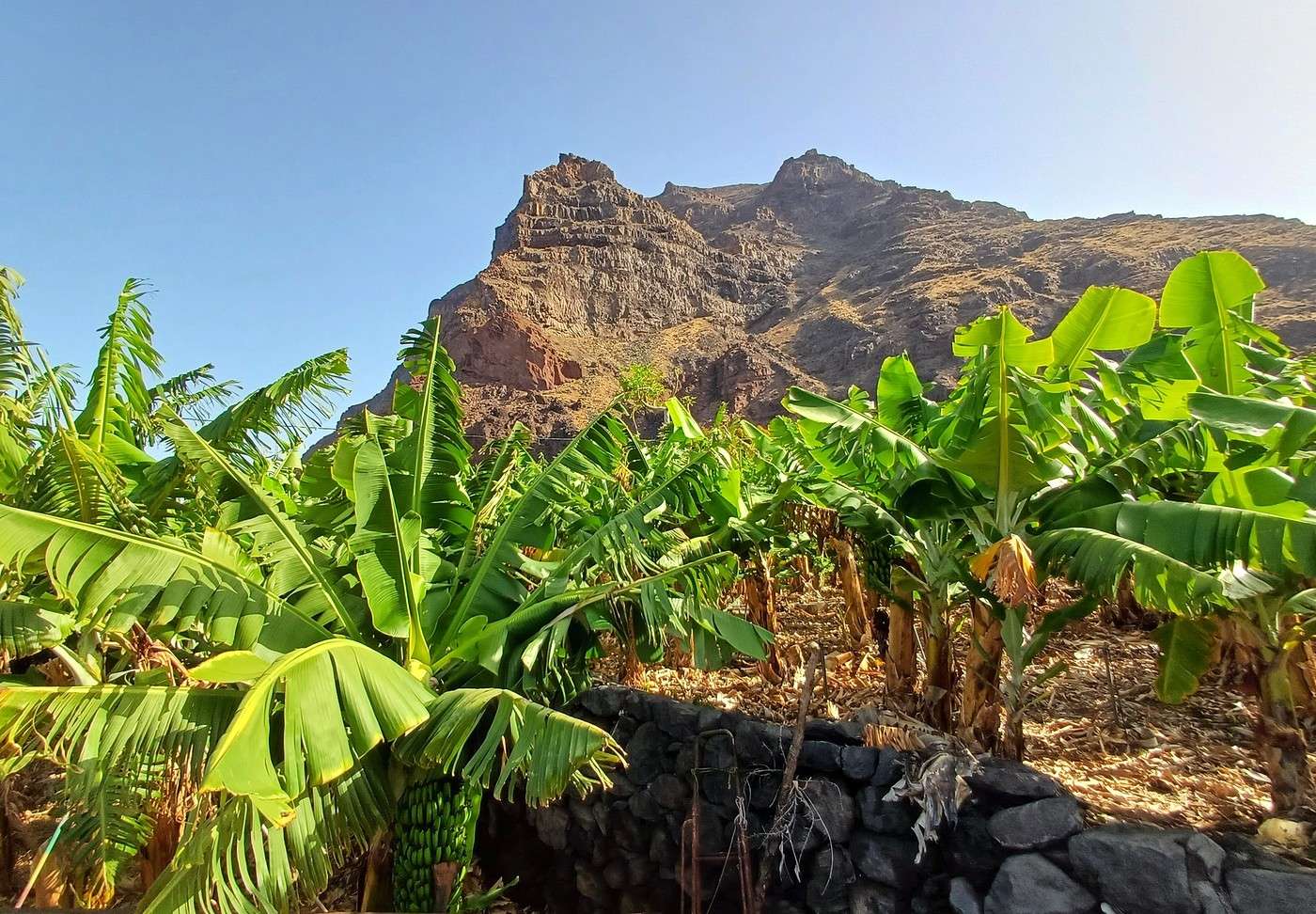
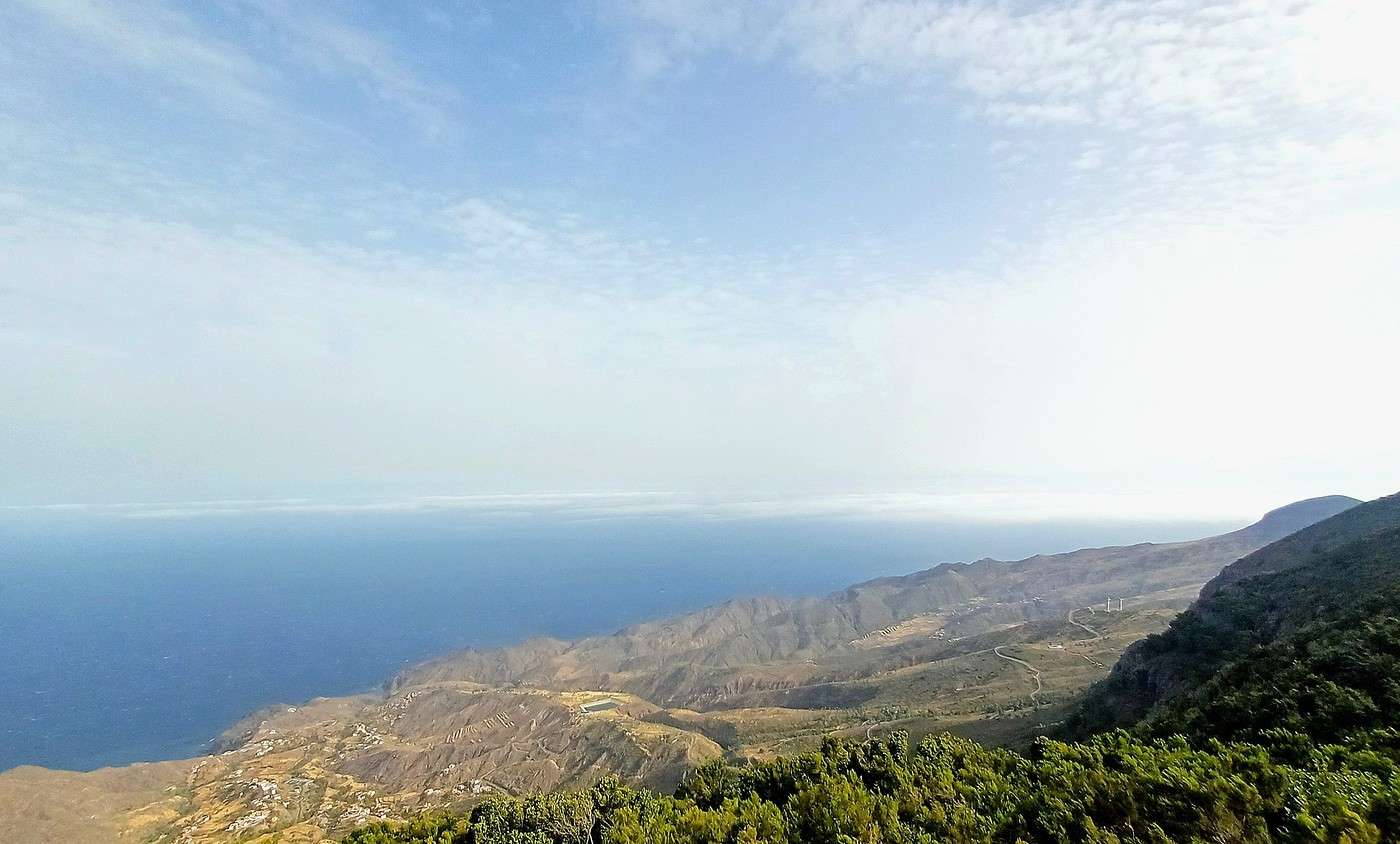
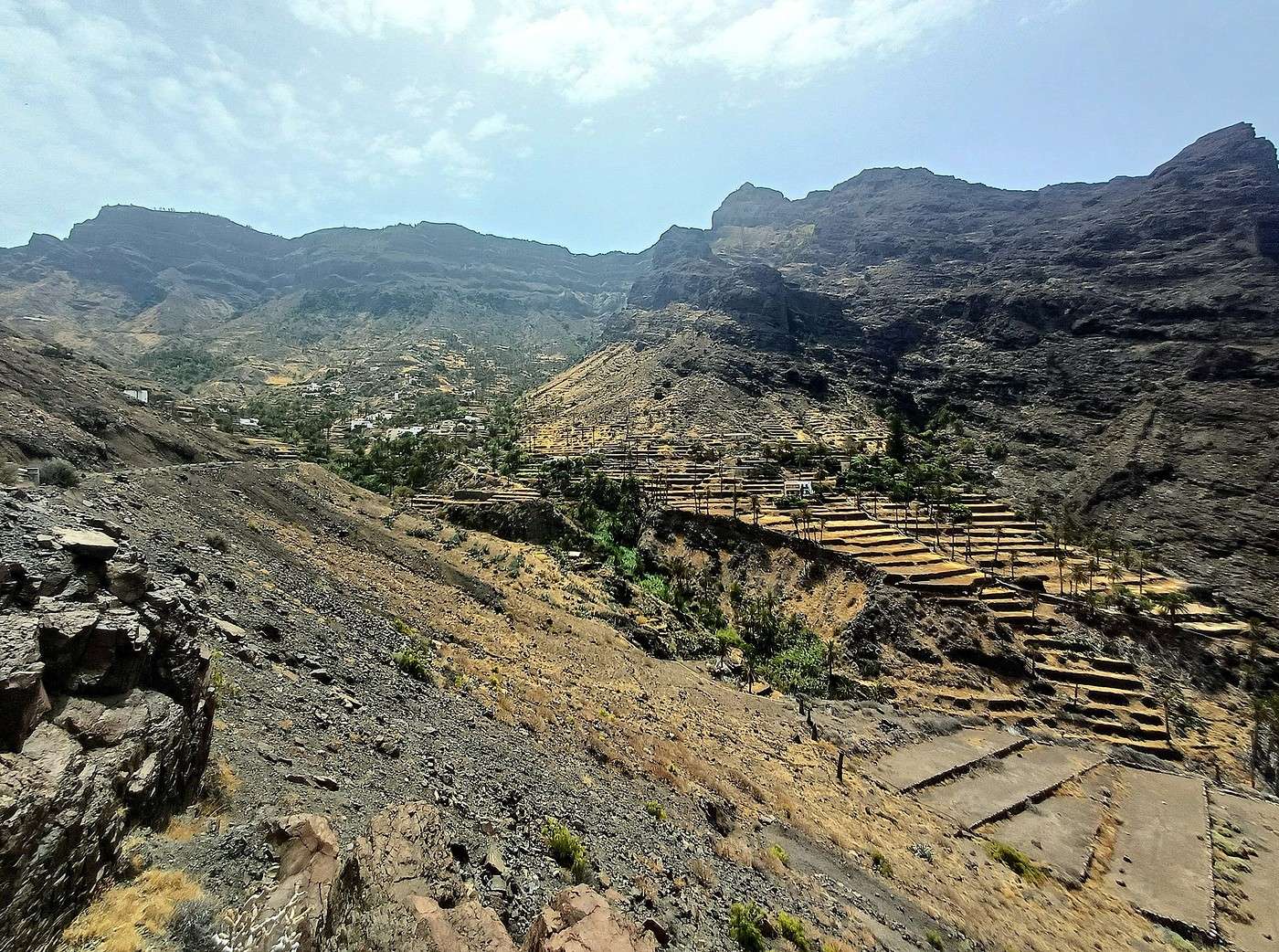
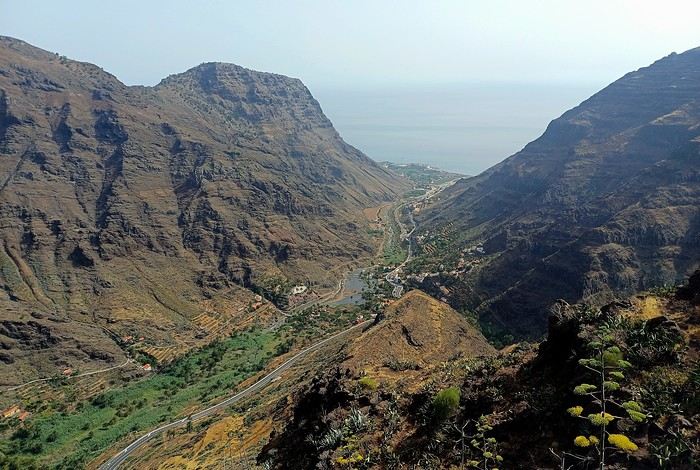
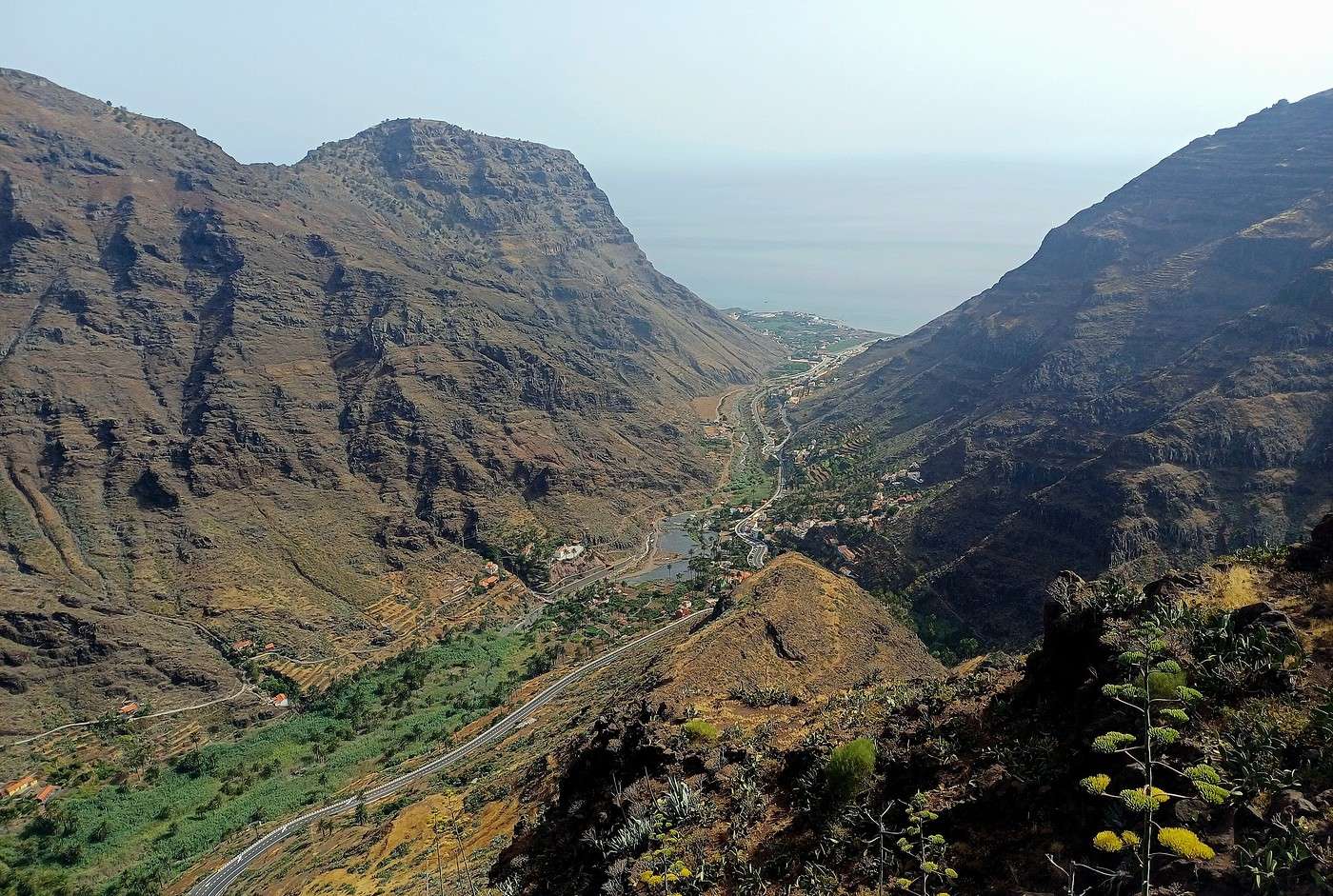
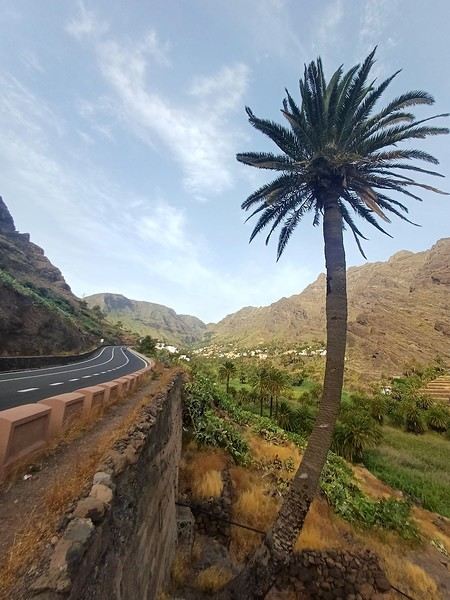
We wind our way upward between the massive ridges and are instantly struck by the beauty of these dry, rocky landscapes in terracotta tones, the result of ancient volcanic activity. They’re covered in terraced fields and dotted with palm trees, banana trees, aloe vera, prickly pears, and more, surrounding us on all sides. Toward the north of the island, the roads get narrower and twistier, sometimes dizzyingly so, with one tight hairpin after another. You’ve got to have a strong stomach! The kids start feeling queasy, and they’re not the only ones… But the breathtaking scenery helps take the edge off, especially the viewpoints along the road that offer jaw-dropping views of the deep valleys. We’re already amazed by this little preview of La Gomera from the safety of our Opel Corsa, which Magali finds perfectly suited to these kinds of roads. We finally get a glimpse of the places we’d imagined while planning this trip and will visit in the coming days: the lush Hermigua Valley with its plunging sea views, the village of Agulo between cliffs and ocean, and even a small part of Garajonay National Park. We get held up for a few minutes because we have our first encounter with real Gomeros, busy clearing branches from the road. This sign of civilization surprises us because we’ve been driving alone for a while and haven’t seen anyone. There’s something very welcoming about these small, stocky road workers with their uniquely weathered skin—they signal for us to wait and wave as we pass. Then the road finally starts to descend, and from a high viewpoint, we spot a valley nestled between two massive mountain slopes, revealing a wide strip of ocean on the horizon: our destination, Valle Gran Rey. The view from above is just as stunning as Hermigua’s.

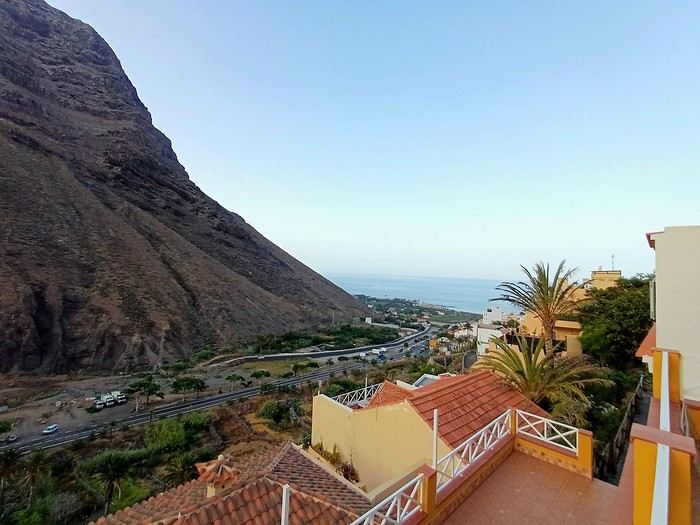
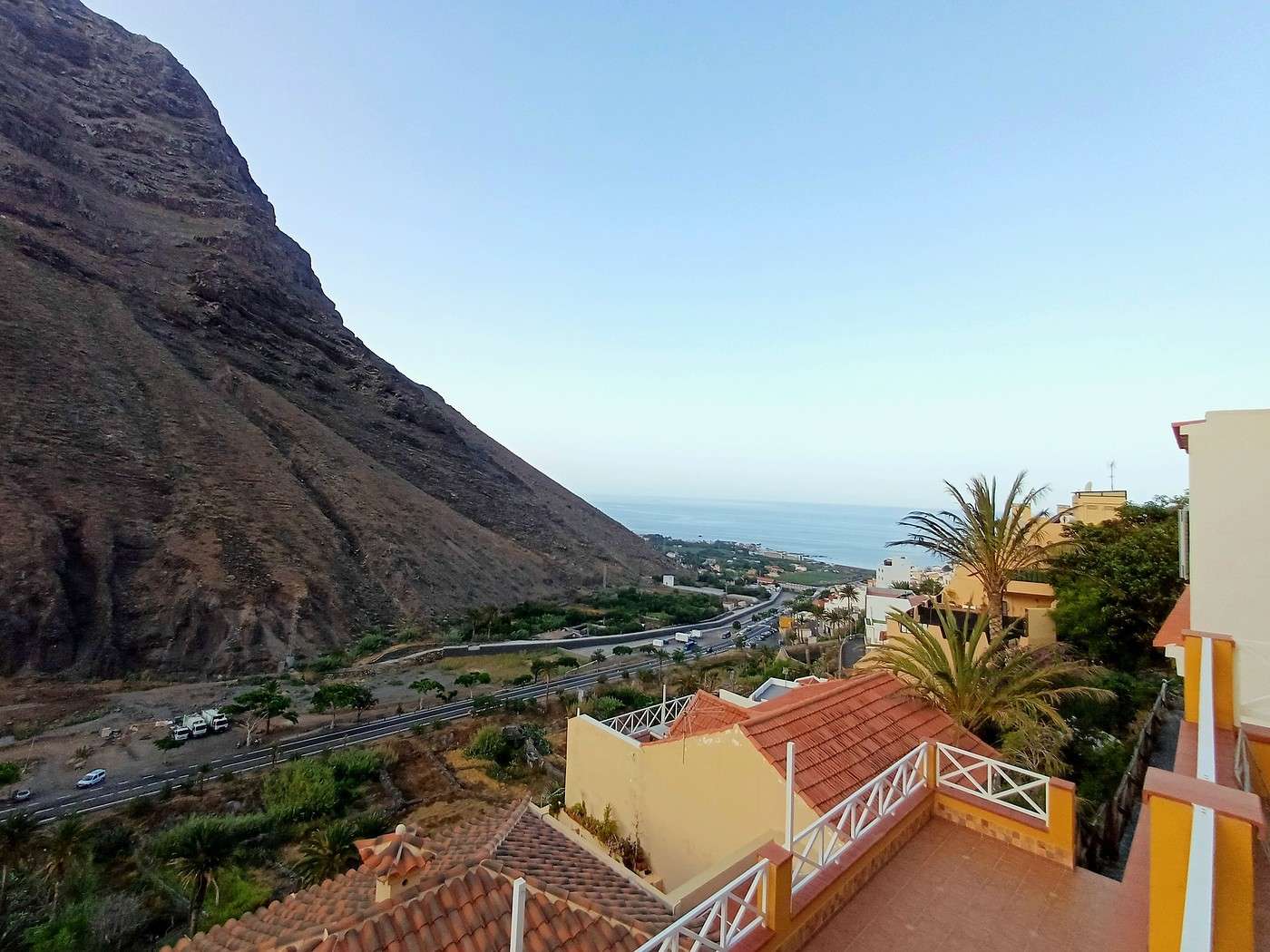
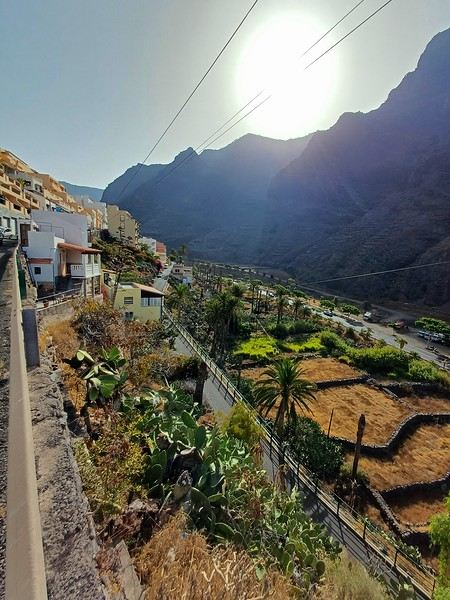
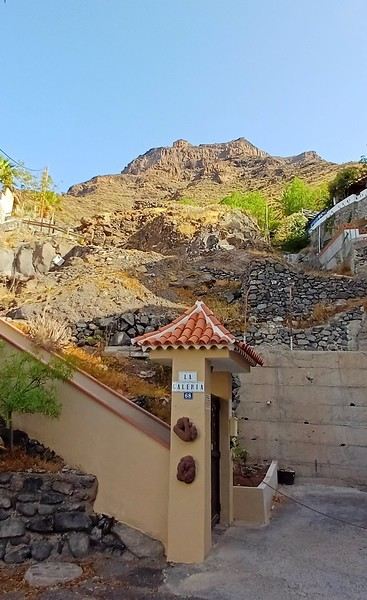
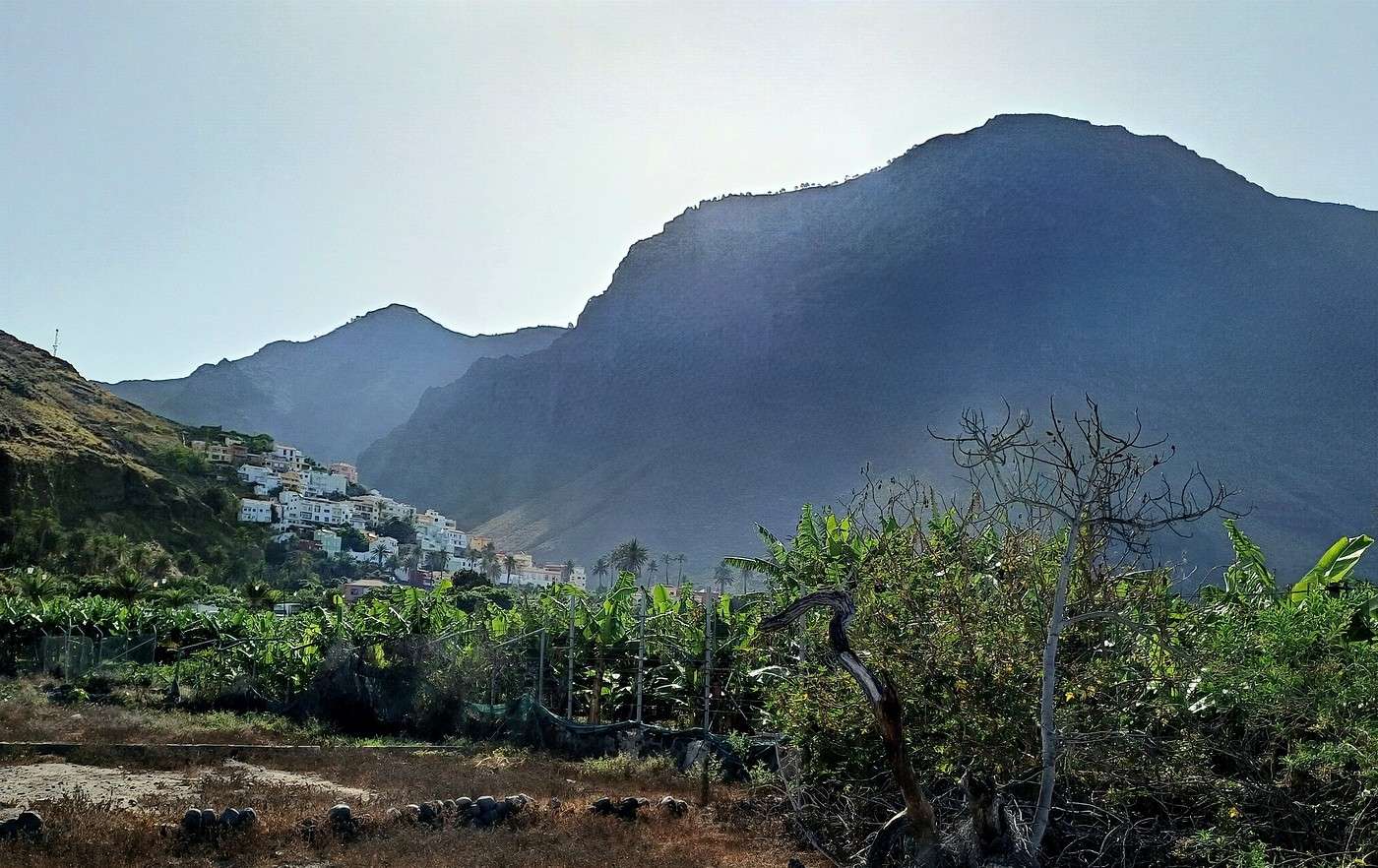
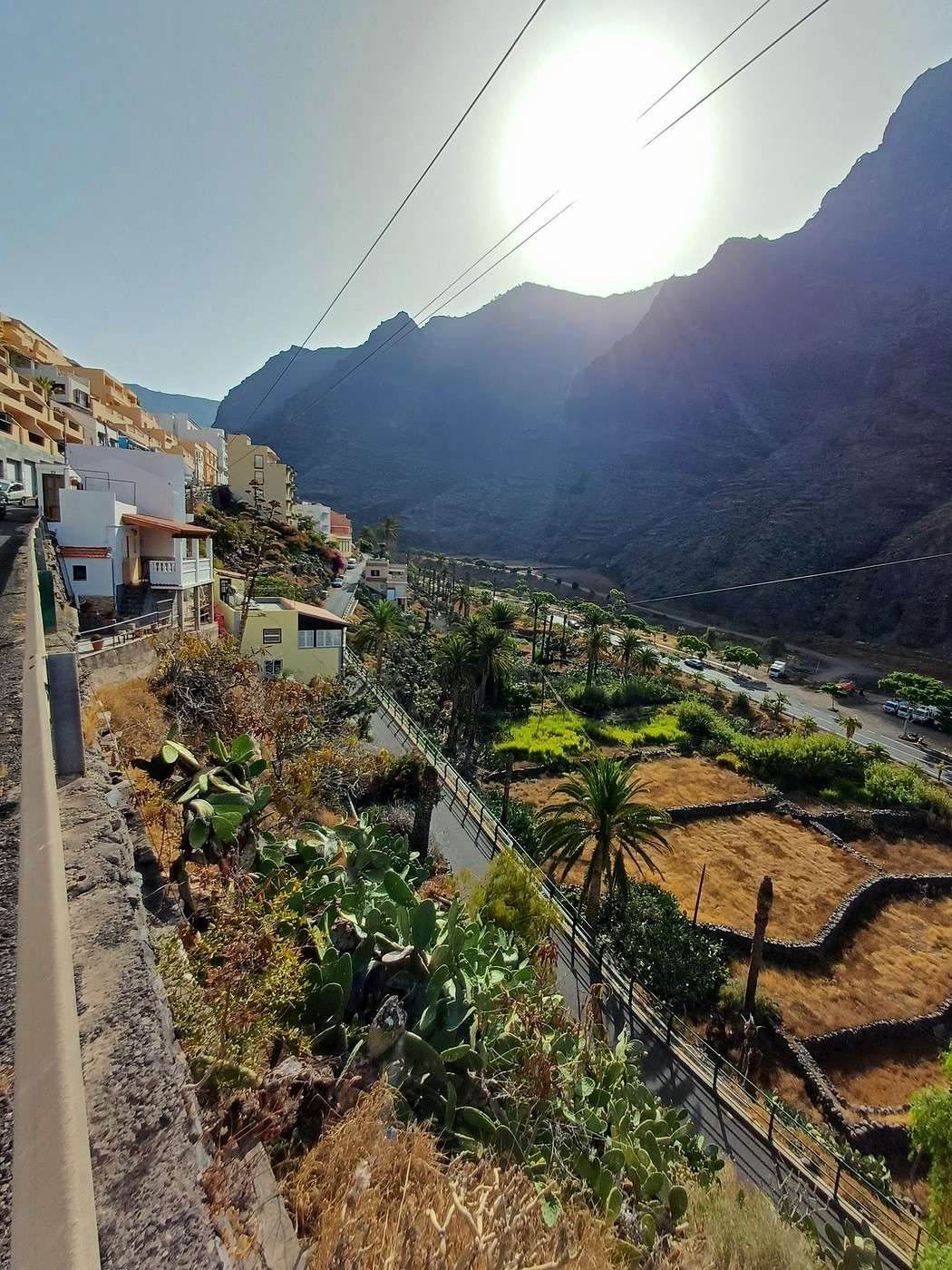
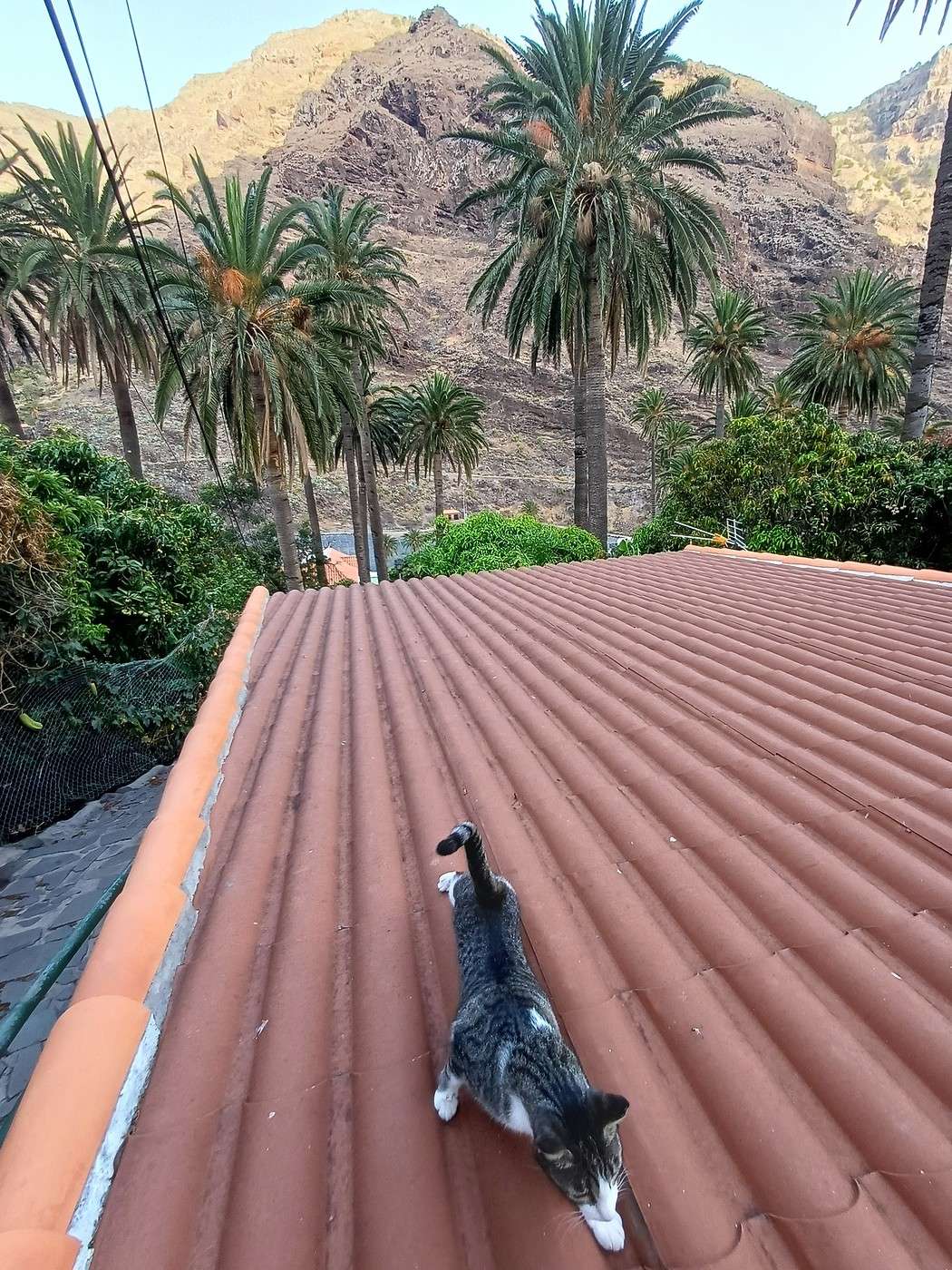
Now we’re looking for our lodging in the little village of La Calera, which, further down, still overlooks the coastline. Actually, the municipality of Valle Gran Rey isn’t a single town but a collection of coastal and mountain villages clustered in the valley. La Calera is one of them. It seems perfectly situated—neither too deep in the mountains nor right by the ocean, with a fantastic view and just a 20-minute walk to the shore. Valle Gran Rey is, along with San Sebastián de La Gomera, the most touristy spot on the island—but that’s relative since La Gomera is still a hidden gem. La Calera feels like an authentic village, mostly home to native Gomeros, but it’s also quite popular with Germans. They’re big fans of La Gomera, especially Valle Gran Rey—so much so that many have invested in properties or vacation homes here, and German has become the island’s unofficial second language. Coincidentally, our Airbnb is owned by a German, and we struggle to find it despite the precise location provided. Magali parks the car on the village’s main street because the lodging is in one of the many *callejónes* clinging to the mountainside—more like steep paths accessible only on foot than actual streets.

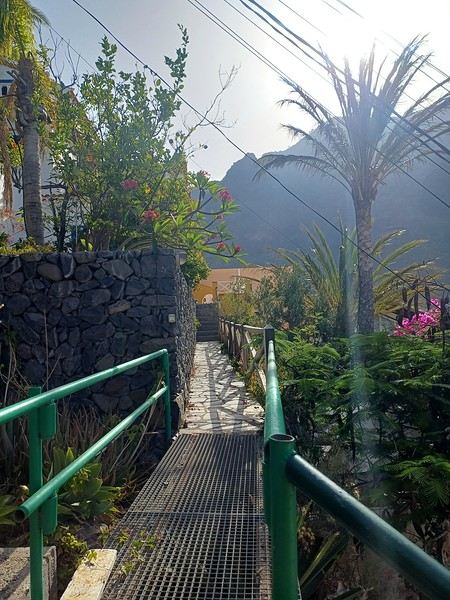
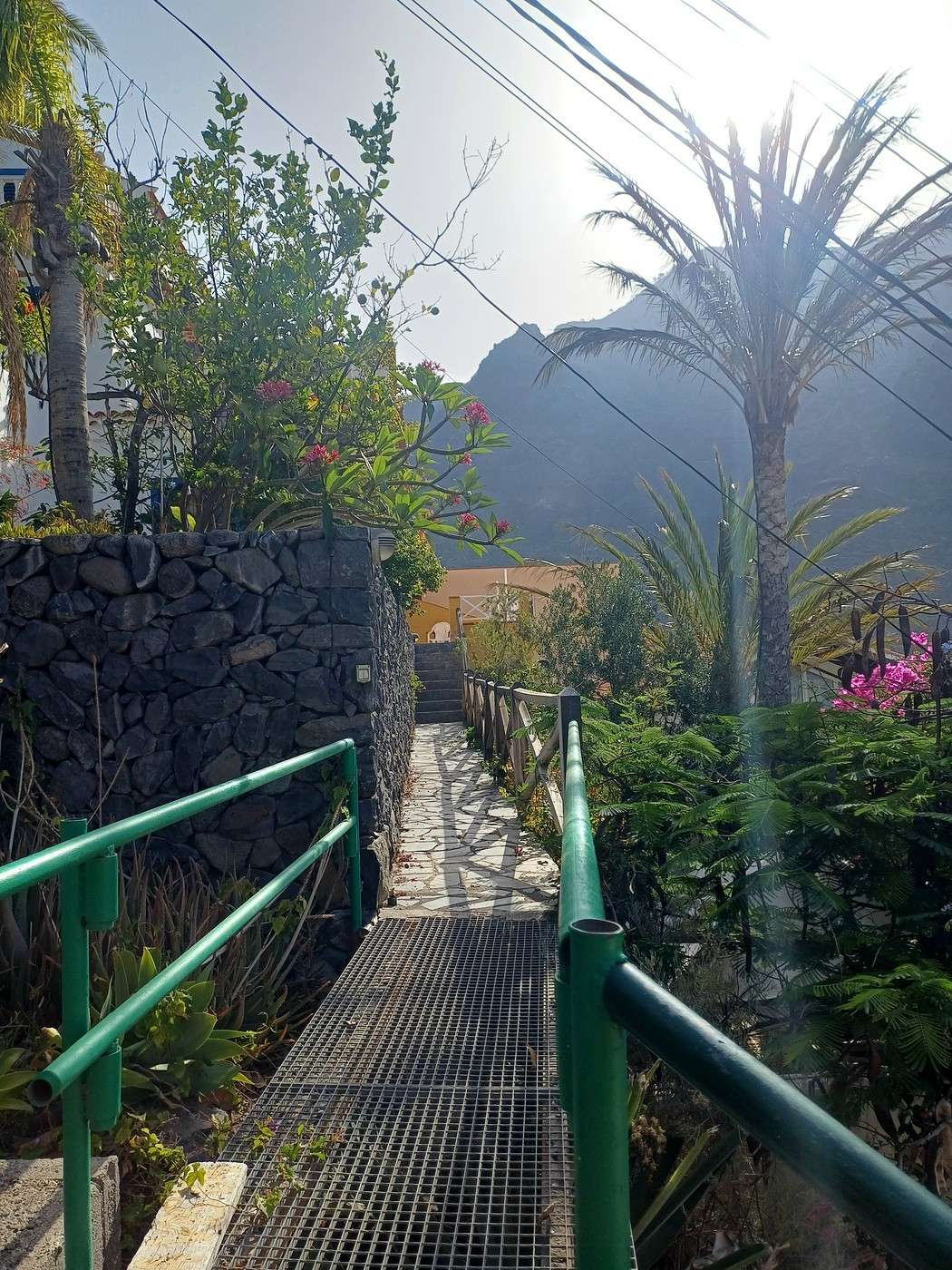
We finally run into a man sipping a beer on a low wall, who we mistake for a Gomero because he looks just like the road workers we met earlier. He hears us talking and approaches in perfect French. Turns out he’s Belgian but seems to know the village like he’s lived there his whole life. He easily points us to our lodging, the aptly named Buena Vista, which is even higher up than we thought. We’d searched in vain in the neighboring path, but it was actually the next one with the same name—probably because they meet up higher up. You’d have to know! The stone-step trail winds through prickly pears, mango trees, and banana plants growing like weeds, with houses stacked in terraces like the surrounding fields. The climb is pretty tough, especially after such a long day with a 20-kilo suitcase. We end up at a metal walkway—without it, a crevasse would block access to the house… and there we are. We didn’t think we’d start our first hike so soon: La Gomera is full immersion from the get-go!

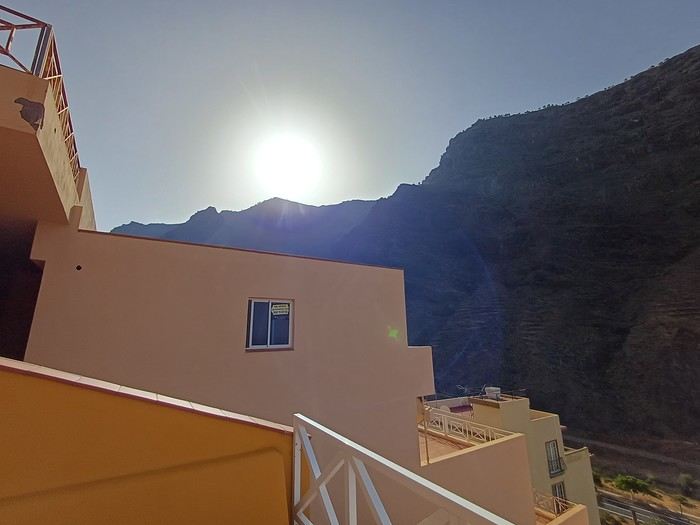
Our German landlord’s German neighbor welcomes us warmly but discreetly. It’s a lovely vacation home with everything we need: a big living room-kitchen, a terrace with an amazing view of the mountains and sea, two upstairs bedrooms, a bathroom, and a balcony above the terrace. We’ll stay here for seven days before moving to Hermigua for the second week.

After unpacking and taking much-needed showers, we head down to the village grocery store, just a two- or three-minute walk away, to stock up and have something to eat tonight. El Chorro Grocery seems to be the main social hub of La Calera, with locals treating it like a bar, beer in hand, chatting with the owner on the doorstep. We’re surprised to see our Belgian friend there, laughing and speaking Spanish with some villagers. The guy seems to have fully blended into the scenery and completed his physical and cultural transformation into a true Gomero! We pick out some Spanish and local products to get into the spirit. Prices are a bit high, but the owner is super welcoming, and we’ve got what we need for tonight and the start of our stay.

I get cooking and whip up a homemade Canarian garbanza with local ingredients, which we enjoy on the terrace with pasta and some improvised tapas—chorizo, squid in sauce—and the obligatory cold Dorada, as the sun casts its last rays over the valley before slowly disappearing behind the ocean. Everything is peaceful, the weather is mild, and there’s almost no noise—just the occasional sound of a car passing on the main road far below. We couldn’t have made a better choice.

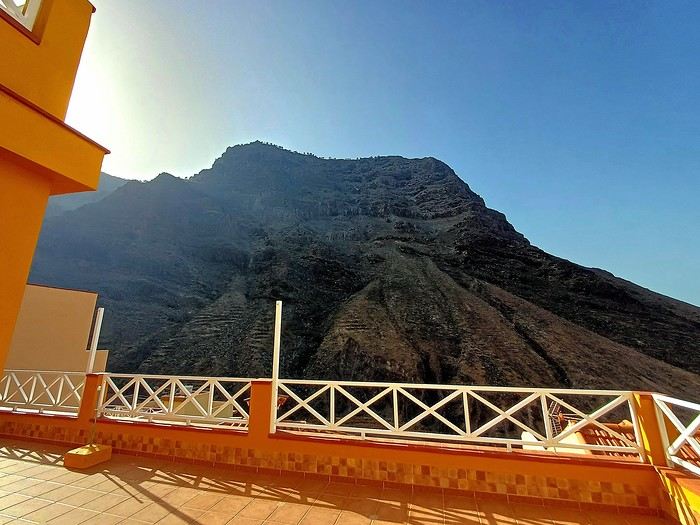
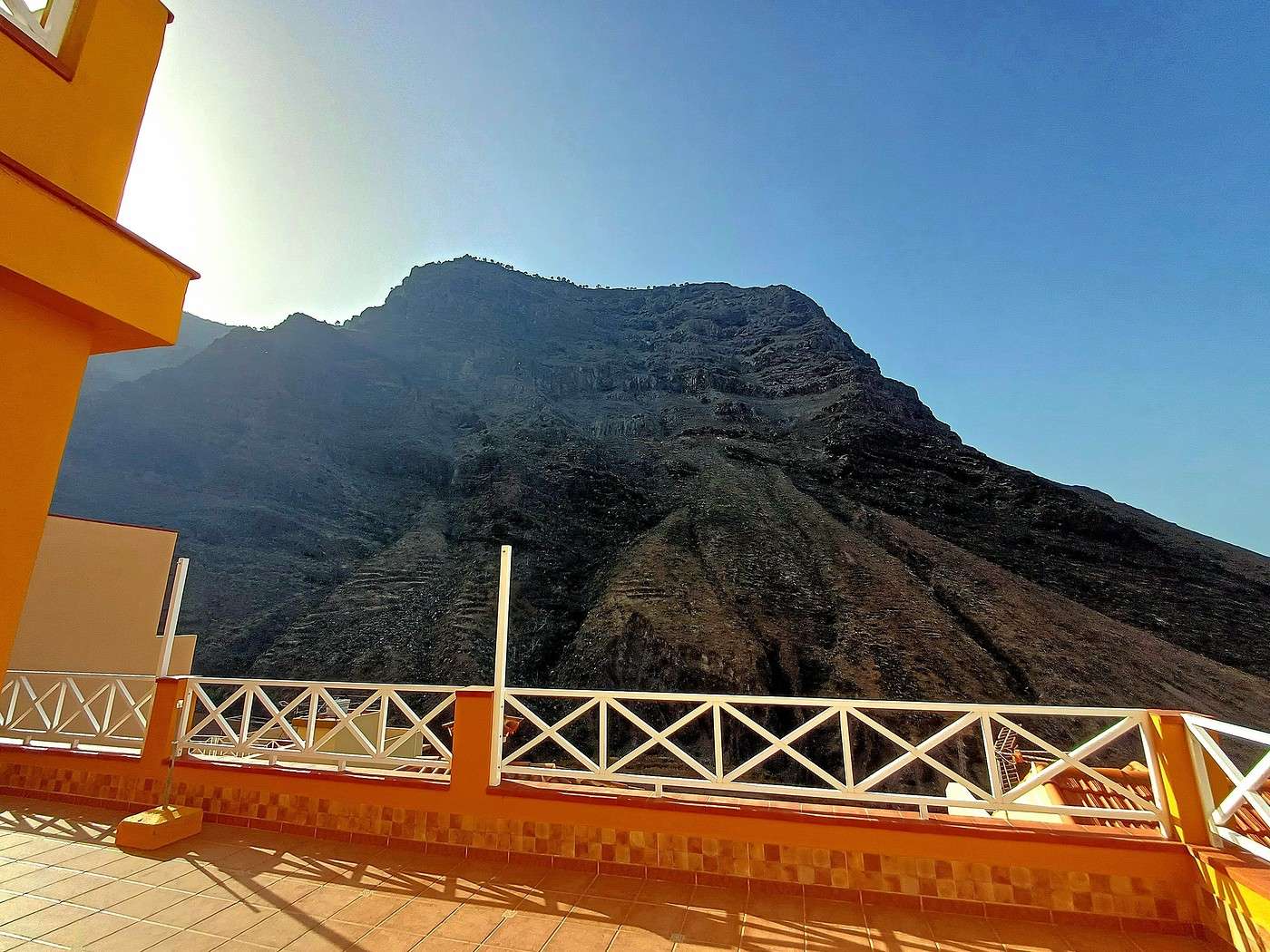
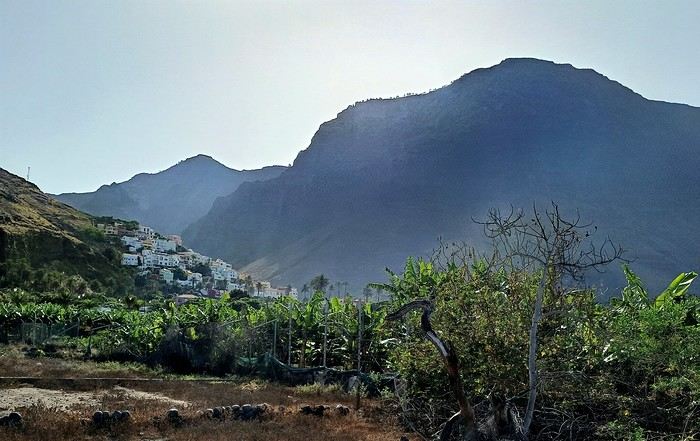
That evening, I start to take a real interest in the colossal mountainside facing ours, meeting up there in a V-shape to give the valley its vast, open feel. This monumental volcanic formation, with its mix of brick red, anthracite, and sparse green vegetation, looms over our terrace like a giant shadow stretching from the mountainous hinterland to the coast. It feels like a wave frozen in time, about to crash over the village. Night falls, turning it into a dark, imposing mass that amplifies the sense of immensity and impending submersion. At the same time, strange noises—like cats fighting—echo through the valley… It catches my attention for a moment, but it doesn’t matter. After 13 hours of nonstop travel—Uber, plane, bus, ferry, and car—it’s time for some well-deserved rest before we start exploring the area tomorrow.
16 days with family in La Gomera (Canary Islands)

Djalma · 2026-08-17 · Message 6 of 54

Hello, Awesome! Just reading a bit has made me want to go there at the end of September Flights with easyJet are convenient and cheap... there are plenty of available accommodations. The north doesn’t seem too arid, and we really like the vegetation... Could you confirm if we can hike freely without needing to pay entry fees on the marked trails that everyone uses?
16 days with family in La Gomera (Canary Islands)

Pagaljavab · 2026-08-17 · Message 7 of 54

Hey Djalma,

I can only recommend you go to La Gomera—I’m sure you’ll love it. I can confirm that loads of holiday rentals are vacant, that the north and center are really green, cooler, and more humid (especially Hermigua Valley and Garajonay Natural Park), and that you can wander absolutely freely and often alone on the island’s 600 kilometers of trails.

Unlike other Canary Islands, La Gomera is a place where you don’t pay for nature, culture, or parking. Even the small museums or explanatory workshops are often free or at worst ridiculously cheap.

I encourage you to check out this super detailed travel journal, as Attila guessed—after that, you’ll know everything!

16 days with family in La Gomera (Canary Islands)

Djalma · 2026-08-17 · Message 8 of 54

Unlike other Canary Islands, La Gomera is a place where you don’t pay for nature, culture, or parking. Even the small museums or explanatory workshops are often free or at worst ridiculously cheap.


Thanks for the info. Actually, it’s not about the budget but for other reasons... Parking and museums aren’t an issue. But nature that’s more or less developed—parks with fences and entry tickets like in Tenerife or elsewhere—I’m not into that. I’ll go ahead and book my flight right away. Thanks again.

16 days with the family in La Gomera (Canary Islands)

Pagaljavab · 2026-08-17 · Message 9 of 54

Day 2, Wednesday, July 29: Valle Gran Rey/La Calera: Charco del Conde, La Calera beach, El Guro, Arure waterfall trails

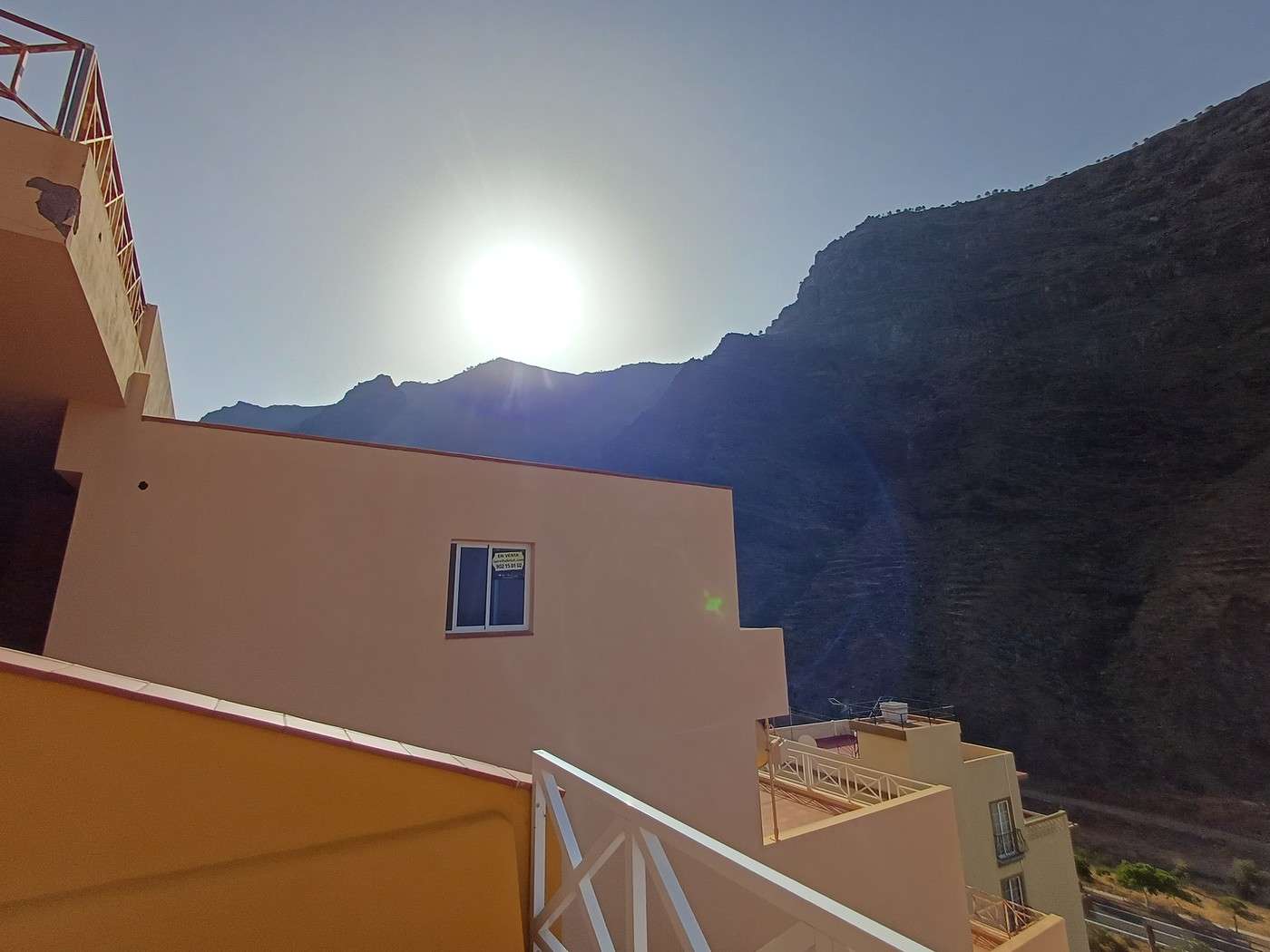
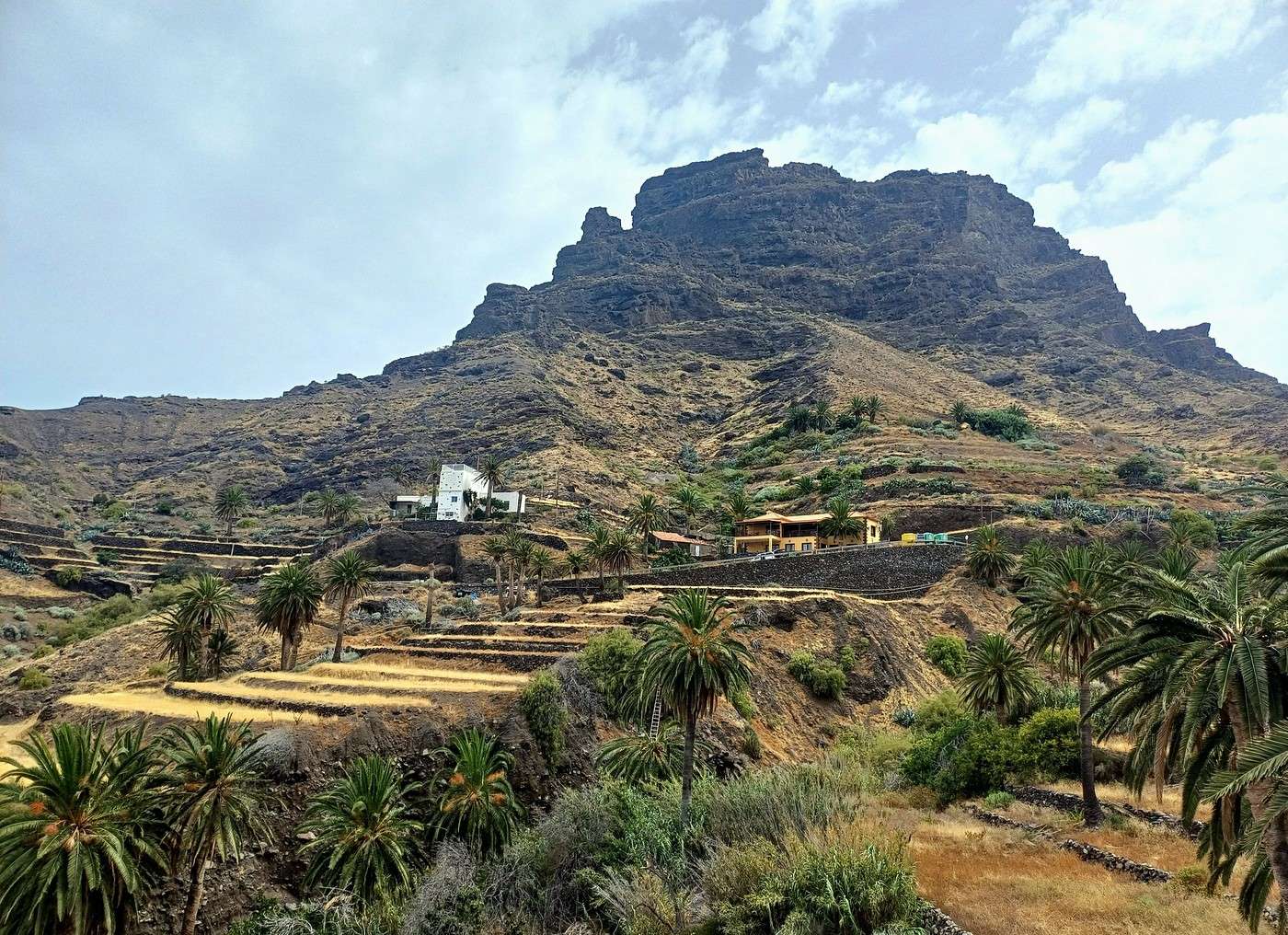
After a good night’s recovery, the gentle morning sun invites us to have breakfast on the terrace. From the balcony of the rooms above the terrace, I’m still staring at that mountain, just as intriguing in broad daylight. Its wall is so steep that the sun doesn’t fully rise above it until around 10 a.m.

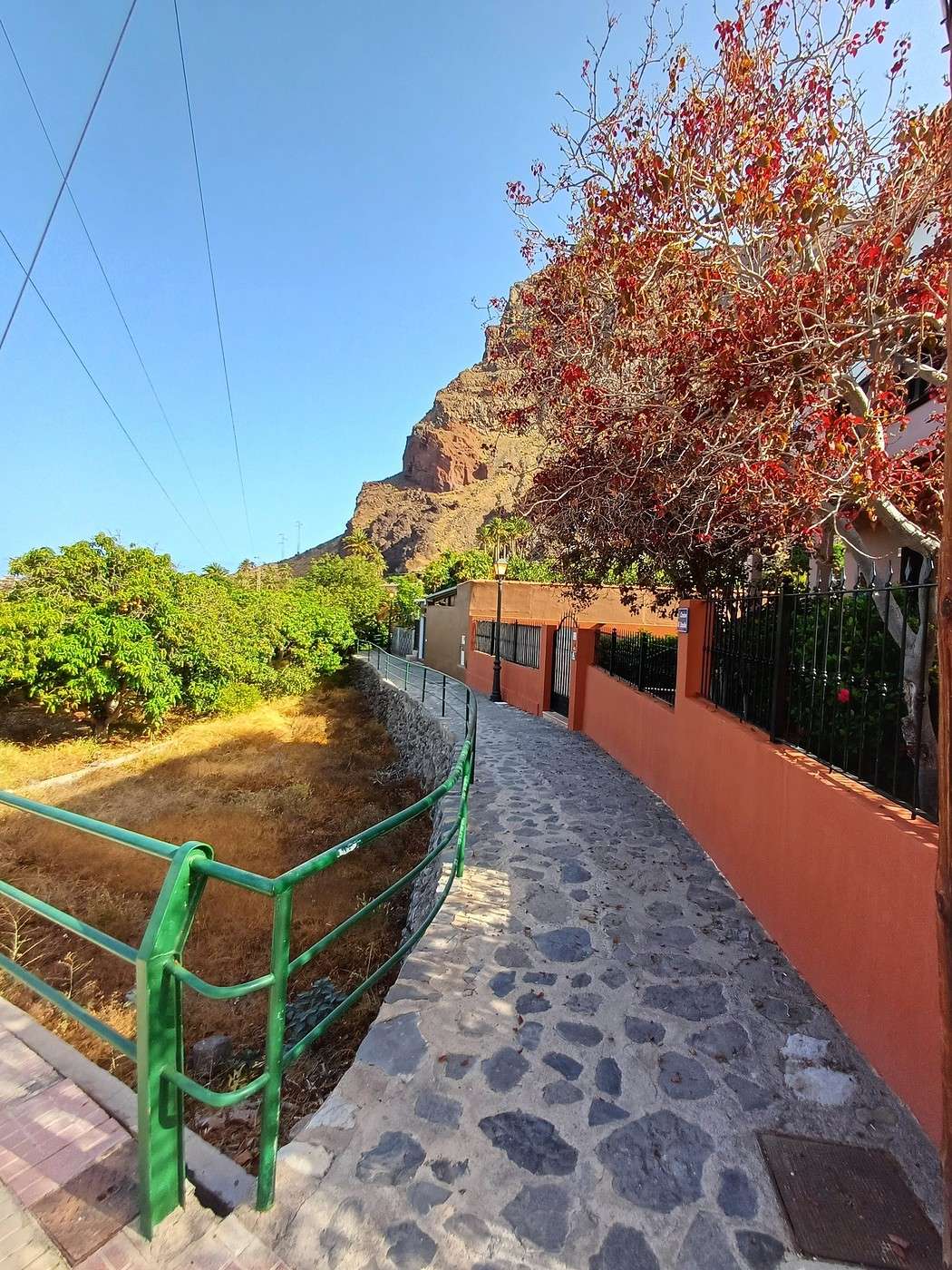
With its large, rounded plateau at the top and its sides ending in frozen lava tentacles, its giant octopus look reminds me of a Lovecraftian deity. Yes, that’s it—a Cthulhu made of volcanic rock! To start this trip off right, we walk down to La Calera toward one of Valle Gran Rey’s beaches. We’re not sure which one to choose, so we take a somewhat random route. We have to go through the village anyway, and after passing the main street above the terraced fields, the grocery store from yesterday, and the main road into the valley, we get a little lost in its charming alleys.

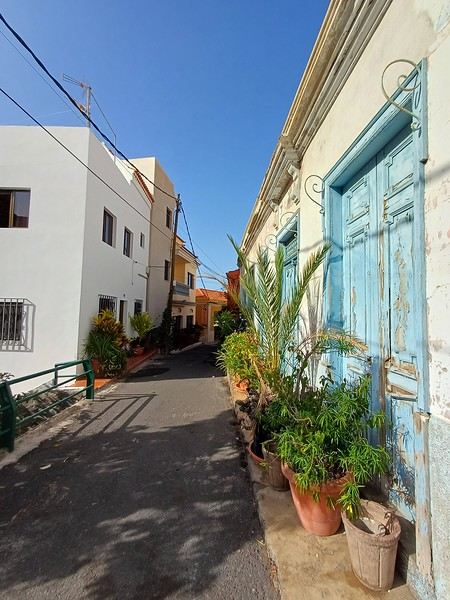
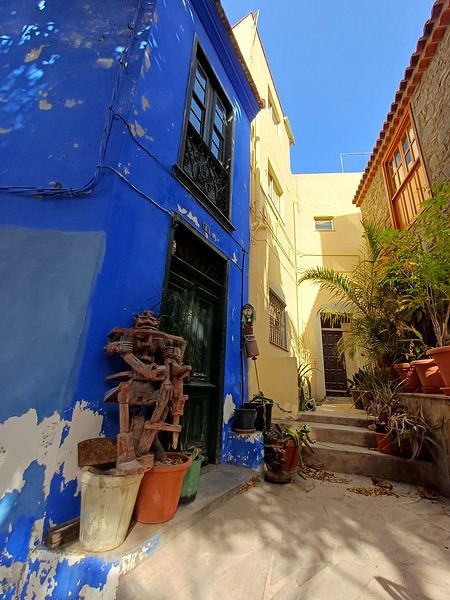
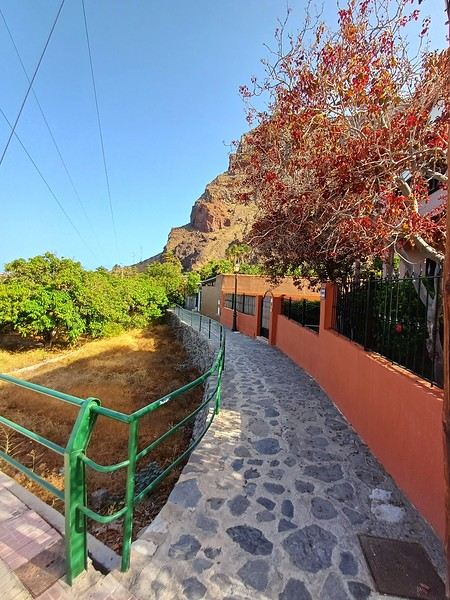
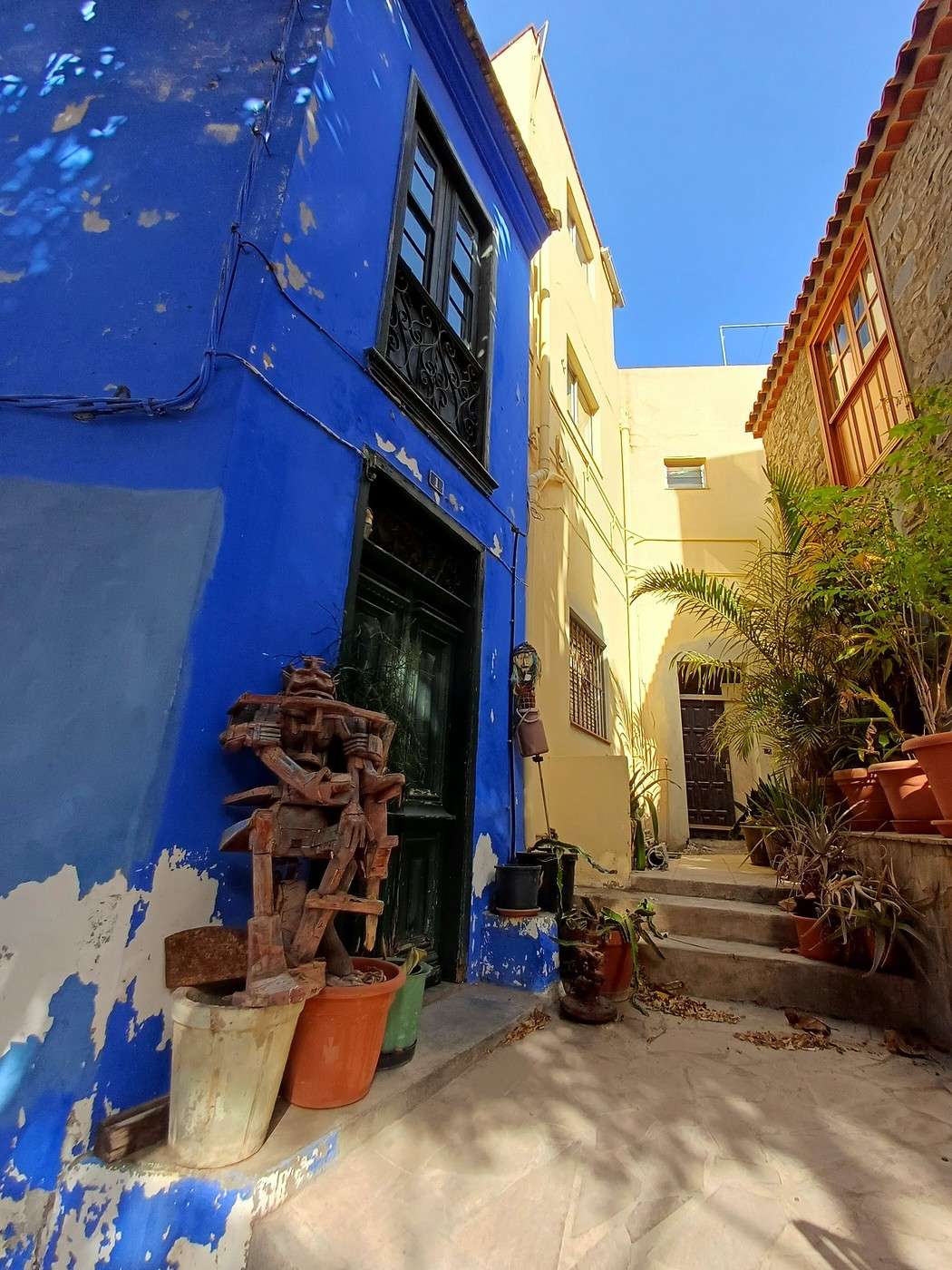
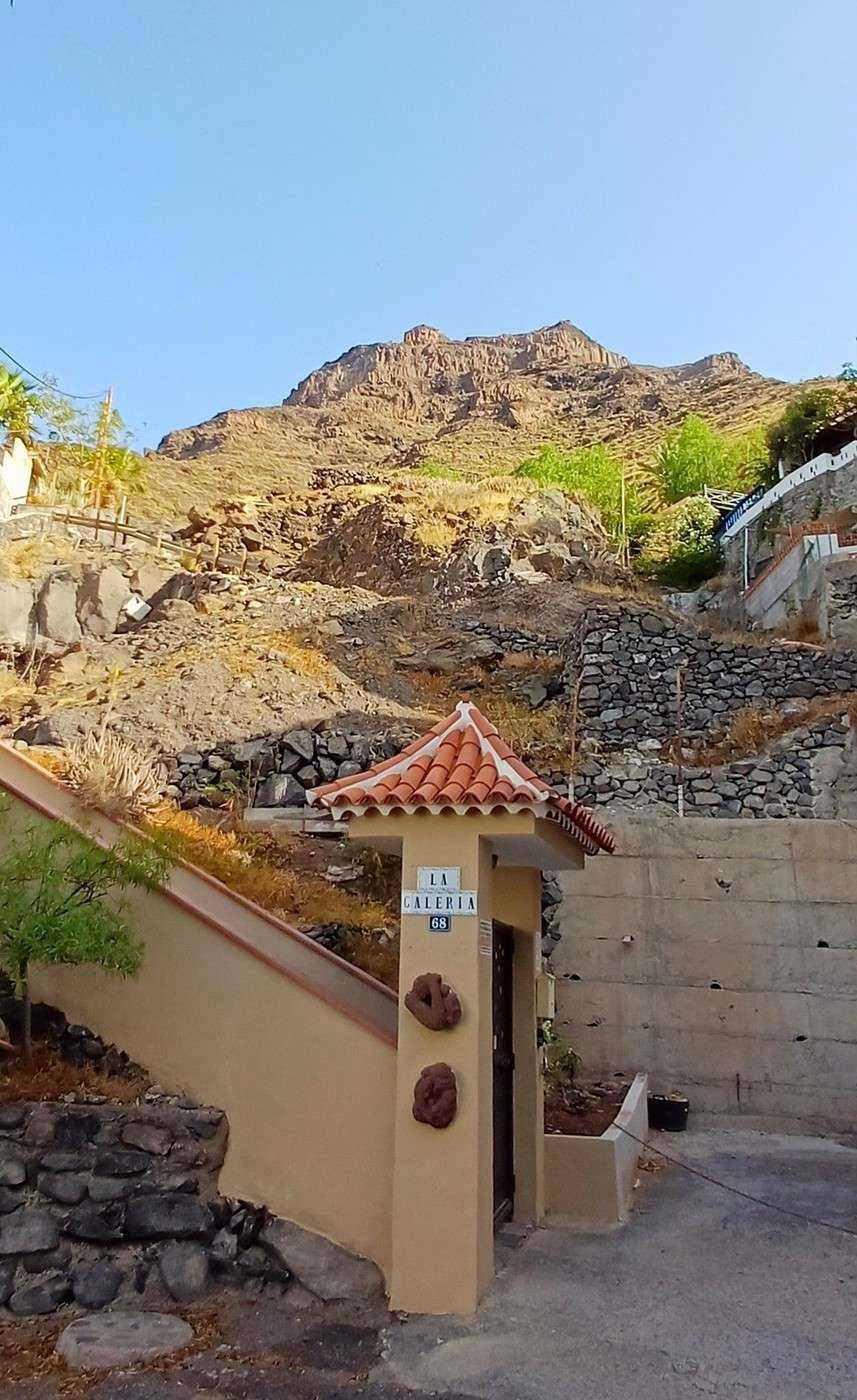
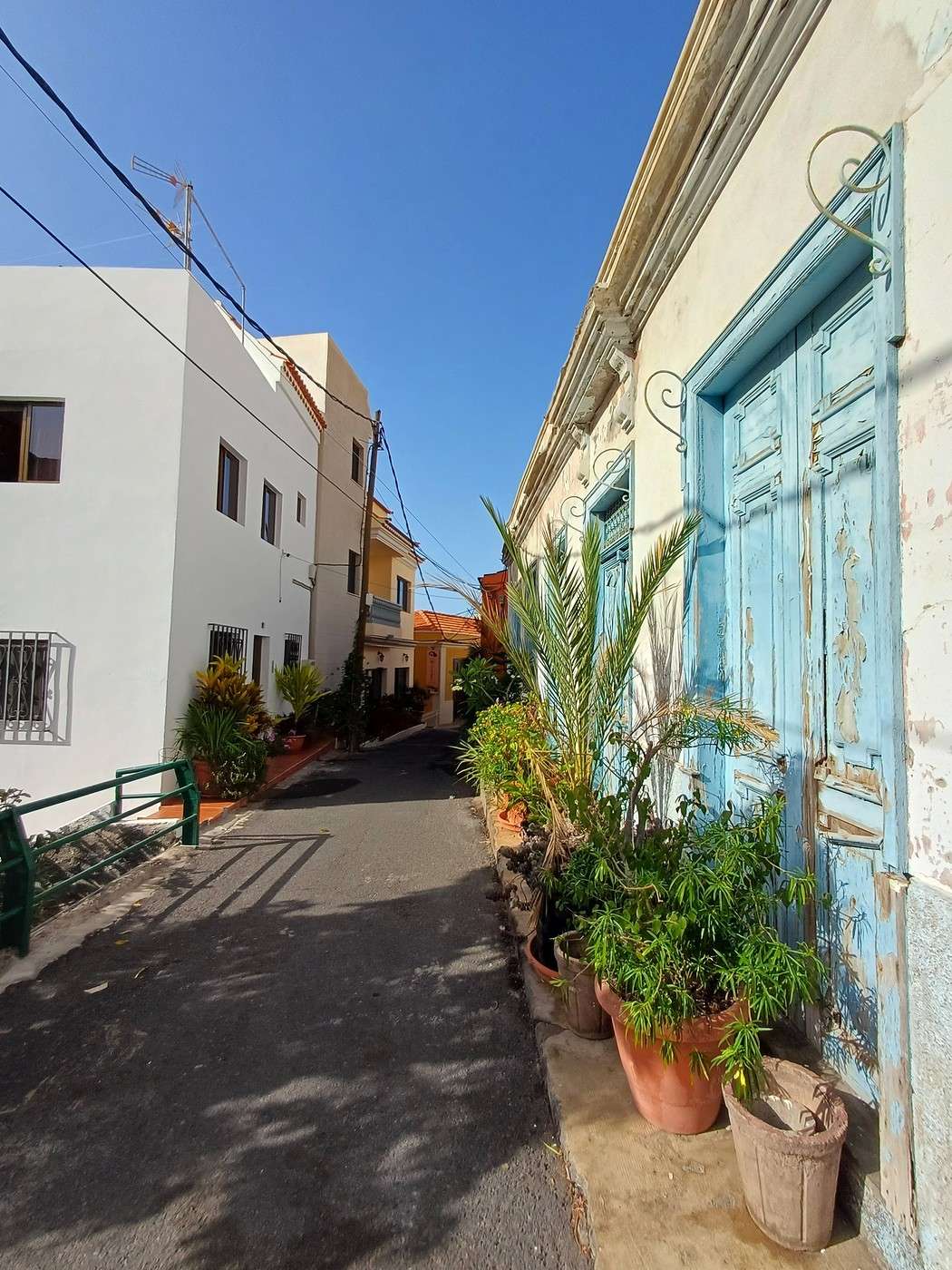
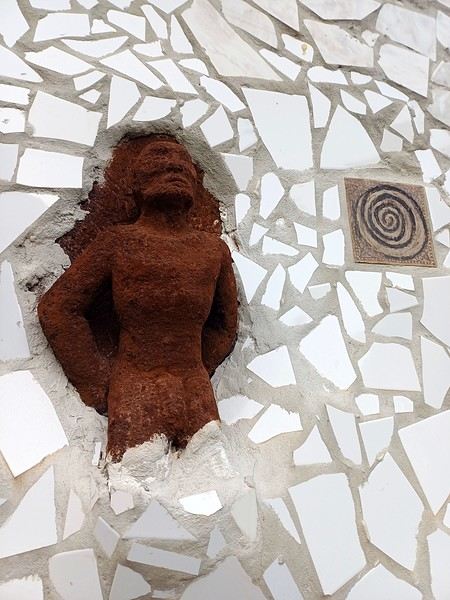
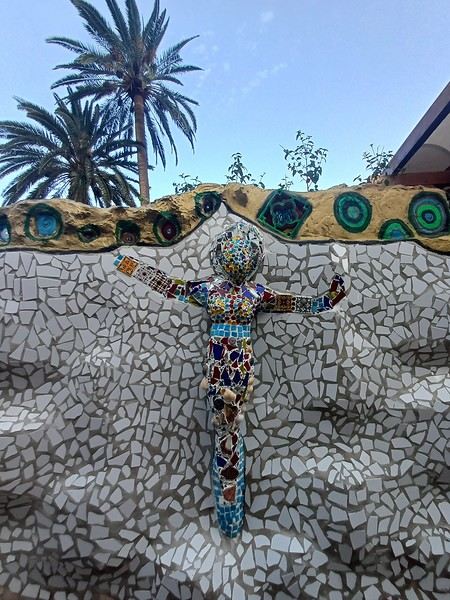
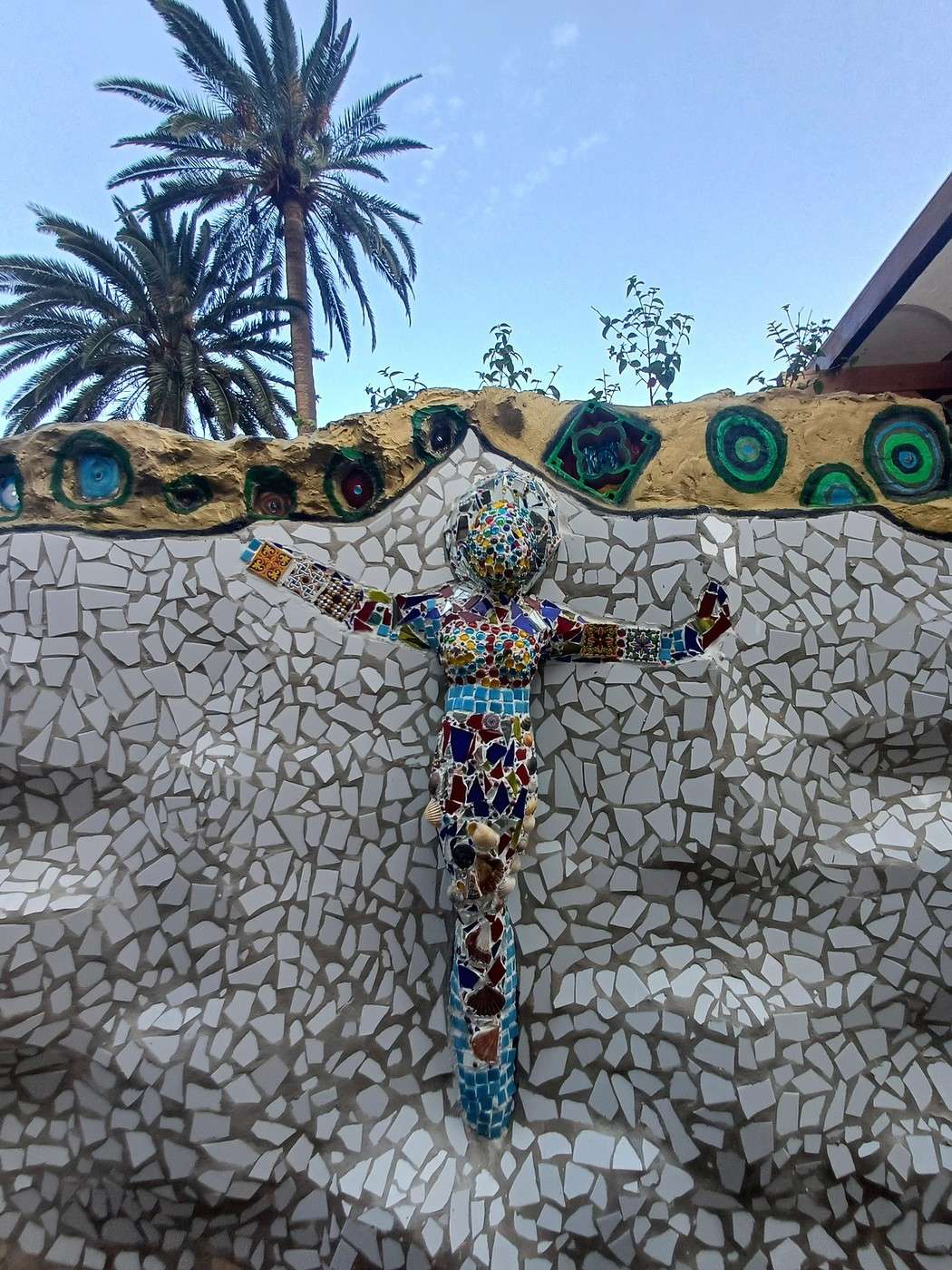
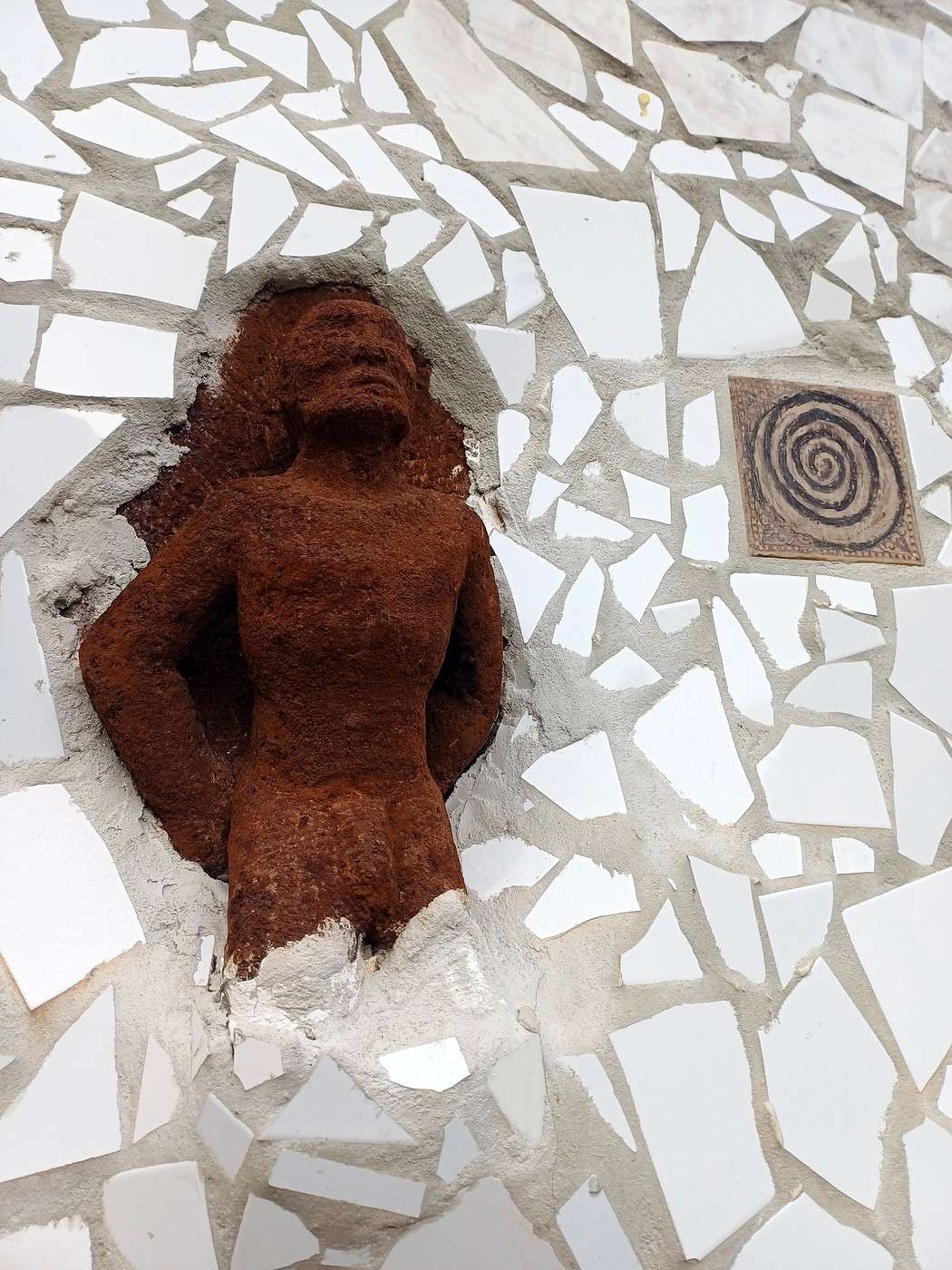
Though we still barely see anyone (Canary Islanders tend to be late risers), the village feels very much alive with its school, small government offices, language classes, colorful houses—some a bit run-down—with exotic gardens or nestled in the rock, and sometimes decorated with strange contemporary creations.

The lower part of La Calera, near the main road, is a bit livelier, like this bar where the village men (and sometimes women) are already smoking and enjoying Dorada beer with bocadillos to soak it all up, carefree in this mild, peaceful climate. La pura vida! There are a few vacation homes here and there, but the village remains mostly authentic. Large banana plantations, mango fields, and other fruit trees stretch out as you leave the village center, right near the seafront.

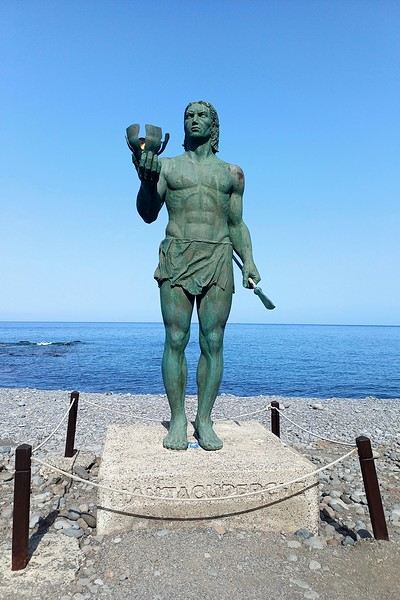
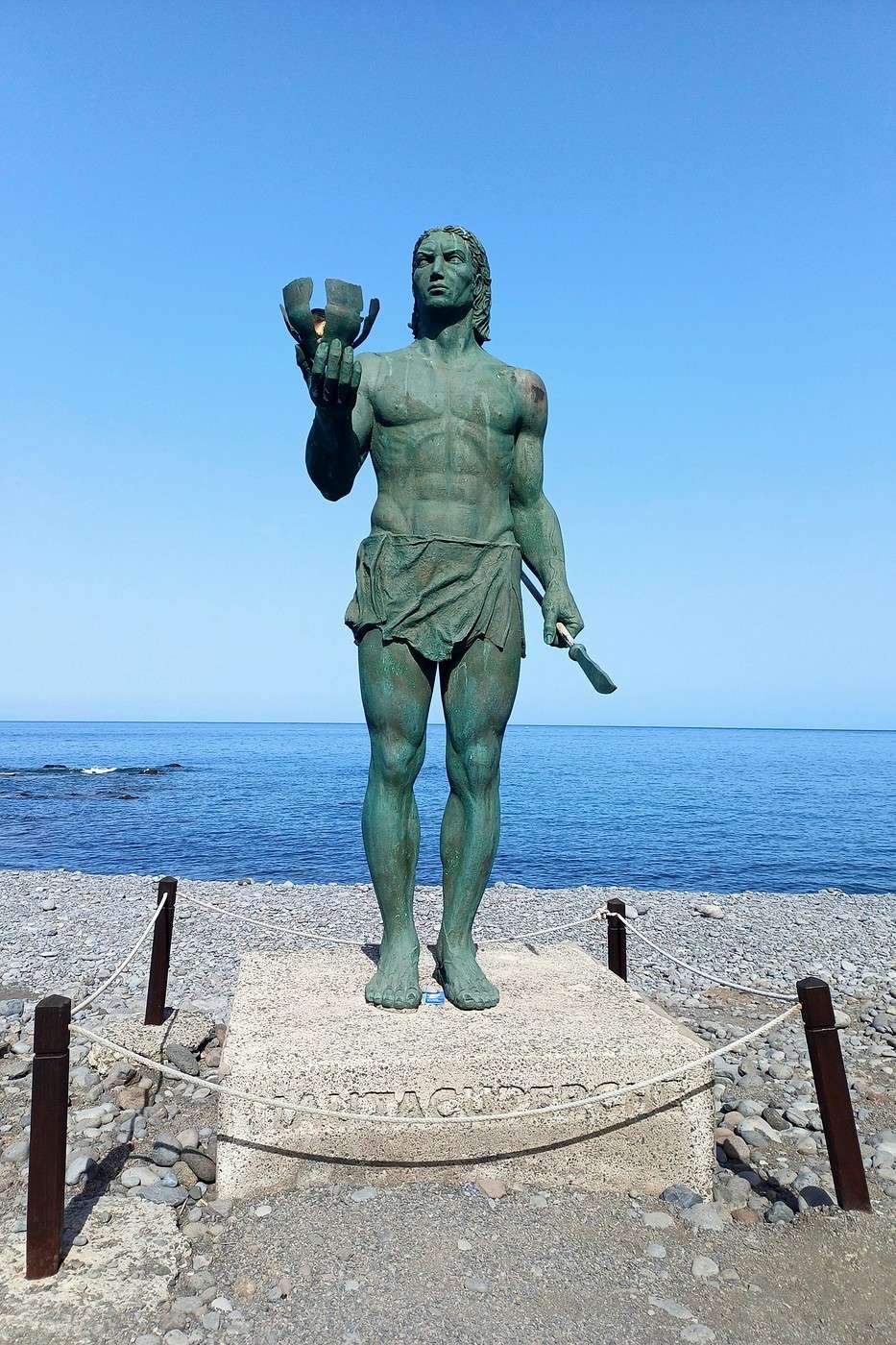
The Canary Islands are known for their charcos (literally “puddles”), called “natural pools”—basins formed by rocks that trap water at high tide and are more or less protected from currents. La Gomera isn’t the best for natural pools, but it does have a few, including the charco del Conde, which is apparently nearby. We’re curious to see what it’s like, even though we’ve heard some are dangerous and have been closed by authorities. First, we walk along La Calera beach and its narrow strip of black sand, then a small seaside path shaded by palm trees that feels a bit like Cuba (where I’ve never been—it’s just a cliché), where the only hotel area in the resort is located, quite discreet, along with a few boat excursion agencies that aren’t open yet or are permanently closed. All the signs are in Spanish and German. At the end of the path, on a small patch of black sand with a few umbrellas, we finally spot the charco del Conde. It’s a small stagnant pool separated from the ocean by a thin strip of rocks. Doesn’t look too dangerous… Oh, there are very few people, but they’re all French. We quickly go dip our feet in. The bottom is rocky, and the water doesn’t go past my knees. It’s fun for Théo with his armbands, and the setting is unique, but after 10 minutes, we’ve seen it all. I wonder if these natural pools aren’t a bit overrated… Maybe we should find a real beach? There’s one right next to the charco, made of pebbles and rocks where big waves crash. No one’s there, and a sign advises against swimming… So we head back toward La Calera beach, which looked great. On the way, we stop for a moment in front of that intriguing statue of a muscular man in a small loincloth facing the ocean, which we’d seen earlier. The site La Gomera Travel, our bible throughout the trip, tells us it’s Hautacuperche (“Blessed by the Gods” in Guanche Berber), the emblematic hero of the Guanches who led the Gomeros’ revolt in 1488 against the Spanish colonists after Governor Hernán Peraza the Younger betrayed the peace and coexistence treaties signed by his more tolerant father. This beautiful 4-meter bronze statue depicts the warrior holding a spear in his left hand, symbolizing armed rebellion, and in his right hand, the broken gánigo, signifying the rupture of the Pact of Colactation with the Spaniards, as it was the clay vessel in which Hernán Peraza the Elder and the Guanche chief shared milk as a sign of brotherhood. Hautacuperche faces the sea with his back to the Valley of the Great King, a name given in reference to the king and spiritual leader of the four Guanche tribes, Hupalupo… hence the name Valle Gran Rey. It seems the Gomerans base much of their distinct identity on this heroic figure, which is also a source of pride for their fellow Canary Islanders. We’ll learn more about this fascinating history later…

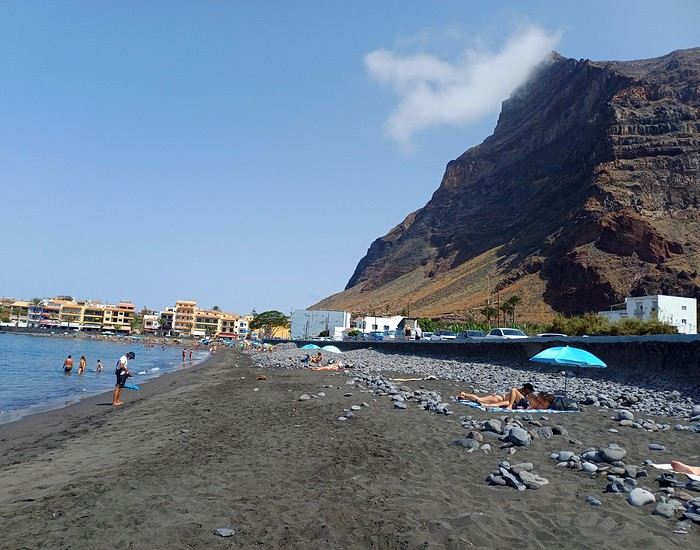
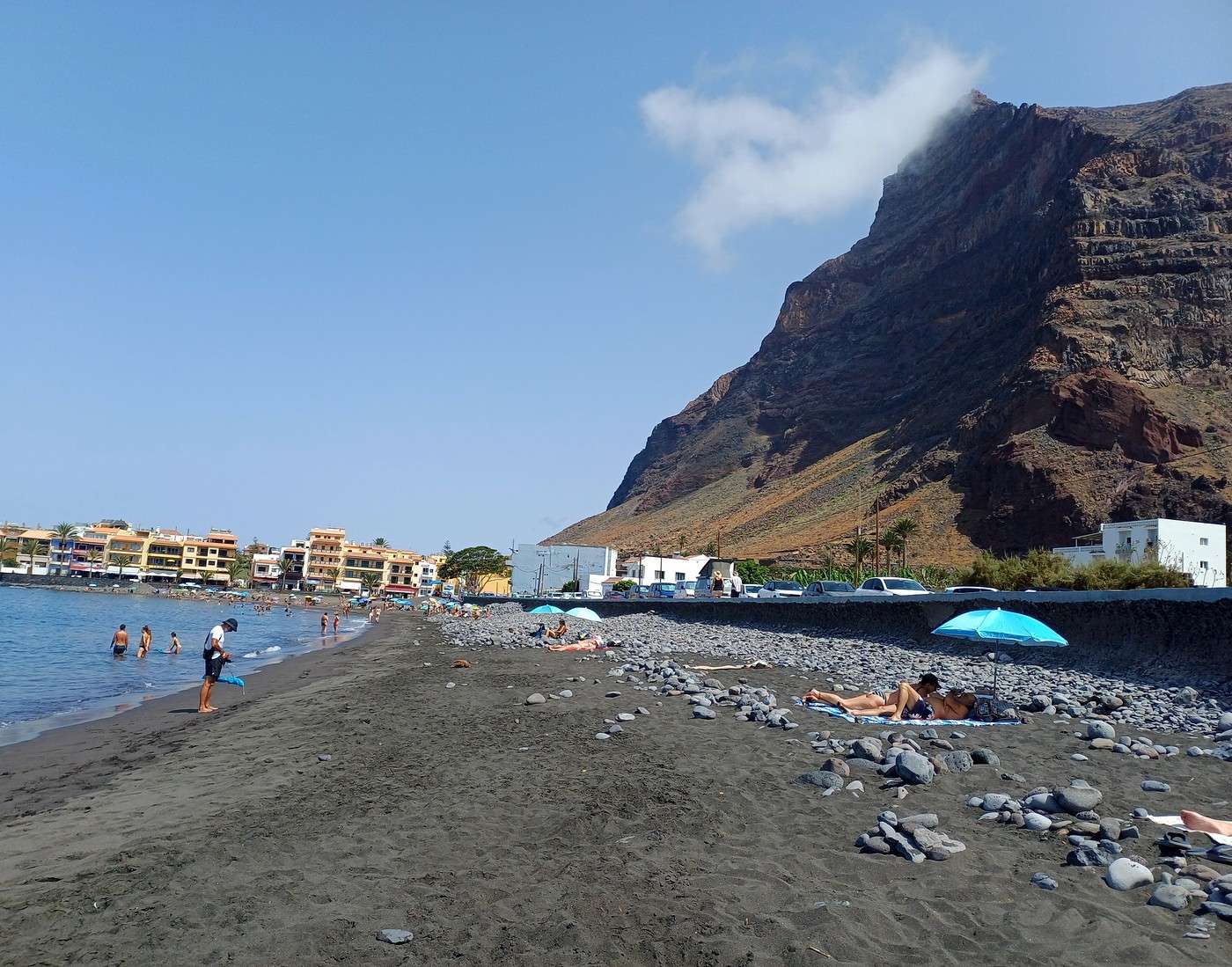
Near the statue begins the beautiful, narrow stretch of black sand at La Calera beach, where there are still very few people at 11 a.m., mostly German retirees who are very “mens sana in corpore sano” and into yoga. The time difference with the Spaniards gives us an advantage throughout our trip: living three hours earlier sometimes makes us feel like we’ve almost privatized the island! The lifeguards have just arrived and put up the green flag. This family-friendly beach is the main one in Valle Gran Rey. It’s very pleasant—the water is perfect for swimming, calm thanks to the cove that shelters it, allowing you to swim far out while still letting gentle waves lap at the shore, and the temperature is ideal (around 23°C, give or take). The kids already love it, and so do we. Nearby, there’s a small urbanized area with a few restaurants, shops, and vacation homes. This is it—our beach, and we won’t find a better one in all of La Gomera. By noon, the Spaniards start arriving gradually with their umbrellas and sunbeds, but it’s not exactly packed. It becomes a place of social distinction and coexistence through women’s attire: the German women often in semi-naturist postures and the Spanish women in string monokinis—a single outfit, two mindsets in harmony!

We rinse our feet and swimsuits at the beach’s only tap and head back up to the perched village, through a landscape of abundant banana plantations (which make you want to snatch a few fruits from those well-stocked bunches) and steep slopes where our little village of La Calera clings.

Kelyandre got ahead of us, and we see him 50 meters ahead carrying bags next to an elderly woman. We catch up, and she explains in Spanish that she didn’t understand why this child hadn’t responded to her requests and had just handed him her shopping bags! Now she realizes we’re French, thanks us warmly, and even gives us some sightseeing tips before heading off on a cute path through fruit plantations. The Gomerans are extremely kind and welcoming—that’s a fact.

Our Belgian friend is still glued to the entrance of El Chorro grocery store, greeting us with a beer in hand alongside the village regulars. We notice that in La Gomera’s villages, there are always a few locals who are a bit marginal, often with disabilities, but always friendly. It’s not a judgment—just an observation. The island is isolated and sparsely populated…

We just stop for a quick shower and head back down by car to La Calera beach, where we’ve spotted a highly rated restaurant, Mango, offering Canarian cuisine and a few exotic specialties. It’s on a small square by the sea where tourists and a few hippie drifters selling shell necklaces and handmade crafts mingle. Magali is delighted with her mixed mango salad, and Kelyandre with his grilled chicken escalope. I’m a bit less thrilled with my shrimp curry rice (very good, actually, but I was expecting something like paella), and we share the gargantuan plate of fried squid and fries, way too much for Théo. The prices are a bit cheaper than in France, especially since the portions are bigger and the restaurant by the beach is charming. Like most Canarian restaurants, the waitress brings us the famous pan y mojo right away—bread with those two slightly spicy green and red sauces, almost always served automatically (you can refuse), and usually charged 1.5 or 2 €. The bill comes to 65 € for four: meals, drinks, and coffees. A great spot, for sure.

After an essential siesta, we continue our cultural exploration with a visit to the Spar. It’s the most widespread and cheapest supermarket chain in La Gomera. There are two in Valle Gran Rey, and since the one by La Calera beach is closed for inventory, we go to the one by Las Vueltas beach, on the other side of the resort, which seems a bit more upscale, though we still see some worn-out hippie drifters digging through the trash. The prices at Spar are still gentler than at the grocery store, and there’s a lot more choice. We stock up on local products: sweet potatoes, papaya, and those small bananas that look like they were plucked straight from the plantation across the way. And of course, a bag of gofio, that roasted grain flour used for just about everything in the Canary Islands. A French guy with a slightly spaced-out, hallucinatory look and clearly misaligned chakras but very friendly jumps on us, explaining in a mix of French and Spanish—like someone searching for words in their native language after a long stay abroad—that we’d be better off buying them at the organic gardens near the bus estación. Thanks, man, that’s cooool!

16 days with family in La Gomera (Canary Islands)

Pagaljavab · 2026-08-17 · Message 10 of 54

Early in the evening, we’re still not hungry at all, and Magali really fancies a little hike while it’s still light out. She’d spotted one near the neighboring hamlet, just a kilometer above La Calera, El Guro. The site La Gomera Travel also tells me there’s a short walk through the terraced gardens that fill the middle of the valley. So we take the car, and on the way, we run into our Belgian friend again, still chatting with the villagers, all with a can of Dorada in hand. They ask if we’re enjoying La Gomera and recommend places to visit. The Belgian insists that the natural pool in Hermigua is a must-see, but one of his friends warns us it’s been closed for a while because it’s too dangerous.

We park in El Guro five minutes later and look for the trail. They’re usually well-marked in La Gomera, and Magali finds one we start even though I’m not convinced it’s the one we’re looking for. It begins on a small path climbing toward the northern cliff, the one where our lodging is clinging below, the risco de la Mérica. We cross a strange little neighborhood in the middle of nature, seemingly completely deserted as we pass, made up of houses and surreal artworks partly crafted from natural elements of La Gomera. The names on the mailboxes and naturopathy signs leave no doubt: it’s a German hippie enclave! Totally unexpected in this somewhat wild spot.

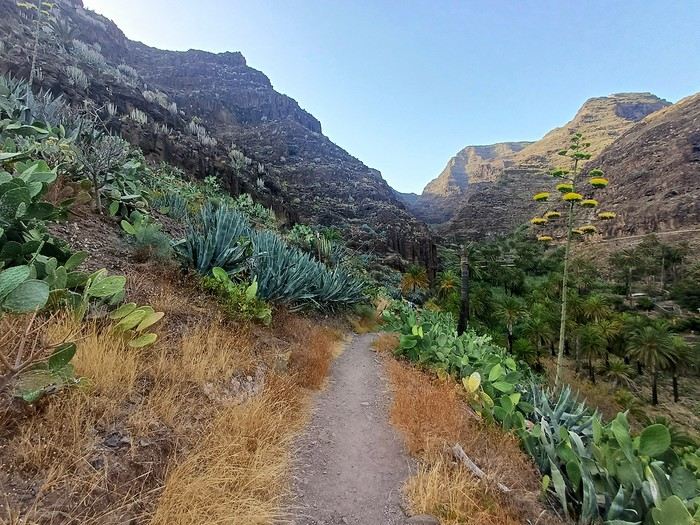
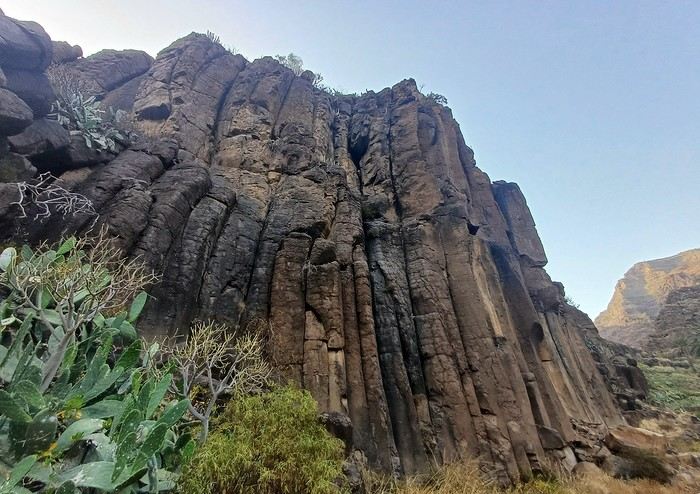
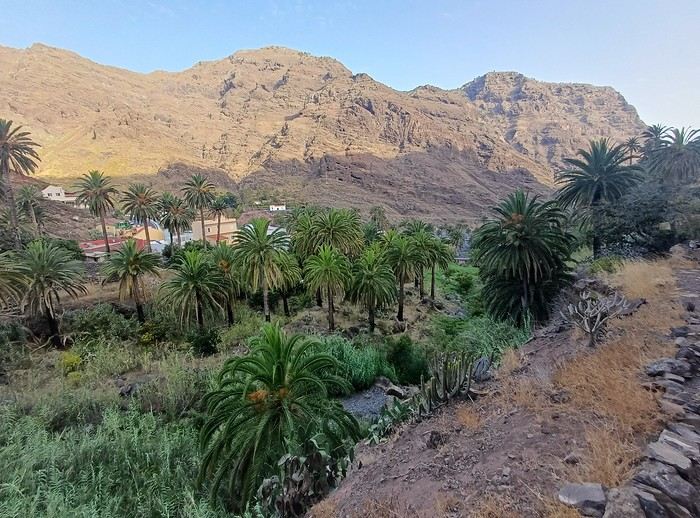
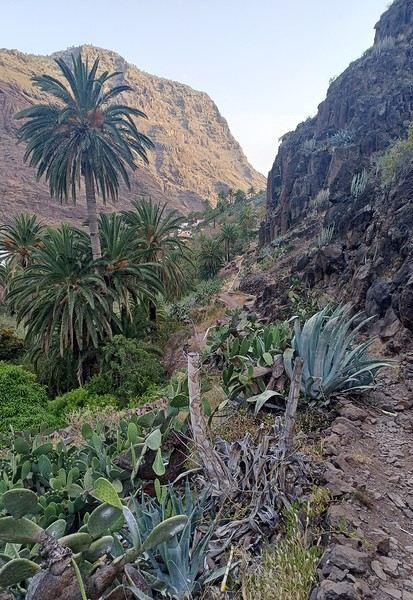
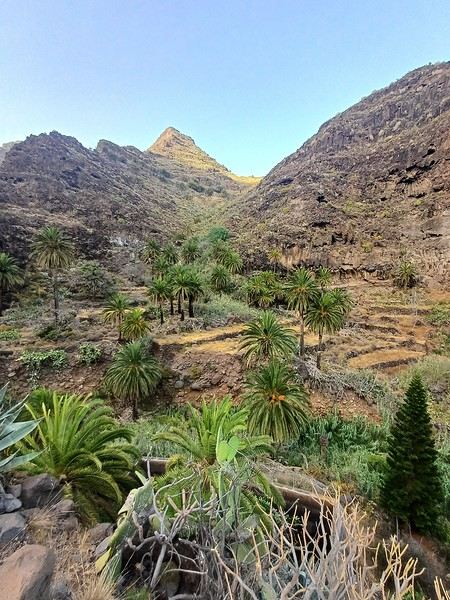
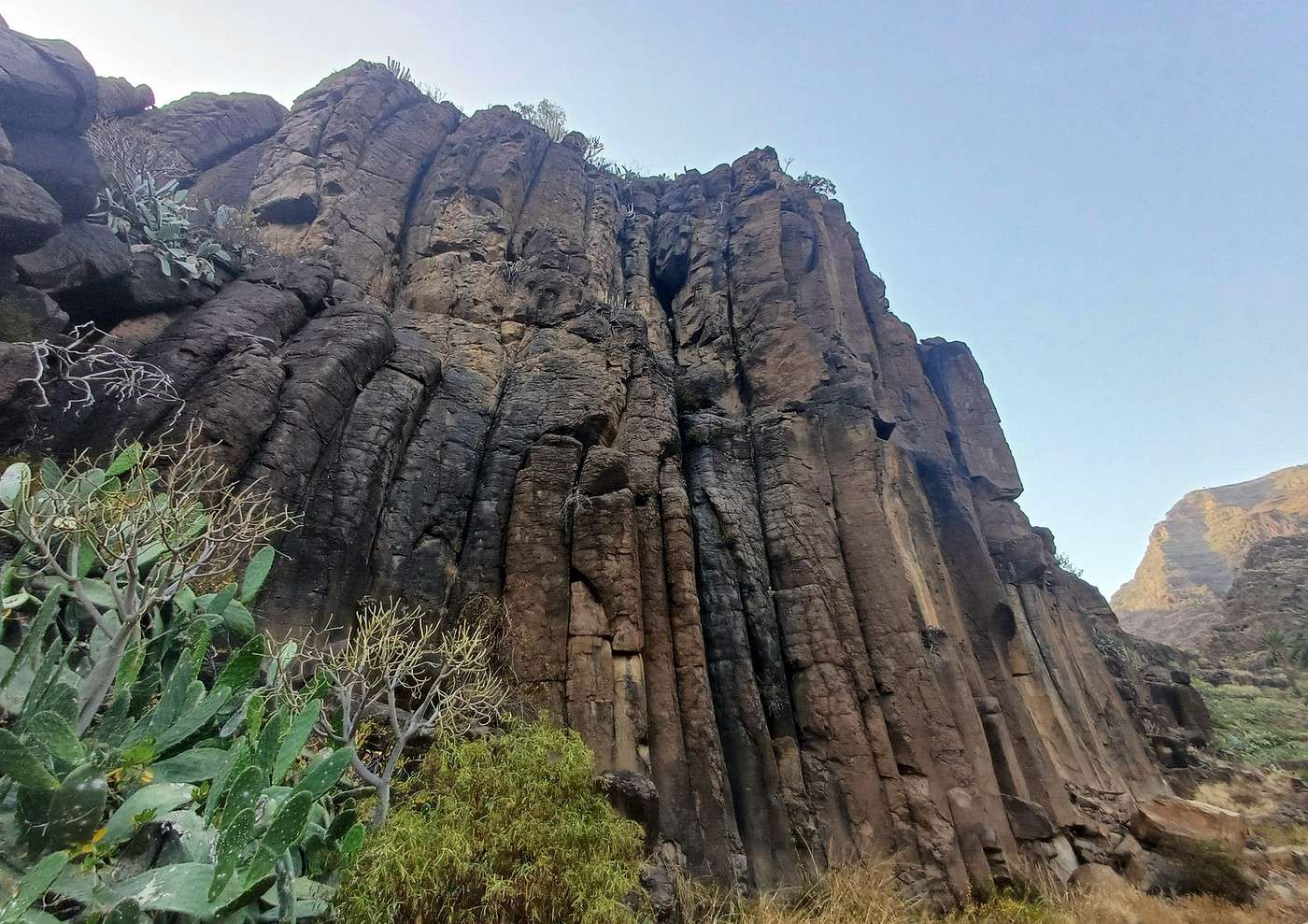
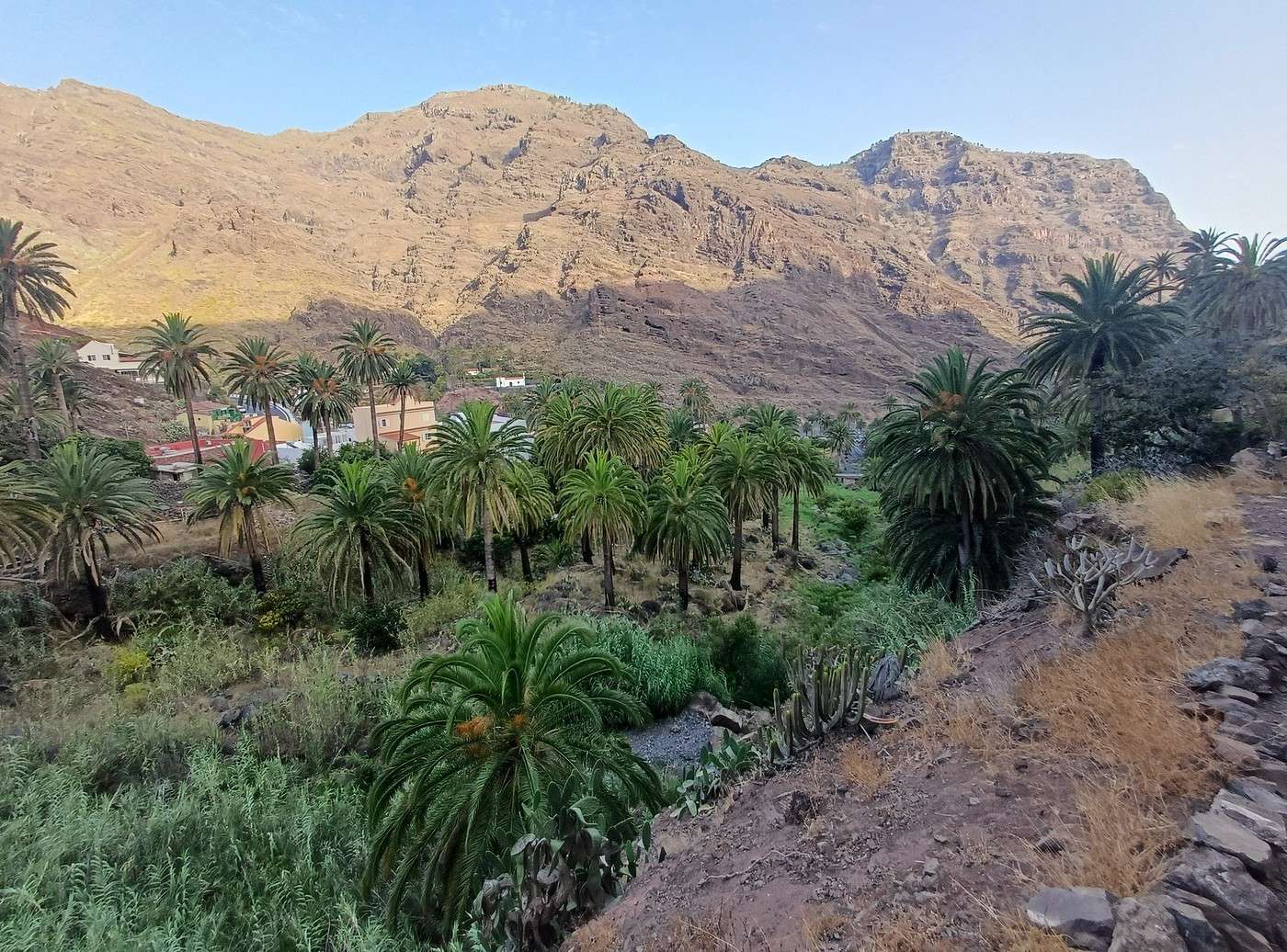
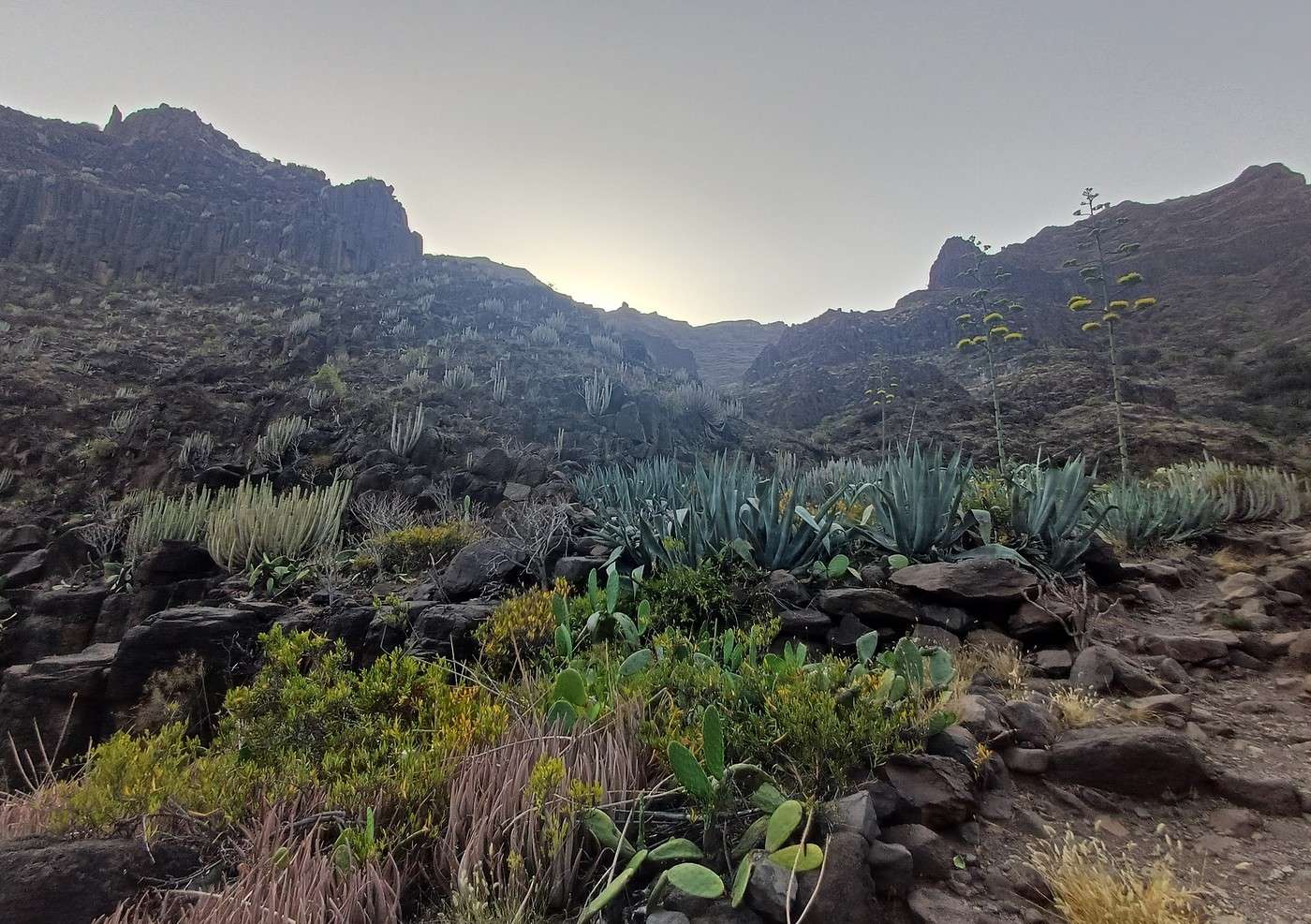
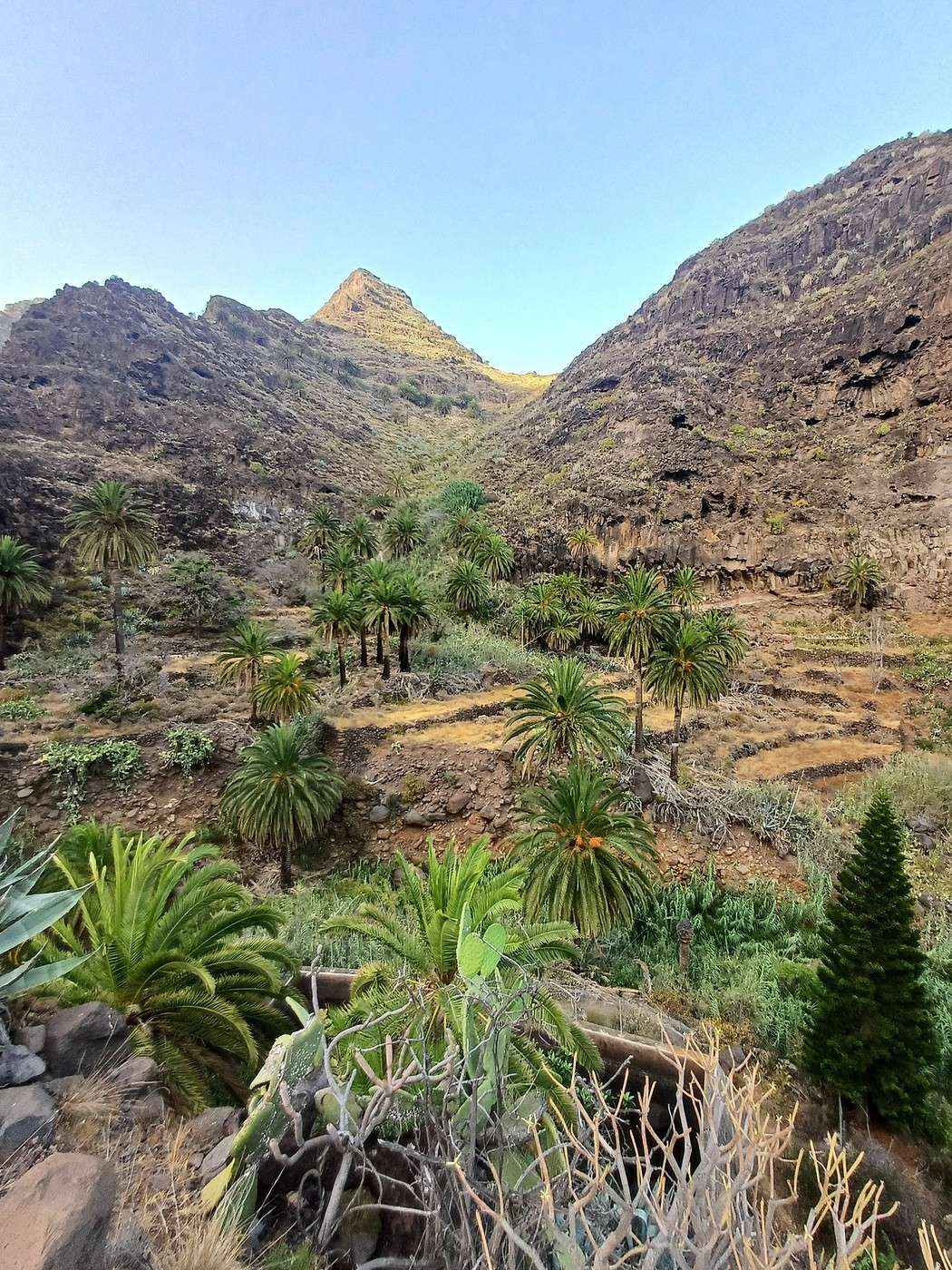
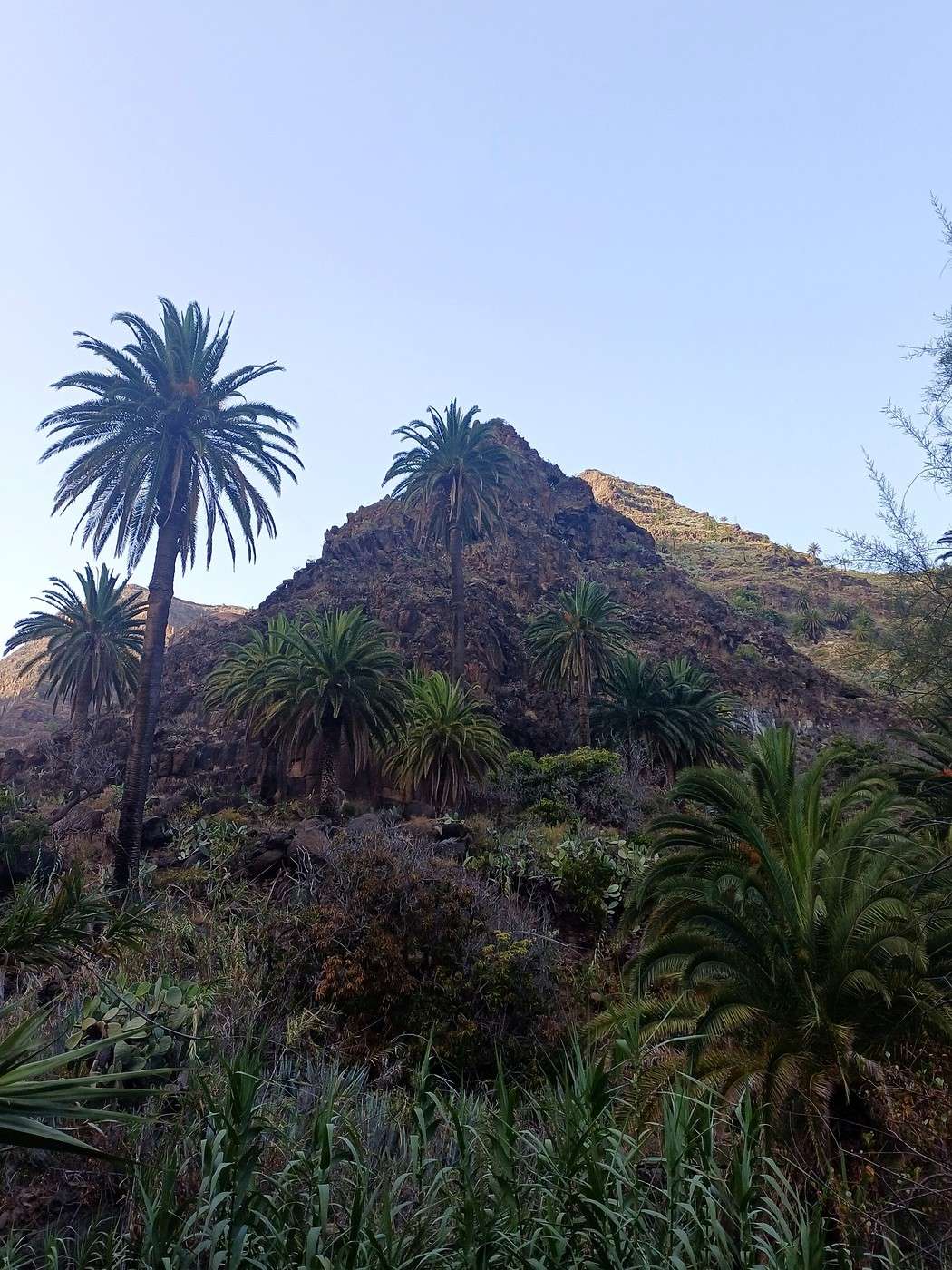
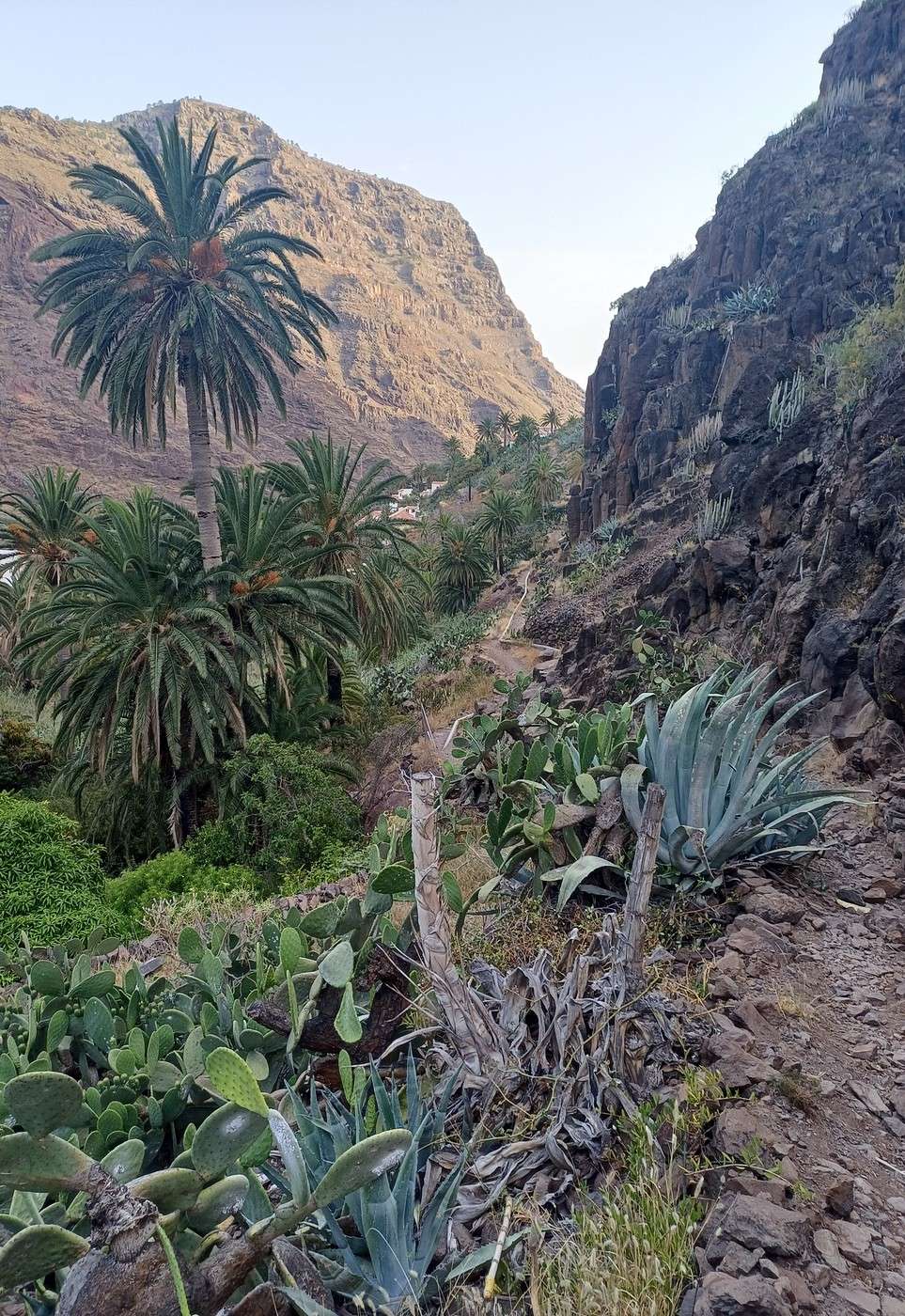
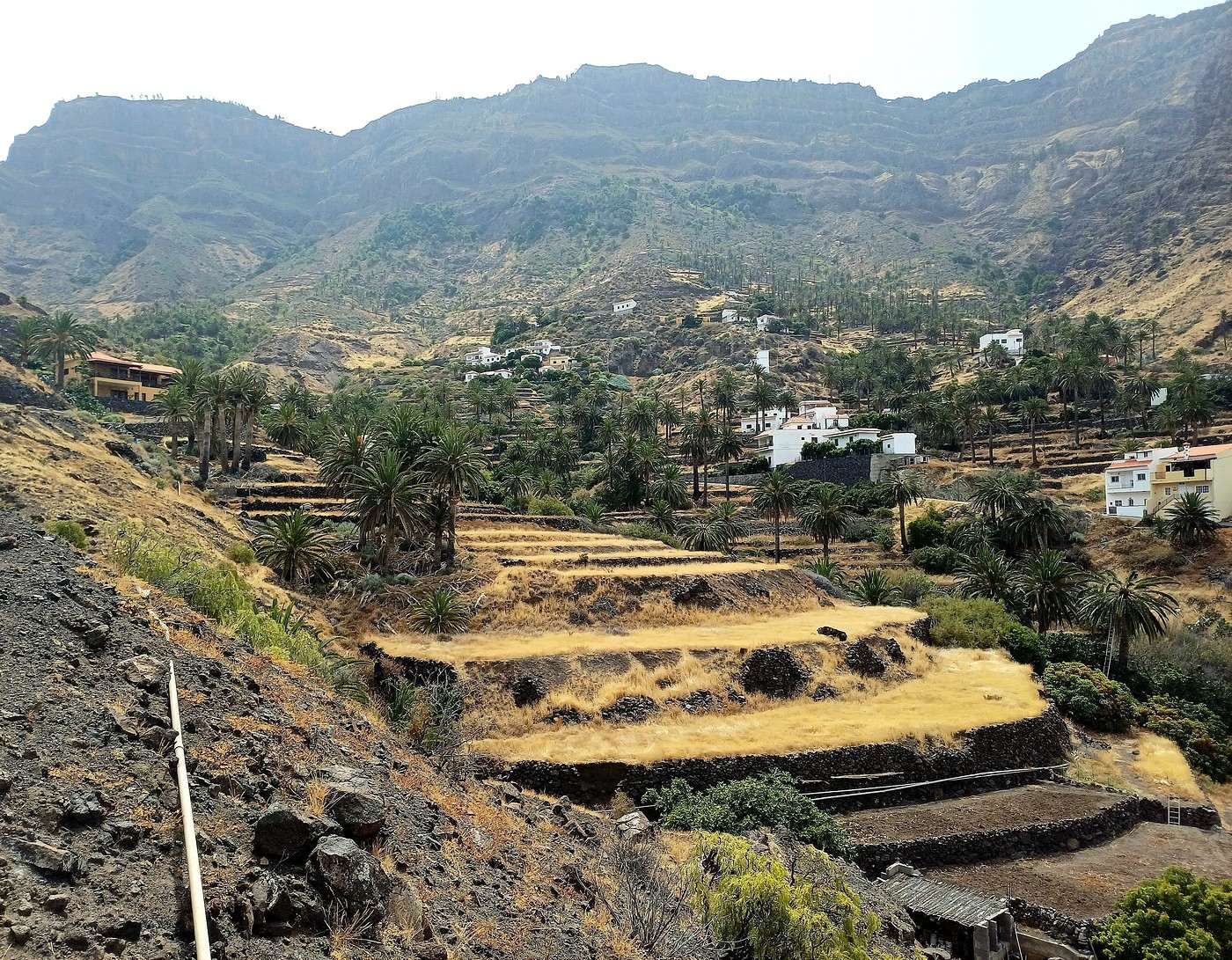
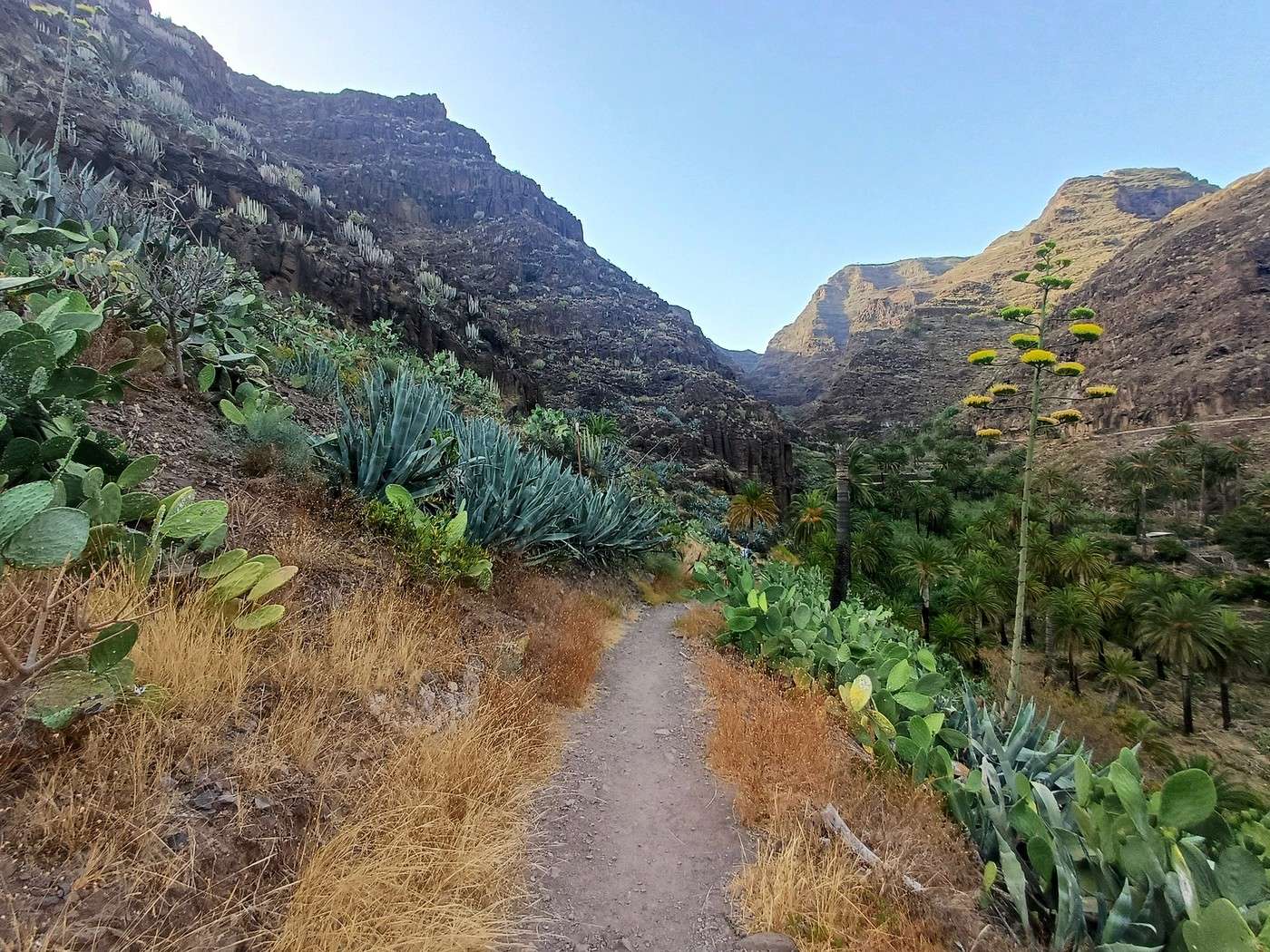
The path is discreetly marked and continues above terraced fields, along the base of the cliff dotted with caves where prickly pears, aloe vera, legions of palm trees, and many plants I can’t identify grow like weeds on prodigious basalt columns.

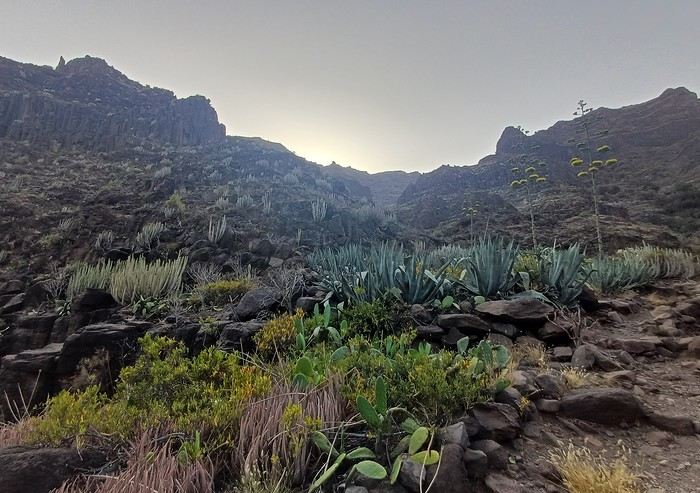
The colors of this vegetation and mineral environment create a truly unique harmony in the late afternoon light.

The trail then splits into what looks like a dried-up riverbed, which gives me a hunch—confirmed by Google Maps. While it had become clear we weren’t on the path to the jardines de los Reyes, we’re actually on the main hike through the barranco de Arure, this steep river we’re climbing in reverse since hikers usually start from the top! I’d read that it’s known to be quite difficult and not recommended with kids... and we’ve already covered more than half the walk. It seems pretty easy to us, though—maybe because at this time of year, there’s no river or waterfall. No matter, the nature is stunning, and we keep going until the light starts to fade, then turn back.

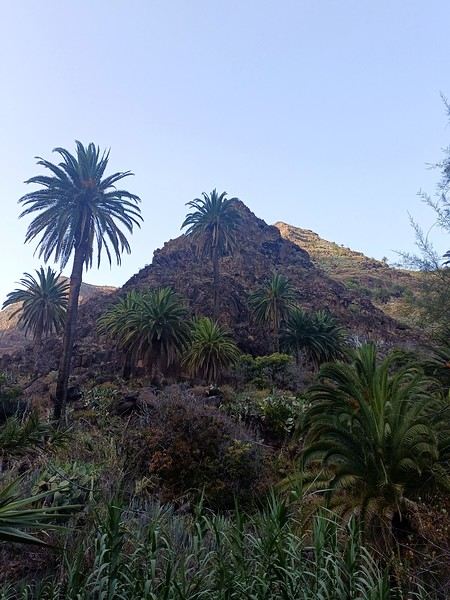
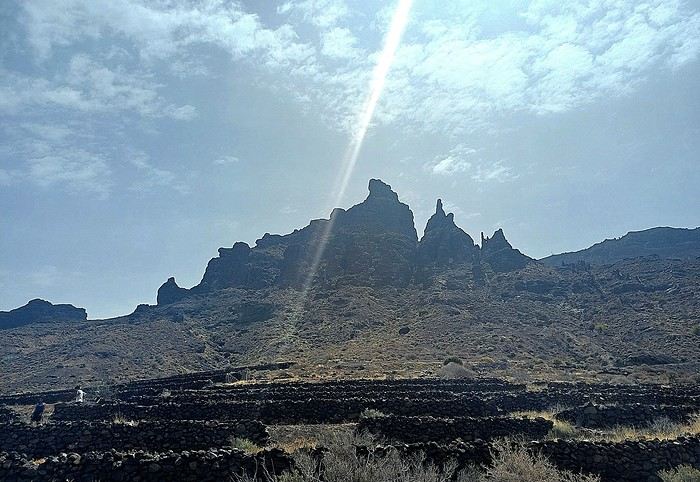
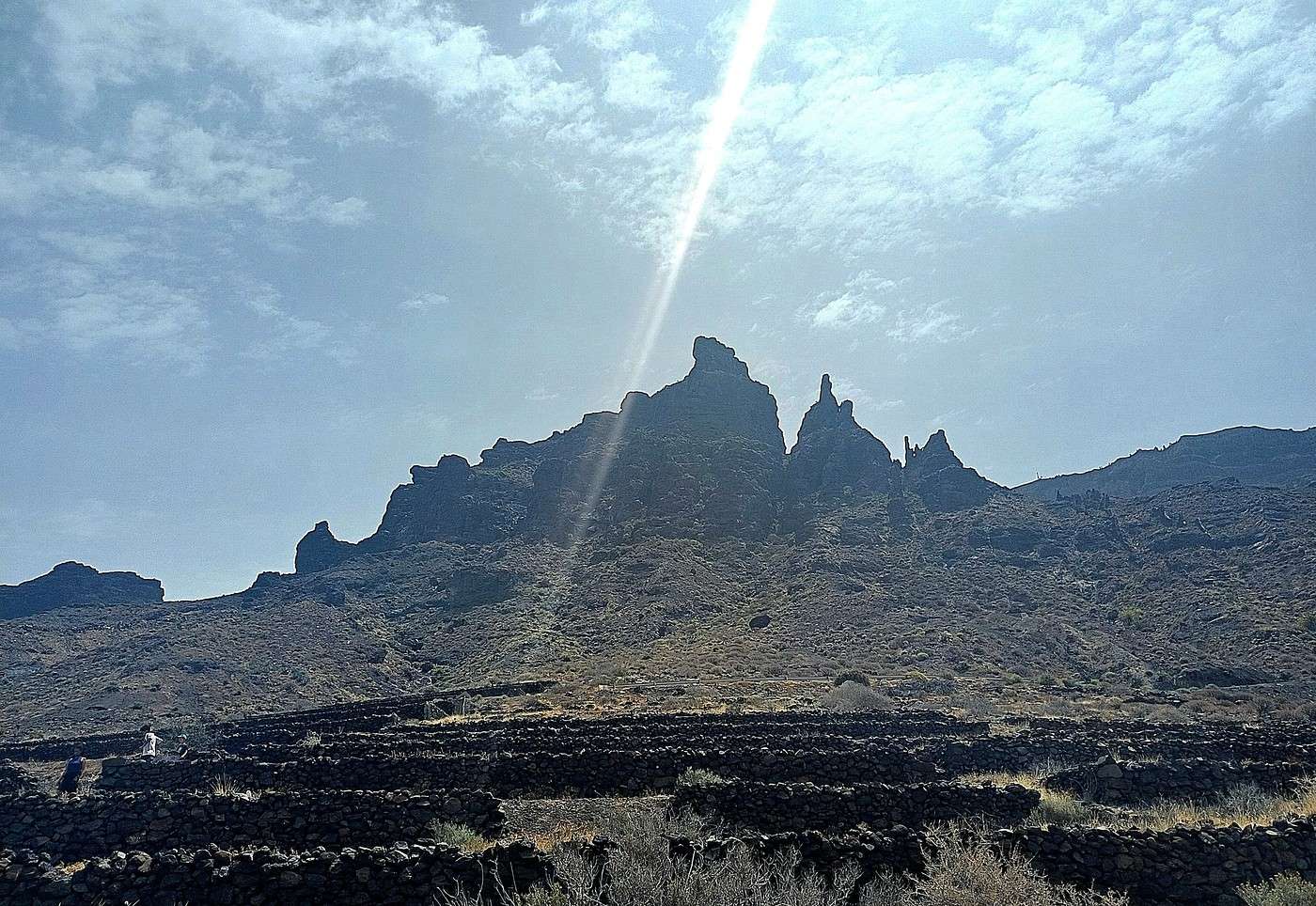
The sunset blows us away, lighting up a pyramid-shaped peak above the higher village of Arure with a golden glow, apparently along the impressive ridge of Lomo del Carretón.

Later, we cross back through the quirky hippie enclave and reach the car after about an hour of walking total—pretty good for a 4-year-old!

That evening, we’re back on the terrace for another feast of tapas and a variation of my garbanza with white beans. One great thing about La Gomera is there are no mosquitoes (at least not this season), so you can enjoy the outdoors freely or sleep without worrying about swatting your head or listening for the buzz of those vicious bloodsuckers.

Night has fallen, and under a beautiful full moon, I gaze again from the balcony at the mountain that’s been calling to me since we arrived yesterday. At one point, I hear that noise again—the one I’d mistaken for fighting cats the night before—but this time, it’s not subtle: there are *lots* of them, and they’re definitely not cats. I’ve never heard anything like it—a sound like a goblin at peak hysteria after eating magic mushrooms, screaming insults in a sped-up, high-pitched voice that multiplies! I try to figure out what it could be and where it’s coming from. It’s so inhuman that I first think it’s coming from a window below, someone playing a fantasy video game or mixing electronic sounds. It sets all the goats and dogs in the valley bleating and barking in a thunderous chorus. Is this normal? Then it gradually stops. I go inside to tell Magali. She heard the cries too, finding them at least strange, though less impressive from indoors. We agree it might be birds, but what *weird* birds! I type something like “scary bird calls La Gomera” into Google. A suspect emerges—I read a description, click on a photo, then a short video—it’s the culprit: the Calonectris diomedea. Behind this scientific name hides... the Cory’s shearwater. My god, what kind of bird makes such an awful noise!

Good night...

16 days with family in La Gomera (Canary Islands)

Pagaljavab · 2026-08-17 · Message 11 of 54

Actually, it's not about budget issues but for other reasons.. Parking lots and museums are no problem. Nature that's more or less developed—parks with fences and entry tickets like in Tenerife or elsewhere—I say no.


I completely agree with your point of view, and that’s exactly why we gave up on the idea of spending a day in Tenerife while passing through.

I was just trying to give you a sense of the island’s vibe, far from commercialism. You’re doing the right thing by booking—you won’t regret it. But don’t spread the secret too much 😉

16 days with family in La Gomera (Canary Islands)

Djalma · 2026-08-17 · Message 12 of 54

I completely agree with your point of view, and that’s exactly why we gave up on the idea of spending a day in Tenerife.


We’ll have to, though, because the EasyJet flight is supposed to land at 6:20 PM and the last ferry leaves at 8 PM. We’ll take the one the next morning. Accommodations near the port are super booked up at the end of September! :(

16 days with family in La Gomera (Canary Islands)

Attila · 2026-08-17 · Message 13 of 54

I didn’t quite get why you didn’t go to Teide.

It’s free, and there are no barriers at all.

Only a few rare trails require prior authorization, and it’s still free except for two of them.

It’s not about being money-driven but about protecting nature.

This is becoming the norm pretty much everywhere in the world since hikers have multiplied.

Even in Auvergne, some trails are now very well-marked!

In France, just like in the Canary Islands, it’s the taxes paid by locals that fund most of the improvements for hikers.

In Madeira and the Faroe Islands, hikers pay almost everywhere for their leisure activities.

There’s hardly anyone on many of Teide’s trails—people all go to the same spot. The sunset on La Palma is incredible, and there’s barely a soul around.

It’s the place that amazed me the most out of all the Canary Islands.

Tenerife is like Puy de Dôme—there are places you shouldn’t go if you don’t like crowds and souvenir vendors, and others where it stays really peaceful.

If you want La Gomera to stay off the beaten path, we shouldn’t advertise it too much...😇

In my opinion, it’s a lost cause.

16 days with family in La Gomera (Canary Islands)

Djalma · 2026-08-17 · Message 14 of 54

Not only is Teide paid entry now, but I’ve read that there are time slots with restrictions—something like that. You really have to want to go! I just read that it’s regulated and paid entry.

16 days with family in La Gomera (Canary Islands)

Pagaljavab · 2026-08-17 · Message 15 of 54

I didn’t quite get why you didn’t go to Teide. It’s free and there are no barriers. Only a few rare trails require prior authorization, and it’s still free.


It seemed like Djalma’s take, and I think it’s very recent—but I might be wrong. The other reason is that we wanted to spend as much time as possible in La Gomera.

It’s not about being mercantile but about protecting nature.


Yeah, because of overtourism...

There’s hardly anyone on many of Teide’s trails—people all flock to the same spot. The sunset over La Palma is amazing and almost empty.


As usual, people all "flock" to the same spot. And I know that, like all tourist destinations, Tenerife has its preserved spots.

If you want La Gomera to stay under the radar, you shouldn’t advertise it...


My travel journal is even more under the radar than La Gomera and meant for just a few VF folks. The handful of people following it who’d go anyway aren’t exactly going to cause overtourism.

In my opinion, it’s a lost cause.


Not so sure—I’ll come back to that in the journal.

16 days with family in La Gomera (Canary Islands)

Attila · 2026-08-17 · Message 16 of 54

I didn’t pay anything in March 2026, and the only barrier was the storm.

Both paid trails have been charging since January 2026.

Personally, I think it makes sense to pay. It’s the polluter-pays principle, in a way...

---

Overtourism is pretty much everywhere...

Even in the Faroe Islands, the soil needs protecting.

And yet, there’s only a handful of hikers. Fewer than on El Hierro, I think.

It’s a shame, but unless we eliminate 95% of the world’s population or drastically reduce people’s standard of living, I don’t see how things can improve.

I think you’re underestimating the power of travel journals. The number of people involved doesn’t matter. All it takes is one person reading your story and being inspired to plan their own trip for the snowball effect to begin.

That person could be a tourism professional looking for new ideas, an Instagrammer with a large following, etc.

Every place ruined by tourism was once a paradise. Just read Djalma’s youth memoirs.

Even Everest has become a nightmare...🤪 (Despite the expensive permit fee and the physical fitness barrier)

But hey, this whole discussion deserves its own thread.[;]

16 days with family in La Gomera (Canary Islands)

Djalma · 2026-08-17 · Message 17 of 54

Even Everest has become a nightmare... (Despite the very costly access fee and the physical fitness barrier)


Yes, that's true, and it applies to all so-called mythical summits—Mont Blanc is one of them. And those who don’t climb the peaks still want to get close, so there are crowds within a 30 km radius. I can just imagine the summit of Teide in summer! Hardly anyone at Kangchenjunga (and within 30 km around it), even though it’s the third-highest peak on the planet. Not too many people in certain parts of Les Écrins either, which are just as beautiful as the Chamonix area for non-climbers. For the rest, I’ve noticed that anything more or less developed (roads, hotels, etc.) with paid sectors or parks attracts crowds. The Vercors, France’s largest natural space, is empty in its southern part (in the middle of August, I sometimes barely cross paths with anyone) because there are no developments, no villages or accommodations—except for rustic cabins that aren’t accessible by motorized vehicles. And nothing is paid for except the ski lifts in the 3 ski resorts of northern Vercors.

16 days with family in La Gomera (Canary Islands)

Muriel18 · 2026-08-18 · Message 18 of 54

le calonectris diomedea.


Just out of curiosity, I went to listen. It’s definitely more than strange for a 🤪 bird!

Otherwise, I don’t remember paying to hike anywhere on Tenerife, and the only reservation I made was for access to the summit of Teide (and I totally get why access is regulated there). Has that changed recently?

16 days with family in La Gomera (Canary Islands)

Pagaljavab · 2026-08-19 · Message 19 of 54

Day 3, Thursday, July 30: Valley Gran Rey/La Calera, Taguluche, Alojera, Valley Gran Rey/La Calera

This morning, we got up earlier because we planned to visit two coastal villages: Taguluche and Alojera. Though they’re only about ten kilometers north of Valle Gran Rey, they’re in the neighboring valley, Vallehermoso. And in Guanche language, “not in the same valley” means “a winding road three times longer.” So, the 10 kilometers turn into 30 kilometers and about an hour’s drive. The Guanche aborigines used to take shorter paths, cutting through the mountains via trails that still exist today, but they were on foot.

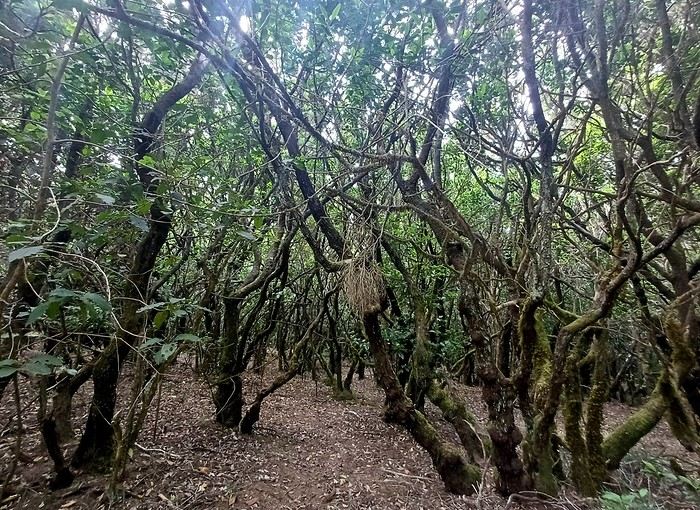
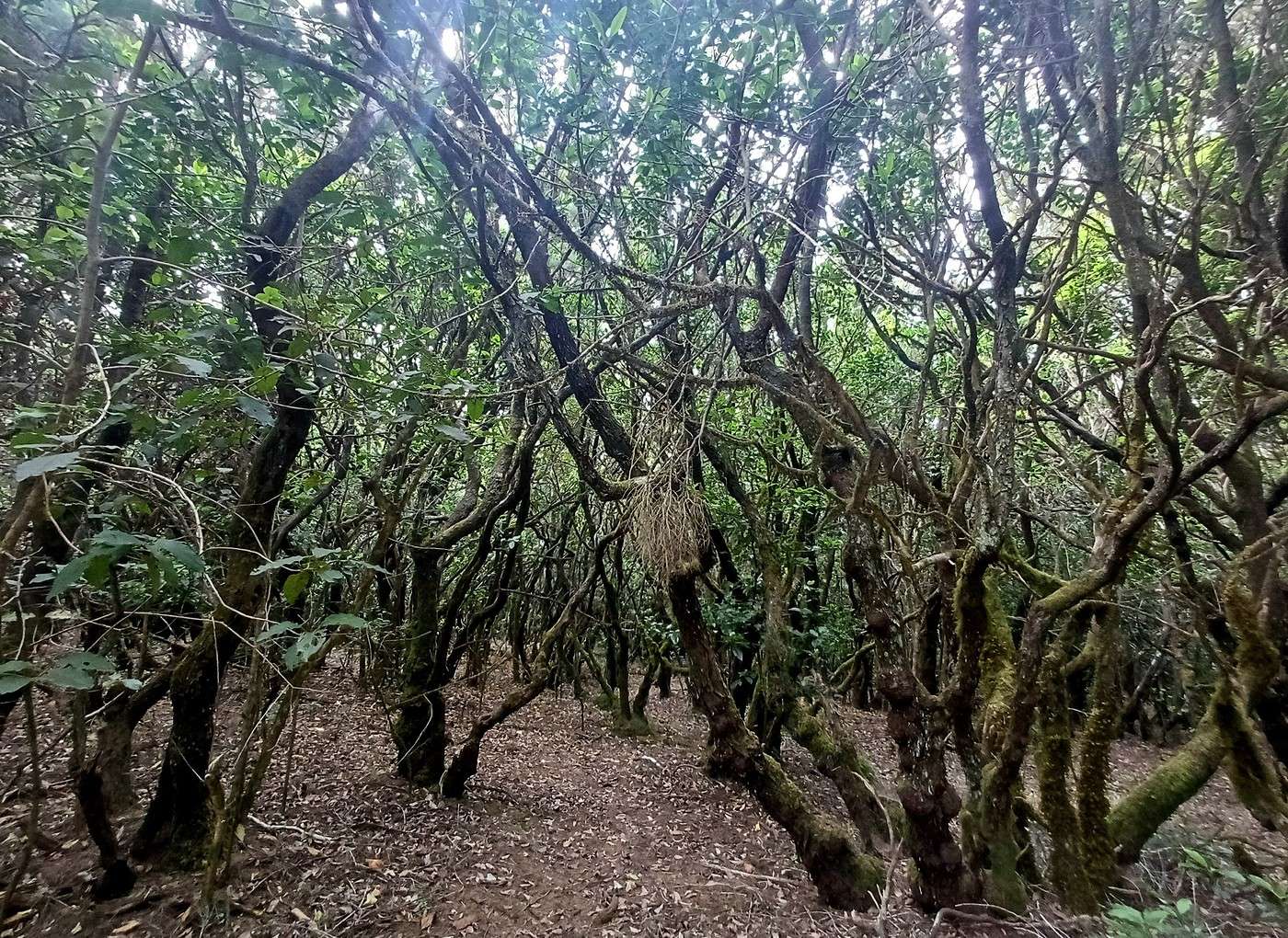
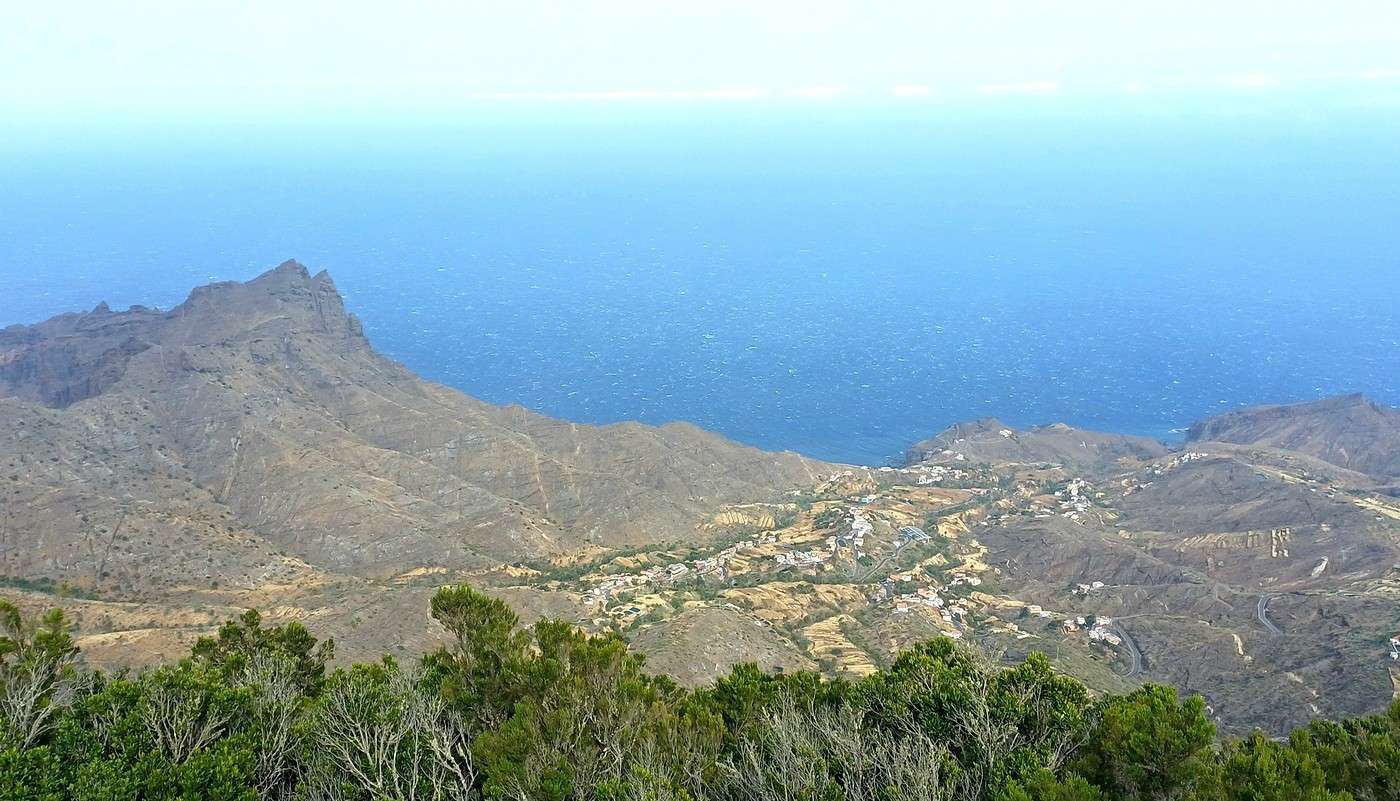
At 9:30 AM, we hit the road. The first part of the drive up to Arure, which sits high above the Valley of the Great King, is tough—even harder going up than coming down—and it’s becoming a habit. We’re starting to feel dizzy and nauseous, especially the kids. Luckily, the roadsides in La Gomera are dotted with trailheads, and we stop at one, the Los Baranquillos trail ("little ravines"). It’s very short, only about half an hour, but it’s just enough to stretch our legs and settle our stomachs. It stays close to the road but passes through a small patch of forest so typical of La Gomera. Then it leads to the Alojera viewpoint, where we’re greeted by a stunning, unobstructed view of Taguluche, Alojera, and the vast ocean.
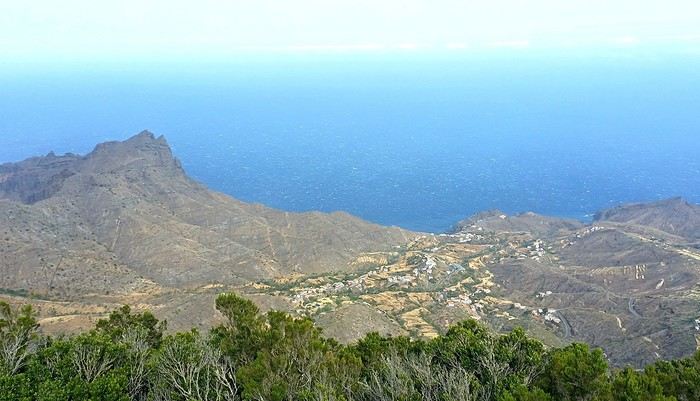
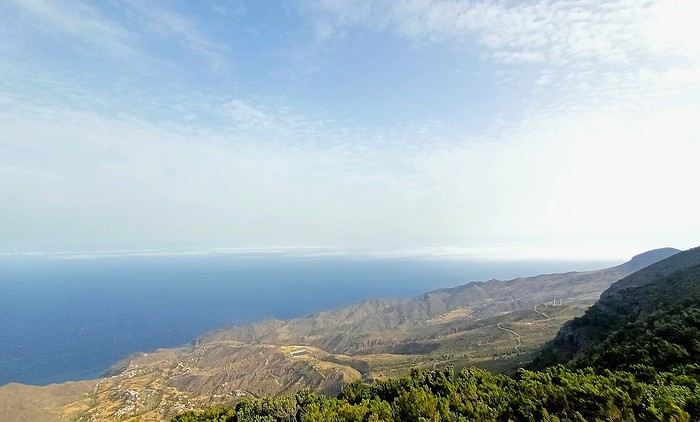
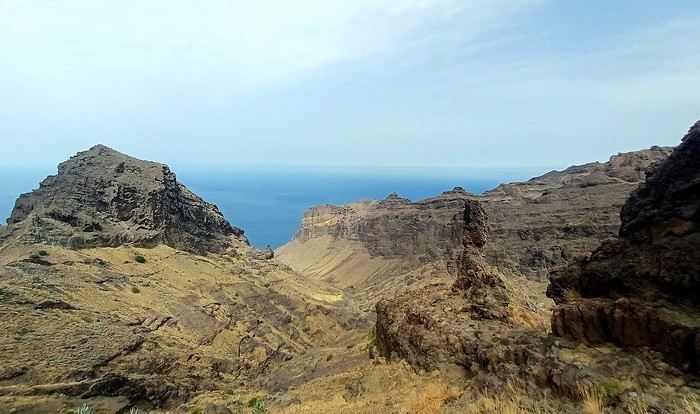
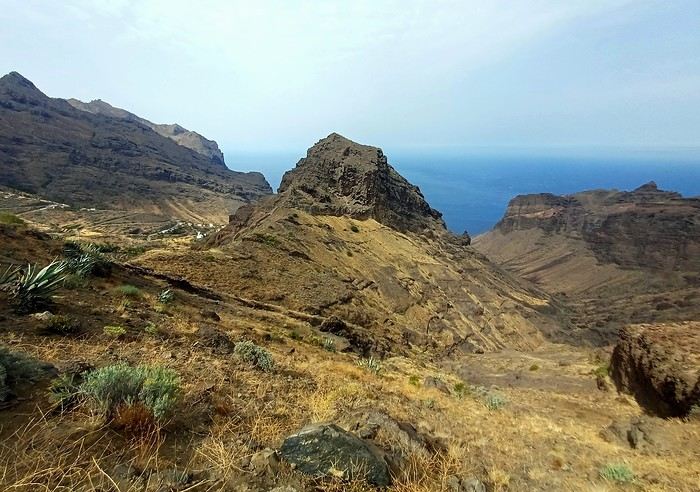
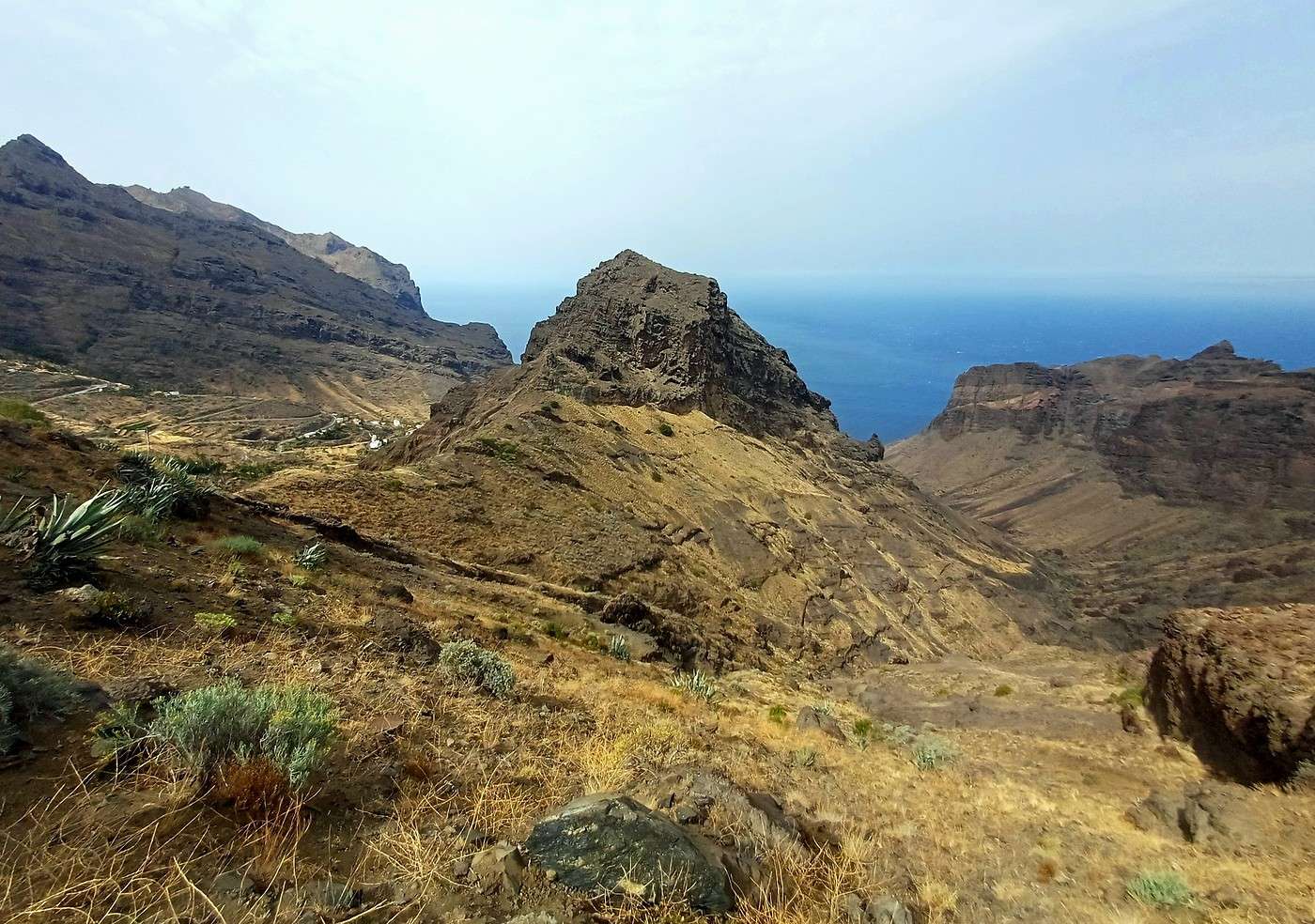
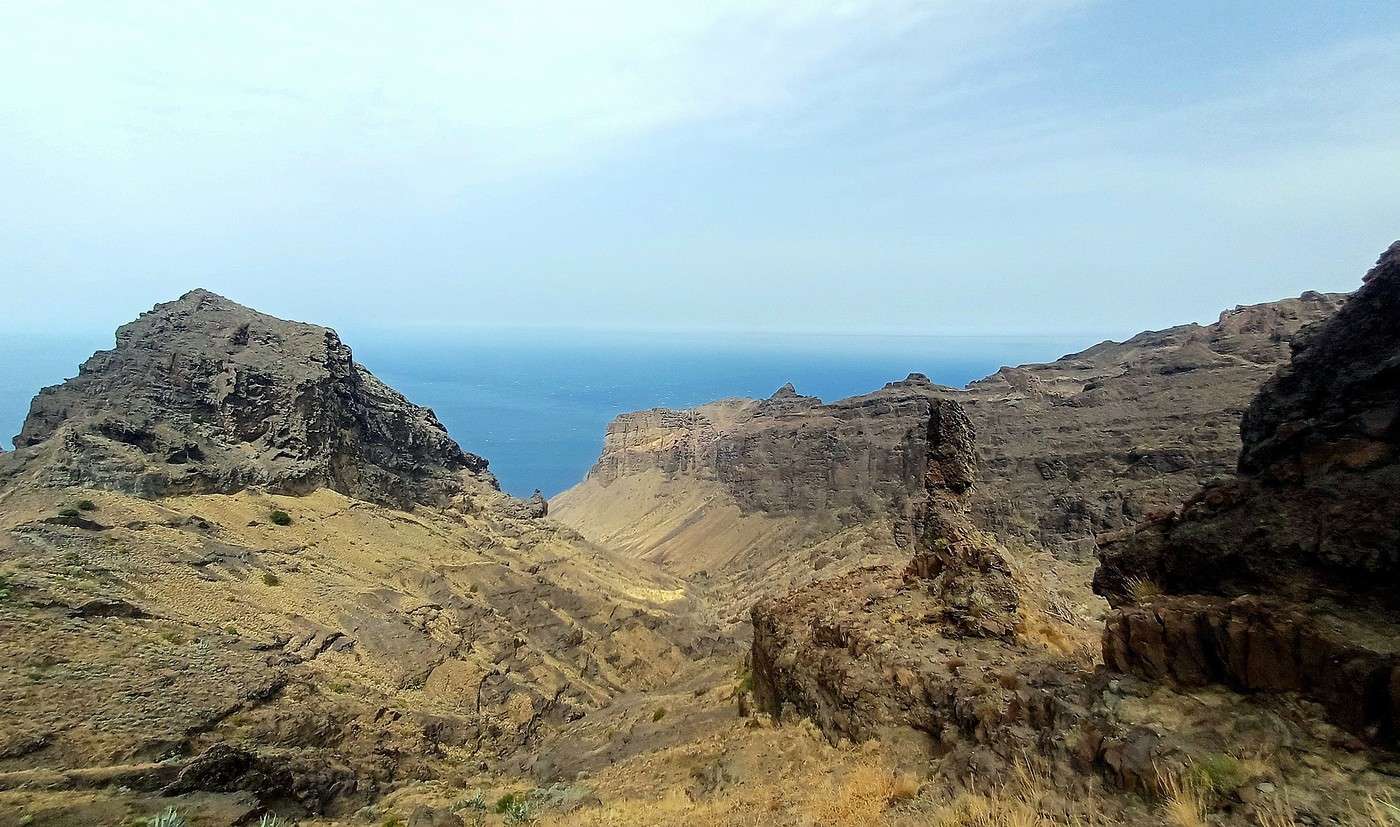
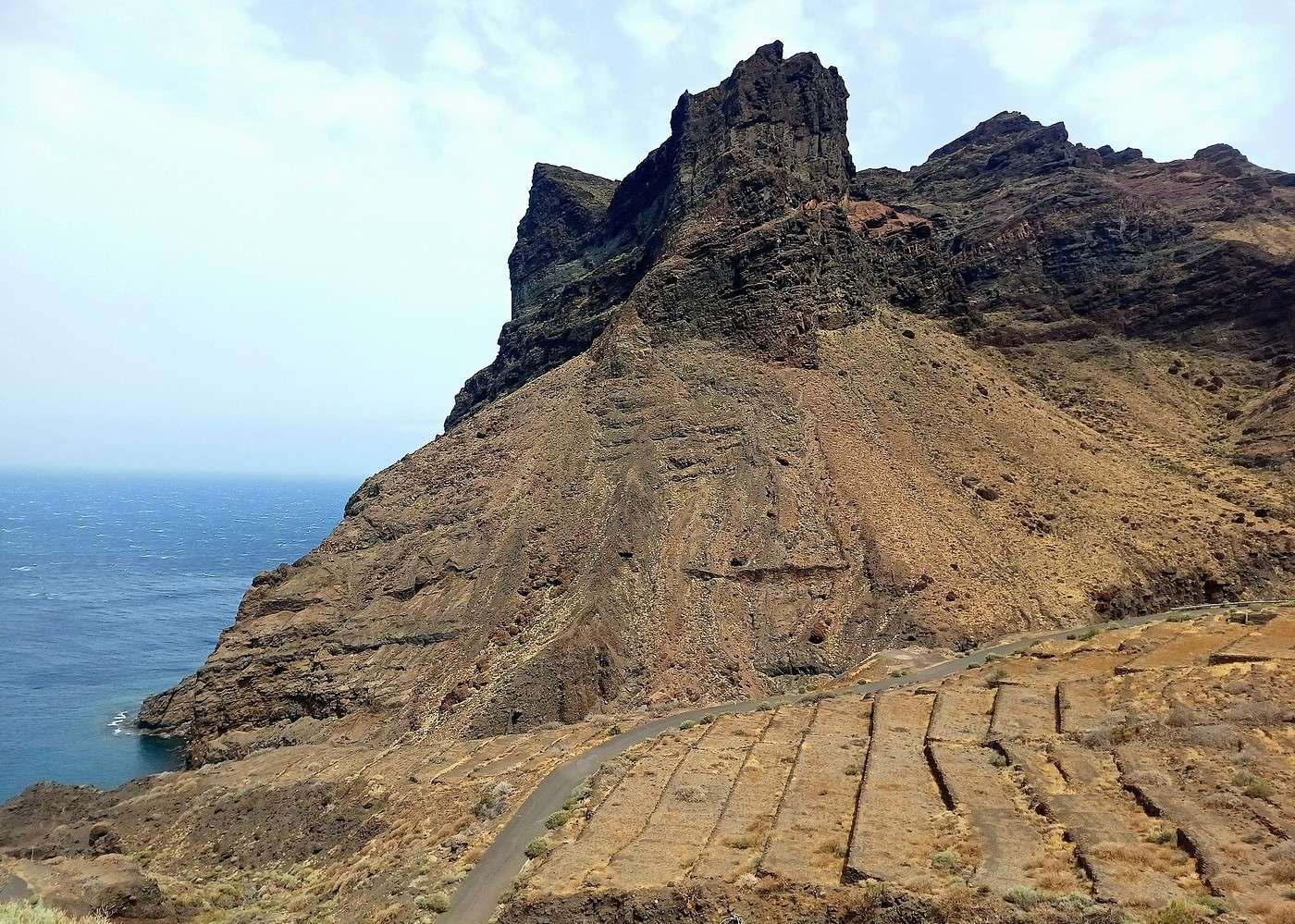
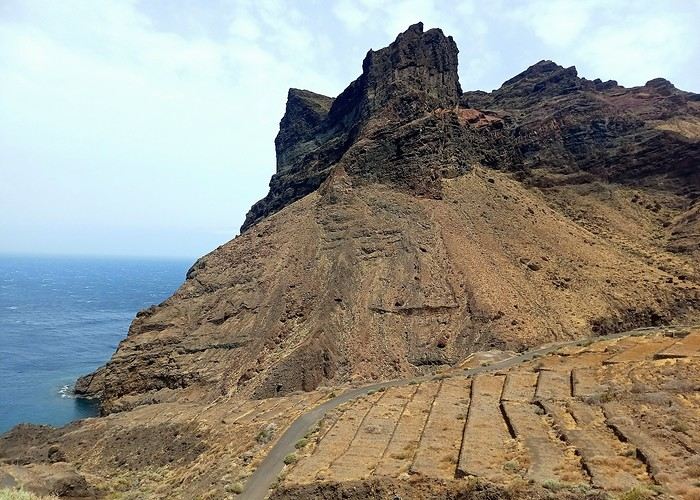
Back on the road, where we still barely see anyone. Before reaching Alojera, we have to turn onto a smaller road that winds steeply down toward Taguluche. Théo is still feeling sick, so we take another break at a breathtaking spot—a crevice in a canyon landscape with red peaks plunging down to Taguluche and the ocean: the Risco de Tejeleche. We recognize the peak from yesterday’s sunset hike in the Barranco de Arure, but from the other side. And to think it took us an hour when we’re just a few kilometers away! Anyway, there are so many jaw-dropping viewpoints that we could stop every five minutes. These necessary little breaks are always welcome.

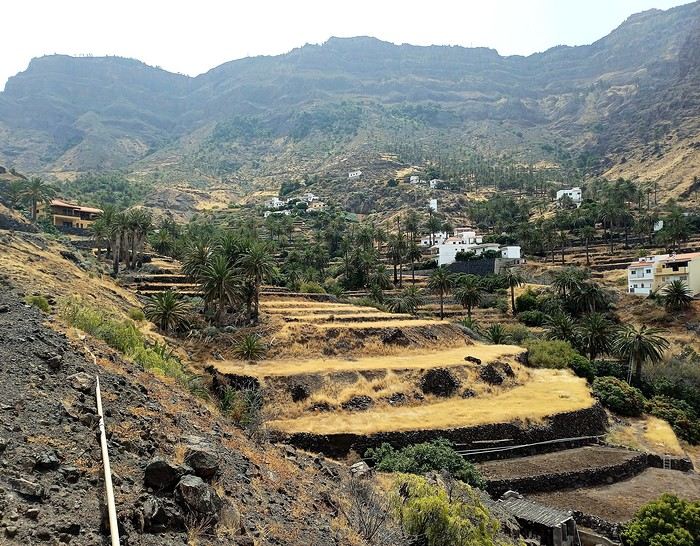
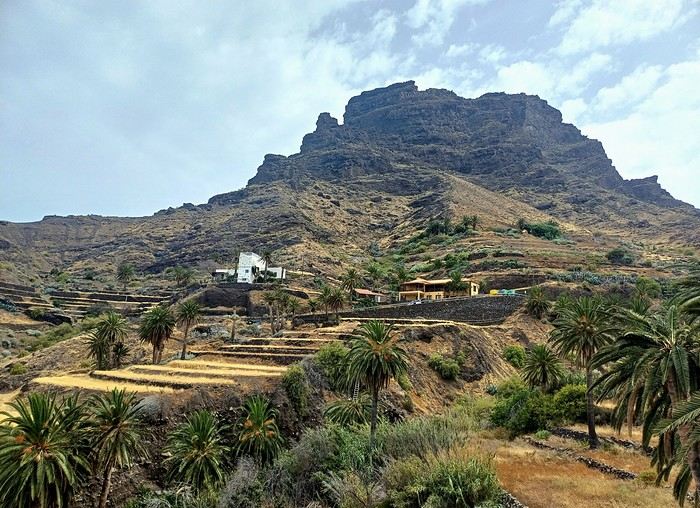
This time, we only have a few hundred meters left before finishing our descent into Taguluche. It’s not that there’s much to do here, but it’s described as a beautiful rural village full of palm trees where they produce La Gomera’s famous palm honey. There are also trails leading down to secluded beaches. The road splits into several paths, each leading to different parts of the village. We take one at random… which dead-ends. There’s no road left, just a dead end. But we don’t turn back because there’s a footpath leading down to the village. A group of Gomeran workers is repainting the village’s electrical cabin. We ask if we can park behind their truck. They remind us of the workers we saw when we first arrived on the island—with that mix of North African, Latin American, and Spanish features so common here—and they’re smiling, radiating a particularly welcoming vibe. After stopping a few meters later at a fig tree to stuff ourselves with its ripe fruit, we descend past a cluster of houses and small farms, passing chicken coops and hearing goats, but there’s not a single person in this village that looks abandoned—more like a hamlet clinging to the slope, with terraced fields that seem to cascade like lava into the ocean.

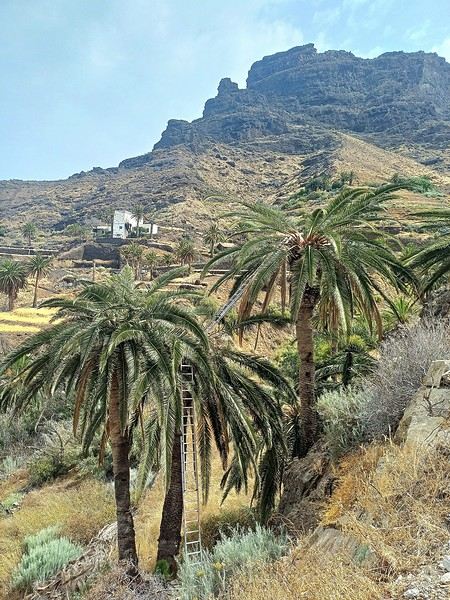
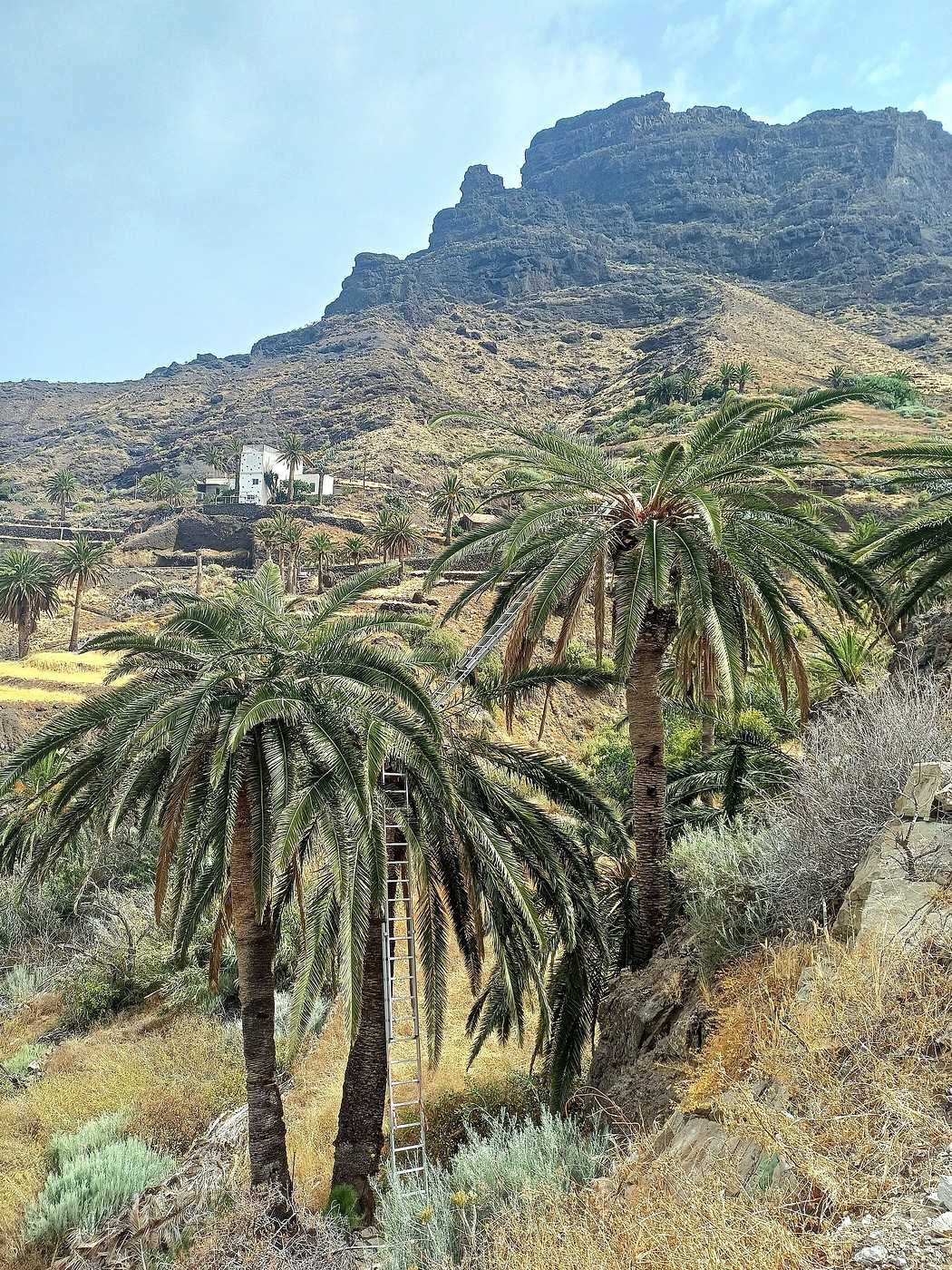
Sometimes, there are ladders leaning against palm trunks, a sign that people must be extracting sap from them. We also notice the irrigation pipes, ubiquitous in La Gomera, which channel water from upstream storage basins to the terraces—essential in summer when all the springs dry up.
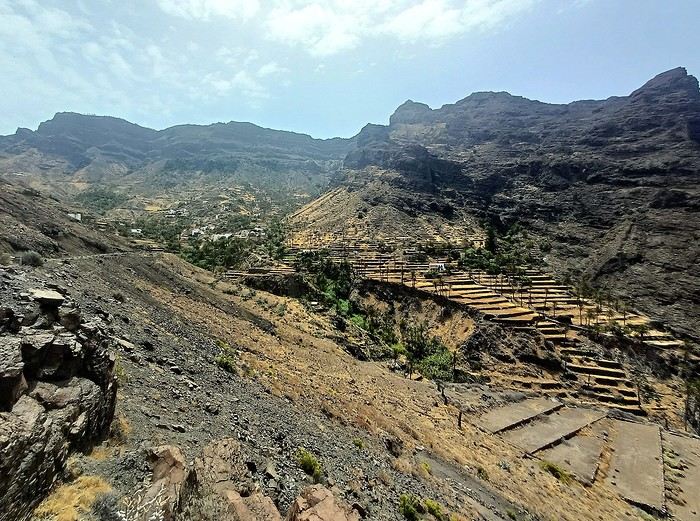
We reach a point where several hikes are possible around the village. But at a bend in the road above, we spot the only bar-restaurant in Taguluche, aptly and simply named Bar Restaurante Taguluche. It’s not lunchtime yet, but a coffee and some refreshments wouldn’t hurt since it’s starting to get hot. Despite its isolation, it has a great reputation, and there’s never a fixed menu—you eat (very well) based on the owner’s inspiration, and the bill is calculated roughly. It’s the owner herself who welcomes us warmly, the first sign of human life in Taguluche. She’s sorry because there was just a power outage, and she doesn’t have much to offer. And there won’t be anything for lunch. The terrace has a magnificent view of the village and the ocean—it’s the perfect spot to enjoy the scenery while sipping our drinks. We pay the modest bill, and she tells us about the paved path that descends along the side of the village toward the secluded beach of Guariñén. We choose that over the Taguluche waterfall trail, which is dry like all the island’s waterfalls this season.

16 days with the family in La Gomera (Canary Islands)

Pagaljavab · 2026-08-19 · Message 20 of 54

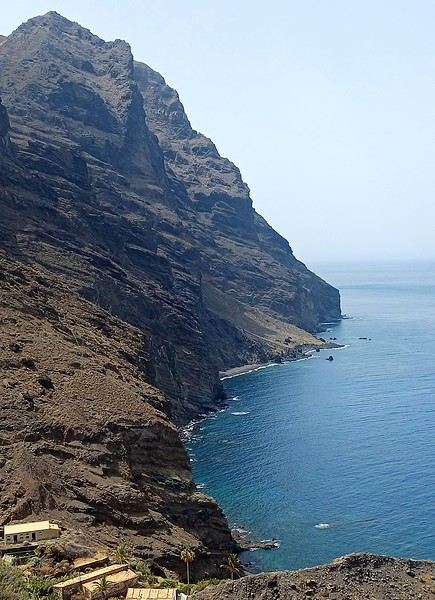
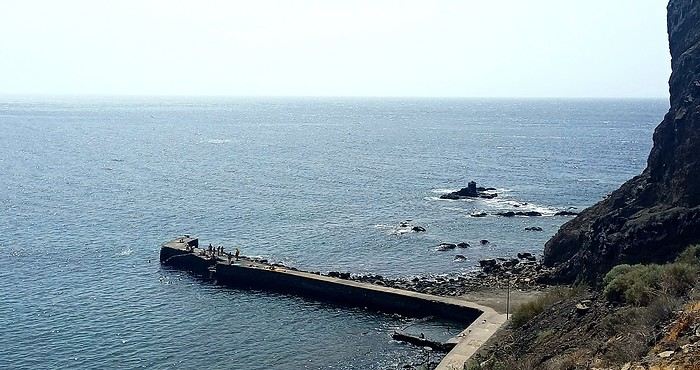
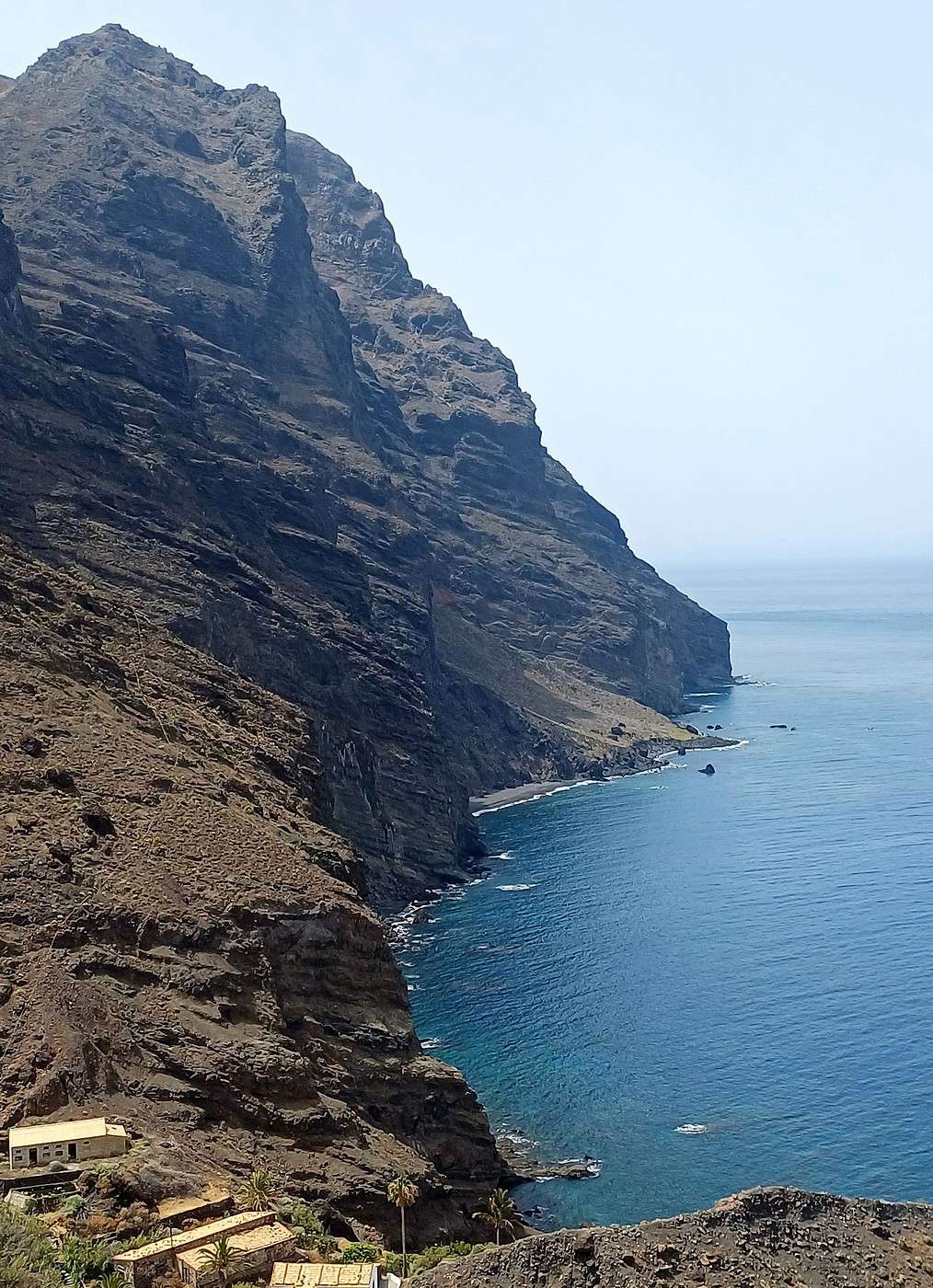
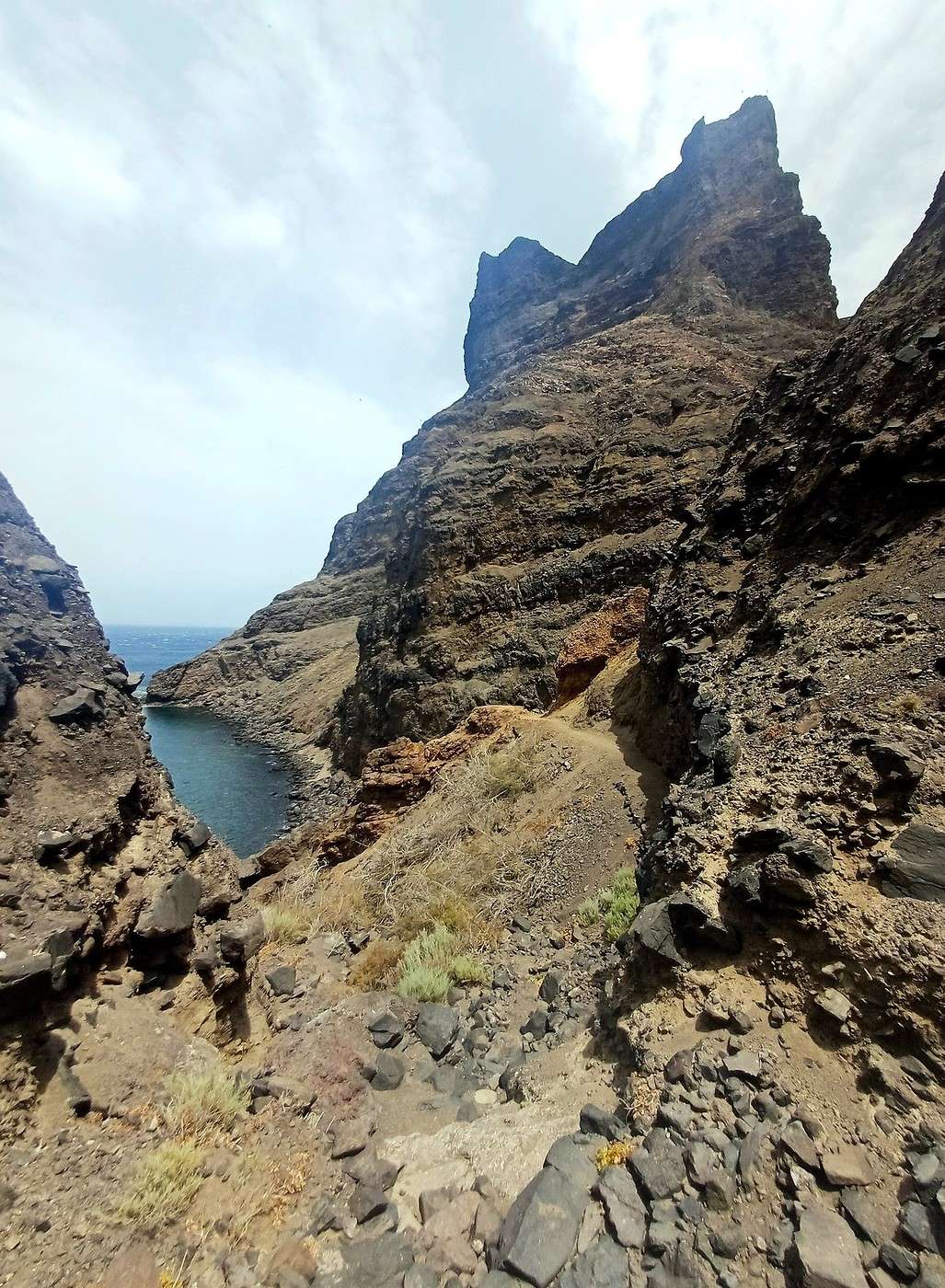
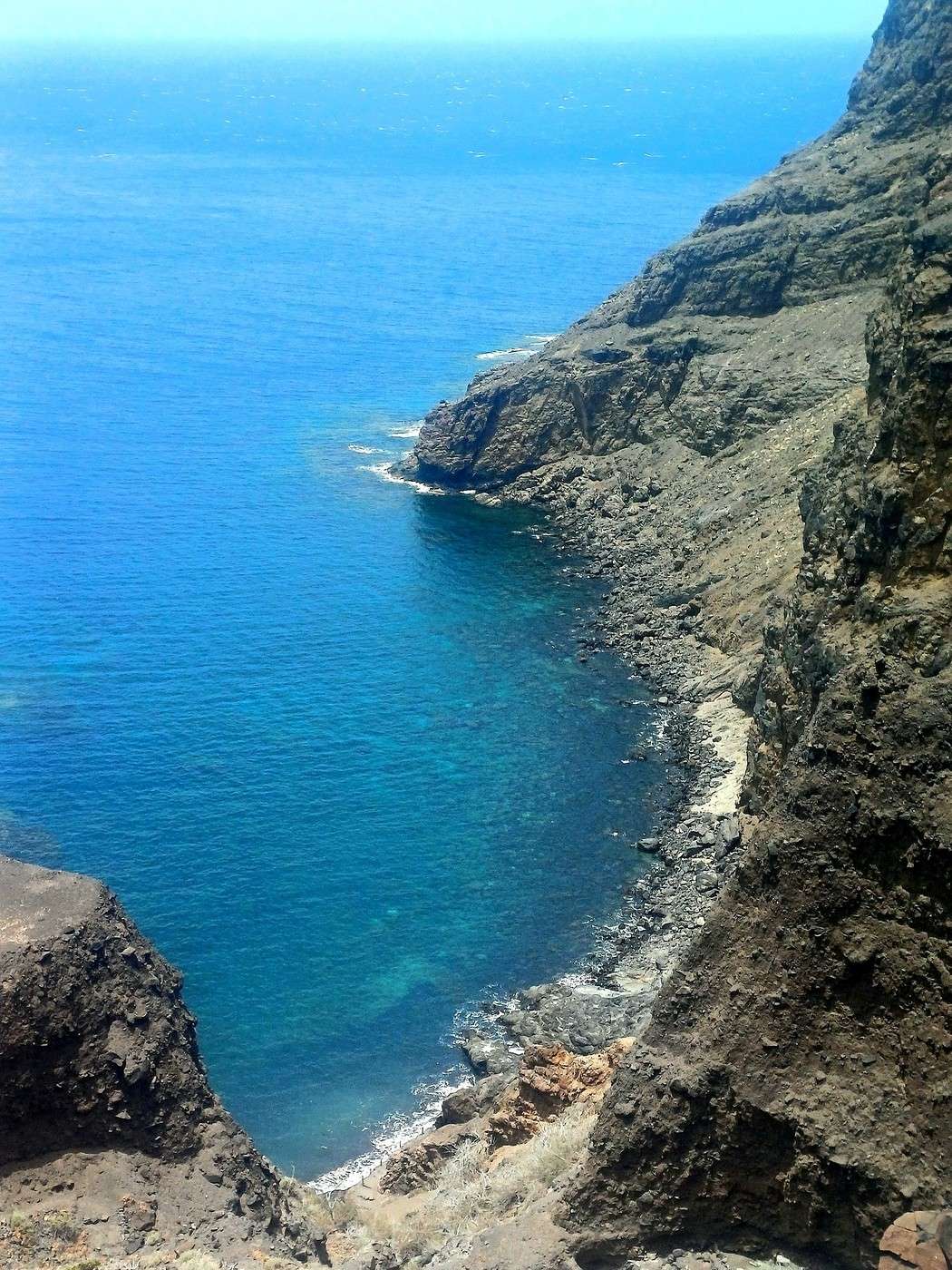
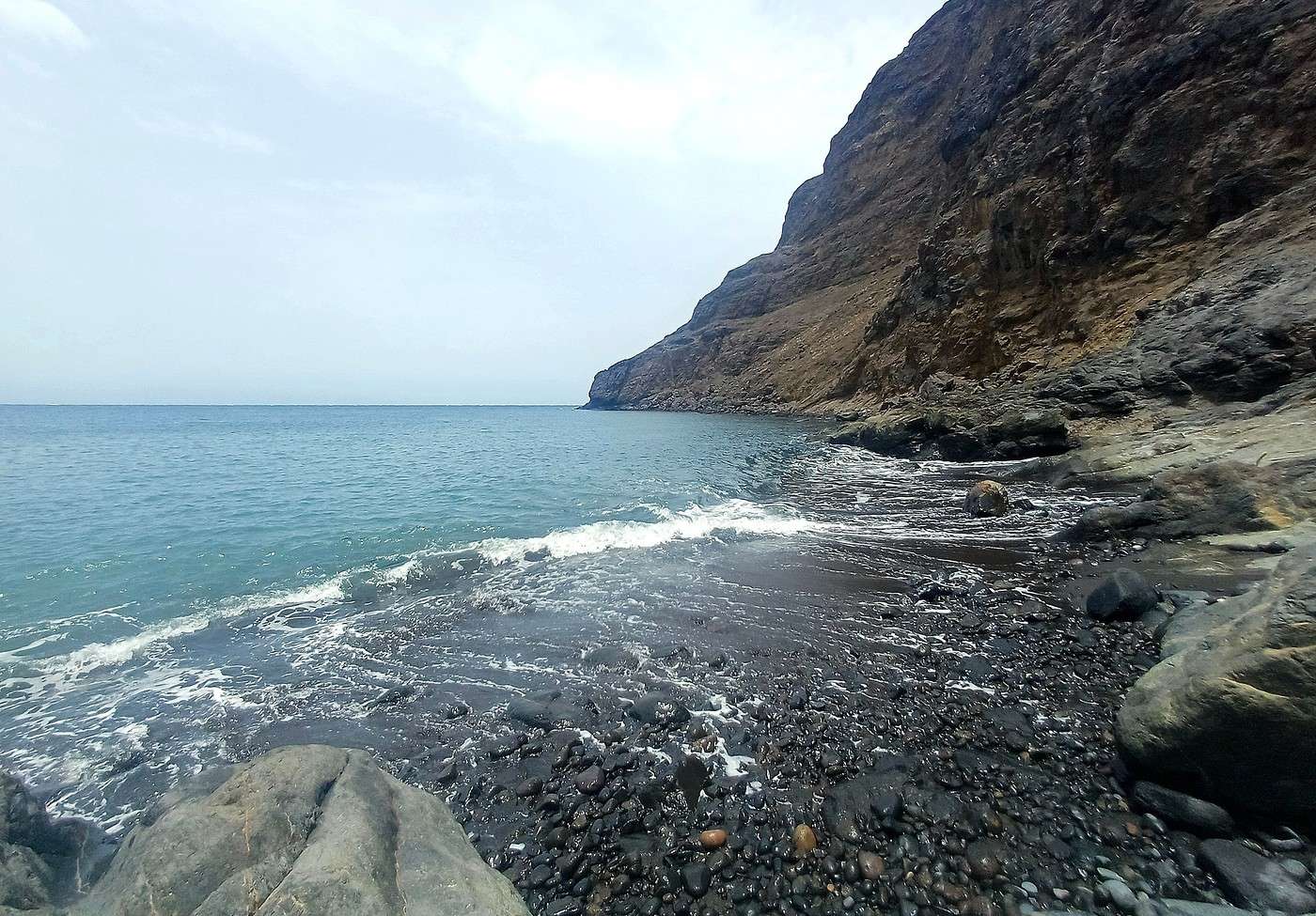
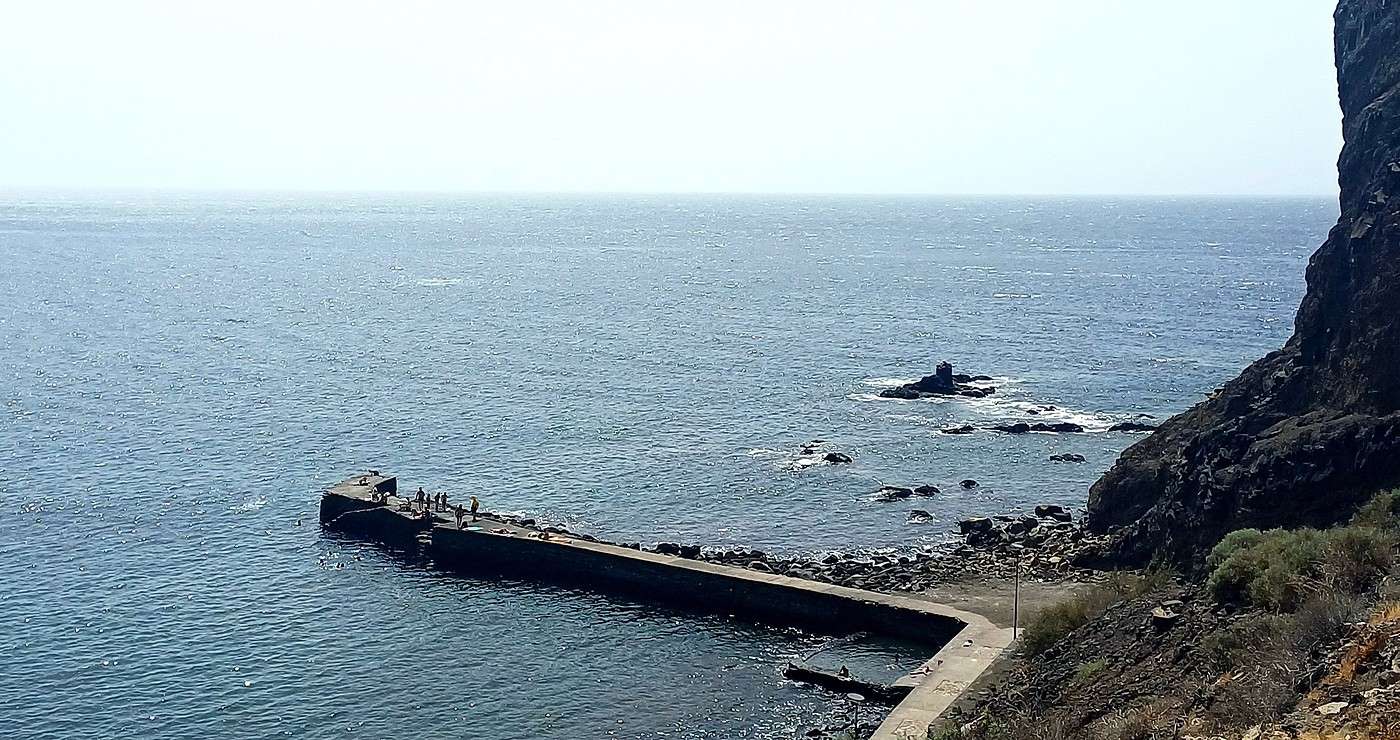
A forty-minute walk along the terraced fields leads us to a cliff above the end of the village and the coastline. Below, the path takes us to a rockier, very Far West-like environment. Down there, we see hikers leaving the road and heading into a ravine… When we reach it, Magali is a bit skeptical that it’s possible to access the beach without being an experienced climber. But there’s indeed a tiny, slightly rugged but manageable path that zigzags between the rocks. From there, we can see the beach shaped like a small Breton cove. It takes us about twenty minutes between the rocks and impressive basalt formations to reach this beautiful little wild black-sand beach nestled between the cliffs. There’s a couple swimming; this stretch of ocean is calm and protected from currents here, so we follow their lead. Plus, the water is really nice, and we can admire from afar another small beach just like it—this one accessible only by boat—and a bit of the old pier’s remains, like those found in all the municipalities of northern La Gomera.
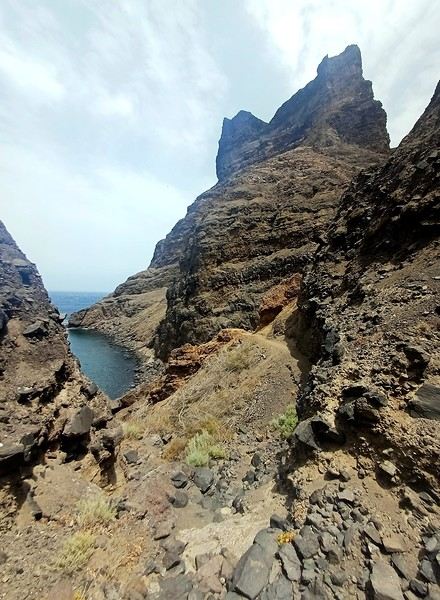
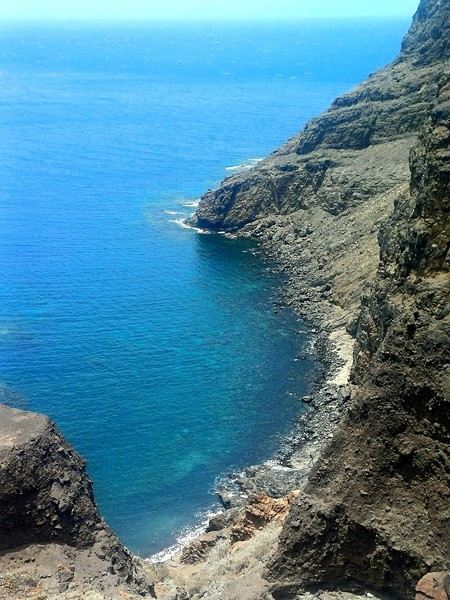
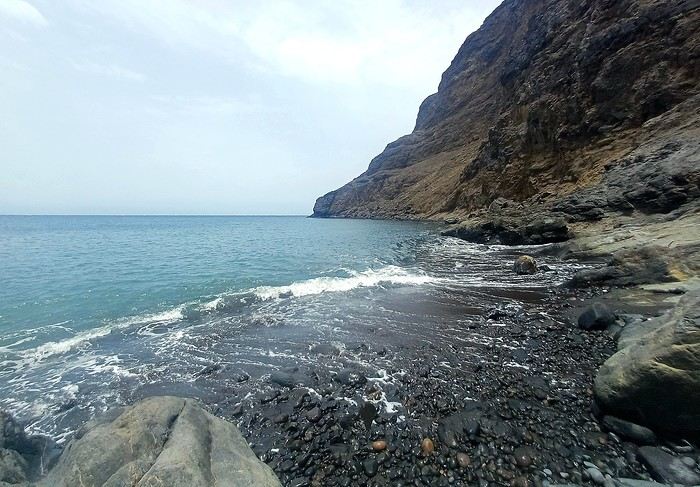
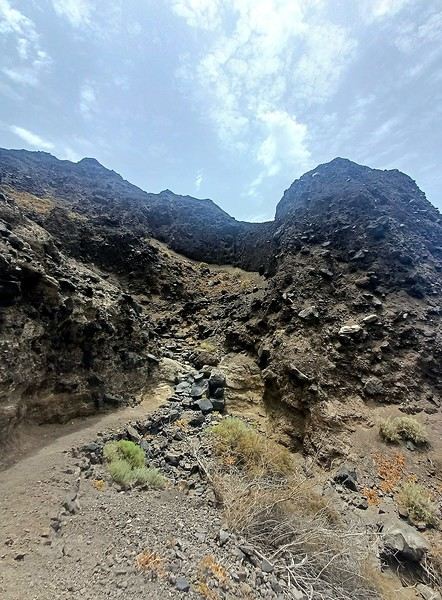
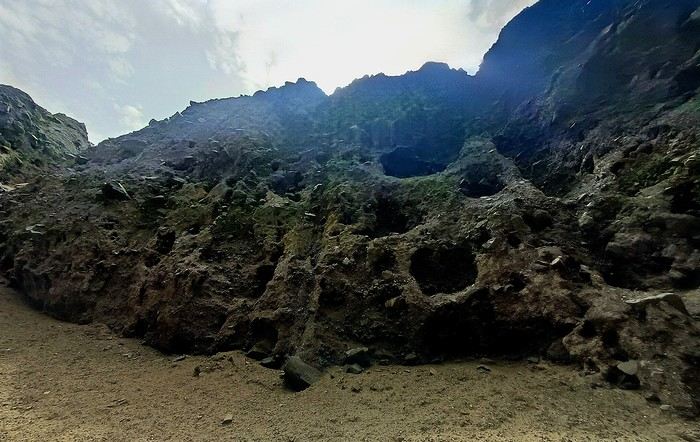
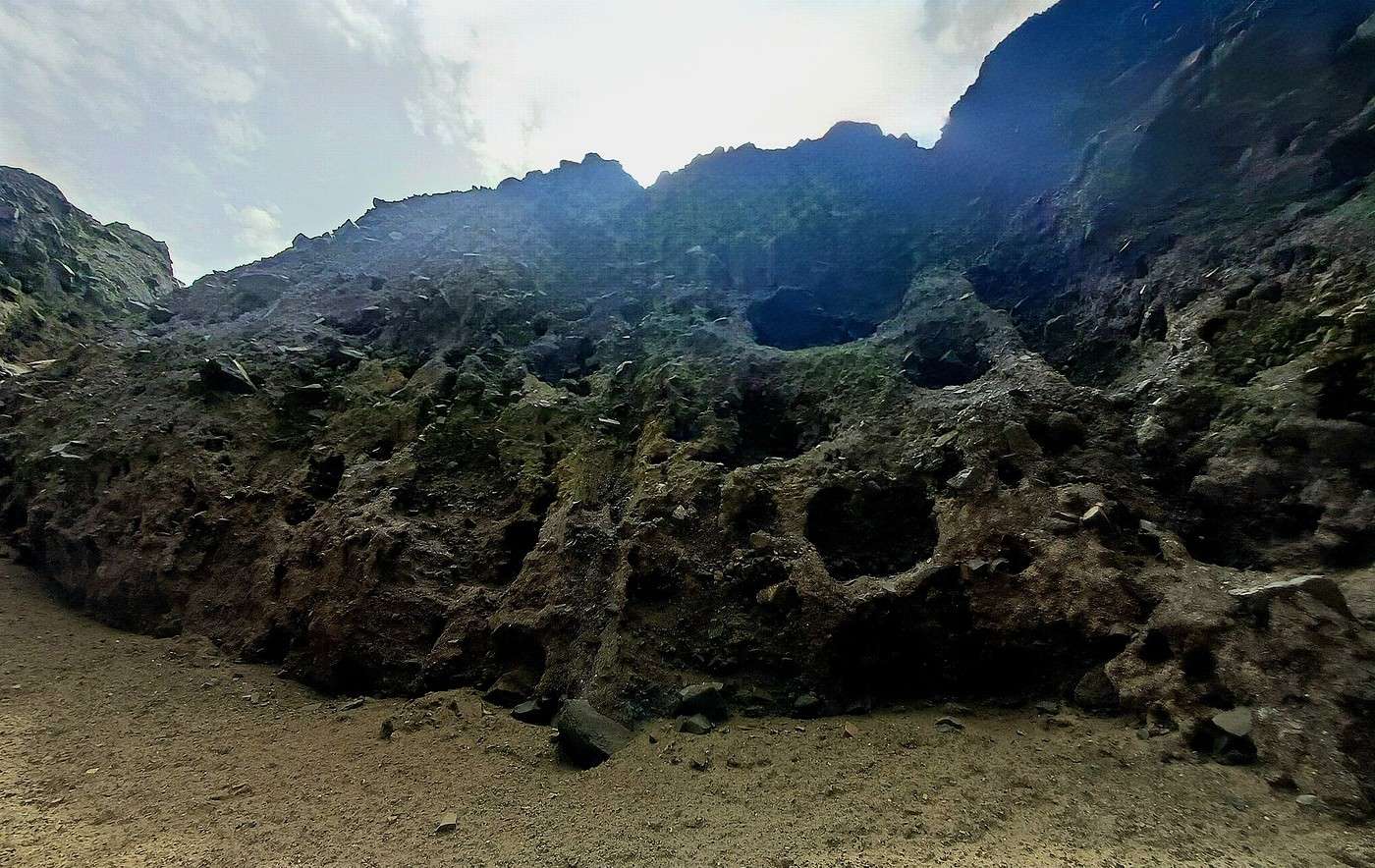
We enjoyed three-quarters of an hour on this end-of-the-world beach, and now we have to leave… We climb back up the path faster than we descended, through the frozen lava flows dotted with cryptic cavities that still give the impression of thick waves about to swallow us.

The heat is something we haven’t experienced since our arrival. We’ve walked several kilometers to get here, climbed this steep path, and the idea of having to walk another good hour under the scorching sun to get back to Taguluche seems more than tough for Théo. The Spanish couple followed in our footsteps and, unlike us, parked at the start of the trail. We secretly hope they’ll offer us a ride, though without much hope… We keep walking with no motivation at all… and our wish comes true! The woman invites us into their van, telling us the road is long and it’s really too hot for the little one: 35°C. We can hardly believe it and thank them a thousand times, wishing them all the luck in the universe. They’re actually from Tenerife—she’s originally from El Hierro—and like many people from Tenerife, they’re on vacation in La Gomera. They drop us off near the now-closed restaurant. From there, it’s just a 10-minute walk to the car. The workers repainting the electrical cabin are still there, but just packing up their tools. They greet us in recognition and hand us a bottle of cold water "para los niños" from their truck, gesturing not to worry: « Nosotros tenemos mucho! ». We’re deeply touched to have experienced Canarian kindness and hospitality in just fifteen minutes.

Now, we’re heading to Alojera, about ten kilometers away, for a little half-hour stop, where we want to visit the Palm Honey Interpretation Center. But first, we’re off to one of the only two restaurants in Alojera because, believe it or not, it’s already 3 PM and we haven’t eaten yet. Restaurant Prisma is nestled among houses right by the sea in a slightly covered alley where its tables spill out widely. It’s almost full, and only one table is left inside. The kids from the neighboring vacation rentals—Spanish and French—are constantly running back and forth to stock up on ice cream. We order a seafood paella for two; it’s pretty good, but we regret it a bit when we see the incredible grilled fish platters going to other tables! Prices are significantly lower than in France for such generous portions. We’re so full we skip the tempting desserts. From the restaurant, there are just a few steps down to the pebble beach and the beautiful pier where kids are jumping into the sparkling ocean.

With heavy stomachs, we head to the Palm Honey Interpretation Center, an unmissable specialty of the Canary Islands, especially La Gomera, the only island where it’s still produced. Entry is free, and while the visit takes about fifteen minutes, we learn a lot about its ancient use by the Guanche aborigines, as the palm tree is an endemic species of the island. Despite its small size, La Gomera has the most specimens—118,000. Growers meticulously extract the liquid sap, called guarapo, from the tree’s crown. It’s cooked until it thickens: it takes 8 liters of sap to produce one liter of palm syrup, locally (and inaccurately) called honey. It’s used like maple syrup in almost all local desserts. The palm’s shoots are traditionally used like wicker to make bags. The center is well-stocked with explanations, mini-documentaries, and quizzes for kids, and of course, there’s a shop where you can buy local palm honey and palm-made items at "preferential prices." The same brands turn out to be the same price, if not slightly cheaper, at Spar. Still, it’s a very informative little visit.

Now it’s time to head back after this exhausting but rewarding day. Back to the winding roads and the mandatory stop, this time at the Mirador de la Curva del Queso, which rises 600 meters straight above Valle Gran Rey, and for which the phrase "breathtaking view" is no exaggeration.

Tonight, needless to say, dinner is very light. A few minutes after nightfall, I settle onto the lounge chair on the balcony and scan the mountain facing us, trying to recall its name. It’s called Teguerguenche, rising to 1,020 meters, and its plateau can be reached by a difficult hike. I’m not surprised to learn it was a high place for ritual practices and sacrifices for the Guanche aborigines—I would’ve sworn it.

And then it happens… At 9:45 PM, the first cry rings out. Followed by several others right above me, before a thunderous concert of hallucinated shrieks shatters the valley plunged into darkness, the full moon’s light hidden by the twin summit of Teguerguenche, the Adivino ("The Seer," where legend says a Guanche shaman had a vision of the Spaniards’ arrival long before the island was taken). Magali comes out and can’t believe her ears, Kelyandre is uneasy, and Théo is literally terrified. There are hundreds of hallucinated pleas, amplified by the immense echo chamber of the valley enclosed by its two mountainous wings. Online sources describe this cry as perhaps the most piercing in the avian kingdom, comparing it to "hoarse wails," "guttural and mournful laments" resembling "human sobs," so much so that it has "fueled legends of ghosts or sirens." I couldn’t describe it better. What’s even more impressive is that these cries aren’t uniform but articulate distinct phrases, as if each one conveyed a human meaning, but in a monstrous way. Amid this chaos of high-pitched shrieks resembling moans, mockery, or malevolent taunts from little demonic beings under the influence of some hallucinogenic substance, you can sometimes hear atrociously deep regurgitations, like a sordid Mongolian throat-singing: those are the females. The kids beg us to close their sliding glass door completely despite the heat. For our part, we stay on the balcony for a while, fascinated, because we’ve never heard anything like it. It’s an unreal experience, especially on this full-moon night in such an intimidating natural and legendary setting. I start imagining the faces of the Spanish navigators hearing this infernal cacophony from their caravels: in their place, I would’ve abandoned exploring this cursed island and set sail as fast as possible. All because of a plain seabird with a ridiculous name: the Cory’s shearwater…

VoyageForum — the largest community of French-speaking travellers.