Cities of the World – Cost and Quality of Life
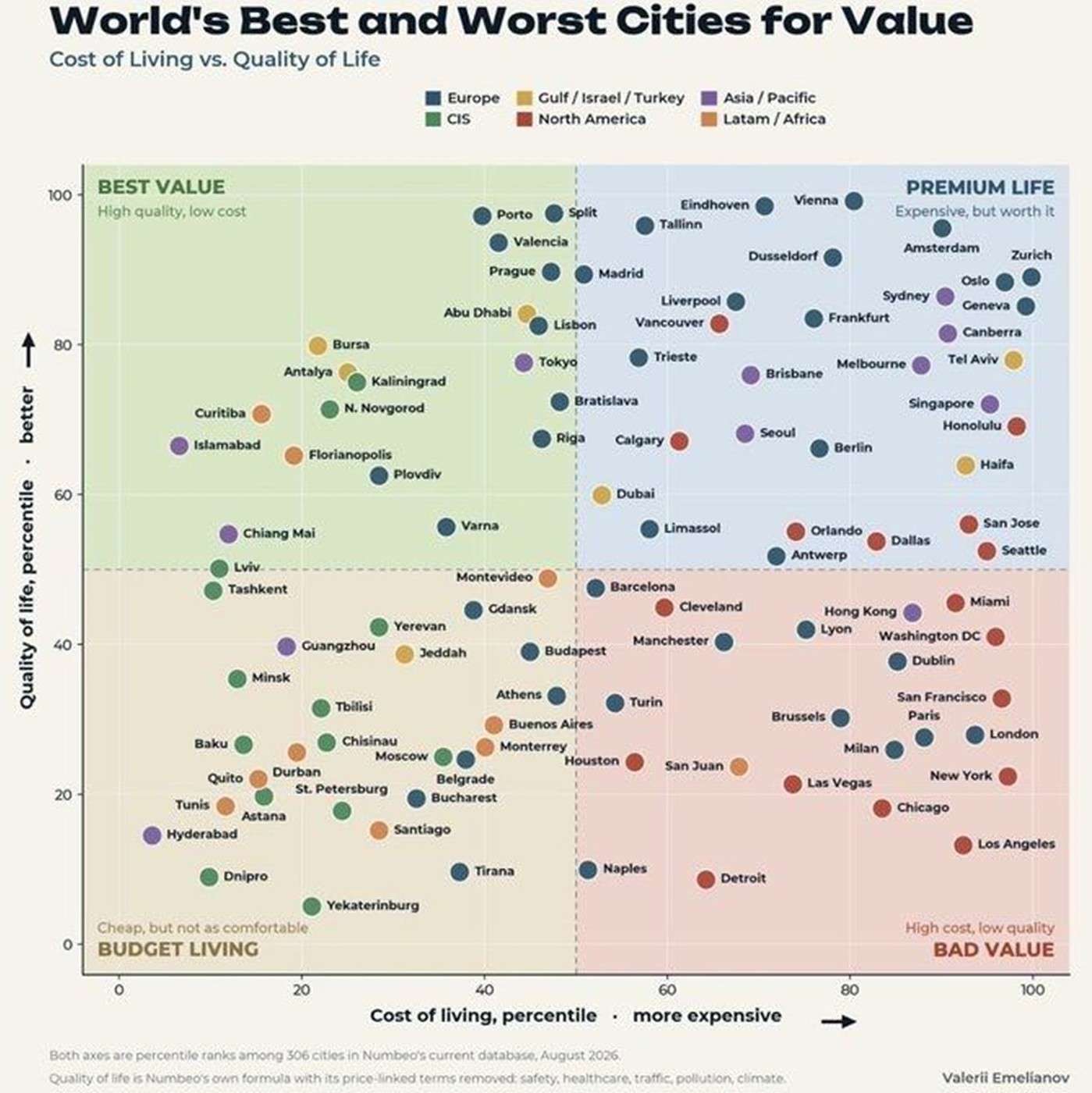
A few days ago, I came across a chart showing a number of cities around the world ranked by cost and quality of life. The source is the Numbeo database, based in Serbia, dated August 2026. There will undoubtedly be a thousand possible questions and criticisms. The main objection is methodological. Anyone with an internet connection can rate a city, so the sample is neither random nor representative, and its size varies enormously from one city to another. Numbeo describes the ranking as reflecting the perceptions and experiences of its contributors rather than measured results.
Is this an appropriate topic for VF? I think so. When traveling abroad, you notice huge differences in lifestyle and naturally ask yourself: is it better here than there, or than at home? The question arises differently depending on the type of trip—short or medium-term tourism, or medium to long-term residence.
And we’re back to the methodology problem. Since anyone can submit ratings to the database, how do we know whether the ranking of a city like Novgorod, Quito, or Islamabad (chosen at random) comes from travelers, foreign residents, or only people who are native to the place and have never left their hometown?
The cost of living in the database is indexed based on restaurant prices, transportation, services, housing (rented or purchased), and income. Fair enough. For quality of life, they mention safety, medical services, traffic, pollution, and climate. I would have liked to see social quality of life (interpersonal relationships, nightlife, shows, restaurants, etc.) as well as the possibility of pleasant and interesting excursions included.
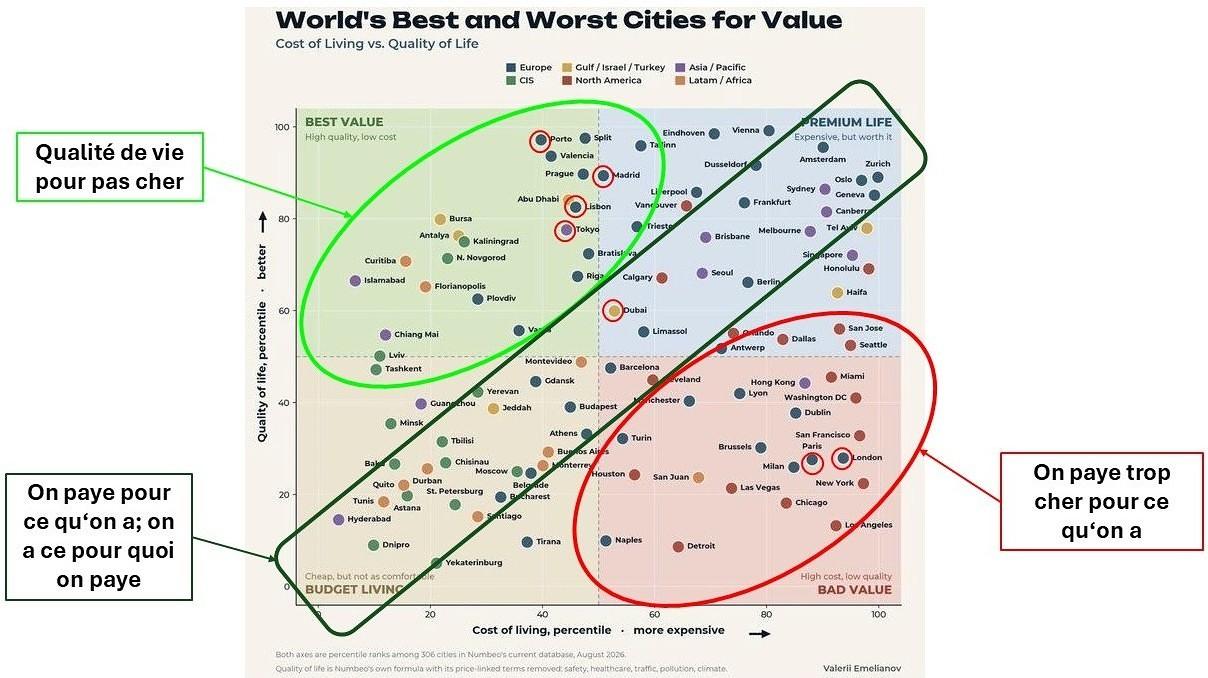
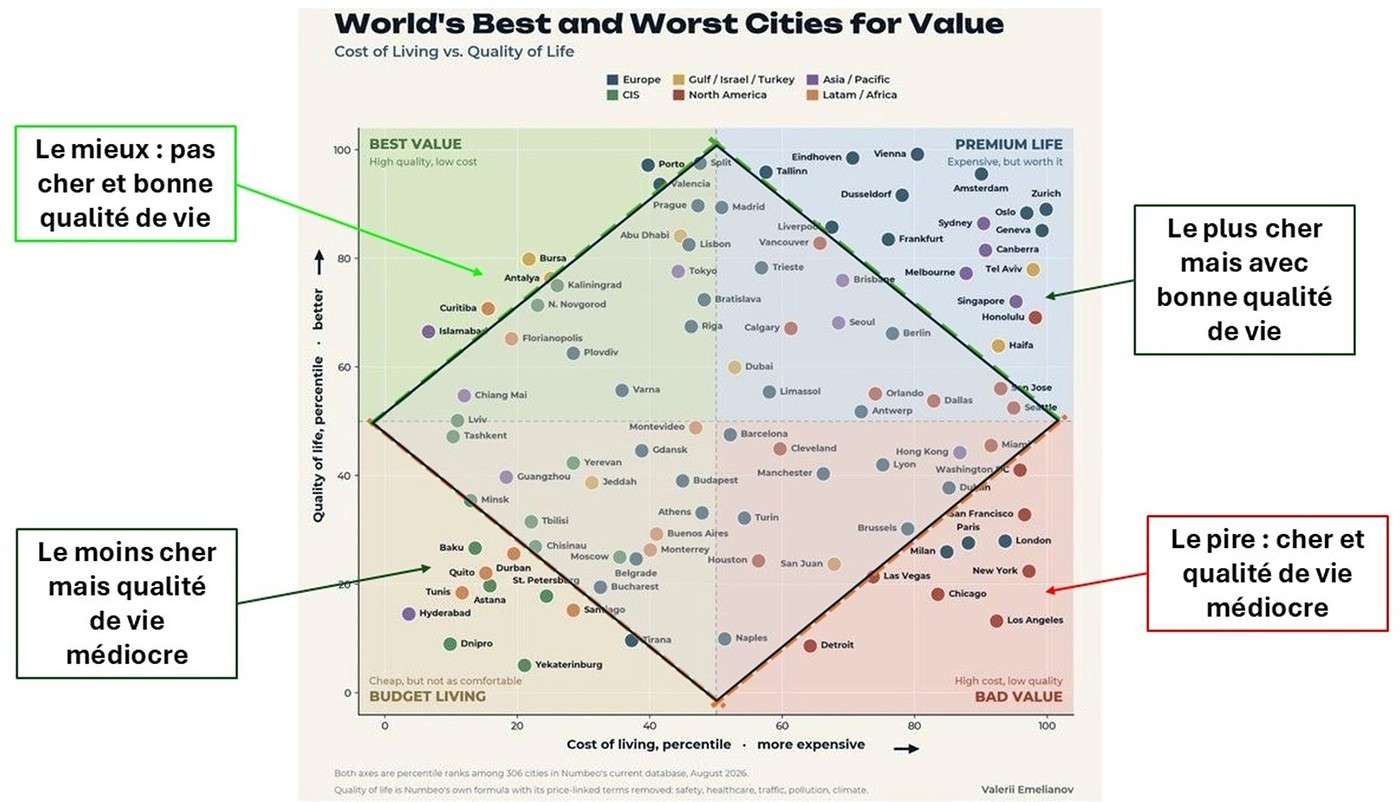
That said, I don’t think it’s completely meaningless. In any case, it can serve as a starting point for those interested in the topic. So, I’m posting the original chart here, along with two versions with my personal annotations. A few comments:
- In principle and in my opinion, there should be a simple cost-quality relationship, which I represent with a diagonal sector running from the bottom-left quadrant to the top-right quadrant—that is, from cheap but low-quality cities to expensive cities offering a higher quality of life. It’s no surprise to find several Australian cities at one extreme of this sector, for example. Take Melbourne: sure, it’s a very pleasant city to live in, but living or visiting there is very expensive.
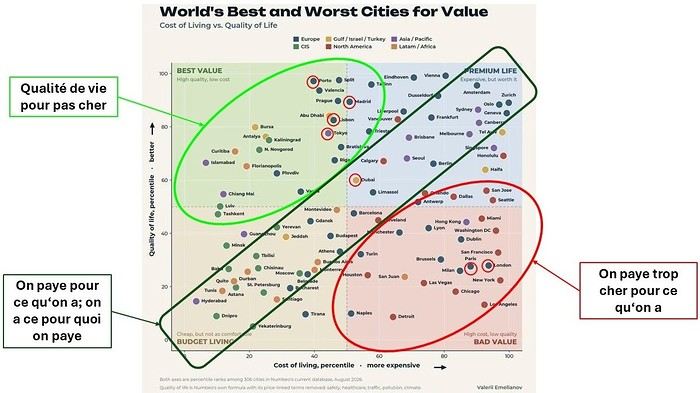
- The bottom-right and top-left quadrants: these are the cities that don’t fit this expected relationship:
o Bottom-right quadrant: expensive cities with mediocre quality of life. London and Paris are here, along with several U.S. cities. No surprise there. The worst is Los Angeles, closely followed by London, Paris, New York, Chicago, Milan... I don’t think that’s a huge revelation. o Top-left quadrant: relatively affordable cities with a good quality of life. We find cities in Brazil (Curitiba, Florianópolis), Turkey (Antalya), Spain, and Portugal. I’m intrigued by the presence of Russian cities and Islamabad—again, who are the people rating these cities?
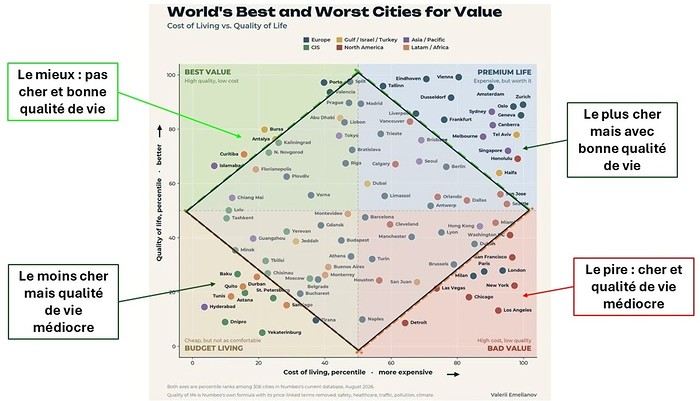
I was drawn to this chart after returning from a trip to Japan. I know some travelers don’t think much of Tokyo, but I had a good impression of it. So, I’m inclined to agree with ranking Tokyo right near Lisbon in the best quadrant. I’m even wondering if it wouldn’t be a good idea to move there for a few months. Other cities in Japan could be worth considering...
What do you think?
Is this an appropriate topic for VF? I think so. When traveling abroad, you notice huge differences in lifestyle and naturally ask yourself: is it better here than there, or than at home? The question arises differently depending on the type of trip—short or medium-term tourism, or medium to long-term residence.
And we’re back to the methodology problem. Since anyone can submit ratings to the database, how do we know whether the ranking of a city like Novgorod, Quito, or Islamabad (chosen at random) comes from travelers, foreign residents, or only people who are native to the place and have never left their hometown?
The cost of living in the database is indexed based on restaurant prices, transportation, services, housing (rented or purchased), and income. Fair enough. For quality of life, they mention safety, medical services, traffic, pollution, and climate. I would have liked to see social quality of life (interpersonal relationships, nightlife, shows, restaurants, etc.) as well as the possibility of pleasant and interesting excursions included.
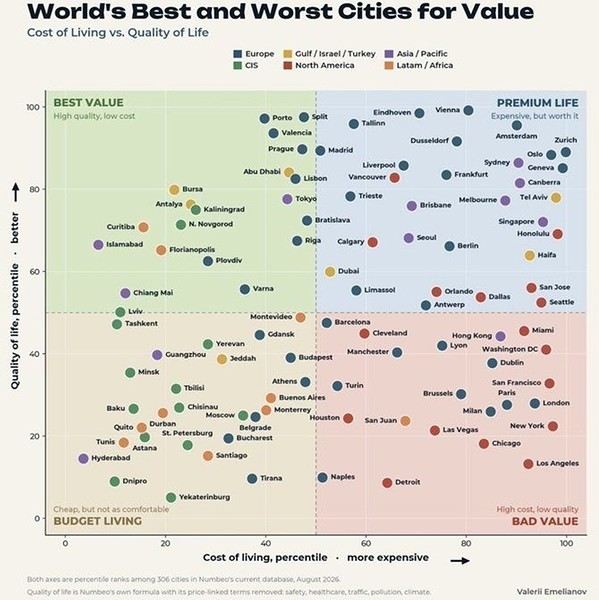
That said, I don’t think it’s completely meaningless. In any case, it can serve as a starting point for those interested in the topic. So, I’m posting the original chart here, along with two versions with my personal annotations. A few comments:
- In principle and in my opinion, there should be a simple cost-quality relationship, which I represent with a diagonal sector running from the bottom-left quadrant to the top-right quadrant—that is, from cheap but low-quality cities to expensive cities offering a higher quality of life. It’s no surprise to find several Australian cities at one extreme of this sector, for example. Take Melbourne: sure, it’s a very pleasant city to live in, but living or visiting there is very expensive.
- The bottom-right and top-left quadrants: these are the cities that don’t fit this expected relationship:
o Bottom-right quadrant: expensive cities with mediocre quality of life. London and Paris are here, along with several U.S. cities. No surprise there. The worst is Los Angeles, closely followed by London, Paris, New York, Chicago, Milan... I don’t think that’s a huge revelation. o Top-left quadrant: relatively affordable cities with a good quality of life. We find cities in Brazil (Curitiba, Florianópolis), Turkey (Antalya), Spain, and Portugal. I’m intrigued by the presence of Russian cities and Islamabad—again, who are the people rating these cities?
I was drawn to this chart after returning from a trip to Japan. I know some travelers don’t think much of Tokyo, but I had a good impression of it. So, I’m inclined to agree with ranking Tokyo right near Lisbon in the best quadrant. I’m even wondering if it wouldn’t be a good idea to move there for a few months. Other cities in Japan could be worth considering...
What do you think?