Back to the discussion

in Entre deux voyages › Carnets de voyage

Mauritius: From One Lagoon to Another via the Southern Roads (page 1 of 3)

Discussion started by Jemaflor on 2016-01-04

41 replies

This thread has been translated into English.


Mauritius: From One Lagoon to Another via the Southern Roads

Jemaflor · 2016-01-04 · Message 1 of 42

From one lagoon to another or from one island to another… From Blue Bay to Le Morne Brabant or from Île aux Aigrettes to Île aux Bénitiers. In this travel journal, I invite you on a journey through the south of Mauritius—a region undoubtedly less known than the busy shores of the beach resorts, yet it’s an enchanting, authentic, and charming Mauritius that unfolds along this route.


Blue Bay, now there’s a place name that immediately sets the tone… obviously, blue is the dominant shade of this lagoon. Here, you’d almost want to add an “s” to the word *blue*, so many are the shades of blue in this bay. From the matte turquoise of the early morning, where the mangroves on the shore are reflected in the lagoon’s depths, to the translucent light blue of midday—most stunning when the sun is at its zenith. Then there’s the deep navy blue of late afternoon, as the last rays of sunlight add golden touches to the ripples.


What a joy to admire this landscape with all its tones—they shift with the angle of the sun, the presence of clouds, or even the underwater terrain (light sand or coral). How could anyone ever tire of such paradise-like sights! Let’s set the scene a little more. This lagoon is one of the largest on Mauritius, and luckily, its shores remain preserved. There are no unsightly buildings along its edges—just a few pavilions from a luxury hotel, partially hidden by *filaos* (a type of tropical pine) and coconut palms. Across the way lies the quiet village and beach of Blue Bay.


For the rest, nature reigns supreme here, with lush greenery (palm trees, *filaos*, and mangroves) alternating with light sandy beaches dotted with black rocks. The lagoon’s entrance is protected by a coral barrier, where waves from the Indian Ocean crash, forming a frothy edge that outlines the horizon. And as if this setting weren’t already idyllic enough, there’s also an island floating on these impossibly beautiful blue waters: Île des Deux Cocos. This private tropical haven has just one structure—a house with striking Moorish-style architecture. Renting it would cost a fortune, I can only imagine… so let’s just admire this dreamy landscape from afar.


Even though the lagoon’s waters are astonishingly clear, to see the tropical fish and coral, you’ll need to explore either by glass-bottom boat (the view is a bit blurry and distorted) or—much better—by snorkeling. There, you swim in the middle of a real aquarium… without any walls. The wonder is guaranteed! I’ll admit that during my (too short) snorkeling session, I didn’t see all the species in this lagoon—far from it! Apparently, there are over 72 different kinds.


But I did spot and admire some elegant angelfish, colorful parrotfish with their shimmering scales, and especially schools of striped fish—the famous sergeant majors. These two Mauritians, seen from behind with their legs in the water, have another way of interacting with the bay’s fish—they’re teasing them with fishing lines and hooks.


Exploring the lagoon can be nicely rounded out with a kayak trip. With just a few paddle strokes, I’m almost in the middle of the bay. There, during a pause, my gaze wavers between admiring the stunning surroundings and peering at the underwater world through the crystal-clear waters. Look! A few fish dart near my kayak… before quickly hiding in the coral crevices. A little farther on, near the lagoon’s shores, I now glide along the mangroves and their tangled roots—another fascinating aspect of the area to discover.


A lagoon so rich in sights and aesthetic emotions quickly makes you feel like you’ve arrived at the gates of paradise. As my thoughts drift with each stroke of the paddle, the peaceful silence of the lagoon is suddenly shattered by a growing noise… a passenger plane flies overhead before landing on a runway near the island’s airport, which is close to the lagoon. Okay, you’ve got to admit—that’s really the only detail in this environment that brings you back to reality. Can paradise truly exist on Earth? Still, luckily, takeoffs and landings aren’t *too* frequent!


Twilight comes quickly in subtropical regions—it’s now the blue hour over the blue lagoon. From Île des Deux Cocos, a few notes of rhythmic music drift over, accompanied by colorful lights. The evening will be festive well into the night…


………………………………………………………………

After the lagoon and its sea baths, it’s time for a *bain de foule*—we’re now in town. The main city in the south, with its 16,000 inhabitants, Mahébourg is even Mauritius’ second-largest urban area. Its vibe is nothing like the hustle (and traffic jams) of the capital, Port Louis. Here, no tall buildings—just residences, houses, shacks, and shops that give off the charming, laid-back atmosphere of a provincial tropical town.


You’ll encounter the crowd a little later at the central market. It’s Monday morning, a busy day, but the morning is just beginning, and some aisles of the covered market are still sparse.


Under these colorful tarps, stalls overflow with mounds of vegetables and fruits. Here, tomatoes in bulk; there, pyramids of eggplants… Farther on, fruit displays: watermelons, pineapples, bananas, and lychees—the first of the season, a vendor tells me. It all looks so appetizing! We continue our visit, weaving between crate carriers, vendors, and busy housewives feeling, weighing, and comparing the produce… before finally buying their groceries. Baskets fill up as conversations flow in a relaxed but somewhat noisy atmosphere.


Near the exit, stalls line up with Indo-Mauritian specialties. Here, the air smells of deep-fried goodness. The displays are piled high with samoussas and dholl puris—those famous flatbreads made with lentil flour and stuffed with spiced vegetables. There are also some eggplant fritters… The sight of all these local treats makes me want to try them, even if it all looks a bit (okay, *very*) greasy. Let’s grab some for our midday picnic! On the other hand, I’ll pass on the chili cakes, even though the vendor kindly offers them. I’m not used to that local *piquant* heat!


Leaving the market, we take a random street—this one’s particularly crowded and busy. It leads to another covered market, this one for clothes. Here, stalls overflow with colorful fabrics and saris, as well as T-shirts, jeans, and caps…


Near the Chaux River, just before the bridge leading to a working-class neighborhood on the outskirts, stands the old lavoir. It seems like a relic from the past—its basins are completely dry, and the place is deserted. No one is scrubbing, beating, or wringing out laundry. Either Monday isn’t laundry day here, or washing machines have replaced the *lavandières* (laundry women)?

A large community of Indian origin lives in Mahébourg, and of course, they have their places of worship, like this Hindu temple at the city’s entrance, decorated with colors and deities.


--

To be continued in the next post: the Hindu festival of Diwali, Île aux Aigrettes, the rocky cliffs of the South…

Mauritius: From One Lagoon to Another via the Southern Roads

Jemaflor · 2016-01-04 · Message 2 of 42

Diwali is the main Hindu festival of the calendar, and this year it’s celebrated on November 11th. Lucky coincidence—it lines up with our stay in Mauritius! The festivities mark the victory of the god Rama over the demon Ravana, truth over lies, and light over darkness.

It’s for that last reason that Hindu families traditionally light up their homes in the evening. The sight is simply stunning.


You have to wait until nightfall for the Festival of Lights to begin. Little by little, colorful garlands start glowing at every street corner, like stars twinkling in the dark. A small crowd has gathered in front of this elegant house—the reason is clearly the dazzling light display. “It belongs to wealthy merchants,” a local admirer tells me in Creole-accented French. At the other end of the street, a glowing “Welcome” sign hangs above the front door. Diwali is a very social festival—families and friends invite each other over, and neighbors exchange gifts. Here’s a man, looking sharp in his light-colored tunic, crossing the street in front of me. In his hands, I spot a gift wrapped in shiny gold paper. He rings the doorbell at his neighbor’s place, and I hear a “Happy Diwali!”

It’s not just well-off Hindu families who decorate their homes with lights. Everyone joins in, according to their means and type of housing—some hang colorful garlands on their facades or balconies. Oh! That’s a pretty sight—sparkling reflections in a puddle. Click, clack! Photo.


And for those living in modest tin-roofed houses—with, as you can imagine, very limited income—a couple of garlands and a few colored lamps do the trick! That’s the spirit of Diwali in Mahébourg, and across the island.

Some Mauritians of Indian origin are Muslim, mainly those from North India, making up just over 15%. In town, they have their mosque with a minaret and light green walls.


The Catholic church is just a few steps from the mosque, at the end of the street on a square. Inside the building, near the side entrance, I see an elderly man sitting on a chair. After a greeting, he immediately points out the statue of Father Laval—probably the sculpture closest to his heart in this church. A wooden statue where a few worshippers are gathered. Father Laval was a French missionary priest ordained in 1839. His life’s work was helping the population—first the enslaved, then the poorest—through his Mission of the Blacks. His efforts earned him beatification in 1979, becoming the Blessed Father Laval.


Let’s end our tour of Mahébourg by the seaside. There’s no beach, but a pleasant waterfront with an exceptional view of the island’s largest lagoon—nearly 7 kilometers from the coral reef to the inland areas, no less! And right across from the promenade, in the middle of the blue waters, the charming Îlot du Mouchoir Rouge offers a view of its little house with a striking red roof.

........................................

A few minutes walking along the lagoon’s edge, and we arrive at Pointe Jérôme, where we’ll board a boat for a nature walk on Île aux Aigrettes. But first, how can you not fall under the spell of the landscape again? A small patch of sand still exposed, then the blue lagoon with the silhouettes of mountain ridges in the background—especially the imposing Lion Mountain. The name comes from its shape, which (with a bit of imagination) resembles a giant resting feline.


The motorboat drops us off on Île aux Aigrettes. The island—or rather, the islet—is a coral-based landmass, a rocky outcrop covered in vegetation. Access is regulated because since 1965, this 25-hectare territory has been a nature reserve. You must be accompanied to explore its trails, some of which are reserved exclusively for scientists. Jackie, our guide, is very educational—she’ll share her passion for studying and conserving the islet’s endemic flora and fauna. Right off the bat, she warns us: “To have a chance of spotting some birds, we need to be discreet!” Eyes peeled, we walk slowly, weaving between bushes and shrubs. Look—over there on the right, on a branch, we spot the red plumage of a Mauritius cardinal, an endemic songbird. Just as I aim my camera, it flies off to another tree.


This pink pigeon, with its pretty rosy plumage, is more relaxed—it lets itself be admired. Here’s an endemic Mauritian species that was once endangered: in 1990, only 9 individuals remained in the wild. Today, there are 40. A great success for the work done in this protected area. Some species still need to breed in aviaries, safely away from predators—like mice, which love to snack on eggs during nesting. It might seem surprising to restrict their freedom and natural laws, but it’s the condition for saving increasingly rare species. The famous dodo didn’t have that chance! This large, flightless pigeon with its clumsy gait disappeared nearly a century after being discovered by Europeans—victim of human predators. Though its meat wasn’t considered tasty, when sailors ran out of food, this easy-to-catch bird did the trick. That’s how no dodos have been seen since the 1700s. There *is* a dodo on Île aux Aigrettes—but it’s a statue! Ah, dodos—though extinct, they’ve become one of Mauritius’ (tourist!) emblems.


On the island, it’s not just birds to observe—you can also see colorful geckos and a few giant tortoises, all tagged and monitored by naturalists. By the way, do you know how to get a resting tortoise moving? Our guide taught us. Just gently massage the grooves on its shell—the ones separating the bumpy diamonds on its back. And sure enough, it works! A little massage, and our tortoise stands up and takes a few slow steps. But to make it bolt like a hare, you’ll have to find another trick!


The flora isn’t left out on the island—some plants are part of conservation programs, grown in a protected greenhouse. Sometimes, naturalists have to make compromises in their preservation plans. For example, in one area, ferns are thriving almost at the expense of rarer plants—but tortoises love them, so they’re left to grow!


As we wander, we walk between hibiscus and latan palms, then further on, between precious ebony trees and orchids with sweet, fragrant scents. And the egrets—you might ask? The species isn’t extinct, but you won’t see them on the island. So why the name Île aux Aigrettes? The answer lies in accounts and engravings left by European settlers, especially the Dutch.


In this drawing—a period reproduction displayed in a reserve hut—you can clearly see an egret in flight, proof the species was once present on the island. And on the ground, among all the details of the scene? A big dodo! That was a long time ago!


One last look at the lagoon’s waters—what a stunning view. The calm, translucent waters near the island let you see the corals, completing the surface landscape. For a moment, you’d think my camera was partly underwater—but no, this shot was taken from the boat. Amazing!

........................................

A little further south, the coast changes dramatically. Gone are the peaceful blue lagoons and fine sandy beaches—the contrast is striking! Near L’Escalier (a rural village lost in the sugarcane fields), we take rough, sometimes muddy tracks to reach the seaside. There, dark rocks and tall cliffs are battered by powerful waves. An offshore depression is bringing clouds and wind today, while a strong swell churns the water’s surface. With my face whipped by salty spray, I take in this panorama where the white foam of the waves stands out against the black rocky walls. Not easy to take photos in these conditions—drops keep beading on my lens!


This almost stormy weather is actually a stroke of luck—it lets us witness an occasional, very impressive phenomenon. We’re now in front of the rocky outcrop called “Le Souffleur.” The name refers to blowholes, which you find along steep cliffs—I’ve seen others in my travels, but this is the first time I’ve seen (and heard!) such a powerful natural water jet!


At intervals, when a wave driven by the wind rushes into the blowhole, a tall column of water shoots skyward! The spectacle is accompanied by a loud whoosh that drowns out the roar of the raging sea. It’s surprising and downright fantastic. This isn’t Mauritius anymore—it’s almost like “Geysir” in Iceland, minus the sulfur fumes, of course!

We continue our walk along these cliffs on this southern tip of Mauritius. Here, a dirt path crosses a small casuarina forest and leads us to a viewpoint overlooking a rocky spur—the dizzying view is breathtaking! Still, I love this spot—the composition seems photogenic as the sun breaks through the clouds, its rays making the lush green vegetation on the cliff edge glow beautifully.


On the sea side, the spectacle remains impressive, with these massive swells crashing against the rocks. Each wave explodes at the base of the cliff, sending giant sprays of water and foam. The seawater then trickles down the dark walls—like tears. Hence the name given to this cape: “Roche qui pleure” (Weeping Rock). Great imagination, right?

........................................


In Mauritius, all roads pass through sugarcane fields—and all Mauritian roads lead to… rum! Sugarcane cultivation is the island’s main agricultural activity, but work in the plantations is modernizing. The image of huge machines harvesting cane is replacing that of workers cutting stalks by hand with machetes. Sugar factories are changing too—here and there, you still see remnants of old distilleries with tall chimneys on the outskirts of villages. Stone chimneys that no longer smoke, but like this one (photo below), are abandoned with a plume of… shrubs at their summit!


As for current factories, they dominate the countryside with their metal structures, though the bright paint covering them doesn’t make them any prettier!


You’ll come across—and often follow—trailers loaded with sugarcane on rural roads. It’s very local color, but in practice, it’s a pain: slow speed, blocked view, and when you finally get a chance to overtake… in the rush, you hit the windshield wipers instead of the turn signal. Oops! That’s right—driving is on the left in Mauritius, and the controls are reversed. All the charm of disorienting driving! Sometimes, luckily, the tractor and its cumbersome trailer take a different turn—phew!

--

To be continued in the next post: Domaine de Saint Aubin, Souillac, Rochester Falls, Vallée des Couleurs…

Mauritius: From One Lagoon to Another via the Southern Roads

Jemaflor · 2016-01-04 · Message 3 of 42


At the very south of the island, near the small town of Souillac, the Domaine de Saint Aubin has been a benchmark in sugar production—and especially the famous rum—for many years. At the end of an elegant palm-lined driveway, the sugar factory continues the cane-processing activity, but it’s the master’s house that really catches our attention—a colonial residence built in 1819. In front of its façade, in the middle of a lawn, a basin and a fountain give it the look of a small tropical palace.

Perfectly restored and maintained, the house has become the setting for a pleasant restaurant. Upstairs, under a beautiful framework, an interesting collection of testimonies about the estate’s history (archive photos of cane cultivation and its transformation into sugar and rum) is displayed, along with some stunning model boats—scale replicas, one of the island’s artisanal specialties.


But the room I love the most is definitely the *varangue*. This outdoor space, half-veranda, half-terrace, is the perfect spot to enjoy the breeze while comfortably seated in one of those wide rattan armchairs. What’s more, this *varangue* overlooks a garden adorned with flowering tropical plants and is right next to the rum house. That’s where the visit ends with a delightful rum tasting. The server praises the quality of the house product—a unique rum. So, let’s taste it! The rum has a lovely amber hue, and among the sips we tried (rum flavored with coffee, vanilla, or coconut…), I must admit I had a soft spot for the *Rhum Spices*. No, it’s not chili that gives this infused rum its originality, but the sweetness of cinnamon.

…………………………………………………………………………………………………………

The town of Souillac seems a little sleepy on this Sunday afternoon—probably siesta time. Yet, around 6,000 Mauritians live here, in this town twinned with Souillac in France, located in the Lot department. The name of this southern island town dates back to when Mauritius was still called the *Isle de France* and had François de Souillac as its Governor, back in the 1780s… At that time, the local port was bustling, as no coral reef blocked access for boats. Ships loaded with sugar headed toward the capital, Port-Louis, while others en route to India stopped here.


These days, the dock only welcomes a few fishermen’s pirogues. At *Batelage*—the name of this port at the mouth of the Savanne River—I notice visitors are more interested in the treetops than the muddy waters. When you see one or more people staring intently in the same direction… you instinctively do the same. Human nature, I guess. So, what’s so fascinating on that huge palm tree towering over the port square? Bats!


Looking at them, these bats are quite different from the ones we see in Europe. These *roussettes* are diurnal and XXL-sized, with a wingspan of nearly a meter! Sure, it’s fun to see them hanging upside down, waiting to take flight with their wings spread… but they’re predators, and many local farmers consider them pests for their crops.

…………………………………………………………………………………………………………

Fields of cane and more water… but this time, we’re inland, in the highlands, just a few kilometers from the coast. As for the water, it’s no longer the sea but that of a waterfall—or rather, the Rochester Falls. The path to the falls winds through a succession of cane fields (already harvested). Near a ravine, a man with a big smile waves us over to park right by the trail. Without waiting, he offers to guide us to the falls. The hiking trail is clearly marked, but he insists. He looks like an agricultural worker trying to make some extra cash as an impromptu tour guide. We know wages aren’t high in Mauritius, and everyone gets by as best they can… so yes, he’ll get a few rupees on the way back! Still, he’s helpful in showing me the fork leading to the overlook of the falls—thanks. From this viewpoint, we dominate the churning torrent and, most of all, get a privileged view of the show: daring youngsters braving their fear by jumping from a tree into the waterfall’s basin—impressive leaps, bravo! One last detail: the falls are a good 10 meters high.


From the base of the falls, the view is probably less striking. So, to enhance the shot, I opt for a long exposure (photo) to create a silky effect—and suddenly, the water looks like a veil. The water’s a bit brown, likely due to decomposing vegetation. Another detail to note in the photo: the structure of the rock wall on the right. Of volcanic origin, the stone crystallized as it cooled, forming these basalt columns.

…………………………………………………………………………………………………………

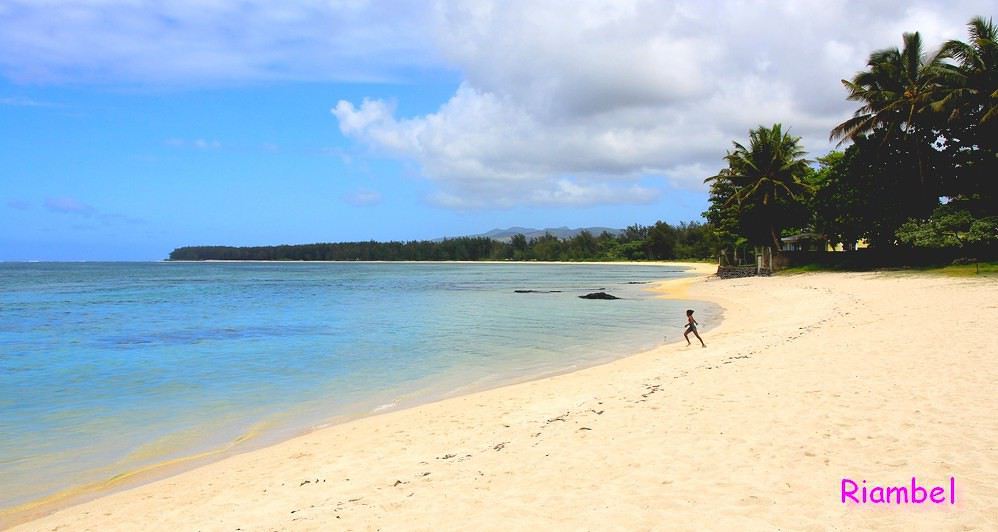
Back to the shore for a stop at Riambel Beach. A dreamy setting with a vast bay whose curve fades into the distance. No buildings, just a long strip of light sand between palm trees, *filaos*, and the blue sea. And who gets to enjoy this preserved spot? Just a few kids running for a swim. Lucky them!

…………………………………………………………………………………………………………

This meandering stroll turns out to be a zigzagging journey between the coast and the island’s interior. Now, it’s time to visit a vibrant site on the slopes of a volcanic ridge: heading to Chamouny and its Vallée des Couleurs. The site is less famous than Chamarel’s Seven Colored Earth, but it’s just as interesting. And here, they claim the earth offers visitors even more shades—some 23 different hues.


The little game is to try and count the number of shades when you discover the colored area. A tricky task, given how rich the palette is—hues blend into one another. This bumpy volcanic earth shifts from ochre to red and from gray-blue to violet… it’s the presence of iron and aluminum oxides (among others) that gives the soil this appearance. To these shades, add another one, very present in this environment: green, from the lush tropical vegetation that thrives in this valley.


The hike takes you through a network of trails among ferns, *vacoas*, shrubs, and flowering grasses, not to mention the most spectacular tree in this green haven: the *ravenala*, with its fan-shaped leaves—better known as the traveler’s tree. Such luxuriance often means humidity. Water is everywhere in this landscape—streams and waterfalls rush down the slopes, and in the sky, a few clouds linger as if magnetized by this elevated ridge. We even got a few raindrops, which added a shiny touch to the vegetation and the hues of this astonishing colored earth.


…………………………………………………………………………………………………………

The next stop brings us back to the coast and other beautiful colors… like those of these flowers captured during the journey, with the flamboyant tree in full bloom as the highlight.


Near Bel Ombre, the road straightens out while moving slightly away from the seashore. On either side of the tarmac, an elegant row of palm trees lines the way.


While there are still some cane fields between plateaus and hills, the coastline is now dotted with hotel complexes—only a few buildings visible, all surrounded by well-kept parks. As for the beaches in the area, they’re reserved for hotel guests… except, of course, the public beach. Here, the wind blows, and the *filaos* by the sea sway with the ocean breezes. A windy spot that seems to attract kitesurfing enthusiasts. We spot their sails dancing between sea and sky.


…………………………………………………………………………………………………………

Then, the coastal road becomes… coastal again, hugging the shore once more. The route west takes us through a few hamlets with a very rural feel. Let’s make a quick stop at Anse St Martin—a name that’s particularly familiar to me, which is probably why I decide to pause here. But what’s there to see? At first glance, nothing out of the ordinary. Hmm, why not take a look at the village cemetery? It’s said to be very decorative, with brightly colored tombs and crosses… much like the earth of the *Vallée des Couleurs* we visited this morning.


…………………………………………………………………………………………………………

A few kilometers further, between two coves, a massive rocky spur juts into the sea. At this spot, the coastal road makes a sharp hairpin turn. A few steps lead up to this famous Rocher de Macondé. From this viewpoint, you get a stunning view: on one side, the winding S-shaped road, and on the other, a panoramic vista from the coast to the marine horizon.


--

To be continued (and end of the story), next post: Morne Brabant, dolphins at sea, Île aux Bénitiers, and the Crystal Rock.

Mauritius: From One Lagoon to Another Along the Southern Roads

Jemaflor · 2016-01-04 · Message 4 of 42


The southwestern tip of Mauritius comes into view around the bend, revealing the sight of Le Morne Brabant. It’s impossible to miss—its 556-meter-high dome towers over the entire area. Paradise-like beaches stretch along the peninsula between the famous morne and a lagoon of unparalleled beauty. Several ideally located hotels enjoy this landscape’s unique charm. But Le Morne Brabant is also—and above all—a major historical site in Mauritius. It’s no coincidence that the area was designated a UNESCO World Heritage Site in July 2008 under the title "Cultural Landscape of Le Morne." This is where the dark era of slavery is commemorated. Indeed, this morne, with its caves, served as a refuge for many "Maroons," or enslaved people fleeing their oppressors. Legend has it that some, fearing capture by soldiers, chose to jump from the summit rather than return to slavery. Whether myth or fact, it’s said that some sacrificed themselves… just as soldiers arrived to announce the abolition of slavery in 1835. At the foot of the morne, a memorial honors these enslaved people with several statues, some donated by foreign countries also marked by the tragic history of slavery, such as Senegal and France… Near the entrance (or exit) of this memorial park, a striking black silhouette depicts an enslaved person in motion—running, escaping… but still bearing the shackles and chains on their wrists!


………………………………………………………………………………………………

This morning, we’re meeting up in Flic en Flac, a village name on the coast that rolls off the tongue like onomatopoeia. The plan? A boat trip beyond the coral reef to meet dolphins in their natural habitat—we’re already getting excited…


First, the captain must skillfully navigate the very narrow pass between the coral reefs. With a bit of wind and swell, the maneuver is tricky: about 1.5 meters of depth and only a few dozen centimeters on either side of the boat’s hull separate us from the coral… There we go—the obstacle is passed, we’re in open sea, and the captain can throttle up toward the south. Now, we just hope the dolphins decide to show up in the area. Of course, there’s no guarantee—we’re not in an aquarium but out in the open ocean! Dolphins, those friendly large marine mammals, attract quite a crowd, so we’re not alone on the water. As a result, you don’t need radar to spot a potential pod—just scan the horizon… where boats cluster, you’re (almost) guaranteed to see a few of them.


Just as two dolphins seem to peek out on the right, they leap to the left. This game of hide-and-seek goes on for a while. Watching them quickly becomes a game, and photographing them requires luck—by the time you aim and focus, they’ve already disappeared beneath the waves!


Then a pod of dolphins appears—how many are there? Nearly a hundred, our captain assures us, who has a keen eye. It’s well known that dolphins are playful—are they happy and full of energy? I don’t know, but they put on a fantastic show. Sure, the performance is short-lived, but it’ll be a sweet memory: jumps, spins, dives, some even glide horizontally on their backs—you’ll want to applaud! Some leap solo, while others coordinate their moves in perfectly synchronized groups.


Swimming with the dolphins is the highlight of this boat trip. Approaching these spirited dolphins isn’t easy. No matter how the captain positions the boat upstream, along their supposed path, they quickly dart off, constantly changing direction.


But you should see the swimmers/divers’ enthusiasm when they climb back on board. Without catching their breath, their faces beaming, they don’t hold back on superlatives to describe their experience: "Amazing! One passed right next to me—I almost touched it… I heard their cries, it was awesome!" For others, the story wavers between joy and slight disappointment: "By the time I spotted them, they’d already taken off… they swim way too fast!"

………………………………………………………………………………………………

After the excitement of these extraordinary aquatic encounters, it’s time to relax and eat. We head to Île aux Bénitiers, a small island about 2 kilometers long and 500 meters wide, located just a short distance from the shore. From its south-facing beach, the view is breathtaking—overlooking the lagoon and the stunning Le Morne Brabant.


On the north side, the view is just as stunning—beach and mountains of Mauritius. A coconut grove occupies the center of the island, with a few leaning coconut trees that are picture-perfect.


There are no permanent residents on the islet—just a few birds, mostly yellow weavers and bulbuls, which sport a cute crest and a bright red patch. They watch the day’s visitors, eyeing the crumbs left by picnickers. By midday, part of the shore is bustling with smoking barbecues and cheerful excursionists enjoying their meals. Vendors selling trinkets/souvenirs (shells, bracelets, and necklaces) wander along the beach with their floating stalls.


………………………………………………………………………………………………

Before returning to Flic en Flac, we still have time to admire what is perhaps Mauritius’ most astonishing rock. The Crystal Rock has even become one of the island’s tourist emblems. This surprising isolated reef in the middle of the lagoon has an eroded base, worn away over the years by the relentless waves. A few tufts of vegetation and one or two shrubs still manage to grow on this jagged rock.


Its strange silhouette sparks the imagination. Some visitors see the shape of a giant petrified mushroom. Others, with a seafaring spirit, imagine a stone vessel sailing on the lagoon’s crystal-clear waters, with the small tree as its makeshift mast… Whether it’s a mushroom, a boat, or even a flying saucer, this rock is yet another charming point of interest in southern Mauritius—which, as this trip proves, has plenty to offer.

JSM. November 2015

--

My other stories about Mauritius:

- The Colors of Mauritius: voyageforum.com/...ost=4250488;#4250488

- Mauritius: Tales of Boats: voyageforum.com/...es-bateaux-d6654469/

Mauritius: From One Lagoon to Another via the Southern Roads

Kate · 2016-01-07 · Message 5 of 42

I just read a colorful and informative travel journal! I learned that you can massage turtles 😉 And that poor extinct dodo... It was ugly, but that didn’t stop it from being devoured! As usual, beautiful photos... But I didn’t find any dates. When were you there during the year?

Mauritius: From One Lagoon to Another via the Southern Roads

Jemaflor · 2016-01-08 · Message 6 of 42

Thanks for the visit and the kind words! This last trip was in mid-November—a great time to explore, enjoy, and make the most of beautiful Mauritius.

Mauritius: From One Lagoon to Another via the Southern Roads

Maya83400 · 2016-01-08 · Message 7 of 42

I read through this report with great attention and pleasure. The text is very enjoyable to read and beautifully complemented by lovely photos. Thanks for sharing. Best regards, Denise

Mauritius: From one lagoon to another via the roads of the South

Nomina · 2016-01-09 · Message 8 of 42

good evening, thanks for this lovely travel journal with beautiful photos. It really helps us picture these landscapes. I’ve discovered some spots I hadn’t planned for my trip—I leave at the end of next week for 15 days on this wonderful island. Best regards,

Mauritius: From One Lagoon to Another via the Southern Roads

Caperam · 2016-01-10 · Message 9 of 42

Thanks for this lovely trip—always beautiful photos and a side of Mauritius I didn’t know about, since I’ve only seen the "beach" side, even though I live so close...

Raf

Mauritius: From one lagoon to another via the roads of the South

Sitik · 2016-01-10 · Message 10 of 42

I had a great time in the Indian Ocean. Your photos bring back some really good memories. According to distant friends, it seems, however, that Pointe Desny between Mahébourg and Blue Bay—and even Blue Bay itself—has lost much of its charm due to urbanization. Back when I used to visit, there was only one family-run guesthouse in Blue Bay. I rented a house right at the tip, with my feet in the water. I can only imagine it’s all gone now, the place was so stunning.

Mauritius: From One Lagoon to Another via the Southern Roads

Jemaflor · 2016-01-12 · Message 11 of 42

Thanks for the visit! This text is a little preview for you and should give you some ideas for "unplanned" sights, as you put it. Just a few more days to wait before you're in Mauritius! You won’t be disappointed. Have a great trip.

Mauritius: From One Lagoon to Another via the Southern Roads

Jemaflor · 2016-01-12 · Message 12 of 42

Glad to hear you enjoyed this story—thanks for the kind words! ... In a little while, I’ll be posting a story (with text and photos) about some local flavors that also add to the charm of this island.

Mauritius: From one lagoon to another via the roads of the South

Jemaflor · 2016-01-12 · Message 13 of 42

Thanks for this lovely trip—always beautiful photos and a side of Mauritius I didn’t know, since I’ve only seen the "beach" side, even though I live so close...

Raf

Of course, the coastline with its beaches is one of the island’s highlights, but there’s so much to discover inland and in the south of Mauritius as well. Thanks for the comment.

Mauritius: From one lagoon to another via the roads of the South

Jemaflor · 2016-01-12 · Message 14 of 42

I had a great time in the Indian Ocean. Your photos bring back some really good memories. According to distant friends, however, it seems that Pointe Desny between Mahébourg and Blue Bay—and even Blue Bay itself—has lost much of its charm due to urbanization. Back when I used to visit, there was only one family-run guesthouse in Blue Bay. I rented a house right at the point, with my feet in the water. I imagine it’s all gone now, considering how stunning the place was.

Thanks for this comment... Since I didn’t know the place "before," I still find it very charming. It’s certain that Blue Bay has changed, but the spot remains one of the few places not yet too spoiled by urbanization.

Mauritius: From One Lagoon to Another via the Southern Roads

Martine2009 · 2016-01-30 · Message 15 of 42

Thanks so much for sharing this and for your amazing photos! I’m heading there next week for a stay near Mahébourg—I’m excited but a little worried about the weather. Are the rains short showers, or can they last all day? Once again, congrats on your travel journal.

Mauritius: From One Lagoon to Another via the Southern Roads

Lisetao · 2016-01-30 · Message 16 of 42

Wow, these photos are stunning!.. They remind me of my three trips to Mauritius—I’m heading back again this October-November. If you have any tips for retracing this kind of route with a guide or another way (we don’t rent a car because we’re nervous about driving on the left), and we mainly get around by bus or taxi from Pereybère, it’s sometimes tricky to make spontaneous stops when you’re in a taxi.. Thanks for any advice!

Mauritius: From One Lagoon to Another via the Southern Roads

Eucalyptus33 · 2016-02-01 · Message 17 of 42

Hi there.

I got back from Mauritius last October: the beauty in the photos you’ve seen already hints at the island’s charm, and I can confirm—it’s in the southeast and southwest, Blue Bay, Le Morne Brabant, where you’ll find the most stunning beaches, less crowded with tourists. The coast between Pointe de Flacq and Mahébourg also hides some lovely, peaceful beaches.

Don’t miss the La Vanille Nature Park - Réserve des Mascareignes in the south near Souillac—it’s amazing. On the other hand, if you can avoid Casela Natural Park near Flic en Flac, do: it’s a total tourist trap.

You’re traveling during the wet season, so there’ll probably be some rain, but it usually doesn’t last long.

Another tip: if you can stop by "La Maison d'Été" near Poste Lafayette and Flacq in the northeast, don’t hesitate—it’s a gorgeous place to stay with top-notch food.

Have a great trip.

Mauritius: From one lagoon to another via the roads of the South

Larosalinda · 2016-02-01 · Message 18 of 42

Hi Jemaflor,

Thank you for these photos! These places are paradise and they’re making me dream.

Have a great day!

Mauritius: From One Lagoon to Another via the Southern Roads

Azerty013 · 2016-02-01 · Message 19 of 42

Fantastic post, thank you so much Jean for this exceptionally enriching trip report.

We’re planning to go to Mauritius on October 15th for about ten days. We’ll be staying at the ONS Motel in Mahébourg (on Royal Road)—we didn’t want a resort, just simplicity.

I haven’t been back to Mauritius since 1998, when I spent four stays there before that year. But we didn’t get around much because the kids were young at the time. We stayed at Blue Lagoon and visited Pointe Jérôme (at Croix du Sud back then). Great memories, but it must have changed a lot since then.

Could you give us some advice on the dolphin-watching excursion? Is there a particular agency you’d recommend? Is the guide Jackie reachable by email? Please let me know.

We’re also planning to visit Île aux Cerfs, but according to some friends who went recently, they were disappointed. Back in the day, I loved it—it was wild. (My wife has never been to Mauritius at all.) I don’t want her to be disappointed, so I’m a bit hesitant.

Thanks anyway for this "complete report on the area we’re visiting." We’d like to explore Grand Baie, the Pamplemousses Garden, and Trou aux Cerfs.

I hope we’ll have enough time in 9 full days to make the most of our stay. If not, we’ll just have to come back—it’ll be a nice change from Thailand.

Mauritius: From one lagoon to another via the roads of the South

Martine2009 · 2016-02-01 · Message 20 of 42

Thanks a lot for all these details, I’ve noted everything down!

VoyageForum — the largest community of French-speaking travellers.