in Thèmes › Voyager à vélo
Hydraulic disc brakes and breakdowns (page 1 of 2)
Discussion started by Hélaine34 on 2017-01-04
23 replies
This thread has been translated into English.
Hydraulic disc brakes and breakdowns
Hélaine34 · 2017-01-04 · Message 1 of 24
First of all... happy New Year! Wishing you great roads in 2017!
I’ve been traveling for a few years now with a high-quality mountain bike, but it’s equipped with hydraulic disc brakes. I live (pedal) with the constant worry of a breakdown (leak, air bubble, heat causing the fluid to...). My bike mechanic tells me it’s impossible to switch them out for V-brakes.
What do you all think? Am I taking a big risk continuing (alone) with these brakes? Thanks in advance for your great tips!
Hydraulic disc brakes and breakdowns
Navigaterre · 2017-01-04 · Message 2 of 24
You can always install cable disc brakes.
Hydraulic disc brakes and breakdowns
A2cmieu · 2017-01-04 · Message 3 of 24
Happy New Year to you too! We’ve had hydraulic brakes on our tandem for eight years now—never had a breakdown, even though we’ve descended cols with panniers and a trailer. Just remember to bleed or even flush the oil every now and then. But we always do that before a trip, and a bike mechanic handles it. Check out our site for more:
http://tandamour.e-monsite.com/
Hydraulic disc brakes and breakdown
Hélaine34 · 2017-01-04 · Message 4 of 24
Ah! Thanks a million, you’ve put my mind at ease! I’ll check out your site.
Thanks! !
Hydraulic disc brakes and breakdown
Lucno · 2017-01-04 · Message 5 of 24
I bought a second-hand KTM bike on LBC—it was about ten years old. Since then, I’ve ridden over 15,000 km. As a precaution, I picked up a bleed kit for any potential repairs.
In the end, I never had to touch the Magura Hs11 hydraulic rim brakes.
Hydraulic disc brakes and breakdowns
Hélaine34 · 2017-01-04 · Message 6 of 24
That’s a great idea! I’ll talk to my bike shop about it—maybe bring something to convert hydraulic brakes to cable brakes if needed.
A2Cmieu’s reply reassured me too. It’s true that you can find recent touring bike models equipped with hydraulic brakes these days.
Thanks, friends! I’m already less worried about my solo trip through the Peloponnese, Albania, etc.
While I’m at it, another concern… Do you bring a spare tire? I’ve got Marathon Schwalbe tires, so they’re tough, but I’ve read stories of blowouts… Even in Europe, there are remote spots where you can’t find repair or replacement parts.
You’ll probably say that with rice powder, mascara, two mirrors (in case one breaks), an evening dress (for the dance halls in Albania), skis (for the mountains in Greece), and my cat, I’m not exactly counting grams anymore—and I can totally bring a little spare tire!
Hydraulic disc brakes and breakdown
Hélaine34 · 2017-01-04 · Message 7 of 24
Ah, yes, good idea with the bleed kit!
I'm making progress thanks to you and feeling more confident!
Thanks, thanks.
Hydraulic disc brakes and breakdowns
A2cmieu · 2017-01-05 · Message 8 of 24
That’s a great idea! I’ll talk to my bike shop about it—maybe bring something to convert hydraulic brakes to cable brakes if needed?
A2Cmieu’s reply reassured me too. It’s true that you can find recent touring bike models equipped with hydraulic brakes on the market.
Thanks, friends! I’m already less worried about my solo trip through the Peloponnese, Albania, etc.
While I’m at it, another concern... Do you bring a spare tire? I’ve got Marathon Schwalbe tires, so they’re tough, but I’ve read stories of blowouts... Even in Europe, there are remote spots where you can’t find repair or replacement parts.
You’ll tell me that with rice powder, mascara, two mirrors (in case one breaks), an evening dress (for Albanian dance halls), skis (for the Greek mountains), and my cat, I’m not exactly counting grams anymore—and I might as well throw in a spare tire! 😄
You’re not bringing your fridge? More seriously, there are foldable-bead tires that fit in a pannier—we do that. Schwalbe makes them, pricier than rigid ones, but good prep.
Hydraulic disc brakes and breakdown
Lucno · 2017-01-05 · Message 9 of 24
What brand are your brakes? We can help you find the right kit, along with detailed instructions for bleeding and adjusting them...
If it's Magura, their website is really well done.
Hydraulic disc brakes and breakdowns
Mazzzz · 2017-01-05 · Message 10 of 24
Hi Hélène,
Hydraulic disc brakes are now completely reliable. The only risk would be damaging a hose and having a leak, but if you protect them well during transport, there’s no reason that should happen.
If it did, the chance of both brakes failing at the same time is highly unlikely. If one brake gives out, you could still continue your journey calmly to the next bike repair shop.
These days, there’s no country in Europe where you can’t get this kind of issue fixed.
We make a "mountain" out of hydraulics, but it’s just oil in a sealed tube instead of a cable in a sheath. If the system is checked and maintained, it’s actually much more reliable than cable technology.
Taking a spare cable brake would mean bringing a caliper, a cable and its sheath, as well as a brake lever.
As for tires, personally, for a long trip, I set off with new tires for peace of mind. The option of carrying a spare folding tire in a pannier is possible, but again, in Europe, you can find tires everywhere...
Hydraulic disc brakes and breakdowns
Vapkse · 2017-01-05 · Message 11 of 24
Hi there.
Hydraulic brakes are super reliable—way more than cables—but like any brake system, it's good to carry a few spare parts.
I’d pack:
Bleed kit for your brake brand
Rear hose the same length as yours, with fittings
Set of brake pads
Maybe a few spare bolts.
Everything’s small and lightweight.
Learn how to bleed your brakes and change your pads—YouTube’s your friend!
If you run into trouble or need to bleed them, you can use vegetable brake fluid instead of the original fluid—like the kind used in (older?) Citroën cars.
Serge
Hydraulic disc brakes and breakdowns
A2cmieu · 2017-01-05 · Message 12 of 24
Yeah, it's true that in Europe you can find tires "almost everywhere," but when there’s a tear, it’s good to have a spare. I’m talking about our case with a tandem and trailer—it’s tough to push the whole setup! For brakes, always keep a set of pads in your kit.
Hydraulic disc brakes and breakdown
Hélaine34 · 2017-01-05 · Message 13 of 24
Sram brakes.
Thanks in advance!
Ln
Hydraulic disc brakes and breakdowns
Boqi · 2017-01-05 · Message 14 of 24
Hmm, not sure if this is clear, but there are 4 types of braking systems:
rim brakes: hydraulic or not
disc brakes: hydraulic or not.
And the secondary ones: putting your foot on the rear tire and backpedaling on single speeds.
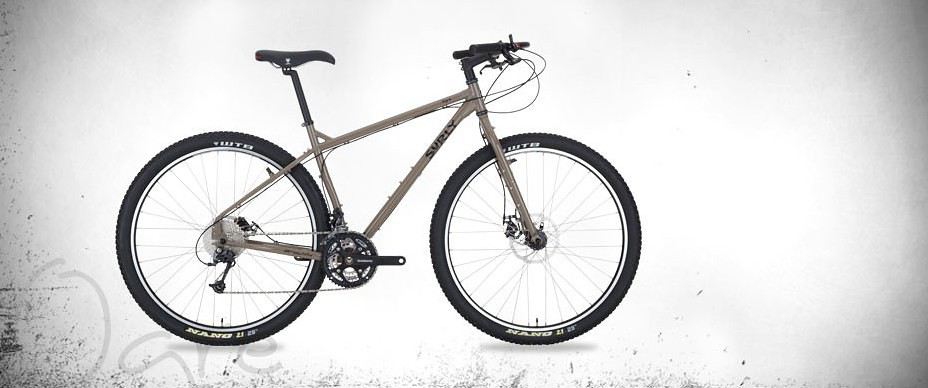
It's very rare to find frames that let you choose between rim brakes and disc brakes for the same frame.
The Surly Ogre, for example:

If you're setting off for roughly 3,000 km, you put on new tires, and if you feel your rear tire is worn, well, you swap it with the front one to finish the trip.
Besides, it’s not the end of the world if a tire blows out—you can just buy and fit a lower-quality tire for a few hundred kilometers. Enough time to find a good tire or simply finish the trip.
To wrap up, on rough roads, you’re more likely to bend your wheel than blow a tire. * And that’s where disc brakes really shine compared to rim brakes—you can ride without worry with a slightly bent wheel if you don’t know how to true a rim perfectly.
For me, bringing a bleed kit seems insane for self-supported travel, but hey, everyone carries the cross they choose. I’ve had disc brakes for nearly 10 years from some obscure budget brand, and this summer, I traveled about 4,000 km and only had to make a quick 2-minute adjustment to bring the pads closer as they wore down.
Hydraulic disc brakes and breakdown
Lucno · 2017-01-05 · Message 15 of 24
Sram is the brand—next, you’d need the model, which is usually written on the brake levers and/or the brake itself.
That should give us the info unless it’s a model that’s no longer distributed.
https://www.sram.com/en
Hydraulic disc brakes and failure
Doyouphil · 2017-01-07 · Message 16 of 24
A link that might be useful for you:
SRAM hydraulic specifics
DOT 5.1
The system is hydraulic, so it's the fluid flowing inside the cables that, pushed by a master cylinder, controls the caliper.
SRAM uses a specific fluid, DOT 5.1, a synthetic oil that withstands high temperatures during powerful braking. In fact, the caliper heats up quickly when in use, and some fluids tend to lose their effectiveness at high temperatures.
Read the practical guide: Bike hydraulic brakes: The fluids
In theory, SRAM found that DOT 5.1 takes twice as long to reach the boiling point compared to DOT 4, thus offering superior performance in extreme conditions. For info, DOT 5.1 is highly corrosive and should be wiped off quickly if it gets on a frame or lever.
Learn how: How to bleed SRAM hydraulic brakes for road bikes?
Hydraulic disc brakes and failure
Hélaine34 · 2017-01-07 · Message 17 of 24
Thank you so much for this post. I feel even more reassured about using my brakes in extreme heat now. No need to cross the Atacama—I had almost two weeks at 45°C in Romania last spring!
Thanks again! Ln
Hydraulic disc brakes and breakdown
Jmanupanta · 2017-01-07 · Message 18 of 24
Hi,
Just a note about Schwalbe and folding-bead tires: there are tons of other options—every manufacturer makes them (Conti, Hutchinson, Clement, etc.). And Schwalbe isn’t necessarily the only or best choice, despite what gets repeated endlessly from forum to forum.
As for folding-bead tires, not only can you fold them and they take up less space in your pannier than rigid ones, but they’re also significantly lighter.
Best,
JM
Hydraulic disc brakes and breakdowns
Hélaine34 · 2017-01-07 · Message 19 of 24
Thanks for the details.
Are flexible-bead tires as sturdy as the others (it’s true that everyone says you don’t get flats with Schwalbe!)?
Thanks in advance and have a great afternoon.
Hydraulic disc brakes and breakdown
Mazzzz · 2017-01-07 · Message 20 of 24
It's not the flexible or rigid rod that determines a tire's durability.
It's the quality of the rubber and/or an internal protective strip, for example, or even the thickness of the tread that will determine whether a "foreign object" punctures the tire or not.
Swabble chose to make very thick tires, so they rarely puncture and last a long time.
The downside is that they're very heavy, which has an extremely negative impact on the bike's efficiency.
In short: poor efficiency but excellent durability.
Other brands opt for a Kevlar protective strip, so the tire stays light but resists punctures well.
Downside: it's often more expensive.
As always, the question is finding the right balance between your desires, your needs, and your wallet!