Hi everyone,
We’re thinking of spending 3 weeks in Crete between mid-August and early September, renting a car, quickly exploring a few spots in the east, and focusing on the west, southwest, and south.
I’m worried about the heavy tourist crowds. Is it really more noticeable than elsewhere in Greece? Is there a way to avoid the crowds without missing out on the iconic places, which I imagine are stunning in Crete? Thanks for your thoughts and experiences!
42 similar discussions in English
Hi there,
Our first trip to Greece as a couple. We're planning to spend 7 days in Greece from August 30th to September 5th. We'll reserve 2 days for Athens at the end of the trip. For the remaining 5 days, we want to visit an island—any recommendations? Thanks for your tips and details, we really appreciate it.
I’m spending 2 weeks in Crete in September and will need a rental car.
I usually go with Europcar, but comparing their offer to what Aegean Rentals has, I see Europcar is charging no less than 400 € more for the same car and similar insurance!
I’d love to hear if others have experience with Aegean Rentals, and if so, whether it was a good one?
Hi there,
I’d like to visit Crete in September, starting on 09/07/2026 for a 20-day trip—to explore, swim, and soak up the island. I usually travel independently on a backpacker budget. We can chat and plan ahead before leaving.
I’d love to share this trip with someone—it’s more fun that way—but we could also just share a few days. I’ve never been to Crete before. Feel free to reach out for more details. I’m 60 years old. Thanks!
I’d love to share this trip with someone—it’s more fun that way—but we could also just share a few days. I’ve never been to Crete before. Feel free to reach out for more details. I’m 60 years old. Thanks!
Hi there,
We're heading to Crete at the end of September, staying in a hotel near Agios Nikolaos—Zeus Premium Mirabello Bay.
Has anyone stayed there before, or at least in that area?
What are the possible outings?
Are there buses to get around easily?
Is the weather still pleasant then?
Thanks for your feedback!
Hi everyone,
We’re thinking of booking an "all-inclusive" trip so we don’t have to worry too much... for a week at the beginning of next September, but we’re torn between several destinations: Crete? Cyprus? Sicily? Sardinia? The only thing we’re really looking for is sunshine. Thanks in advance for any tips you can share!
We’re thinking of booking an "all-inclusive" trip so we don’t have to worry too much... for a week at the beginning of next September, but we’re torn between several destinations: Crete? Cyprus? Sicily? Sardinia? The only thing we’re really looking for is sunshine. Thanks in advance for any tips you can share!
14-Day Trip Report to Milos and Kimolos in September-October 2021
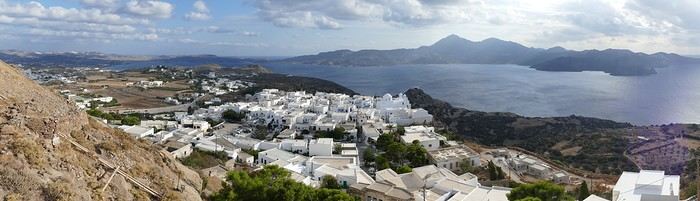
The village of Plaka in Milos
It was with great pleasure that we finally reconnected with our old habits as inveterate travelers! Greece, and more specifically the Greek islands, was the natural choice for us. After having already visited many Greek islands during around 18 trips, we decided to revisit islands we had seen over 40 years ago, like Milos, where our memories were extremely hazy. Our route was well-planned and familiar: a low-cost flight from Basel-Mulhouse to Athens, then a traditional ferry from Piraeus to Milos. Taking a speedboat, which is faster, would have forced us to spend a night in Piraeus. Plus, we felt that the traditional ferry was part of the journey, and with good weather, spending eight hours on deck wasn’t unpleasant at all. Watching the docking maneuvers with the comings and goings of trucks and cars, observing the passengers, reading a book, or admiring the scenery—all of that is part of the travel experience. Milos Island: Accommodation in Adamas We arrived quite late, around 11 PM, in Adamas, the port of Milos. No worries—the friendly couple managing the apartment was waiting for us, and it was just a 10-minute walk from the port. The first two days were spent unwinding, with swimming at the nearby beach, strolling through Adamas, and relaxing.
Discovering Plaka On the third day, we took the path along the small beach west of town toward a French military cemetery! A historical reminder of our presence here during the Crimean War, among others. The path climbs toward a beacon perched on top of a hill before disappearing into the scrubland. We returned to Adamas for lunch on our terrace.
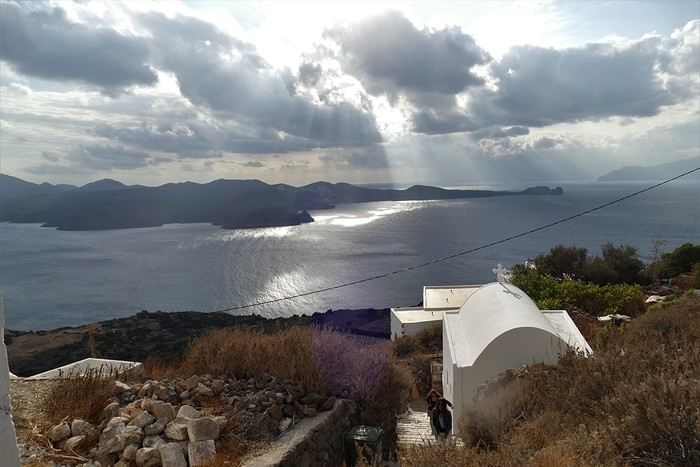
In the afternoon, we visited the hilltop village of Plaka by bus from Adamas. Plaka is the original old town, dominated by a church and, even higher up, the ruins of the Kastro. The view is magnificent. We stopped at a pastry shop in the village to enjoy excellent orange cakes and baklavas. Back in Adamas, we checked out car rental agencies to be more mobile, though the bus network seemed quite extensive. It costs around 40 € per day, plus 8 € if you want to significantly reduce the deductible. Port of Klima.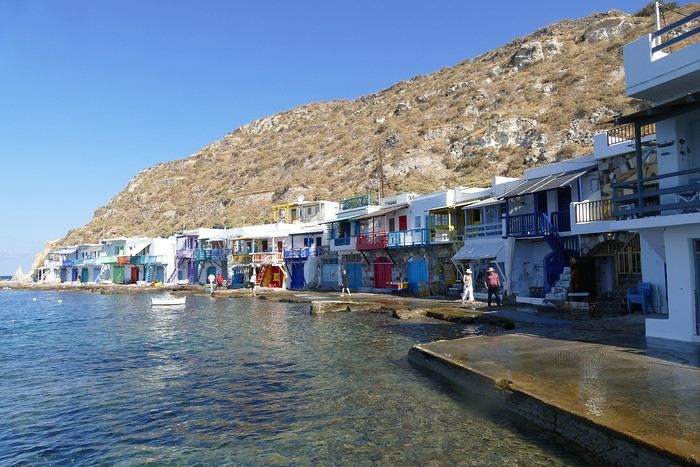
Yesterday’s weather was quite mixed with lots of clouds, but today the sun is shining again. We drove to the small port of Klima, famous for its boat garages called "sirmatas." It’s true that in the morning sun, these boat garages carved into the volcanic tuff are beautifully lit, turning the village into a colorful mosaic. Above the village, a path climbs directly to the magnificent Roman theater overlooking the surroundings and the sea.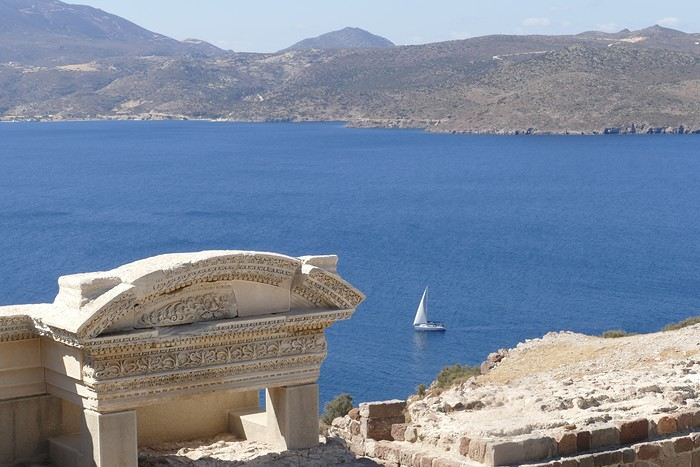 Following the well-marked path, we reached the road leading 200 meters down to the catacombs. It’s an impressive complex of 3rd and 4th-century catacombs, though only a small part is open to visitors—it’s still very moving. In the mid-afternoon, we got back in the car to visit the tiny ports of Firopotamos and Mandraki, which also have their colorful sirmatas. We took the opportunity to swim at the small beach in Mandraki, where the water was warm and calm.
Mandraki Port. We had a decent dinner at a seaside restaurant in Adamas, though you have to be selective—we had a bad experience at Kynigos on the second night!
Moving to Polonia in Eastern Milos, Sarakiniko Site
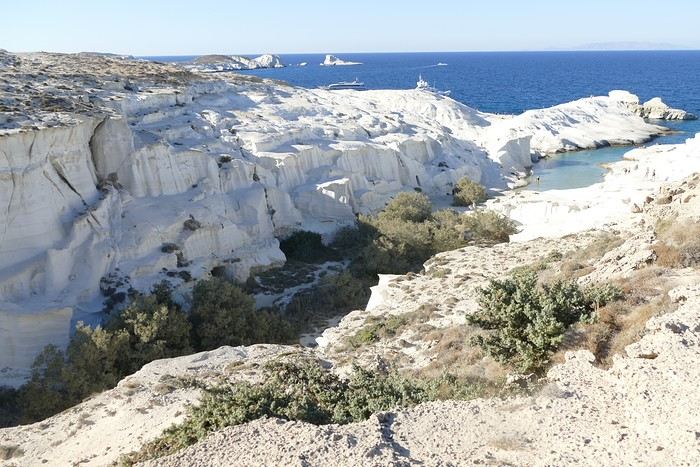
The Sarakiniko site We left Adamas for a second stay on Milos, this time in Polonia. The rental Panda was packed with the four of us and our luggage! Our apartment was in a beautiful house surrounded by a grove, so our lovely terrace was well-shaded. Luckily, there was a small beach nearby, and we went for a swim right away. Apart from us, there were only three other swimmers—definitely the end of the season!
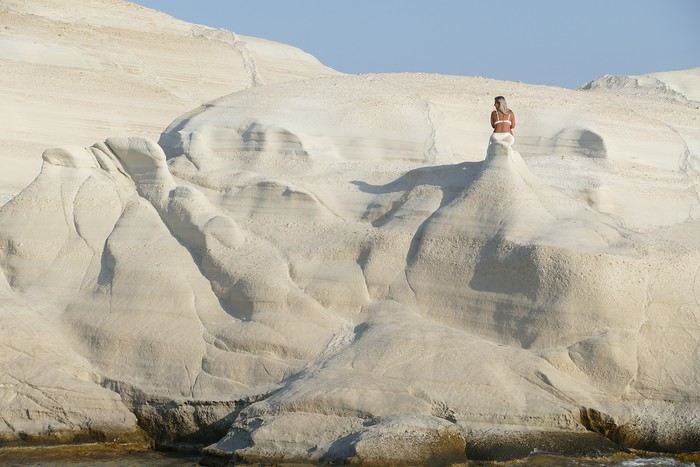
"Fairy chimney"! In the afternoon, we visited the famous Sarakiniko site, Milos’ emblematic spot. Judging by the number of cars in the parking lot, we wouldn’t be alone. As we approached, we heard an indefinable rock/punk/metal music: some young people had brought a sound system and a foghorn and were having fun diving off a fairly high cliff to impress the crowd. It definitely spoiled the visit. Most spots were taken by couples busy taking selfies, so getting photos of the site without tourists was impossible. Still, the site is magnificent, with its white cliffs looking like they’re covered in whipped cream! The sun was still very bright, reflecting strongly off the cliffs, making photography difficult due to the excessive brightness. We had a fish dinner in Polonia at the Enalion restaurant: while the octopus and squid were good, the fish soup tasted more like vegetable soup with a few fish crumbs—too bad.
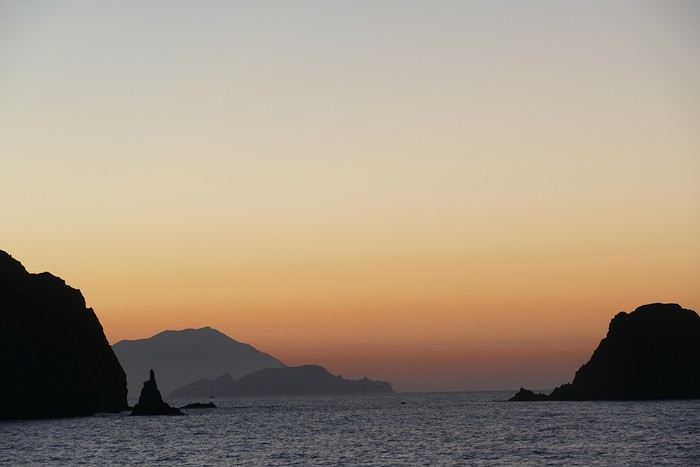
Sunset in Polonia
Ports of Papafranga and Mytikos We continued our exploration of Milos with the Papafranga gorge, a narrow and deep gorge that opens to the sea, where the water is a stunning color. Access via an unstable and dangerous path is prohibited, but that didn’t stop a couple of tourists in flip-flops from venturing in!!! We then swam in the tiny, calm, and sheltered cove of the small port of Mytikos. We returned to Polonia for lunch at Alkis: excellent moussaka. In the late afternoon, Pat and I went out to take some photos just before sunset near the Agios Nikolaos chapel, the beacon, and the new Petakoudia neighborhood next to Polonia to the north.
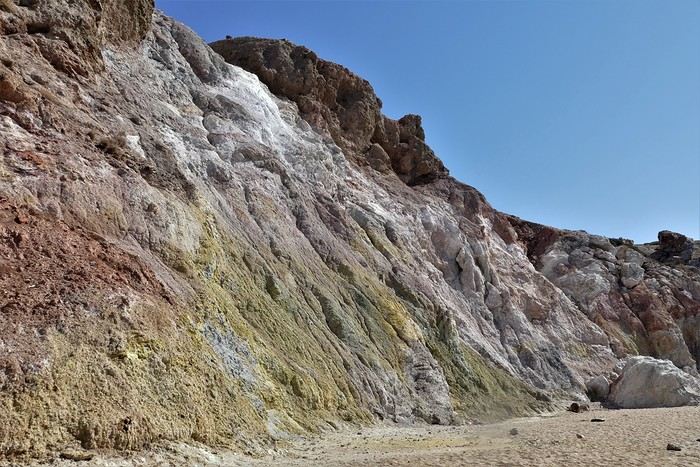
Paleochori Beach
Toward the Multicolored Beach of Paleochori Another sunny day: we still had to discover Paleochori Beach in the south of the island. It was 10:30 AM, and the beach was almost deserted! The water was pleasant, though a bit chilly when we first entered. The beach is bordered by a cliff that, in some places, displays a beautiful multicolored palette. We returned to Polonia in the late afternoon, and Pat and I headed toward Vouddhia Beach south of Polonia—bad choice. The beach is surrounded by a huge mining site served by a dusty road where lines of trucks loaded with ore cross paths. It’s the other side of the coin, and Greece still has progress to make in this area. Dinner at Alki’s was just as good as always. Return to the Sarakiniko Site Early this morning, Pat and I went back to the Sarakiniko site, hoping to take photos in better conditions. While there were fewer people, the parking lot was still full because sunrise is a must in Milos. Still, the conditions were good, and the sunrise spectators left quickly once the sun had risen above the horizon. During the day, an increasingly strong wind cooled the atmosphere, making swimming less enjoyable. Departure for Kimolos Island We changed islands and left Milos for Kimolos, a nearby island—just a 30-minute trip from Polonia’s port. Our apartment was at the entrance of the hilltop village. It’s a village with typical Cycladic architecture, featuring the remains of an old kastro, a few old churches, and windmill towers perched on the hill. We dined in a tiny tavern where the small outdoor tables were squeezed against the walls to let passersby through! As soon as the sun disappeared, it got cold, especially because of the wind. Ports of Kara and Goupa This morning, we explored the small hamlets of Kara and Goupa by Rema Beach, east of the main port. There, we found the sirmatas again—those boat garages partly carved into the volcanic tuff. The path winds between several sirmatas before climbing back up to the Praça road to return to the apartment.
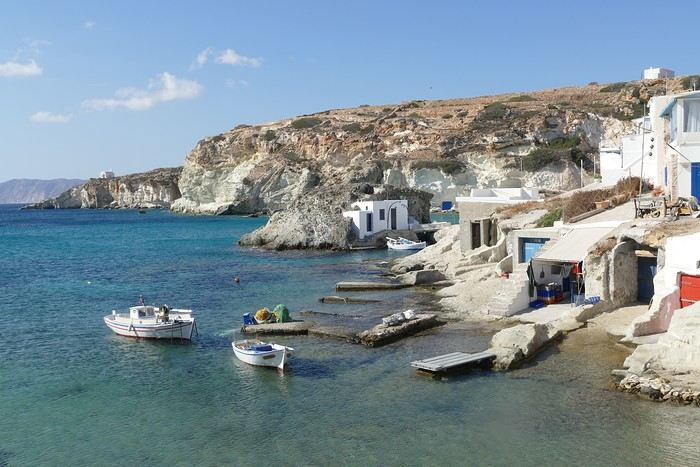
Ports of Kara and Goupa
In the afternoon, we strolled through town, and Pat and I climbed the hill overlooking the village to get a closer look at the few more or less ruined windmills dotting the ridge. Only one mill still had its complete mechanism in place under the roof; the others were empty. The view over the village, port, and sea was beautiful. That evening, we tried another restaurant in the village center, Kali Kardia Bohoris, which was well-frequented by locals, and we didn’t regret it: delicious food, efficient and friendly service, and reasonable prices.
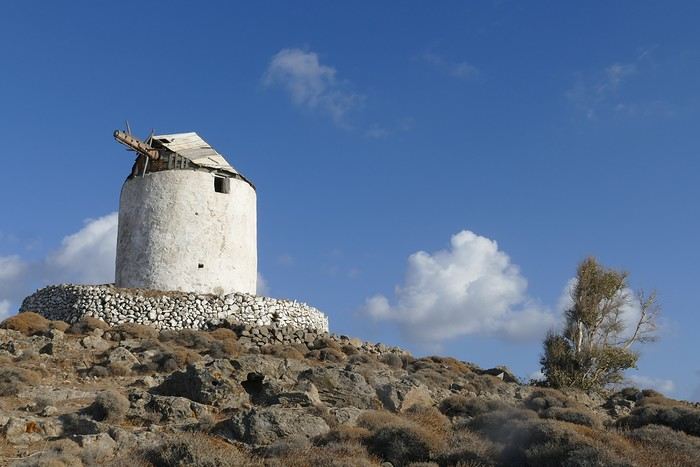
The Kastro Mill
Toward Aliki Beach We walked to Aliki Beach, west of the main village. It’s a large sandy beach shaded by tamarisk trees, but the strong wind prevented us from enjoying it. In the afternoon, I set off on a hike toward the fairy chimney at Skiadi (1.5 hours one way). The paths were very well-marked with signs indicating the trail number and the time to reach the destination. The countryside was beautiful but very dry at this time of year, and as always in Greece, many white chapels dotted the landscape. The numerous dry stone walls testify to the immense labor done by the island’s inhabitants over the centuries! For our last day in Kimolos, we decided to visit the beautiful Praça Beach, one of the most beautiful according to the guides! To get there, we took a path through the interior before joining the paved road near a large dump overflowing with various waste. It’s the flip side of the scenery, and Greece still has progress to make in this area. In the end, Praça Beach left us underwhelmed. The environment, marred by mining operations, detracts from the charm of the beautiful sandy beach. End of the Trip, Return to Piraeus and France And that’s it—we took the Zanteferries ferry back to Piraeus, arriving after a calm and sunny 10-hour journey. We had dinner at Souvlaki Street on the port and spent a good night at the Faros I Hotel in Piraeus—a great spot, close to the port, very clean, and reasonably priced. We flew from Athens to Basel-Mulhouse EuroAirport without any issues. N.B. Budget: around 1850 € all included for 14 days per couple The photo album is available by clicking this link: https://photos.app.goo.gl/wRpxRipg4erpzGj99
The village of Plaka in Milos
It was with great pleasure that we finally reconnected with our old habits as inveterate travelers! Greece, and more specifically the Greek islands, was the natural choice for us. After having already visited many Greek islands during around 18 trips, we decided to revisit islands we had seen over 40 years ago, like Milos, where our memories were extremely hazy. Our route was well-planned and familiar: a low-cost flight from Basel-Mulhouse to Athens, then a traditional ferry from Piraeus to Milos. Taking a speedboat, which is faster, would have forced us to spend a night in Piraeus. Plus, we felt that the traditional ferry was part of the journey, and with good weather, spending eight hours on deck wasn’t unpleasant at all. Watching the docking maneuvers with the comings and goings of trucks and cars, observing the passengers, reading a book, or admiring the scenery—all of that is part of the travel experience. Milos Island: Accommodation in Adamas We arrived quite late, around 11 PM, in Adamas, the port of Milos. No worries—the friendly couple managing the apartment was waiting for us, and it was just a 10-minute walk from the port. The first two days were spent unwinding, with swimming at the nearby beach, strolling through Adamas, and relaxing.
Discovering Plaka On the third day, we took the path along the small beach west of town toward a French military cemetery! A historical reminder of our presence here during the Crimean War, among others. The path climbs toward a beacon perched on top of a hill before disappearing into the scrubland. We returned to Adamas for lunch on our terrace.
In the afternoon, we visited the hilltop village of Plaka by bus from Adamas. Plaka is the original old town, dominated by a church and, even higher up, the ruins of the Kastro. The view is magnificent. We stopped at a pastry shop in the village to enjoy excellent orange cakes and baklavas. Back in Adamas, we checked out car rental agencies to be more mobile, though the bus network seemed quite extensive. It costs around 40 € per day, plus 8 € if you want to significantly reduce the deductible. Port of Klima.
Yesterday’s weather was quite mixed with lots of clouds, but today the sun is shining again. We drove to the small port of Klima, famous for its boat garages called "sirmatas." It’s true that in the morning sun, these boat garages carved into the volcanic tuff are beautifully lit, turning the village into a colorful mosaic. Above the village, a path climbs directly to the magnificent Roman theater overlooking the surroundings and the sea.
Following the well-marked path, we reached the road leading 200 meters down to the catacombs. It’s an impressive complex of 3rd and 4th-century catacombs, though only a small part is open to visitors—it’s still very moving. In the mid-afternoon, we got back in the car to visit the tiny ports of Firopotamos and Mandraki, which also have their colorful sirmatas. We took the opportunity to swim at the small beach in Mandraki, where the water was warm and calm.
Mandraki Port. We had a decent dinner at a seaside restaurant in Adamas, though you have to be selective—we had a bad experience at Kynigos on the second night!
Moving to Polonia in Eastern Milos, Sarakiniko SiteThe Sarakiniko site We left Adamas for a second stay on Milos, this time in Polonia. The rental Panda was packed with the four of us and our luggage! Our apartment was in a beautiful house surrounded by a grove, so our lovely terrace was well-shaded. Luckily, there was a small beach nearby, and we went for a swim right away. Apart from us, there were only three other swimmers—definitely the end of the season!
"Fairy chimney"! In the afternoon, we visited the famous Sarakiniko site, Milos’ emblematic spot. Judging by the number of cars in the parking lot, we wouldn’t be alone. As we approached, we heard an indefinable rock/punk/metal music: some young people had brought a sound system and a foghorn and were having fun diving off a fairly high cliff to impress the crowd. It definitely spoiled the visit. Most spots were taken by couples busy taking selfies, so getting photos of the site without tourists was impossible. Still, the site is magnificent, with its white cliffs looking like they’re covered in whipped cream! The sun was still very bright, reflecting strongly off the cliffs, making photography difficult due to the excessive brightness. We had a fish dinner in Polonia at the Enalion restaurant: while the octopus and squid were good, the fish soup tasted more like vegetable soup with a few fish crumbs—too bad.
Sunset in Polonia
Ports of Papafranga and Mytikos We continued our exploration of Milos with the Papafranga gorge, a narrow and deep gorge that opens to the sea, where the water is a stunning color. Access via an unstable and dangerous path is prohibited, but that didn’t stop a couple of tourists in flip-flops from venturing in!!! We then swam in the tiny, calm, and sheltered cove of the small port of Mytikos. We returned to Polonia for lunch at Alkis: excellent moussaka. In the late afternoon, Pat and I went out to take some photos just before sunset near the Agios Nikolaos chapel, the beacon, and the new Petakoudia neighborhood next to Polonia to the north.
Paleochori Beach
Toward the Multicolored Beach of Paleochori Another sunny day: we still had to discover Paleochori Beach in the south of the island. It was 10:30 AM, and the beach was almost deserted! The water was pleasant, though a bit chilly when we first entered. The beach is bordered by a cliff that, in some places, displays a beautiful multicolored palette. We returned to Polonia in the late afternoon, and Pat and I headed toward Vouddhia Beach south of Polonia—bad choice. The beach is surrounded by a huge mining site served by a dusty road where lines of trucks loaded with ore cross paths. It’s the other side of the coin, and Greece still has progress to make in this area. Dinner at Alki’s was just as good as always. Return to the Sarakiniko Site Early this morning, Pat and I went back to the Sarakiniko site, hoping to take photos in better conditions. While there were fewer people, the parking lot was still full because sunrise is a must in Milos. Still, the conditions were good, and the sunrise spectators left quickly once the sun had risen above the horizon. During the day, an increasingly strong wind cooled the atmosphere, making swimming less enjoyable. Departure for Kimolos Island We changed islands and left Milos for Kimolos, a nearby island—just a 30-minute trip from Polonia’s port. Our apartment was at the entrance of the hilltop village. It’s a village with typical Cycladic architecture, featuring the remains of an old kastro, a few old churches, and windmill towers perched on the hill. We dined in a tiny tavern where the small outdoor tables were squeezed against the walls to let passersby through! As soon as the sun disappeared, it got cold, especially because of the wind. Ports of Kara and Goupa This morning, we explored the small hamlets of Kara and Goupa by Rema Beach, east of the main port. There, we found the sirmatas again—those boat garages partly carved into the volcanic tuff. The path winds between several sirmatas before climbing back up to the Praça road to return to the apartment.
Ports of Kara and Goupa
In the afternoon, we strolled through town, and Pat and I climbed the hill overlooking the village to get a closer look at the few more or less ruined windmills dotting the ridge. Only one mill still had its complete mechanism in place under the roof; the others were empty. The view over the village, port, and sea was beautiful. That evening, we tried another restaurant in the village center, Kali Kardia Bohoris, which was well-frequented by locals, and we didn’t regret it: delicious food, efficient and friendly service, and reasonable prices.
The Kastro Mill
Toward Aliki Beach We walked to Aliki Beach, west of the main village. It’s a large sandy beach shaded by tamarisk trees, but the strong wind prevented us from enjoying it. In the afternoon, I set off on a hike toward the fairy chimney at Skiadi (1.5 hours one way). The paths were very well-marked with signs indicating the trail number and the time to reach the destination. The countryside was beautiful but very dry at this time of year, and as always in Greece, many white chapels dotted the landscape. The numerous dry stone walls testify to the immense labor done by the island’s inhabitants over the centuries! For our last day in Kimolos, we decided to visit the beautiful Praça Beach, one of the most beautiful according to the guides! To get there, we took a path through the interior before joining the paved road near a large dump overflowing with various waste. It’s the flip side of the scenery, and Greece still has progress to make in this area. In the end, Praça Beach left us underwhelmed. The environment, marred by mining operations, detracts from the charm of the beautiful sandy beach. End of the Trip, Return to Piraeus and France And that’s it—we took the Zanteferries ferry back to Piraeus, arriving after a calm and sunny 10-hour journey. We had dinner at Souvlaki Street on the port and spent a good night at the Faros I Hotel in Piraeus—a great spot, close to the port, very clean, and reasonably priced. We flew from Athens to Basel-Mulhouse EuroAirport without any issues. N.B. Budget: around 1850 € all included for 14 days per couple The photo album is available by clicking this link: https://photos.app.goo.gl/wRpxRipg4erpzGj99
Hi everyone,
I’m planning my first trip to Greece from October 29th to November 23rd and I’d love to hear your thoughts and suggestions on the itinerary I’m considering. For a first visit, I’ll definitely cover the traditional tourist route, but I’m also open to off-the-beaten-path ideas. I’m curious and interested in history, archaeological sites, and the islands—more for culture than beaches, anyway, especially in November!
Here’s the plan: 3–4 days in Athens, 2 days in Nafplio: visiting Epidaurus and Mycenae, Stop in Olympia on the way to Delphi via Patras by bus? To avoid backtracking to Athens; 2 days in Delphi, including the site and Mount Parnassus, Explore the Ionian coast and a few islands? A few days in Corfu, 3 days in Meteora, 2–3 days in Thessaloniki, Direct flight from Thessaloniki to Heraklion, Crete, 3–4 days in Crete, November 22nd–23rd: overnight ferry back to Athens to catch my return flight to Montreal.
You’ve probably guessed I’m traveling solo. It might seem a bit scattered right now—I’ve started reading up on Greece, and there are must-see spots. What feels unclear are the 4–5 days between Delphi and Corfu. Also, mid-November in the islands might not be ideal if the weather’s bad.
Is Corfu worth it? Maybe there are other options—like a few days in Albania? Just throwing the idea out there.
Thanks for your input! I’d love to hear about your experiences to help enrich my upcoming trip.
hi everyone
It's still just a plan, but I'm considering traveling to Antalya in Turkey in autumn 2025 using the following route: - From France to the Croatian coast (route not yet defined) - "Down" the Croatian coast, Montenegro, Albania, and Greece. - Crossing the Peloponnese to Kalamata - Ferry to Kissamos (Crete) - Crossing Crete and ferry from Sitia to Rhodes - Tour of Rhodes and crossing to Fethiye (Turkey) - Connection to Antalya
If anyone has already taken this route, I’d love to hear any tips or advice. For now, I don’t have info on ferries for September and October—have you taken them? Do they allow bikes? Top
Hi everyone!
Blue skies (lots of them), whitewashed villages with steep alleyways, hundreds of churches, and... thousands of stairs? Welcome to the Cyclades! 🙂
We’d been dreaming about this for a while, but in July-August—with the crowds—no way! Now that I can travel outside school holidays, the Cyclades are back on the agenda. And so begins a loooong period of planning and second-guessing, with countless itinerary changes: the Cyclades, yes, but which ones? I was fixated on Folegandros (we won’t be going after all) and really wanted to visit Delos. So, for this first trip, it’ll be: Mykonos (and Delos)-Naxos-Amorgos-Santorini.
Saturday 24/05: Departure from Orly on a Transavia flight, arriving in Mykonos in the late afternoon. We found a hotel that offers free transfers (pretty rare and not insignificant—it’s 25 € each way for just a few kilometers 😠) and at a reasonable price (83 € per night for B&B). Time for dinner already: Greek salad and souvlaki (we’re in Greece, right?)
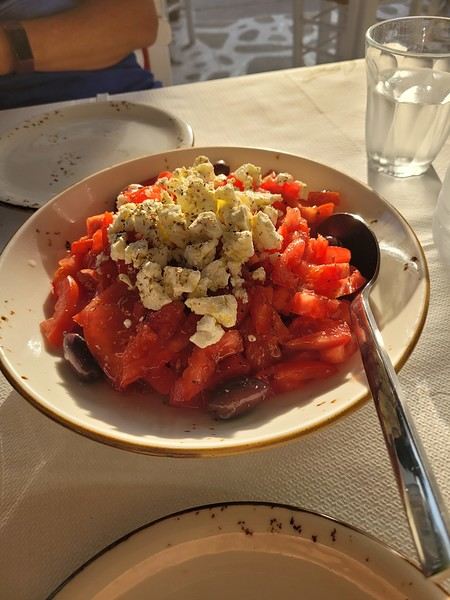 (Okay, this is actually a dakos with Naxos cheese, but I don’t have a photo of a Greek salad 😏).
Blue skies (lots of them), whitewashed villages with steep alleyways, hundreds of churches, and... thousands of stairs? Welcome to the Cyclades! 🙂
We’d been dreaming about this for a while, but in July-August—with the crowds—no way! Now that I can travel outside school holidays, the Cyclades are back on the agenda. And so begins a loooong period of planning and second-guessing, with countless itinerary changes: the Cyclades, yes, but which ones? I was fixated on Folegandros (we won’t be going after all) and really wanted to visit Delos. So, for this first trip, it’ll be: Mykonos (and Delos)-Naxos-Amorgos-Santorini.
Saturday 24/05: Departure from Orly on a Transavia flight, arriving in Mykonos in the late afternoon. We found a hotel that offers free transfers (pretty rare and not insignificant—it’s 25 € each way for just a few kilometers 😠) and at a reasonable price (83 € per night for B&B). Time for dinner already: Greek salad and souvlaki (we’re in Greece, right?)
(Okay, this is actually a dakos with Naxos cheese, but I don’t have a photo of a Greek salad 😏).Curious travelers all share the same wish: to discover a country or region by stepping off the beaten path and avoiding tourist traps. Who wouldn’t agree with that?
But does that mean we should skip the tourist sites that guidebooks and local tourism offices tout as must-sees? Of course not!
On the Greek island of Rhodes, Lindos, the "Pearl of the South," is undoubtedly the most visited village. Making the trip there is enough to understand its appeal—and I’ll admit, I too fell under the spell of this enchanting place. Through this post and these photos, I want to share my memories, impressions, and a lot of my enthusiasm.
First, there’s that stunning panoramic view you get from the road when arriving from the north of the island. The urge to stop is irresistible.

Perched on a rocky spur, an imposing citadel overlooks a village with that classic Greek charm—whitewashed houses. At the foot of the hill, you can see a perfectly curved bay (the arc is almost flawless) with deep blue waters bordering a lovely stretch of light sand...
With an artist’s eye, you could say this landscape is an ideal painting, and what a beautiful palette of colors! A photographer’s eye will be delighted by the balance of the composition, and any traveler who loves beautiful scenery will simply be captivated by this exceptional view.
This plunging viewpoint is a delicious preview of the site, making me eager to discover more and see Lindos in every detail.
The road winds along the mountainside for about two kilometers before reaching the destination—well, you quickly realize you can’t drive into the narrow alleys! No, you have to leave your car in the parking lots near the village. Spaces are already filling up with private cars and a neat line of tour buses—so we won’t be the only ones visiting Lindos this morning!
The main street, at the heart of the village, is a succession of cafés, tavernas serving ouzo/feta/moussaka, and souvenir shops (T-shirts, pottery, trinkets, flags...). At peak hours, it’s the usual tourist hustle and bustle—easy to imagine.
Fortunately, just a few steps down a side alley, and you quickly find calm and almost solitude.

Aren’t there any cats in Lindos? Not really—domestic felines are everywhere in the village’s alleys. Here are two: a black-and-white one resting on a windowsill and another, all white, heading toward a dead end. In that narrow lane sits an elderly man, his face weathered by the sun, with a salt-and-pepper mustache. Our eyes meet, and I greet him with a "Kalimera" (good morning in Greek, one of the few words I know in the local language!). That earns me a hint of a smile, followed by a question. He’s asking for a cigarette—sorry, my friend, but I don’t smoke!
Wandering, observing, even getting lost in these narrow alleys—that’s how to truly appreciate Lindos. Dazzling white walls, beautiful homes (some dating back to the 15th century), entrances framed by Gothic arches, and wreaths or bouquets of dried flowers adorning the facades. Here and there, muffled conversations can be heard through half-closed shutters, and an ajar door offers a glimpse of lovely inner courtyards where the reds and purples of bougainvillea contrast with the white walls. The locals also add beautiful decorative touches to the floors of patios or stair steps, with black-and-white pebble mosaics forming geometric patterns.
At times, the silence of the alleys away from the center is broken by the puttering of a scooter or hybrid vehicles—half-scooter, half-van—that barely squeeze between the walls of the narrow lanes!

After crisscrossing this real labyrinth, I arrive in front of the village’s main church, the Church of Panagia. A beautiful building dedicated to the Virgin, restored in the 15th century by the Knights of the Order of St. John.
Looking up to admire the bell tower of this Greek Orthodox church, I catch a glimpse among the clustered rooftops of part of the fortifications overlooking the town—the next step in my discovery of Lindos’ heritage.
To reach the citadel’s rock, you’re offered "Lindos taxis" at every corner—donkey rides. The effect is guaranteed for tourists discouraged by the 115 meters of elevation to climb to reach the ramparts: bursts of laughter, donkey hooves slipping on the cobblestones, and the capricious moods of these sometimes stubborn animals. Hee-haw!

You guessed it—I chose to walk up the path along the mountainside. The route reveals magnificent panoramas of the village and the coast, lined with pink oleanders, and you breathe in the fresh air among the olive trees—though sometimes the unmistakable smell of donkey droppings fills the air, with the sea breeze helping to disperse it.

Climbing the fortress steps is like traveling back in time. Here, the testimonies of Lindos’ rich history unfold before visitors’ eyes.
First, the imposing ramparts, built in the Middle Ages by the Knights of the Order of St. John—master builders of defensive structures whose primary mission was to aid and care for pilgrims wounded during the Crusades.
Within the fortifications, you’ll also find the remains of a Byzantine-era church from the 13th century, with its frescoes and murals. Further up, at the top of the rocks, you encounter ancient Greece: the acropolis and the temple dedicated to the goddess Athena. According to historians, the first inhabitants of the site were the Minoans, around 1200 BCE. An ambitious architectural restoration program aims to bring this past back to life.

But once you reach the ancient esplanade, most visitors head straight for the ramparts. The view through their openings is simply breathtaking and dizzying. On the sea side, the cliff drops steeply, and at the foot of the cliffs lies another bay, its shape reminiscent of a heart. Turquoise waters and a small white chapel surrounded by oleanders.
Seeing this panorama, you tell yourself you absolutely must visit it before leaving Lindos.

On the village side, the view is just as stunning—a true aerial perspective of the entire town and its charming white houses. You can easily spot the church with its red-tiled roof. Among the cluster of houses, some have flat rooftops—these belonged to the captains. Lindos was once an important commercial port, strategically located on the maritime route from Europe to the East. From their terraces, these famous ship captains could watch the comings and goings of their vessels.

Back then, Lindos was the capital of Rhodes and had nearly 17,000 inhabitants—far more than the 700 current residents. But these locals proudly claim Lindos is still the capital of Rhodes—well, a tourist capital, at least!
From the vantage point of these ramparts, you also overlook the tiny beach below. The sight of it can only make you want to take a dip—my next stop, a welcome break after the historical and cultural visit.
Walking back through the village via different alleys, I pass some beautiful homes and new chapels, like the one I’m in front of now—a white dome, a classic example of Greek island religious architecture. Dedicated to St. George, it dates back to the 14th century.
Time for some beach fun—that’s Lindos too! A chance to take a dip in crystal-clear, delicious waters with that unmistakable view of Lindos as your backdrop.

Now, heading toward St. Paul’s Bay—the one I spotted from the citadel. Seen from ground level, it’s even more charming, with its little white chapel nestled against the cliffs. The bay and the church are named after the Apostle Paul. History—or legend—tells of the religious figure stopping here during a journey between Ephesus and Syria.

These days, the chapel is a hit with newlyweds—celebrations seem to be back-to-back this afternoon. The idyllic setting is perfect for a beautiful keepsake photo, as any amateur photographer would agree!
As the hours pass, the flow of day-trippers thins out, and Lindos regains a sense of calm and authenticity that suits it so well. As if by magic, the fading light bathes the village in a golden hue—worth admiring without restraint.

Though Lindos is well sheltered from the sea, nestled in its protective cove, its entire past is oriented toward the open water. To etch this unique site even deeper into my memory, I want to see Lindos again from the sea.
The boat, "Captain Manolis," is ready. This morning, we’re at the pebble beach of Vlicha, just a short distance from the village.

The start of the voyage takes us along stark rocky cliffs—a mineral world animated by seabirds, which is classic, but also by goats, which is more unusual. These sure-footed caprins navigate the cliffside along the rock strata—no fear of heights here!
Then, your gaze is drawn to Lindos again, always Lindos—a viewpoint that’s also worth the detour: perched fortifications, white village, and a broad expanse of deep blue in the foreground.

A palette of blues enriched by the waters of the bay just south of the village. The play of light, the reflection of the sky, the transparency of the sea, combined with sandy seabeds, create a breathtaking result: an unreal, almost magical shade of blue. The deep blue!

Puff! Puff! Puff! The boat’s engine slows down. Our captain seems focused and attentive as we navigate through a narrow corridor of jagged rocks. These impressive cliffs have sparked sailors’ imaginations, and our captain points out the lion. A wild feline in the area? Not exactly, but a rock whose shape might suggest a lion’s head—why not, from a certain angle? Just as you start to see the resemblance, the image fades—a fleeting lion, like a mirage.

Twilight also offers visitors fleeting and magical sights. As the deep blue envelops the atmosphere, the lights enhance Lindos’ panorama.
And to add an original and aesthetic touch (as if it were needed!), the amateur photographer in me plays with my camera’s aperture to make the bay and village sparkle with dozens of stars. Isn’t Lindos called the "Pearl of the South"? A pearl that sometimes shines brilliantly!
 LINDOS ISLAND OF RHODES (GREECE) May 2011
Tips: To avoid the crowds of tourists arriving (by boat and especially by bus or car!) for a day trip, it’s best to arrive before 9 AM. Also note: the visit to the Citadel/Ancient Ruins starts at 8:30 AM and closes at 3 PM. Ticket to access the site: 6 €. In the late afternoon, the lighting is beautiful over the village—a splendid viewpoint from the road leading to St. Paul’s Bay. Boat excursion with "Captain Manolis": daily departures (May to September) from Vlicha Beach (a bay 3 km north of Lindos), 25 €.
But does that mean we should skip the tourist sites that guidebooks and local tourism offices tout as must-sees? Of course not!
On the Greek island of Rhodes, Lindos, the "Pearl of the South," is undoubtedly the most visited village. Making the trip there is enough to understand its appeal—and I’ll admit, I too fell under the spell of this enchanting place. Through this post and these photos, I want to share my memories, impressions, and a lot of my enthusiasm.
First, there’s that stunning panoramic view you get from the road when arriving from the north of the island. The urge to stop is irresistible.
Perched on a rocky spur, an imposing citadel overlooks a village with that classic Greek charm—whitewashed houses. At the foot of the hill, you can see a perfectly curved bay (the arc is almost flawless) with deep blue waters bordering a lovely stretch of light sand...
With an artist’s eye, you could say this landscape is an ideal painting, and what a beautiful palette of colors! A photographer’s eye will be delighted by the balance of the composition, and any traveler who loves beautiful scenery will simply be captivated by this exceptional view.
This plunging viewpoint is a delicious preview of the site, making me eager to discover more and see Lindos in every detail.
The road winds along the mountainside for about two kilometers before reaching the destination—well, you quickly realize you can’t drive into the narrow alleys! No, you have to leave your car in the parking lots near the village. Spaces are already filling up with private cars and a neat line of tour buses—so we won’t be the only ones visiting Lindos this morning!
The main street, at the heart of the village, is a succession of cafés, tavernas serving ouzo/feta/moussaka, and souvenir shops (T-shirts, pottery, trinkets, flags...). At peak hours, it’s the usual tourist hustle and bustle—easy to imagine.
Fortunately, just a few steps down a side alley, and you quickly find calm and almost solitude.
Aren’t there any cats in Lindos? Not really—domestic felines are everywhere in the village’s alleys. Here are two: a black-and-white one resting on a windowsill and another, all white, heading toward a dead end. In that narrow lane sits an elderly man, his face weathered by the sun, with a salt-and-pepper mustache. Our eyes meet, and I greet him with a "Kalimera" (good morning in Greek, one of the few words I know in the local language!). That earns me a hint of a smile, followed by a question. He’s asking for a cigarette—sorry, my friend, but I don’t smoke!
Wandering, observing, even getting lost in these narrow alleys—that’s how to truly appreciate Lindos. Dazzling white walls, beautiful homes (some dating back to the 15th century), entrances framed by Gothic arches, and wreaths or bouquets of dried flowers adorning the facades. Here and there, muffled conversations can be heard through half-closed shutters, and an ajar door offers a glimpse of lovely inner courtyards where the reds and purples of bougainvillea contrast with the white walls. The locals also add beautiful decorative touches to the floors of patios or stair steps, with black-and-white pebble mosaics forming geometric patterns.
At times, the silence of the alleys away from the center is broken by the puttering of a scooter or hybrid vehicles—half-scooter, half-van—that barely squeeze between the walls of the narrow lanes!
After crisscrossing this real labyrinth, I arrive in front of the village’s main church, the Church of Panagia. A beautiful building dedicated to the Virgin, restored in the 15th century by the Knights of the Order of St. John.
Looking up to admire the bell tower of this Greek Orthodox church, I catch a glimpse among the clustered rooftops of part of the fortifications overlooking the town—the next step in my discovery of Lindos’ heritage.
To reach the citadel’s rock, you’re offered "Lindos taxis" at every corner—donkey rides. The effect is guaranteed for tourists discouraged by the 115 meters of elevation to climb to reach the ramparts: bursts of laughter, donkey hooves slipping on the cobblestones, and the capricious moods of these sometimes stubborn animals. Hee-haw!
You guessed it—I chose to walk up the path along the mountainside. The route reveals magnificent panoramas of the village and the coast, lined with pink oleanders, and you breathe in the fresh air among the olive trees—though sometimes the unmistakable smell of donkey droppings fills the air, with the sea breeze helping to disperse it.
Climbing the fortress steps is like traveling back in time. Here, the testimonies of Lindos’ rich history unfold before visitors’ eyes.
First, the imposing ramparts, built in the Middle Ages by the Knights of the Order of St. John—master builders of defensive structures whose primary mission was to aid and care for pilgrims wounded during the Crusades.
Within the fortifications, you’ll also find the remains of a Byzantine-era church from the 13th century, with its frescoes and murals. Further up, at the top of the rocks, you encounter ancient Greece: the acropolis and the temple dedicated to the goddess Athena. According to historians, the first inhabitants of the site were the Minoans, around 1200 BCE. An ambitious architectural restoration program aims to bring this past back to life.
But once you reach the ancient esplanade, most visitors head straight for the ramparts. The view through their openings is simply breathtaking and dizzying. On the sea side, the cliff drops steeply, and at the foot of the cliffs lies another bay, its shape reminiscent of a heart. Turquoise waters and a small white chapel surrounded by oleanders.
Seeing this panorama, you tell yourself you absolutely must visit it before leaving Lindos.
On the village side, the view is just as stunning—a true aerial perspective of the entire town and its charming white houses. You can easily spot the church with its red-tiled roof. Among the cluster of houses, some have flat rooftops—these belonged to the captains. Lindos was once an important commercial port, strategically located on the maritime route from Europe to the East. From their terraces, these famous ship captains could watch the comings and goings of their vessels.
Back then, Lindos was the capital of Rhodes and had nearly 17,000 inhabitants—far more than the 700 current residents. But these locals proudly claim Lindos is still the capital of Rhodes—well, a tourist capital, at least!
From the vantage point of these ramparts, you also overlook the tiny beach below. The sight of it can only make you want to take a dip—my next stop, a welcome break after the historical and cultural visit.
Walking back through the village via different alleys, I pass some beautiful homes and new chapels, like the one I’m in front of now—a white dome, a classic example of Greek island religious architecture. Dedicated to St. George, it dates back to the 14th century.
Time for some beach fun—that’s Lindos too! A chance to take a dip in crystal-clear, delicious waters with that unmistakable view of Lindos as your backdrop.
Now, heading toward St. Paul’s Bay—the one I spotted from the citadel. Seen from ground level, it’s even more charming, with its little white chapel nestled against the cliffs. The bay and the church are named after the Apostle Paul. History—or legend—tells of the religious figure stopping here during a journey between Ephesus and Syria.
These days, the chapel is a hit with newlyweds—celebrations seem to be back-to-back this afternoon. The idyllic setting is perfect for a beautiful keepsake photo, as any amateur photographer would agree!
As the hours pass, the flow of day-trippers thins out, and Lindos regains a sense of calm and authenticity that suits it so well. As if by magic, the fading light bathes the village in a golden hue—worth admiring without restraint.
Though Lindos is well sheltered from the sea, nestled in its protective cove, its entire past is oriented toward the open water. To etch this unique site even deeper into my memory, I want to see Lindos again from the sea.
The boat, "Captain Manolis," is ready. This morning, we’re at the pebble beach of Vlicha, just a short distance from the village.
The start of the voyage takes us along stark rocky cliffs—a mineral world animated by seabirds, which is classic, but also by goats, which is more unusual. These sure-footed caprins navigate the cliffside along the rock strata—no fear of heights here!
Then, your gaze is drawn to Lindos again, always Lindos—a viewpoint that’s also worth the detour: perched fortifications, white village, and a broad expanse of deep blue in the foreground.
A palette of blues enriched by the waters of the bay just south of the village. The play of light, the reflection of the sky, the transparency of the sea, combined with sandy seabeds, create a breathtaking result: an unreal, almost magical shade of blue. The deep blue!
Puff! Puff! Puff! The boat’s engine slows down. Our captain seems focused and attentive as we navigate through a narrow corridor of jagged rocks. These impressive cliffs have sparked sailors’ imaginations, and our captain points out the lion. A wild feline in the area? Not exactly, but a rock whose shape might suggest a lion’s head—why not, from a certain angle? Just as you start to see the resemblance, the image fades—a fleeting lion, like a mirage.
Twilight also offers visitors fleeting and magical sights. As the deep blue envelops the atmosphere, the lights enhance Lindos’ panorama.
And to add an original and aesthetic touch (as if it were needed!), the amateur photographer in me plays with my camera’s aperture to make the bay and village sparkle with dozens of stars. Isn’t Lindos called the "Pearl of the South"? A pearl that sometimes shines brilliantly!
LINDOS ISLAND OF RHODES (GREECE) May 2011Tips: To avoid the crowds of tourists arriving (by boat and especially by bus or car!) for a day trip, it’s best to arrive before 9 AM. Also note: the visit to the Citadel/Ancient Ruins starts at 8:30 AM and closes at 3 PM. Ticket to access the site: 6 €. In the late afternoon, the lighting is beautiful over the village—a splendid viewpoint from the road leading to St. Paul’s Bay. Boat excursion with "Captain Manolis": daily departures (May to September) from Vlicha Beach (a bay 3 km north of Lindos), 25 €.
Hi there,
I’m spending 2 days in Athens in July with my two daughters, aged 10 and 13, during our Greek trip. I’ve seen there’s a multi-day pass for all the major sites in Athens. Is it worth it? I’d love to know if there are any must-see spots (we’ll obviously do the Acropolis, even if it seems like a hassle) and any places to avoid?
I’m also visiting Meteora for 1 to 2 days... which monasteries and caves should we prioritize?
Finally, a few days on Sifnos and Serifos. Should I book a car in advance, or is it easy and quick to rent one when we arrive by ferry?
Thanks for your tips! 😎
Hi! We’d like to go away for 10 days around May 15th, either to Menorca or Crete—we don’t know either place. We love hiking, unspoiled nature, good food, swimming, and, if possible, avoiding crowds. We enjoy getting off the beaten track. Menorca seems ideal because it’s not far by plane from Lyon, but if Crete is really wilder and more beautiful in terms of landscapes, we can add an extra hour of flight time. Can you help us out? Thanks!
Hi there!
We’re heading to Crete (Heraklion) as a couple and I’d like to rent a car.
1) Do we need an international driver’s permit?
2) Are rentals super expensive?
Thanks everyone!
Hi there,
I’m reaching out for your advice on a Crete itinerary. We’re a group of 3 (2 adults and 1 teen) and will be traveling for 13 days / 12 nights in early August. To enjoy the trip without rushing too much, we’ve decided to focus on the western part of the island. Before diving into the details of our planned route, here’s a bit about how we like to travel. We’re big fans of hiking, bivouacking in the Pyrenees, or bike touring. We’re well aware that Crete is a popular summer destination, but we’d like to avoid overly crowded spots while still trying to visit places we consider "must-sees"—or at least those we’re eager to discover. For activities, hiking might be tricky due to the heat, but we’re thinking of water-based fun and historical visits: snorkeling, windsurfing or paddleboarding, gorges, and so on. For accommodations, we’ll mix it up between guesthouses, hotels, and private rentals.
Here’s what we’re considering: Day 1: Arrival in the evening in Heraklion – Night in Heraklion. Day 2: Head to Chania / Night in Chania - 3 nights in Falassarna (exploring Balos and the surrounding area) - 3 nights in Paleochora (discovering Elafonissi and nearby) - 3 nights in Sougia (day trip by ferry to Loutro, Agia Roumeli) Then, return to Rethymnon in the morning by road and spend our last night there (after checking various guides and forums, the ferry option seems a bit too restrictive, so we’re planning to drive back to Heraklion for our flight at the end of the day).
I’m a bit unsure—should we dedicate more time to the northern part of the island? What do you think? Thanks in advance for your valuable tips! Stéphanie
Hello,
We’re planning to spend a week in Crete soon. We’ve read that renting a car is a must. We’ll be landing in Heraklion.
We’re used to traveling modestly, hiking, and wandering around in rather bucolic spots.
We’d love to hear any tips or experiences that might match our travel style.
Thanks in advance!
Françoise and Jean-Pierre
Hello, now that I'm retired, I'd like to go to Greece from January until the end of April. So I'd love to know which island and part of the island has the mildest climate (warmth and wind) for that period. I've done some research, and the islands that come up most often are Crete and Rhodes.
I'm looking forward to your suggestions.
Thanks!
I'm looking forward to your suggestions.
Thanks!
Hello,
My partner and I are heading to Crete for 17 days this summer, from July 25 to August 11, with a rental car. We’ll book the first night or the first two nights, but our plan is to explore the east—and only the east—with no set itinerary and no other reservations.
For those in the know, are we being reckless? 🤣
We’ve had some experience with this kind of travel in Greece before: 10 days in western Crete in 2021 (though that was post-Covid) and 10 days in the Peloponnese in 2024. We only booked the first night each time, and it wasn’t really an issue. Even if we didn’t always find a place in the exact spot we were aiming for, we’d just stay a little further out, a bit less touristy, and it was great!
Do you think this style of travel is still doable in Crete in August by 2026?
Thanks for any insights if you’ve had this experience!
Best,
Hi there,
We’re planning to visit Crete during the second half of May and rent a car.
A knee issue means we can’t do any hiking anymore, just leisurely walks.
Is it realistic to explore the whole island by basing ourselves in two spots—one in the east and one in the west?
Could you recommend some nice places to stay that aren’t tourist factories?
Thanks in advance for your help with my questions.
Best regards.
hi,
I'm looking to rent a small car, not too expensive, for Crete in April. Do you have any great tips? Thanks in advance! Best regards
I'm looking to rent a small car, not too expensive, for Crete in April. Do you have any great tips? Thanks in advance! Best regards
Hello,
We’re planning a trip to Crete for Christmas week 2025 and would love advice from travelers who’ve visited the island in winter. What should we expect in terms of weather? Which sights are best to prioritize—or avoid? Is it easy to find restaurants open? Obviously, we’re not expecting to hit the beach 😉 or do long hikes. We love traveling at a relaxed pace, soaking up the local atmosphere without covering too many kilometers by car.
Thanks in advance to anyone who can share tips!
Best regards,
Hi there,
we’re heading to Crete from May 8th to 15th, staying at a hotel in Agia Pelagia, 20 km from Heraklion, on half-board, so we’ll be back every evening. What daily itinerary would you recommend? We love hiking and discovering local cultures...
Thanks in advance!!
Hi there!
I’m heading to Crete at the end of the month for just a few days. I’d love to know where to go to listen to Cretan musicians—any tips?
Thanks!
We’ve only been to Crete in Greece before, so this trip is new to us—but planning the itinerary isn’t easy because we have to make choices. We’d love to hear from those in the know about the following plan:
Day 1: flight to Athens, then flight to Milos
3 days in Milos,
4 days in Sifnos,
3 days in Paros,
Final 3 days in Athens.
Should we book ferry tickets between the islands in March in advance, or can we wait until the last minute?
Same question for accommodations on these different islands.
Finally, on the 3 islands we’ve chosen, is renting a car essential, or are the buses enough?
Thanks for your help!
Hi everyone,
I’d love to get your thoughts on a 13-night trip to Crete this summer. We’ll be 2 adults and 2 kids (5 and 10 years old), and we’re renting a car to get around.
➔ If you have any tips on renting a car, I’m all ears! (I was thinking of picking it up at the airport.)
For now, I’m planning a round-trip flight to Heraklion (I’m still debating whether to return from Chania, in which case we’d spend our last night in Paleóchora or Elos). Here’s how I’m splitting up the nights:
08/07 - 11/07 (3 nights) → Heraklion
Visit the Minoan Palace of Knossos Explore the city: archaeological museum, Venetian harbor, Koules Fortress Possible day trip to Matala or the east coast, depending on how we feel
11/07 - 14/07 (3 nights) → Rethymnon
Explore Rethymnon’s old town Walk around Argiroupoli (natural springs, waterfalls) Relax on the beaches in the area
14/07 - 18/07 (4 nights) → Chania
Visit the historic center Day trip to Seitan Limania (wild beach) Day at Balos Beach & Gramvousa (by boat or hike)
18/07 - 20/07 (2 nights) → Paleóchora or Elos ➔ Do you have a preference between these two spots? They both seem like great, low-key places, but Elos is more mountainous.
Hike through Samaria Gorge (full-day trip) ➔ Do you think this is doable with a 5-year-old? I’ve read there’s a bus at the end of the gorge, but I’m worried about missing the ferry and having to rush the kids. Relax at Elafonissi Beach
20/07 - 21/07 (1 night) → Heraklion
Return the day before our flight to avoid stress.
Thanks in advance for your feedback and tips! 😊
Hi,
I’m renting a car in Greece (Heraklion).
Should I get extra insurance?
What’s driving like with the Greeks?
Thanks for any tips!
Hi there.
I’m planning a family trip to Greece in July for 7/8 days. There are two adults and I have three daughters aged 12, 4, and 2. 1. Which islands would you recommend for a total budget of 3000 €? For activities, we’re looking for beaches, short walks, and other kid-friendly options. 2. Is it better to go all-inclusive or book flights, hotels, and meals separately? Thanks
I’m planning a family trip to Greece in July for 7/8 days. There are two adults and I have three daughters aged 12, 4, and 2. 1. Which islands would you recommend for a total budget of 3000 €? For activities, we’re looking for beaches, short walks, and other kid-friendly options. 2. Is it better to go all-inclusive or book flights, hotels, and meals separately? Thanks
Hi everyone,
Here’s a little account of our two-week family trip (with two boys aged 7 and 10) to Corfu. I hope it helps other travelers! We chose Corfu because there are direct flights from Paris, and we were looking for a destination where it’d be easy to swim with the kids. We were there from August 14 to 28.
Since I wasn’t sure about the distances and had read quite a bit about Greek driving and the state of the roads, I decided to split the trip into three parts: Corfu Town, the North, and the South.
Corfu Town (3 nights) Day 1: We landed in the late afternoon. Booked three nights via Booking on the edge of the old town (Sueno Garden Apartment), which is walkable from the airport—no need to rent a car for the first few days or stay in Corfu Town. First evening in the old town, dinner at Pane e Souvlaki on Dimarchiou Square. Touristy, but good vibes.
Day 2: Visited the Old Fort. Nice for the Church of St. George, which looks like an ancient Greek temple, and especially for the 360° view from the top. By 11 a.m., the sun was already beating down. Left the fort and strolled through the People’s Gardens. Lunch at Mouragia a bit further away, then backtracked to let the kids swim at Faliraki Bathing Beach.
Day 3: We took bus line 2A from Spinada (in front of the Old Fort) to the end of the runway (stop ΚΑΛΟΚΑΙΡΙ Ε). Poorly signposted when you’re at the top—you have to go down via the bar. Not well set up, which is a shame. The Panagia Vlacherna Monastery is pretty on its little island, but don’t turn around—the landings are impressive. Returned via the 2A with a stop at Mon Repos Beach, where the kids loved jumping off the pier.
North (6 nights) Day 4: Headed to Sidari, rented a small Fiat Panda from Europcar—no issues with this rental company (I booked late, so it’s probably possible to find cheaper). We’d also booked via Booking at Blue Dreams Apartment, just south of Sidari. A family-run hotel with a nice pool, we had a great stay (it’s just been taken over by Belgians who speak French). We wandered around Sidari to the Canal d’Amour. Not easy to access—you have to walk through all the bars, and the tiny beach is pretty dirty. Still, it’s fun for a swim and exploring the cave.
Day 5: Quick breakfast to be at Cap Drastis by 9 a.m. Parked at the top, but there’s very little space (we couldn’t park on the way back), and it’s a dirt road. The signs saying “To the sea” actually lead to a boat dock for a cape tour. You only see the cape from above, not below. A bit of a letdown, but since it was early and no one was down there yet, we treated ourselves to a quick swim. Brunch back in Sidari at Eviva—I recommend it: not Greek at all, but high quality. Agios Stefanos in the late afternoon after the heat. The port is awful (dirty and uninteresting), but there’s a swimming spot just before the beach, near the old port (park above, by the church). No one was there—great moment with the kids.
Day 6: Left around 9 a.m. for Mount Pantokrator. A bit of a climb at the end in the Fiat Panda—it’s steep! The road is long, but I think it’s worth it for the lunar landscape at the top, the monastery-antenna, and the 360° view. Then down to Kassiopi (we paid 5 euros for the Kassiopi Car Park—I think it’s the best option, as there’s no big free parking like in Sidari) and a swim at Paralia Mpataria (small but nice). Really relaxing in the late afternoon. Walked around the peninsula and saw several dolphin pods with amazing jumps. Unforgettable. Kassiopi is more family-friendly than Sidari and has more charm (Sidari has none, so that’s easy!).
Day 7: Morning off at the hotel, then afternoon at Paralia Kalamaki for the inflatable playground the kids had spotted on the way back from Kassiopi. 10 euros per person for an hour, not many people around 4 p.m., and we had a blast. Shallow sandy beach. Not much marine life, but safe for young kids. Note: free freshwater shower. Dinner at Nikos Family Restaurant in Roda. Great welcome and atmosphere. The stifado and soutzoukakia were delicious, and the Greek desserts were amazing too. Next door, at Roda Park restaurant, there was a Greek party with traditional dancing and plaster plate-smashing. Even though we didn’t eat there, everyone was invited to join in the street—it was fun. Probably touristy, but pretty spontaneous, and it was a good time.
Day 8: I’d booked two dives in Paleokastritsa with Achilleon Diving Center, directly via WhatsApp. Great international vibe, two easy but interesting dives (a barracuda school and a “cow” nudibranch at Colovri Reefs, cool crevasses and holes at Donald’s Place). In the afternoon, we visited the Paleokastritsa Monastery (well-maintained, pretty nice) and spent some time at the beach (very crowded).
Day 9: Day off—we enjoyed the hotel pool and went to Olea next door to buy a small olive wood souvenir. Note that the old man who works the wood doesn’t have many fingers left…
South (5 nights) Day 10: Headed to Lefkimmi. Stopped at Achilleion on the way. I knew from reviews that only the gardens were accessible, but I think it’s worth it, even at 7 euros. We passed by the French military cemetery nearby (nothing special, poorly signposted but quiet and peaceful) and ate at Elia Tavern right next door: super good, best calamari of the trip. We’d booked our accommodation at Villa Rosa South Corfu, a bit outside Lefkimmi, near Alikes. Pretty isolated, but the beach is a 3-minute walk away, right next to the old salt pans. On the way, we saw a poster (use Google Lens to translate) for a local festival near Linia. We went that evening: barbecue, concert, and local dancing. Lots of people, but only locals—it was a great time.
Day 11: Short “hike” to Arkoudilas. We parked at the exit of Kavos, just before The Rose Tree restaurant. Some people drive all the way to the beach, but it’s very rocky. We followed the “Monastery” path to see Cape Asprokavos and the ruins of the monastery nearby. To avoid backtracking, we continued through the woods after the monastery to reach Arkoudilas Beach. Nice shaded walk, but dusty road. Dinner at Agali on the Potami Canal (friendly family vibe, but long wait).
Day 12: Boat trip to Sivota with Pegasus. A wooden boat, human-sized. Crowded, but not cramped. Two swimming stops (Blue Lagoon in the morning and a beach in the afternoon) and a 2-hour stop at noon in Sivota. We knew it’d be touristy, but the vibe was good, with some dancing on the way back. Not too many people at the swimming stops.
Day 13: Kouris Museum in Lefkimmi. Okay, don’t go for the history—the guide cracks more jokes than gives rational explanations. Still, we laughed a lot and had a great time. Lunch at The Village on the main road: very fresh, very good. Perfect homemade dip platter. Not the best location since it’s right on the road, but it’s worth it. Free ice cream for the kids, super-friendly owner. Fresh ratatouille (finally, some veggies!). Afternoon at Paralia Issos. View of Korission Lagoon and a walk through the sand dunes, a bit like the Sahara in places (hard to do before 5 p.m., even 6 p.m., because of the heat).
Day 14: I’d booked a visit/tasting at Pontiglio Winery. Short tour of the small site and tasting of the 4 wines produced there: 2 whites, 1 red, 1 rosé. Fresh homemade snacks, fruit for the kids, great welcome. Then to Paralia Kanoula Beach. Mikro Nisi Bar, sunbeds at 20 euros—expensive. But a nice beach with some rocks, so a bit of marine life. We saw octopuses while snorkeling with the kids—great moment.
Honest take on Corfu The island is dirty—not just at the garbage sites, which aren’t collected often enough and overflow constantly, but everywhere. Not a single square meter without cigarette butts, even if you get off the main paths. Stray cats everywhere, wasps everywhere, sewage smells often.
The natural heritage is stunning but ruined by private encroachment on the coastline. Bars and restaurants take over the land right up to the sea. I’d only been to Santorini and Paros about ten years ago, and I don’t remember it being like this at all. Maybe the Cyclades are different now. From talking to a few tourists here and there, it seems Crete is better managed. We still had a good vacation, even if it was sometimes hard to overlook the dirtiness.
Hi everyone!!
I’d love to get your opinions and advice on a destination. It’s actually for my 19-year-old son who wants to go to Greece with his cousin, who’s the same age. They’re looking at leaving on October 24th for 7 to 10 days. For their trip, they want gorgeous beaches where they can swim, beautiful typical villages and historic cities, stunning landscapes, but also lively spots for their nights out. In short, they’re not just going there to laze around—they want to make the most of it...
But here’s the thing: will the weather be too iffy at that time, especially for swimming? Also, would Crete be the best choice for what they’re looking for? Then, a travel agent suggested Tenerife instead because of the weather at that time of year—he said the climate there is the same all year round. But will they find landscapes and beaches as beautiful as in Crete?
Thanks in advance for your help
If you're torn between visiting Knossos and Phaistos during your trip to Crete, here are a few points to help you decide!
Knossos is the island’s most famous and most visited archaeological site, largely thanks to its impressive Minoan palace and its proximity to Heraklion. It’s a must-see for history, mythology, and archaeology buffs.
That said, to avoid disappointment, you should know the site is completely reconstructed according to one archaeologist’s vision. So, it’s all very concrete...
See the full details on Knossos
Phaistos, on the other hand, is quieter and less crowded, which can make for a more intimate and peaceful experience. Its palace is less restored than Knossos’s, but Phaistos has its own charm thanks to its stunning views of the Messara Plain and the Libyan Sea. The site is simpler but just as fascinating, with its ruins and the famous "Phaistos Disc," a mysterious artifact that still puzzles researchers.
Check out the info on Phaistos for some photos