Hi everyone! 😊
I’m looking for a place in Albania to go scuba diving with my boyfriend. We’ve never done it before and we’d love to try this activity.
Thanks so much! 🌺🌺
3,711 similar discussions in English
Hello everyone,
We’ve just returned from a few days in Cork with my partner, and we really wanted to share our experience with you. We loved the vibe of the city and its surroundings!
What we loved:
The highlight of our visit was definitely our guided walking tour of Cork City. We booked it through GetYourGuide with Dorren, and honestly, it was amazing. If you're looking for a guide in French, go for it—he’s the only one we found offering this service, and he does a remarkable job. He knows the city like the back of his hand and shared anecdotes we’d never have found in regular guidebooks.
We also spent ages at the English Market, a must-visit for food lovers. The atmosphere is authentic, the local products are excellent—it’s really the heart of the city.
A little stop in Cobh:
We also took the time to head down to Cobh. It’s a gorgeous town with its colorful houses climbing up the hill and its majestic cathedral overlooking the harbor. The maritime history is very present—it’s an emotional and very photogenic visit.
A few extra tips:
Must-see: St. Peter and Paul Church. It’s truly stunning, much more impressive and rich in detail than we expected.
Avoid: To be honest, we were a bit disappointed by St. Finbarr’s Cathedral. We’d heard so much about it, but inside, we felt the decor wasn’t really worth the entry fee. In my opinion, you can skip it or just admire it from the outside.
Food:
If you’re looking for somewhere to eat, we tried Market Lane. It was a real favorite! The ingredients are super fresh (they often use produce from the English Market), the menu is great, and the service is top-notch. Just remember to book ahead—it’s a popular spot, and now we understand why!
In short, Cork is a perfect destination for a city break. If you have any questions about the itinerary or the tour with Dorren, don’t hesitate!
Happy travels to those planning their trip! !
All aboard our tuk-tuk! Yes, you read that right: a real tuk-tuk, a tiny, colorful, rattling box on wheels that putters along at a snail’s pace. The idea? Well, first off, Sri Lanka and its winding roads leading to vast expanses of lush nature are *perfect* for this kind of ride. And since it’s one of only two countries in the world that let foreigners rent and drive these mini speedsters, we’re gonna crisscross the island behind the wheel of our rolling two-square-meter adventure.
Hello everyone!
Who wants to join me for 3 weeks in French Polynesia in September 2027?
I’m passionate about snorkeling and dreaming of lagoons, especially swimming with whales (that’s why I’m going in September).
I already have a rough idea of which islands to visit and explore—we’ll just need to fine-tune it, of course.
I’m not super keen on long hikes, but I do enjoy a good stroll.
A few visits here and there, discovering local customs, crafts, songs, and dances, etc...
Accommodation with locals or in cozy guesthouses—no overwater hotels or fancy restaurants. The famous *roulottes* (food trucks) will do the trick, or eating with locals depending on where we stay. Small, typical restaurants are great too.
Renting a car or scooter if necessary (the catch is I’ve never ridden a scooter before… not helpful, lol).
We’ll plan the trip together to make sure it aligns with our dreams and desires.
This is a once-in-a-lifetime journey, and I’m excited to share it, exchange ideas and impressions, and just enjoy it all in harmony, with conviviality and respect.
Here’s my message in a bottle… looking forward to hearing from you!
Hi everyone,
We’re leaving in 9 days for a two-week trip to Madeira, mainly to hike.
From my research, I’ve found that since last year, access to most trails—and systematically for the most popular ones—is now paid. You have to pay an access fee of 4.50 € per person per classified hike in 2026, and even 10.50 € for the most iconic hike: Pico Arieiro to Pico Ruivo. When paying, you also have to choose a day and a 30-minute time slot for your start time. Of course, this reservation is neither changeable nor refundable, even if the weather that day is terrible.
Personally, given the massive influx of tourists to the island in recent years, I don’t mind paying a fee to help maintain the trails. Similarly, setting a limit on the number of people who can hike them per day is certainly preferable to preserve this priceless heritage.
However, what’s much less fair is that in reality, most of the available spots are reserved: 1/ for Madeira residents (which is normal); 2/ for "economic operators" (meaning local tour operators). For example, if you’re a non-resident (independent tourist), no booking is possible for the Pico Arieiro hike for an early morning start before September! So, unfortunately, we’ll have to skip this hike. It’s the same issue for Ponta de São Lourenço, the 25 Fontes, Pico Ruivo... in short, all the most popular hikes. Oh well, we’ll skip those too!
So my question is: which hikes do you recommend where we won’t face the huge crowds that the others get? And where we can book the day before for the next day, taking the weather into account?
Finally, a quick accommodation question: we’ve booked the first week in Funchal, but I haven’t decided yet for the second week. Do you have any advice on where to stay in the south or north, preferably avoiding overly concrete-heavy and touristy spots?
Thanks in advance for your tips! 🙂
Pascal
Hi there! 😊
We just got back from two weeks in Madagascar, and before we left, we had *so* many practical questions. Between the sometimes contradictory info online and the lack of recent updates on certain topics, it wasn’t always easy to know what to expect for a first trip there.
So, after returning, I put together an article with all the info I wish I’d had before heading to Madagascar—just concrete tips based on our experience there.
I cover: • Visa and arrival at Antananarivo airport • Currency exchange, withdrawals, and payments on the ground • Transportation and real travel times • Health and trip prep • SIM cards, budget, and general organization • Mistakes and little hassles you can easily avoid on your first trip
The goal was to create a practical, honest guide to help people planning their trip and avoid a few unpleasant surprises once they’re there! 😊
If this can help some of you: https://aventures-sans-mesaventure.com/preparatif-pour-un-voyage-a-madagascar/
Happy travels! !
Hey everyone!
Last-minute booking :-) I’ll be back in Thailand from May 12 to 26, and my itinerary is a blank page! Since it’s only two weeks, I’ll be bouncing between Bangkok, Hua Hin, Pattaya, and Koh Samet.
My plan is zero stress and 100% discovery: beaches, walks, sightseeing, street food, nights out...
If you’re around and want to share some spontaneous moments, hit me up! The more, the merrier!
See you soon!
Hi everyone, I’m Julien!
This summer, from late June to late July, I’m planning a one-month solo trip to Japan—my first time!
I’d love to hear your thoughts and advice on the itinerary I’ve put together to explore this amazing country.
Here are the routes I’m considering:
**Option 1: More mountain and nature-focused**
Tokyo: 8 nights, with day trips to Nikko and maybe the Izu Peninsula Kawaguchiko (Lake Kawaguchi/Mt. Fuji): 1 night. The place looks stunning, but I’m worried Mt. Fuji might not be visible due to the weather Kyoto: 6–7 nights (including a trip to Nara) Osaka: 1–2 nights, where I’d like to drop off my things to make the Kumano Kodo easier Kumano Kodo: 3 nights—an experience I haven’t seen much elsewhere, but I thought it sounded really interesting Hiroshima: 2 nights Miyajima: 1 night Takayama: 3 days Kanazawa: 3 days (From what I understand, the Osaka–Takayama–Kanazawa–Tokyo route is convenient for transport) Tokyo: 1 night (return)
**Option 2: More varied but a bit vague in parts**
Tokyo: 8 nights Kyoto: 7 nights (+ Nara) Osaka: 2 nights Kobe + Himeji: just passing through—I’m not sure if it’s worth a night Naoshima: 1 night—still pretty unclear for me Takamatsu: 2 nights. An interesting city, but I’m not sure how long to stay Shimanami Kaido: biking from Imabari to Onomichi, then heading to Hiroshima Hiroshima: 2 nights Miyajima: 1 night Kyushu road trip (Aso + onsens + Fukuoka): 5 nights (also pretty vague—I could fly from Fukuoka back to Tokyo) Tokyo: 1 night
**Option 3: More balanced/simplified**
Tokyo: 8 nights Kawaguchiko: 1 night Kyoto: 7 nights (+ Nara) Osaka: 2 nights Koya-san: 1 night Kumano Kodo: 3 nights Takayama: 3 nights Kanazawa: 3 nights Tokyo: 1 night
A few key points: I haven’t made any reservations yet, except for the flight tickets. I know my plans are too packed and will need to be adjusted. I’m specifically looking for advice on which stops to cut or shorten.
Hi everyone,
I’d like to do the Mare a Mare Sud in May over 4 days. I’ve found quite a few places to stay along the route, but I’m stuck on the start and finish. I’ll be arriving by plane on Sunday evening and would like to start pretty early on Monday morning. Ideally, accommodation right at the trailhead (Alzu di Gallina) would be amazing, but I can’t find anything. Any tips? Also, for the transfer from Figari Airport to Porto Vecchio or Alzu di Gallina? At the end, I’d like to pick up a rental car—any advice on that too?
Thanks in advance!
Caro
Everything You Need to Know About Argentina’s Currency Exchange Maze (2026 Edition)
Hi fellow travelers,
Packing your bags for Buenos Aires? Watch out—here, money is a science almost as complex as the dance steps in a tango!
As of March 2026, the situation has shifted dramatically: the "Blue" (parallel) rate is now neck-and-neck with the official rate. To save you from losing your hard-earned euros in bureaucratic mazes or "disastrous" exchange rates, I’ve laced up my reporter boots and hit the famous Calle Florida for you.
In my latest video (and the accompanying article), I take you behind the scenes of currency exchange:
Arbolitos and Cuevas: Who are they, and can you still trust them? The Rate Showdown: Why Banco Nación is currently the worst place for your savings. Western Union: Why it’s often your best ally right now. Cash or Card? The little secret to getting an instant 10–15% discount at restaurants or hotels. The Bill Trap: Why your 500 € notes or stained dollars might stay in your wallet.
Argentina changes fast—*very* fast (by the end of March, today’s advice might already be old news!). So don’t leave without checking the market’s pulse.
Check out all my tips in the video here: https://www.youtube.com/watch?v=KKmKFux4fpQ
And remember: in Argentina, don’t exchange money on weekends—unless you want your cash to melt like snow in the sun!
Safe travels, and see you on the road! Hergé
Hey everyone,
We're currently in Thailand. I'm opening this thread to share practical info for those planning their trip. As for impressions and feelings—I love it, but I'll let everyone form their own opinions. The goal here is more about: how to do this or that, how to get there, etc.
Hi everyone who’s reading this!
I’m heading to Taiwan soon and would love some up-to-date info on Wi-Fi. From what I’ve gathered, Taiwan offers it for free, but I’ve heard it’s not secure since it’s not protected by a "password." Since I’ve been traveling outside the EU for years without a local SIM card, I only use Wi-Fi in hotels, restaurants, and cafés. For me, that’s more than enough. So, my question is: Do these places secure their Wi-Fi with a "password"? If not, does buying a SIM card or eSIM seem like the only alternative?
Also, if any of you have recommendations for budget-friendly hotels in the main "cities," I’d love to hear them!
Thanks in advance for your replies! !
Hi everyone,
We're leaving in less than a month, and I'm making a list of last-minute purchases. Could you please review/complete my list? We're traveling with no luggage, just one backpack per person. Here’s what I have on my list: - coral-safe sunscreen 100 ml – I started a separate thread on this topic, so if anyone can answer, thanks in advance ; - long-sleeve UV-protective t-shirts (for boat tours); - compression socks; - lightweight pants for visiting the Royal Palace (the schedule is tight, and I don’t want to waste too much time shopping at the start of the trip, unless we can find them at 7-Eleven); - waterproof pouches for phones and passports; - what else?
Thanks in advance for your tips!
I just got back from a week in Mirleft, south of Agadir, and I felt like I’d stumbled upon an "off-the-beaten-path" Morocco: a raw Atlantic coastline, cliffs, endless beaches... and that slow pace that helps you unplug within 24 hours.
We had a house with a pool (the perfect combo when the wind picks up and the ocean cools the air), and then we alternated between: - Wandering the souk and alleyways (local vibe, regional products, and the big Monday souk if you can make it) - Surf sessions / scouting spots (depending on the swell and wind, it makes all the difference) - Wild beaches + viewpoints where you can settle far from the crowds - Legzira at sunset: the orange rock, the deep roar of the Atlantic, and that natural arch that seems to hold "by magic" - A little detour to Tiznit (45 min away): medina, silver craftsmanship, and an unexpected blue spring in the heart of the city - The mandatory "reset": hammam + massage after salt, sand, and road trips
I especially noted a bunch of details to avoid hassles: when to go (wind/weather), how to get around (a car is pretty much essential), what to watch out for on the road at night, and even super practical tips for summer accommodations.
If you want the full article with all the practical info + must-sees (and our tips to avoid mishaps), it’s here: https://aventures-sans-mesaventure.blogspot.com/2026/01/que-faire-mirleft-au-maroc-en-7-jours.html
Happy reading and/or safe travels! :)
Hi everyone,
Second trip to India (15 years later 🙂!!) during the last two weeks of March 2026. Arriving in Delhi for a trip that’s not really planned out—Jaipur, Jaisalmer, Agra, maybe more!!... No set duration for stops or a precise order.
If any traveler happens to be around... It’d be great to share a leg of the journey and a travel moment!!
I see some folks had trouble with the e-visa? I haven’t done mine yet—how’s it going???
Thanks, see you soon.
Jérôme
Hi everyone again 🙂
I was thinking of continuing the questions from my first post, but since the title was changed... I’m starting a new thread
The plane should land on Saturday around 11 AM. After collecting luggage and the car, I think we’ll leave the airport between 1 and 2 PM. Question #1: Where should we stop along the way, allowing some buffer time so we don’t end up driving at night if the flight is delayed? (The idea isn’t to sightsee but just to take a break while making progress toward Kruger.)
We’ll spend part of Sunday, Monday, Tuesday, Wednesday, and Thursday (a little over 4 days) in Kruger. Questions #2 and beyond: What route should we take? I’ve considered two options: either enter from the south (Malelane Gate?) and head north up to the Olifants area to exit at Orpen Gate. How many accommodations should we book in this case, and where? Or enter at Orpen Gate and exit near Hazyview (or the other way around, and near Hazyview, should it be Paul Kruger Gate or Phabeni?). In this case, it would allow us to spend 2 nights in one place and 2 in another, but we’d skip the south (or is it possible to visit it in a day?) Well, for accommodations (accessible by sedan), all suggestions are welcome… but I’ve checked October availability, and there aren’t many left 😕 I plan to spend Thursday in the park and exit before it closes to sleep outside, which would save time the next day for the drive to the airport. I was thinking of Hazyview (again, no sightseeing since we already visited the area in 2009), but do you have another/better idea?
For clarity, here’s a summary of the Kruger part: Day 1: Arrival in Johannesburg and drive to ? Day 2: Enter Kruger (likely late morning or early afternoon) Days 3, 4, and 5: Kruger with exit at the end of Day 5 Day 6: Drive to the airport for the Cape Town and surrounds portion
Regarding Kruger bookings, it seems (I lost my old notes when my hard drive crashed—I backed up work documents but not vacation ones, what a mess!) that you can monitor reservations, and if a preferred accommodation becomes available, you can book it and cancel the old one. Is that still the case? (And is it easy to do?)
Thanks in advance for your answers. I’m off to reread travel journals about Cape Town and will probably be back with more questions (the accommodation availability issue seems less urgent there, so less of a priority).
Hi everyone,
I’ve been browsing accommodation sites for the Togian Islands for a few days now.
It’s a bit overwhelming—there are so many options and islands—so I was wondering what the forum members’ favorite spots have been.
We’ll be there for 5-6 days, and we’ll be making the crossing (Gorontalo -> Ampana or the other way around, not sure yet). I’m thinking it might be possible to stop in Bomba or Kadidiri and then Malenge?
We’re looking for simple places to stay—we’re not into luxury resorts. Small beach bungalows would be amazing. Also, one of my kids wants to get their diving certification, so if there’s an option with an accessible dive center, that’d be a plus (though not a must—priority is the scenery, proximity to magical spots, and an authentic vibe).
Thanks for your tips—I’m looking forward to reading your replies!
Hi everyone,
I need your help!
We’re planning to visit Guadeloupe and take the opportunity to explore the islands La Désirade, Marie-Galante, and Les Saintes.
I initially planned to rent a car to get around the main island and then take the ferry from Trois-Rivières to Les Saintes, from Pointe-à-Pitre to Marie-Galante, and finally from Saint-François to La Désirade, following that route.
But when I look at it, the car would sit unused for at least 5 days—that’s paying for nothing🙁.
Is it possible to go from LES SAINTES to MARIE-GALANTE and then on to LA DÉSIRADE? We’d only rent a car once we arrive in Saint-François to continue exploring Guadeloupe. What do you think—is that doable?
This trip is planned for April.
Thanks so much for your help
Hi everyone,
First post in years on the forum—I’m so happy it’s back up and running!
I’ve been wrestling with this question for weeks now: Flores or Sulawesi?
I’m leaving in July for 24 days, followed by 2 weeks around Makassar/Wakatobi for work. For the first part, I’m traveling with my family (my partner + 3 kids aged 6 to 14).
I’ve had a long-time dream of Komodo, but I’m worried it’s become super touristy... though the crossing to Maumere still sounds amazing. I’m also not thrilled about all the internal flights.
On the other hand, since I’ll be in Sulawesi anyway, I’m thinking a crossing from Gorontalo to Luwuk via the Togians (maybe even a few days in Banggai) + a detour to Toraja (which I visited 10 years ago) could be an incredible trip too.
For my family, this is their first trip to Indonesia, so I’d love it to feel *mythic* ;).
Any advice is welcome—I’m really struggling to decide! I know it’s a choice between two great options...
Thanks!
Hi everyone,
I’m trying to finalize my 2-week itinerary for mid-February.
We’ll have traveled from Port Elizabeth to George, stopping by Plettenberg and Knysna, and we’ll be around De Rust at the end.
We want to take the return route to Port Elizabeth with an overnight stop since we don’t like driving for long hours.
We’re torn between going through the Karoo with a stop in Steytlerville or taking the R62 via Joubertina and Kareedouw.
Which option would you recommend, please?
Just to clarify, we’ll have a compact car.
Thanks for your help!
Maeva
Hi,
Everything’s already in the title ;) I’m looking for people who love partying and want to join me there during that time. I already know the place well, so no worries about figuring out what to do or where to go. See you soon!
Olivier
I’ve read everything and its opposite in travel guides and online. It seems that hotel owners—and the government—require tourists to pay in foreign currency rather than the local one (pounds). This is a huge problem for me since I’ll be in Egypt for 3 months. I can’t exactly walk around with thousands of dollars on me (I’m from Quebec). I could pay with a credit card—easier—but I think there’s an extra fee. Is that really the case? But what do I do if a small-town hotel doesn’t accept credit cards??? I thought about using a WISE debit card, but again, what if the place doesn’t have a payment terminal??? Can I hope that some establishments in less touristy areas might accept payment in pounds? And most importantly: does the same issue apply to paying for entry to archaeological sites??? A big thank you for your insights—I’m totally in the DARK here!!!
Marc Lamarre
Marc Lamarre
I’m just starting to plan our trip for late August 2026, but I’ve read multiple times that campsite bookings need to be made *way* in advance if we want to secure a spot—especially in the parks. Before I get too far into my road book, I’d love to get a sense of what “way in advance” actually means.
That leads to another question: what’s the best *channel* for making these reservations? Can I find a list of campsites online?
From what I’ve gathered, there aren’t any fenced campsites—is wild camping allowed?
I’ll admit, I’m short on time, and reading a few threads here has shown me how quick and helpful the experts are 😉.
We’re a group of 4 and plan to rent a 4x4. Rooftop tents seem like the better option given the wildlife (and, well, *people* roaming freely), especially compared to Namibia (which we visited in 2018).
Thanks in advance to everyone!
Hey everyone :-) ,
I land in Thailand on 12/08 and stay until New Year’s.
Haven’t decided on the cities yet. If you’re there during this time and up for a chill vibe—sightseeing, beaches, going out—hit me up! ;-)
See ya++
I land in Thailand on 12/08 and stay until New Year’s.
Haven’t decided on the cities yet. If you’re there during this time and up for a chill vibe—sightseeing, beaches, going out—hit me up! ;-)
See ya++
Hi everyone,
Since it’s a hot topic, yet rarely shown, and since there’s quite a bit of criticism and prejudice around it—and since I’ve had three in ten days—I’m going to talk about layovers at Istanbul Airport, especially with Turkish Airlines. This is a common scenario for forum members planning trips to Central Asia, the Caucasus, but also Japan, China, Australia, Africa, and more.
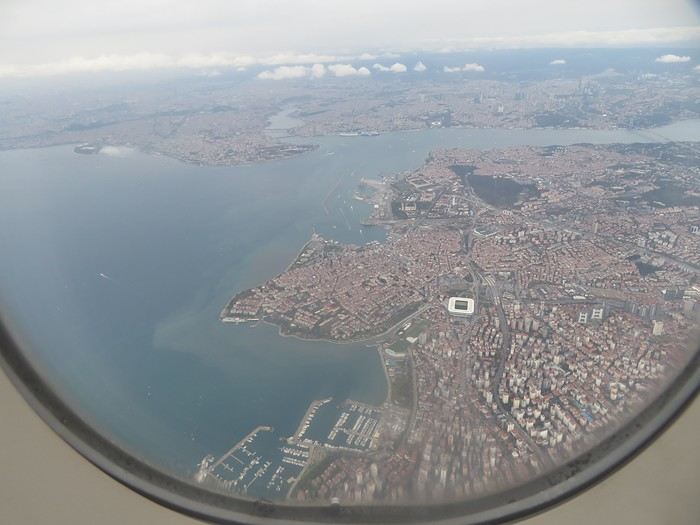
It all starts on a plane beginning its descent, knowing that the approach to Istanbul Airport is always quite long—about thirty minutes. Through the windows, if you’re lucky, you get a view of the city. You need to know a little to get your bearings, but here we’re on the side of Sabiha Gökçen Airport, south of Istanbul on the Asian side. You can spot the Bosphorus, the Golden Horn, and Fenerbahçe’s football stadium.

Landing over highways with three times four lanes, and then the airport tarmac for the taxi phase. This can take a while—sometimes nearly half an hour—but this morning, luck was on my side: barely more than 10 minutes. It’s rare now for Turkish Airlines planes to unload via pax buses, so we got a jet bridge. Avgeeks will immediately notice they’re not in Europe anymore but in another world: Pobeda, Belavia, and plenty of more exotic airlines. As the captain seriously put it in his final announcement after thanking the kids, it’s the “crossroads of the world.”
We suddenly step into a massive corridor, an endless, bright hall, usually deserted, and turn left or right—I think it’s always left for the flights I take, heading toward “transfers.” The walk is supposed to take a good ten minutes at worst. Watch out for airport vehicles—they come fast and don’t honk.
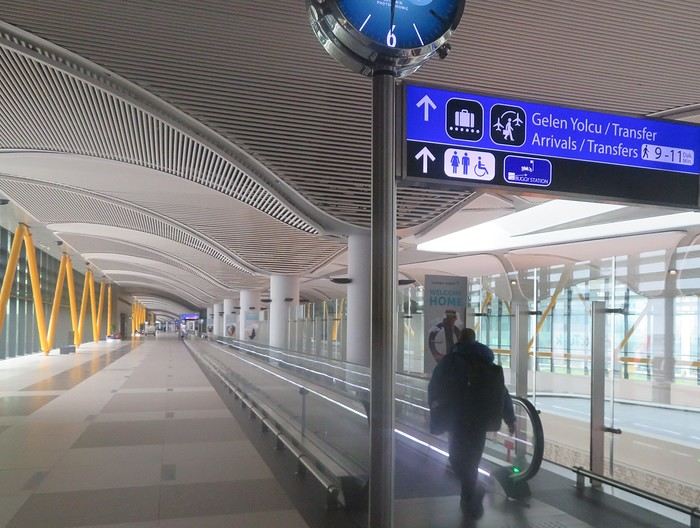
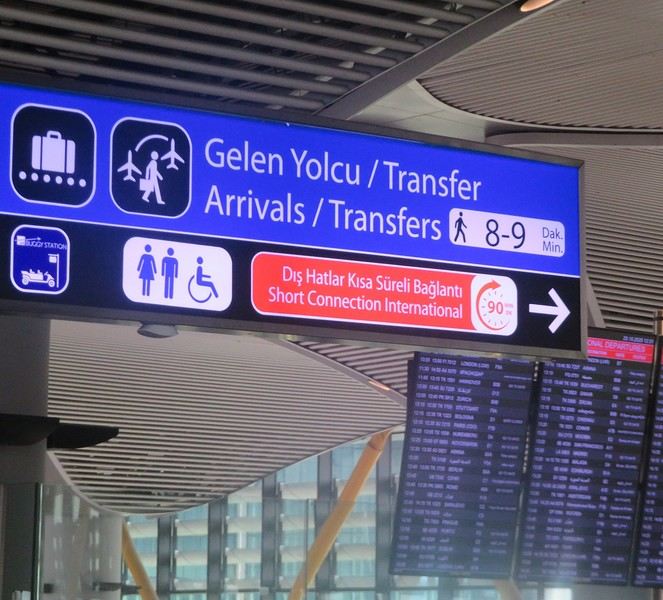
Here’s where it gets interesting: Istanbul has always had a bypass for short layovers, something you never hear about on forums. In the past, you had to bolt out of the jet bridge like a rocket and vaguely show your boarding pass to an attendant before sprinting. But now it’s institutionalized, and there’s signage that spares you from running all the way to the main security check. Until recently—at least the last time I did this—it even let you skip all formalities, dropping you like a wild dog into the departures area, which is spacious enough to stretch your legs!
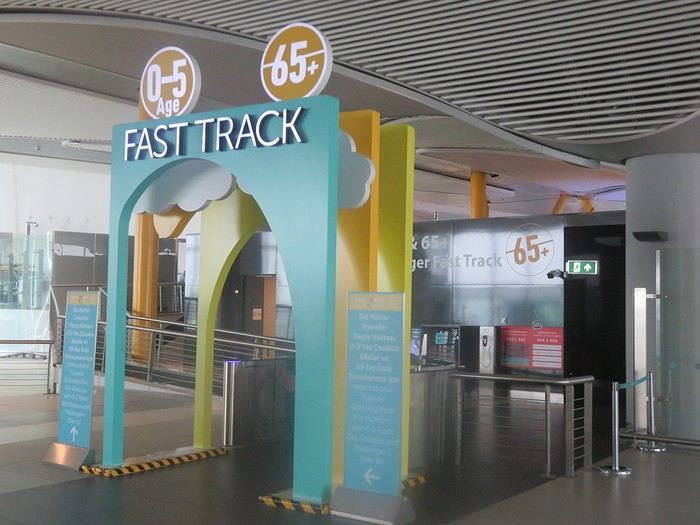
A heads-up for the young and the not-so-young: even without the bypass, if you’re under 5 (accompanied), over 65 (alone), you get fast track. That saves you a few hundred meters and possibly some waiting time, though I’m less sure about that. The entrance honestly looks like an amusement park, though.
So, not young enough, not old enough, I keep going. I pass by dozens of passport control booths (in blue) and reach the transfer security checkpoint (in red). There’s a fast track for Business and Gold passengers—in my case, I’m both—but since it’s at the wrong end for my direction, it wouldn’t even be worth it. It’d just be a frivolous sprint. None of this is crowded at all; the wait lasted about a minute. You have to take out your laptop at this checkpoint—not all of them—but you haven’t had to take out liquids for a while in Istanbul. A hallway, an escalator, and then—bam—you’re in the Dubai-esque hall. One look says it all. Everything sparkles, everything’s expensive. *Very* expensive. Just for show, I spot a sandwich for around 12 €, and some simits for about 4 € (it’s in TL, but that’s roughly the conversion).
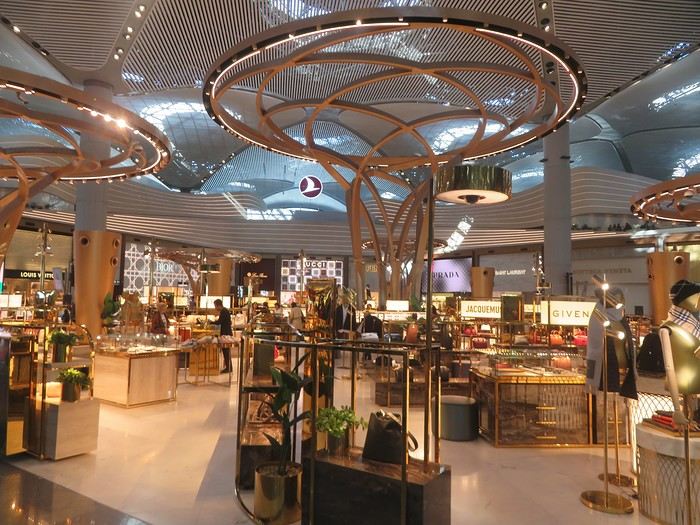
So, I head to the lounge—or one of the lounges—at Turkish Airlines, upstairs. Here too, there’s a priority entrance for families and people with reduced mobility, and an extra hundred meters for everyone else. A few of us seem to have had the same idea, and the twin lounges are under renovation for three months. One is for Business Class passengers, the other for Miles & Smiles and Gold members. They’re nearly identical. Needless to say, it’s packed—just as crowded in one as the other. There are *tons* of Business Class passengers on Turkish Airlines. I assume some other airlines’ passengers are mixed in, but not enough to explain the crowd. It’s as busy as Gare Montparnasse on a holiday departure day, and the 5 or 6 food counters, along with the salad and dessert buffets, are struggling to keep up. I didn’t dare ask to access the shower area, but I’ll admit the Wi-Fi works without the torturous maneuvers it required just a few months ago. Later, I’ll have to watch for the gate for my destination—Warsaw. With my usual luck, it’ll be in the F double-digits, the farthest ones, listed as 15 to 19 minutes away. That said, once you reach the end of that dead end, there’s plenty of quiet space with power outlets. Because here, there’s high demand for kilowatts.
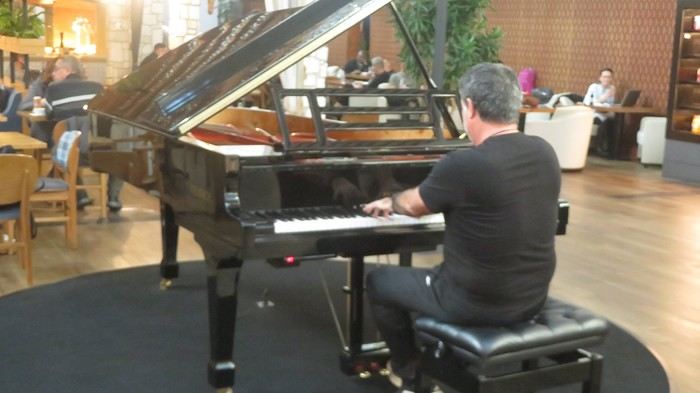
My reporter’s conscience doesn’t go so far as to guide me here—I’ve covered the free access up to the iGA lounge, which has a good reputation but costs nearly 100 € for three hours. Maybe another time, on a promo day—I’ll keep an eye on their site. The piano starts playing “Bésame Mucho,” so I’ll pause my story here.
Michel
Since it’s a hot topic, yet rarely shown, and since there’s quite a bit of criticism and prejudice around it—and since I’ve had three in ten days—I’m going to talk about layovers at Istanbul Airport, especially with Turkish Airlines. This is a common scenario for forum members planning trips to Central Asia, the Caucasus, but also Japan, China, Australia, Africa, and more.
It all starts on a plane beginning its descent, knowing that the approach to Istanbul Airport is always quite long—about thirty minutes. Through the windows, if you’re lucky, you get a view of the city. You need to know a little to get your bearings, but here we’re on the side of Sabiha Gökçen Airport, south of Istanbul on the Asian side. You can spot the Bosphorus, the Golden Horn, and Fenerbahçe’s football stadium.
Landing over highways with three times four lanes, and then the airport tarmac for the taxi phase. This can take a while—sometimes nearly half an hour—but this morning, luck was on my side: barely more than 10 minutes. It’s rare now for Turkish Airlines planes to unload via pax buses, so we got a jet bridge. Avgeeks will immediately notice they’re not in Europe anymore but in another world: Pobeda, Belavia, and plenty of more exotic airlines. As the captain seriously put it in his final announcement after thanking the kids, it’s the “crossroads of the world.”
We suddenly step into a massive corridor, an endless, bright hall, usually deserted, and turn left or right—I think it’s always left for the flights I take, heading toward “transfers.” The walk is supposed to take a good ten minutes at worst. Watch out for airport vehicles—they come fast and don’t honk.
Here’s where it gets interesting: Istanbul has always had a bypass for short layovers, something you never hear about on forums. In the past, you had to bolt out of the jet bridge like a rocket and vaguely show your boarding pass to an attendant before sprinting. But now it’s institutionalized, and there’s signage that spares you from running all the way to the main security check. Until recently—at least the last time I did this—it even let you skip all formalities, dropping you like a wild dog into the departures area, which is spacious enough to stretch your legs!
A heads-up for the young and the not-so-young: even without the bypass, if you’re under 5 (accompanied), over 65 (alone), you get fast track. That saves you a few hundred meters and possibly some waiting time, though I’m less sure about that. The entrance honestly looks like an amusement park, though.
So, not young enough, not old enough, I keep going. I pass by dozens of passport control booths (in blue) and reach the transfer security checkpoint (in red). There’s a fast track for Business and Gold passengers—in my case, I’m both—but since it’s at the wrong end for my direction, it wouldn’t even be worth it. It’d just be a frivolous sprint. None of this is crowded at all; the wait lasted about a minute. You have to take out your laptop at this checkpoint—not all of them—but you haven’t had to take out liquids for a while in Istanbul. A hallway, an escalator, and then—bam—you’re in the Dubai-esque hall. One look says it all. Everything sparkles, everything’s expensive. *Very* expensive. Just for show, I spot a sandwich for around 12 €, and some simits for about 4 € (it’s in TL, but that’s roughly the conversion).
So, I head to the lounge—or one of the lounges—at Turkish Airlines, upstairs. Here too, there’s a priority entrance for families and people with reduced mobility, and an extra hundred meters for everyone else. A few of us seem to have had the same idea, and the twin lounges are under renovation for three months. One is for Business Class passengers, the other for Miles & Smiles and Gold members. They’re nearly identical. Needless to say, it’s packed—just as crowded in one as the other. There are *tons* of Business Class passengers on Turkish Airlines. I assume some other airlines’ passengers are mixed in, but not enough to explain the crowd. It’s as busy as Gare Montparnasse on a holiday departure day, and the 5 or 6 food counters, along with the salad and dessert buffets, are struggling to keep up. I didn’t dare ask to access the shower area, but I’ll admit the Wi-Fi works without the torturous maneuvers it required just a few months ago. Later, I’ll have to watch for the gate for my destination—Warsaw. With my usual luck, it’ll be in the F double-digits, the farthest ones, listed as 15 to 19 minutes away. That said, once you reach the end of that dead end, there’s plenty of quiet space with power outlets. Because here, there’s high demand for kilowatts.
My reporter’s conscience doesn’t go so far as to guide me here—I’ve covered the free access up to the iGA lounge, which has a good reputation but costs nearly 100 € for three hours. Maybe another time, on a promo day—I’ll keep an eye on their site. The piano starts playing “Bésame Mucho,” so I’ll pause my story here.
Michel
I’m open to anything: either abroad or somewhere in France. Not specifically to party, just to get away from Paris—being near a beach would be ideal.
We’ve read it all about Bali: mass tourism, non-stop parties, ferry disasters, the kingdom of “Instagrammers,” pollution, “Bali belly”... But luckily, this island isn’t just about Kuta’s beaches and the Lempuyang Temple.
Hi there,
It’s all in the title. I’m starting to think about my destination for summer 2026, and Cambodia is currently at the top of my list. Among the spots frequently mentioned for a 2- or 3-week trip to Cambodia, Battambang comes up often. However, so far, I haven’t found any truly remarkable features that would justify spending 2 or 3 days (including travel and visits) in this city during a 3-week stay, especially since I’m primarily looking for stunning photography spots—whether natural landscapes, urban scenes, or architecture. Where can I find some enlightening documentation on Battambang to help shift my perspective? Sorry for exposing my ignorance about this city like this, but all the photos I’ve seen online and the travel journals I’ve read don’t really showcase what makes it appealing, even though the descriptions suggest it’s very charming.
Thanks for any insights you can share!
Gollum ;-)
Hi everyone.
I’ve been doing brisk walking every day for years (an hour every morning at dawn) through forests, along rivers, on trails, tracks, and pavement. I wanted to try Nordic walking, so I bought the poles (apparently, they work your abs extra). I lasted 5 days 😄 And I’m stopping because, for me, it’s incompatible with how I combine sport and wildlife. I tried all the tips (rubber and steel), and they all make a racket that scares off every animal 😅
I get that some athletes go from point A to point B without paying attention to what’s in between, but that’s not me. I love intense exercise, but whenever something’s beautiful, I stop to enjoy it for a few moments (same when I spot an animal). With the poles, it’s impossible—they’re too noisy, even if you don’t press hard.
Oh well, I wasted 20 € on this purchase (though they might come in handy for scrambling, for example).
Anyway, for the brisk walking I do, the poles I totally mastered by the second day (syncing the movement) actually slow me down. Plus, it’s annoying to hear that constant noise in a dreamy landscape when my shoes barely make a sound. And on roads (pavement), they make all the dogs in their houses bark 😅
As for working the abs, brisk walking without poles lets you engage your core if you want, so it works those muscles too.
Into the bin go my poles and their tips, already dead after 5 days (long live wildlife and nature!) 🤘
Hi everyone.
For those traveling to Cuba and then planning to go to the USA, you won’t be able to get your ESTA for the United States (same applies) if you’ve been to Cuba after 2021 due to a law passed by Donald Trump (a law that Biden later repealed).
You’ll have no choice but to apply for a visa, which costs 200 € (and approval isn’t guaranteed even after payment).
If you’re in this situation, the process to get this visa will be a real hassle—you’ll need to book an appointment at the U.S. Embassy in Paris. It’s the only embassy in France authorized to handle your application after you’ve filled out the visa request on the official website.
If you try to cheat by applying for an ESTA for the USA, just know that the American administration has ways of finding out if you’ve been to Cuba. 😉