Hi everyone,
I’m planning our very first trip to mainland France in January 2027. There’ll be 2 adults and 2 kids, and we’ll mostly be traveling by train.
Here’s our itinerary:
Paris
Rouen (Normandy)
Lyon
Aix-les-Bains (with day trips to Annecy and Geneva)
Saint-Gervais-les-Bains (with Chamonix and a day in Aosta)
Back to Paris
Do you think this itinerary is well-balanced? Any tips, must-see spots, or mistakes to avoid for a first-time visit?
Thanks in advance for your advice! !
12 similar discussions in English
Hey everyone, travelers! Here’s a little post to share our bike trip this summer. We did the Via Rhôna from Geneva all the way to the Mediterranean Sea. It was a truly amazing adventure—no hitches, lots of independent greenways, and we felt like we had the Rhône all to ourselves as our guide for 700 km over 7 days. That averages out to 100 km a day. We thought we’d do less, but the Via Rhôna is flat and not too tiring, which let us push to around 100 km each day!
Here’s the full video of our route: www.youtube.com/watch?v=x_cpBro6Df8
We’re not seasoned cyclists—we just love biking, and this trip was our first big bike touring adventure. As for our bikes (see photo), we had road bikes, sturdy ones with fairly large wheels and rear racks for our gear.
Speaking of gear, here’s what we brought: just the essentials for 7 days of biking and camping—1 tent for 2, two sleeping bags, a few clothes (not too many), 1 book each, toiletries, phone chargers, a basic bike repair kit... and maybe 2 or 3 things I’m forgetting. The idea is to travel light so you’re carrying as little as possible!
We camped every night. Along the Rhône, it’s pretty easy to find campgrounds, and they’re cheap too! Each morning, we’d decide on our destination for the evening (usually based on available campgrounds) and call during the day to book. We always managed to get a spot right away (except when we reached the Mediterranean coast, but we should’ve seen that coming 😛).
For expenses, we slept at campgrounds (between 15 and 25 € per site for 2) and either picnicked or ate at restaurants. Other than that, there weren’t really any other costs besides a few small souvenirs here and there. In total, we spent about 500 € for two over 7 days (so 35 € per person per day). I think it’s possible to spend even less—we decided not to restrict ourselves when it came to restaurants and campground prices.
For us, the most beautiful part was between Geneva and Lyon! The Rhône is still a bit wild there, as are its banks. Not too many roads, highways, trains, or factories around—just nature and peace. You gradually leave the Alps behind and head further south. It was truly stunning. We also loved the "Rhône Valley" after Lyon. The succession of dozens of suspension bridges and little villages, each more charming than the last, really enchanted us.
The trickiest part was leaving Lyon... The Via Rhôna disappears for a long stretch, forcing you to alternate between roads, traffic, danger, and pollution. We had to wait until Givors, further south, to finally get back to the quiet bike path and the Rhône showing us the way. Also, after Lyon, the Rhône becomes a bit more industrial—you pass by dams, factories, and power plants more often. But it’s really just a small detail, the exception that proves the rule of this magnificent Via Rhôna.
The Via Rhôna is a fantastic way to see how water from the mountains of Lake Geneva flows, travels, and winds its way for hundreds of kilometers to reach the sea. With this trip, you get closer to the Rhône—it becomes your accomplice, your guide. Plus, you cross a beautiful part of France, with its charm and little villages. It’s the France we love, and it’s great to explore your own country like a tourist.
That’s it for our little travel journal. I didn’t go into too much detail about our days since everyone will follow the same route, and everyone can go at their own pace :) But I’m happy to answer any questions (logistics, technical stuff, routes, etc.)—I’d be glad to help!
Here’s the video of our route again—I also composed the music, so I hope you’ll like it: www.youtube.com/watch?v=x_cpBro6Df8
Happy travels,
Flo
Hi there,
We’re flying from Montreal to Lyon this August to go hiking in the French Alps. We’ve rented a car and will be staying at campgrounds. We’re planning to do day hikes and want to stay a few days in one spot, do a few hikes, then move on to our next camping spot. Could you share your favorite spots or any recommendations for places to spend a few days with great hikes?
A few details: We arrive in early August and leave in early September. We’re looking for day hikes (or shorter), moderate difficulty, with a cumulative elevation gain of no more than 1000m, and of course, beautiful scenery! We’d prefer not to drive too much—maybe it’s best not to head too far south and deal with unnecessary heat? Along the same lines, if you know of any great campgrounds where we can start our hike directly without needing the car, we’d love to hear your suggestions!
Thanks! :-)
Looking for advice on staying in Lyon for 3 days in a hotel in the 5th arrondissement—affordable but safe and clean. In October 2025.
Hi there,
I’m planning to spend three days in the Annecy region. What would you recommend visiting? Just so you know, I love nature and enjoy walking, but I prefer hikes that aren’t longer than two hours.
Thanks for your great tips!
I’m planning to spend three days in the Annecy region. What would you recommend visiting? Just so you know, I love nature and enjoy walking, but I prefer hikes that aren’t longer than two hours.
Thanks for your great tips!
regions Brittany, Rhône-Alpes, and Massif Central (Auvergne Limousin)
I’ve lived in Savoie long enough to tell you one thing: Vanoise National Park isn’t just a pretty postcard. Here, nature is vast, untamed, and incredibly alive. Whether you're visiting for a holiday or live in a nearby valley, here are my top picks you shouldn’t miss.
Sleeping in a mountain hut—the best way to experience the mountains
Hiking in Vanoise National Park is already magical, but spending a night in a refuge? That’s sacred. I recommend the glacier tour, a 4- to 7-day trek with stops at huts like L’Arpont, Dent Parrachée, or Leisse. The food’s great, you’ll meet other hikers, and in the early morning, when the sun lights up the peaks, I guarantee you won’t be thinking about your emails. Even a single night at Refuge du Fond d’Aussois or La Valette is enough to unplug.
High-altitude lakes: when the peaks reflect in the water
High-altitude lakes are a bit like my madeleine de Proust. I love climbing up early in the morning when everything’s still quiet. Lac Blanc, starting from Termignon, is a pretty accessible hike, often punctuated by the whistling of marmots. Wilder, Lac de la Glière near Champagny-en-Vanoise is one of my favorite spots for a picnic far from everything.
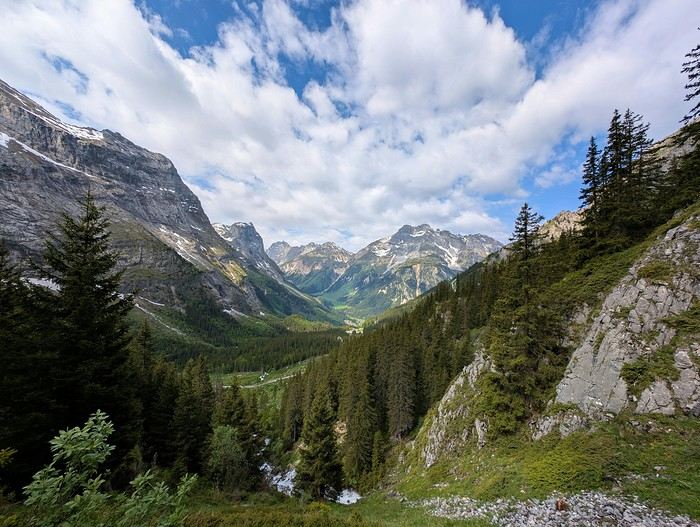
Glacial valleys—my breath of fresh air
I often go there to reconnect with the mountains, especially when I want a spectacular setting without hours of climbing. The Orgère valley, starting from Saint-André in Maurienne, is a gem. Easy to access, super wild, with its Swiss pine trees and singing streams... You’re instantly immersed in the alpine atmosphere. A little higher up, from Val Cenis/Termignon, I recommend the Cirque du Génépy. It’s an old glacial landscape just the way we love it: rocks smoothed by ice, near-total silence, and a real sense of the end of the world.
Glacier mountaineering at the heart of the ice
For the more athletic (and always with a guide, of course), climbing the Grande Casse, 3,855 m, remains a legendary goal. I’ve only done it once, but what a rush! You’ll need crampons, an ice axe, and good fitness, but the view up there is indescribable. There are also more accessible glacial routes around Pointe de la Réchasse or the Dôme de Chasseforêt.
Gateways to Vanoise National Park
Bonneval-sur-Arc... this little village perched at 1,835 meters, I never get tired of it. It’s kept its charm: stone houses, slate roofs, fountains... It’s simple, everything’s beautiful. It’s also a great base for hiking in the park. And then there’s Pralognan-la-Vanoise, my favorite gateway. It’s a mountain village just the way I like them—quiet streets, typical chalets, and above all, direct access to incredible landscapes.
Sleeping in a mountain hut—the best way to experience the mountains
Hiking in Vanoise National Park is already magical, but spending a night in a refuge? That’s sacred. I recommend the glacier tour, a 4- to 7-day trek with stops at huts like L’Arpont, Dent Parrachée, or Leisse. The food’s great, you’ll meet other hikers, and in the early morning, when the sun lights up the peaks, I guarantee you won’t be thinking about your emails. Even a single night at Refuge du Fond d’Aussois or La Valette is enough to unplug.
High-altitude lakes: when the peaks reflect in the water
High-altitude lakes are a bit like my madeleine de Proust. I love climbing up early in the morning when everything’s still quiet. Lac Blanc, starting from Termignon, is a pretty accessible hike, often punctuated by the whistling of marmots. Wilder, Lac de la Glière near Champagny-en-Vanoise is one of my favorite spots for a picnic far from everything.
Glacial valleys—my breath of fresh air
I often go there to reconnect with the mountains, especially when I want a spectacular setting without hours of climbing. The Orgère valley, starting from Saint-André in Maurienne, is a gem. Easy to access, super wild, with its Swiss pine trees and singing streams... You’re instantly immersed in the alpine atmosphere. A little higher up, from Val Cenis/Termignon, I recommend the Cirque du Génépy. It’s an old glacial landscape just the way we love it: rocks smoothed by ice, near-total silence, and a real sense of the end of the world.
Glacier mountaineering at the heart of the ice
For the more athletic (and always with a guide, of course), climbing the Grande Casse, 3,855 m, remains a legendary goal. I’ve only done it once, but what a rush! You’ll need crampons, an ice axe, and good fitness, but the view up there is indescribable. There are also more accessible glacial routes around Pointe de la Réchasse or the Dôme de Chasseforêt.
Gateways to Vanoise National Park
Bonneval-sur-Arc... this little village perched at 1,835 meters, I never get tired of it. It’s kept its charm: stone houses, slate roofs, fountains... It’s simple, everything’s beautiful. It’s also a great base for hiking in the park. And then there’s Pralognan-la-Vanoise, my favorite gateway. It’s a mountain village just the way I like them—quiet streets, typical chalets, and above all, direct access to incredible landscapes.
Hello,
I’m planning to spend a few days in Ardèche and I’d like to know if we should choose just one base or more to visit the region. Looking at the department map and the main sites to see, I’d personally go for 2 bases to avoid too much driving. So, if anyone who knows this beautiful region well could give me some advice on this, I’d really appreciate it in advance!
I’m planning to spend a few days in Ardèche and I’d like to know if we should choose just one base or more to visit the region. Looking at the department map and the main sites to see, I’d personally go for 2 bases to avoid too much driving. So, if anyone who knows this beautiful region well could give me some advice on this, I’d really appreciate it in advance!
Hi there,
We’re planning to spend a few days in Valencia and the surrounding area. Can you recommend the must-see sights? PS: If you know any great restaurants, we’re all ears!
Thanks in advance
We’re planning to spend a few days in Valencia and the surrounding area. Can you recommend the must-see sights? PS: If you know any great restaurants, we’re all ears!
Thanks in advance
Hi,
We’d like to visit the Alpes de Haute-Provence for 2 weeks with our 2 (adult) kids.
Any ideas for things to see and do?
Where should we choose our accommodation (house only) to be centrally located for sightseeing? We’re looking for villages with restaurants and bakeries.
Thanks in advance for your tips!
Best regards
Hello!
With the summer sun, what could be better than a holiday combining naturism, cool sports activities, culture, music, heritage, hiking, and an apéro 😉
I’m on holiday from August 23rd to September 13th and I’m looking for naturists—or non-naturists—to join me in naturist resorts to experience daily nudity, between relaxation, swimming, activities, and discoveries.
Duration, locations, visits, and activities… all to be decided together to co-create this holiday project.
The mindset is clear: energy, culture, sharing, respect, and curiosity about the world. Chill vibes.
The word *naturism* is to be taken in its original sense. This is a FRIENDLY endeavor: any notions of exhibitionism, voyeurism, swinging, or disrespect (for dunes, people) are STRICTLY FORBIDDEN. Link to the French Naturist Federation: https://ffn-naturisme.com/ We can discuss this via messaging and/or over a coffee/ice cream in Paris, Marne-la-Vallée, or Meaux. Naturally, Marc, 🙂 (already 54 years old! *sigh*. From Seine-et-Marne)
The word *naturism* is to be taken in its original sense. This is a FRIENDLY endeavor: any notions of exhibitionism, voyeurism, swinging, or disrespect (for dunes, people) are STRICTLY FORBIDDEN. Link to the French Naturist Federation: https://ffn-naturisme.com/ We can discuss this via messaging and/or over a coffee/ice cream in Paris, Marne-la-Vallée, or Meaux. Naturally, Marc, 🙂 (already 54 years old! *sigh*. From Seine-et-Marne)
Hi,
Our son, currently in Central America, will board a sailboat on 04/16 to cross the Atlantic. He’s expected to arrive around 05/31 in Port-Saint-Louis-du-Rhône, and we’d like to welcome him on the day he arrives.
I’m looking for accommodation in the area for a few days around that date, from which we can explore the Camargue. We’ll be bringing our e-bikes.
Could you tell me which towns to look in and which areas to avoid, please? I think Port-Saint-Louis isn’t a great option if we want to avoid the toll for the ferry every time we leave by car.
Thanks for your tips.
Claire
PS: Are there a lot of mosquitoes in late May/early June?
PS: Are there a lot of mosquitoes in late May/early June?