Discussions Brabo16 took part in
7 results on this page.
More options
Many results are in French, the community’s main language. English translations are added over time.
Search results
Un nouveau tête à tête mère-fils magnifique! Avril 2019
Après un road-trip multigénérationnel en juillet 2015, nous sommes retournés avec mon fils, surnommé T., dans l’ouest américain en avril 2017 pour un magnifique voyage en tête à tête ! Nous avions adoré partir en avril, températures plus clémentes, coup de cœur pour Death Valley… Donc, comme à chaque retour, une seule idée en tête, renouveler cette incroyable expérience !
Et cette année encore, grâce aux conseils puisés sur VF (une nouvelle fois merci à tous), le voyage fut merveilleux ! Tous les jours son lot de découvertes et d’émerveillements !
Nous avons été particulièrement touchés par le foisonnement de fleurs tout au long du voyage, par des milliers de papillons nous faisant tourner la tête à Death Valley et par l’impression d’être seuls au monde dans ces merveilleux paysages (très faible fréquentation à cette période) 😎! Comme à chaque fois, nous avons apprécié les rencontres et la gentillesse des américains !
Par contre nous avons été surpris par la chaleur 🤪: très heureux d’avoir beau temps, mais étonnés par les températures élevées (31° C dès midi toute la 1ere semaine) ! Aussi le programme a un peu évolué par rapport à celui d’origine en fonction de la météo essentiellement mais aussi en fonction de problèmes techniques rencontrés ou de notre état de fatigue.
Programme effectué avec 3212km au compteur :
JOUR 1 : France – LAS VEGAS. Nuit Las Vegas
JOUR 2 : Seven Magic Mountains - Amboy ROY'S café - JOSHUA TREE (Arch Rock trail, Cholla Cactus, Skull Rock, Hidden Valley et Keys View). Nuit Twentynine Palms voyageforum.com/...st=9647375;a=9647375
JOUR 3 : AMBOY Crater - Kelso Depot - Baker (plus grand thermomètre – Boutique Alien) - SOSHONE (Museum, Dublin Gulch) - DEATH VALLEY par badwater road (avec découverte pédestre de Badwater, Artists Palette et Mars Hill). Nuit1 Furnace Creek voyageforum.com/...st=9648823;a=9648823
JOUR 4 : DEATH VALLEY : lever de soleil à Zabriskie + trail pour Meanly Beacon - Piscine - Devil' s golf Course, Artist Drive, Mushroom Rock, coucher de soleil à Zabriskie. Nuit2 Furnace Creek voyageforum.com/...st=9649703;a=9649703
JOUR 5 : DEATH VALLEY ( Gnome's Workshop, Salt creek et Mustard Canyon). PARHUMP (museum + boulangerie O HAPPY BREAD) - RED ROCK CANYON (avec Calico Hills- Lost Creek). Nuit Las Vegas voyageforum.com/...st=9651800;a=9651800
JOUR 6 : SNOW CANYON (avec Sand Dunes, Hidden Pinyon - Petrified dunes trail et Lava Flow). Nuit ST GEORGE voyageforum.com/...st=9658216;a=9658216
JOUR 7 : ZION : avec Scout's Overlook - rim trail, Riverside Walk, Weeping Rock. Nuit Kanab. voyageforum.com/...st=9664493;a=9664493
JOUR 8 : Johnson Canyon - The Chains - MONUMENT VALLEY : Wildcat trail. Nuit cabin Monument Valley voyageforum.com/...st=9669060;a=9669060
JOUR 9 : MONUMENT VALLEY (Mesa rim trail + Lee Cly trail) - CANYON DE CHELLY : South rim avec White House trail. Nuit Chinle voyageforum.com/...st=9673898;a=9673898
JOUR 10 : PAINTED DESERT - PETRIFIED FOREST : avec Blue Mesa trail, Crystal Forest, Giant Logs, Long Logs et Agate house trail. HOLBROOK (Museum – Wigwam Hotel )- Nuit Flagstaff voyageforum.com/...st=9676578;a=9676578
JOUR 11 : Route 66 : SELIGMAN, HACKBERRY, KINGMAN. Nuit LAS VEGAS voyageforum.com/...st=9678172;a=9678172
JOUR 12 : LAS VEGAS avec Count's Kustom's, Old Las Vegas Mormon fort, Gold & Silver Pawn shop... voyageforum.com/...st=9678610;a=9678610
JOUR 13 : LAS VEGAS avec VOID Star Wars, spectacle LOVE (the Beatles)… voyageforum.com/...st=9678639;a=9678639
JOUR 14 : Retour FRANCEhttps://voyageforum.com/v.f?post=9678644;a=9678644
Voilà, un programme à notre image, nous sommes plutôt des contemplatifs, nous aimons nous perdre dans des lieux magnifiques, s'isoler pour s'imprégner des lieux, marcher pour découvrir des petites merveilles... mais pas des sportifs expérimentés comme on peut le voir sur d'autres carnets😉! Les photos, j'en fait beaucoup... trop d'après T😉! Mais pour moi, ça fait parti du plaisir, pouvoir s'imprégner de la beauté des lieux, partager des sensations et fixer à jamais des souvenirs😎!Les préparatifs :BUDGET TOTAL : 1500€/pers tout compris (souvenirs, loisirs, nourriture, avions, voiture, essence, parkings, hôtels…)Billets d’avions : 500€/pers, achetés sur Air Canada + 50€ bagage en soute! Alors nous ne sommes pas fidèles à une compagnie ! On change à chaque fois car on prend en fonction des meilleurs prix ! Mais Air Canada ne restera pas dans nos favoris 😕!
La voiture : 340€ pour 12 jours avec Alamo. Voiture Hyundai, super confortable, caméra de recul, écran avec affichage de la pression de chaque pneu (cela s’avérera utile😉) … ! Réservé sur Alamo.fr comme à chaque voyage, mais première fois que l’on rencontre un problème à la prise de voiture malgré Skip the Counter😠! Côté essence = 137$ !
Les hôtels : réservés majoritairement sur hotels.com… ce qui permet à chaque voyage d’utiliser des nuits gratuites! Et via Igraal et Poulpeo pour le cashback… Cette année j’ai beaucoup utilisé l’annulation gratuite et est modifié mes réservations à nombreuses reprises ce qui nous a permis de faire des économies conséquentes (plus de 200€) !
Les frais bancaires : Depuis notre voyage en avril 2017, j’ai conservé mon compte Boursorama, avec carte 1er gratuite (donc réservations d'avion faites avec pour l'assurance associée) et niveau frais pour les paiements aux USA, nettement plus intéressant qu’avec LCL! Pour tout achat important sur internet ou tout 1er achat à l'étranger, on reçoit un sms pour nous prévenir... rien à faire si c'est nous... et sinon, on peut de suite intervenir en cas de fraude! Essayé, c’est l’adopter !
GPS : Points préparés à l’avance… mais malheureusement pour rien, le GPS nous a lâché dès le 1er jour 😠 !
Forfait téléphonique : FREE avec USA et Canada! Grâce au bon plan de Gilles😉
La suite bientôt avec le voyage!
Family trip from Marrakech to the desert
We went to Morocco in April with our children and grandchildren.
We landed in Marrakech around 9 AM and took a bus to our small hotel in the Guéliz district. This was to avoid dealing with taxi drivers who might give our young travelers a very negative impression of Marrakech... The bus drops us off very close to the Hôtel Toulousain, which has always given us the warmest welcome for over 25 years. We settle into our rooms and head to the medina to have lunch first and then wander through the streets of the old city, introducing it to our little group.
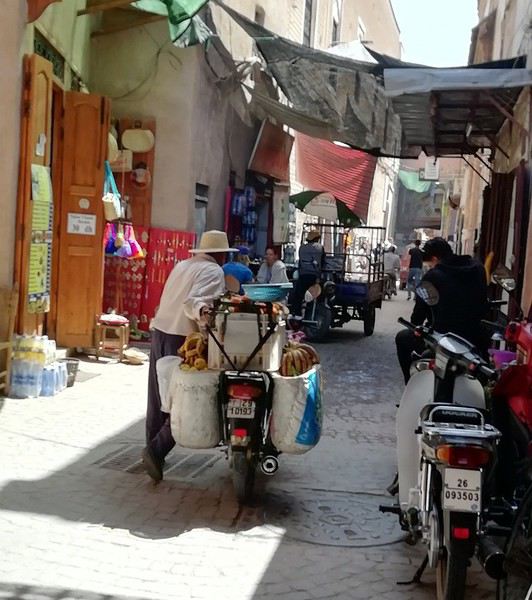
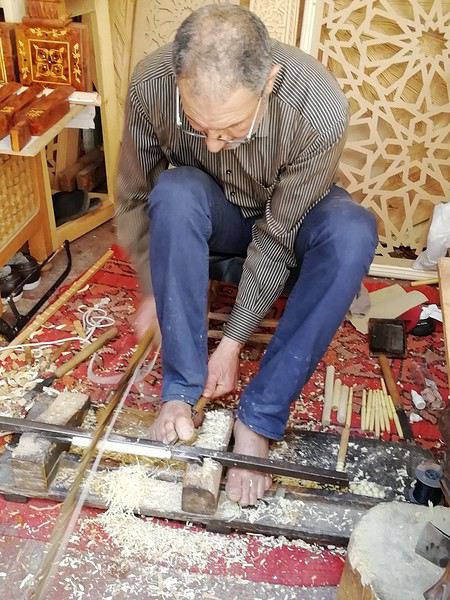
Young and old alike are amazed by the craftsmanship and attention to detail in the work done by the various artisans.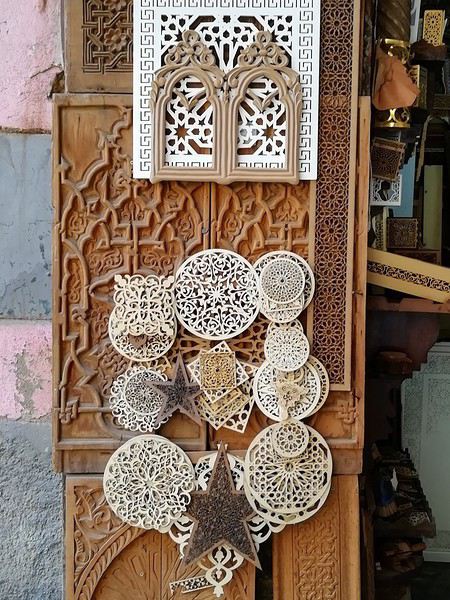
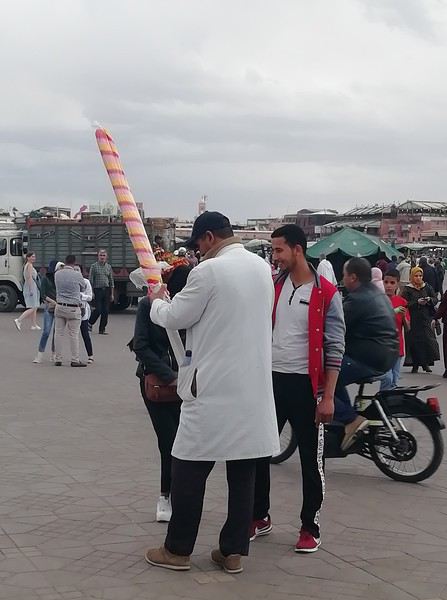
The souks also impress first-time visitors, both with their size and the sheer amount of goods on offer. For those visiting for the first time, it’s a real maze. Colorful chameleons everywhere... Will they survive for long in their cages under the scorching sun?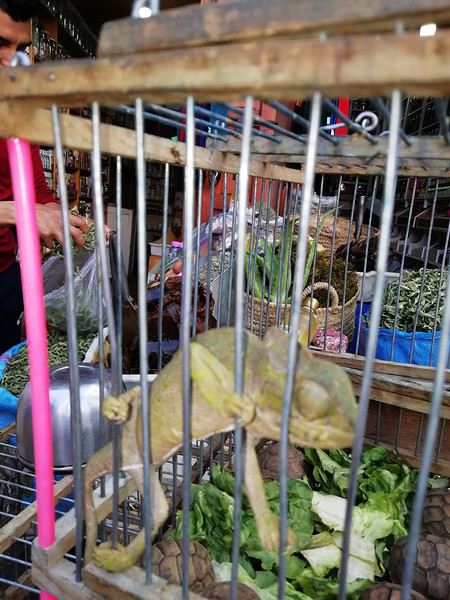 Another surprise for the kids: the lollipop vendor in Jemaa El Fna Square, with giant lollipops that really whet their appetites...
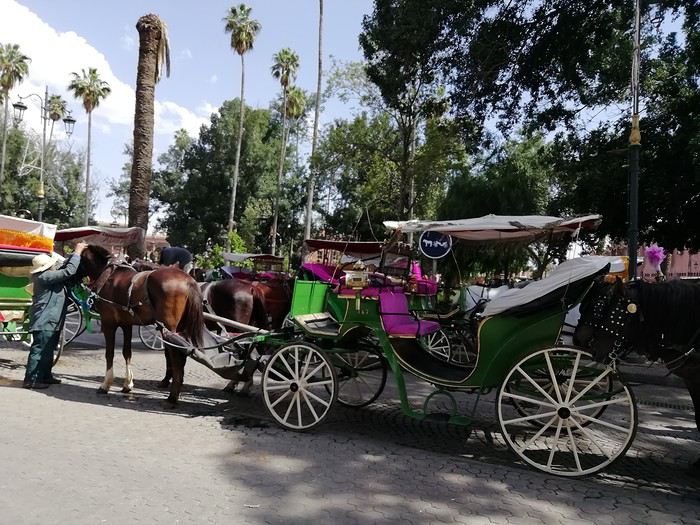
By late afternoon, little legs are tired, and horse-drawn carriages are a welcome way to get back to the hotel.
Young and old alike are amazed by the craftsmanship and attention to detail in the work done by the various artisans.
The souks also impress first-time visitors, both with their size and the sheer amount of goods on offer. For those visiting for the first time, it’s a real maze. Colorful chameleons everywhere... Will they survive for long in their cages under the scorching sun?
Another surprise for the kids: the lollipop vendor in Jemaa El Fna Square, with giant lollipops that really whet their appetites...By late afternoon, little legs are tired, and horse-drawn carriages are a welcome way to get back to the hotel.
Roadtrip Ouest US de 20 jours
17 et 18 juin C'est le départ ! Marseille Barstow Tout d'abord direction Turin. Pourquoi Turin? Tout simplement parce que les taxes d'aéroport sont tellement moins chères qu'en France. Nos vols Turin Los Angeles 320 euros pièce. A 6 cela nous fait 2000 euros d'économisés par rapport à un départ de Marseille. Après 4h30 de route, quelques émotions pour accéder au parking réservé à l'avance, passage de l'embarquement et nous voilà fin prêts. Mais c'était sans compter les grèves d'Air France qui ont perturbé le ciel européen. Résultats des courses notre vol Turin Madrid parti avec 2 heures de retard, un sprint de dingue à Madrid pour chopper notre vol. Malheureusement les bagages n'ont pas suivi et on se retrouve à LA sans rien. Ça commence bien!! Mais positivons, nous , nous y sommes. Après déclaration au desk bagages perdus direction Alamo pour récupérer notre véhicule. Nous quittons non sans mal Los Angeles, la circulation est dense et nous dirigeons vers Barstow pour notre première nuit au Best Western Desert Villa Inn. Nous avons décidé de quitter Los Angeles pour nous rapprocher du Grand Canyon. Avant d'arriver à l'hôtel, arrêt aux outlets à l'entrée de Barstow. Les bagages n'étant pas arrivés, American Airlines nous a autorisé à nous habiller et nous chausser. Pas de montant particulier, la consigne étant ''budget raisonnable'' ça veut dire quoi raisonnable?? Nous avons bien été remboursés de nos dépenses à peu près 1 mois après notre retour en France. Les Outlets de Barstow ne sont pas aussi spectaculaires qu'à Vegas mais nous trouvons Ralph Lauren, Calvin Klein, Levis, Nike...Séquence shopping terminée, un petit détour au supermarché, notre hôtel ne fait pas restaurant. L'hôtel est très correct, l'accueil sympathique. Un petit bain à la piscine, un casse croûte et au dodo !
Résumé https://www.youtube.com/watch?v=9n0WAuCTddc&t=9s
19 juin Barstow - Williams par la 66
Le décalage horaire ça a du bon. Lever matinal, ça tombe bien aujourd'hui nous avons une longue route.
Après avoir acheté 2 glacières, récupéré des glaçons, l'aventure peut commencer. Les gars sont au volant et nous déroulent des kilomètres, quelquefois sans âme qui vive... Notre premier arrêt sera au mythique Bagdad Café autrefois appelé Sidewinder Cafe. Au son de ''Calling You '' interprété par Jevetta Steele nous pouvons réaliser à quel point ce lieu est très prisé et en particulier par les français. Les murs sont recouverts d'autocollants de club sportif, d'associations, au plafond des écharpes, des maillots, et une multitude de billets de banque de différents pays. Pour faire comme tout le monde nous laissons notre empreinte avec une licence de basket et une ancienne carte d'électeur...
Mexique, un kaléidoscope de couleurs
Voici mes impressions du Yucatan que j'ai découvert pour la première fois avec mon amie du 10/03/2019 au 27/03/2019.
Nous avons fait un parcours classique en autotour et avons parcouru environ 2500km sur des routes en bon état pour l'ensemble sauf dans les Chiapas.

Nous avons pris un vol par Air france direct à l'aller et avec un passage par Atlanta (Delta Airlines+Air France) pour le retour.(Penser à demander un ESTA mème pour une escale au USA!)
Le vol nous a paru long à l'aller car les écrans ne marchaient pas...
c'est assez surprenant de survoler des étendus glacées alors qu'on se dirige vers l'équateur!

Notre avion arrive vers 18h et il fait nuit quand nous récupérons la voiture (location avec Sixt très bien). Nous ne nous attendions pas a une voiture automatique mais comme on en avait déjà utilisé aux Usa les réflexes reviennent vite! Ce soir nous dormons en auberge de jeunesse (Agavero Hostel Cancun 450 pesos : bien) La chambre est petite l'hostel arrangé de façon original et nous ne tardons pas a nous endormir.

Bien qu'ayant fait du change en France nous décidons d'en refaire avant de nous diriger vers l'ile d'Holbox. Le cours est 1 €=20 pesos Nous avons quelques difficultés avec la fermeture du coffre aussi nous repassons chez Sixt qui nous dépanne et nous en profitons pour continuer voir le bord de mer qui est une grande bande sableuse séparée de la ville par des marais plein de crocodiles! Là tout les grands hôtels squattés par les nord américains s'alignent. l'accès libre à la plage est rare et le dollar est roi...

la mer est très agitée et les sargasses sont échouées tout le long de la frange océane.

Nous retournons à notre auberge pour prendre le petit déjeuner (compris dans le prix) composé d'une omelette avec de la viande de boeuf hachée : c'est assez surprenant pour nous français! Nous achetons quelques nourritures dans un centre commercial puis prenons la route vers Chiquila Grace à Maps me nous sortons sans encombre de Cancun et prenons l'autoroute : c'est étrange car nous sommes sur une 2 voies entourées par une végétation touffue et comme il n'y a pas de relief on a l'impression d'être dans un tunnel végétal pendant des kilomètres...
En cas de panne on devrait s'arrêter sur la route... Le prix de l'autoroute est cher. Nous la quittons pour remonter vers Chiquila d'ou nous prendrons le bateau pour Holbox. En cours de route nous traversons de petits villages pauvres et à l'habitat délabré. Faire attention à l'entrée de tous les villages, mais aussi au centre, il y a des ralentisseurs pas toujours bien indiqué (les topes) qu'il convient de prendre à pas plus de 20km/h sous peine de décoller!!! Arrivé à Chiquila il faut laisser sa voiture dans un parking privé (ils sont tous au mème prix environ 100MXN par 24H) Nous avons décider de laisser un de nos 2 sacs dans la voiture pour être plus léger Ensuite direction le port ou 2 compagnies se partagent les traversées : une avec des bateaux vieillots et l'autre plus moderne (150mxn l'aller).

Sur l'ile pas de voiture pour les touristes mais des quads et de voiturettes de golf! Les rues sont en sable et on arrive au port à l'opposé de la partie ou sont les hébergements mais les distances sont faibles! Il fait très chaud comme durant tout notre séjour au Yucatan (entre 30 et 38 degrés) Nous dormons 2 nuits en Airbnb au Casa Ohana (1620mxn pour 2 nuits :déco sympa mais environnement assez bruyant)

Nous avons hâte de découvrir la plage!

Ici l'ambiance est très différente de Cancun : c'est plus relax et bohème! De nombreuses peintures murales égayent les murs des maisons mème les plus modestes.


Des hamacs sont à la disposition de tous dans l'eau.


La plage est idéale pour les enfants car il n'y a pas de profondeur sur une grande distance. Nous prenons une consommation dans ce bar en pleine air.
puis mangeons dans ce restaurant (très bien).
 Nous rentrons nous coucher heureux de cette journée.
Nous avons pris un vol par Air france direct à l'aller et avec un passage par Atlanta (Delta Airlines+Air France) pour le retour.(Penser à demander un ESTA mème pour une escale au USA!)
Le vol nous a paru long à l'aller car les écrans ne marchaient pas...
c'est assez surprenant de survoler des étendus glacées alors qu'on se dirige vers l'équateur!
Notre avion arrive vers 18h et il fait nuit quand nous récupérons la voiture (location avec Sixt très bien). Nous ne nous attendions pas a une voiture automatique mais comme on en avait déjà utilisé aux Usa les réflexes reviennent vite! Ce soir nous dormons en auberge de jeunesse (Agavero Hostel Cancun 450 pesos : bien) La chambre est petite l'hostel arrangé de façon original et nous ne tardons pas a nous endormir.
Bien qu'ayant fait du change en France nous décidons d'en refaire avant de nous diriger vers l'ile d'Holbox. Le cours est 1 €=20 pesos Nous avons quelques difficultés avec la fermeture du coffre aussi nous repassons chez Sixt qui nous dépanne et nous en profitons pour continuer voir le bord de mer qui est une grande bande sableuse séparée de la ville par des marais plein de crocodiles! Là tout les grands hôtels squattés par les nord américains s'alignent. l'accès libre à la plage est rare et le dollar est roi...
la mer est très agitée et les sargasses sont échouées tout le long de la frange océane.
Nous retournons à notre auberge pour prendre le petit déjeuner (compris dans le prix) composé d'une omelette avec de la viande de boeuf hachée : c'est assez surprenant pour nous français! Nous achetons quelques nourritures dans un centre commercial puis prenons la route vers Chiquila Grace à Maps me nous sortons sans encombre de Cancun et prenons l'autoroute : c'est étrange car nous sommes sur une 2 voies entourées par une végétation touffue et comme il n'y a pas de relief on a l'impression d'être dans un tunnel végétal pendant des kilomètres...
En cas de panne on devrait s'arrêter sur la route... Le prix de l'autoroute est cher. Nous la quittons pour remonter vers Chiquila d'ou nous prendrons le bateau pour Holbox. En cours de route nous traversons de petits villages pauvres et à l'habitat délabré. Faire attention à l'entrée de tous les villages, mais aussi au centre, il y a des ralentisseurs pas toujours bien indiqué (les topes) qu'il convient de prendre à pas plus de 20km/h sous peine de décoller!!! Arrivé à Chiquila il faut laisser sa voiture dans un parking privé (ils sont tous au mème prix environ 100MXN par 24H) Nous avons décider de laisser un de nos 2 sacs dans la voiture pour être plus léger Ensuite direction le port ou 2 compagnies se partagent les traversées : une avec des bateaux vieillots et l'autre plus moderne (150mxn l'aller).
Sur l'ile pas de voiture pour les touristes mais des quads et de voiturettes de golf! Les rues sont en sable et on arrive au port à l'opposé de la partie ou sont les hébergements mais les distances sont faibles! Il fait très chaud comme durant tout notre séjour au Yucatan (entre 30 et 38 degrés) Nous dormons 2 nuits en Airbnb au Casa Ohana (1620mxn pour 2 nuits :déco sympa mais environnement assez bruyant)
Nous avons hâte de découvrir la plage!
Ici l'ambiance est très différente de Cancun : c'est plus relax et bohème! De nombreuses peintures murales égayent les murs des maisons mème les plus modestes.
Des hamacs sont à la disposition de tous dans l'eau.
La plage est idéale pour les enfants car il n'y a pas de profondeur sur une grande distance. Nous prenons une consommation dans ce bar en pleine air.
puis mangeons dans ce restaurant (très bien).
Nous rentrons nous coucher heureux de cette journée.Road trip Croatie
Ça y est !!!
Nous voilà de retour après 3 semaines à arpenter les routes Croates.
Je vais vous proposer notre parcours afin de mieux finaliser votre voyage.
En premier lieu, nous avons décidé de faire la route de notre domicile en Croatie en voiture avec une étape à SIRMIONE au lac de Garde - Italie.
Les paysages parcourus jusque là ne sont pas à la hauteur de mon attente.
Heureusement, SIRMIONE est un village fortifié magnifique...Une belle découverte.
Nous avons séjourné à l'hôtel RIEL.
Après avoir profité de la piscine, nous empruntons les vélos que l'hôtel met à disposition pour nous rendre au village historique distant de 2 à 3 kilomètres seulement en longeant le lac de Garde par une piste cyclable. Très agréable...


Après une nuit recupératrice et un très bon petit déjeuner, nous prenons l'option de rejoindre directement Pula. La Slovénie traversée, nous faisons une halte au village de Roving... Les façades du village historique sont très colorées...Nous découvrons ses nombreuses ruelles étroites pourvues d'escaliers pour accéder à son point culminant l'église d'où la vue est tout simplement sublime...Une belle surprise !


Je vais vous proposer notre parcours afin de mieux finaliser votre voyage.
En premier lieu, nous avons décidé de faire la route de notre domicile en Croatie en voiture avec une étape à SIRMIONE au lac de Garde - Italie.
Les paysages parcourus jusque là ne sont pas à la hauteur de mon attente.
Heureusement, SIRMIONE est un village fortifié magnifique...Une belle découverte.
Nous avons séjourné à l'hôtel RIEL.
Après avoir profité de la piscine, nous empruntons les vélos que l'hôtel met à disposition pour nous rendre au village historique distant de 2 à 3 kilomètres seulement en longeant le lac de Garde par une piste cyclable. Très agréable...
Après une nuit recupératrice et un très bon petit déjeuner, nous prenons l'option de rejoindre directement Pula. La Slovénie traversée, nous faisons une halte au village de Roving... Les façades du village historique sont très colorées...Nous découvrons ses nombreuses ruelles étroites pourvues d'escaliers pour accéder à son point culminant l'église d'où la vue est tout simplement sublime...Une belle surprise !
Red Rocks 2016
Jeudi 5 mai 2016
Décidé seulement 2 mois avant, suite à l’abandon temporaire de notre autre projet, je trouve des places sur Delta Airlines au prix où je les prends d’habitude quand je réserve 10 mois avant. Vite, la voiture, les Estas (oh là, il y a plein de nouvelles infos à remplir par rapport à il y a 2 ans) et c’est parti : Cette année 2016 , nous sommes 2 et c’est notre 7ème voyage dans l’ouest. Les messages subliminaux de mon cher et tendre qui me parle de l’ouest avec des trémolos dans la voix depuis des mois m’ont fait craquer donc une fois de plus mais il va falloir me motiver en me trouvant de nouvelles idées.
Ce sera un peu plus court que d’habitude et nous avons, hors voyage, 14 jours sur place. L’idée centrale reste The Wave. Même si nous y sommes allés déjà 2 fois, la zone est très grande et en dehors de la perle elle-même, il y a beaucoup à voir. Pour moi, c’est le plus beau paysage de l’ouest américain, même si avec notre dernière rando de cette année, ce « World famous site » (oui, je la fais à l’américaine) va partager son titre dans notre coeur. Je laisse donc un peu de suspense (sauf pour ceux qui m’ont suivi sur FB) sur le déroulement de l’aventure. Pas grand-chose à dire sur ce premier voyage même si un stop à NYC nous rend le voyage très long. Je remarque pour la première fois des éoliennes en mer au large de l’Angleterre.
Chez Dollars, nous choisissons un premier véhicule Jeep Patriot : super pneus, belle habitabilité, haute garde au sol, une vraie roue de secours, mais seulement 2x4 et un GPS indémontable qui prend de la place et que nous ne devons pas utiliser sous peine d’être prélevé d’un certain nombre de $ : en plus il s’allume à chaque fois et donc il faut l'éteindre... chaque fois. Nous nous installons pour la nuit au Days Inn proche de l’aéroport. Evidemment le tarif est très intéressant, mais la proximité de 2 grands parkings pleins de camions bruyants ne nous rend pas la chambre confortable.
Vendredi 6 mai
A 7h (aidés par le décalage horaire car d’habitude, ce n’est pas mon heure préférée pour les courses), nous partons pour le Walmart. Nous sortons notre propre GPS et nous rendons compte que la seule prise 12v de l’allume cigare ne fonctionne pas (détournée pour le fameux gps encombrant). Nous avons absolument besoin de cette prise. Retour Dollars et changement de véhicule : ne reste qu’une autre Jeep Patriot : la même en moins neuve (surtout les pneus) mais sans gps. Comme hier, les seuls AWD sont trop petits nous nous. Nous la prendrons donc.
Les courses seront rapides car nous connaissons les rayons par cœur et savons déjà ce qu’il nous faut. Direction Riverside. Le temps est aux gris. Notre projet de rando à Little Finland que nous avions vu en 2011 assez rapidement se trouve compromis. De plus la voiture dégage régulièrement une odeur de brûlé qui nous inquiète quand nous comprenons qu’il ne s’agit pas des véhicules qui nous doublent. Nous prenons la piste et arrivons jusqu’à Devil’s Throat. Cette fois il pleut : ce n’est pas raisonnable de prendre les washs par ce temps. Nous déjeunons et notre sujet de conversation, c’est la voiture : que faire si la boîte de vitesse nous lâche ? Nous repartons en direction de Kanab. Le temps est de pire en pire jusqu’à cet orage de grêle qui recouvre le macadam de blanc et nous oblige à chercher un abri pour la voiture. Nous nous installons dans une chambre Air BnB plutôt pas mal pour le prix vu les tarifs sur Kanab.
Samedi 7 mai :
Bon il pleut ! Pas cool… 1ère tentative de loterie ratée il y avait 48 boules. Nous perdons un peu de temps puis voyant une amélioration, partons explorer une zone proche de Page sur la US89 : Water Pocket (enfin, je ne suis pas sûre du nom). Sur place premier pique-nique. La zone est sympa avec le joli hoodoo en point de mire et c’est une mise en jambe très agréable. Balade familiale facile d’accès que nous apprécions puisque notre première.


Le soir, nous dînerons à L’Iron Horse avec musique d’ambiance. C’est pas mal ! Sinon, la boîte de vitesse ne donne plus signe d'odeurs de brûlé. Pourvu que ça dure ! Le temps n’étant pas au mieux, nous abandonnons l’idée de notre premier camping et de notre première rando importante. Nous réservons une chambre au Travelodge. Un voisinage bruyant rend la nuit difficile.
Dimanche 8 mai :
Au réveil, le temps est très couvert. Nous ratons notre 2ème tentative de loterie (57 boules cette fois) . L’humeur comme le temps est morose. Que faire ? Philippe (alias Sedonax) m’avait donné l’indication pour un joli point de vue photographique : « Cathédral » proche de la 89 en allant vers Page : il s’agit d’une grotte avec un arbre devant. L’accès n’est pas difficile et nous laissons la voiture au coral pour finir à pied les 800m qui nous sépare du site et qui sont trop sableux pour notre 2x4. Photo faite en HDR


Ca, c'est bien le seul genre de camper qui me donnerait envie !
De retour vers Kanab, nous cherchons une autre idée : le temps s’est levé et le vent souffle fort. Nous nous garons dans les tournants avant la House rock Valley road et partons sur la droite explorer un peu la zone qui nous semble prometteuse. Au début, c’est simple mais très vite le terrain devient très compliqué et nous progressons difficilement dans la végétation, utilisant les petits washs, essayant d’éviter les nombreuses et profondes crevasses. Bref nous arrivons à une jolie zone et arrêtons là les frais.


Nous retournons nous installer à Kanab dans le même BnB que vendredi soir, et ce pour 2 nuits, après avoir mangé une délicieuse razzlepie au Houston’s trails End.
Décidé seulement 2 mois avant, suite à l’abandon temporaire de notre autre projet, je trouve des places sur Delta Airlines au prix où je les prends d’habitude quand je réserve 10 mois avant. Vite, la voiture, les Estas (oh là, il y a plein de nouvelles infos à remplir par rapport à il y a 2 ans) et c’est parti : Cette année 2016 , nous sommes 2 et c’est notre 7ème voyage dans l’ouest. Les messages subliminaux de mon cher et tendre qui me parle de l’ouest avec des trémolos dans la voix depuis des mois m’ont fait craquer donc une fois de plus mais il va falloir me motiver en me trouvant de nouvelles idées.
Ce sera un peu plus court que d’habitude et nous avons, hors voyage, 14 jours sur place. L’idée centrale reste The Wave. Même si nous y sommes allés déjà 2 fois, la zone est très grande et en dehors de la perle elle-même, il y a beaucoup à voir. Pour moi, c’est le plus beau paysage de l’ouest américain, même si avec notre dernière rando de cette année, ce « World famous site » (oui, je la fais à l’américaine) va partager son titre dans notre coeur. Je laisse donc un peu de suspense (sauf pour ceux qui m’ont suivi sur FB) sur le déroulement de l’aventure. Pas grand-chose à dire sur ce premier voyage même si un stop à NYC nous rend le voyage très long. Je remarque pour la première fois des éoliennes en mer au large de l’Angleterre.
Chez Dollars, nous choisissons un premier véhicule Jeep Patriot : super pneus, belle habitabilité, haute garde au sol, une vraie roue de secours, mais seulement 2x4 et un GPS indémontable qui prend de la place et que nous ne devons pas utiliser sous peine d’être prélevé d’un certain nombre de $ : en plus il s’allume à chaque fois et donc il faut l'éteindre... chaque fois. Nous nous installons pour la nuit au Days Inn proche de l’aéroport. Evidemment le tarif est très intéressant, mais la proximité de 2 grands parkings pleins de camions bruyants ne nous rend pas la chambre confortable.
Vendredi 6 mai
A 7h (aidés par le décalage horaire car d’habitude, ce n’est pas mon heure préférée pour les courses), nous partons pour le Walmart. Nous sortons notre propre GPS et nous rendons compte que la seule prise 12v de l’allume cigare ne fonctionne pas (détournée pour le fameux gps encombrant). Nous avons absolument besoin de cette prise. Retour Dollars et changement de véhicule : ne reste qu’une autre Jeep Patriot : la même en moins neuve (surtout les pneus) mais sans gps. Comme hier, les seuls AWD sont trop petits nous nous. Nous la prendrons donc.
Les courses seront rapides car nous connaissons les rayons par cœur et savons déjà ce qu’il nous faut. Direction Riverside. Le temps est aux gris. Notre projet de rando à Little Finland que nous avions vu en 2011 assez rapidement se trouve compromis. De plus la voiture dégage régulièrement une odeur de brûlé qui nous inquiète quand nous comprenons qu’il ne s’agit pas des véhicules qui nous doublent. Nous prenons la piste et arrivons jusqu’à Devil’s Throat. Cette fois il pleut : ce n’est pas raisonnable de prendre les washs par ce temps. Nous déjeunons et notre sujet de conversation, c’est la voiture : que faire si la boîte de vitesse nous lâche ? Nous repartons en direction de Kanab. Le temps est de pire en pire jusqu’à cet orage de grêle qui recouvre le macadam de blanc et nous oblige à chercher un abri pour la voiture. Nous nous installons dans une chambre Air BnB plutôt pas mal pour le prix vu les tarifs sur Kanab.
Samedi 7 mai :
Bon il pleut ! Pas cool… 1ère tentative de loterie ratée il y avait 48 boules. Nous perdons un peu de temps puis voyant une amélioration, partons explorer une zone proche de Page sur la US89 : Water Pocket (enfin, je ne suis pas sûre du nom). Sur place premier pique-nique. La zone est sympa avec le joli hoodoo en point de mire et c’est une mise en jambe très agréable. Balade familiale facile d’accès que nous apprécions puisque notre première.
Le soir, nous dînerons à L’Iron Horse avec musique d’ambiance. C’est pas mal ! Sinon, la boîte de vitesse ne donne plus signe d'odeurs de brûlé. Pourvu que ça dure ! Le temps n’étant pas au mieux, nous abandonnons l’idée de notre premier camping et de notre première rando importante. Nous réservons une chambre au Travelodge. Un voisinage bruyant rend la nuit difficile.
Dimanche 8 mai :
Au réveil, le temps est très couvert. Nous ratons notre 2ème tentative de loterie (57 boules cette fois) . L’humeur comme le temps est morose. Que faire ? Philippe (alias Sedonax) m’avait donné l’indication pour un joli point de vue photographique : « Cathédral » proche de la 89 en allant vers Page : il s’agit d’une grotte avec un arbre devant. L’accès n’est pas difficile et nous laissons la voiture au coral pour finir à pied les 800m qui nous sépare du site et qui sont trop sableux pour notre 2x4. Photo faite en HDR
Ca, c'est bien le seul genre de camper qui me donnerait envie !
De retour vers Kanab, nous cherchons une autre idée : le temps s’est levé et le vent souffle fort. Nous nous garons dans les tournants avant la House rock Valley road et partons sur la droite explorer un peu la zone qui nous semble prometteuse. Au début, c’est simple mais très vite le terrain devient très compliqué et nous progressons difficilement dans la végétation, utilisant les petits washs, essayant d’éviter les nombreuses et profondes crevasses. Bref nous arrivons à une jolie zone et arrêtons là les frais.
Nous retournons nous installer à Kanab dans le même BnB que vendredi soir, et ce pour 2 nuits, après avoir mangé une délicieuse razzlepie au Houston’s trails End.
8-Day Trip to the Marquesas Islands from Papeete
This trip is a more budget-friendly—and shorter—alternative to the 14-day Aranui 5 cruise, which includes a few days at sea and a detour to Bora Bora in the Leeward Islands on the way back. The advantage of the cruise is that it lets you see and visit (though far too quickly) the two islands of Tahuata and Fatu Hiva, which don’t have airports. By plane, you’ll only be able to land on 4 of the 6 islands. However, Tahuata is accessible from Hiva Oa via a day trip (or two-day trip) shuttle. Plan for two extra days in your total time dedicated to the Marquesas Islands (called *Fenua Enata* in Marquesan language).
Our itinerary is perfect for those who aren’t excited by cruises and prefer to get closer to the local communities. This 9-day trip cost us around 2500 € all-inclusive. For a 14-day cruise on the Aranui, expect to pay 2300 € per person for a basic cabin for four, or 3800 € per person for a superior double cabin.
Air Tahiti offers a 4-island Marquesas Pass (Nuku Hiva, Ua Pou, Ua Huka, and Hiva Oa) for 86,000 XPF (about 700 €). The journey is made on an ATR 72 from Tahiti to Nuku Hiva or Hiva Oa, and on a 19-seat Twin Otter between the islands (often only 13 or 15 seats are available due to cargo, so book well in advance). We’re traveling as a couple. We booked our family-run guesthouse stays at the Tourism Fair in early February, where you can meet the owners and make your choice. Stays are almost always half-board or breakfast-only. Transfers are usually included, but you can always book a car or taxi.
**NUKU HIVA**
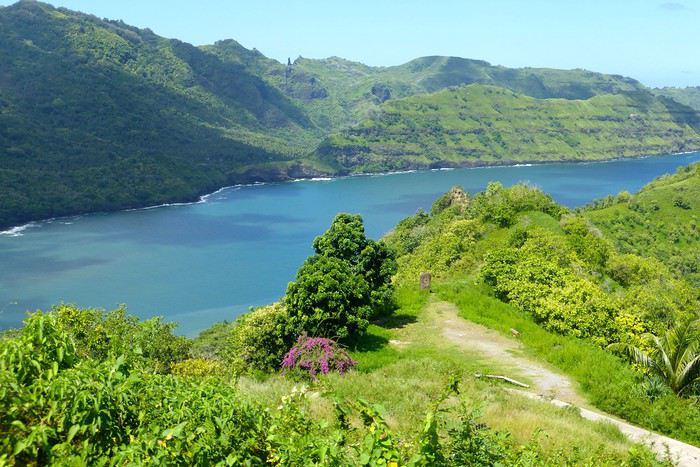
**A LITTLE GEOGRAPHY** Nuku Hiva (NH) is located about 1,500 km from Tahiti, in the north of French Polynesia. At 387 km², it’s the second-largest island in French Polynesia after Tahiti. It was formed by incredible volcanic phenomena and cataclysms between 1 and 6 million years ago, which lifted the island thousands of meters above the sea. Even after millennia of slow erosion, collapses, and settling, NH remains the most majestic of the Marquesas, with its sheer cliffs, deep valleys featuring immense waterfalls, and black walls that were once the inner walls of enormous volcanoes.
**A LITTLE HISTORY** The first contact between NH’s inhabitants and Europeans was in 1595 with Spanish navigators who only stayed briefly. It wasn’t until the late 18th century that Europeans arrived in greater numbers on NH (and the other Marquesas Islands), disrupting a very fragile social and cultural balance. It’s believed that nearly 100,000 people lived on Nuku Hiva at that time—a population decimated over the decades by epidemics, diseases brought by Europeans, and alcohol used for barter. The disastrous result: by the 1930s, only 2,500 people remained, having largely lost their identity and living in poverty. Today, the island has about 2,600 inhabitants spread across several villages, with Taiohae as the main one.
**NUKU HIVA IN LITERATURE**
1 / One of the famous writers who visited NH and stayed there was Herman Melville, who arrived in July 1842, the author of *Moby Dick*. The island had just come under French protectorate. Seduced by the enchanting *vahinés* and dazzled by his paradisiacal vision of the place, Melville deserted his ship. He ended up a prisoner of a local tribe, the Taipi, in Taipivai, where he stayed for a month and a half until an Australian ship captain secured his release in exchange for a musket and a roll of cotton fabric! Melville wrote a novel about this tumultuous episode in his life, considered a classic of travel literature. The book, *Typee: A Peep at Polynesian Life*, published in 1846 in the United States, was a huge success.
2 / Another famous Scottish writer, Robert Louis Stevenson, arrived in NH aboard a yacht that anchored in Anaho Bay, the island’s most beautiful, in July 1888. Stevenson was already known for two magnificent novels that marked their era: *Treasure Island* and *Dr. Jekyll & Mr. Hyde*. Stevenson, too, was captivated by the island’s natural beauty, though he also noted the devastating decline in identity, socio-cultural life, and physical health of a population ravaged by disease and alcohol. His account of his stay, *In the South Seas: An Account of Experiences and Observations in the Marquesas, Paumotus, and Gilbert Islands During Two Cruises on the Yacht Casco (1888) and the Schooner Equator (1889)*, was published in 1896 in New York, four years after his death in Apia, Western Samoa, where he had settled. It was also published in London in 1900.
3 / In August 1903, Victor Segalen, a French naval doctor, ethnologist, and archaeologist, landed in NH from the ship *La Durance*, sent to Polynesia to recover the possessions of the painter Paul Gauguin, who had died in April of that year. He, too, was enthralled by the Marquesas but lamented the loss of identity, dignity, and pride of the Māori, alienated by a Christianization that destroyed their culture and customs, denied their gods, and erased their past. He wrote about his experience, doubts, and fears in *Les Immémoriaux*.
4 / In December 1907, Jack London arrived in NH aboard the sailboat *Stark*, following in the footsteps of his illustrious predecessor, Herman Melville. London was in poor physical condition, exhausted from his relentless travels that had taken him from the Klondike in Canada to Japan, Australia, and London in Europe. He was appalled and shocked by Nuku Hiva’s degraded health situation: where Melville had encountered over 2,000 vigorous and healthy Marquesan warriors, London found only 12 suffering from various diseases—the rest had been wiped out by tuberculosis! His approach remained humanistic, and he maintained a sharp geopolitical awareness of these traditional Polynesian cultures, weakened by the inexorable advance of modernity in the early 20th century. He continued his journey to the Tuamotu Islands and Tahiti, publishing *Martin Eden*, the moving account of his initiatory voyage in the South Pacific, in 1911.
5 / Finally, Alain Gerbault, a writer, linguist, ethnologist, and tireless traveler, arrived in the Marquesas via the Panama Canal in December 1933. He was completely exhausted after an endless crossing on a small sailboat, the *Firecrest*. Enthralled by his stay in the Marquesas, he continued to the Tuamotu Islands in 1934, then Tahiti in 1935. Gerbault fought for the preservation of traditions, as well as the songs and dances banned by the Churches and the French Administration (these bans lasted over 50 years, mind you...!!!). Bora Bora remained his favorite island. A staunch Pétainist during World War II, he was forced to flee Bora Bora for Samoa, then Tonga, and finally Timor, a half-Portuguese island and thus neutral during the war. His travel accounts, *In Pursuit of the Sun: Logbook from New York to Tahiti* and *A Paradise Is Dying*, were published in the late 1940s. He died in Timor in 1941, and his ashes were repatriated to Bora Bora.
Back to our trip and stay.
**Day 1: April 27**
Departure from Papeete at 6:30 AM—we had to wake up two hours earlier and reach the airport in the dark. Takeoff at dawn, good weather en route, flight duration: 4 hours.
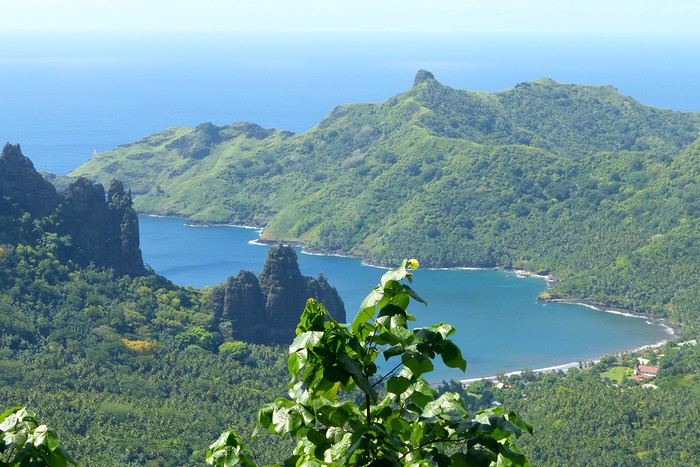
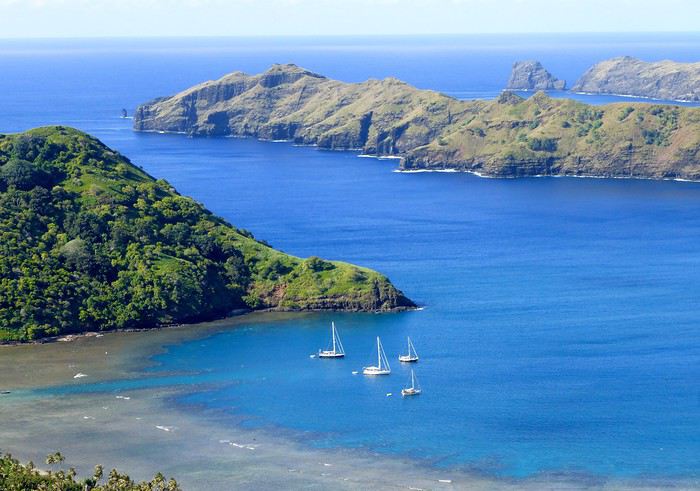
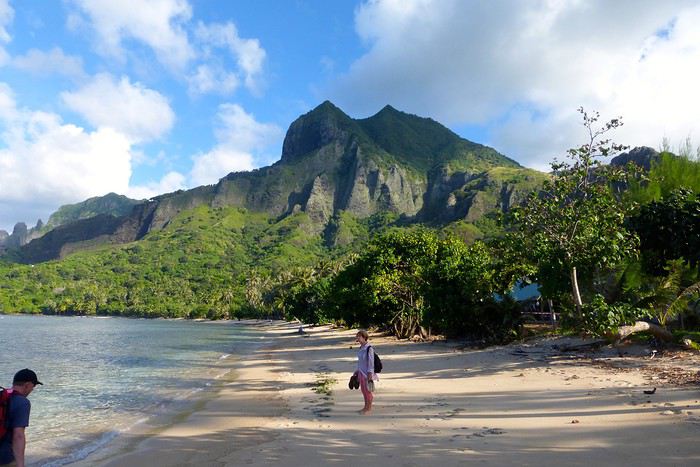
Arrival around 10:30 AM in Nuku Hiva, the first stop of this trip. We booked two nights in half-board at Pension Koku’u, transfers included. Maybe not such a great idea, those included transfers, especially on this unique island where the airport is located on *Terre Déserte*, on the other side of the mountain, opposite and about 45 km from the main village of Taiohae. They’re charged at a steep price. Expect 6,000 XPF round-trip by taxi, but 15,000 XPF charged by guesthouses or hotels. The difference is notable. It wasn’t the best idea, but we can’t go back. Even for residents like us who know how to travel in Polynesia, the Air Tahiti employee who sold me the Pass couldn’t give any useful advice about the stay itself—probably because he’d never been to the Marquesas. It’s really annoying! In short, the good idea to remember is renting a car (like a Suzuki) to be free to manage your time and stop at leisure. The road signage is a bit basic, but you’ll manage just fine. Our host Alvane waits for us—without a sign (sic!)—and after searching for each other for 5 minutes, we’re off on a journey of over an hour (with photo stops) in a Land Rover with smooth tires (luckily, it’s not raining!). The recently paved and marked mountain road is impeccable. No time to catch our breath at the guesthouse; we leave immediately (not a great idea after waking up at dawn plus 4 hours on a plane) for a half-day hike that was also included in the prepaid stay. A sandwich was provided (really pathetic for the physical effort required), we have water, and we fill a few bottles at the spring near the ceremonial site of Taipivai, our first stop. Then the hike begins in the Hanaheu Valley, descending toward Anaho Bay and its namesake beach. A magnificent and wild spot, a few sailboats anchored, we swim—the water is really warm, over 30°C at the shore. That warm is rare and not necessarily pleasant. We then have to climb a very steep slope; this hike is actually quite tough. The air is still, humid, and stifling under the foliage, there’s a bit of mud, and tiny ants (which don’t bite, I’ll have you know), locally called *fofolles*, running over shoes, ankles, and calves. Not very pleasant...! On top of that, there are mosquitoes to protect against! In hindsight, it seems wise to bring energy bars from Papeete if you plan to hike on the afternoon of your arrival day. We weren’t careful... Result: a moment of weakness for me and a hyperventilation attack climbing back up from Anaho Bay!!! We return to the guesthouse at night. There we find Claudine and her four children—Marquesan-style atmosphere, friendly and casual. We share family life. Very simple room with a bathroom, no mosquitoes, we can sleep with the window open, but the night will be noisy, as is often the case in Polynesia. Roosters are everywhere and don’t sleep, dogs bark or whine. So we end up waking up early... like everyone else.
**Day 2: April 28**
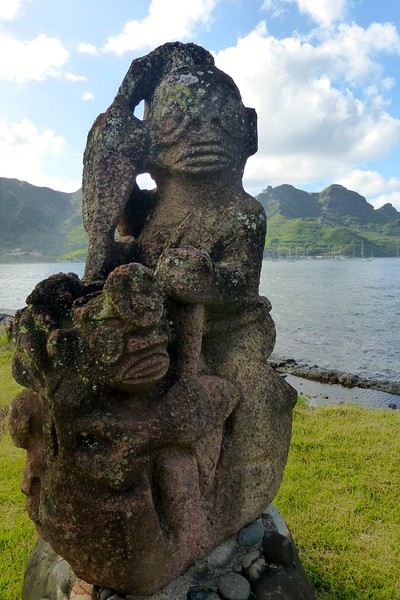
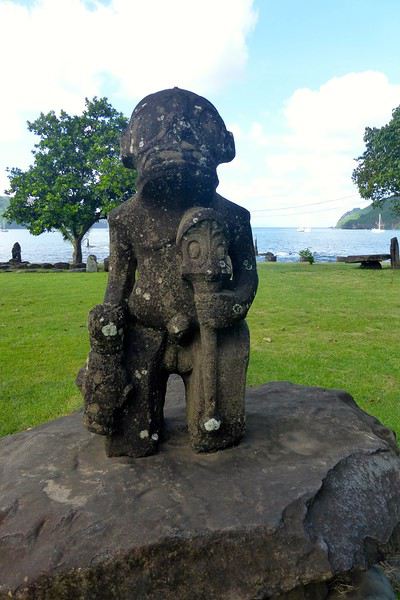
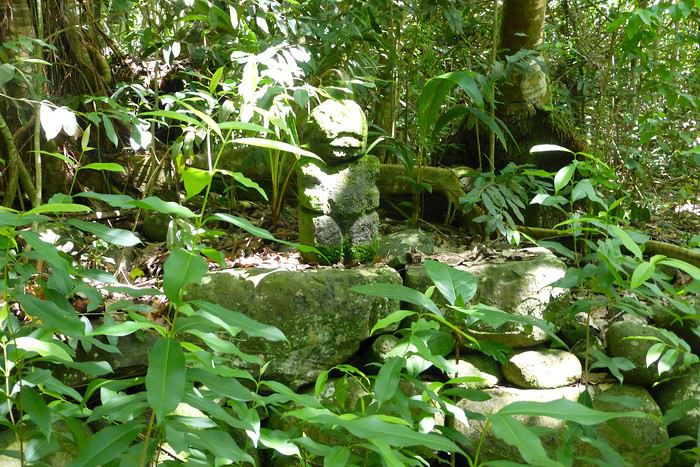
We booked a full-day excursion with Thierry: it starts with a 45-minute boat ride to reach Hakatea Beach, hidden in a small secret bay like many along Nuku Hiva’s coasts. From there, the hike lasts all day—11 km round-trip on flat but also rugged terrain (ancient paved and elevated paths over 1,000 years old)—and river crossings. Bring the right shoes (like plastic Crocs with high socks—not very stylish but practical). We cross the former village of Hakaui, walk along the foundations of dwellings, and there are still weathered tikis in the lush vegetation. The ultimate goal of this hike is to reach the tall Vaipo waterfall. The place is magical, with openings in the vegetation and immense trees allowing photos of the treetops and caves where funeral canoes containing the bones of chiefs or great warriors were once placed. We return the same way to the beach and take another boat ride to reach Taihoae’s port. Back at the guesthouse after a glimpse of Taihoae’s waterfront.
**UA POU**
**Day 3: April 29**
Back to the airport in the late morning for the second flight of the trip to Ua Pou. 20-minute crossing in a Twin Otter (18 seats but only 13 occupied due to cargo between the islands). Beautiful weather, blue sea, nice photos to take upon departure from NH and arrival in UP. We’re greeted by Jérôme, a former military man turned tourism professional, who runs Pension Pukue’e with his wife Elisa, a native of UP. We’re in for two exceptional days. The guesthouse is comfortable, Jérôme and Elisa are very professional and pleasant. Jérôme is also a professional hiker, and Elisa is an excellent cook. We leave quickly for a half-day excursion to Hohoi, after a stop at the archaeological, cultural, and religious site of Maui’a, the Tavaka tribe’s territory. Jérôme is there to explain how Marquesan society functioned at the time and the events that took place on a site still largely buried under vegetation. Then we visit a flower-stone sculptor he knows—the only place in the Marquesas where you’ll find these stones. They’re collected in the river flowing into the sea at Hohoi, sometimes on the beach itself. Back to the guesthouse.
**Day 4: April 30**
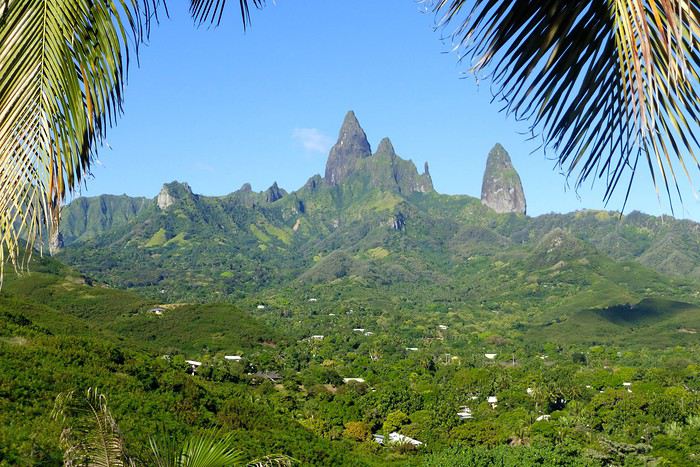
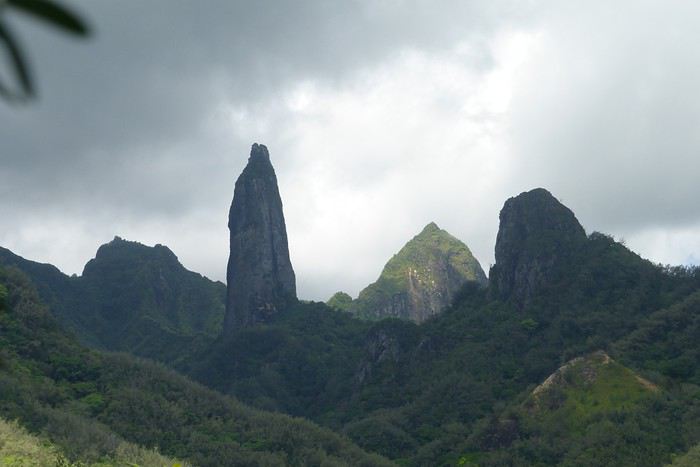
A nature hike in the mountains—moderately difficult—toward the Vaiea waterfall is on our program for a good 4 hours. It’s hot, there are mosquitoes, and the dip in the pool under the waterfall (24°C water) is a rare pleasure. Lunch at a friend of Jérôme’s, a former chef for French minister François Fillon, who prepares delicious food. Elisa picks us up by car to return to the guesthouse. Ua Pou is a beautiful and elegant island with its sharp peaks and wild nature. Our favorite, thanks to Jérôme and his wife.
**UA HUKA**
**Day 4: May 1**
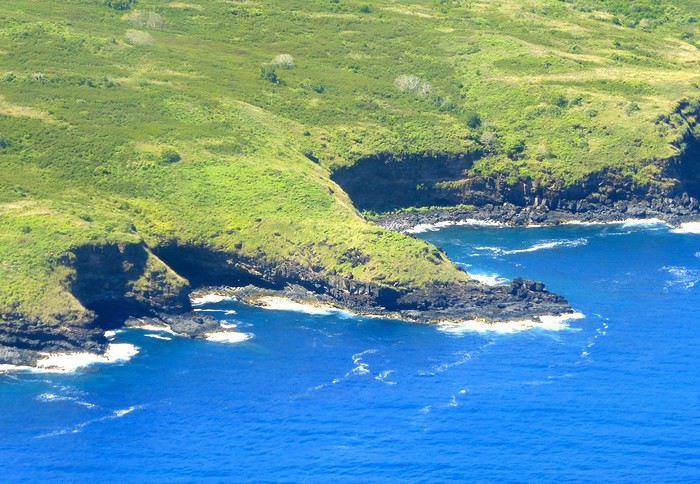
Departure for Ua Huka, the smallest inhabited island in the northern group of the Marquesas, located about 1,300 km northeast of Tahiti. Landing is at the oldest airfield in the Marquesas, built in 1972, between the villages of Vaipaee and Hane. Ua Huka has about 680 inhabitants, according to the last census, spread across 3 villages (since the 1870s): Vaipaee, Hane, and Hokatu. The island peaks at Mount Hitikau at only 884 meters. Its origin: a Hawaiian-type shield volcano that—over a few million years—collapsed to become a caldera (or elliptical depression) in which two small volcanoes appeared, the craters of Tahoatikiau and Teepoepo, now part of the Vaikivi Park. The island is rugged and wild, lower than the others, so less cloud-covered and drier. The bays are jagged, the coastline in ochre tones above the intense blue of the sea, and the beaches are constantly disturbed by the powerful surf. The village of Hokatu is only a few kilometers away (just 14 km of road on the island), but Maurice, our host, drives slowly, and it takes time to go up and down. The road is entirely paved or concreted, which isn’t the case on Ua Pou, for example. The guesthouse is disappointing, perched above the village and thus isolated. Beautiful view of the famous Hane motu and the sparkling sea under the bright sun. Apart from that, there are mosquitoes and cockroaches, the bungalow isn’t clean. Meals are taken with Maurice and Delphine in the village—fine dining isn’t on the menu! Ouch!!! We didn’t luck out...
**Day 5: May 2**
Early in the morning, after breakfast, Delphine takes us to the craft center, which turns out to be a letdown—the items for sale are, in my opinion, crude and poorly carved. Nothing like what’s offered at the Marquesas Fair, held twice a year in Papeete, where you can admire and buy small wonders: wood carvings, flower stone, and coral. Delphine is disappointed we’re not interested, and it shows... She’s a bit sulky! These are items meant for Aranui cruise passengers who land on Ua Huka once every two weeks... Solo travelers like us don’t seem to interest her much. The rest of the day—spent with Maurice—is dedicated to visiting cultural centers and small museums, like the Sea Museum in Hane with its ancient canoes, the municipal archaeological museum on the Te Tumu site above the airfield, the petroglyph house near Hokatu Beach, and finally the Papuakeikaraa arboretum, which gathers endemic plants from all over Polynesia and an impressive citrus collection. No excursion planned to Vaikivi Park, toward the previously mentioned craters that recall the island’s volcanic past. Also missing are the viewpoints, the unique endemic vegetation, and especially the petroglyphs. Too bad... at that price!!! Still, in the evening, we go fishing—with sandwiches and drinks in coolers—with other villagers from the dock at the end of the paved road. It’s cool, windy, no mosquitoes, lots of fish caught, and a great atmosphere. Plus, magnificently starry skies.
Ua Huka is one of the rare islands not invaded by the black rat, which has preserved its birdlife, particularly the ultramarine lorikeet (or *pihiti* in Marquesan), which feeds almost exclusively on flower nectar (banana, coconut, hibiscus, mango, guava trees). A dog imported from New Zealand has been specially trained to detect rats: it inspects cargo unloaded from boats and the docks.
I recommend spending two full days on the island—one for visiting the various museums, the other for hiking in the island’s center park, where the archaeological sites are in their raw state: foundations of agricultural terrace walls, gathering places (or *tohua*), dwelling pavements (or *paepae*), sacred sites (or *me’ae* in Marquesan, *marae* in Tahitian) with their tikis and petroglyphs.
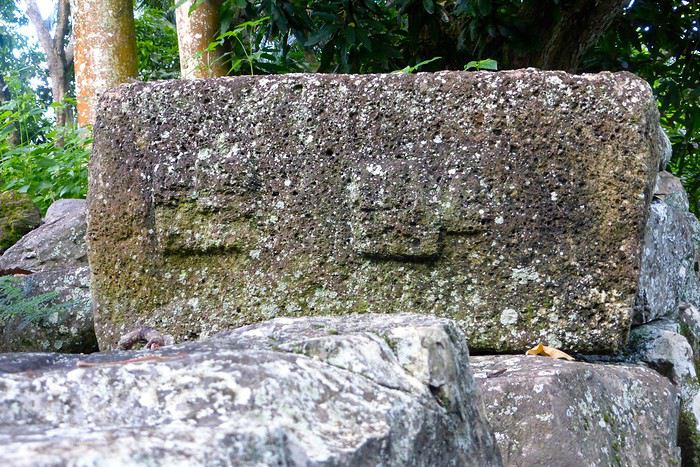
To finish, a bit of info on the island’s name, tied to Marquesan oral culture: according to the legend of the creation of the six Marquesas Islands, Ua Huka is the one that puts the finishing touch on the construction of the god Oatea’s house, each island having a defined architectural function. Ua Huka represents the hole (*ua*) where the god deposits what’s left (*huka* in Marquesan) of the unused materials during construction.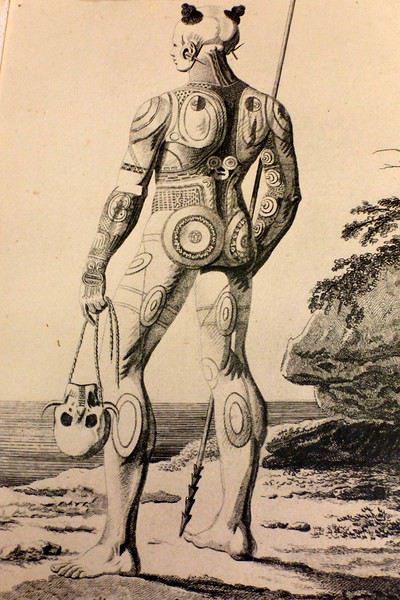
**HIVA OA**
**Day 6: May 3**
Departure in the late morning for Hiva Oa. Maurice—who had other things to do—dropped us off at the airfield 3 hours early... so this stop is a bit of a flop, even if we decided to stay positive! Hiva Oa is the third-largest island in French Polynesia after Tahiti and Nuku Hiva, and before Raiatea in the Leeward Islands. The island is beautiful, lush, verdant, and jagged. The mountains soar into the sky, the sea views are grand, the light is sublime—we’re lucky. Beautiful weather. Tania from Pension Kanahau waits for us at the airport. We’re in for two wonderful days with her. Tania is welcoming, smiling, and dynamic. What a pleasure to be with her, at her place—she cooks divinely and serves the best tuna in the world (the Big Eye reserved for the Japanese) and croquettes made with lobster, shrimp, and crab with breadfruit cubes, for example. Comfortable bungalow, no mosquitoes at night, we can sleep with the window open. It’s fantastic! After settling in, Tania takes us to town in Atuona, a pleasant and well-laid-out little village. We start with lunch—a delicious raw fish in coconut milk—then continue with the must-see attractions: the Catholic cemetery where Paul Gauguin and Jacques Brel’s graves are, overlooking the town; the abandoned Protestant cemetery, reclaimed by the bush, with impressive Marquesan warrior tombs made of huge coral slabs and adorned with a tiki head (harder to find, as no one goes there... ask for directions!); the craft center; the Gauguin Museum (and the Jacques Brel Museum); and the waterfront. While we stroll peacefully, Tania organizes an excursion for the next day, May 4, a full day with Pifa O’Connor, a 36-year-old who knows his island inside out, is passionate about local history, and with whom we’ll hit it off.
**Day 7: May 4**
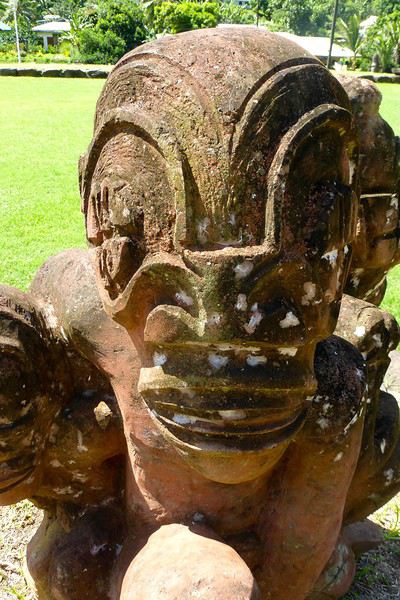
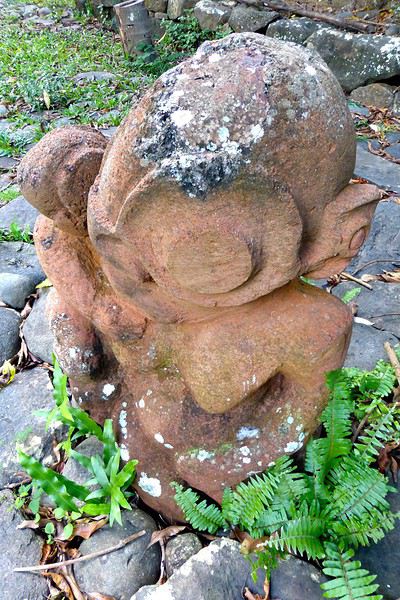
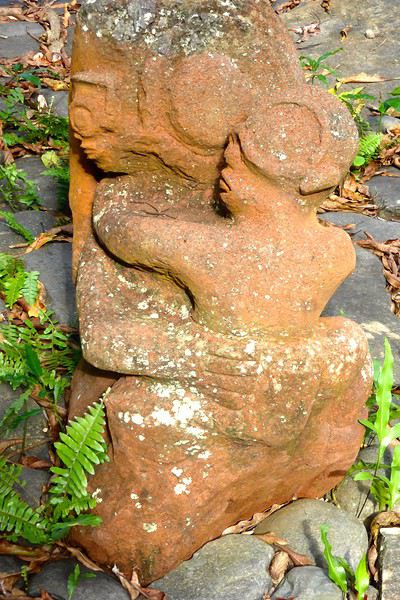
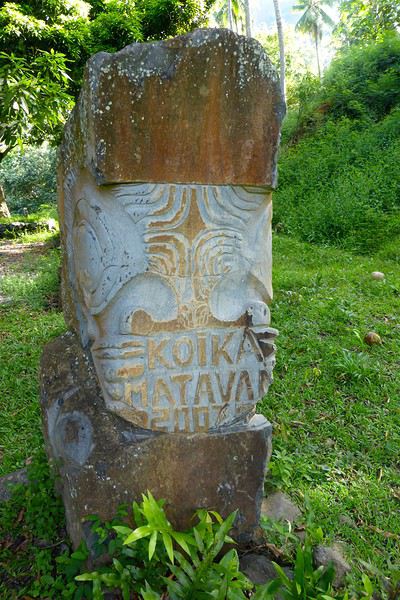
Pifa arrives at 8 AM sharp at the guesthouse, and we immediately buy sandwiches and water at a small supermarket in Atuona. First, we make a brief stop by the roadside at an unmarked spot, from which we descend a small path through dense vegetation leading to the famous smiling tiki—the only one of its kind in the Marquesas and Polynesia. The place is improbable, the tiki isn’t huge, but it’s beautiful and impressive. Then we’re off on the road that, dizzyingly, runs along and overlooks the island’s northern coast, at the edge of the ancient volcano. Few vehicles pass, the road—now a rocky track—is full of potholes, and we proceed slowly. (Note that this road has been fully paved since 2018.) The panoramas are majestic, with every shade of green against the blue sea. We stop again at the top of a cliff adorned with a huge stone, the *sacrifice stone*, from which young virgin girls were once thrown into the sea to appease angry gods. Another pause for lunch this time, at a small restaurant near the exceptional archaeological site of Puamau. We’ll experience the highlights of this trip during this excursion with our guide, Pifa, who spares no explanations. We discover, on a vast esplanade, the ceremonial complexes of Ta’a Oa and Meae Te I’Ipona, the latter featuring superb tikis, particularly the reclining tiki—or *Maki Taua Pepe*—representing Motherhood, a woman giving birth in a squatting position, as was often the case in many civilizations. Also notable is the *Takaii*, the largest tiki recorded in Polynesia to date. There’s also a huge stone with a now-blunt edge, on which the circumcision of chiefs’ and notables’ pre-adolescent sons was performed. A tough ordeal! But that’s not all! It seems there are more on the mountainside rising steeply behind the archaeological site—overturned tikis, platforms, and, apparently, a giant tiki at the top, which must have fallen but was visible from afar on the sea 30 or 40 years ago, according to the island’s elders. This meeting, worship, and living place—it was actually a small town—is immense. Thousands of people once lived in this part of the island. The site—a religious, social, and cultural sanctuary—would be the size of the largest Mayan sites in Yucatán, but the few concerned owners—two or three families who own the mountainside—don’t want to hear about intensive clearing or tree cutting for now. UNESCO rightly asks for some compliance efforts to grant special treatment to Hiva Oa in particular and the Marquesas in general. We’re not there yet, unfortunately, due to insurmountable local rigidities! This kind of attitude is quite typical in Polynesia: people are afraid to uncover *marae* buried under vegetation—they’re taboo and sometimes said to emit negative and deadly waves, so it’s better not to disturb or anger the ancient spirits or gods who might take revenge. The old religion is never far away in Polynesia, despite the successes of the missionaries.
We return to the guesthouse in the late afternoon. Last night in the Marquesas with Tania, who prepares a fine and delicious meal. Note that dinner costs 2,500 XPF per person.
**Day 8: May 5**
We take the plane as planned, via Nuku Hiva (short stopover). Arrival on time in Papeete.
May this travel journal inspire many of you to visit the Marquesas one day. It’s far, it’s expensive, it’s the trip of a lifetime—it’s unforgettable and unmissable.
Our itinerary is perfect for those who aren’t excited by cruises and prefer to get closer to the local communities. This 9-day trip cost us around 2500 € all-inclusive. For a 14-day cruise on the Aranui, expect to pay 2300 € per person for a basic cabin for four, or 3800 € per person for a superior double cabin.
Air Tahiti offers a 4-island Marquesas Pass (Nuku Hiva, Ua Pou, Ua Huka, and Hiva Oa) for 86,000 XPF (about 700 €). The journey is made on an ATR 72 from Tahiti to Nuku Hiva or Hiva Oa, and on a 19-seat Twin Otter between the islands (often only 13 or 15 seats are available due to cargo, so book well in advance). We’re traveling as a couple. We booked our family-run guesthouse stays at the Tourism Fair in early February, where you can meet the owners and make your choice. Stays are almost always half-board or breakfast-only. Transfers are usually included, but you can always book a car or taxi.
**NUKU HIVA**
**A LITTLE GEOGRAPHY** Nuku Hiva (NH) is located about 1,500 km from Tahiti, in the north of French Polynesia. At 387 km², it’s the second-largest island in French Polynesia after Tahiti. It was formed by incredible volcanic phenomena and cataclysms between 1 and 6 million years ago, which lifted the island thousands of meters above the sea. Even after millennia of slow erosion, collapses, and settling, NH remains the most majestic of the Marquesas, with its sheer cliffs, deep valleys featuring immense waterfalls, and black walls that were once the inner walls of enormous volcanoes.
**A LITTLE HISTORY** The first contact between NH’s inhabitants and Europeans was in 1595 with Spanish navigators who only stayed briefly. It wasn’t until the late 18th century that Europeans arrived in greater numbers on NH (and the other Marquesas Islands), disrupting a very fragile social and cultural balance. It’s believed that nearly 100,000 people lived on Nuku Hiva at that time—a population decimated over the decades by epidemics, diseases brought by Europeans, and alcohol used for barter. The disastrous result: by the 1930s, only 2,500 people remained, having largely lost their identity and living in poverty. Today, the island has about 2,600 inhabitants spread across several villages, with Taiohae as the main one.
**NUKU HIVA IN LITERATURE**
1 / One of the famous writers who visited NH and stayed there was Herman Melville, who arrived in July 1842, the author of *Moby Dick*. The island had just come under French protectorate. Seduced by the enchanting *vahinés* and dazzled by his paradisiacal vision of the place, Melville deserted his ship. He ended up a prisoner of a local tribe, the Taipi, in Taipivai, where he stayed for a month and a half until an Australian ship captain secured his release in exchange for a musket and a roll of cotton fabric! Melville wrote a novel about this tumultuous episode in his life, considered a classic of travel literature. The book, *Typee: A Peep at Polynesian Life*, published in 1846 in the United States, was a huge success.
2 / Another famous Scottish writer, Robert Louis Stevenson, arrived in NH aboard a yacht that anchored in Anaho Bay, the island’s most beautiful, in July 1888. Stevenson was already known for two magnificent novels that marked their era: *Treasure Island* and *Dr. Jekyll & Mr. Hyde*. Stevenson, too, was captivated by the island’s natural beauty, though he also noted the devastating decline in identity, socio-cultural life, and physical health of a population ravaged by disease and alcohol. His account of his stay, *In the South Seas: An Account of Experiences and Observations in the Marquesas, Paumotus, and Gilbert Islands During Two Cruises on the Yacht Casco (1888) and the Schooner Equator (1889)*, was published in 1896 in New York, four years after his death in Apia, Western Samoa, where he had settled. It was also published in London in 1900.
3 / In August 1903, Victor Segalen, a French naval doctor, ethnologist, and archaeologist, landed in NH from the ship *La Durance*, sent to Polynesia to recover the possessions of the painter Paul Gauguin, who had died in April of that year. He, too, was enthralled by the Marquesas but lamented the loss of identity, dignity, and pride of the Māori, alienated by a Christianization that destroyed their culture and customs, denied their gods, and erased their past. He wrote about his experience, doubts, and fears in *Les Immémoriaux*.
4 / In December 1907, Jack London arrived in NH aboard the sailboat *Stark*, following in the footsteps of his illustrious predecessor, Herman Melville. London was in poor physical condition, exhausted from his relentless travels that had taken him from the Klondike in Canada to Japan, Australia, and London in Europe. He was appalled and shocked by Nuku Hiva’s degraded health situation: where Melville had encountered over 2,000 vigorous and healthy Marquesan warriors, London found only 12 suffering from various diseases—the rest had been wiped out by tuberculosis! His approach remained humanistic, and he maintained a sharp geopolitical awareness of these traditional Polynesian cultures, weakened by the inexorable advance of modernity in the early 20th century. He continued his journey to the Tuamotu Islands and Tahiti, publishing *Martin Eden*, the moving account of his initiatory voyage in the South Pacific, in 1911.
5 / Finally, Alain Gerbault, a writer, linguist, ethnologist, and tireless traveler, arrived in the Marquesas via the Panama Canal in December 1933. He was completely exhausted after an endless crossing on a small sailboat, the *Firecrest*. Enthralled by his stay in the Marquesas, he continued to the Tuamotu Islands in 1934, then Tahiti in 1935. Gerbault fought for the preservation of traditions, as well as the songs and dances banned by the Churches and the French Administration (these bans lasted over 50 years, mind you...!!!). Bora Bora remained his favorite island. A staunch Pétainist during World War II, he was forced to flee Bora Bora for Samoa, then Tonga, and finally Timor, a half-Portuguese island and thus neutral during the war. His travel accounts, *In Pursuit of the Sun: Logbook from New York to Tahiti* and *A Paradise Is Dying*, were published in the late 1940s. He died in Timor in 1941, and his ashes were repatriated to Bora Bora.
Back to our trip and stay.
**Day 1: April 27**
Departure from Papeete at 6:30 AM—we had to wake up two hours earlier and reach the airport in the dark. Takeoff at dawn, good weather en route, flight duration: 4 hours.
Arrival around 10:30 AM in Nuku Hiva, the first stop of this trip. We booked two nights in half-board at Pension Koku’u, transfers included. Maybe not such a great idea, those included transfers, especially on this unique island where the airport is located on *Terre Déserte*, on the other side of the mountain, opposite and about 45 km from the main village of Taiohae. They’re charged at a steep price. Expect 6,000 XPF round-trip by taxi, but 15,000 XPF charged by guesthouses or hotels. The difference is notable. It wasn’t the best idea, but we can’t go back. Even for residents like us who know how to travel in Polynesia, the Air Tahiti employee who sold me the Pass couldn’t give any useful advice about the stay itself—probably because he’d never been to the Marquesas. It’s really annoying! In short, the good idea to remember is renting a car (like a Suzuki) to be free to manage your time and stop at leisure. The road signage is a bit basic, but you’ll manage just fine. Our host Alvane waits for us—without a sign (sic!)—and after searching for each other for 5 minutes, we’re off on a journey of over an hour (with photo stops) in a Land Rover with smooth tires (luckily, it’s not raining!). The recently paved and marked mountain road is impeccable. No time to catch our breath at the guesthouse; we leave immediately (not a great idea after waking up at dawn plus 4 hours on a plane) for a half-day hike that was also included in the prepaid stay. A sandwich was provided (really pathetic for the physical effort required), we have water, and we fill a few bottles at the spring near the ceremonial site of Taipivai, our first stop. Then the hike begins in the Hanaheu Valley, descending toward Anaho Bay and its namesake beach. A magnificent and wild spot, a few sailboats anchored, we swim—the water is really warm, over 30°C at the shore. That warm is rare and not necessarily pleasant. We then have to climb a very steep slope; this hike is actually quite tough. The air is still, humid, and stifling under the foliage, there’s a bit of mud, and tiny ants (which don’t bite, I’ll have you know), locally called *fofolles*, running over shoes, ankles, and calves. Not very pleasant...! On top of that, there are mosquitoes to protect against! In hindsight, it seems wise to bring energy bars from Papeete if you plan to hike on the afternoon of your arrival day. We weren’t careful... Result: a moment of weakness for me and a hyperventilation attack climbing back up from Anaho Bay!!! We return to the guesthouse at night. There we find Claudine and her four children—Marquesan-style atmosphere, friendly and casual. We share family life. Very simple room with a bathroom, no mosquitoes, we can sleep with the window open, but the night will be noisy, as is often the case in Polynesia. Roosters are everywhere and don’t sleep, dogs bark or whine. So we end up waking up early... like everyone else.
**Day 2: April 28**
We booked a full-day excursion with Thierry: it starts with a 45-minute boat ride to reach Hakatea Beach, hidden in a small secret bay like many along Nuku Hiva’s coasts. From there, the hike lasts all day—11 km round-trip on flat but also rugged terrain (ancient paved and elevated paths over 1,000 years old)—and river crossings. Bring the right shoes (like plastic Crocs with high socks—not very stylish but practical). We cross the former village of Hakaui, walk along the foundations of dwellings, and there are still weathered tikis in the lush vegetation. The ultimate goal of this hike is to reach the tall Vaipo waterfall. The place is magical, with openings in the vegetation and immense trees allowing photos of the treetops and caves where funeral canoes containing the bones of chiefs or great warriors were once placed. We return the same way to the beach and take another boat ride to reach Taihoae’s port. Back at the guesthouse after a glimpse of Taihoae’s waterfront.
**UA POU**
**Day 3: April 29**
Back to the airport in the late morning for the second flight of the trip to Ua Pou. 20-minute crossing in a Twin Otter (18 seats but only 13 occupied due to cargo between the islands). Beautiful weather, blue sea, nice photos to take upon departure from NH and arrival in UP. We’re greeted by Jérôme, a former military man turned tourism professional, who runs Pension Pukue’e with his wife Elisa, a native of UP. We’re in for two exceptional days. The guesthouse is comfortable, Jérôme and Elisa are very professional and pleasant. Jérôme is also a professional hiker, and Elisa is an excellent cook. We leave quickly for a half-day excursion to Hohoi, after a stop at the archaeological, cultural, and religious site of Maui’a, the Tavaka tribe’s territory. Jérôme is there to explain how Marquesan society functioned at the time and the events that took place on a site still largely buried under vegetation. Then we visit a flower-stone sculptor he knows—the only place in the Marquesas where you’ll find these stones. They’re collected in the river flowing into the sea at Hohoi, sometimes on the beach itself. Back to the guesthouse.
**Day 4: April 30**
A nature hike in the mountains—moderately difficult—toward the Vaiea waterfall is on our program for a good 4 hours. It’s hot, there are mosquitoes, and the dip in the pool under the waterfall (24°C water) is a rare pleasure. Lunch at a friend of Jérôme’s, a former chef for French minister François Fillon, who prepares delicious food. Elisa picks us up by car to return to the guesthouse. Ua Pou is a beautiful and elegant island with its sharp peaks and wild nature. Our favorite, thanks to Jérôme and his wife.
**UA HUKA**
**Day 4: May 1**
Departure for Ua Huka, the smallest inhabited island in the northern group of the Marquesas, located about 1,300 km northeast of Tahiti. Landing is at the oldest airfield in the Marquesas, built in 1972, between the villages of Vaipaee and Hane. Ua Huka has about 680 inhabitants, according to the last census, spread across 3 villages (since the 1870s): Vaipaee, Hane, and Hokatu. The island peaks at Mount Hitikau at only 884 meters. Its origin: a Hawaiian-type shield volcano that—over a few million years—collapsed to become a caldera (or elliptical depression) in which two small volcanoes appeared, the craters of Tahoatikiau and Teepoepo, now part of the Vaikivi Park. The island is rugged and wild, lower than the others, so less cloud-covered and drier. The bays are jagged, the coastline in ochre tones above the intense blue of the sea, and the beaches are constantly disturbed by the powerful surf. The village of Hokatu is only a few kilometers away (just 14 km of road on the island), but Maurice, our host, drives slowly, and it takes time to go up and down. The road is entirely paved or concreted, which isn’t the case on Ua Pou, for example. The guesthouse is disappointing, perched above the village and thus isolated. Beautiful view of the famous Hane motu and the sparkling sea under the bright sun. Apart from that, there are mosquitoes and cockroaches, the bungalow isn’t clean. Meals are taken with Maurice and Delphine in the village—fine dining isn’t on the menu! Ouch!!! We didn’t luck out...
**Day 5: May 2**
Early in the morning, after breakfast, Delphine takes us to the craft center, which turns out to be a letdown—the items for sale are, in my opinion, crude and poorly carved. Nothing like what’s offered at the Marquesas Fair, held twice a year in Papeete, where you can admire and buy small wonders: wood carvings, flower stone, and coral. Delphine is disappointed we’re not interested, and it shows... She’s a bit sulky! These are items meant for Aranui cruise passengers who land on Ua Huka once every two weeks... Solo travelers like us don’t seem to interest her much. The rest of the day—spent with Maurice—is dedicated to visiting cultural centers and small museums, like the Sea Museum in Hane with its ancient canoes, the municipal archaeological museum on the Te Tumu site above the airfield, the petroglyph house near Hokatu Beach, and finally the Papuakeikaraa arboretum, which gathers endemic plants from all over Polynesia and an impressive citrus collection. No excursion planned to Vaikivi Park, toward the previously mentioned craters that recall the island’s volcanic past. Also missing are the viewpoints, the unique endemic vegetation, and especially the petroglyphs. Too bad... at that price!!! Still, in the evening, we go fishing—with sandwiches and drinks in coolers—with other villagers from the dock at the end of the paved road. It’s cool, windy, no mosquitoes, lots of fish caught, and a great atmosphere. Plus, magnificently starry skies.
Ua Huka is one of the rare islands not invaded by the black rat, which has preserved its birdlife, particularly the ultramarine lorikeet (or *pihiti* in Marquesan), which feeds almost exclusively on flower nectar (banana, coconut, hibiscus, mango, guava trees). A dog imported from New Zealand has been specially trained to detect rats: it inspects cargo unloaded from boats and the docks.
I recommend spending two full days on the island—one for visiting the various museums, the other for hiking in the island’s center park, where the archaeological sites are in their raw state: foundations of agricultural terrace walls, gathering places (or *tohua*), dwelling pavements (or *paepae*), sacred sites (or *me’ae* in Marquesan, *marae* in Tahitian) with their tikis and petroglyphs.
To finish, a bit of info on the island’s name, tied to Marquesan oral culture: according to the legend of the creation of the six Marquesas Islands, Ua Huka is the one that puts the finishing touch on the construction of the god Oatea’s house, each island having a defined architectural function. Ua Huka represents the hole (*ua*) where the god deposits what’s left (*huka* in Marquesan) of the unused materials during construction.
**HIVA OA**
**Day 6: May 3**
Departure in the late morning for Hiva Oa. Maurice—who had other things to do—dropped us off at the airfield 3 hours early... so this stop is a bit of a flop, even if we decided to stay positive! Hiva Oa is the third-largest island in French Polynesia after Tahiti and Nuku Hiva, and before Raiatea in the Leeward Islands. The island is beautiful, lush, verdant, and jagged. The mountains soar into the sky, the sea views are grand, the light is sublime—we’re lucky. Beautiful weather. Tania from Pension Kanahau waits for us at the airport. We’re in for two wonderful days with her. Tania is welcoming, smiling, and dynamic. What a pleasure to be with her, at her place—she cooks divinely and serves the best tuna in the world (the Big Eye reserved for the Japanese) and croquettes made with lobster, shrimp, and crab with breadfruit cubes, for example. Comfortable bungalow, no mosquitoes at night, we can sleep with the window open. It’s fantastic! After settling in, Tania takes us to town in Atuona, a pleasant and well-laid-out little village. We start with lunch—a delicious raw fish in coconut milk—then continue with the must-see attractions: the Catholic cemetery where Paul Gauguin and Jacques Brel’s graves are, overlooking the town; the abandoned Protestant cemetery, reclaimed by the bush, with impressive Marquesan warrior tombs made of huge coral slabs and adorned with a tiki head (harder to find, as no one goes there... ask for directions!); the craft center; the Gauguin Museum (and the Jacques Brel Museum); and the waterfront. While we stroll peacefully, Tania organizes an excursion for the next day, May 4, a full day with Pifa O’Connor, a 36-year-old who knows his island inside out, is passionate about local history, and with whom we’ll hit it off.
**Day 7: May 4**
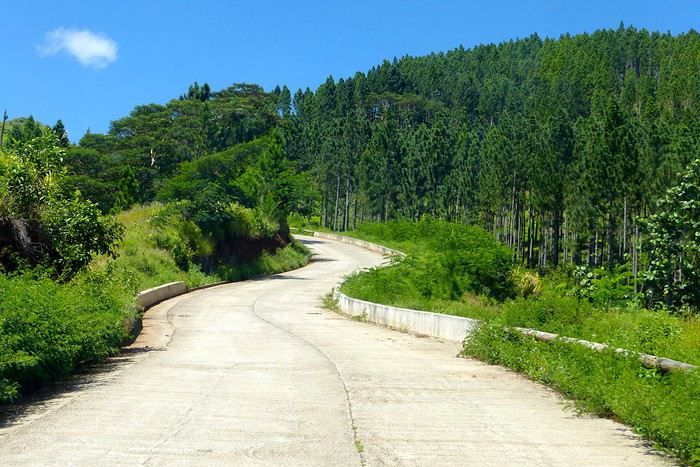
Pifa arrives at 8 AM sharp at the guesthouse, and we immediately buy sandwiches and water at a small supermarket in Atuona. First, we make a brief stop by the roadside at an unmarked spot, from which we descend a small path through dense vegetation leading to the famous smiling tiki—the only one of its kind in the Marquesas and Polynesia. The place is improbable, the tiki isn’t huge, but it’s beautiful and impressive. Then we’re off on the road that, dizzyingly, runs along and overlooks the island’s northern coast, at the edge of the ancient volcano. Few vehicles pass, the road—now a rocky track—is full of potholes, and we proceed slowly. (Note that this road has been fully paved since 2018.) The panoramas are majestic, with every shade of green against the blue sea. We stop again at the top of a cliff adorned with a huge stone, the *sacrifice stone*, from which young virgin girls were once thrown into the sea to appease angry gods. Another pause for lunch this time, at a small restaurant near the exceptional archaeological site of Puamau. We’ll experience the highlights of this trip during this excursion with our guide, Pifa, who spares no explanations. We discover, on a vast esplanade, the ceremonial complexes of Ta’a Oa and Meae Te I’Ipona, the latter featuring superb tikis, particularly the reclining tiki—or *Maki Taua Pepe*—representing Motherhood, a woman giving birth in a squatting position, as was often the case in many civilizations. Also notable is the *Takaii*, the largest tiki recorded in Polynesia to date. There’s also a huge stone with a now-blunt edge, on which the circumcision of chiefs’ and notables’ pre-adolescent sons was performed. A tough ordeal! But that’s not all! It seems there are more on the mountainside rising steeply behind the archaeological site—overturned tikis, platforms, and, apparently, a giant tiki at the top, which must have fallen but was visible from afar on the sea 30 or 40 years ago, according to the island’s elders. This meeting, worship, and living place—it was actually a small town—is immense. Thousands of people once lived in this part of the island. The site—a religious, social, and cultural sanctuary—would be the size of the largest Mayan sites in Yucatán, but the few concerned owners—two or three families who own the mountainside—don’t want to hear about intensive clearing or tree cutting for now. UNESCO rightly asks for some compliance efforts to grant special treatment to Hiva Oa in particular and the Marquesas in general. We’re not there yet, unfortunately, due to insurmountable local rigidities! This kind of attitude is quite typical in Polynesia: people are afraid to uncover *marae* buried under vegetation—they’re taboo and sometimes said to emit negative and deadly waves, so it’s better not to disturb or anger the ancient spirits or gods who might take revenge. The old religion is never far away in Polynesia, despite the successes of the missionaries.
We return to the guesthouse in the late afternoon. Last night in the Marquesas with Tania, who prepares a fine and delicious meal. Note that dinner costs 2,500 XPF per person.
**Day 8: May 5**
We take the plane as planned, via Nuku Hiva (short stopover). Arrival on time in Papeete.
May this travel journal inspire many of you to visit the Marquesas one day. It’s far, it’s expensive, it’s the trip of a lifetime—it’s unforgettable and unmissable.