Posts by Aleph240758
About 1,447 results.
More options
Search results
Where to settle down / relax in India?
Well, Kolkata—having been back there in April—is nothing like Mumbai.
It’s Kolkata: it hits you hard. Are you ready for that? The city has its own soul, and you won’t see the same kind of street-level progress as in other cities, but it’s still incredibly interesting.
If you want to see a region with Catholics around Kolkata, there are plenty, and Meghalaya and Nagaland are Catholic.
It might be too far, though.
In Bodh Gaya, you’ve got Buddhist monasteries from all over Asia right next to the impoverished local population.
In Varanasi, you can go during Chhath Puja, which happens soon after Diwali—a festival also celebrated in Bodh Gaya.
But all of that is far from Kerala, and even in three months, it’s a lot of moving around. It really depends on how you travel.
India is lived, not just visited.
Where to stay / relax in India?
Hello
If you want to see a festival that's less touristy than Pushkar, there's the Chandrabagha Fair in Jhalawar Jalarpathan from November 23rd to 25th, followed by the festival in Bundi from the 27th to 29th.
Both are really nice!
Both are really nice!
Where to settle down / relax in India?
Good evening,
Indeed, Chettinad, where we spent two days in 2019, is the kind of place where you can quietly explore the heritage and find establishments of a certain standard, where you can recharge... It's exactly the kind of place I'd like to discover elsewhere.
In the northern regions where havelis are found, there must be villages/towns quieter than others, right?
Otherwise, I’m noting your recommendations around Jodhpur, and as for Jaisalmer, I’m not sure yet if we’ll include it in our itinerary (since we’ll have to make choices)!
And I’ve already had the chance to read your travel journals with interest...
If you're looking for places similar to Chettinad, Shekhawati is a definite must—I’ve talked about it a lot in one of my travel journals. Madhya Pradesh isn’t very touristy, and you can find nice villages where you can stay for several days.... I think in every Indian state, you can find peaceful villages—it’s up to you to choose. (Assam, West Bengal, Madhya Pradesh, Rajasthan, Karnataka, Tamil Nadu... and many more.)
If you're looking for places similar to Chettinad, Shekhawati is a definite must—I’ve talked about it a lot in one of my travel journals. Madhya Pradesh isn’t very touristy, and you can find nice villages where you can stay for several days.... I think in every Indian state, you can find peaceful villages—it’s up to you to choose. (Assam, West Bengal, Madhya Pradesh, Rajasthan, Karnataka, Tamil Nadu... and many more.)
Villages around Hazaribagh in West Bengal
Thank you all for your messages.
And to wrap up:
I’d like to give a big shout-out to the heatwave—without those 40°C spikes, this travel journal would never have happened😎
I’ll share the contact details for the Guide in Hazaribagh. He’s the only guide in this region, and you can easily find him on social media.
Adam Imam: phone +91 98211 77806.
Adichats, Adiou!!!!!
Adichats, Adiou!!!!!
Villages around Hazaribagh in West Bengal
Thanks Alain!
No worries, there’ll be more travel journals—several trips are already planned in my head, and I’ve gotta make them happen before 😉
They’ll be different but just as interesting, well, I hope so.😎
Villages around Hazaribagh in West Bengal
Even if it doesn’t inspire other travelers, this travel journal will leave an incredible mark. VoyageForum is lucky to have you as a member 😉
Thanks, Kate. Maybe it’ll give you some ideas for another trip. Now we just have to convince Richard 😉
Thanks, Kate. Maybe it’ll give you some ideas for another trip. Now we just have to convince Richard 😉
Villages around Hazaribagh in West Bengal
Back in Kolkata and the end of the trip
I’m back in Kolkata and settling into Ichamati Guesthouse again, just like when I arrived. More than just a hotel room, I almost feel like I’m coming home: I’m back in the same room, the same familiar spots. Tonight, I’ll go back to my favorite restaurant, Mocambo, a nice way to wrap up this trip that had its ups and downs.

Some stops in Jharkhand didn’t amaze me as much as I’d hoped, but West Bengal remains a real revelation for me. I still don’t understand why this region is so overlooked by travelers. It has incredible architectural wealth, diverse landscapes, traditions that are still very much alive, and above all, a population that’s incredibly kind, always ready to chat and welcome you. I could come back to this part of India again and again—it’s so captivating. There are still so many places to discover, so many villages to explore. Last day before departure After breakfast, I check out of my room and leave my bag at the hotel entrance. I’m free until 4 PM before heading to the airport. Inside the hotel, the coolness is pleasant, but as soon as I step into the lobby, I feel the heat immediately. Outside, it’s heavy, humid, almost stifling. A typical Kolkata heat that I’m less enthusiastic about this time. I’m not a big fan of museums, but since this one is just a few hundred meters from the hotel, I decide to go, hoping to enjoy a bit of air conditioning and the coolness of the rooms. No luck: there’s almost no one there this morning, and the temperature isn’t much better inside.
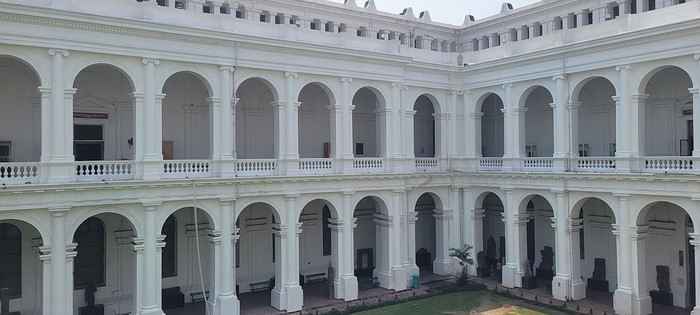
I wander from room to room but can’t really get into it.
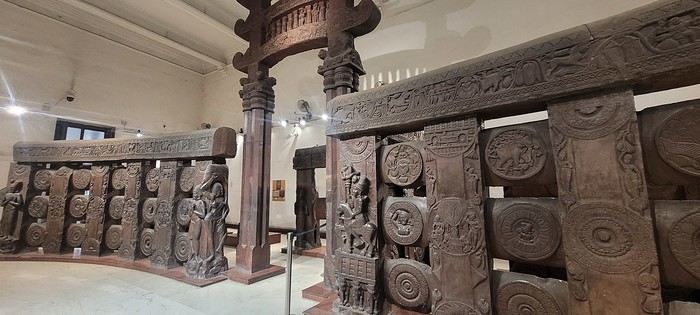 My mind is elsewhere. I think, without even meaning to, I’m already reflecting on these six weeks that flew by in the blink of an eye.
Images come back in waves: Bishnupur, a place where I felt something special and where I’d love to return; the warm welcome in Naya and the stunning Patachitra paintings; the many markets I passed through over the days; the houses decorated with Sohrai paintings in the villages of Jharkhand; Santiniketan and my bike rides, including that infamous flat tire I won’t soon forget; Murshidabad, with its palaces and fascinating history; and finally, Kalna, with its temples that provided such a beautiful conclusion to the trip.
These six weeks were rich, varied, sometimes surprising, sometimes more challenging, but always filled with discovery. So many encounters, landscapes, architectural gems, and unexpected moments… I almost have a tear in my eye.
I decide to leave the museum pretty quickly and head to New Market.
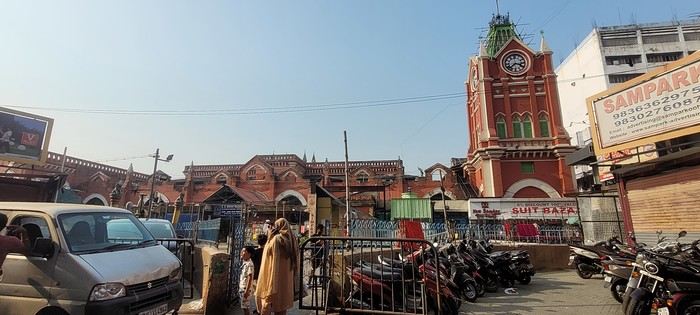
At least there, I find Kolkata’s lively atmosphere again. I wander through the aisles one last time, intentionally getting lost in the familiar hustle and bustle, and make my final purchases before heading back to the hotel.
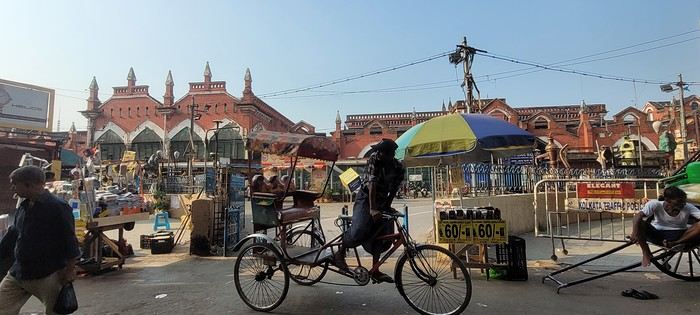
I ask if it would be possible to take a shower before I leave, but all the rooms are already booked. I’ll have to make do with a quick freshen-up at the sink in the entrance restroom… That’ll be my last moment of comfort before the long journey home. The final taxi arrives. A hotel staff member walks me to the parking lot. The last goodbyes are exchanged… This time, it’s really over—the trip is finished. All I hope for now is a smooth journey back. The flight to Dubai is on time, but the one to Barcelona ends up being an hour late. The bus that was supposed to take me to Perpignan won’t wait for me, but luckily the next one isn’t full, and I’ll finally be able to get home without any issues. All that’s left is to warmly thank everyone who followed these two travel journals. Your messages and encouragement accompanied me throughout this adventure. Now, it’s time to start preparing for the next trip… and yes, India again! This country always has something new to offer, even in regions I’ve already visited. That’s undoubtedly what makes it so endearing: the feeling that you’ll never truly be done with it.
Some stops in Jharkhand didn’t amaze me as much as I’d hoped, but West Bengal remains a real revelation for me. I still don’t understand why this region is so overlooked by travelers. It has incredible architectural wealth, diverse landscapes, traditions that are still very much alive, and above all, a population that’s incredibly kind, always ready to chat and welcome you. I could come back to this part of India again and again—it’s so captivating. There are still so many places to discover, so many villages to explore. Last day before departure After breakfast, I check out of my room and leave my bag at the hotel entrance. I’m free until 4 PM before heading to the airport. Inside the hotel, the coolness is pleasant, but as soon as I step into the lobby, I feel the heat immediately. Outside, it’s heavy, humid, almost stifling. A typical Kolkata heat that I’m less enthusiastic about this time. I’m not a big fan of museums, but since this one is just a few hundred meters from the hotel, I decide to go, hoping to enjoy a bit of air conditioning and the coolness of the rooms. No luck: there’s almost no one there this morning, and the temperature isn’t much better inside.
I wander from room to room but can’t really get into it.
My mind is elsewhere. I think, without even meaning to, I’m already reflecting on these six weeks that flew by in the blink of an eye.
Images come back in waves: Bishnupur, a place where I felt something special and where I’d love to return; the warm welcome in Naya and the stunning Patachitra paintings; the many markets I passed through over the days; the houses decorated with Sohrai paintings in the villages of Jharkhand; Santiniketan and my bike rides, including that infamous flat tire I won’t soon forget; Murshidabad, with its palaces and fascinating history; and finally, Kalna, with its temples that provided such a beautiful conclusion to the trip.
These six weeks were rich, varied, sometimes surprising, sometimes more challenging, but always filled with discovery. So many encounters, landscapes, architectural gems, and unexpected moments… I almost have a tear in my eye.
I decide to leave the museum pretty quickly and head to New Market.At least there, I find Kolkata’s lively atmosphere again. I wander through the aisles one last time, intentionally getting lost in the familiar hustle and bustle, and make my final purchases before heading back to the hotel.
I ask if it would be possible to take a shower before I leave, but all the rooms are already booked. I’ll have to make do with a quick freshen-up at the sink in the entrance restroom… That’ll be my last moment of comfort before the long journey home. The final taxi arrives. A hotel staff member walks me to the parking lot. The last goodbyes are exchanged… This time, it’s really over—the trip is finished. All I hope for now is a smooth journey back. The flight to Dubai is on time, but the one to Barcelona ends up being an hour late. The bus that was supposed to take me to Perpignan won’t wait for me, but luckily the next one isn’t full, and I’ll finally be able to get home without any issues. All that’s left is to warmly thank everyone who followed these two travel journals. Your messages and encouragement accompanied me throughout this adventure. Now, it’s time to start preparing for the next trip… and yes, India again! This country always has something new to offer, even in regions I’ve already visited. That’s undoubtedly what makes it so endearing: the feeling that you’ll never truly be done with it.
Villages around Hazaribagh in West Bengal
Thanks Noëlle, I know you follow all my travel journals.
Preparing for this one wasn’t easy—I didn’t find a single blog about Jharkhand. I just drew inspiration from the few travel agencies that offer it. Hope this journal inspires other travelers; I already know two who are heading to Hazaribagh... not a bad start 😉
Villages around Hazaribagh in West Bengal
Thanks Didier, this travel journal is coming to an end, but did you read the first part, "New Discoveries from Perpignan to Ranchi," which is also interesting?
Villages around Hazaribagh in West Bengal
Back to Kalna
The day isn’t over yet, though. I head back to the Rajbari complex to see the temples lit up at night.
Night completely transforms the place. The lights highlight the reliefs on the facades, the delicate sculptures, and the temple silhouettes that seem to emerge differently in the darkness. After admiring them in daylight, seeing them illuminated like this offers a nearly magical experience.
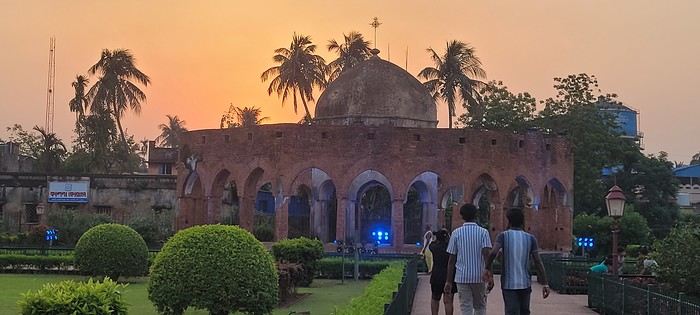
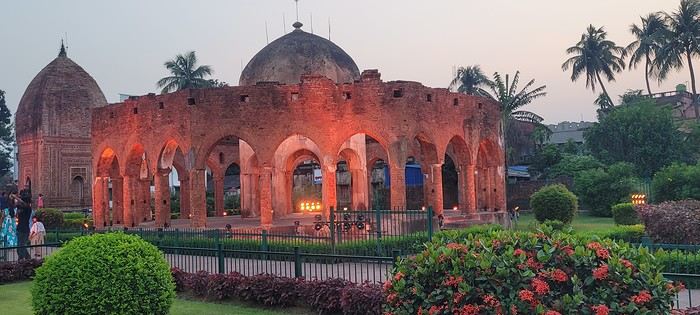
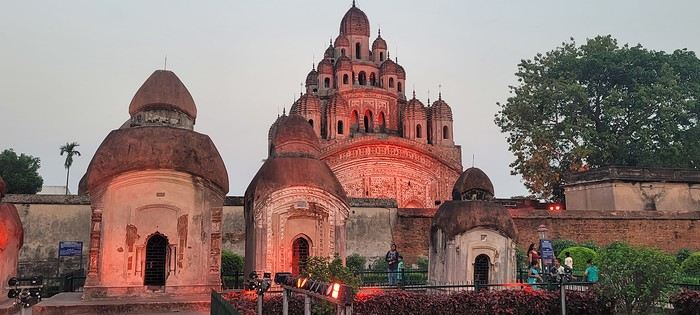
I savor this moment for a long time. It’s the perfect way to end this leg of the journey—and, in a way, this long trip through Jharkhand and West Bengal. Over the past few weeks, I’ve traveled through regions with very different identities: the tribal villages of Jharkhand, their ancestral traditions, the art of Sohrai and Khovar, and then West Bengal with its terracotta temples, forgotten palaces, artisans, and markets. Even though I’d already visited this region ten years ago, this new trip allowed me to discover it differently—with more time, more encounters, and a fresh perspective. Revisiting familiar places like Kalna or Guptipara gives them a special flavor: that of reunions, but also of rediscovery. Without having imagined it when I arrived, the 108 Shiva temples take on a special resonance. Their symbolism of fulfillment, liberation, and enlightenment seems to gently accompany the end of my journey. Tomorrow, I’ll leave Kalna for Kolkata, the final stop before heading home. But tonight, in front of these illuminated temples, I feel like I’m closing a beautiful travel chapter.
I savor this moment for a long time. It’s the perfect way to end this leg of the journey—and, in a way, this long trip through Jharkhand and West Bengal. Over the past few weeks, I’ve traveled through regions with very different identities: the tribal villages of Jharkhand, their ancestral traditions, the art of Sohrai and Khovar, and then West Bengal with its terracotta temples, forgotten palaces, artisans, and markets. Even though I’d already visited this region ten years ago, this new trip allowed me to discover it differently—with more time, more encounters, and a fresh perspective. Revisiting familiar places like Kalna or Guptipara gives them a special flavor: that of reunions, but also of rediscovery. Without having imagined it when I arrived, the 108 Shiva temples take on a special resonance. Their symbolism of fulfillment, liberation, and enlightenment seems to gently accompany the end of my journey. Tomorrow, I’ll leave Kalna for Kolkata, the final stop before heading home. But tonight, in front of these illuminated temples, I feel like I’m closing a beautiful travel chapter.
Villages around Hazaribagh in West Bengal
(continued)
A day between Santipur and Guptipara After leaving the complex, I now need to find an auto to continue my explorations. Several drivers are waiting for customers, but none want to take me. So, I head toward the Nrisinghapur Ferry Ghat dock, and soon enough, an auto finally stops and agrees to drive me there.
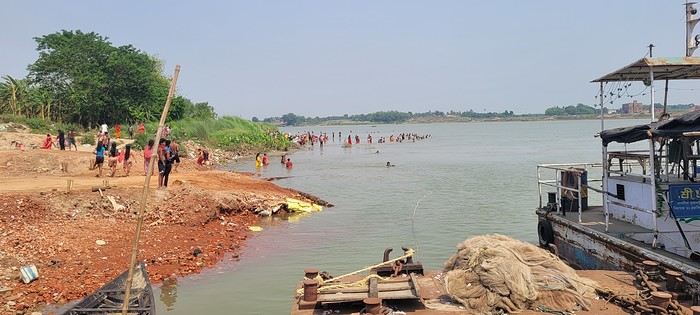
The river crossing is quick. These small ferries, numerous and regular, make it easy to reach the other bank and are part of the locals' daily life. From there, I take another auto to Santipur, a town famous for its sari market. The driver drops me off at the entrance of the town, near a market, but it’s not the one I’m looking for. I search for a long time for that famous building until a woman finally agrees to help me. She points out the place but tells me the market isn’t happening today. I’m disappointed, but you have to accept the unexpected when traveling. These little setbacks are part of the adventure too. I then take a tuk-tuk toward Guptipara. Along the way, we pass a sari shop, and I ask the driver to stop. We spend a good half-hour there, picking out two very affordable saris. The driver then drops me off at another dock. A quick crossing takes me near Guptipara. The boats are frequent and regular. A new auto is waiting for me on the other side and takes me to the Brindavan Chandra Math complex.
I’m alone visiting this place, which I had already discovered ten years ago and really loved. Seeing it again today gives me a special feeling: that of rediscovering a familiar place with a new perspective.
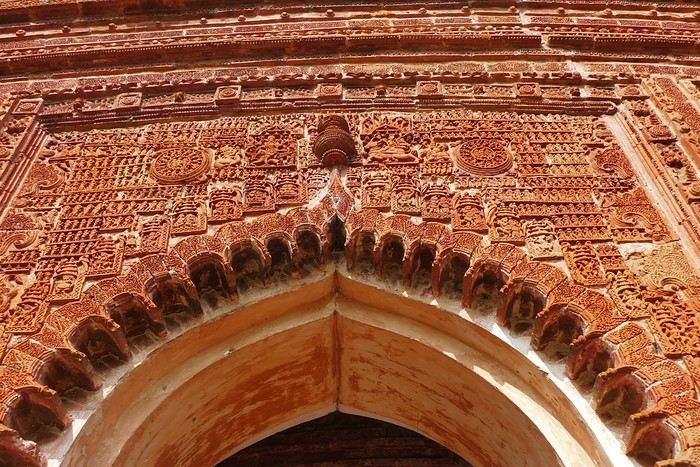
The complex consists of four temples. The Ramchandra Temple has magnificent sculptures on its façade, showcasing the richness of Bengal’s terracotta art.
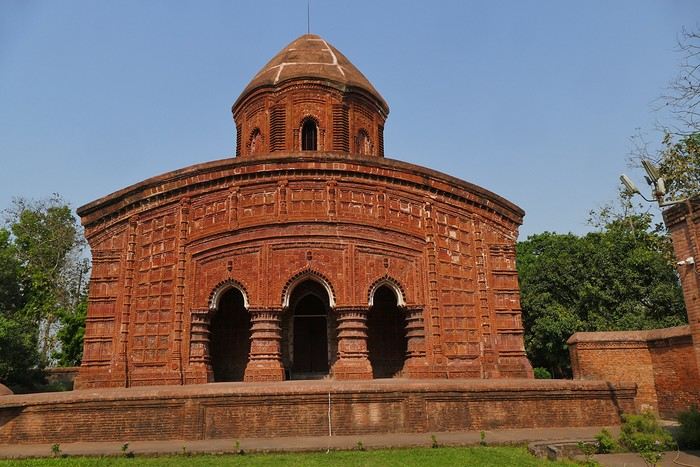
The Brindavan Chandra Temple dominates the complex. Its exterior façade is relatively simple, but its charm lies mainly in the interior of the temple.
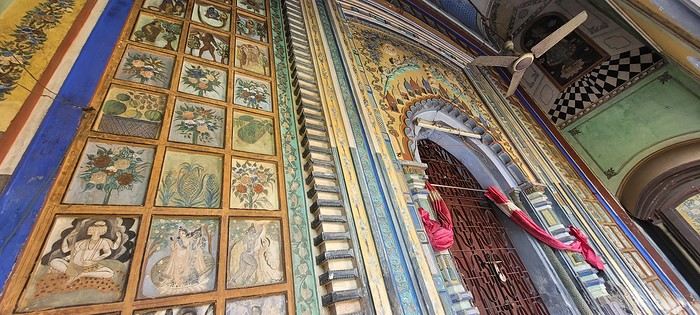
It’s always a wonder to step inside. The inner veranda and sanctuary are entirely adorned with frescoes, from the walls to the ceiling, featuring intricate floral patterns and mythological scenes.
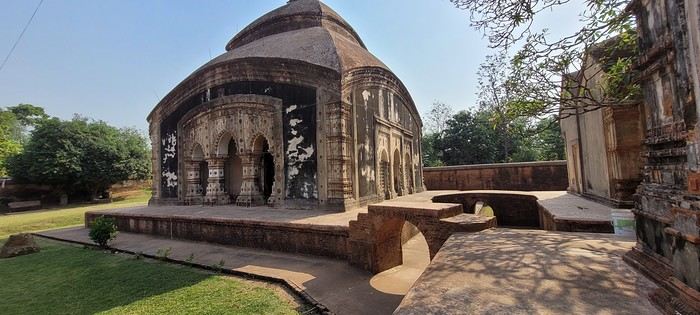
The Chaitanya Temple is the smallest in the complex.
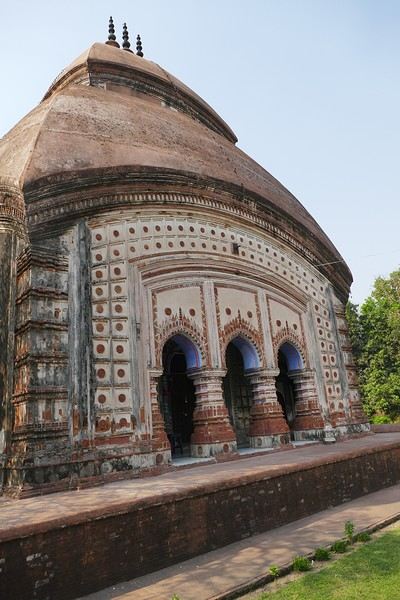
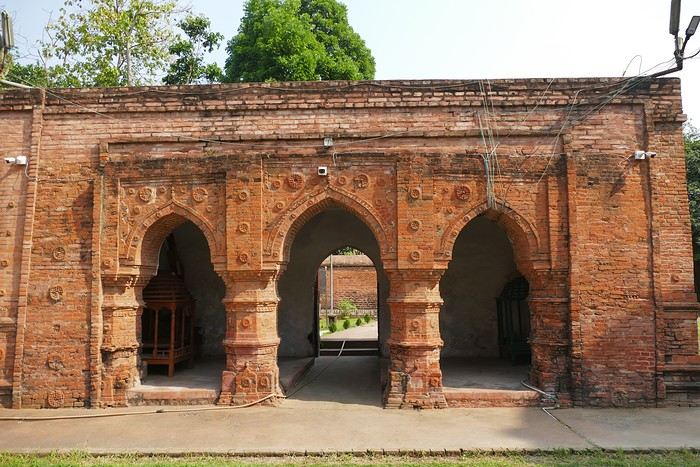
The Krishna Chandra Temple is decorated mainly around its three-arched entrance.
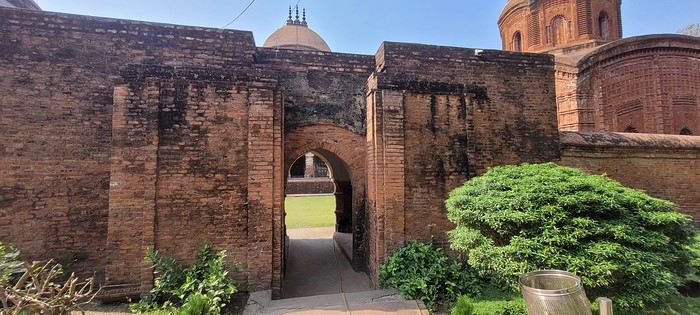
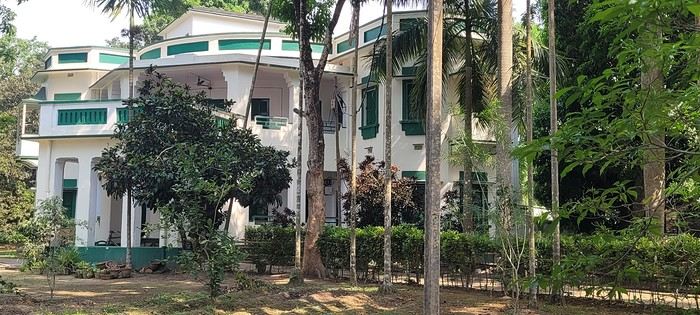
I also take the time to admire the elegant and imposing entrance gate of the complex. On the way back to the village, I pass by a large mansion surrounded by a well-kept park: the Sen Bari. The entrance gate is slightly open. I slip inside, looking for someone who might allow me to visit, but it’s a private property, and unfortunately, visits aren’t possible.
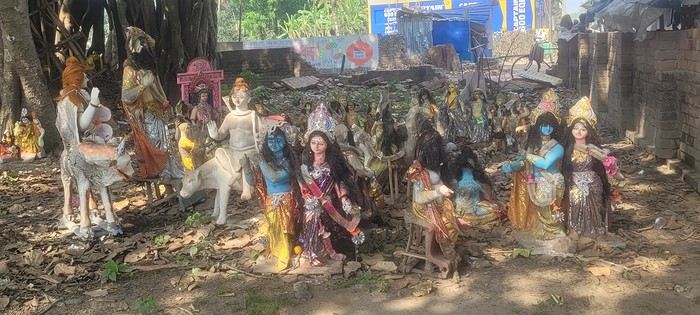
Right across the street is another temple where many devotees are gathered. I approach it. Inside, pujas are being performed in a serene atmosphere. Outside, at the foot of a tree, small statues have been placed as silent offerings.
I then return to Kalna by train.
A day between Santipur and Guptipara After leaving the complex, I now need to find an auto to continue my explorations. Several drivers are waiting for customers, but none want to take me. So, I head toward the Nrisinghapur Ferry Ghat dock, and soon enough, an auto finally stops and agrees to drive me there.
The river crossing is quick. These small ferries, numerous and regular, make it easy to reach the other bank and are part of the locals' daily life. From there, I take another auto to Santipur, a town famous for its sari market. The driver drops me off at the entrance of the town, near a market, but it’s not the one I’m looking for. I search for a long time for that famous building until a woman finally agrees to help me. She points out the place but tells me the market isn’t happening today. I’m disappointed, but you have to accept the unexpected when traveling. These little setbacks are part of the adventure too. I then take a tuk-tuk toward Guptipara. Along the way, we pass a sari shop, and I ask the driver to stop. We spend a good half-hour there, picking out two very affordable saris. The driver then drops me off at another dock. A quick crossing takes me near Guptipara. The boats are frequent and regular. A new auto is waiting for me on the other side and takes me to the Brindavan Chandra Math complex.
I’m alone visiting this place, which I had already discovered ten years ago and really loved. Seeing it again today gives me a special feeling: that of rediscovering a familiar place with a new perspective.
The complex consists of four temples. The Ramchandra Temple has magnificent sculptures on its façade, showcasing the richness of Bengal’s terracotta art.
The Brindavan Chandra Temple dominates the complex. Its exterior façade is relatively simple, but its charm lies mainly in the interior of the temple.
It’s always a wonder to step inside. The inner veranda and sanctuary are entirely adorned with frescoes, from the walls to the ceiling, featuring intricate floral patterns and mythological scenes.
The Chaitanya Temple is the smallest in the complex.
The Krishna Chandra Temple is decorated mainly around its three-arched entrance.
I also take the time to admire the elegant and imposing entrance gate of the complex. On the way back to the village, I pass by a large mansion surrounded by a well-kept park: the Sen Bari. The entrance gate is slightly open. I slip inside, looking for someone who might allow me to visit, but it’s a private property, and unfortunately, visits aren’t possible.
Right across the street is another temple where many devotees are gathered. I approach it. Inside, pujas are being performed in a serene atmosphere. Outside, at the foot of a tree, small statues have been placed as silent offerings.
I then return to Kalna by train.
Villages around Hazaribagh in West Bengal
(continued)
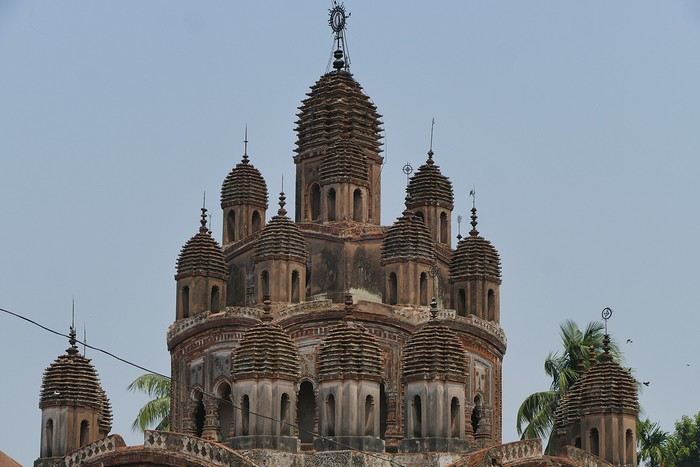
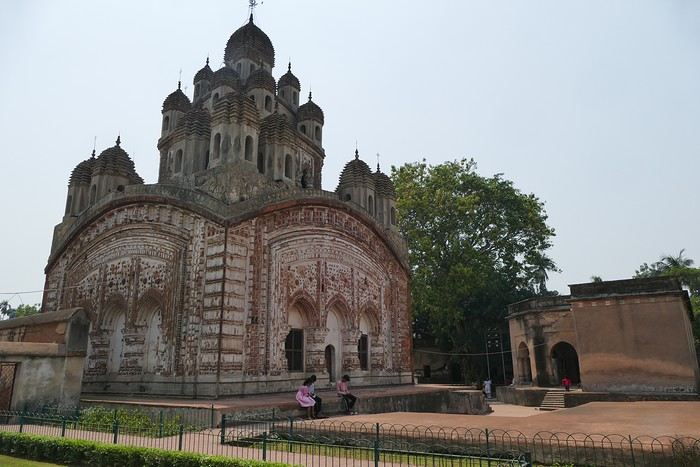
The path then winds around these buildings and leads to the majestic Krishnachandra temple. Its rich decorations, 25 spires, and three-arched entrances on each side make it one of the complex’s jewels. The main façade, particularly elaborate, reflects the refinement of the era.
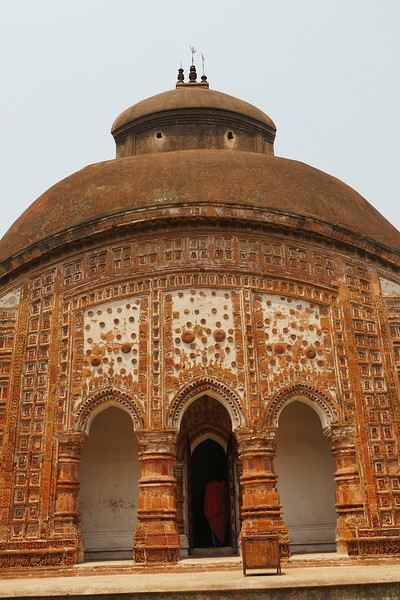
Behind this temple stands a more discreet building, the Vijaya Vidyanath, whose façade is also adorned with beautiful decorations.
Outside the complex, other temples still exist, but I don’t linger there. After so many discoveries, I’d rather extend this moment in this peaceful garden where history still seems present.
The path then winds around these buildings and leads to the majestic Krishnachandra temple. Its rich decorations, 25 spires, and three-arched entrances on each side make it one of the complex’s jewels. The main façade, particularly elaborate, reflects the refinement of the era.
Behind this temple stands a more discreet building, the Vijaya Vidyanath, whose façade is also adorned with beautiful decorations.
Outside the complex, other temples still exist, but I don’t linger there. After so many discoveries, I’d rather extend this moment in this peaceful garden where history still seems present.
Villages around Hazaribagh in West Bengal
Sunday, April 12 and Monday, April 13Ambica Kalna, the temple town of Bengal
I leave this hotel where I had a great stay. As soon as the restaurant opens, I have breakfast and then take an auto-rickshaw to Baharampur. From there, I catch a bus to Kalna.
Upon arrival, near the bus parking, I spot a guesthouse. Since I hadn’t booked anything, I decide to stop there. The receptionist isn’t very friendly, the place is noisy, and not very inviting. Across the road is the hotel where I stayed ten years ago. They’ve since opened a restaurant there. I negotiate the room price; it’s very basic, but options are limited here, so I’ll make do.
Once settled, I head out to stretch my legs in the neighborhood. Revisiting this town after so many years already brings back some memories.
The next morning, after breakfast, I set off on foot to explore the temples located about three kilometers from the hotel. The walk lets me stroll through the town, observe daily life, and reach one of Bengal’s most beautiful religious sites at my own pace.
The Nava Kailash Temples
The Nava Kailash temples are exceptional. They consist of a circle of 108 shrines dedicated to Shiva, built in 1809. Their decorative panels depict scenes from the Ramayana and the Mahabharata, true stories carved in terracotta.
The complex is organized into two concentric circles: 34 temples on the inside and 74 on the outside. Their architecture is intentionally simple, but each shrine houses a Shiva lingam, black or white, arranged alternately in a symbolic pattern.
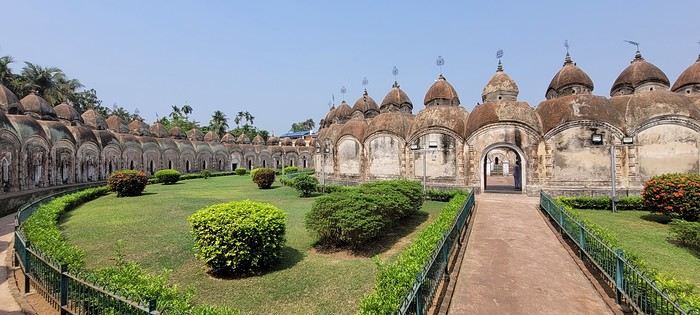
The number 108 holds sacred significance in several religions, including Hinduism, Buddhism, and Jainism. It represents deep spiritual symbolism: the 1 stands for unity; the 0 evokes emptiness, the stilling of thought, a pure and perfectly clear mind; the 8 symbolizes infinity. Thus, 108 represents the culmination of the spiritual journey: ecstasy, liberation, enlightenment, like the end of an inner voyage. The Rajbari Complex of Kalna Facing the 108 Shiv Mandir is the Rajbari complex of Kalna. As I cross the entrance, I’m once again amazed to discover this beautiful ensemble of temples surrounded by a well-maintained garden.
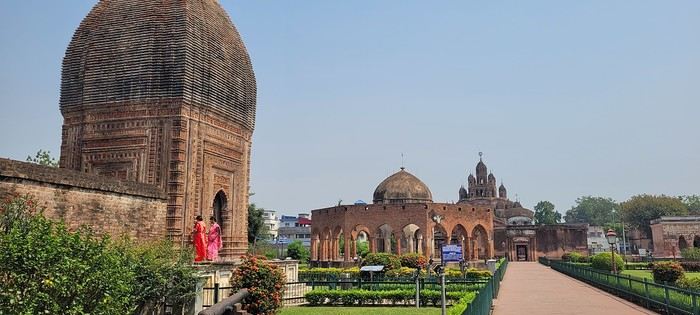
This is my second time here, but the emotion is the same as ten years ago. The place is still just as magnificent, peaceful, and harmonious. The first temple on the left is the Pratapeshwar.
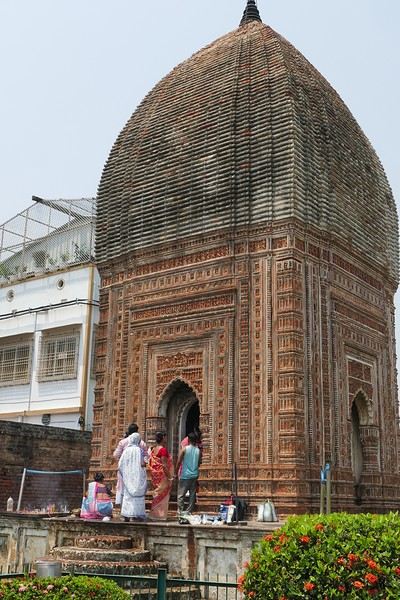
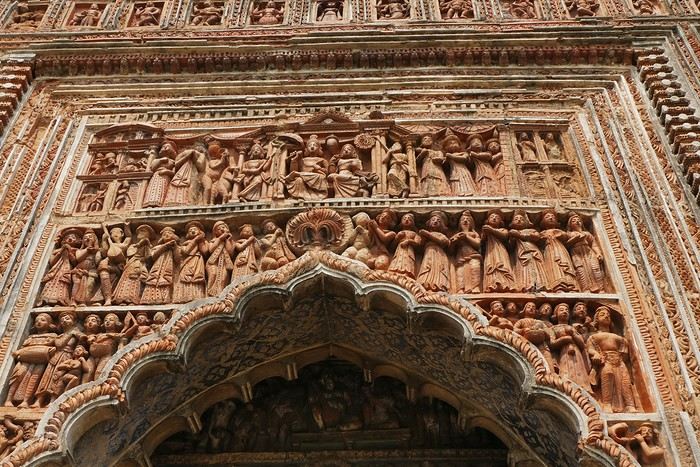
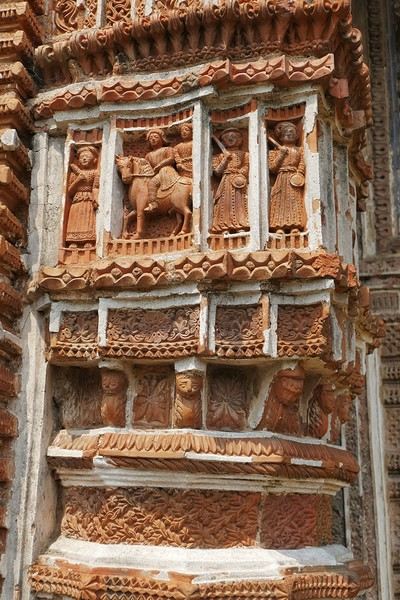
It features sculptures on all four sides and false doors on three sides, richly decorated.
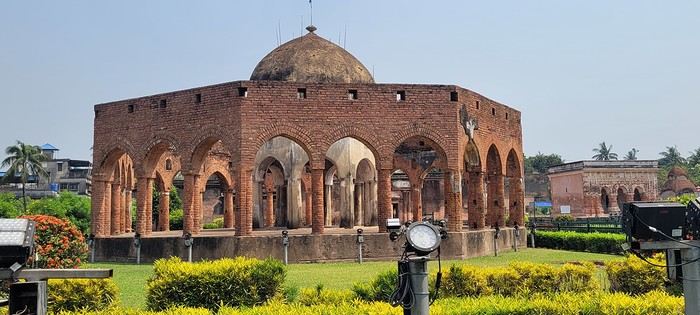
A few steps away is the Rasmancha, circular in shape, with its many openings. Its roof is now gone, revealing an elegant structure open to the sky.
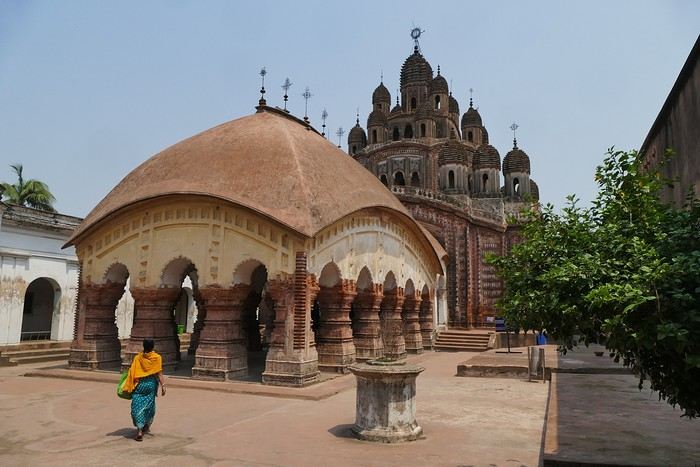
Next, you pass through a gate to reach the Lalji Temple, the oldest in the complex. It has 25 pinnacles spread across three levels. Its second floor, octagonal in shape, features a pinnacle at each of its eight corners.
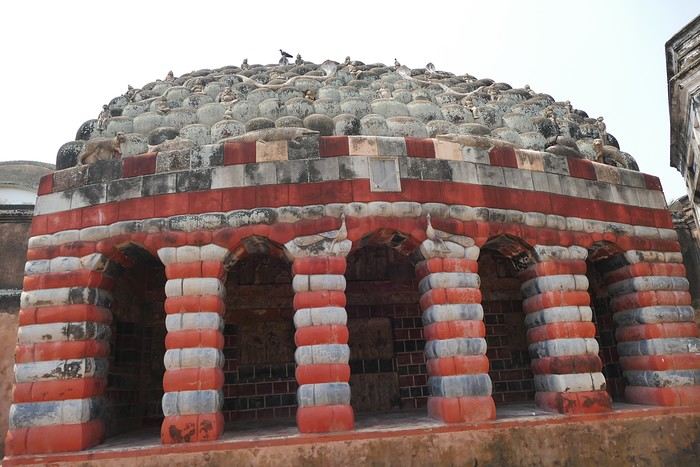
A little further on, the Giri Gobardhan Temple catches the eye with its sculptures of animals and human figures on its roof. It has four sloping roofs and once served as a gathering place for devotees.
Passing back through the gate on the right, I discover a flat-roofed temple
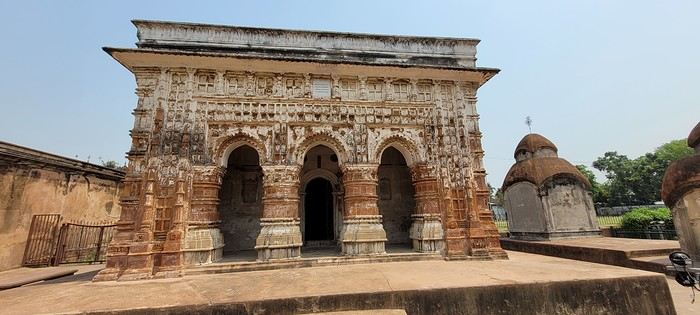
as well as the Pancharatna, a group of five small temples of varying sizes.
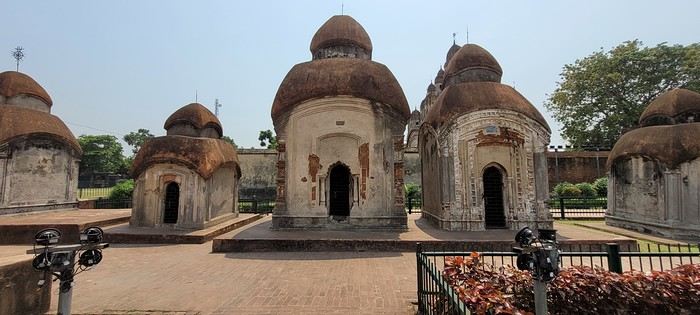
The number 108 holds sacred significance in several religions, including Hinduism, Buddhism, and Jainism. It represents deep spiritual symbolism: the 1 stands for unity; the 0 evokes emptiness, the stilling of thought, a pure and perfectly clear mind; the 8 symbolizes infinity. Thus, 108 represents the culmination of the spiritual journey: ecstasy, liberation, enlightenment, like the end of an inner voyage. The Rajbari Complex of Kalna Facing the 108 Shiv Mandir is the Rajbari complex of Kalna. As I cross the entrance, I’m once again amazed to discover this beautiful ensemble of temples surrounded by a well-maintained garden.
This is my second time here, but the emotion is the same as ten years ago. The place is still just as magnificent, peaceful, and harmonious. The first temple on the left is the Pratapeshwar.
It features sculptures on all four sides and false doors on three sides, richly decorated.
A few steps away is the Rasmancha, circular in shape, with its many openings. Its roof is now gone, revealing an elegant structure open to the sky.
Next, you pass through a gate to reach the Lalji Temple, the oldest in the complex. It has 25 pinnacles spread across three levels. Its second floor, octagonal in shape, features a pinnacle at each of its eight corners.
A little further on, the Giri Gobardhan Temple catches the eye with its sculptures of animals and human figures on its roof. It has four sloping roofs and once served as a gathering place for devotees.
Passing back through the gate on the right, I discover a flat-roofed temple
as well as the Pancharatna, a group of five small temples of varying sizes.
Villages around Hazaribagh in West Bengal
Back in Murshidabad, I set off one last time in search of the old city gates.
The road here is also under repair: the asphalt is spread by hand, using simple rakes. What a job... A scene that feels almost timeless, giving me the impression of leaving a world where time flows differently.
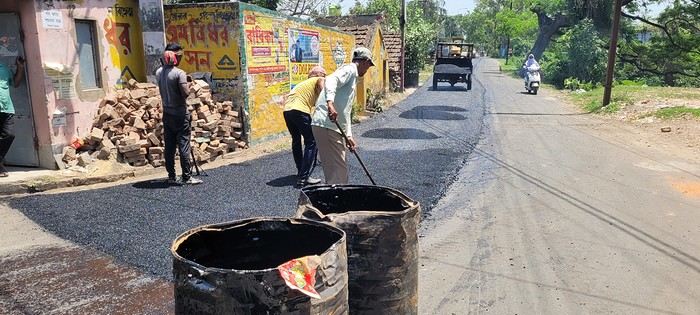
Before reaching the Tripolia Gate, I pass through the Chawk Bazaar Gate, an old fortified gate that still blends harmoniously into the urban landscape. It seems to bridge the past and present life, unobtrusive yet ever-present.
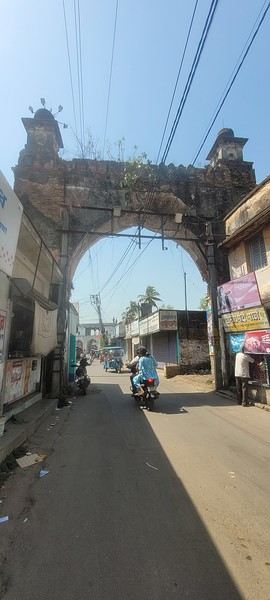
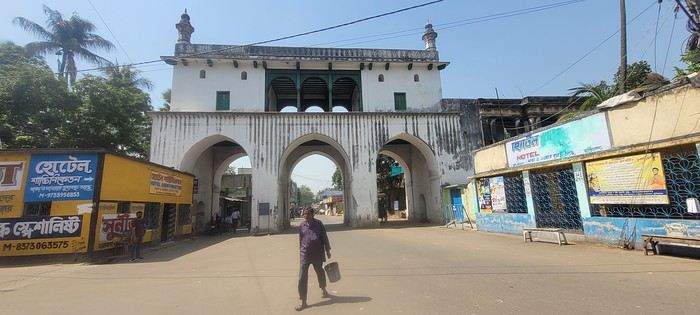
I then head toward the Tripolia Gate, formerly called Chawk Gate, a Mughal-style entrance that once led to the Kila Nizamat complex.
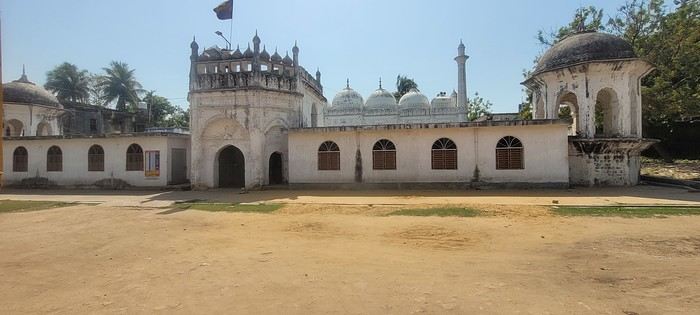
Nearby stands a large white mosque.
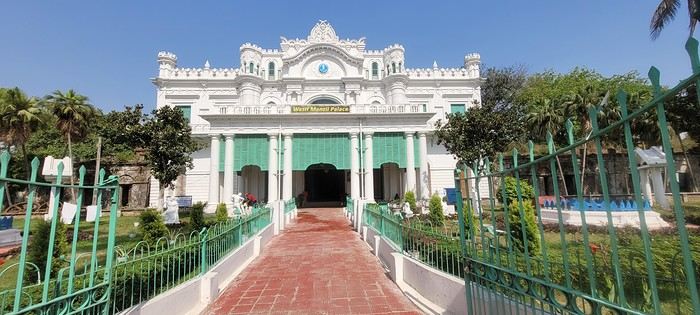
I pass by the Wasif Manzil again, with its beautiful European-inspired architecture. I can’t resist photographing it one last time, as if to preserve a clearer memory before leaving.
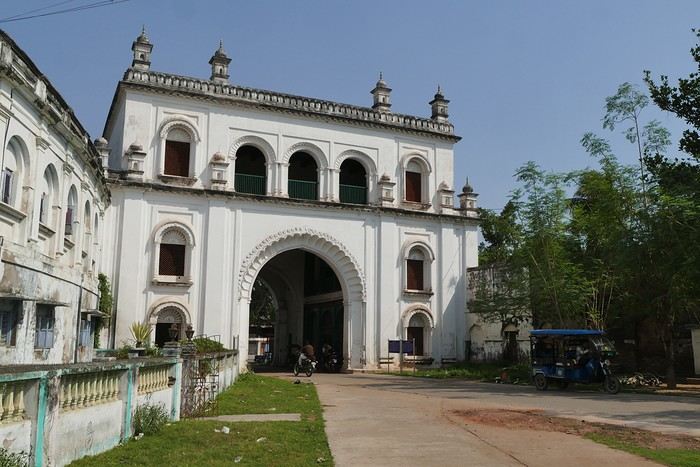
I continue to the southern gate, the Dakshin Darwaza, an imposing two-story brick structure. Up there, in the past, musicians in the Nahabat Khana would announce the arrival of visitors and troops. Today, the place seems silent, almost frozen, as if the echo of that music had faded with time.
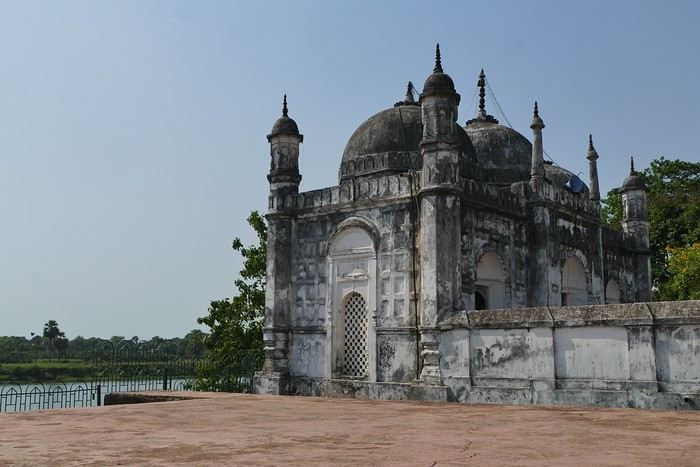
Nearby, by the riverside, a small white mosque, quite dilapidated, stands discreetly.
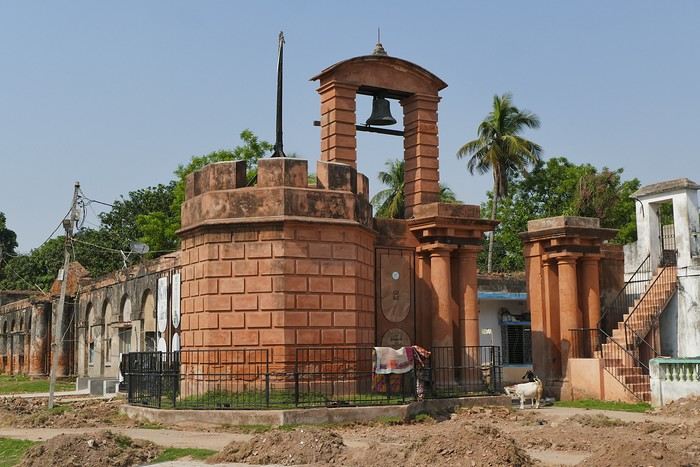
Across from it, the Ghanta Ghar of Kila Nizamat, an old clock tower, also evokes a bygone era when life was marked by the chime of the hours.
Everything seems to bear the mark of the past, as if Murshidabad were gently closing behind me. On my way back, I make one last detour through Motijheel Park, near the hotel. The shaded paths form a horseshoe around the lake, children play, and a few families stroll. I walk slowly, soaking in this peaceful atmosphere, aware that these are my final moments here. The day gently comes to an end, and with it, my stay in Murshidabad.
Before reaching the Tripolia Gate, I pass through the Chawk Bazaar Gate, an old fortified gate that still blends harmoniously into the urban landscape. It seems to bridge the past and present life, unobtrusive yet ever-present.
I then head toward the Tripolia Gate, formerly called Chawk Gate, a Mughal-style entrance that once led to the Kila Nizamat complex.
Nearby stands a large white mosque.
I pass by the Wasif Manzil again, with its beautiful European-inspired architecture. I can’t resist photographing it one last time, as if to preserve a clearer memory before leaving.
I continue to the southern gate, the Dakshin Darwaza, an imposing two-story brick structure. Up there, in the past, musicians in the Nahabat Khana would announce the arrival of visitors and troops. Today, the place seems silent, almost frozen, as if the echo of that music had faded with time.
Nearby, by the riverside, a small white mosque, quite dilapidated, stands discreetly.
Across from it, the Ghanta Ghar of Kila Nizamat, an old clock tower, also evokes a bygone era when life was marked by the chime of the hours.
Everything seems to bear the mark of the past, as if Murshidabad were gently closing behind me. On my way back, I make one last detour through Motijheel Park, near the hotel. The shaded paths form a horseshoe around the lake, children play, and a few families stroll. I walk slowly, soaking in this peaceful atmosphere, aware that these are my final moments here. The day gently comes to an end, and with it, my stay in Murshidabad.
Villages around Hazaribagh to West Bengal
Saturday, April 11
Last day in Murshidabad.
The hotel is located outside the city, on the road leading to Cossimbazar. I set off on foot along this quiet, almost deserted little road. At the end, I pass by a chicken farm: the chicks are piled on top of each other, a sight that really doesn’t make me want to eat any.

I look for a car, but as often happens, it’s a motorcyclist who stops. He offers to take me. I have to ride sidesaddle on the bike; at first, I’m not very reassured, but I eventually find the position quite comfortable. He drops me off two kilometers further on, at a crossroads, and flags down a driver who agrees to take me to the Roy Rajbari in Cossimbazar, now transformed into a charming hotel with a museum.
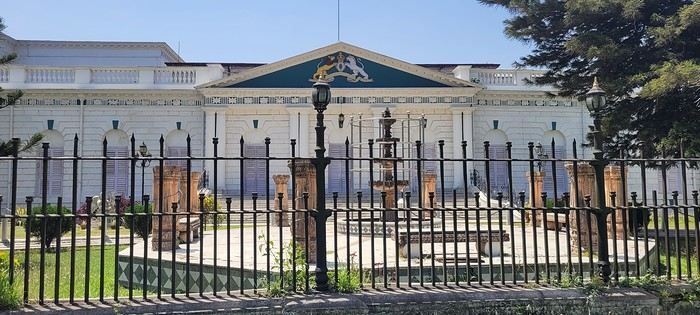
Part of this family home still belongs to the Roy family, who undertook its restoration themselves to create the Cossimbazar Palace. The white building is impressive, and the museum occupies the former residence.
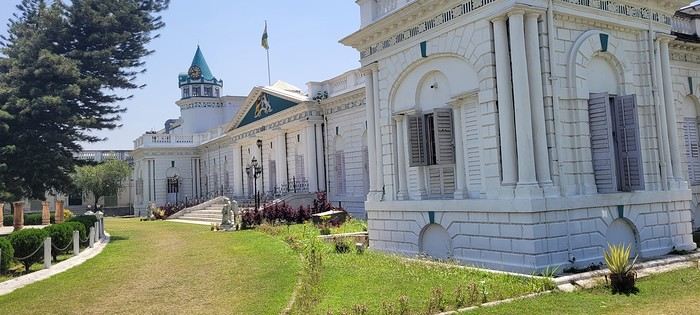
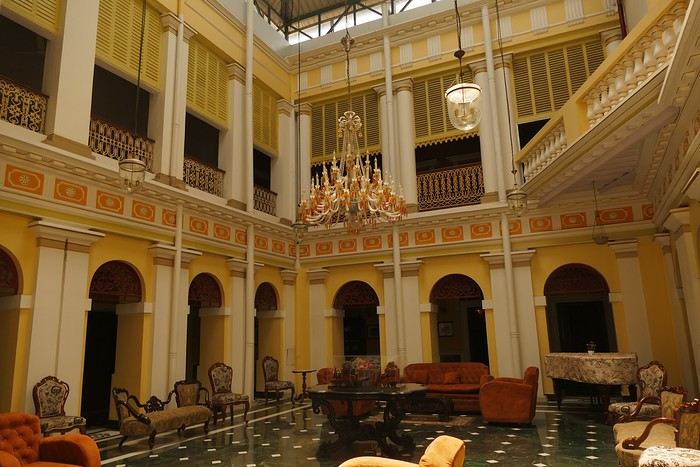
The visit feels like a stroll through time: inner courtyards, ballrooms, long corridors… all the way to the temples of Durga and Chandi.
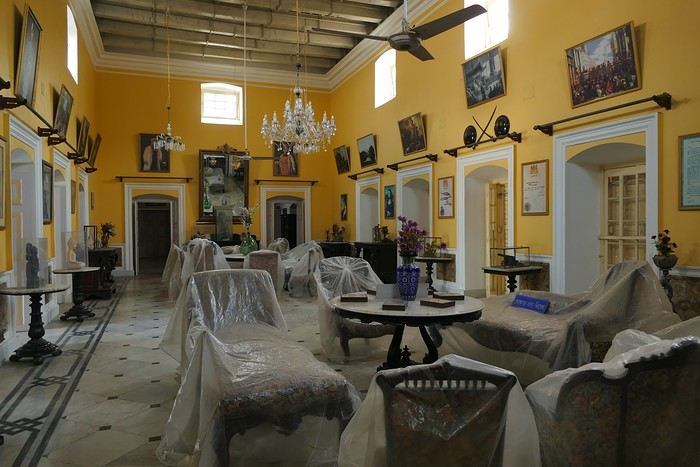 The rooms are furnished with Victorian furniture, the walls adorned with trophies, and heavy Belgian glass chandeliers hang from the ceiling. All the furniture is covered with clear plastic sheets, giving the whole place a strange, almost frozen atmosphere.
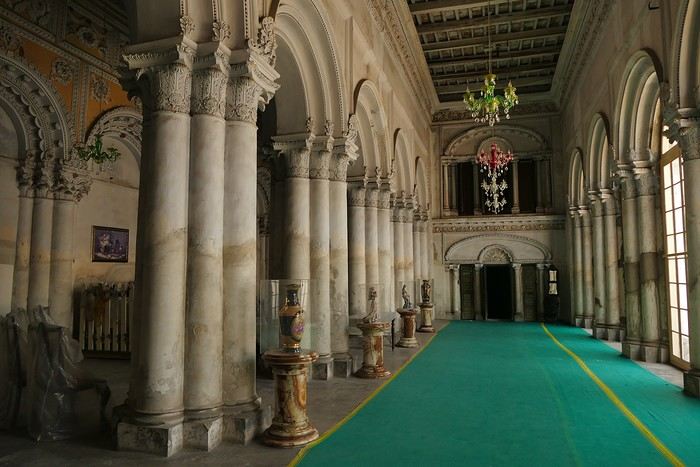
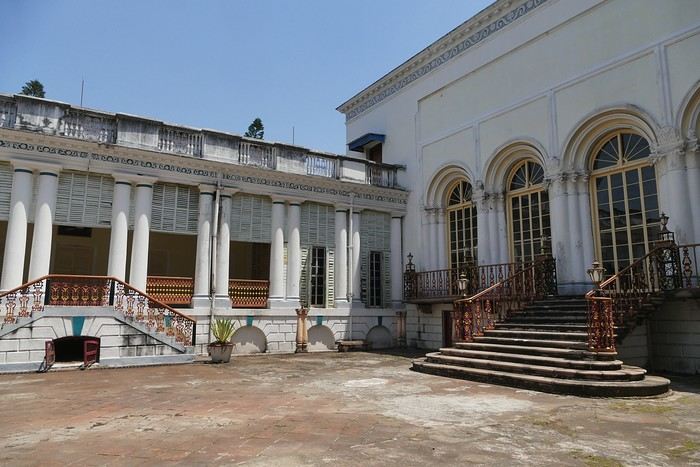
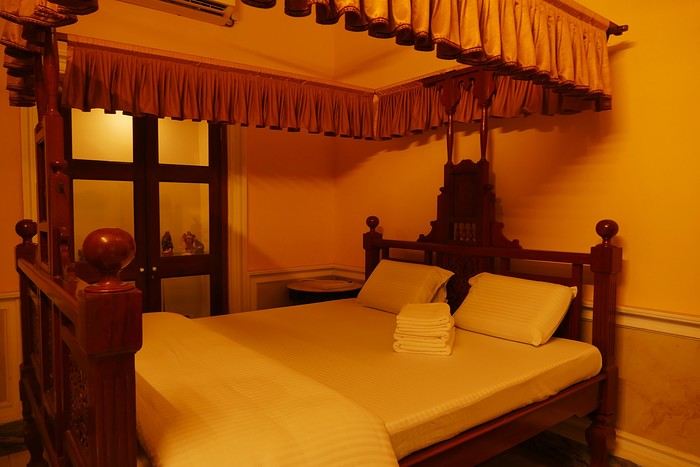
After the visit, I head to the hotel where I’m shown the inner courtyard and a room—71 € per night. Still, I’m a bit disappointed: I’d much preferred the visit the day before at the Bari Hotel, where the welcome had been much warmer. Here, since I was just passing through, I had to insist to get a quick look around.
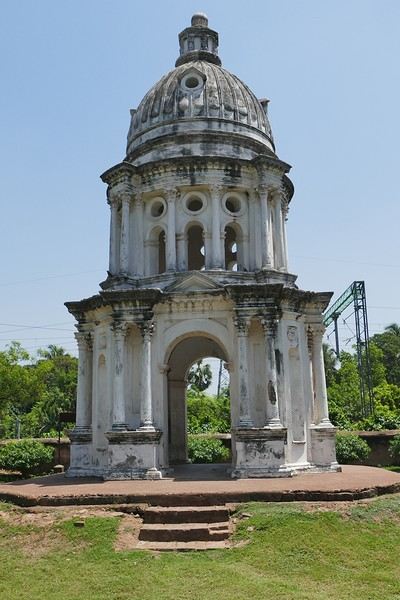
On the way back, I stop in front of a cemetery. A sign at the entrance reads: DUTCH CEMETERY. This cemetery is located on the site of the former Dutch trading post. According to François Bernier, a French physician and traveler who arrived in India in 1658 and served the Mughal prince Dara Shikoh, the site already existed in 1666 and employed between 700 and 800 men. It now houses 47 tombs, the oldest of which is that of Daniel Van Der Miyl, who died in 1721.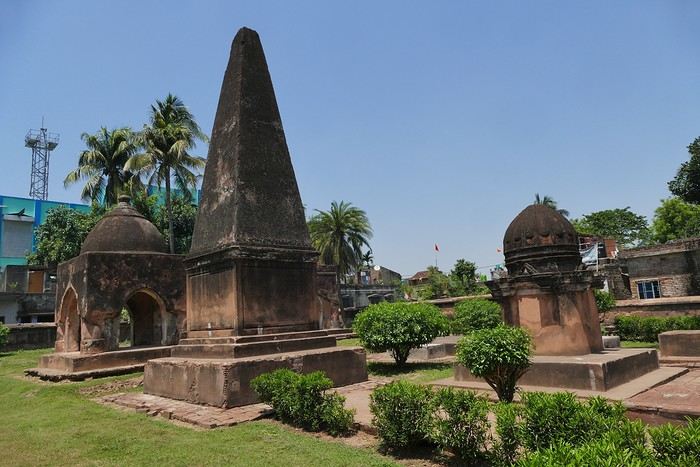
I look for a car, but as often happens, it’s a motorcyclist who stops. He offers to take me. I have to ride sidesaddle on the bike; at first, I’m not very reassured, but I eventually find the position quite comfortable. He drops me off two kilometers further on, at a crossroads, and flags down a driver who agrees to take me to the Roy Rajbari in Cossimbazar, now transformed into a charming hotel with a museum.
Part of this family home still belongs to the Roy family, who undertook its restoration themselves to create the Cossimbazar Palace. The white building is impressive, and the museum occupies the former residence.
The visit feels like a stroll through time: inner courtyards, ballrooms, long corridors… all the way to the temples of Durga and Chandi.
The rooms are furnished with Victorian furniture, the walls adorned with trophies, and heavy Belgian glass chandeliers hang from the ceiling. All the furniture is covered with clear plastic sheets, giving the whole place a strange, almost frozen atmosphere.After the visit, I head to the hotel where I’m shown the inner courtyard and a room—71 € per night. Still, I’m a bit disappointed: I’d much preferred the visit the day before at the Bari Hotel, where the welcome had been much warmer. Here, since I was just passing through, I had to insist to get a quick look around.
On the way back, I stop in front of a cemetery. A sign at the entrance reads: DUTCH CEMETERY. This cemetery is located on the site of the former Dutch trading post. According to François Bernier, a French physician and traveler who arrived in India in 1658 and served the Mughal prince Dara Shikoh, the site already existed in 1666 and employed between 700 and 800 men. It now houses 47 tombs, the oldest of which is that of Daniel Van Der Miyl, who died in 1721.
Villages around Hazaribagh in West Bengal
(continued)
We return to Azimganj, where I make a final stop at the Jain temple Sambhavnathji, just before it closes.
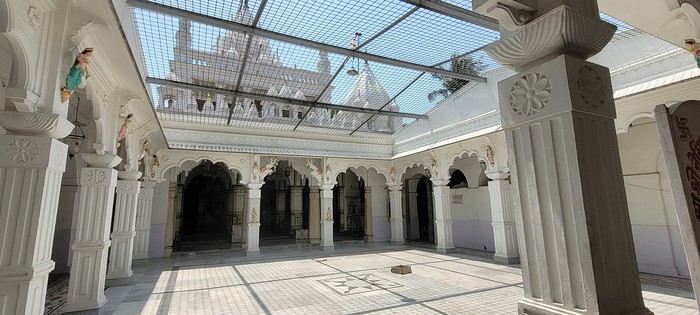
The place is peaceful, and I take these last moments to explore the sanctuary before the doors close.
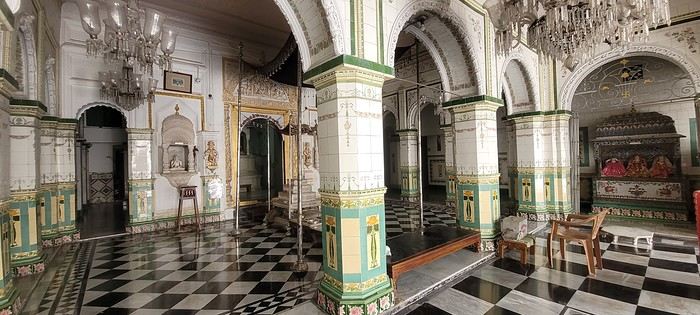
From there, I set off on foot in search of the old *havelis* that still bear witness to the past wealth of the Jain merchant families in the region.
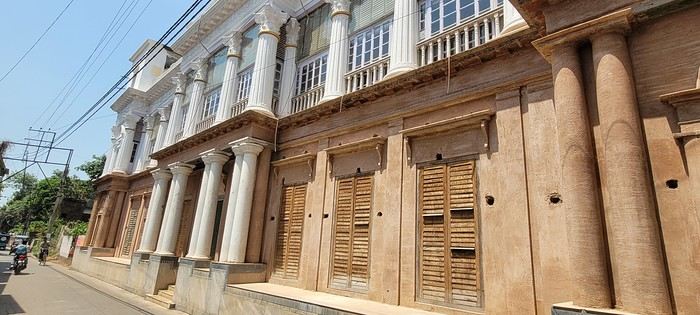
My walk ends in front of a charming house, the Bari Hotel. From the outside, the place doesn’t look like much, and I even wonder if I’ve arrived at the right spot.
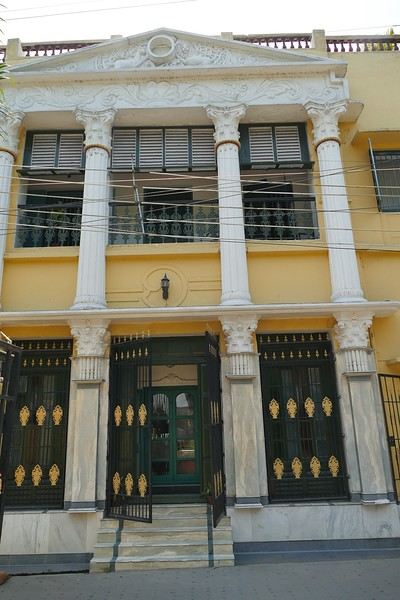
I gather my courage and push the door open to ask if I can visit. A waitress invites me in and to sit down in a lounge.
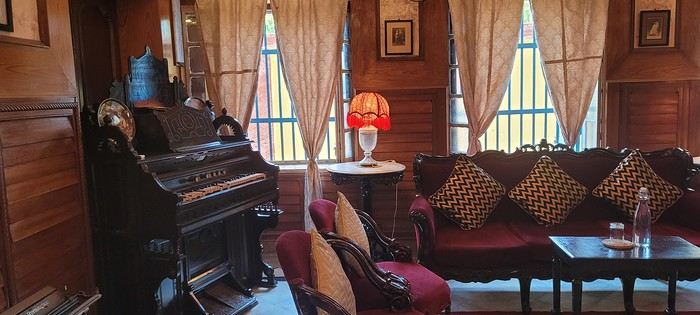
A few moments later, another person brings me a cold drink. A man then comes to greet me and explains that a visit is possible—on the condition that I have lunch there, for 1500 rupees. I’m not hungry, and the price is too high for me, so I decline. Eventually, he kindly agrees to let me see just the ground floor.
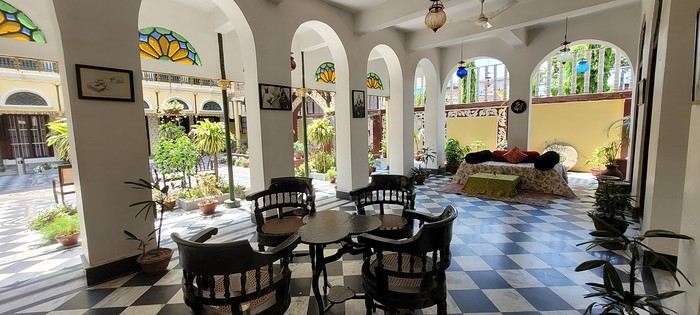
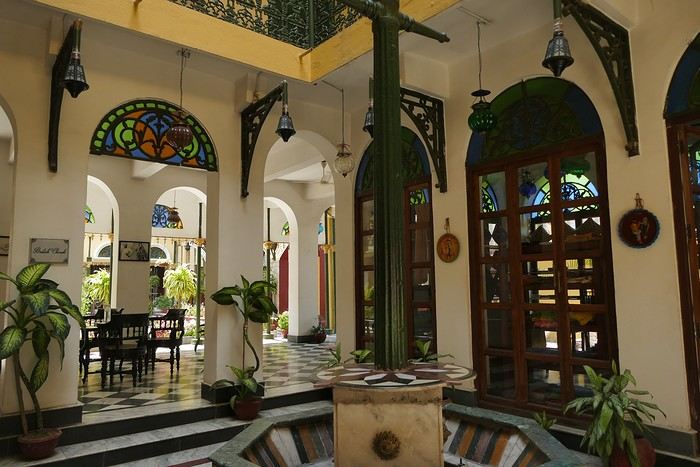
And what a surprise! Behind this unassuming façade lies an absolutely stunning place. The rooms are elegant, decorated with refinement, and you can sense the prestigious past of this residence.
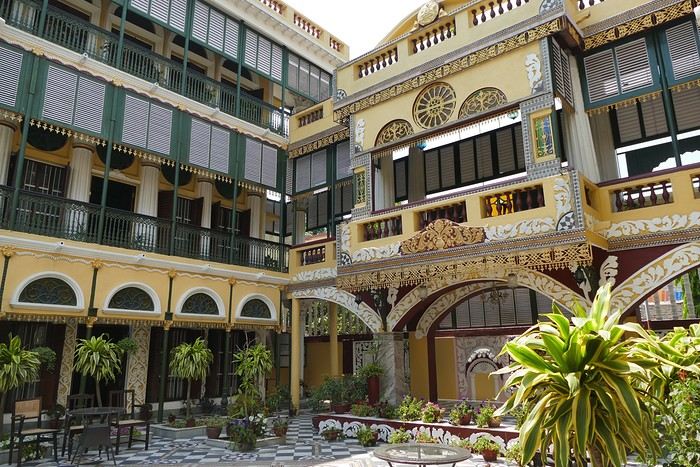
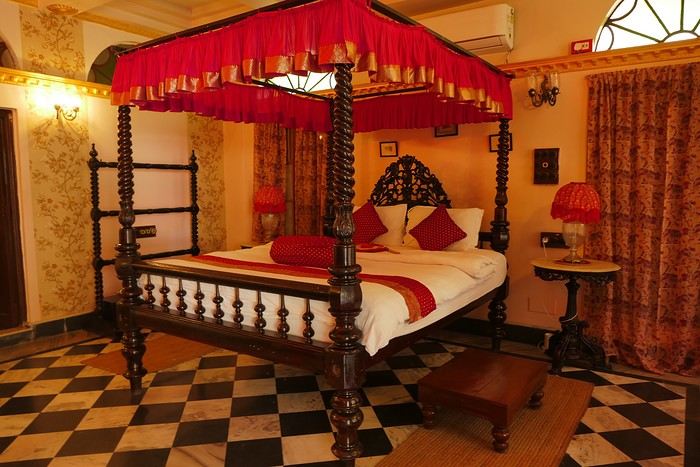
I didn’t dare ask about the price of the rooms—probably beyond my budget—but this visit will remain a wonderful unexpected discovery.
Back in Murshidabad, I set off in search of a tailor for a few jobs. I end up spending a long time with him, explaining how to make curtains and pie bags. Communication isn’t always easy, but with a few gestures and a lot of goodwill, we manage to understand each other. He offers me *chai*, then a man and a woman join us to chat for a while. When it’s time to pay, he asks for a very modest amount. I decide to give him double, a gesture that touches him deeply. His friend seems to approve, and the three of us share a simple but warm moment. These small everyday exchanges are often the most beautiful memories of a trip. I then head back to the hotel. Elections are supposed to take place at the end of the month, and several people are already preparing flags. As I walk by, some insist on giving me one. I refuse sometimes, but their enthusiasm and eagerness to share this local moment with me make me smile. A little further on, I pass a house decorated for a wedding. People are sitting outside and spontaneously invite me to join them. Quickly, curiosity gives way to friendliness: I’m invited inside, introduced to the future bride and groom, and offered pastries.
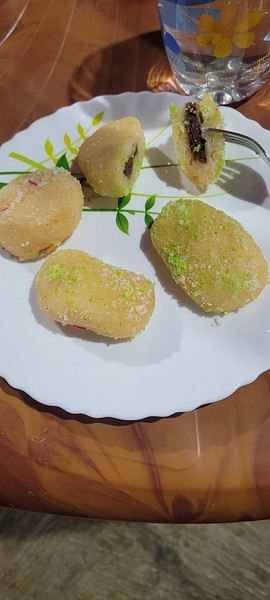
I can’t eat them all on the spot, so I ask if I can take a few with me. The woman then returns with an entire box full of cakes. Now I have dessert for several days! Once again, this day ends with an unexpected encounter, just like India knows how to offer so well. Beyond palaces and temples, it’s these moments of sharing, these smiles, and this spontaneous generosity that make travel so rich.
We return to Azimganj, where I make a final stop at the Jain temple Sambhavnathji, just before it closes.
The place is peaceful, and I take these last moments to explore the sanctuary before the doors close.
From there, I set off on foot in search of the old *havelis* that still bear witness to the past wealth of the Jain merchant families in the region.
My walk ends in front of a charming house, the Bari Hotel. From the outside, the place doesn’t look like much, and I even wonder if I’ve arrived at the right spot.
I gather my courage and push the door open to ask if I can visit. A waitress invites me in and to sit down in a lounge.
A few moments later, another person brings me a cold drink. A man then comes to greet me and explains that a visit is possible—on the condition that I have lunch there, for 1500 rupees. I’m not hungry, and the price is too high for me, so I decline. Eventually, he kindly agrees to let me see just the ground floor.
And what a surprise! Behind this unassuming façade lies an absolutely stunning place. The rooms are elegant, decorated with refinement, and you can sense the prestigious past of this residence.
I didn’t dare ask about the price of the rooms—probably beyond my budget—but this visit will remain a wonderful unexpected discovery.
Back in Murshidabad, I set off in search of a tailor for a few jobs. I end up spending a long time with him, explaining how to make curtains and pie bags. Communication isn’t always easy, but with a few gestures and a lot of goodwill, we manage to understand each other. He offers me *chai*, then a man and a woman join us to chat for a while. When it’s time to pay, he asks for a very modest amount. I decide to give him double, a gesture that touches him deeply. His friend seems to approve, and the three of us share a simple but warm moment. These small everyday exchanges are often the most beautiful memories of a trip. I then head back to the hotel. Elections are supposed to take place at the end of the month, and several people are already preparing flags. As I walk by, some insist on giving me one. I refuse sometimes, but their enthusiasm and eagerness to share this local moment with me make me smile. A little further on, I pass a house decorated for a wedding. People are sitting outside and spontaneously invite me to join them. Quickly, curiosity gives way to friendliness: I’m invited inside, introduced to the future bride and groom, and offered pastries.
I can’t eat them all on the spot, so I ask if I can take a few with me. The woman then returns with an entire box full of cakes. Now I have dessert for several days! Once again, this day ends with an unexpected encounter, just like India knows how to offer so well. Beyond palaces and temples, it’s these moments of sharing, these smiles, and this spontaneous generosity that make travel so rich.
Villages around Hazaribagh in West Bengal
Friday, April 10.
The temples of Baranagar
Today, I set off to explore the temples of Baranagar, located on the other side of the Bhagirathi River, just a few kilometers from Murshidabad. I walk to the ferry landing. Along the way, a motorcyclist slows down beside me, curious to know which country I’m from and where I’m headed. When I explain my plan, he spontaneously offers to take me there. Once again, the kindness of the locals makes my travels easier.
The river crossing is quick.
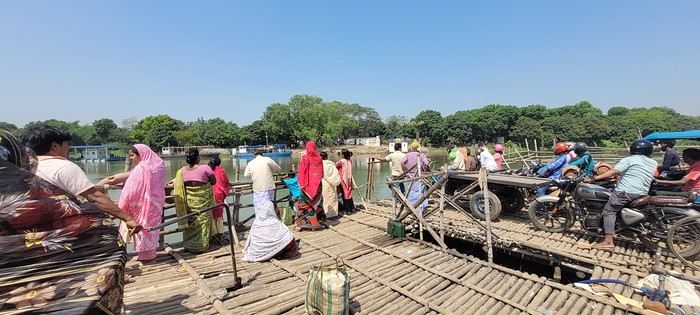
On the other side, several auto-rickshaws are waiting for travelers. I don’t have to wait long and quickly hop in to reach the temple complex. The village of Baranagar, near Azimganj, is home to a remarkable collection of terracotta temples built in the 18th century by Rani Bhabani, a wealthy zamindar (landowner) from Bengal and a great patron of religious architecture. The terracotta panels covering their facades depict both episodes from sacred texts and scenes from daily life at the time.
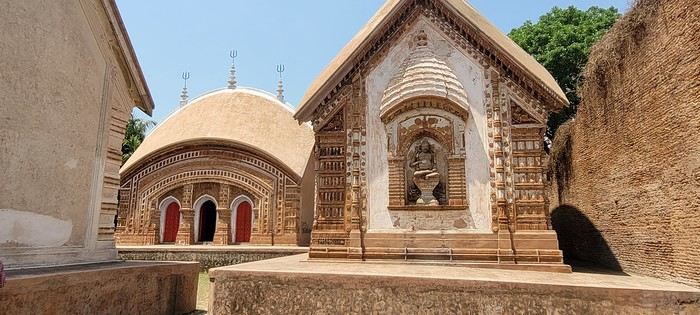
At the entrance to the site, the guard asks me to sign a register. He then accompanies me on the visit and tells me the history of these temples. Afterward, he leaves me to welcome an Indian couple. I can take my time, observe the details, and photograph the facades in peace. I also check out the explanations I found on a blog to better understand the scenes depicted.
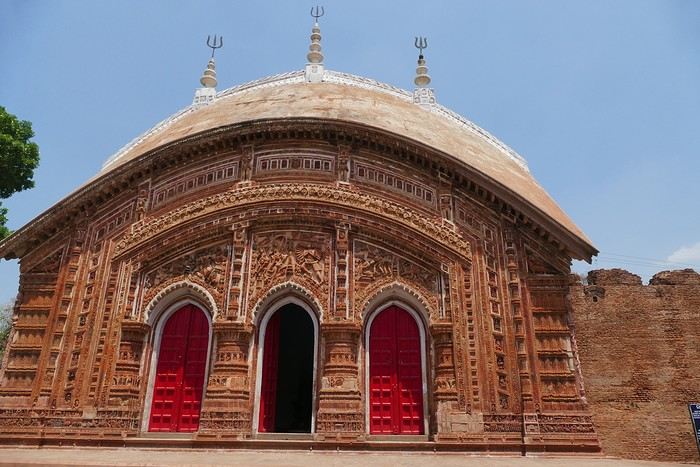
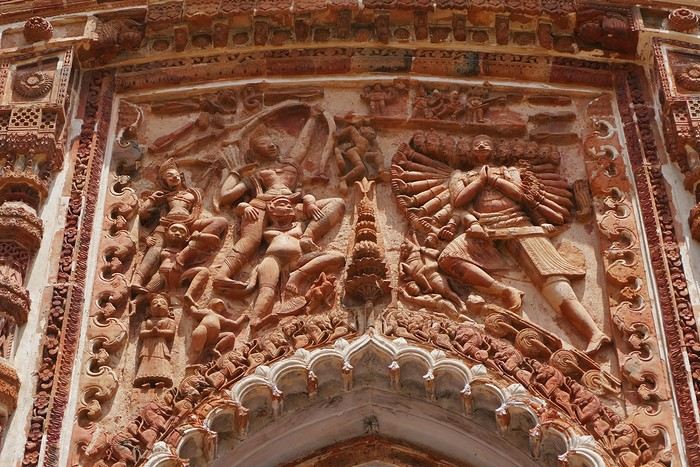
On one terracotta panel, I discover a depiction of Rama confronting Ravana, the ten-headed demon king, a famous episode from the Ramayana.
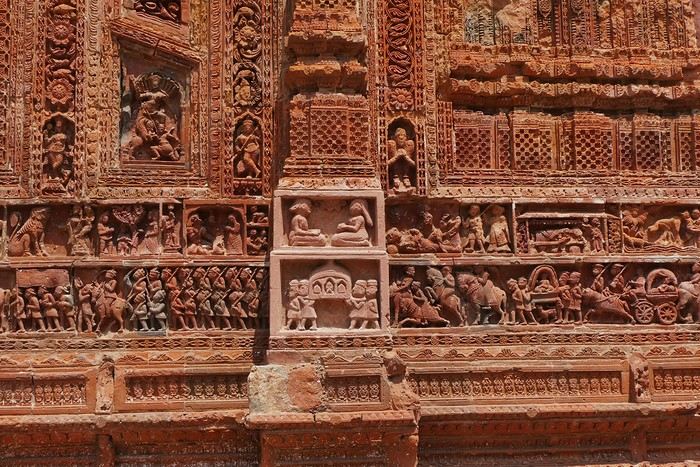
 Other panels show scenes from daily life: people at work, musicians, animals, and even battle scenes. These small sculptures are true archives of 18th-century Bengali society.
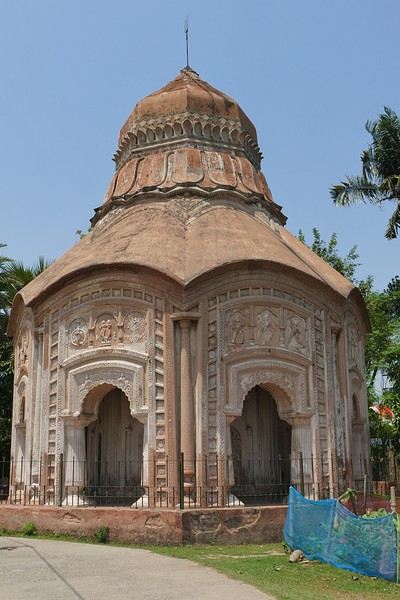
A little further on is the hexagonal Bhabanisar Shiva temple, located by the roadside. Unfortunately, the gates are locked, and I can’t go inside.
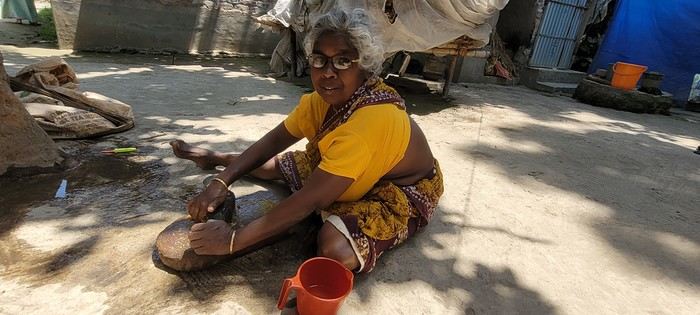
I try to walk around it anyway and end up in the courtyard of a neighboring house, where a woman is sitting on the ground grinding ginger. A simple scene of everyday life that contrasts with the ancient monuments I’ve just been admiring.
I head back to my auto-rickshaw, and we continue through the countryside in search of another temple: the Gangeshwar Jor Bangla. Isolated in a rural setting, it gives the impression of being made up of two adjoining sanctuaries, a characteristic architecture of the jor bangla style ("two joined houses").
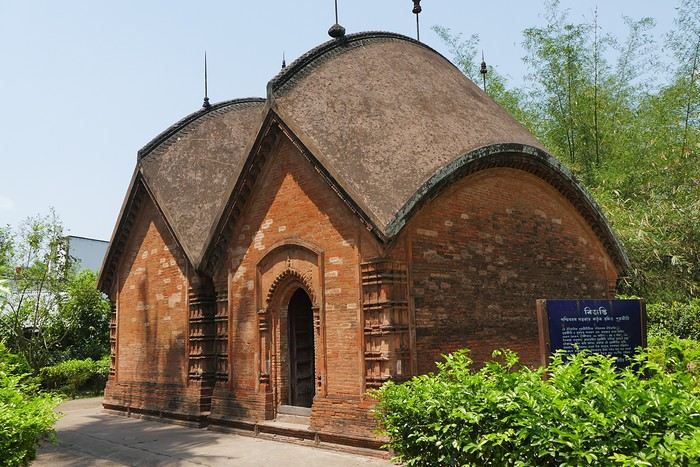
Here too, the facades are adorned with numerous terracotta panels depicting various aspects of daily life, people, animals, and decorative motifs.
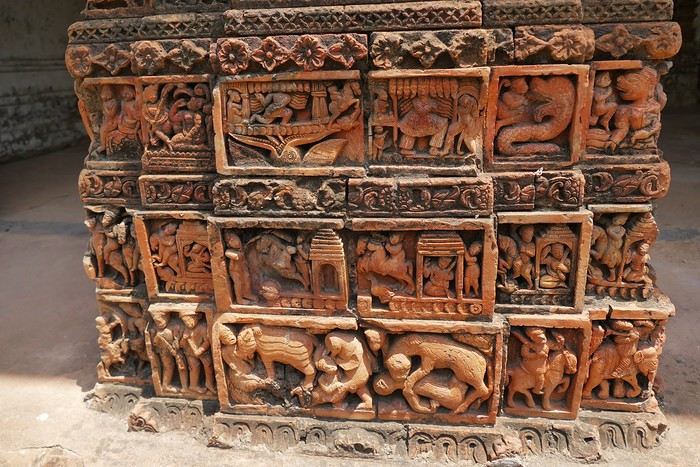
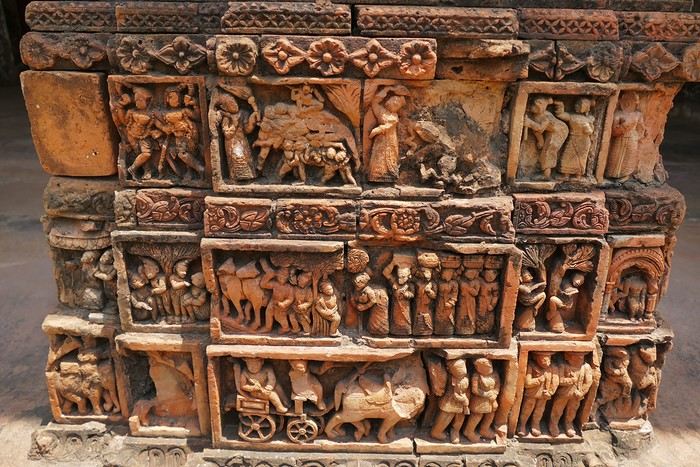
I end this visit with the feeling of having discovered a discreet but exceptional heritage. Far from the grand palaces of Murshidabad, these small village temples tell another story of Bengal—one of beliefs, craftsmen, and daily life etched in clay.
On the other side, several auto-rickshaws are waiting for travelers. I don’t have to wait long and quickly hop in to reach the temple complex. The village of Baranagar, near Azimganj, is home to a remarkable collection of terracotta temples built in the 18th century by Rani Bhabani, a wealthy zamindar (landowner) from Bengal and a great patron of religious architecture. The terracotta panels covering their facades depict both episodes from sacred texts and scenes from daily life at the time.
At the entrance to the site, the guard asks me to sign a register. He then accompanies me on the visit and tells me the history of these temples. Afterward, he leaves me to welcome an Indian couple. I can take my time, observe the details, and photograph the facades in peace. I also check out the explanations I found on a blog to better understand the scenes depicted.
On one terracotta panel, I discover a depiction of Rama confronting Ravana, the ten-headed demon king, a famous episode from the Ramayana.
Other panels show scenes from daily life: people at work, musicians, animals, and even battle scenes. These small sculptures are true archives of 18th-century Bengali society.A little further on is the hexagonal Bhabanisar Shiva temple, located by the roadside. Unfortunately, the gates are locked, and I can’t go inside.
I try to walk around it anyway and end up in the courtyard of a neighboring house, where a woman is sitting on the ground grinding ginger. A simple scene of everyday life that contrasts with the ancient monuments I’ve just been admiring.
I head back to my auto-rickshaw, and we continue through the countryside in search of another temple: the Gangeshwar Jor Bangla. Isolated in a rural setting, it gives the impression of being made up of two adjoining sanctuaries, a characteristic architecture of the jor bangla style ("two joined houses").
Here too, the facades are adorned with numerous terracotta panels depicting various aspects of daily life, people, animals, and decorative motifs.
I end this visit with the feeling of having discovered a discreet but exceptional heritage. Far from the grand palaces of Murshidabad, these small village temples tell another story of Bengal—one of beliefs, craftsmen, and daily life etched in clay.
Where to settle down / relax in India?
Hello,
We’ve already traveled to India twice before, but only for two-week periods (2013, a loop from Mumbai including Hampi, and in 2019, Tamil Nadu) ... This time, we’re leaving at the end of October for nearly three months of travel, which is a first for us! We’ll arrive in Delhi and depart from Bangalore. Our goal is to explore Northern India and then head down to Kerala, taking a flight at most once and prioritizing trains.
Traveling for so long should allow us to plan longer stops to slow down the pace and fully enjoy our trip...
What are the places you’ve enjoyed with this in mind?
I’ve already thought of Gokarna... Do you have any other suggestions, especially in Northern India?
Thanks in advance for your feedback.
Good evening Arielle, It’s a wonderful project that requires good preparation! It’s always tricky to suggest ideas without knowing your personal tastes. To start, I recommend reading some travel journals: they’re a fantastic source of inspiration and might make you want to discover a state you wouldn’t have thought of spontaneously.
Good evening Arielle, It’s a wonderful project that requires good preparation! It’s always tricky to suggest ideas without knowing your personal tastes. To start, I recommend reading some travel journals: they’re a fantastic source of inspiration and might make you want to discover a state you wouldn’t have thought of spontaneously.
Villages around Hazaribagh to West Bengal
I continue on to Kathgola Palace, walking along a long avenue lined with magnificent trees. In Murshidabad, palaces are plentiful but often far apart from each other. Since I love exploring on foot, the day promises to be intense—I’ll probably break my walking record.
As soon as you arrive, the tone is set: the monumental gate to the park is already grand, almost like a palace in its own right. It’s adorned with Corinthian columns and delicate floral stucco motifs, reflecting a strong European influence and a taste for refined ornamentation. It hints at the opulence and significance of the place even before you step inside.
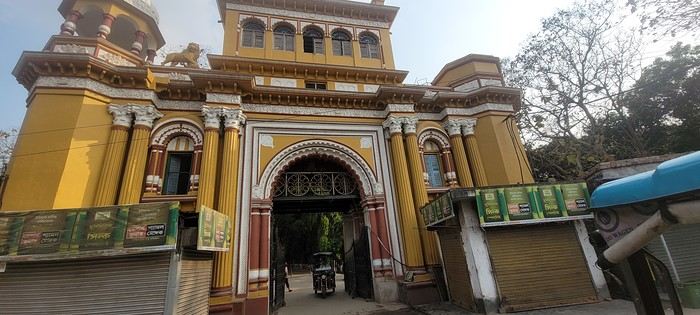
A large basin faces the palace, its elegant façade reflected in the water, adding even more majesty to the site.
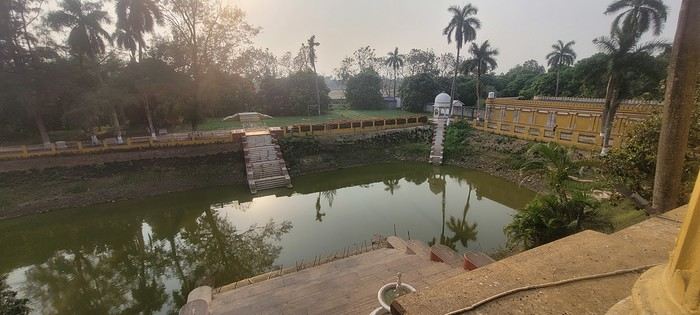
Built in the 19th century by a wealthy Jain merchant family, Kathgola Palace is a testament to Murshidabad’s commercial prosperity at the time, when it was still a major financial hub in Bengal. Its name, "Kathgola," means "wooden house," referring to the wood warehouses that contributed to its owners' wealth, along with the mention of a rose garden that once surrounded the estate.
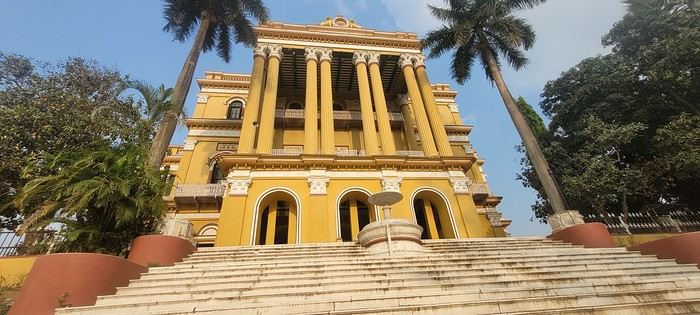
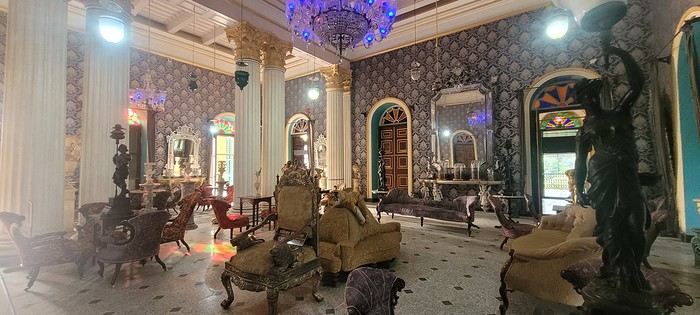
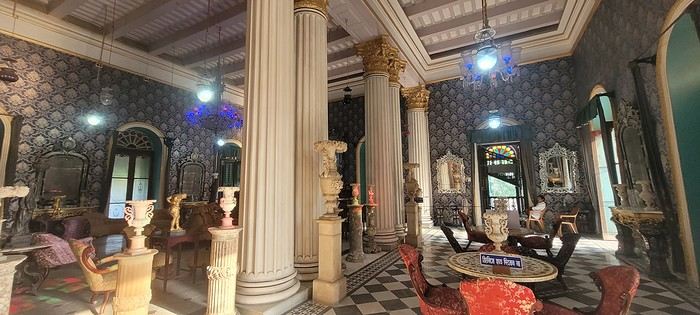
The four-story building features European-inspired architecture, blending neoclassical influences with local tastes. By the late 19th century, French architects contributed to its renovation, adding an even more Western touch, including lion statues that enhance the palace’s majestic appearance. Photos are prohibited inside, except in the grand hall on the upper floor, which is absolutely remarkable. This vast, richly decorated room reflects the refinement and luxury in which the owners lived. The monumental staircase, finely crafted, is also stunning and adds to the sense of grandeur.
On the top floor, a large terrace offers a view of the entire estate. From here, you can take in the gardens, the basin, and the surroundings, providing a beautiful perspective on the harmony of the site. In the gardens, an elegant kiosk evokes the lifestyle of the era, when these spaces were used for strolls, gatherings, and moments of relaxation.
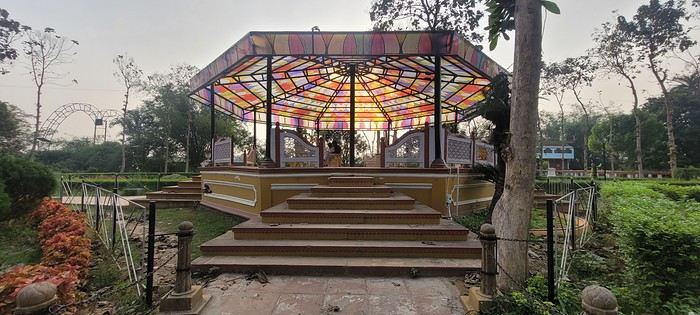
Under this kiosk, a few young people now rest while checking their phones, adding a contemporary touch to this historic place. From here, you can enjoy a view of the gardens, a fountain, and, in the distance, the Adinatha Temple, which stands out with its dazzling whiteness.
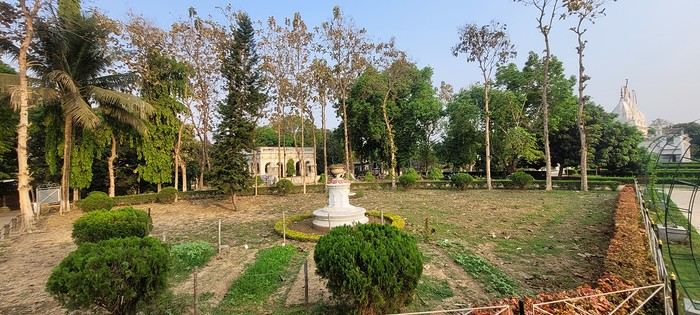
This Jain temple, dedicated to the first Tirthankara, reflects the religious affiliation of the palace’s patrons and the importance of this merchant community in Murshidabad’s history. Finally, a *baori*—an ancient stepwell typical of Indian architecture—completes the estate. The one at Kathgola Palace has a special story: it’s said to have filled with water after a flood from the Bhagirathi River, located on the opposite bank.
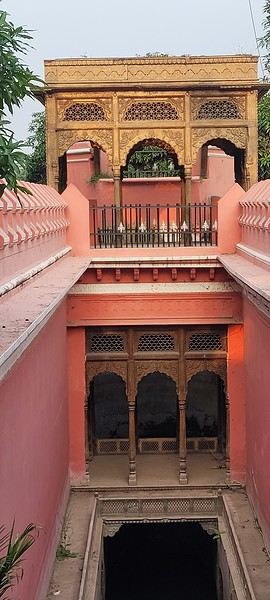
Beside the well, a statue carved from Italian marble adds another refined detail, illustrating once again the blend of Indian and European influences that characterize the estate. Victorian-style lions, fountains, and numerous decorative elements also reflect the British influence that shaped Murshidabad’s architecture in the 19th century.
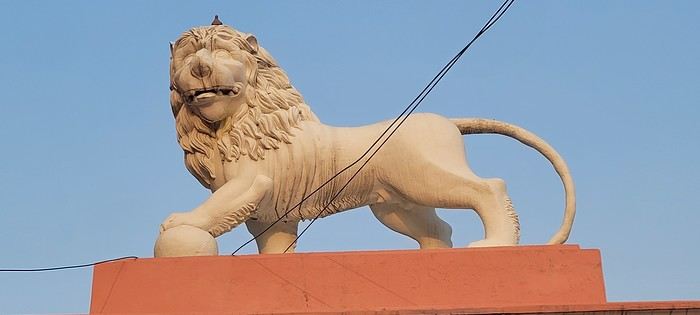
Kathgola Palace thus reflects an era when wealthy Jain merchant families displayed their success by combining Indian traditions, local craftsmanship, and Western architectural trends that were very much in vogue at the time.
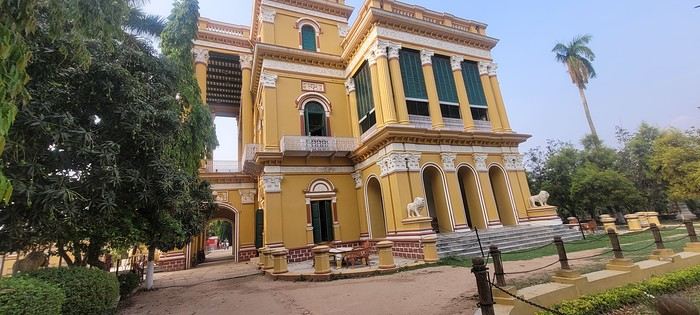
I’m really savoring this moment because I’ve fallen in love with this place. After all these discoveries, I take the time to wander around the estate a little longer, extending my visit until sunset. The light that envelops the gardens, the palace, and the basin creates a special atmosphere, almost timeless. But after such a long day of walking and exploring, I have to think about heading back. I’ll eventually take an auto to return to my hotel, which is quite far from the center.
A large basin faces the palace, its elegant façade reflected in the water, adding even more majesty to the site.
Built in the 19th century by a wealthy Jain merchant family, Kathgola Palace is a testament to Murshidabad’s commercial prosperity at the time, when it was still a major financial hub in Bengal. Its name, "Kathgola," means "wooden house," referring to the wood warehouses that contributed to its owners' wealth, along with the mention of a rose garden that once surrounded the estate.
The four-story building features European-inspired architecture, blending neoclassical influences with local tastes. By the late 19th century, French architects contributed to its renovation, adding an even more Western touch, including lion statues that enhance the palace’s majestic appearance. Photos are prohibited inside, except in the grand hall on the upper floor, which is absolutely remarkable. This vast, richly decorated room reflects the refinement and luxury in which the owners lived. The monumental staircase, finely crafted, is also stunning and adds to the sense of grandeur.
On the top floor, a large terrace offers a view of the entire estate. From here, you can take in the gardens, the basin, and the surroundings, providing a beautiful perspective on the harmony of the site. In the gardens, an elegant kiosk evokes the lifestyle of the era, when these spaces were used for strolls, gatherings, and moments of relaxation.
Under this kiosk, a few young people now rest while checking their phones, adding a contemporary touch to this historic place. From here, you can enjoy a view of the gardens, a fountain, and, in the distance, the Adinatha Temple, which stands out with its dazzling whiteness.
This Jain temple, dedicated to the first Tirthankara, reflects the religious affiliation of the palace’s patrons and the importance of this merchant community in Murshidabad’s history. Finally, a *baori*—an ancient stepwell typical of Indian architecture—completes the estate. The one at Kathgola Palace has a special story: it’s said to have filled with water after a flood from the Bhagirathi River, located on the opposite bank.
Beside the well, a statue carved from Italian marble adds another refined detail, illustrating once again the blend of Indian and European influences that characterize the estate. Victorian-style lions, fountains, and numerous decorative elements also reflect the British influence that shaped Murshidabad’s architecture in the 19th century.
Kathgola Palace thus reflects an era when wealthy Jain merchant families displayed their success by combining Indian traditions, local craftsmanship, and Western architectural trends that were very much in vogue at the time.
I’m really savoring this moment because I’ve fallen in love with this place. After all these discoveries, I take the time to wander around the estate a little longer, extending my visit until sunset. The light that envelops the gardens, the palace, and the basin creates a special atmosphere, almost timeless. But after such a long day of walking and exploring, I have to think about heading back. I’ll eventually take an auto to return to my hotel, which is quite far from the center.
Villages around Hazaribagh in West Bengal
(continued)
Next door is the Jagat Seth House museum, whose name means "banker to the world." Photos are, once again, forbidden inside, but I manage to take a few discreetly.
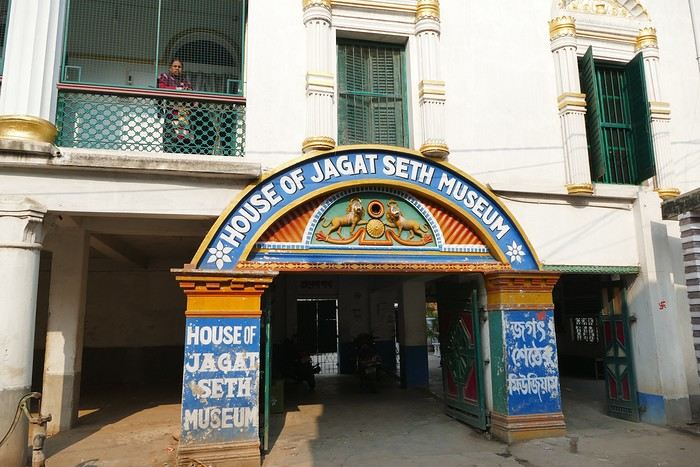
The rooms are richly decorated and display a wide variety of objects, reflecting the prosperity and refinement of this influential family.
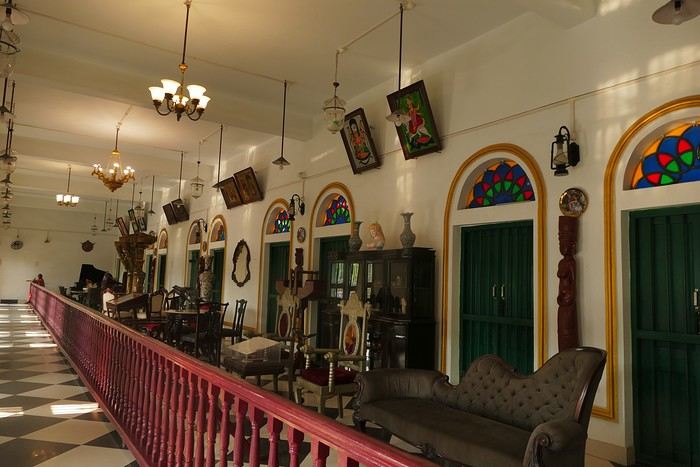
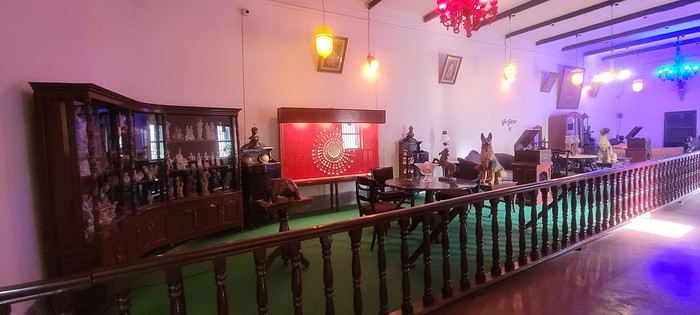
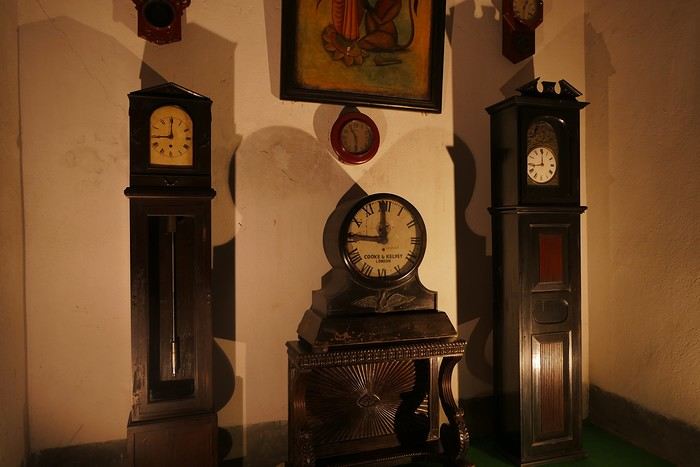
Among them, Comtoise-style clocks, surprisingly present here, catch my eye: an unexpected detail that speaks to the exchanges and influences from Europe.
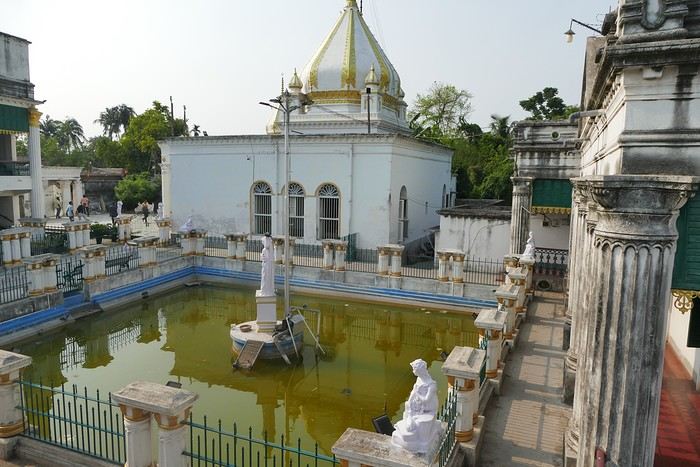
A secret tunnel, quite surprising, runs through the building; it once allowed its owner to stay protected or move around out of sight. Outside, a basin with a fountain adds a touch of serenity.
 A cannon is displayed near the building, imposing with its tier, a reminder of the power and prestige of the place.
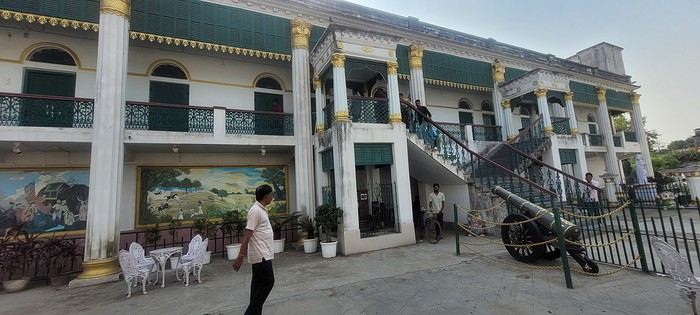
Next door is the Jagat Seth House museum, whose name means "banker to the world." Photos are, once again, forbidden inside, but I manage to take a few discreetly.
The rooms are richly decorated and display a wide variety of objects, reflecting the prosperity and refinement of this influential family.
Among them, Comtoise-style clocks, surprisingly present here, catch my eye: an unexpected detail that speaks to the exchanges and influences from Europe.
A secret tunnel, quite surprising, runs through the building; it once allowed its owner to stay protected or move around out of sight. Outside, a basin with a fountain adds a touch of serenity.
A cannon is displayed near the building, imposing with its tier, a reminder of the power and prestige of the place.