Posts by Isamacha
About 62 results.
More options
Many results are in French, the community’s main language. English translations are added over time.
Search results
A Classic Trio: Praslin, La Digue, Mahé (Seychelles)
Hi Mewmew,
I’m replying to the thread:
on La Digue: Badamier Self-Catering via Booking
on Praslin: Exotic Guest House via Booking
on Mahé: Joli View Self-Catering Apartments, also via Booking
Best,
Marc
4 weeks in Bali, Java, and Sulawesi
hi,
sorry for the late reply—I didn’t see the alert for your message.
Our stay in Sulawesi was organized by the Evaneos agency. We had a guide and a driver from Rantepao to Ampana. In Ampana, we took a ferry to Wakai (about 3 hours), where the manager of Lia Beach Bamboo resort, located on Walea Kodi, picked us up for a 3-hour motorboat ride.
I’m happy to help if you have more questions! Best, Marc
4 weeks in Bali, Java, and Sulawesi
Hi there,
Sorry for the late reply—I didn’t get an alert.
In the Togian Islands, we stayed at Lia Beach Bamboo Resort on Waela Codi, a cluster of 3 bungalows where the managers pick you up from Wakai port (a 3-hour motorboat ride). We’d set off from Ampana.
Our stay in Sulawesi was organized by Evaneos.
I’m happy to help if you have any other questions.
Best,
Marc
2 weeks in the Seychelles
We spent two weeks in the Seychelles at the end of March and beginning of April 2026.
We split our stay as follows: 4 nights on La Digue, nights on Praslin (assuming you meant a specific number here—let me know if you'd like to correct it!), and 6 nights on Mahé.
It’s a classic itinerary.
Inter-island transfers are done with the Cat Coco company. You can book the transfers online on their website, which also offers an airport-to-port shuttle when you arrive in Mahé. It takes about 50 minutes to go from Mahé to Praslin and 10 minutes between Praslin and La Digue.
La Digue is an island with very few cars (only taxis and a few official or business vehicles) and lots of bikes. You can rent them everywhere on the island—we rented ours from our landlady. Things to see and do on the island: a bike tour around the island, the Veuve Reserve (it’s a bird), Union Estate with a giant tortoise park, and especially Anse Source d’Argent (our favorite beach across all three islands) and all the other coves, including Grande Anse, Petite Anse, and Anse Sévère.
For food, there are several takeaways on the island and plenty of small shops for groceries—same goes for the other two islands.
On Praslin, we rented a car, but you can also use the bus network. There aren’t many destinations, the main one being the Vallée de Mai, a must-visit as the sanctuary of the coco de mer (the "butt nut"). It’s best to visit with a guide—they wait for a small group, and the ticket price can be split four ways. You *can* visit alone, but you’ll miss out on a lot of information. Another destination is Anse Georgette, in the north of the island near the airport and the golf course of a big resort. Have your accommodation notify the hotel when you’re heading there, and if you’re driving, park as soon as you see the first signs for the parking lot. Anse Lazio is famous, but much more touristy than Anse Georgette. We stayed in Anse Volbert Village at Côte d’Or, a stunning 3 km beach with shops, takeaways, and restaurants.
Mahé is the largest island. Like on Praslin, you can rent a car or use the buses—we rented one. The roads are good but sometimes narrow. Don’t forget the mountainous terrain in this part of the Seychelles, which makes some climbs very steep (same as on Praslin). Opt for small cars—they’re often automatic, and remember you drive on the left here!
Things to see on Mahé: the Jardin du Roi, a collection of everything that grows in the Seychelles—very interesting, with a great restaurant. Visit Anse Intendance, Anse Bazarca, and Police Bay in the south—three gorgeous beaches. Also check out Anse Royale. For souvenirs, head to the Craft Village, where you can find some unique items. If you’re a fan, visit the Takamaka distillery.
In conclusion, we should’ve added one or two more nights on La Digue—it’s really beautiful—and only stayed three nights on Praslin. We rented apartments through Booking and Airbnb. Don’t forget to get your tourist visa online. The Seychelles is a clean, safe, relaxed, and stress-free country
A super classic trio: Praslin, La Digue, Mahé (Seychelles)
thanks Muriel
A super classic trio: Praslin, La Digue, Mahé (Seychelles)
Since no travel journal has been posted about this destination since 2020, I’m giving it a go—maybe it’ll jog some memories or give others a few ideas... even if, in the end, there isn’t much to tell 😎!
Even though the itinerary was as classic as can be, it still led to a few brain knots: in what order? How many nights on each island? Rent a car or not?
In short, plenty of existential questions to settle on 4 nights on each island, ending with Mahé to avoid any last-minute surprises before the return flight.
Saturday 22/03: Flight to Mahé with Qatar Airways (no—or rather, no more—direct flights from Paris 😕) A nice surprise at CDG with the discovery of a new lounge in Terminal 1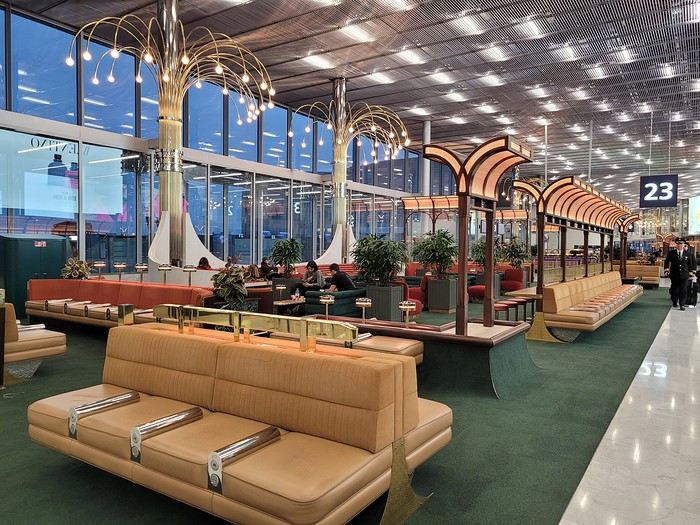
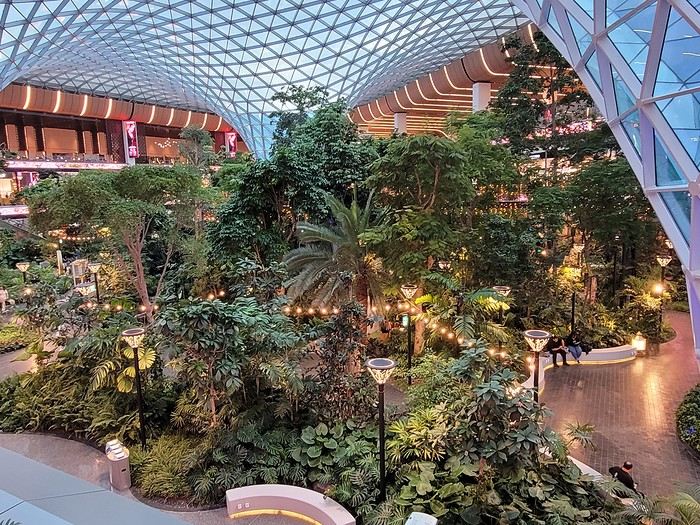
Then an in-depth exploration of Doha Airport thanks to (or because of) a loooong layover:
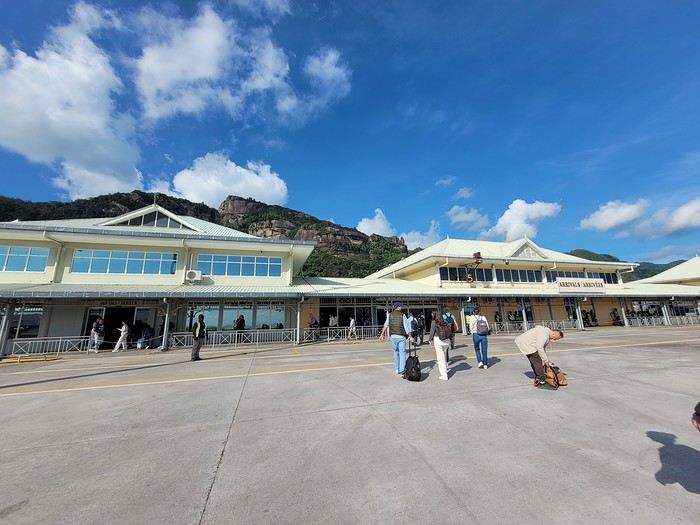
And finally, arrival at the tiny Mahé Airport where we step onto the tarmac feeling like we’ve walked into a steam room
 Baggage claim is quick, the shuttle to the port is on time, the ferry is punctual (we, on the other hand, are way early ), and there’s Praslin in sight:
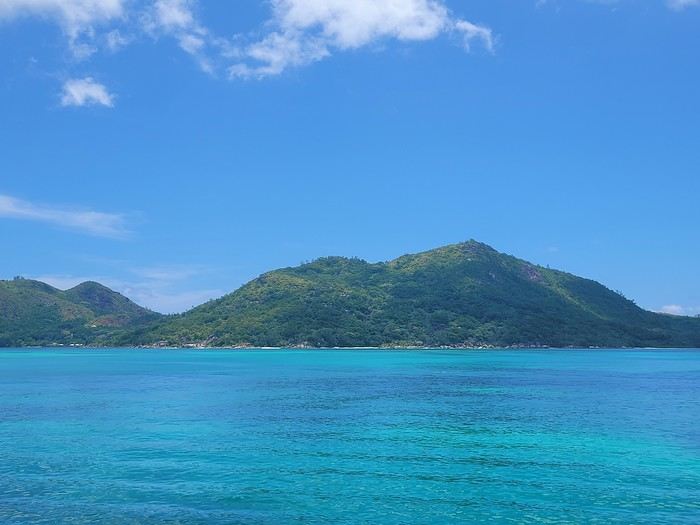
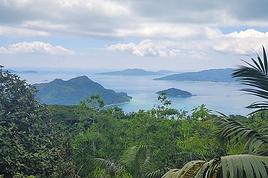
... with a sneak peek of the sea’s colors 🙂 A quick note on the photos: most were taken with a smartphone, and the colors are a bit more saturated than in real life (I did bring my hybrid camera, but in the end, I barely used it since it wasn’t very practical to carry around on the water or for snorkeling).
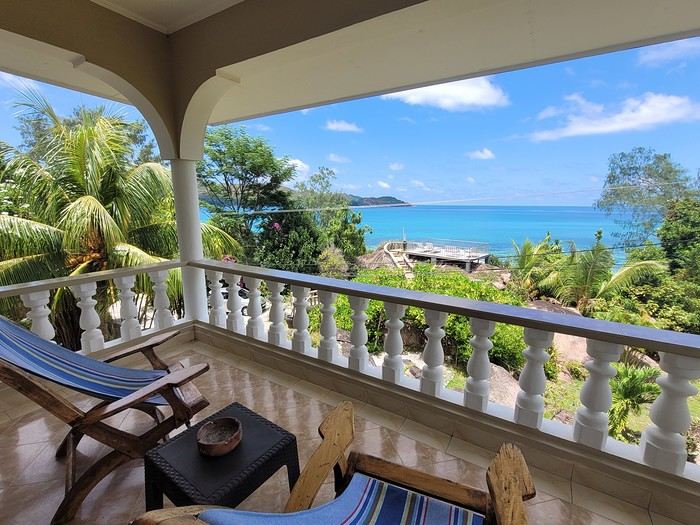
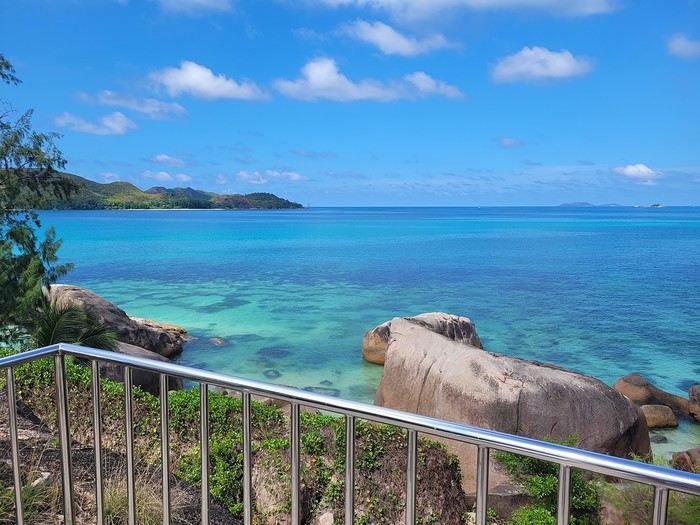
We pick up the car (a grand I10 instead of a Picanto) from a muddy parking lot (it just rained) and off we go—of course, turning on the windshield wipers instead of the blinker 😎, left-hand driving obliges. In just a few minutes, we arrive at our accommodation for these 4 nights on Praslin (Oh, the "lien" tab isn’t working! ) We’re blown away by the view from the terrace:
Then by the view from the small shared terrace on a promontory:
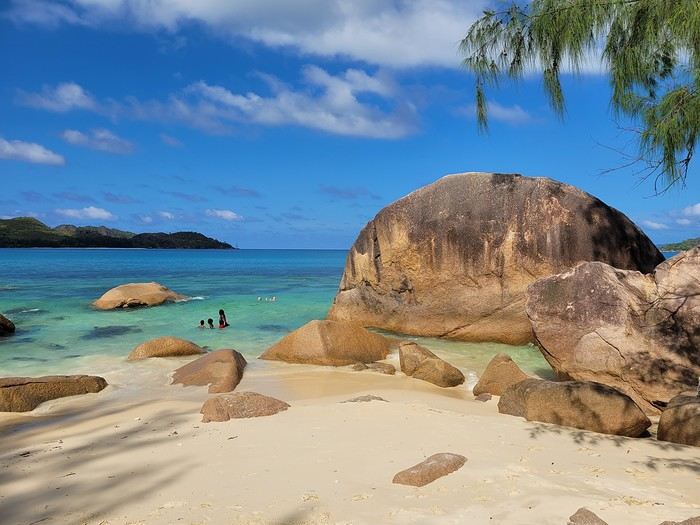
 Before heading to test the water temperature on the other side of the road, at Anse Boudin, and spotting our first fish.
Hi Muriel, We’re heading to the Seychelles on March 21st—thanks for starting your story! We could use some practical tips on getting around the three islands: buses, bikes, cars, and inter-island travel, like ferry frequency, for example. Also, about the airport-to-port shuttle you took. For accommodations, what do you recommend? Hotels, guesthouses, Airbnb? Thanks for your feedback! Best, Marc
Saturday 22/03: Flight to Mahé with Qatar Airways (no—or rather, no more—direct flights from Paris 😕) A nice surprise at CDG with the discovery of a new lounge in Terminal 1
Then an in-depth exploration of Doha Airport thanks to (or because of) a loooong layover:
And finally, arrival at the tiny Mahé Airport where we step onto the tarmac feeling like we’ve walked into a steam room
Baggage claim is quick, the shuttle to the port is on time, the ferry is punctual (we, on the other hand, are way early ), and there’s Praslin in sight:... with a sneak peek of the sea’s colors 🙂 A quick note on the photos: most were taken with a smartphone, and the colors are a bit more saturated than in real life (I did bring my hybrid camera, but in the end, I barely used it since it wasn’t very practical to carry around on the water or for snorkeling).
We pick up the car (a grand I10 instead of a Picanto) from a muddy parking lot (it just rained) and off we go—of course, turning on the windshield wipers instead of the blinker 😎, left-hand driving obliges. In just a few minutes, we arrive at our accommodation for these 4 nights on Praslin (Oh, the "lien" tab isn’t working! ) We’re blown away by the view from the terrace:
Then by the view from the small shared terrace on a promontory:
Before heading to test the water temperature on the other side of the road, at Anse Boudin, and spotting our first fish.
Hi Muriel, We’re heading to the Seychelles on March 21st—thanks for starting your story! We could use some practical tips on getting around the three islands: buses, bikes, cars, and inter-island travel, like ferry frequency, for example. Also, about the airport-to-port shuttle you took. For accommodations, what do you recommend? Hotels, guesthouses, Airbnb? Thanks for your feedback! Best, Marc
4 weeks in Bali, Java, and Sulawesi
We’re a couple in our sixties and spent four weeks in Indonesia during October 2025.
First, we got all the necessary documents—Indonesian visa, Bali-specific visa, and customs forms—from specialized Indonesian websites. You *can* get them on arrival, but it takes a lot of time.
Unfortunately, we chose to spend the first six days of our trip in Ubud and Amed, on Bali, which we bitterly regretted. You can arrive in Indonesia without going through Bali—this island is overcrowded with tourists, cars, and scooters, and it’s home to 4,400,000 people despite being smaller than Corsica. The locals are very kind, helpful, and friendly, and the food is good, but everything is geared toward tourists—nothing feels truly authentic. At least in the parts of Bali we visited: Sanur in the south (where we spent three days before flying back to France), Ubud, and Amed. The north of the island might be more interesting, but we didn’t go there.
After Bali, we headed to Yogyakarta, on Java, to explore the city and, most importantly, visit the temples of Borobudur and Prambanan.
It’s like going from a hyper-touristy universe to a world with almost no tourists. When you walk around the city, you barely see any tourists—the people are very approachable and happy to chat. As for Borobudur and Prambanan, they’re an absolute must on this trip. You *can* visit both temples in one day, including seeing Borobudur at sunrise. We split the visits over two days. We booked Borobudur the day before on the official site, which offers specific visiting times. For Prambanan, we bought the ticket and hired a guide on-site.
We spent four days on Java before flying to Sulawesi, also called Celebes. Makassar, the island’s capital, was just a stopover between flights, but we had time to admire the beautiful new mosque at sunset. Then, we spent four days in Toraja country, another highlight of the trip, visiting cemeteries and attending a funeral ceremony with around 600 people near Rantepao. We experienced truly unique and extraordinary moments. Above Toraja country, a few hours’ drive away, lies the Bada Valley and its megaliths—the tallest is 4.8 meters high, and there are about fifteen scattered across the rice fields. We saw five of them. There were a few tourists in Toraja, but in Bada, we were alone. Unforgettable memories, stunning landscapes, and always-smiling, kind, approachable people.
To wrap up the trip, we spent five nights in the Togian Islands, north of the Bada Valley, alone in a resort with three bungalows. The view was a white-sand beach and the nearby coral reef, complete with colorful fish, turtles, dolphins, and sharks.
After eleven nights in Sulawesi, we returned to Bali. Our last nights were in Sanur, a beach town with all-inclusive hotels (we stayed in an Airbnb), restaurants serving beef bourguignon, and tourists who don’t really go to Indonesia—they just go to Bali.
Practical tip: download Grab, the local Uber—it’s super handy. This year, we opted for an eSIM, which is also very convenient. You can buy it in France and activate it when you arrive at the airport.
I’m happy to answer any questions!
PS: Despite my mixed feelings about Bali, it *can* still be a travel destination—but Indonesia has so much more to offer! Marc
Feedback on 3 weeks in Brazil
The phone at the end of the strap
please correct
Sharing our 3-week Brazil trip experiences
We used our phones for GPS—I’d downloaded maps of Rio and other cities so we could get around offline. It’s tough in Rio, at least, to find tourist spots when you exit the metro, for example, since there are no signs. I kept my phone in my pocket and my wife had hers on a lanyard. Nothing too obvious—you can buy a plastic pouch with a lanyard that lets you take your phone everywhere, even in the water while swimming. Could be a good solution.
Feedback on 3 weeks in Brazil
Hi Marie Claude,
Tough question—we met a 25-30-year-old French woman on Ilha Grande who was traveling solo, and she told us she felt more hassled in Paris than in Rio. She said she walked around Copacabana late at night without any issues. That’s the only firsthand example I can share from our trip to Brazil that directly answers your question.
If you stick to the well-trodden "tourist" paths, avoid going alone to "risky" areas (I’m thinking of favelas, but there are others), you’ll see police everywhere, as well as private militias patrolling the streets—we spotted them in Olinda. If you go out without a bag, no "big" camera, just wearing shorts, flip-flops, and a t-shirt (i.e., dressed like a local), with a copy of your passport and a few bills, your phone tucked between your skin and fabric, sunglasses, and a cap... or a small crossbody bag for your glasses, a book, etc.
At the airport, for example, take a taxi from the desk inside the arrivals hall—not outside—or book an Uber, which is widely used there.
For payments, you can use your phone if you don’t want to carry too much cash—also very common.
Follow these rules that Brazilians remind tourists about. To them, Rio *is* dangerous—they say it themselves—but we never felt at risk, even in Recife, where the city is really run-down and the population is struggling.
Brazilians are always incredibly attentive and kind.
Anyway, just take the usual precautions. Hope this helps! Marc
Feedback on 3 weeks in Brazil
Hi Christelle,
Ilha Grande is twice as large as Boïpeba, 193 km² compared to 88, and it's mountainous, with its peak at 1,000 meters, so it might be better suited for hiking. Boïpeba is further north, with higher temperatures, and the ocean is also warmer there. Ilha Grande is more easily accessible from Rio—2 hours by car and 30 minutes by speedboat—while Boïpeba takes longer to reach from Salvador: 40 minutes by boat, 2 hours by car to Valença, then another good half-hour by speedboat to get to Boïpeba. Their main towns are similar in size, with between 3,000 and 4,000 inhabitants. No cars on the islands (except for emergency services). Lots of accommodations, restaurants, and shops, as well as plenty of boat transport options to get around each island or reach the beaches. Both islands have stunning beaches, which were "empty" when we were there. I think Boïpeba is less crowded than Ilha Grande, though Ilha Grande is less well-known, even among Brazilians. Since Ilha Grande is located between Rio and Paraty, it’s easy to stop there. I might have preferred Boïpeba because of its beaches. Hope this helps! Marc
Ilha Grande is twice as large as Boïpeba, 193 km² compared to 88, and it's mountainous, with its peak at 1,000 meters, so it might be better suited for hiking. Boïpeba is further north, with higher temperatures, and the ocean is also warmer there. Ilha Grande is more easily accessible from Rio—2 hours by car and 30 minutes by speedboat—while Boïpeba takes longer to reach from Salvador: 40 minutes by boat, 2 hours by car to Valença, then another good half-hour by speedboat to get to Boïpeba. Their main towns are similar in size, with between 3,000 and 4,000 inhabitants. No cars on the islands (except for emergency services). Lots of accommodations, restaurants, and shops, as well as plenty of boat transport options to get around each island or reach the beaches. Both islands have stunning beaches, which were "empty" when we were there. I think Boïpeba is less crowded than Ilha Grande, though Ilha Grande is less well-known, even among Brazilians. Since Ilha Grande is located between Rio and Paraty, it’s easy to stop there. I might have preferred Boïpeba because of its beaches. Hope this helps! Marc
Sharing our 3-week experience in Brazil
Hello,
We’re a couple in our sixties and we’ve just spent 22 days in Brazil, from October 29th to November 21st.
We flew from Marseille via Lisbon—outbound to Rio, and back from Recife.
Our itinerary:
4 days in Rio
4 days on Ilha Grande
2 days in Paraty
4 days in Salvador
4 days on Boïpeba
4 days in Olinda
The transfer between Boïpeba and Recife took us 2 days—boats, taxis, and a flight.
We stayed in Airbnbs except in Paraty, where we were in a pousada, and during the Boïpeba–Recife transfer, when we booked a hotel near the airport.
Our flights were with Gol and Azul.
Transfers from Rio were arranged through Paraty Tour.
In Rio, we used a local agency to visit Corcovado and Sugarloaf Mountain.
Happy to answer any questions! Marc
Happy to answer any questions! Marc
De retour d'Éthiopie (Nord en 13 jours)
merci
Retour de 35 jours en Éthiopie
merci
De retour d'Éthiopie (Nord en 13 jours)
bonjour
avez vous contacté cette agence sur place ou depuis la France ?
quel est le coût du séjour sur place ?
merci
merci
Retour de 35 jours en Éthiopie
Bonjour
pouvez vous me donner le nom de l'agence sur place et votre circuit ?
merci
pouvez vous me donner le nom de l'agence sur place et votre circuit ?
merci
Une semaine au Maroc au départ de Fès
merci
Une semaine au Maroc au départ de Fès
bonjour
je suis a la recherche d'idées de visites pour un séjour d'une semaine au Maroc, en arrivant et en repartant de Fes, en incluant Meknes, Volubilis et Rabat
merci pour vos retours
Retour de trois semaines en Birmanie
bonjour
prendre aussi bien des euros que des dollars, les bureaux de change acceptent les deux, nous avions de billets de 200 euros et 50 euros, le taux est plus intéressant avec ces billets qu'avec des billets de 20 ou 10 euros (c'est affiché), le taux le plus intéressant était a l'aéroport en arrivant, 1 euro = 1780 kyats, le plus gros billet étant de 10000 kyats, donc 100 euros = 178000 kyats, soit 17 billets de 10000 et 8 billets de 1000 (le taxi de l'aéroport en ville coûte 13000 kyats environ) les hotels prennent les dollars ou les kyats, pas les euros, nous les avons toujours payé en kyats le paiement par carte génère des frais, mais il y a des distributeurs partout bref, nous avons changé la majorité de nos euros en arrivant, les billets doivent être impeccables, pas forcément neufs mais ne doivent pas présenter de trace de pliure, ni d'infime déchirure ou simple accroc, on m'en a refusé un. donc prenez soin de vos billets, conservez les bien à plat les hotels pratiquent le taux des banques pour les dollars et les euros (avec une commission bien sur) voila
bon voyage
Retour de trois semaines en Birmanie
Bonjour
nous sommes rentrés hier d'un séjour de trois semaines en Birmanie. Tout s'est très bien déroulé, dans de bonnes conditions de transport et d'hébergement, mais nous ne sommes pas sortis des sentiers les plus touristiques.
Notre circuit:
Yangon, 1 journée, visite du centre le Rocher d'Or et la région de Bago, 2eme et 3eme journées le lac Inlé, 3 jours Mandalay, 2 jours Bagan, 5 jours Ngapali, 3 jours Yangon, 2 jours
avion entre Yangon et le lac Inlé, entre le lac Inlé et Mandalay, entre Bagan et Ngapali et Ngapali et Yangon, bateau entre Mandalay et Bagan
le change 1 euro = 1780 kiats, prendre des billets non abimés, non déchirés ni froissés
un bon repas pour 4 euros,
tres beau pays, gens charmants, on y mange bien et on sourit tout le temps, allez y !