Results for "Champs-Élysées+et+hébergement+|+127"
18810 results found.
Prague in June: Packing and Sightseeing Tips
Hello,
We’re heading to Prague with so much excitement from June 10th to 20th. I’ve got three main questions for those who live there or have visited:
- What are your thoughts on what to pack clothing-wise? What’s the weather usually like at this time of year? We’re a bit sensitive to the cold—we live way down in southern Andalusia and are used to the *calor* 😎... Should we pack rain gear? Are we likely to get a lot of rain (which we’re dreading a little, but we couldn’t choose other dates)?
- I’ve seen there are "passes" for various attractions, museums, and sites, including one that’s valid for 10 days but costs a whopping 160 € per person—that’s an average of 16 € per day. Do you think it’s really worth it? We won’t be spending our days rushing between every indoor site; we also love wandering the streets and discovering things a bit "at random." If we do two paid visits a day, that’ll probably be the max... Can we make it worth the cost with that? Of course, we want to visit the castle and take a boat trip as a minimum. Are the sites included in these passes iconic, or are they more "minor" attractions? Does having the pass help us skip long lines?
- Finally, a question about communication: I speak French, obviously, plus Spanish and English fluently, but very little German (haven’t practiced in ages), and no Russian or Czech at all. My husband knows a few words of Russian, but it’s "Cuban" Russian—about the same level as my current German 🙂 !! Can we still get by without too much trouble? We don’t want to spend 10 days not saying a word to anyone and communicating only with gestures!!
Thanks for your valuable tips and opinions.
Already twenty years...
« Ali is not dead; he continues to inspire many talented musicians. There’s a new generation of artists who have their own style, but they’ve all listened to Ali Farka Touré. » (Ms. Kuypers-Touré, widow of Ali Farka Touré)
Ali Farka Touré (1939-2006)
Recognized worldwide as one of the most important musicians from Africa, his guitar playing earned him the nickname “the African John Lee Hooker.” But Ali Farka Touré preferred to flip the script and highlight the roots of Southern U.S. music in the Sahel region: « I have the roots and the trunk; they only have the leaves and branches. » In other words, what John Lee Hooker played was an echo of a distant African past. Ali Farka Touré was the guardian of traditions, and even though his sound resembled the blues, it remained deeply tied to the land of his ancestors—in Africa, in Mali. A farmer at heart, the famous Malian singer and guitarist continued to cultivate the land until his hospitalization for cancer, from which he passed away on March 7, 2006, in Bamako at the age of 66.
The son of a soldier who fell in combat while serving in the French army, he was born in 1939 in Kanau, near Timbuktu, then part of French Sudan (a subdivision of French West Africa, now Mali). He was raised by an uncle with harsh teaching methods and a grandmother who was “strong in voodoo,” communicating with spirits. At ten years old, he had a revelation for the single-string lute djurkel, “the instrument of the spirits,” and for the fiddle njarka. Seven years later, while training as a driver at a clinic, he fell in love with a colleague’s guitar. It wasn’t until 1968, when he was to represent Mali in Bulgaria, that he finally had the chance to acquire his first six-string guitar. International acclaim came later, following numerous concerts in the UK in the mid-1980s, at the invitation of World Circuit, the independent English label to which he remained loyal his entire life.
Several times, Ali Farka Touré announced his plan to stop making music. « It’s time for me to focus on my own. I don’t want Europe to tear me away from Africa. [...] Me, I love cultivating the land. In my life, if I’m not in the fields, I’m fishing or in the garden! »
Yet, Ali Farka Touré regularly returned to perform in Europe and the U.S. In 1995, he won his first Grammy Award for the album Talking Timbuktu, recorded in 1993 with bassist John Patitucci, percussionist Jim Keltner, the great Californian guitarist Ry Cooder, and the venerable guitarist Clarence Gatemouth Brown. His last three years were extraordinarily productive. Back to back, he recorded his best albums: In the Heart of the Moon (2004), Ali & Toumani (released in 2010), both duets with kora player Toumani Diabaté, and Savane (2005), dedicated to the traditional Peul and Songhai repertoires. At the same time, he tirelessly devoted himself to his agricultural work and his duties as mayor, a role he had held since 2004.
A multi-instrumentalist, he was a self-taught musician with an impressive musical culture. His discography includes around fifteen albums and several timeless hits used in films or as TV program themes. A universal symbol of West African sound heritage, his presence and his role in spreading a centuries-old legacy are undeniable. His son, also a musician, Vieux Farka Touré, now bears the heavy responsibility of carrying on his illustrious father’s message and legacy. His album Les Racines, released in 2002, is his contribution to preserving an instantly recognizable sound.
Meanwhile, his country, Mali, has paid tribute to him: for several years now, a square and a street in Bamako, the capital of Mali, have borne his name (both located in the Lafiabougou district).
In 2023, World Circuit released a new posthumous album, Voyageur, the first to feature previously unreleased tracks since 2010. It includes pieces composed and recorded spontaneously over the last 15 years, whether during his many tours or in the studio. These tracks once again showcase Touré’s passion for the musical traditions of his homeland and for the creativity and cultural diversity of West Africa. Below, an excerpt from this album: the beautiful song Chérie (with a very young Oumou Sangaré)—magnificent!!!
hgb
Ali Farka Touré feat. Oumou Sangaré: Chérie
Ali Farka Touré (1939-2006)
Recognized worldwide as one of the most important musicians from Africa, his guitar playing earned him the nickname “the African John Lee Hooker.” But Ali Farka Touré preferred to flip the script and highlight the roots of Southern U.S. music in the Sahel region: « I have the roots and the trunk; they only have the leaves and branches. » In other words, what John Lee Hooker played was an echo of a distant African past. Ali Farka Touré was the guardian of traditions, and even though his sound resembled the blues, it remained deeply tied to the land of his ancestors—in Africa, in Mali. A farmer at heart, the famous Malian singer and guitarist continued to cultivate the land until his hospitalization for cancer, from which he passed away on March 7, 2006, in Bamako at the age of 66.
The son of a soldier who fell in combat while serving in the French army, he was born in 1939 in Kanau, near Timbuktu, then part of French Sudan (a subdivision of French West Africa, now Mali). He was raised by an uncle with harsh teaching methods and a grandmother who was “strong in voodoo,” communicating with spirits. At ten years old, he had a revelation for the single-string lute djurkel, “the instrument of the spirits,” and for the fiddle njarka. Seven years later, while training as a driver at a clinic, he fell in love with a colleague’s guitar. It wasn’t until 1968, when he was to represent Mali in Bulgaria, that he finally had the chance to acquire his first six-string guitar. International acclaim came later, following numerous concerts in the UK in the mid-1980s, at the invitation of World Circuit, the independent English label to which he remained loyal his entire life.
Several times, Ali Farka Touré announced his plan to stop making music. « It’s time for me to focus on my own. I don’t want Europe to tear me away from Africa. [...] Me, I love cultivating the land. In my life, if I’m not in the fields, I’m fishing or in the garden! »
Yet, Ali Farka Touré regularly returned to perform in Europe and the U.S. In 1995, he won his first Grammy Award for the album Talking Timbuktu, recorded in 1993 with bassist John Patitucci, percussionist Jim Keltner, the great Californian guitarist Ry Cooder, and the venerable guitarist Clarence Gatemouth Brown. His last three years were extraordinarily productive. Back to back, he recorded his best albums: In the Heart of the Moon (2004), Ali & Toumani (released in 2010), both duets with kora player Toumani Diabaté, and Savane (2005), dedicated to the traditional Peul and Songhai repertoires. At the same time, he tirelessly devoted himself to his agricultural work and his duties as mayor, a role he had held since 2004.
A multi-instrumentalist, he was a self-taught musician with an impressive musical culture. His discography includes around fifteen albums and several timeless hits used in films or as TV program themes. A universal symbol of West African sound heritage, his presence and his role in spreading a centuries-old legacy are undeniable. His son, also a musician, Vieux Farka Touré, now bears the heavy responsibility of carrying on his illustrious father’s message and legacy. His album Les Racines, released in 2002, is his contribution to preserving an instantly recognizable sound.
Meanwhile, his country, Mali, has paid tribute to him: for several years now, a square and a street in Bamako, the capital of Mali, have borne his name (both located in the Lafiabougou district).
In 2023, World Circuit released a new posthumous album, Voyageur, the first to feature previously unreleased tracks since 2010. It includes pieces composed and recorded spontaneously over the last 15 years, whether during his many tours or in the studio. These tracks once again showcase Touré’s passion for the musical traditions of his homeland and for the creativity and cultural diversity of West Africa. Below, an excerpt from this album: the beautiful song Chérie (with a very young Oumou Sangaré)—magnificent!!!
hgb
Ali Farka Touré feat. Oumou Sangaré: Chérie
From the Awakening to Travel to Morocco in the 90s
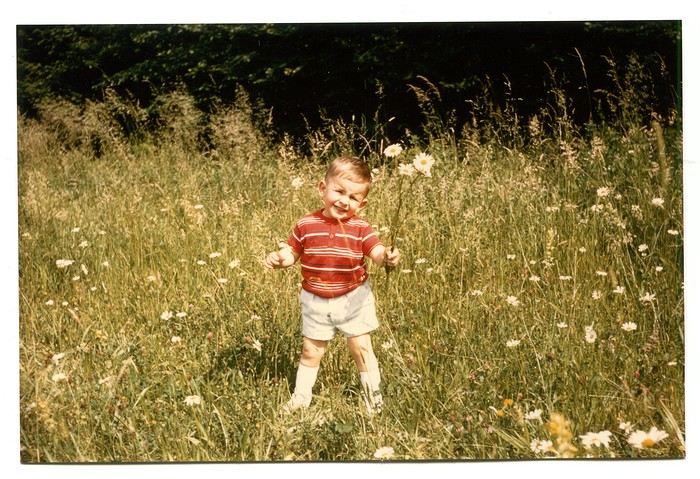
As I’ve mentioned elsewhere, I inherited my love of travel from my parents and some of my grandparents. A strong passion, but one that was unfortunately limited by our family’s modest resources. Back then, living in northern Alsace, a simple trip to the southern part of the region—with the Wine Route as our destination—felt like an extraordinary journey to a land of plenty for the little boy I was in the late 60s and early 70s.
Everything seemed so huge when you were still just a kid.
Back then, I was overwhelmed by countless sensations—I was already highly sensitive, with a keen mind and a nose and taste buds that were developing like a pro’s. Which, as I’d later realize, wasn’t always an advantage.
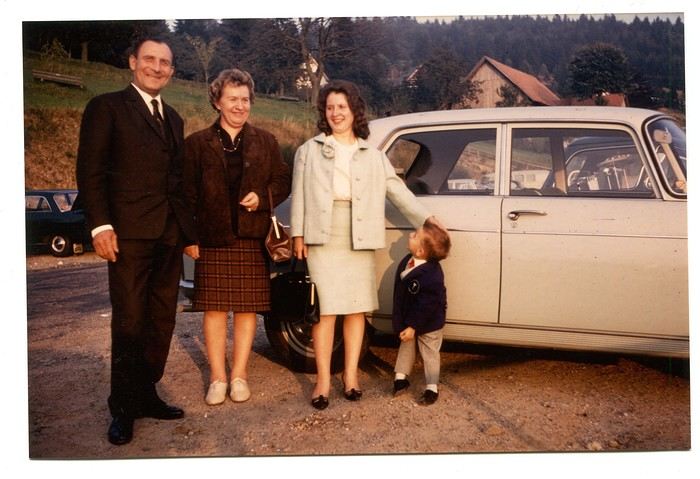
Those magical days always began with a gentle late-spring or midsummer morning. The interior of the white Peugeot 404, license plate 210 LZ 67, had already soaked up the sun before the engine purred to life, and the cabin gave off a scent I could still recognize today—a fragrance I found so pleasant. Back then, I had no idea it was just the smell of warm plastic from the car’s interior. Yes, the scents of the 404 on sunny days became my madeleine de Proust... What’s more, the whole family was unusually cheerful because those moments of relaxation and leisure were rare. Everyone worked, and no one had an easy job or was well paid. Without the *Trente Glorieuses*, these experiences might never have happened.
Once we crossed the canton’s borders, I felt like I was light-years away from my everyday surroundings, and every kilometer plunged me deeper into *terra incognita*. It was thrilling. Far from my so-called "medium-sized" town, wheat fields, cornfields, and cabbage patches stretched out, punctuated by tall poles connected by long wires and topped with vegetation—like giant clotheslines without laundry, where magical beanstalks might grow to touch the sky. Back then, I was still far from tasting their product, which was simply beer. At the time, there was still a significant local hop production. Fun fact: it wasn’t until 2002 that Anglo-Saxon scientists proved hops and cannabis belong to the same biological family.
After the fields, the landscape took another step up as it rolled past the little boy’s eyes, often glued to the windows. First came modest hills, then a succession of rolling slopes that soon formed an unbroken chain. Their 700 meters in altitude felt like Himalayan peaks to me—impressive, inert giants, a whole new world. Gazing at them, an intense emotion welled up somewhere between my stomach and lungs, nearly taking my breath away. What mysteries, what treasures did these heights hold? And then there were the cherries on top—the crowning touch that made the scene even more magical: proud, majestic castles perched on the summits like impassive sentinels. Monuments from the past, yet firmly rooted in the present on their rocky spurs. The little boy’s eyes sparkled—he’d been given a castle for Christmas, complete with battlements, towers, a drawbridge, and fully armed knights. He’d watched and lived *Ivanhoe* on the only French TV channel that existed back then.
Only once did my paternal grandfather join us on one of these trips. A tall, intelligent man with a face that could shift from stern to mischievous, clearly full of humor and charisma. Sadly, his relationship with alcohol had taken a toll on his life and, by extension, those of his loved ones. He had a strong personality—if his boss crossed the line, he wouldn’t hesitate to punch him, which meant he went through a lot of different jobs. Back then, you could quit one job and easily find another. It was quite something to see him in his final stages, hallucinating pink elephants and even drinking perfume when he had nothing else left. The last time I saw him, he’d slipped away from the doctors and nurses while hospitalized in pretty bad shape—at least, I assume his liver was the issue. We were sitting down for a family lunch when the door burst open, and there he stood in his pajamas, eyes twinkling with mischief, clearly pleased with the dramatic entrance. That theatrical moment didn’t spare us from burying him a few months later at the age of 71. One day, my mother told me the family doctor had quietly remarked that it was a shame—with his robust constitution, he could’ve lived to be a hundred. Yes, the family doctor—this was the man who’d come treat you any day, at almost any hour, just for a phone call. It really existed, it’s not a myth!
That day, his wife—my paternal grandmother—was also along for the ride. Everyone agreed that Jeannette was a good woman. She worked as a waitress at *Le Tigre*, the biggest brasserie in town, right in the center. Most customers preferred to be served by her, including local dignitaries and even the mayor. As a kid, I didn’t find her very fun, open, or warm—she seemed a bit stern. Back then, women in their fifties already had the face and build of grandmothers. Same went for men, don’t get me wrong. I had no idea about the struggles she faced because of her husband. I didn’t know that 30 years earlier, she’d had to flee Alsace while pregnant, under threat from Nazi fighter-bombers. I didn’t know she’d had several miscarriages, and that my father—her only surviving child, born prematurely in March 1940 at the other end of France—weighed less than a kilo at birth and was so tiny he could fit in a shoebox. Hard to imagine he’d grow into a strapping man nearly 1.80 meters tall, tipping the scales at 100 kilos. When you come back from summer camp in early August and ask why she didn’t pick you up with your parents, and they gently tell you she’s "in heaven," you don’t realize she passed away at 54 after suffering greatly from stomach cancer that had spread.
Back to that family outing, that enchanted parenthesis. I even remembered where we’d had lunch when I passed through Dambach-la-Ville decades later. One of those charming, flower-filled towns Alsace produces in abundance—and preserves so well. This one sits high on a hill, and I was a bit stunned on the parking lot because the view stretched far, revealing the Alsace plain below—its fields, villages, hills, and forests. The world seemed so vast and enticing that day, even though I was only glimpsing a tiny fraction of it.
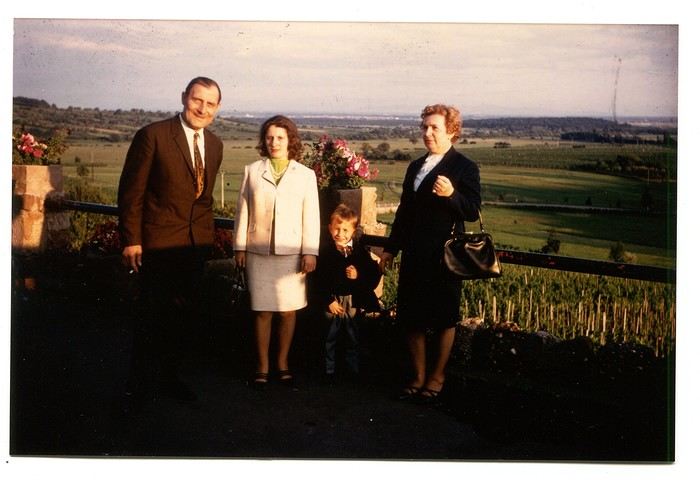
The region was already very touristy, but I wouldn’t notice the downsides until much later. That Sunday noon, I discovered a large restaurant filled with diners. I can still see the enormous piece of meat they served me, decorated with a little wooden skewer topped with a flag. I kept that one for a long time. Those were the golden days of rich, flowing, thick sauces—so flavorful—and the era of the world’s best fries, made on the spot with the best potatoes. To top it off, I was *exceptionally* allowed a small bottle of apple juice, Orangina, or—even better if possible—Sinalco. Yes, Sinalco—like Orangina, but better. A brand that must’ve disappeared in the 70s, but why, and what a shame! Since then, Orangina’s little bubbles have taken the brand to the other side of the planet—it’s now Japanese.
Year after year, I’d eagerly await that ecstatic moment when the most beautiful castle in Alsace, the Haut-Koenigsbourg, appeared in my field of vision. The perfect model, the archetype that blended into the landscape at the height of a child’s dreams. The trip home always felt like a reality check—less jarring than an alarm clock, but more diffuse and melancholic. From then on, there was only one wish: *When do we leave again?*
Those magical days always began with a gentle late-spring or midsummer morning. The interior of the white Peugeot 404, license plate 210 LZ 67, had already soaked up the sun before the engine purred to life, and the cabin gave off a scent I could still recognize today—a fragrance I found so pleasant. Back then, I had no idea it was just the smell of warm plastic from the car’s interior. Yes, the scents of the 404 on sunny days became my madeleine de Proust... What’s more, the whole family was unusually cheerful because those moments of relaxation and leisure were rare. Everyone worked, and no one had an easy job or was well paid. Without the *Trente Glorieuses*, these experiences might never have happened.
Once we crossed the canton’s borders, I felt like I was light-years away from my everyday surroundings, and every kilometer plunged me deeper into *terra incognita*. It was thrilling. Far from my so-called "medium-sized" town, wheat fields, cornfields, and cabbage patches stretched out, punctuated by tall poles connected by long wires and topped with vegetation—like giant clotheslines without laundry, where magical beanstalks might grow to touch the sky. Back then, I was still far from tasting their product, which was simply beer. At the time, there was still a significant local hop production. Fun fact: it wasn’t until 2002 that Anglo-Saxon scientists proved hops and cannabis belong to the same biological family.
After the fields, the landscape took another step up as it rolled past the little boy’s eyes, often glued to the windows. First came modest hills, then a succession of rolling slopes that soon formed an unbroken chain. Their 700 meters in altitude felt like Himalayan peaks to me—impressive, inert giants, a whole new world. Gazing at them, an intense emotion welled up somewhere between my stomach and lungs, nearly taking my breath away. What mysteries, what treasures did these heights hold? And then there were the cherries on top—the crowning touch that made the scene even more magical: proud, majestic castles perched on the summits like impassive sentinels. Monuments from the past, yet firmly rooted in the present on their rocky spurs. The little boy’s eyes sparkled—he’d been given a castle for Christmas, complete with battlements, towers, a drawbridge, and fully armed knights. He’d watched and lived *Ivanhoe* on the only French TV channel that existed back then.
Only once did my paternal grandfather join us on one of these trips. A tall, intelligent man with a face that could shift from stern to mischievous, clearly full of humor and charisma. Sadly, his relationship with alcohol had taken a toll on his life and, by extension, those of his loved ones. He had a strong personality—if his boss crossed the line, he wouldn’t hesitate to punch him, which meant he went through a lot of different jobs. Back then, you could quit one job and easily find another. It was quite something to see him in his final stages, hallucinating pink elephants and even drinking perfume when he had nothing else left. The last time I saw him, he’d slipped away from the doctors and nurses while hospitalized in pretty bad shape—at least, I assume his liver was the issue. We were sitting down for a family lunch when the door burst open, and there he stood in his pajamas, eyes twinkling with mischief, clearly pleased with the dramatic entrance. That theatrical moment didn’t spare us from burying him a few months later at the age of 71. One day, my mother told me the family doctor had quietly remarked that it was a shame—with his robust constitution, he could’ve lived to be a hundred. Yes, the family doctor—this was the man who’d come treat you any day, at almost any hour, just for a phone call. It really existed, it’s not a myth!
That day, his wife—my paternal grandmother—was also along for the ride. Everyone agreed that Jeannette was a good woman. She worked as a waitress at *Le Tigre*, the biggest brasserie in town, right in the center. Most customers preferred to be served by her, including local dignitaries and even the mayor. As a kid, I didn’t find her very fun, open, or warm—she seemed a bit stern. Back then, women in their fifties already had the face and build of grandmothers. Same went for men, don’t get me wrong. I had no idea about the struggles she faced because of her husband. I didn’t know that 30 years earlier, she’d had to flee Alsace while pregnant, under threat from Nazi fighter-bombers. I didn’t know she’d had several miscarriages, and that my father—her only surviving child, born prematurely in March 1940 at the other end of France—weighed less than a kilo at birth and was so tiny he could fit in a shoebox. Hard to imagine he’d grow into a strapping man nearly 1.80 meters tall, tipping the scales at 100 kilos. When you come back from summer camp in early August and ask why she didn’t pick you up with your parents, and they gently tell you she’s "in heaven," you don’t realize she passed away at 54 after suffering greatly from stomach cancer that had spread.
Back to that family outing, that enchanted parenthesis. I even remembered where we’d had lunch when I passed through Dambach-la-Ville decades later. One of those charming, flower-filled towns Alsace produces in abundance—and preserves so well. This one sits high on a hill, and I was a bit stunned on the parking lot because the view stretched far, revealing the Alsace plain below—its fields, villages, hills, and forests. The world seemed so vast and enticing that day, even though I was only glimpsing a tiny fraction of it.
The region was already very touristy, but I wouldn’t notice the downsides until much later. That Sunday noon, I discovered a large restaurant filled with diners. I can still see the enormous piece of meat they served me, decorated with a little wooden skewer topped with a flag. I kept that one for a long time. Those were the golden days of rich, flowing, thick sauces—so flavorful—and the era of the world’s best fries, made on the spot with the best potatoes. To top it off, I was *exceptionally* allowed a small bottle of apple juice, Orangina, or—even better if possible—Sinalco. Yes, Sinalco—like Orangina, but better. A brand that must’ve disappeared in the 70s, but why, and what a shame! Since then, Orangina’s little bubbles have taken the brand to the other side of the planet—it’s now Japanese.
Year after year, I’d eagerly await that ecstatic moment when the most beautiful castle in Alsace, the Haut-Koenigsbourg, appeared in my field of vision. The perfect model, the archetype that blended into the landscape at the height of a child’s dreams. The trip home always felt like a reality check—less jarring than an alarm clock, but more diffuse and melancholic. From then on, there was only one wish: *When do we leave again?*
Road conditions between San Pedro de Atacama and Salta, Argentina
Hi,
we’re planning a round trip from San Pedro de Atacama, Chile, to Salta, Argentina, in two months. On the way there, we’ll take the northern route via Susques, Route 27, then 52. But for the return, we were thinking of taking the southern route via San Antonio de los Cobres, Route 51, then 23. Is it similar to the northern route in terms of road surface? How busy is it, and are there gas stations? Basically, should we be worried about doing it in an SUV that’s supposedly 4x4 but has regular road tires and no second spare wheel, obviously...
I’ve seen that we can stop over in San Antonio de los Cobres.
Thanks for your feedback.
Raf.
Discussion: Waterways Around the World - January 2026 Photo Contest
To chat about waterways, this is the place.
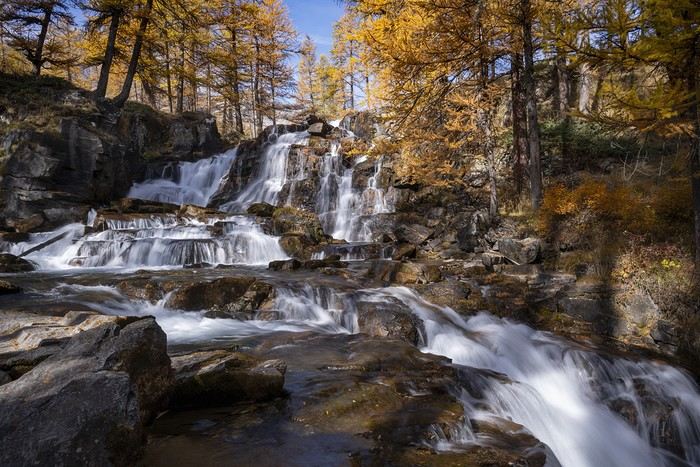
Waterways Around the World: January 2026 Photo Contest
The first theme of 2026 is:
"Waterways Around the World".
Water is present almost everywhere on our blue planet, so I’ve narrowed the theme down to waterways—rivers, streams, brooks, and the like.
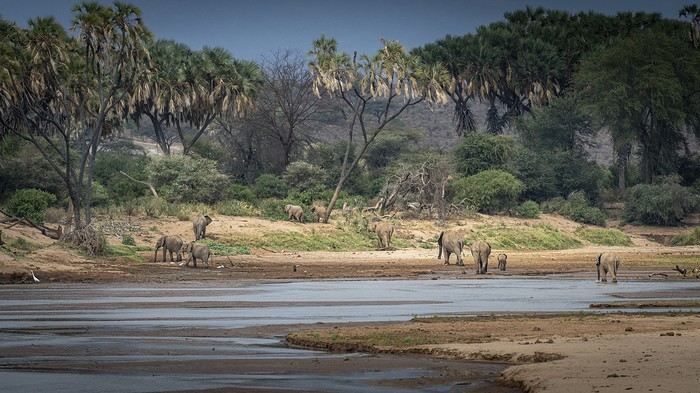
Seas, oceans, lakes, or other stagnant waters won’t be considered for this month’s theme 😅. However, waterfalls and cascades are very welcome 😊!
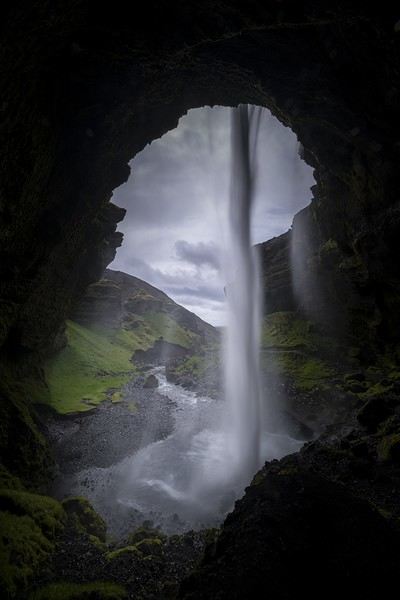
Practical details:
**Participation** Each VF member can submit up to 3 photos, until Sunday, January 25th at 11:59 PM Paris time. Each photo must be posted in a separate message, with its number (1, 2, or 3). Don’t forget to add a little explanation (commentary, location, etc.).
**Voting** Each VF member can vote for the 3 photos they consider the best, based on their own criteria and the theme.
Voting will take place from Monday, January 26th to Saturday, January 31st at 11:59 PM Paris time.
Photos should be ranked in order of preference: - 1st photo: 3 points - 2nd photo: 2 points - 3rd photo: 1 point
The winner is the photographer whose photo receives the most points.
Results will be published on February 1st. In case of a tie, the number of first-place votes will decide. The winner will have the honor of organizing February 2026’s contest.
Photos that have already been nominated (1st, 2nd, or 3rd place) in another contest are not eligible to participate in this one.
This thread is exclusively for contest photo submissions. All discussions, comments, and chit-chat should take place in the thread: here
Water is present almost everywhere on our blue planet, so I’ve narrowed the theme down to waterways—rivers, streams, brooks, and the like.
Seas, oceans, lakes, or other stagnant waters won’t be considered for this month’s theme 😅. However, waterfalls and cascades are very welcome 😊!
Practical details:
**Participation** Each VF member can submit up to 3 photos, until Sunday, January 25th at 11:59 PM Paris time. Each photo must be posted in a separate message, with its number (1, 2, or 3). Don’t forget to add a little explanation (commentary, location, etc.).
**Voting** Each VF member can vote for the 3 photos they consider the best, based on their own criteria and the theme.
Voting will take place from Monday, January 26th to Saturday, January 31st at 11:59 PM Paris time.
Photos should be ranked in order of preference: - 1st photo: 3 points - 2nd photo: 2 points - 3rd photo: 1 point
The winner is the photographer whose photo receives the most points.
Results will be published on February 1st. In case of a tie, the number of first-place votes will decide. The winner will have the honor of organizing February 2026’s contest.
Photos that have already been nominated (1st, 2nd, or 3rd place) in another contest are not eligible to participate in this one.
This thread is exclusively for contest photo submissions. All discussions, comments, and chit-chat should take place in the thread: here
Comoros again: trip report
Well, I still feel a bit lonely about this destination—no requests for info, no travel journals, or trip reports since I last posted over a year ago. A little disheartening.
That said, I did cross paths with slightly more tourists this time. Not a ton, but enough to notice compared to my last stay. Beyond that, not much has changed—the people are just as lovely, and every interaction, whether at the market, in the medinas, in town, or in the countryside, was positive. It was so pleasant; my "alert meter" stayed at zero the whole time (which is pretty different from some other places I visit now and then). The roads outside the cities remain dangerous, and the accident rate seems high. Best to drive during the day and take it easy (on some rough stretches, you don’t really have a choice anyway). The scattered plastic and metal waste hasn’t magically disappeared, and it’s still pretty discouraging to see the most beautiful beaches surrounded by empty bottles, straws, diapers, and rusted carcasses of an old Xantia or a skeletal Espace. When it’s not on the beach itself (since those are cleaned), it’s just a few meters away. Usually, there’s not much in the water or close to shore—the seabeds are gorgeous, with coral and a wide variety of scaly friends... But stepping back onto the hardened lava, you dodge a chip bag or a shriveled battery. Such a paradox. Honestly, it’s like this almost everywhere except on hotel beaches or those far from human settlements. But otherwise, in places like Chomoni, Bouni, Itsandra, Moya, and Domoni (on Anjouan), Nioumachoua (on Mohéli, and even on the nearby islets), it’s hard to ignore. And it unfortunately tarnishes the beauty of these otherwise stunning spots.
That said, you can still find secluded micro-bays, protected and remote, where this isn’t an issue. And where there are hotels—like in Petite Itsandra in Moroni, in front of Laka Lodge in Nioumachoua, Trou du Prophète, or even Chomoni (though the surrounding areas are so littered...)—the beaches are cleaned, so...
So why go? Why still love it despite all this? Well, first, the Comorians themselves—that’s already essential and probably the main reason. Then there’s the breathtaking topography: the imposing Karthala, the dizzying peaks and cliffs of Anjouan, vast ravines, a tortured geology covered in lush nature, and Mohéli, much more serene and gentle, blanketed in spice plants and trees with names that make you dream, like an open-air spice market. The flora across the islands—the fields, trees, scents: clove trees, cinnamon trees, lychee, mango, cardamom, nutmeg, vanilla, coconut palms, banana trees, coffee plants, cocoa... A profusion of green dotted with red, white, and yellow berries and flowers... The seabeds are stunning in many places, and there are some beautiful beaches/oceanfront spots, especially near Trou du Prophète (but not only there). The history and culture—between traditional festivals, but especially the medinas with their staircases, covered passages, palaces, and mosques that create Escher-like constructions. I love wandering through them for hours, stumbling upon an unlikely shop, a more or less philosophical saying like "pain is a warning," "a promise is a debt," or the less original "little by little, the bird makes its nest." A grocery store, women negotiating freshly caught fish (usually tuna, immediately cut and ready to sell), kids playing, old men playing checkers, a call to prayer... In Moroni, Mutsamudu, and Domoni, I spent most of my "urban" time.
If anyone’s interested—though given the hype about Comoros on the forum, I doubt it—but if you need info on accommodation across the three islands, some restaurants, or sites to visit, don’t hesitate to ask.
This message is another message in a bottle (one more, if I dare...) for the Comoros destination.
That said, I did cross paths with slightly more tourists this time. Not a ton, but enough to notice compared to my last stay. Beyond that, not much has changed—the people are just as lovely, and every interaction, whether at the market, in the medinas, in town, or in the countryside, was positive. It was so pleasant; my "alert meter" stayed at zero the whole time (which is pretty different from some other places I visit now and then). The roads outside the cities remain dangerous, and the accident rate seems high. Best to drive during the day and take it easy (on some rough stretches, you don’t really have a choice anyway). The scattered plastic and metal waste hasn’t magically disappeared, and it’s still pretty discouraging to see the most beautiful beaches surrounded by empty bottles, straws, diapers, and rusted carcasses of an old Xantia or a skeletal Espace. When it’s not on the beach itself (since those are cleaned), it’s just a few meters away. Usually, there’s not much in the water or close to shore—the seabeds are gorgeous, with coral and a wide variety of scaly friends... But stepping back onto the hardened lava, you dodge a chip bag or a shriveled battery. Such a paradox. Honestly, it’s like this almost everywhere except on hotel beaches or those far from human settlements. But otherwise, in places like Chomoni, Bouni, Itsandra, Moya, and Domoni (on Anjouan), Nioumachoua (on Mohéli, and even on the nearby islets), it’s hard to ignore. And it unfortunately tarnishes the beauty of these otherwise stunning spots.
That said, you can still find secluded micro-bays, protected and remote, where this isn’t an issue. And where there are hotels—like in Petite Itsandra in Moroni, in front of Laka Lodge in Nioumachoua, Trou du Prophète, or even Chomoni (though the surrounding areas are so littered...)—the beaches are cleaned, so...
So why go? Why still love it despite all this? Well, first, the Comorians themselves—that’s already essential and probably the main reason. Then there’s the breathtaking topography: the imposing Karthala, the dizzying peaks and cliffs of Anjouan, vast ravines, a tortured geology covered in lush nature, and Mohéli, much more serene and gentle, blanketed in spice plants and trees with names that make you dream, like an open-air spice market. The flora across the islands—the fields, trees, scents: clove trees, cinnamon trees, lychee, mango, cardamom, nutmeg, vanilla, coconut palms, banana trees, coffee plants, cocoa... A profusion of green dotted with red, white, and yellow berries and flowers... The seabeds are stunning in many places, and there are some beautiful beaches/oceanfront spots, especially near Trou du Prophète (but not only there). The history and culture—between traditional festivals, but especially the medinas with their staircases, covered passages, palaces, and mosques that create Escher-like constructions. I love wandering through them for hours, stumbling upon an unlikely shop, a more or less philosophical saying like "pain is a warning," "a promise is a debt," or the less original "little by little, the bird makes its nest." A grocery store, women negotiating freshly caught fish (usually tuna, immediately cut and ready to sell), kids playing, old men playing checkers, a call to prayer... In Moroni, Mutsamudu, and Domoni, I spent most of my "urban" time.
If anyone’s interested—though given the hype about Comoros on the forum, I doubt it—but if you need info on accommodation across the three islands, some restaurants, or sites to visit, don’t hesitate to ask.
This message is another message in a bottle (one more, if I dare...) for the Comoros destination.
Transport, accommodation, and great spots for a month in Cambodia
Hello!
We’re heading to Cambodia for a month in March. We’re planning to visit Phnom Penh, Battambang, Siem Reap, the Angkor temples, Kompong Luong, then head down to Kampot, Kep, and finish our trip on the islands of Koh Rong. Has anyone done this trip recently?
Any great spots to recommend? Neighborhoods to stay in Phnom Penh (lively but not too touristy)?
Tips for getting around between the major cities—bus, train, boat, motorbike?
Thanks for all the advice!
Fabienne
Tips and addresses for backpackers traveling from Tanzania to South Africa
Since Voyage Forum is restarting after a few years of hiatus, I couldn’t find any recent info about my trip between late November 2024 and January 20, 2025, going from DAR ES SALAAM to the Cape Town area via ZAMBIA and BOTSWANA.
I’m really happy the site is back up, but I’ve noticed more and more people planning their trips down to the day, mentioning what they’ve scheduled and asking for technical advice for their 4x4 routes.
That’s not how I travel at all—I prefer to leave a lot to the unexpected, like public transport (and the weather) and the people you meet along the way.
The tips I’m sharing below come from the current situation, the randomness that makes unplanned trips special, and the strong connections you can make when you take your time without knowing what tomorrow will bring.
😏 TANZANIA: I had booked a TAZARA train ticket via WhatsApp before leaving to go from DAR ES SALAAM to MBEYA near the Zambian border. I’d contacted the station manager in Dar at +255 713 413 141, who kindly confirmed my reservation. Unfortunately, the train was out of service for an indefinite period, so I had to take the bus from the new Mwenge bus station on the city’s outskirts (allow extra time to get there—traffic is heavy). There’s no longer a direct train to ZAMBIA. You have to get off at MBEYA, then take a bus to the TUNDUMA border (2 hours to the bus station, then a 2 km taxi ride to the border). Crossing is easy—visa is free, no no-man’s-land, and you arrive directly in NAKONDE, Zambia. Exchange money on the Zambian side, but don’t change with the first person you see—check the rate first. I preferred to stop for the night in IRINGA since I took the bus at 4 PM. I arrived at 2 AM at Georges’ place, who picked me up directly from the bus station (several km from town). I’d booked the accommodation via Booking under Travellers Backpackers and Free City Tours. Georges and his employee were extremely helpful—they organized my bus trip to MBEYA the next day (bought the ticket and dropped me off, no commission). The place is decent, clean, and comfortable (10 € per night). Georges also organizes tours and safaris in the area (+255 679 529 700 direct). In MBEYA, I stayed at Karibuni Center Hotel (a quiet evangelical convent, very friendly and open to everyone, 13 € per night with breakfast). You can eat at a restaurant across the street. The rooms are clean and quiet (contact +255 754 510 174). To head to Lake MALAWI or the tea fields in TUKUYU, it’s best to take a moto-taxi from MBEYA to the Uyole junction. From there, you’ll find minibuses heading south frequently—change buses in TUKUYU (the tea fields are 4-5 km away).
😏 ZAMBIA: In NAKONDE, I highly recommend Izukanji Lodge—very quiet and clean, 2 km from the station (take a moto-taxi). The main building’s rooms are pricier than the annex across the street (where the restaurant and pool are). The rooms are just as clean and quiet but only 10 €, breakfast included. Contact the manager directly on WhatsApp at +260 979 649 452. If it’s full, try Divine Guest House (+260 973 127 816). The train isn’t always on time—if you catch it on the scheduled day, consider yourself lucky. The stationmaster, Mr. Chulu, is lovely. Contact him on WhatsApp at +260 777 550 302 for real-time updates. First-class berths are great (4 per compartment), 15 € one-way to KAPIRI MPOSHI. There always seems to be space. Book two berths if you want extra comfort. No need to bring food—the dining car serves decent meals, and there’s a bar. In KAPIRI MPOSHI, I stayed at Kapiri Council Lodge, 2 km from the train station. It’s okay, but there are often power outages in the evening, which means no water either. You’ll have to wait until 8 PM. Breakfast is very basic. For LUSAKA, there are plenty of buses in the morning from the downtown bus station (2-3 hours). The best companies are Power Tools (yellow buses) or UBZ if you can find it (the best in Zambia—Western comfort). In LUSAKA, use Yango taxis (download the app—it’s like Uber in Zambia, very affordable). I stayed at Natwange (Hostelworld chain), reachable at +260 966 303 816. It’s a beautiful, quiet place 3-4 km from downtown, very shady, with a pool. The rooms are clean and comfortable, and the food is excellent (great salads). The staff is super friendly, as they are everywhere in the country. There’s also a mini-supermarket nearby with everything, including takeout meals. Book your bus ticket to LIVINGSTONE at least the day before (UBZ). The trip is pleasant. In LIVINGSTONE, many backpackers stay at Jolly Boys—it’s a nice place to relax by the pool with a beer at the end of the day, but it’s mostly a party hostel for young people doing rafting or canyoning on the Zambezi (pricier than elsewhere). For those who prefer peace and quiet, I highly recommend Likute Guest House on the same street, right near Jolly Boys. The rooms are decent for 10 €, breakfast included (same price as a dorm at JB). You can order dinner in advance. The staff is friendly. Great value at Da Canton restaurant on the main road (pizza, pasta, meat, salads, etc.). The Livingstone Museum is worth a visit if you have time. At the bottom of Kapondo Street, you can take a shared taxi to Victoria Falls or even to KAZUNGULA at the Botswana border (cheap—the taxi leaves when full). People short on time often compare the views of Victoria Falls from the Zambian side (20 $) and the Zimbabwean side (30 $). Honestly, they’re very different, and it’s worth seeing the falls from Zimbabwe even if it’s pricier (visa required, easy to get at the border—everything is done on foot). Cross the bridge where you can bungee jump. Take your time at the falls—it’s truly stunning. You can visit Zimbabwe for half a day and stay in Zambia (cheaper, since everything in Zimbabwe is paid in dollars). There’s more water on the Zimbabwean side, but the Zambian side is beautiful too.
😏 BOTSWANA: Crossing the border at KAZUNGULA from Zambia is quick and easy (brand-new bridge over the Zambezi). Visa is free. Don’t exchange money at the border. There’s a shopping center 1 km away (Choppies store) with an ATM (no commission). I hitched a ride with tourists to the bank since they had a car. In the shopping center parking lot, you can easily find a shared taxi to KASANE. In the area, you can get around easily by shared taxi (just give the name of your guesthouse, and the drivers will tell you which vehicle to take). The fare is fixed (0.50 €). I stayed at Elephant Trail GH and Backpackers—a great spot where you can stay in a 4-bed dorm for 10 €. There are also huts for two in the garden (clean and comfortable) with a pool. You can order dinner (great food) or cook your own meals. The place is quiet and friendly (they organize safaris with early-morning pickups for Chobe and evening boat trips in the Kwando marshes to see animals). I preferred flying (Air Botswana) with a friend to MAUN (55 €) instead of taking an 8-10 hour bus (tickets can be bought directly at the airport). In MAUN, I stayed at Jayla Homestay with Mapula (+267 71 658 737)—a wonderful, kind woman always ready to help. The homestay is in a beautiful family home 3-4 km from downtown, past the Kwanokeng gas station. It’s easy to get there by shared taxi from the downtown taxi stand near Shoprite. Mapula cooks refined, varied meals on request. She also organizes safaris in the OKAVANGO with morning pickups from the guesthouse (picnic included) at a great price. Her rooms are comfortable and very clean (microwave, coffee/tea, and kettle available). The day trip by canoe in the OKAVANGO marshes is a must. However, we saw very few animals because the rainy season had started (zebras, giraffes, buffaloes, hippos). The atmosphere, serenity, and changing light throughout the day were remarkable. Direct flight from MAUN to CAPE TOWN with Airlink for 280 € on December 24.
😏 SOUTH AFRICA: In Cape Town, I stayed at Sunflower Stop Backpackers in the Green Point neighborhood—very quiet and safe. This hostel is perfect for meeting travelers of all ages. Everything is nearby (supermarkets, bars, restaurants, the sea, the park, tourist areas, the stadium, Sea Point, and the Waterfront). I spent 13 days in Cape Town and always found something to do—this city is so pleasant to live in, welcoming, and packed with sports and cultural activities. Don’t miss the Minstrel Carnival in early January if you’re in the area. Kalk Bay beach (with its colorful beach huts) is worth the detour on the way to SIMON’S TOWN and Boulders Beach. Stop for lunch at Salt in FISH HOEK—the homemade ravioli and fish are amazing. Everything is excellent there. At Boulders Beach, when you arrive at the main beach after the entrance gate, don’t hesitate to wade into the water up to your waist if the tide is high and head straight past the northern end of the beach—the penguins are farther out. Beautiful beach and sunset at Scarborough Beach. I took the 8-day Bazbus pass (134 €) for the Garden Route and stopped in STELLENBOSCH on the last day of my loop back to Cape Town. This lets you extend the trip to 10 days if you stay 2 nights in STELLENBOSCH, since it’s easy and cheap to get back to Cape Town with an Uber. I really liked this Bazbus option—it’s convenient because they drop you off and pick you up directly at your chosen hostel or hotel. I loved HERMANUS, even though I didn’t see any whales. The atmosphere is very British and classy. The coastline is beautiful and rugged. Don’t miss the walk to Mosselberg, which overlooks the entire bay. MOSSEL BAY is more working-class and run-down—nothing particularly interesting, in my opinion. In WILDERNESS, try to stay at Beach House Backpackers Lodge. The sea view is stunning, even from the dorm. In KNYSNA, Thesen Island is overrated—it’s full of soulless new buildings. Prefer Leisure Island, which is just as busy with wealthy owners but nice for walks and swimming. Head to The Heads to wander the coastal trails with incredible views of the bay. Don’t hesitate to explore the heart of the artistic Concordia neighborhood (Rastafarian) to Judah Square on your own. The locals are warm and laid-back. No need to go through a tour operator. Anchorage restaurant is excellent for refined dishes and a great variety of food. In STELLENBOSCH, I stayed at Just a Bed (booked for one person on Booking). Don’t hesitate to contact the owner—she has several rooms in her guesthouse. The place is cozy and charming. The town is pleasant but feels disconnected from the surrounding population. You can walk to the Lanzerac vineyard, but don’t miss Boschendal a few kilometers away on the way to FRANSCHHOEK. People talk a lot about safety in South Africa, but as long as you respect the local norms, everything goes smoothly—the people are really welcoming, no matter their social background.
😏 TANZANIA: I had booked a TAZARA train ticket via WhatsApp before leaving to go from DAR ES SALAAM to MBEYA near the Zambian border. I’d contacted the station manager in Dar at +255 713 413 141, who kindly confirmed my reservation. Unfortunately, the train was out of service for an indefinite period, so I had to take the bus from the new Mwenge bus station on the city’s outskirts (allow extra time to get there—traffic is heavy). There’s no longer a direct train to ZAMBIA. You have to get off at MBEYA, then take a bus to the TUNDUMA border (2 hours to the bus station, then a 2 km taxi ride to the border). Crossing is easy—visa is free, no no-man’s-land, and you arrive directly in NAKONDE, Zambia. Exchange money on the Zambian side, but don’t change with the first person you see—check the rate first. I preferred to stop for the night in IRINGA since I took the bus at 4 PM. I arrived at 2 AM at Georges’ place, who picked me up directly from the bus station (several km from town). I’d booked the accommodation via Booking under Travellers Backpackers and Free City Tours. Georges and his employee were extremely helpful—they organized my bus trip to MBEYA the next day (bought the ticket and dropped me off, no commission). The place is decent, clean, and comfortable (10 € per night). Georges also organizes tours and safaris in the area (+255 679 529 700 direct). In MBEYA, I stayed at Karibuni Center Hotel (a quiet evangelical convent, very friendly and open to everyone, 13 € per night with breakfast). You can eat at a restaurant across the street. The rooms are clean and quiet (contact +255 754 510 174). To head to Lake MALAWI or the tea fields in TUKUYU, it’s best to take a moto-taxi from MBEYA to the Uyole junction. From there, you’ll find minibuses heading south frequently—change buses in TUKUYU (the tea fields are 4-5 km away).
😏 ZAMBIA: In NAKONDE, I highly recommend Izukanji Lodge—very quiet and clean, 2 km from the station (take a moto-taxi). The main building’s rooms are pricier than the annex across the street (where the restaurant and pool are). The rooms are just as clean and quiet but only 10 €, breakfast included. Contact the manager directly on WhatsApp at +260 979 649 452. If it’s full, try Divine Guest House (+260 973 127 816). The train isn’t always on time—if you catch it on the scheduled day, consider yourself lucky. The stationmaster, Mr. Chulu, is lovely. Contact him on WhatsApp at +260 777 550 302 for real-time updates. First-class berths are great (4 per compartment), 15 € one-way to KAPIRI MPOSHI. There always seems to be space. Book two berths if you want extra comfort. No need to bring food—the dining car serves decent meals, and there’s a bar. In KAPIRI MPOSHI, I stayed at Kapiri Council Lodge, 2 km from the train station. It’s okay, but there are often power outages in the evening, which means no water either. You’ll have to wait until 8 PM. Breakfast is very basic. For LUSAKA, there are plenty of buses in the morning from the downtown bus station (2-3 hours). The best companies are Power Tools (yellow buses) or UBZ if you can find it (the best in Zambia—Western comfort). In LUSAKA, use Yango taxis (download the app—it’s like Uber in Zambia, very affordable). I stayed at Natwange (Hostelworld chain), reachable at +260 966 303 816. It’s a beautiful, quiet place 3-4 km from downtown, very shady, with a pool. The rooms are clean and comfortable, and the food is excellent (great salads). The staff is super friendly, as they are everywhere in the country. There’s also a mini-supermarket nearby with everything, including takeout meals. Book your bus ticket to LIVINGSTONE at least the day before (UBZ). The trip is pleasant. In LIVINGSTONE, many backpackers stay at Jolly Boys—it’s a nice place to relax by the pool with a beer at the end of the day, but it’s mostly a party hostel for young people doing rafting or canyoning on the Zambezi (pricier than elsewhere). For those who prefer peace and quiet, I highly recommend Likute Guest House on the same street, right near Jolly Boys. The rooms are decent for 10 €, breakfast included (same price as a dorm at JB). You can order dinner in advance. The staff is friendly. Great value at Da Canton restaurant on the main road (pizza, pasta, meat, salads, etc.). The Livingstone Museum is worth a visit if you have time. At the bottom of Kapondo Street, you can take a shared taxi to Victoria Falls or even to KAZUNGULA at the Botswana border (cheap—the taxi leaves when full). People short on time often compare the views of Victoria Falls from the Zambian side (20 $) and the Zimbabwean side (30 $). Honestly, they’re very different, and it’s worth seeing the falls from Zimbabwe even if it’s pricier (visa required, easy to get at the border—everything is done on foot). Cross the bridge where you can bungee jump. Take your time at the falls—it’s truly stunning. You can visit Zimbabwe for half a day and stay in Zambia (cheaper, since everything in Zimbabwe is paid in dollars). There’s more water on the Zimbabwean side, but the Zambian side is beautiful too.
😏 BOTSWANA: Crossing the border at KAZUNGULA from Zambia is quick and easy (brand-new bridge over the Zambezi). Visa is free. Don’t exchange money at the border. There’s a shopping center 1 km away (Choppies store) with an ATM (no commission). I hitched a ride with tourists to the bank since they had a car. In the shopping center parking lot, you can easily find a shared taxi to KASANE. In the area, you can get around easily by shared taxi (just give the name of your guesthouse, and the drivers will tell you which vehicle to take). The fare is fixed (0.50 €). I stayed at Elephant Trail GH and Backpackers—a great spot where you can stay in a 4-bed dorm for 10 €. There are also huts for two in the garden (clean and comfortable) with a pool. You can order dinner (great food) or cook your own meals. The place is quiet and friendly (they organize safaris with early-morning pickups for Chobe and evening boat trips in the Kwando marshes to see animals). I preferred flying (Air Botswana) with a friend to MAUN (55 €) instead of taking an 8-10 hour bus (tickets can be bought directly at the airport). In MAUN, I stayed at Jayla Homestay with Mapula (+267 71 658 737)—a wonderful, kind woman always ready to help. The homestay is in a beautiful family home 3-4 km from downtown, past the Kwanokeng gas station. It’s easy to get there by shared taxi from the downtown taxi stand near Shoprite. Mapula cooks refined, varied meals on request. She also organizes safaris in the OKAVANGO with morning pickups from the guesthouse (picnic included) at a great price. Her rooms are comfortable and very clean (microwave, coffee/tea, and kettle available). The day trip by canoe in the OKAVANGO marshes is a must. However, we saw very few animals because the rainy season had started (zebras, giraffes, buffaloes, hippos). The atmosphere, serenity, and changing light throughout the day were remarkable. Direct flight from MAUN to CAPE TOWN with Airlink for 280 € on December 24.
😏 SOUTH AFRICA: In Cape Town, I stayed at Sunflower Stop Backpackers in the Green Point neighborhood—very quiet and safe. This hostel is perfect for meeting travelers of all ages. Everything is nearby (supermarkets, bars, restaurants, the sea, the park, tourist areas, the stadium, Sea Point, and the Waterfront). I spent 13 days in Cape Town and always found something to do—this city is so pleasant to live in, welcoming, and packed with sports and cultural activities. Don’t miss the Minstrel Carnival in early January if you’re in the area. Kalk Bay beach (with its colorful beach huts) is worth the detour on the way to SIMON’S TOWN and Boulders Beach. Stop for lunch at Salt in FISH HOEK—the homemade ravioli and fish are amazing. Everything is excellent there. At Boulders Beach, when you arrive at the main beach after the entrance gate, don’t hesitate to wade into the water up to your waist if the tide is high and head straight past the northern end of the beach—the penguins are farther out. Beautiful beach and sunset at Scarborough Beach. I took the 8-day Bazbus pass (134 €) for the Garden Route and stopped in STELLENBOSCH on the last day of my loop back to Cape Town. This lets you extend the trip to 10 days if you stay 2 nights in STELLENBOSCH, since it’s easy and cheap to get back to Cape Town with an Uber. I really liked this Bazbus option—it’s convenient because they drop you off and pick you up directly at your chosen hostel or hotel. I loved HERMANUS, even though I didn’t see any whales. The atmosphere is very British and classy. The coastline is beautiful and rugged. Don’t miss the walk to Mosselberg, which overlooks the entire bay. MOSSEL BAY is more working-class and run-down—nothing particularly interesting, in my opinion. In WILDERNESS, try to stay at Beach House Backpackers Lodge. The sea view is stunning, even from the dorm. In KNYSNA, Thesen Island is overrated—it’s full of soulless new buildings. Prefer Leisure Island, which is just as busy with wealthy owners but nice for walks and swimming. Head to The Heads to wander the coastal trails with incredible views of the bay. Don’t hesitate to explore the heart of the artistic Concordia neighborhood (Rastafarian) to Judah Square on your own. The locals are warm and laid-back. No need to go through a tour operator. Anchorage restaurant is excellent for refined dishes and a great variety of food. In STELLENBOSCH, I stayed at Just a Bed (booked for one person on Booking). Don’t hesitate to contact the owner—she has several rooms in her guesthouse. The place is cozy and charming. The town is pleasant but feels disconnected from the surrounding population. You can walk to the Lanzerac vineyard, but don’t miss Boschendal a few kilometers away on the way to FRANSCHHOEK. People talk a lot about safety in South Africa, but as long as you respect the local norms, everything goes smoothly—the people are really welcoming, no matter their social background.
Info for 2-day treks in Mondulkiri and Ratanakiri
Hi there,
Could anyone give me some tips on 2-day treks in these areas? We're heading there in November...
Thanks so much!
Self-organized stopovers in the Canary Islands and Madeira
Hi there! We’d love some tips on organizing stopovers on our own in Santa Cruz de Tenerife, Arrecife, Puerto del Rosario, Santa Cruz de La Palma, Las Palmas, and Funchal. Thanks so much for your help
Accommodation with parking in a good neighborhood in Saga and Northern Kyushu itinerary
Hello everyone, dear community members,
After several trips to Tokyo and the surrounding areas, as well as Osaka Bay, we’re heading to Northern Kyushu for a week in mid-October (we’ll be in China the other week). We’re a couple with two kids, aged 7 and 9. We’ll arrive at Saga Airport and plan to stay there for a few days to explore Arita, Imari, Karatsu, Hirado, and Dazaifu. We’re thinking Saga isn’t too touristy, so it might be a good choice to find accommodation for 3 or 4 days there and immerse ourselves in a typical Japanese city in the evenings with fewer tourists. 1) Is this a good idea?
My second question is: 2) What are the best neighborhoods in Saga where I can find accommodation (preferably an Airbnb) with free parking but still close to the city center, please? 3) Would you recommend Fukuoka instead?
4) Here’s my first draft of the itinerary:
Saga Airport (we leave straight away) → Beppu Onsen (2-hour drive, we stay one night + Mount Yufu) → Kurokawa Onsen (we stay one night + Mount Kuju) → we pass by Mount Aso (just a drive-around and short walk) → then we go to Suizenji Jojuen in Kumamoto (park in a paid parking lot nearby) → return to Saga in the evening, where we stay this time. Stay in Saga for 3 or 4 nights in an Airbnb with convenient parking in the city center, not too far out, and explore the surrounding areas (Imari, Arita, Karatsu, Hirado, Dazaifu...).
Saga to Nagasaki (minimum 2 nights, ideally 3). Then return to Saga. 5) Same question: where to stay in Nagasaki in accommodation where we can park the car for free and be near or easily accessible to the city center? 6) For all these places, what do you recommend doing with the kids?
Thanks so much to everyone!
After several trips to Tokyo and the surrounding areas, as well as Osaka Bay, we’re heading to Northern Kyushu for a week in mid-October (we’ll be in China the other week). We’re a couple with two kids, aged 7 and 9. We’ll arrive at Saga Airport and plan to stay there for a few days to explore Arita, Imari, Karatsu, Hirado, and Dazaifu. We’re thinking Saga isn’t too touristy, so it might be a good choice to find accommodation for 3 or 4 days there and immerse ourselves in a typical Japanese city in the evenings with fewer tourists. 1) Is this a good idea?
My second question is: 2) What are the best neighborhoods in Saga where I can find accommodation (preferably an Airbnb) with free parking but still close to the city center, please? 3) Would you recommend Fukuoka instead?
4) Here’s my first draft of the itinerary:
Saga Airport (we leave straight away) → Beppu Onsen (2-hour drive, we stay one night + Mount Yufu) → Kurokawa Onsen (we stay one night + Mount Kuju) → we pass by Mount Aso (just a drive-around and short walk) → then we go to Suizenji Jojuen in Kumamoto (park in a paid parking lot nearby) → return to Saga in the evening, where we stay this time. Stay in Saga for 3 or 4 nights in an Airbnb with convenient parking in the city center, not too far out, and explore the surrounding areas (Imari, Arita, Karatsu, Hirado, Dazaifu...).
Saga to Nagasaki (minimum 2 nights, ideally 3). Then return to Saga. 5) Same question: where to stay in Nagasaki in accommodation where we can park the car for free and be near or easily accessible to the city center? 6) For all these places, what do you recommend doing with the kids?
Thanks so much to everyone!
A Series: June 2025 Photo Contest Theme
The theme for June is: A SERIES
"A series is a set of coherent images that share several common points while still being different from one another."
In 3 photos, posted simultaneously in the same message, I’d like you to tell me a little story with a few words. You’re allowed 2 series.
They can be narrative or thematic. For example: 3 shots representing 3 professions, 3 places of worship, 3 market stalls, 3 trains... the ideas are endless—whether in the same place or in different countries... or 3 images of the same place, photographed from 3 different angles, under 3 different lights... or 3 images where the predominant color is the same... Narrative and theme can, of course, overlap.
Practical details:
Participation Each VF member can submit up to 2 series, until Saturday, June 21 at 11:59 PM Paris time. Each series of 3 photos must be presented in a single message, with its number indicated (series 1, series 2).
Voting: Each VF member can vote for the 3 series they consider the best, based on their own criteria and the theme.
Voting will take place from Saturday, June 21 at midnight until Saturday, June 28 at 11:59 PM Paris time.
The selected series will be ranked in order of preference: - 1st series: 3 points - 2nd: 2 points - 3rd: 1 point
The winner is the author of the series with the most points.
Results will be published on June 29 during the day. In case of a tie, the number of first-place votes will decide. The winner will have the honor of organizing July 2025’s contest.
Photos that have won (1st, 2nd, or 3rd place) in another VF contest are not eligible for this one.
This thread is exclusively for series submitted to the contest. All discussions, comments, and other chatter should take place in this thread.
...................................................................
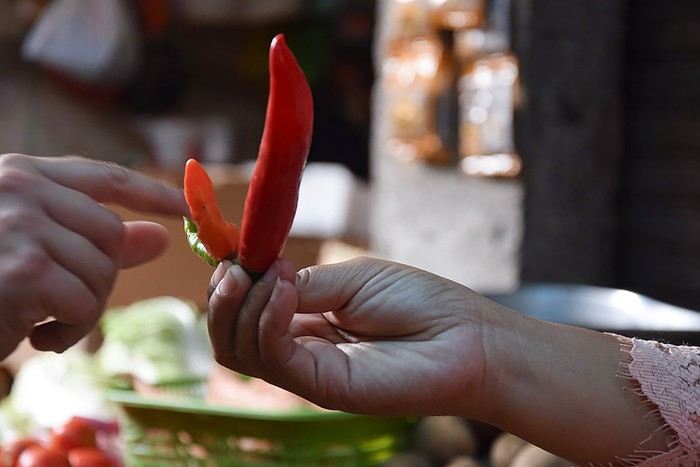
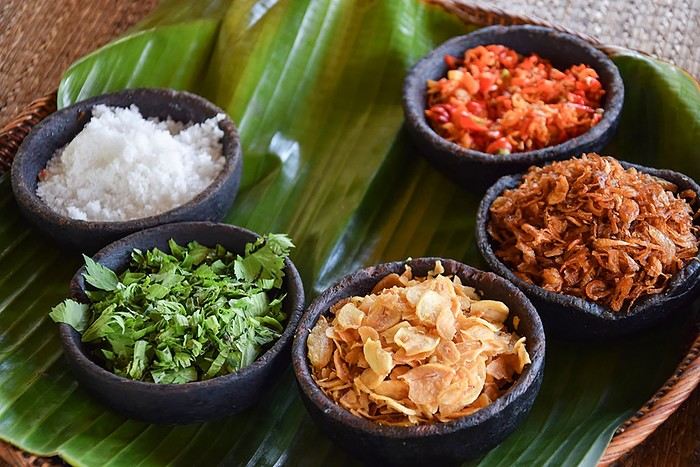
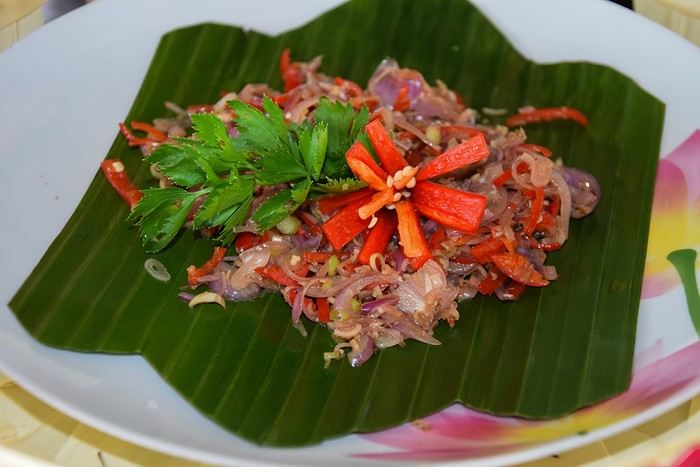
Narrative: In Bali, I took a cooking class. We went to the market to shop with the teacher. We cleaned and prepped the ingredients to make, among other things, a lovely salad.
...........................................................................
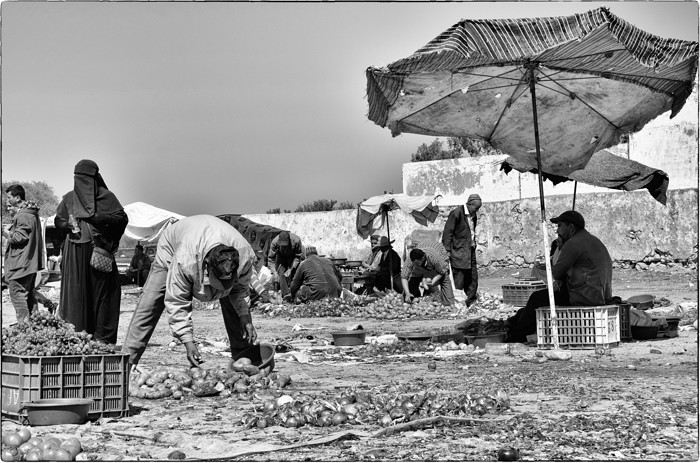
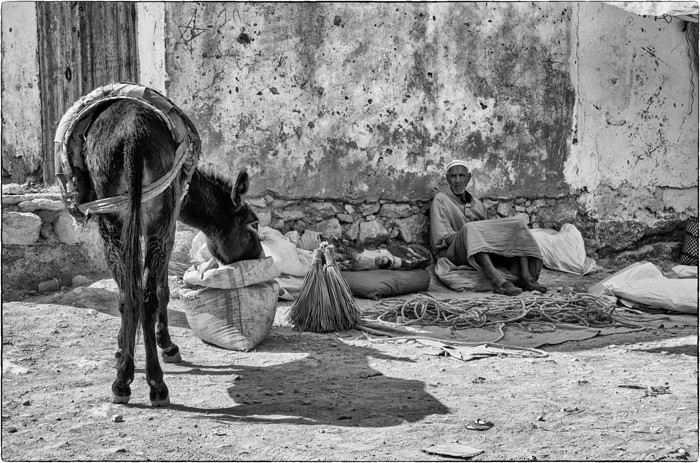
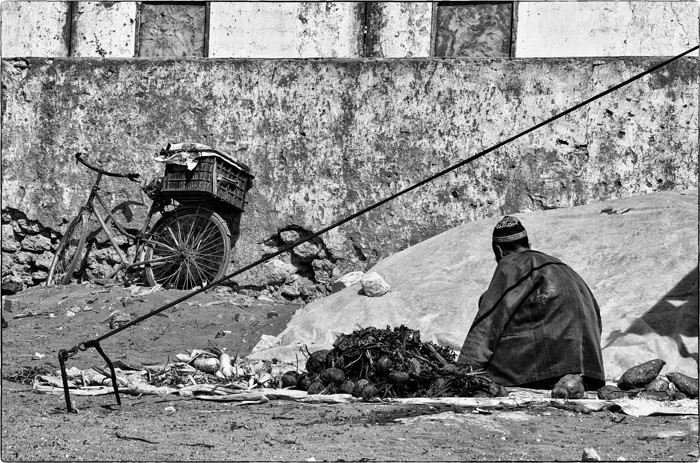
Narrative and thematic: I really loved this place 30 km from Essaouira. A little souk "just as it is," as they say. The souk of Ida Ougourd.
...........................................................................
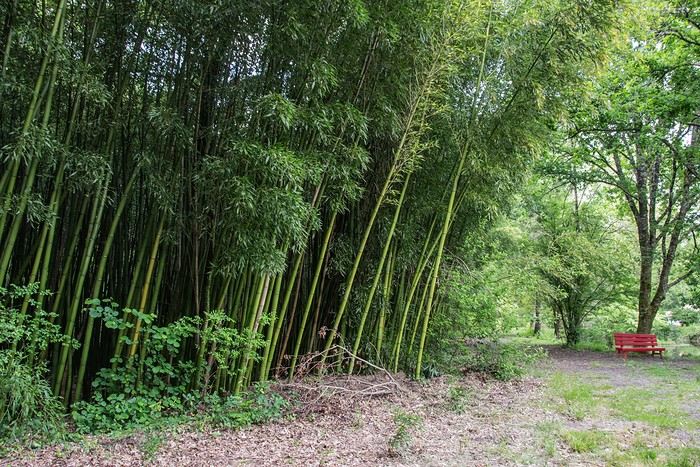
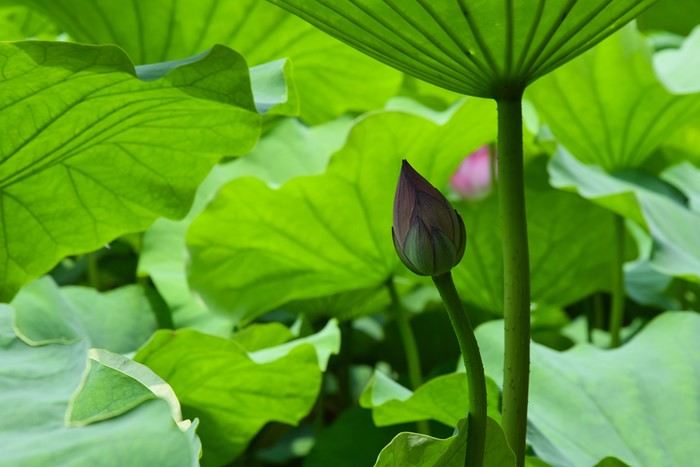
Thematic: Green in nature. The green of tea plantations in Munnar, a bamboo forest in Les Landes, and a park in Tokyo.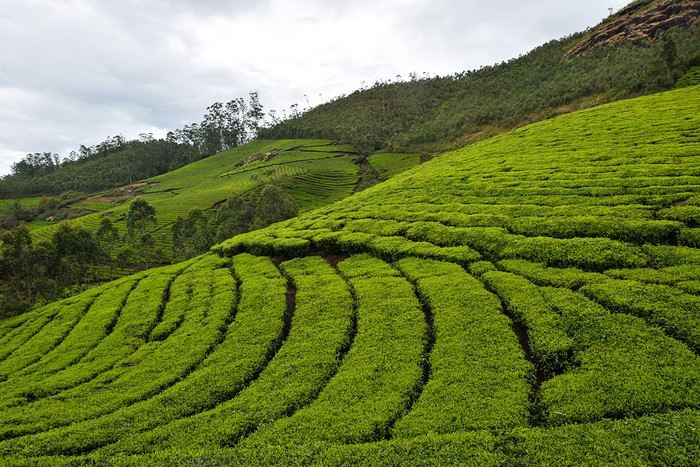
In 3 photos, posted simultaneously in the same message, I’d like you to tell me a little story with a few words. You’re allowed 2 series.
They can be narrative or thematic. For example: 3 shots representing 3 professions, 3 places of worship, 3 market stalls, 3 trains... the ideas are endless—whether in the same place or in different countries... or 3 images of the same place, photographed from 3 different angles, under 3 different lights... or 3 images where the predominant color is the same... Narrative and theme can, of course, overlap.
Practical details:
Participation Each VF member can submit up to 2 series, until Saturday, June 21 at 11:59 PM Paris time. Each series of 3 photos must be presented in a single message, with its number indicated (series 1, series 2).
Voting: Each VF member can vote for the 3 series they consider the best, based on their own criteria and the theme.
Voting will take place from Saturday, June 21 at midnight until Saturday, June 28 at 11:59 PM Paris time.
The selected series will be ranked in order of preference: - 1st series: 3 points - 2nd: 2 points - 3rd: 1 point
The winner is the author of the series with the most points.
Results will be published on June 29 during the day. In case of a tie, the number of first-place votes will decide. The winner will have the honor of organizing July 2025’s contest.
Photos that have won (1st, 2nd, or 3rd place) in another VF contest are not eligible for this one.
This thread is exclusively for series submitted to the contest. All discussions, comments, and other chatter should take place in this thread.
...................................................................
Narrative: In Bali, I took a cooking class. We went to the market to shop with the teacher. We cleaned and prepped the ingredients to make, among other things, a lovely salad.
...........................................................................
Narrative and thematic: I really loved this place 30 km from Essaouira. A little souk "just as it is," as they say. The souk of Ida Ougourd.
...........................................................................
Thematic: Green in nature. The green of tea plantations in Munnar, a bamboo forest in Les Landes, and a park in Tokyo.
Indonesia C1 Visa Extension
Hi there. I hold a 60-day C1 visa obtained online in early April, and I’ve been in Indonesia since April 14th.
I’d like to extend my visa, something I thought was possible online under the same conditions as when I got the visa—but oh no! I realize first that I can’t find my visa on the immigration website with the requested details (passport number, date of birth, nationality)... and also that it seems a sponsor is required for the C1 visa, not only for the extension but even for the initial visa application, which wasn’t asked of me before!!!!
So, I’m wondering how I should go about getting this extension... Has anyone gone through this experience? What solutions might there be, given I only have two weeks left to sort this out...
Thanks for your helpful feedback
That's Kenya too...
Hey fellow travelers,
I'm back in the "travel journal" section to share our 15-day adventure in Kenya in November 2024. It was pretty much our first time in East Africa (since Zanzibar doesn’t really count 😜).
As usual, I’m sharing the journal I made for our loved ones—still as casual and cheerful as ever, just to give them a little break from their tough workdays 😄.
We organized the whole trip ourselves, and to be original here LOL, we took some *very* well-trodden paths: Naivasha, Tsavo, and Diani. But what I loved about this country is that it’s so easy to go off the beaten track—even on the "tourist highways" 😉.
So, if you're a safari fanatic or after stunning wildlife photos, you might be disappointed. But if you want to discover other sides of Kenya, you might just find what you're looking for 😉.
Looking forward to sharing this fun journey with you all 😊.
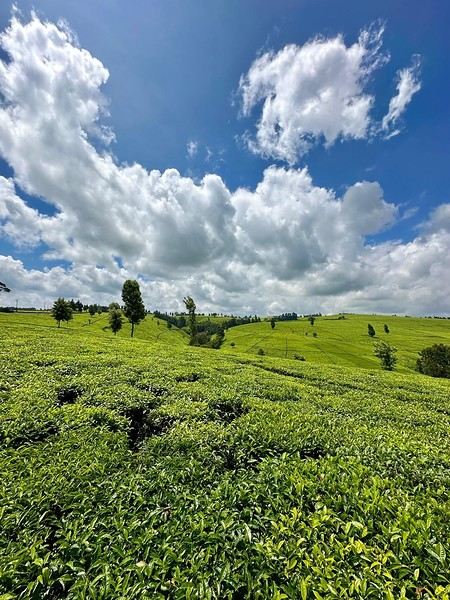
I'm back in the "travel journal" section to share our 15-day adventure in Kenya in November 2024. It was pretty much our first time in East Africa (since Zanzibar doesn’t really count 😜).
As usual, I’m sharing the journal I made for our loved ones—still as casual and cheerful as ever, just to give them a little break from their tough workdays 😄.
We organized the whole trip ourselves, and to be original here LOL, we took some *very* well-trodden paths: Naivasha, Tsavo, and Diani. But what I loved about this country is that it’s so easy to go off the beaten track—even on the "tourist highways" 😉.
So, if you're a safari fanatic or after stunning wildlife photos, you might be disappointed. But if you want to discover other sides of Kenya, you might just find what you're looking for 😉.
Looking forward to sharing this fun journey with you all 😊.
Feedback on 15-day Malaysia itinerary
Hi there,
My partner and I are heading to Malaysia in early July. We arrive in KL on 03/07 in the late afternoon and leave from KL on 18/07 in the evening.
We’ve planned: Day 1: KL Day 2: Cameron Highlands day trip from KL Day 3: KL → Taman Negara (bus) Day 4 & 5: Trek in Taman Negara Day 6: Taman Negara → Perhentians (bus + boat) Day 7 & 8: Perhentians Day 9: Perhentians → Pulau Redang (boat + bus + boat) Day 10 & 11: Pulau Redang Day 12: Pulau Redang → George Town (flight) Day 13: George Town Day 14: George Town → KL (flight) Day 15: KL + return flight at 23:45
I feel like this might not be the most efficient route. Any tips on how to optimize the order of things (even though I’d prefer to start with Taman Negara)? How’s the best way to travel between places?
Should we book everything (transport, accommodation, activities) in advance, or can we figure it out day by day? I prefer spontaneous travel to keep things flexible, but will there be availability, or will we be struggling constantly?
Thanks in advance for any advice you can share!
My partner and I are heading to Malaysia in early July. We arrive in KL on 03/07 in the late afternoon and leave from KL on 18/07 in the evening.
We’ve planned: Day 1: KL Day 2: Cameron Highlands day trip from KL Day 3: KL → Taman Negara (bus) Day 4 & 5: Trek in Taman Negara Day 6: Taman Negara → Perhentians (bus + boat) Day 7 & 8: Perhentians Day 9: Perhentians → Pulau Redang (boat + bus + boat) Day 10 & 11: Pulau Redang Day 12: Pulau Redang → George Town (flight) Day 13: George Town Day 14: George Town → KL (flight) Day 15: KL + return flight at 23:45
I feel like this might not be the most efficient route. Any tips on how to optimize the order of things (even though I’d prefer to start with Taman Negara)? How’s the best way to travel between places?
Should we book everything (transport, accommodation, activities) in advance, or can we figure it out day by day? I prefer spontaneous travel to keep things flexible, but will there be availability, or will we be struggling constantly?
Thanks in advance for any advice you can share!
Louisiana - Mississippi - Tennessee - Arkansas - April 2024
The context:
The urge to return to the USA, to explore a new part of the country. I don’t need much convincing to go back to Uncle Sam’s land. My wife’s on board too.
So, off we go for my 9th trip to the USA! (I didn’t take notes, so this is from memory)
Day 1: The departure: Flight with two layovers. I usually avoid layovers in the US before the final destination because of immigration. This time, my flight was Lyon/Munich, then Munich/Chicago, and finally Chicago/New Orleans. The layover in Chicago was 3 hours, and since I’d been through this airport twice before and found it super efficient both times, I wasn’t too worried when I booked my tickets—especially with Lufthansa. Unfortunately, there were several flight changes before departure, the last one leaving us with only a 2h14 layover in Chicago. I called Lufthansa to check if that would be enough, and they told me immigration in Chicago takes about an hour and 45 minutes (according to their calculations). So, I left feeling confident. A 15-minute delay leaving Lyon, then a 1-hour delay leaving Munich—now I’m starting to worry. When we arrived in Chicago, we rushed, cut in line, and made it to immigration. And then—an impossible queue. Game over, we missed our last flight. Of course, Lufthansa rebooked us for the next morning, arriving around 10 AM, and booked us a hotel. I found someone to call Alamo in New Orleans to make sure my rental car would still be there. Everything’s sorted—except our luggage, which we have no idea where it is! My little worry is that we land at 9:45 AM the next morning, and we’ve booked a tour at 11 AM at Laura Plantation, which is about an hour’s drive away! Wait and see…
The +: We're back in the USA The -: Once again, flight delays
Day 1: The departure: Flight with two layovers. I usually avoid layovers in the US before the final destination because of immigration. This time, my flight was Lyon/Munich, then Munich/Chicago, and finally Chicago/New Orleans. The layover in Chicago was 3 hours, and since I’d been through this airport twice before and found it super efficient both times, I wasn’t too worried when I booked my tickets—especially with Lufthansa. Unfortunately, there were several flight changes before departure, the last one leaving us with only a 2h14 layover in Chicago. I called Lufthansa to check if that would be enough, and they told me immigration in Chicago takes about an hour and 45 minutes (according to their calculations). So, I left feeling confident. A 15-minute delay leaving Lyon, then a 1-hour delay leaving Munich—now I’m starting to worry. When we arrived in Chicago, we rushed, cut in line, and made it to immigration. And then—an impossible queue. Game over, we missed our last flight. Of course, Lufthansa rebooked us for the next morning, arriving around 10 AM, and booked us a hotel. I found someone to call Alamo in New Orleans to make sure my rental car would still be there. Everything’s sorted—except our luggage, which we have no idea where it is! My little worry is that we land at 9:45 AM the next morning, and we’ve booked a tour at 11 AM at Laura Plantation, which is about an hour’s drive away! Wait and see…
The +: We're back in the USA The -: Once again, flight delays
M'Goun: which side to start the ascent?
Hey everyone!
I’m heading to Morocco in 2 weeks to climb M'Goun.
Which side is the most practical for logistics, please? I’ll be hiring a muleteer/cook.
I’m torn between starting from the Happy Valley (Agouti, Aït Bouguemez) or the southern slope (Skoura, Kalaat El M'Gouna).
I tried to go 5 years ago, 2 weeks before COVID, and ended up switching to Siroua based on Willempsie’s advice, given the season... but mid-May should be fine now, right?
Thanks for your help,
Pacoloco
On the Derisive Thread (Episode 1)
Dear members of this forum,
*With the pandemic, travel guides were replaced by cookbooks. With lockdown, there’s no need for the *Guía del Trotamundos*—the cookbook is gospel, and your daily life turns into a *Spaghetti Western*. It’s no longer about good and bad actors but good and bad fats. And for a few extra pinches of salt. To the tune of Ennio Morricone, it’s hard to diagnose pastalogy—sorry, the pathology—you’re suffering from. Italy, now confined, and pasta—no more aimless gondola rides on Venice’s canals or *Dolce Vita* weekends in Rome. The beauty of the soul blends with minestrone preparation.
*With the pandemic, Professor Didier Raoult became the new Christ-like figure; like the Indira Gandhi of medicine, like Moses showing the way to the people across the Dead Sea, for tormented souls, the value of a medical prescription doesn’t wait for the years to pass. And plexiglass reigned over the world.
*With the pandemic and gender theory, in particular, pushing us to become androgynous, hermaphroditic beings—*patatras*—the Colossi of Rhodes we are waver because of a tiny nuisance.
*Phew, the pandemic has receded... but watch out for a new swine flu pandemic, because on this forum, it’ll be followed by long-winded rants. Political/historical revisionism with such a pandemic—Fidel Castro wouldn’t have been able to invade the *Bahía de los Cochinos*. And that’s where his comrade Ernesto *Che* Guevara becomes a perfect scam. A fierce opponent of capitalist ideology, yet many clothing sellers got rich selling T-shirts with his face on them.
*Neutrality and the Helvetic underground. Last summer, I found myself passing the *Chalet Gaillard* deep in the *Forêt du Risoux* in the Jura, then crossing the border into the Canton of Vaud on foot. My disappointment was great: no sign indicating we were in neutral territory. And what kind of neutrality are we talking about? Since neutrality is an abstract concept. It’s like those visitors eager to see Calais who, spotting the sign for the *Pas-de-Calais* department, turn around on the road.
*There’s always a traveler quick to recommend a local guide. I know an excellent guide named Michel who lives in Cairo—Michel of Cairo. He has a truck and takes you to see the pharaoh’s ruins by truck. Still, be careful—good guides aren’t that common, because there are only eight Cairenes.
*The mix between large mammals and humans. Or how infantilism rules the world. The ultimate quest for happiness is petting rhinos in Nepal—we’ll confirm if this kind of animal is visible on the streets of Sauraha, a town near Chitwan National Park. The downside of this animal? It takes up too much space as a pet—better to raise a Yorkshire terrier in your modest apartment.
*I’m tired of recurring topics like, *‘Do I have time for my connection at New York airport?’* Aren’t you? There’s the discussion about *Gare de Lyon Part-Dieu*—*Gare de Lyon Part-Dieu*, God bless you. In the name of the Father, the taxman, and the Holy Spirit, don’t miss your connection. *Gare de Lyon-Part-Dieu*—apparently, a great French actor, Gérard de Part-Dieu, was born there. If you think you’ll miss your connection, just get rich and fly private. The working masses of the *lumpenproletariat*—they dare everything, that’s how you recognize them.
*Experts in non-events: learning that some members don’t like Spanish-speaking countries because, supposedly, the people are too loud. That’s it, I’m not going to China anymore—too many stairs on the Great Wall. So, too bad, I’m not going. It’s like two people crossing paths—one asks, *‘Going fishing?’* and the other says no. These experts are probably natives of Arles, because with people like that, it’s *l’Arlésienne*...
*The art of taking selfies at every turn. You’d think it’s an ancient practice, almost an anthropological ritual—everything suggests it dates back to prehistoric times. Back in the days of the Lascaux caves, instead of photographing the meal they were about to eat (it’s crazy how many food photos we see on this forum, especially in travel journals), prehistoric men and women could only make cave paintings. From there, it’s only a small step to conclude that cave art was nothing more than the menu served in caves that doubled as *Buffalo Grills* long before the chain existed. By the way, if you want to visit the caves, ask for a guide named Josiane. When it comes to parietal art skills, Josiane beats Lascaux... (Only the French on this forum will get that one.)
*Mythology of an object: the suitcase (a nod to Mr. Éric Libiot, whose columns I enjoy) An object that gets lost during a flight, especially during a transfer at an airport. And it’s stuffed to the brim with clothes and other useless items, like Mickey Mouse slippers. You’re in despair: when going through customs, the officers find those slightly risqué photos hidden in your laundry, taken at Cap d’Agde on a naturist beach. The suitcase is an object that makes noise when rolling because of its wheels—you’re quickly spotted.
*Hurry up and visit New York while you still can. Because of *Woke* ideology, more and more statues are being torn down, and the Statue of Liberty will likely meet the same fate. *Queer* culture isn’t everyone’s cup of tea.
*The Dead Poets Society I admired the beautiful photos of Venice, and *click*—I check the new discussions when I come across one where Mr. J.M.B. offers money loans. This person probably works at the Ministry of Finance and risks loosening the purse strings of your wallets.
*Toward the independence of New Caledonia: will we call it *Nouvelle Nouvelle-Calédonie*? From what I know, Chinese authorities want to settle there and invest; apparently, they want to send (fake) tourists—facsimiles of real travelers. So, it’ll be hard to separate the wheat from the chaff (the *ivraie* tourists).
*There’s a topic about hitchhiking in Scotland: apparently, Scots are very welcoming people. I imagine arriving at Aberdeen Airport to a typical welcoming committee—men in kilts and a bagpiper playing. Just like arriving in Papeete, where you’re greeted with flower leis—*Aloha! (Jacta Est)*. To attract tourists, Scottish cities will end up installing whisky vending machines.
*Eskimo pies banned for sale because of *cancel culture*—you can’t go to Iqaluit anymore. Panicked, ice cream manufacturers had to revise their *packaging*—sorry for the anglicism. Because of *cancel culture*, we can no longer say *Eskimo* without it being pejorative. The identity of the Arctic people of the same name takes a hit—it’s crazy how *bien-pensance* wreaks havoc in our minds... We can’t even bite into a chocolate *Eskimo* pie anymore.
*Diplomatic tensions between France and Australia: and there goes the submarine sale project, canceled. Given that the cost of these machines is a fifth of Australia’s public finances budget, it’s tough to pay in didgeridoos and kangaroo skins.
Thanks for reading, and see you soon for more chronicles.
*With the pandemic, travel guides were replaced by cookbooks. With lockdown, there’s no need for the *Guía del Trotamundos*—the cookbook is gospel, and your daily life turns into a *Spaghetti Western*. It’s no longer about good and bad actors but good and bad fats. And for a few extra pinches of salt. To the tune of Ennio Morricone, it’s hard to diagnose pastalogy—sorry, the pathology—you’re suffering from. Italy, now confined, and pasta—no more aimless gondola rides on Venice’s canals or *Dolce Vita* weekends in Rome. The beauty of the soul blends with minestrone preparation.
*With the pandemic, Professor Didier Raoult became the new Christ-like figure; like the Indira Gandhi of medicine, like Moses showing the way to the people across the Dead Sea, for tormented souls, the value of a medical prescription doesn’t wait for the years to pass. And plexiglass reigned over the world.
*With the pandemic and gender theory, in particular, pushing us to become androgynous, hermaphroditic beings—*patatras*—the Colossi of Rhodes we are waver because of a tiny nuisance.
*Phew, the pandemic has receded... but watch out for a new swine flu pandemic, because on this forum, it’ll be followed by long-winded rants. Political/historical revisionism with such a pandemic—Fidel Castro wouldn’t have been able to invade the *Bahía de los Cochinos*. And that’s where his comrade Ernesto *Che* Guevara becomes a perfect scam. A fierce opponent of capitalist ideology, yet many clothing sellers got rich selling T-shirts with his face on them.
*Neutrality and the Helvetic underground. Last summer, I found myself passing the *Chalet Gaillard* deep in the *Forêt du Risoux* in the Jura, then crossing the border into the Canton of Vaud on foot. My disappointment was great: no sign indicating we were in neutral territory. And what kind of neutrality are we talking about? Since neutrality is an abstract concept. It’s like those visitors eager to see Calais who, spotting the sign for the *Pas-de-Calais* department, turn around on the road.
*There’s always a traveler quick to recommend a local guide. I know an excellent guide named Michel who lives in Cairo—Michel of Cairo. He has a truck and takes you to see the pharaoh’s ruins by truck. Still, be careful—good guides aren’t that common, because there are only eight Cairenes.
*The mix between large mammals and humans. Or how infantilism rules the world. The ultimate quest for happiness is petting rhinos in Nepal—we’ll confirm if this kind of animal is visible on the streets of Sauraha, a town near Chitwan National Park. The downside of this animal? It takes up too much space as a pet—better to raise a Yorkshire terrier in your modest apartment.
*I’m tired of recurring topics like, *‘Do I have time for my connection at New York airport?’* Aren’t you? There’s the discussion about *Gare de Lyon Part-Dieu*—*Gare de Lyon Part-Dieu*, God bless you. In the name of the Father, the taxman, and the Holy Spirit, don’t miss your connection. *Gare de Lyon-Part-Dieu*—apparently, a great French actor, Gérard de Part-Dieu, was born there. If you think you’ll miss your connection, just get rich and fly private. The working masses of the *lumpenproletariat*—they dare everything, that’s how you recognize them.
*Experts in non-events: learning that some members don’t like Spanish-speaking countries because, supposedly, the people are too loud. That’s it, I’m not going to China anymore—too many stairs on the Great Wall. So, too bad, I’m not going. It’s like two people crossing paths—one asks, *‘Going fishing?’* and the other says no. These experts are probably natives of Arles, because with people like that, it’s *l’Arlésienne*...
*The art of taking selfies at every turn. You’d think it’s an ancient practice, almost an anthropological ritual—everything suggests it dates back to prehistoric times. Back in the days of the Lascaux caves, instead of photographing the meal they were about to eat (it’s crazy how many food photos we see on this forum, especially in travel journals), prehistoric men and women could only make cave paintings. From there, it’s only a small step to conclude that cave art was nothing more than the menu served in caves that doubled as *Buffalo Grills* long before the chain existed. By the way, if you want to visit the caves, ask for a guide named Josiane. When it comes to parietal art skills, Josiane beats Lascaux... (Only the French on this forum will get that one.)
*Mythology of an object: the suitcase (a nod to Mr. Éric Libiot, whose columns I enjoy) An object that gets lost during a flight, especially during a transfer at an airport. And it’s stuffed to the brim with clothes and other useless items, like Mickey Mouse slippers. You’re in despair: when going through customs, the officers find those slightly risqué photos hidden in your laundry, taken at Cap d’Agde on a naturist beach. The suitcase is an object that makes noise when rolling because of its wheels—you’re quickly spotted.
*Hurry up and visit New York while you still can. Because of *Woke* ideology, more and more statues are being torn down, and the Statue of Liberty will likely meet the same fate. *Queer* culture isn’t everyone’s cup of tea.
*The Dead Poets Society I admired the beautiful photos of Venice, and *click*—I check the new discussions when I come across one where Mr. J.M.B. offers money loans. This person probably works at the Ministry of Finance and risks loosening the purse strings of your wallets.
*Toward the independence of New Caledonia: will we call it *Nouvelle Nouvelle-Calédonie*? From what I know, Chinese authorities want to settle there and invest; apparently, they want to send (fake) tourists—facsimiles of real travelers. So, it’ll be hard to separate the wheat from the chaff (the *ivraie* tourists).
*There’s a topic about hitchhiking in Scotland: apparently, Scots are very welcoming people. I imagine arriving at Aberdeen Airport to a typical welcoming committee—men in kilts and a bagpiper playing. Just like arriving in Papeete, where you’re greeted with flower leis—*Aloha! (Jacta Est)*. To attract tourists, Scottish cities will end up installing whisky vending machines.
*Eskimo pies banned for sale because of *cancel culture*—you can’t go to Iqaluit anymore. Panicked, ice cream manufacturers had to revise their *packaging*—sorry for the anglicism. Because of *cancel culture*, we can no longer say *Eskimo* without it being pejorative. The identity of the Arctic people of the same name takes a hit—it’s crazy how *bien-pensance* wreaks havoc in our minds... We can’t even bite into a chocolate *Eskimo* pie anymore.
*Diplomatic tensions between France and Australia: and there goes the submarine sale project, canceled. Given that the cost of these machines is a fifth of Australia’s public finances budget, it’s tough to pay in didgeridoos and kangaroo skins.
Thanks for reading, and see you soon for more chronicles.
Buying vanilla in Nosy Be (Madagascar)
Hi there,
I’m heading to Madagascar for 15 days next March, specifically to Nosy Be, and I’d like to buy some vanilla. Where can I buy it in Nosy Be, and what’s the current price of vanilla? I’ve heard that the price of vanilla has skyrocketed (like everything else, to be honest). If anyone has bought some recently, that would be a huge help.
Thanks in advance!
Tuscany with 3 kids
Hi there,
A little travel journal of our few days in Tuscany in August 2024 with our three daughters aged 16 months, 4, and 6. A beautiful trip but ruined by extreme heat. The same thing in spring or autumn would have been magical.
Itinerary We used our own car for this mini-trip.
Carpentras-Isolalunga: 1 night
Isolalunga-Barberino (Val d’Elsa): 4 nights
Lucca and Pisa
Siena
Val d’Orcia
Volterra
Barberino-Carpentras
Visits
Lucca is less well-known than its neighbors Florence, Pisa, and Siena. Yet it was already a prosperous city during the Renaissance. The Duomo is magnificent, and strolling along the ramparts in the shade of the trees is very pleasant. The large square, where the buildings were constructed using the walls of the amphitheater, is a curiosity. We used the stroller.
Pisa needs no introduction, but it’s also impossible to pass by without stopping. Alexandre and I had already visited it 15 years ago, so this time we didn’t climb the tower or go inside the Duomo. We arrived around 5 PM, so we were short on time, but the heat had dropped, which made the visit very enjoyable.
Siena is a magnificent city but dry. There’s no watercourse here, which has always been the city’s problem. Everything was designed, including the slope of the main square to collect water. The Duomo is absolutely stunning. We bought the pass to visit the Duomo, the baptistery, the crypt, the museum of the works, the panorama, and the “Gate of Heaven.”
The “Gate of Heaven” is a guided tour that allows you to climb to the top of the Duomo, walk under the roof to see the framework, and admire the beautiful frescoes on the floor from above, as well as the stained glass and ceiling paintings from much closer. Of course, the view of Siena from up there is splendid. It’s really worth it. We left the stroller downstairs, and Alex carried Artemisia.
The museum of the works contains some magnificent paintings and original sculptures from the Duomo.
We didn’t find a park for a picnic. We had to settle for a public garden that wasn’t really well-maintained.
Our visit for the “Gate of Heaven” was at 6:30 PM, so we had dinner in Siena. The restaurant was expensive and disappointing. However, we enjoyed the city’s parade—lots of people in costume, plenty of colors, and brass band music. Nice.
Val d’Orcia
The first goal was to see the famous “Gladiator” house, which was used as a set in Ridley Scott’s film. You’ll have to settle for a photo because it’s not open for visits. The place is pretty, but no more so than many Tuscan estates, so I’d say it’s not worth the detour.
We visited the lovely village of San Quirico d’Orcia, where we had a picnic. In the afternoon, we saw the beautiful Abbey of San Galgano and the Chapel of San Lorenzo, where a sword is planted in the stone (its owner stopped waging war to dedicate his life to God—no apparent connection to the legend of King Arthur). The abbey is in ruins, but the site, planted with cypress trees and sunflower fields, is very beautiful.
Volterra
Volterra is a hilltop village with many facets, aside from a still-active penitentiary in the old fortification.
We bought the “Volterra Card” to visit, in particular, the Palazzo dei Priori, which is as beautiful inside as it is outside, and to climb to the top of the tower, where the view is magnificent.
The Roman ruins (especially the amphitheater and arenas under excavation)
The alabaster museum is very small but highlights one of the region’s ongoing activities.
The Etruscan art museum is a must-see. It’s a high-quality museum with many pieces, mainly richly decorated tombs depicting the lives of the deceased. And it’s air-conditioned!
It’s a bit of a hassle with the stroller. A baby carrier would have been more practical.
We had a picnic in the lovely Enrico Fiumi Park (with playgrounds for kids), which overlooks the city.
There are many charming shops in Volterra for bringing back souvenirs, especially food-related ones.
I find that hotels are very expensive in Italy, so I opted for a farmhouse rental.
We picnicked at lunchtime and ate at restaurants or in our accommodation in the evening. Unfortunately, I can’t recommend any great restaurants.
Budget
Accommodation: 120 € per night
Volterra family card: 20 €
A little travel journal of our few days in Tuscany in August 2024 with our three daughters aged 16 months, 4, and 6. A beautiful trip but ruined by extreme heat. The same thing in spring or autumn would have been magical.
Itinerary We used our own car for this mini-trip.
Carpentras-Isolalunga: 1 night
Isolalunga-Barberino (Val d’Elsa): 4 nights
Lucca and Pisa
Siena
Val d’Orcia
Volterra
Barberino-Carpentras
Visits
Lucca is less well-known than its neighbors Florence, Pisa, and Siena. Yet it was already a prosperous city during the Renaissance. The Duomo is magnificent, and strolling along the ramparts in the shade of the trees is very pleasant. The large square, where the buildings were constructed using the walls of the amphitheater, is a curiosity. We used the stroller.
Pisa needs no introduction, but it’s also impossible to pass by without stopping. Alexandre and I had already visited it 15 years ago, so this time we didn’t climb the tower or go inside the Duomo. We arrived around 5 PM, so we were short on time, but the heat had dropped, which made the visit very enjoyable.
Siena is a magnificent city but dry. There’s no watercourse here, which has always been the city’s problem. Everything was designed, including the slope of the main square to collect water. The Duomo is absolutely stunning. We bought the pass to visit the Duomo, the baptistery, the crypt, the museum of the works, the panorama, and the “Gate of Heaven.”
The “Gate of Heaven” is a guided tour that allows you to climb to the top of the Duomo, walk under the roof to see the framework, and admire the beautiful frescoes on the floor from above, as well as the stained glass and ceiling paintings from much closer. Of course, the view of Siena from up there is splendid. It’s really worth it. We left the stroller downstairs, and Alex carried Artemisia.
The museum of the works contains some magnificent paintings and original sculptures from the Duomo.
We didn’t find a park for a picnic. We had to settle for a public garden that wasn’t really well-maintained.
Our visit for the “Gate of Heaven” was at 6:30 PM, so we had dinner in Siena. The restaurant was expensive and disappointing. However, we enjoyed the city’s parade—lots of people in costume, plenty of colors, and brass band music. Nice.
Val d’Orcia
The first goal was to see the famous “Gladiator” house, which was used as a set in Ridley Scott’s film. You’ll have to settle for a photo because it’s not open for visits. The place is pretty, but no more so than many Tuscan estates, so I’d say it’s not worth the detour.
We visited the lovely village of San Quirico d’Orcia, where we had a picnic. In the afternoon, we saw the beautiful Abbey of San Galgano and the Chapel of San Lorenzo, where a sword is planted in the stone (its owner stopped waging war to dedicate his life to God—no apparent connection to the legend of King Arthur). The abbey is in ruins, but the site, planted with cypress trees and sunflower fields, is very beautiful.
Volterra
Volterra is a hilltop village with many facets, aside from a still-active penitentiary in the old fortification.
We bought the “Volterra Card” to visit, in particular, the Palazzo dei Priori, which is as beautiful inside as it is outside, and to climb to the top of the tower, where the view is magnificent.
The Roman ruins (especially the amphitheater and arenas under excavation)
The alabaster museum is very small but highlights one of the region’s ongoing activities.
The Etruscan art museum is a must-see. It’s a high-quality museum with many pieces, mainly richly decorated tombs depicting the lives of the deceased. And it’s air-conditioned!
It’s a bit of a hassle with the stroller. A baby carrier would have been more practical.
We had a picnic in the lovely Enrico Fiumi Park (with playgrounds for kids), which overlooks the city.
There are many charming shops in Volterra for bringing back souvenirs, especially food-related ones.
I find that hotels are very expensive in Italy, so I opted for a farmhouse rental.
We picnicked at lunchtime and ate at restaurants or in our accommodation in the evening. Unfortunately, I can’t recommend any great restaurants.
Budget
Accommodation: 120 € per night
Volterra family card: 20 €
Quiet island accessible from Tokyo
Hi there,
My wife and I are heading to Japan from March 27 to April 22, 2025. On the evening of the 21st, we’ll be staying in Tokyo to catch our international flight. For this first trip, we’ve prioritized a fairly classic itinerary. Here’s the plan:
- Osaka (arriving at Kansai Airport) - Hiroshima - Itsukushima (also known as Miyajima) - Kyoto - Nara - Kanazawa - Shirakawa-go - Takayama - Tokyo
We’ll likely finish our sightseeing in Tokyo around March 17.
We’re thinking of heading somewhere "quiet" or "by the sea," maybe an island, between the 17th/18th and the evening of the 21st.
What are your thoughts or experiences?
Thanks
My wife and I are heading to Japan from March 27 to April 22, 2025. On the evening of the 21st, we’ll be staying in Tokyo to catch our international flight. For this first trip, we’ve prioritized a fairly classic itinerary. Here’s the plan:
- Osaka (arriving at Kansai Airport) - Hiroshima - Itsukushima (also known as Miyajima) - Kyoto - Nara - Kanazawa - Shirakawa-go - Takayama - Tokyo
We’ll likely finish our sightseeing in Tokyo around March 17.
We’re thinking of heading somewhere "quiet" or "by the sea," maybe an island, between the 17th/18th and the evening of the 21st.
What are your thoughts or experiences?
Thanks
Back from 3 weeks in Guatemala – self-drive trip
Hi everyone.
I wanted to share a little feedback from our trip to Guatemala—we got back a month ago, and I really appreciated the well-commented posts here that helped us out. So, in turn, I wanted to share our own little recap.
We’ve traveled quite a bit together (we’re 38 and 42), and Guatemala had been on our radar for a while. But with so much info out there, it was hard to sort through it all—especially since we only had 3 weeks on the ground and didn’t want to waste time.
Here’s the itinerary we followed: Antigua, the Pacific coast, Lake Atitlán, a private coffee and bird reserve, Chichicastenango, Sayaxché, El Remate, Río Dulce, and Lake Izabal.
We rented a 4x4, which was essential given the state of some roads.
Our highlights: * **Pacific coast**: So authentic and preserved. We met sea turtles, cooked and baked coconut bread with a women’s community—such a meaningful exchange—and kayaked through a pristine mangrove full of birds. * **Lake Atitlán**: Even though we were worried it might feel too touristy, a private tour let us discover local crafts, hidden workshops (weaving, pottery), and the stunning views from the boat. * **Sayaxché**: The starting point for the Aguateca and Dos Pilas sites—one of our favorite outings. The site is breathtaking: walking through the canyon and jungle-covered ruins with almost no one around. We stayed in a little bungalow on an island, totally off the grid. * **In Petén**, we met an Itza Maya tribe—an unforgettable day sharing a meal and plant-based healing rituals. Wow. This tribe resisted the conquistadors and still lives traditionally. We also took a tour on Lake Petén and swam at hidden little beaches. Tikal was nice, but we preferred Yaxhá. * **Río Dulce**: A day at a private cocoa plantation—an adventure in a buggy with the owner himself. We harvested cocoa and ate the chocolate paste afterward, then swam in a waterfall on the property. Since it’s private, there was no one else around. A real privilege. * **Boat tour on the Río Dulce**: For us, the highlight. We visited a school where they’re committed to giving kids a solid education while blending Maya rituals. * **Lake Izabal**: A peaceful end to the trip in a magical setting. We visited Quiriguá.
We went through an organizer who knows the country really well. We weren’t initially planning on that, but thanks to her, we had experiences we never would’ve found on our own. On top of that, we actually paid less for the trip overall because of her local rates. I’m not getting anything out of this—I just think it could help other travelers. Her business is Secretplaceincostarica (she also does Costa Rica, which we’re now eager to explore).
On the ground, we felt completely safe. The people are lovely, the roads can be a little chaotic at times, but we loved every minute of it.
Happy travels to all! Marie
I wanted to share a little feedback from our trip to Guatemala—we got back a month ago, and I really appreciated the well-commented posts here that helped us out. So, in turn, I wanted to share our own little recap.
We’ve traveled quite a bit together (we’re 38 and 42), and Guatemala had been on our radar for a while. But with so much info out there, it was hard to sort through it all—especially since we only had 3 weeks on the ground and didn’t want to waste time.
Here’s the itinerary we followed: Antigua, the Pacific coast, Lake Atitlán, a private coffee and bird reserve, Chichicastenango, Sayaxché, El Remate, Río Dulce, and Lake Izabal.
We rented a 4x4, which was essential given the state of some roads.
Our highlights: * **Pacific coast**: So authentic and preserved. We met sea turtles, cooked and baked coconut bread with a women’s community—such a meaningful exchange—and kayaked through a pristine mangrove full of birds. * **Lake Atitlán**: Even though we were worried it might feel too touristy, a private tour let us discover local crafts, hidden workshops (weaving, pottery), and the stunning views from the boat. * **Sayaxché**: The starting point for the Aguateca and Dos Pilas sites—one of our favorite outings. The site is breathtaking: walking through the canyon and jungle-covered ruins with almost no one around. We stayed in a little bungalow on an island, totally off the grid. * **In Petén**, we met an Itza Maya tribe—an unforgettable day sharing a meal and plant-based healing rituals. Wow. This tribe resisted the conquistadors and still lives traditionally. We also took a tour on Lake Petén and swam at hidden little beaches. Tikal was nice, but we preferred Yaxhá. * **Río Dulce**: A day at a private cocoa plantation—an adventure in a buggy with the owner himself. We harvested cocoa and ate the chocolate paste afterward, then swam in a waterfall on the property. Since it’s private, there was no one else around. A real privilege. * **Boat tour on the Río Dulce**: For us, the highlight. We visited a school where they’re committed to giving kids a solid education while blending Maya rituals. * **Lake Izabal**: A peaceful end to the trip in a magical setting. We visited Quiriguá.
We went through an organizer who knows the country really well. We weren’t initially planning on that, but thanks to her, we had experiences we never would’ve found on our own. On top of that, we actually paid less for the trip overall because of her local rates. I’m not getting anything out of this—I just think it could help other travelers. Her business is Secretplaceincostarica (she also does Costa Rica, which we’re now eager to explore).
On the ground, we felt completely safe. The people are lovely, the roads can be a little chaotic at times, but we loved every minute of it.
Happy travels to all! Marie
If you're passing through the Montreal area
If you're passing through the area (Montreal region), drop us a line in this thread. We’d love to say hello in person, you VFers, and maybe help you enjoy your time in Quebec even more. 😉
For lack of a better option, this is our way of celebrating this big comeback—we’re so happy to see this amazing platform, VoyageForum.com, active again! 🙂
Really looking forward to reconnecting with the regulars who used to contribute here too! 🙂
Right now, on this Friday, October 25th, the cold is starting to set in. Halloween decorations are everywhere. Winter will be back before we know it. 🤪
For lack of a better option, this is our way of celebrating this big comeback—we’re so happy to see this amazing platform, VoyageForum.com, active again! 🙂
Really looking forward to reconnecting with the regulars who used to contribute here too! 🙂
Right now, on this Friday, October 25th, the cold is starting to set in. Halloween decorations are everywhere. Winter will be back before we know it. 🤪
Trois semaines en Italie entre les Dolomites et Vérone English translation pending
Bonjour à toutes et tous
Bon ben voilà, cela fait 1mois 1/2 que nous sommes rentrés de vacances et comme les photos sont triées, il est temps de vous faire un petit retour de nos 3 semaines de congés 🙂
Les Dolomites ... Voilà une destination qui me faisait envie depuis quelques temps. Entre les ouïes dire et les photos, j'avais envie de découvrir cette région italienne. Mon mari a suivi mes envies sans problème et mes enfants aussi alors, une fois rentrés de notre dernier séjour en août dernier, il a cherché des locations ( c'est le chef pour dénicher les bons plans 😛 ).
Notre but pour juillet 2020 : 15 jours dans les Dolomites et 1 semaine à Vérone pour faire la ville et le lac de Garde. Pour chaque semaine, nous voulions quelque chose de "central" pour pouvoir rayonner. Ce n'était pas l'idéal pour la route mais cela nous permettait de nous poser à chaque fois : les valises pouvaient être défaites , on pouvait faire des lessives et se préparer nos repas comme on voulait.
Tout se déroulait très bien, les réservations étaient terminées à Noël, il n'y avait plus qu'a peaufiner ce que nous voulions faire/voir et attendre l'heure du départ. Et puis est arrivé le Covid ... Ah, frontière fermée avec l'Italie 😕 et donc complication en vue avec ce satané virus 😠 Mais, tout s'est débloqué 10 jours avant notre départ et les italiens n'ont pas annulé nos réservations alors on pouvait croire en notre chance 😏 Nous sommes partis le 10 juillet de Nice avec un stock de masques et puis c'est tout.
Pour la 1ère semaine, nous avons logé dans un appart-hôtel à Carezza. Ce dernier se situait dans un immense hôtel. En fait, il y avait des chambres d'hôtel classiques et des appartements de particulier. Original mais bon ... Nous, nous étions donc chez un particulier. Et pour tout dire, il n'y avait pas grand monde dans cet établissement. C'était un peu, beaucoup, vide et tous les fauteuils de bienvenu étaient condamnés 🤪 L'appartement par lui-même était un peu trop petit pour 4 personnes mais il y avait tout le nécessaire. Nous sommes arrivés l'après-midi sous la pluie et avec 8°C 🏴☠️. Le temps de prendre possession du lieu, de ranger un peu les affaires, le ciel s'est dégagé et nous avons été nous balader à pied dans les alentours. Vue de notre chambre
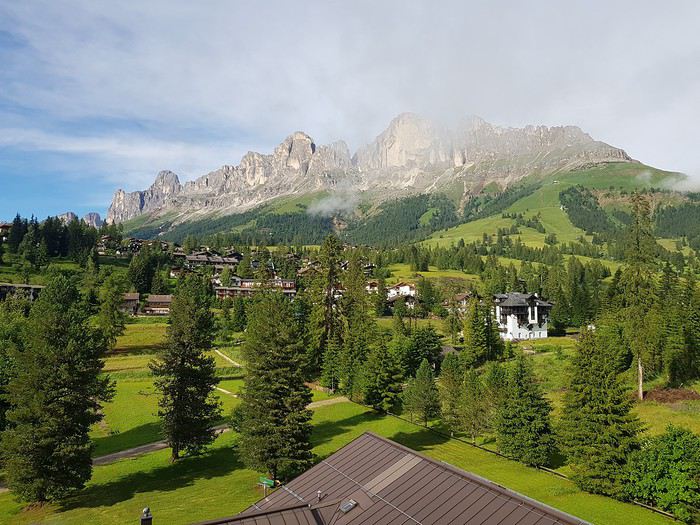
Notre hôtel
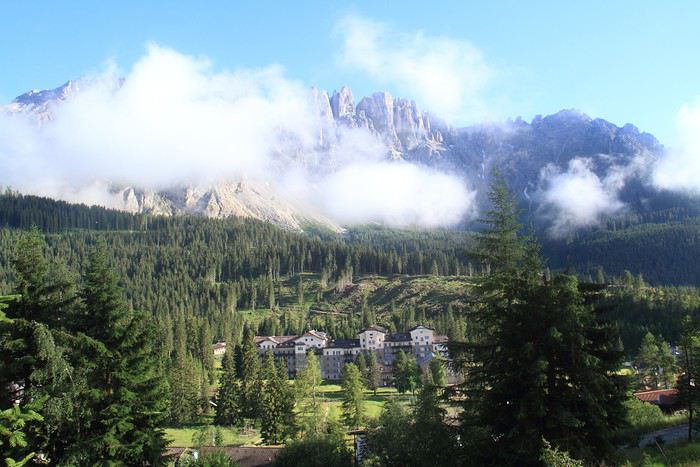

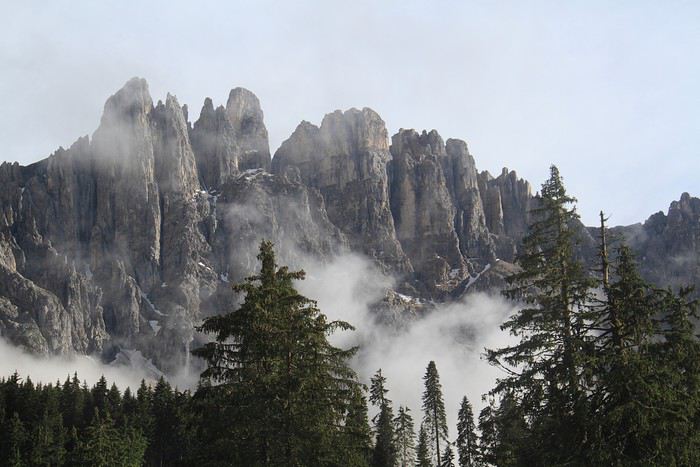
Le ciel se dégage bien
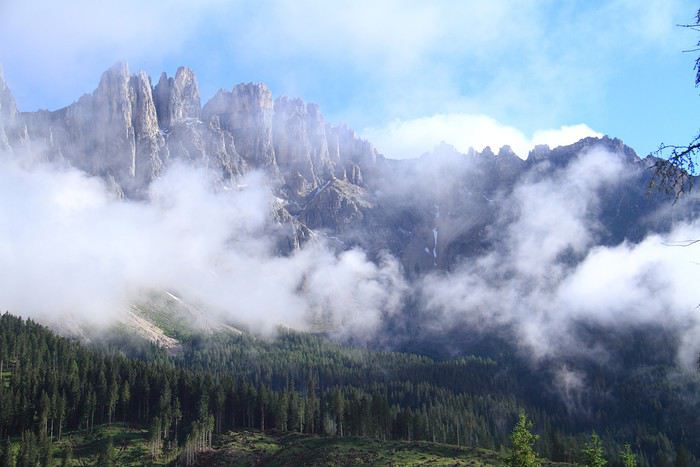
Bon ben voilà, cela fait 1mois 1/2 que nous sommes rentrés de vacances et comme les photos sont triées, il est temps de vous faire un petit retour de nos 3 semaines de congés 🙂
Les Dolomites ... Voilà une destination qui me faisait envie depuis quelques temps. Entre les ouïes dire et les photos, j'avais envie de découvrir cette région italienne. Mon mari a suivi mes envies sans problème et mes enfants aussi alors, une fois rentrés de notre dernier séjour en août dernier, il a cherché des locations ( c'est le chef pour dénicher les bons plans 😛 ).
Notre but pour juillet 2020 : 15 jours dans les Dolomites et 1 semaine à Vérone pour faire la ville et le lac de Garde. Pour chaque semaine, nous voulions quelque chose de "central" pour pouvoir rayonner. Ce n'était pas l'idéal pour la route mais cela nous permettait de nous poser à chaque fois : les valises pouvaient être défaites , on pouvait faire des lessives et se préparer nos repas comme on voulait.
Tout se déroulait très bien, les réservations étaient terminées à Noël, il n'y avait plus qu'a peaufiner ce que nous voulions faire/voir et attendre l'heure du départ. Et puis est arrivé le Covid ... Ah, frontière fermée avec l'Italie 😕 et donc complication en vue avec ce satané virus 😠 Mais, tout s'est débloqué 10 jours avant notre départ et les italiens n'ont pas annulé nos réservations alors on pouvait croire en notre chance 😏 Nous sommes partis le 10 juillet de Nice avec un stock de masques et puis c'est tout.
Pour la 1ère semaine, nous avons logé dans un appart-hôtel à Carezza. Ce dernier se situait dans un immense hôtel. En fait, il y avait des chambres d'hôtel classiques et des appartements de particulier. Original mais bon ... Nous, nous étions donc chez un particulier. Et pour tout dire, il n'y avait pas grand monde dans cet établissement. C'était un peu, beaucoup, vide et tous les fauteuils de bienvenu étaient condamnés 🤪 L'appartement par lui-même était un peu trop petit pour 4 personnes mais il y avait tout le nécessaire. Nous sommes arrivés l'après-midi sous la pluie et avec 8°C 🏴☠️. Le temps de prendre possession du lieu, de ranger un peu les affaires, le ciel s'est dégagé et nous avons été nous balader à pied dans les alentours. Vue de notre chambre
Notre hôtel
Le ciel se dégage bien
To the Top West End
In this time of general travel-journal scarcity, I’m stepping up to tell you about a far-too-short getaway to the Top West End, a local term for the very northern part of Western Australia, right on the border ( ;) ) with the Northern Territory.
As usual, I didn’t manage to keep it short, but this time I’ve got photos to go with it!
August 2020. Since the opportunities to explore the world are extremely limited right now, all we (R&X) can do is explore our own island! Well, just a part of it, because with the state borders still closed, we’re stuck in Western Australia (WA).
Luckily, we’re pretty fortunate because this state is huge: over 2.5 million km² (that’s more than four times the size of France or 1.5 times Quebec). What’s more, stretching over 20 degrees of latitude between the Antarctic Ocean and the Timor Sea, you’ll find climates ranging from Mediterranean to arid to tropical. That’s actually why we decided to head as far north as possible. Sick of the endless rainy winter in Perth, bring on the heat of the Kimberley... way up Nooorth!
Friday. At the airport, the main terminal was closed (not enough flights), so we ended up in the annex (where flights to the various mines usually depart from). There was no crowd at the gate, and in this huge, single departure lounge, empty seats were plentiful. Only three flights were listed on the screens for the rest of the morning: the first to Coondewanna (?), the second to Darwin, and ours to Kununurra (code KNX).
A cool breeze swept through the half-open corridors along the runways. At the top of the walkway leading to the Fokker 100 (the Airbuses and Boeings are now parked!), a flight attendant greeted us with a basket full of sanitary masks. We were actually the only masked passengers (the staff weren’t wearing them either). With zero Covid-19 cases in WA at the time, the only rule was to maintain social distancing—something pretty hard to do on a full plane!
It was also my first time wearing a mask—it felt weird, pretty uncomfortable, and after a while, painful behind the ears. I really feel for those who have to wear one all day, every day. The flight lasted three long hours, but luckily, I had a good book. From the window, I watched an endless expanse of salt lakes in all shapes and sizes—round, elongated, gray, white, sometimes blue and green—and an infinity of winding, capricious meanders, along with long straight lines that led nowhere. The last half-hour got more interesting as rocky, swollen formations and long, sloping plateaus appeared. Against the vast ochre landscape, green patches became more frequent.
Just before landing, rows of green fields briefly appeared, along with an surprisingly wide river—but we were already rolling down the tarmac. A few hangars, a myriad of small, stationary planes, and a tiny terminal topped with a sign: “Welcome to Kununurra.”
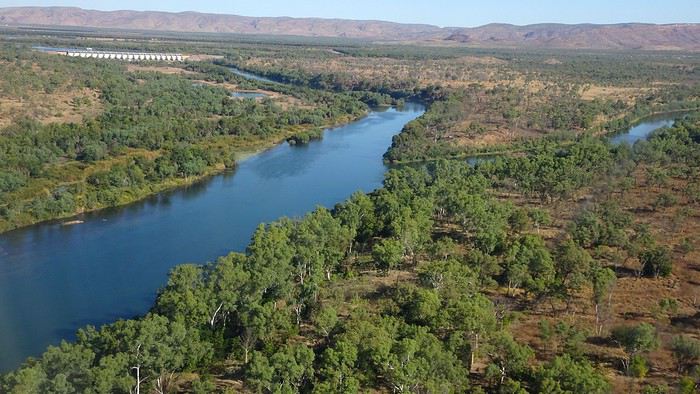
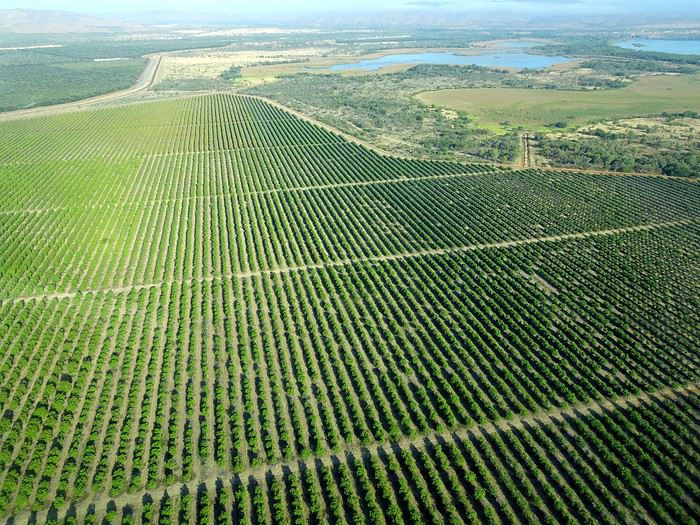
We wanted heat, and here it was—34°C the moment we stepped off the plane! We felt alive again and totally ridiculous in our jeans and sweaters. We quickly grabbed our suitcase and picked up the 4x4 we’d rented—more out of necessity, since only that type of vehicle can access the national parks we planned to visit.
Just four kilometers separated us from Kununurra, a town of 5,000 people founded in 1961 during the construction of the Lake Argyle Dam and the development of the Ord River Irrigation Area Scheme (more on that later). On the horizon, mountain ranges (a bit of an exaggeration, since we know Mt. Meharry, WA’s highest ‘mountain,’ doesn’t even reach 1,250 meters!) and closer to the road, a few irrigation canals cutting through stretches of bush, then a huge park overlooking a small lake lined with reeds.
A row of baobabs (yes, there are baobabs in Australia too!), a series of motels with immaculate lawns, a gas station, and there’s the main street leading to the town center—that is, the parking lots of the two supermarkets, the bottleshop, the pub, the Town Hall, the municipal pool, and the Tourist Office (already closed!), and at the next roundabout, another park, the Presbyterian church, and a few other shops. In short, two or three green blocks that you can explore in no time.
One road leads to the small industrial area and one of the town’s three or four campgrounds, while another heads toward the residential neighborhoods, which look just like the typical suburbs you find in any Australian city—except with tropical vegetation. We stocked up at Coles, an identical copy of the one near our place, and—surprise—the prices were practically the same.
We checked into one of the motels. The receptionist listed the town’s three or four restaurants, insisting that it’s always better to book a table. She recommended the Pump House, a bit outside town on the lake’s edge. “Best spot to watch the sunset, but hurry up.” she told us. It was only 5:00 PM!
When we got there half an hour later, the place was packed, and the sun had already disappeared behind a row of trees! Sure enough, we’d see a few days later that the sunset can be a stunning spectacle—if you wait a bit for the sky (especially if it’s cloudy) to blaze and reflect in the lake’s calm waters. A little disappointed, we headed back into town, where we easily found the other lively spot in town: the pub (nothing like an old English pub). Above the long L-shaped bar, several giant screens (thankfully muted) were broadcasting live footy, rugby league, etc. In one corner, players circled the pool table, while in another, customers were digging into plates of the day’s special. Instead of rooms, there were various patios where groups of friends and coworkers (easily recognizable by the fluoro vests they were still wearing) were gathered. We found a table under a mango tree—unfortunately, a little too close to the guitarist strumming his entire Country Music repertoire, complete with Keith Urban-style tremolos. Guaranteed culture shock!
Since it’s the custom here, we called the Country Club to book a table before the kitchen closed! The CC is the town’s—and even the region’s—fancy spot. Dark decor, modern furniture, dim lighting, and the air conditioning blasting. The twenty or so customers had taken refuge on the vast terrace, lit by torches. The view of the tall eucalyptus trees, illuminated by spotlights shifting from red to blue, was breathtaking.
The menu was minimal, but the grilled salmon was excellent, and the Pavlova (the meringue dessert Kiwis and Aussies have been arguing over since 1906) with melon and watermelon was absolutely divine.
It wasn’t even 9:00 PM, and we were already in bed. Had we already adopted the Top West End’s chicken schedule?!
To be continued... Journal dedicated to Attila
As usual, I didn’t manage to keep it short, but this time I’ve got photos to go with it!
August 2020. Since the opportunities to explore the world are extremely limited right now, all we (R&X) can do is explore our own island! Well, just a part of it, because with the state borders still closed, we’re stuck in Western Australia (WA).
Luckily, we’re pretty fortunate because this state is huge: over 2.5 million km² (that’s more than four times the size of France or 1.5 times Quebec). What’s more, stretching over 20 degrees of latitude between the Antarctic Ocean and the Timor Sea, you’ll find climates ranging from Mediterranean to arid to tropical. That’s actually why we decided to head as far north as possible. Sick of the endless rainy winter in Perth, bring on the heat of the Kimberley... way up Nooorth!
Friday. At the airport, the main terminal was closed (not enough flights), so we ended up in the annex (where flights to the various mines usually depart from). There was no crowd at the gate, and in this huge, single departure lounge, empty seats were plentiful. Only three flights were listed on the screens for the rest of the morning: the first to Coondewanna (?), the second to Darwin, and ours to Kununurra (code KNX).
A cool breeze swept through the half-open corridors along the runways. At the top of the walkway leading to the Fokker 100 (the Airbuses and Boeings are now parked!), a flight attendant greeted us with a basket full of sanitary masks. We were actually the only masked passengers (the staff weren’t wearing them either). With zero Covid-19 cases in WA at the time, the only rule was to maintain social distancing—something pretty hard to do on a full plane!
It was also my first time wearing a mask—it felt weird, pretty uncomfortable, and after a while, painful behind the ears. I really feel for those who have to wear one all day, every day. The flight lasted three long hours, but luckily, I had a good book. From the window, I watched an endless expanse of salt lakes in all shapes and sizes—round, elongated, gray, white, sometimes blue and green—and an infinity of winding, capricious meanders, along with long straight lines that led nowhere. The last half-hour got more interesting as rocky, swollen formations and long, sloping plateaus appeared. Against the vast ochre landscape, green patches became more frequent.
Just before landing, rows of green fields briefly appeared, along with an surprisingly wide river—but we were already rolling down the tarmac. A few hangars, a myriad of small, stationary planes, and a tiny terminal topped with a sign: “Welcome to Kununurra.”
We wanted heat, and here it was—34°C the moment we stepped off the plane! We felt alive again and totally ridiculous in our jeans and sweaters. We quickly grabbed our suitcase and picked up the 4x4 we’d rented—more out of necessity, since only that type of vehicle can access the national parks we planned to visit.
Just four kilometers separated us from Kununurra, a town of 5,000 people founded in 1961 during the construction of the Lake Argyle Dam and the development of the Ord River Irrigation Area Scheme (more on that later). On the horizon, mountain ranges (a bit of an exaggeration, since we know Mt. Meharry, WA’s highest ‘mountain,’ doesn’t even reach 1,250 meters!) and closer to the road, a few irrigation canals cutting through stretches of bush, then a huge park overlooking a small lake lined with reeds.
A row of baobabs (yes, there are baobabs in Australia too!), a series of motels with immaculate lawns, a gas station, and there’s the main street leading to the town center—that is, the parking lots of the two supermarkets, the bottleshop, the pub, the Town Hall, the municipal pool, and the Tourist Office (already closed!), and at the next roundabout, another park, the Presbyterian church, and a few other shops. In short, two or three green blocks that you can explore in no time.
One road leads to the small industrial area and one of the town’s three or four campgrounds, while another heads toward the residential neighborhoods, which look just like the typical suburbs you find in any Australian city—except with tropical vegetation. We stocked up at Coles, an identical copy of the one near our place, and—surprise—the prices were practically the same.
We checked into one of the motels. The receptionist listed the town’s three or four restaurants, insisting that it’s always better to book a table. She recommended the Pump House, a bit outside town on the lake’s edge. “Best spot to watch the sunset, but hurry up.” she told us. It was only 5:00 PM!
When we got there half an hour later, the place was packed, and the sun had already disappeared behind a row of trees! Sure enough, we’d see a few days later that the sunset can be a stunning spectacle—if you wait a bit for the sky (especially if it’s cloudy) to blaze and reflect in the lake’s calm waters. A little disappointed, we headed back into town, where we easily found the other lively spot in town: the pub (nothing like an old English pub). Above the long L-shaped bar, several giant screens (thankfully muted) were broadcasting live footy, rugby league, etc. In one corner, players circled the pool table, while in another, customers were digging into plates of the day’s special. Instead of rooms, there were various patios where groups of friends and coworkers (easily recognizable by the fluoro vests they were still wearing) were gathered. We found a table under a mango tree—unfortunately, a little too close to the guitarist strumming his entire Country Music repertoire, complete with Keith Urban-style tremolos. Guaranteed culture shock!
Since it’s the custom here, we called the Country Club to book a table before the kitchen closed! The CC is the town’s—and even the region’s—fancy spot. Dark decor, modern furniture, dim lighting, and the air conditioning blasting. The twenty or so customers had taken refuge on the vast terrace, lit by torches. The view of the tall eucalyptus trees, illuminated by spotlights shifting from red to blue, was breathtaking.
The menu was minimal, but the grilled salmon was excellent, and the Pavlova (the meringue dessert Kiwis and Aussies have been arguing over since 1906) with melon and watermelon was absolutely divine.
It wasn’t even 9:00 PM, and we were already in bed. Had we already adopted the Top West End’s chicken schedule?!
To be continued... Journal dedicated to Attila
Visiter l'Italie du Sud pendant un mois en changeant de camping tous les 4-5 jours English translation pending
Bonjour à toutes et à tous. Je souhaiterais visiter l'Italie du Sud pendant un mois complet en août en changeant de camping tous les 4-5 jours. Une sorte de circuit. J'aime la randonnée, la nature, le patrimoine, les contacts humains, vivre au rythme du pays et dans sa culture. Qui pourrait me conseiller sur un circuit? Les endroits à ne pas rater?Les bons plans? Les erreurs à éviter?Le budget? Enfin bref, tout conseil est le bienvenu. J'habite dans l'Oise. Merci d'avance à toutes et à tous.😍
Balade au pays des beaux châteaux romains English translation pending
C'était le deuxième jour du sentier Via Francigena lorsque nous avons parcouru environ 20 kms du village de Saint Vicent jusqu'à la ville de Verres.
Regardez la vidéo complète ici: https://youtu.be/iVpURU1A93s N'oubliez pas de cliquer sur les sous-titres français dans la vidéo.
Nous nous sommes réveillés dans un camping calme que nous avons trouvé hier et nous avions tout pour nous. Hier soir, il y a eu un orage qui a beaucoup perturbé notre sommeil et nous ne pouvions donc pas nous endormir à l'heure. Pour cette raison, nous nous sommes levés une heure plus tard que prévu et avons commencé la journée un peu en retard.
Le début de la journée a été ensoleillé et chaud et a été très similaire à la précédente. L'air était plus frais après la pluie et c'était une grande sensation.
Nous sommes descendus à la ville de Saint Vicent et avons acheté deux glaces aux cerises pour avoir quelque chose de sucré après le petit déjeuner. Seulement ici en Italie, nous avons découvert la meilleure crème glacée de notre vie et ce qui est plus incroyable facilement disponible dans n'importe quel supermarché. La saveur de cerise était également très nouvelle pour nous et nous l'avons adorée.
Après cette belle petite pause sucrée, nous nous sommes dirigés vers le début du sentier. Toute la première partie se déroulait bien à travers les sentiers forestiers ombragés profonds et nous l'avons beaucoup apprécié car nous savions que cela ne durera pas éternellement. Partout, nous avons vu beaucoup de matériel d'irrigation qui ruisselait une grande eau coule sur les champs et les prairies. Il était difficile de les traverser sans se mouiller, mais par ces journées chaudes, c'était bien et même rafraîchissant. Nous avons également remarqué beaucoup de pas du cheval et nous nous sommes dit que peut-être quelqu'un faisait la Via Francigena à cheval, même si c'est un spectacle rare à voir de nos jours. Il s'agissait plutôt d'un court sentier pédestre pour quelqu'un.
Nous traversions beaucoup de cerisiers sauvages et de jardins fruitiers remplis de nectarines et d'abricots qui étaient très tentants. Soudain, nous sommes tombés sur un couple de cyclistes que nous faisions la Via Francigena à vélo et nous étions déterminés à aller jusqu'à Rome. C'était notre première rencontre avec de vrais pèlerins en chemin.
Ensuite, lorsque nous avons eu une petite pause dans l'ombre, nous avons vu un spectacle incroyable. Au début, nous pensions que c'était une guêpe volant de part et d'autre de la paroi rocheuse, mais nous avons réalisé que c'était une sorte de mouche camouflée comme une guêpe. Mais ce qui nous a le plus impressionné, c'est qu'elle transportait de petits bâtons et des rochers jusqu'au petit trou dans les rochers et construisait probablement son nid de cette façon. Nous n'avons jamais pensé que l'insecte comme une mouche peut réellement transporter des objets. C'était donc une découverte incroyable pour nous et c'était si spécial que nous avons pu le voir en personne.
Le sentier tourbillonnait entre les champs et les petits villages aux toits rocheux, les montagnes étaient toujours autour de nous, nous offrant un beau paysage à regarder. Nous marchions dans une sorte de gorge entre les montagnes et les montées et les descentes étaient toujours là mais pas tant que ça. Le deuxième jour, nous avons vu beaucoup de vieux châteaux au sommet des collines. Il semblait que chaque village avait un château où vivait un major ou un roi. Cela a définitivement rendu le sentier plus spécial à parcourir.
Parce que nous avons commencé la journée un peu plus tôt qu'hier et que le climat était meilleur pour marcher, nous avons pu faire 18 kms jusqu'à Verres vers 14h ce qui n'était pas mal du tout. Nous sommes entrés au supermarché pour faire nos courses habituelles et avons fait une petite pause au banc de la ville. Les nuages apparaissaient dans le ciel et nous avons entendu le tonnerre quelque part dans les montagnes. Soudain, il a commencé à pleuvoir mais ça n'a pas duré longtemps heureusement.
Aujourd'hui, nous savions que nous allions au camp sauvage parce qu'il n'y avait pas de camping aux alentours et nous ne voulions pas prendre un bus pour le plus proche à 13 km et sauter une partie du sentier. Nous avons donc quitté la ville, traversé le pont de la rivière et heureusement trouvé un endroit très proche du sentier dans la petite forêt. C'était assez isolé et dans l'ombre des arbres, personne ne pouvait nous repérer de n'importe quelle route. Il y avait de nombreuses routes et même une autoroute à proximité mais c'était une réalité de ces endroits très difficiles pour ce genre de camping. Les montagnes étaient assez raides et rocheuses et tout l'espace plat était généralement utilisé à des fins de construction et d'agriculture, malheureusement. Nous sommes donc arrivés à cet endroit assez tôt à 18 heures, avons pris une douche de notre réservoir d'eau, pris une petite collation parce que nous avions déjà déjeuné il n'y a pas longtemps et que nous étions bien pour dormir parce que demain nous voulions commencer la journée encore plus tôt pour marcher dans des conditions météorologiques plus fraîches. Donc, après avoir fait tout ce que nous avons appelé un jour, nous nous sommes endormis.
Quel est le plus beau château que vous ayez jamais visité?
Regardez la vidéo complète ici: https://youtu.be/iVpURU1A93s N'oubliez pas de cliquer sur les sous-titres français dans la vidéo.
Nous nous sommes réveillés dans un camping calme que nous avons trouvé hier et nous avions tout pour nous. Hier soir, il y a eu un orage qui a beaucoup perturbé notre sommeil et nous ne pouvions donc pas nous endormir à l'heure. Pour cette raison, nous nous sommes levés une heure plus tard que prévu et avons commencé la journée un peu en retard.
Le début de la journée a été ensoleillé et chaud et a été très similaire à la précédente. L'air était plus frais après la pluie et c'était une grande sensation.
Nous sommes descendus à la ville de Saint Vicent et avons acheté deux glaces aux cerises pour avoir quelque chose de sucré après le petit déjeuner. Seulement ici en Italie, nous avons découvert la meilleure crème glacée de notre vie et ce qui est plus incroyable facilement disponible dans n'importe quel supermarché. La saveur de cerise était également très nouvelle pour nous et nous l'avons adorée.
Après cette belle petite pause sucrée, nous nous sommes dirigés vers le début du sentier. Toute la première partie se déroulait bien à travers les sentiers forestiers ombragés profonds et nous l'avons beaucoup apprécié car nous savions que cela ne durera pas éternellement. Partout, nous avons vu beaucoup de matériel d'irrigation qui ruisselait une grande eau coule sur les champs et les prairies. Il était difficile de les traverser sans se mouiller, mais par ces journées chaudes, c'était bien et même rafraîchissant. Nous avons également remarqué beaucoup de pas du cheval et nous nous sommes dit que peut-être quelqu'un faisait la Via Francigena à cheval, même si c'est un spectacle rare à voir de nos jours. Il s'agissait plutôt d'un court sentier pédestre pour quelqu'un.
Nous traversions beaucoup de cerisiers sauvages et de jardins fruitiers remplis de nectarines et d'abricots qui étaient très tentants. Soudain, nous sommes tombés sur un couple de cyclistes que nous faisions la Via Francigena à vélo et nous étions déterminés à aller jusqu'à Rome. C'était notre première rencontre avec de vrais pèlerins en chemin.
Ensuite, lorsque nous avons eu une petite pause dans l'ombre, nous avons vu un spectacle incroyable. Au début, nous pensions que c'était une guêpe volant de part et d'autre de la paroi rocheuse, mais nous avons réalisé que c'était une sorte de mouche camouflée comme une guêpe. Mais ce qui nous a le plus impressionné, c'est qu'elle transportait de petits bâtons et des rochers jusqu'au petit trou dans les rochers et construisait probablement son nid de cette façon. Nous n'avons jamais pensé que l'insecte comme une mouche peut réellement transporter des objets. C'était donc une découverte incroyable pour nous et c'était si spécial que nous avons pu le voir en personne.
Le sentier tourbillonnait entre les champs et les petits villages aux toits rocheux, les montagnes étaient toujours autour de nous, nous offrant un beau paysage à regarder. Nous marchions dans une sorte de gorge entre les montagnes et les montées et les descentes étaient toujours là mais pas tant que ça. Le deuxième jour, nous avons vu beaucoup de vieux châteaux au sommet des collines. Il semblait que chaque village avait un château où vivait un major ou un roi. Cela a définitivement rendu le sentier plus spécial à parcourir.
Parce que nous avons commencé la journée un peu plus tôt qu'hier et que le climat était meilleur pour marcher, nous avons pu faire 18 kms jusqu'à Verres vers 14h ce qui n'était pas mal du tout. Nous sommes entrés au supermarché pour faire nos courses habituelles et avons fait une petite pause au banc de la ville. Les nuages apparaissaient dans le ciel et nous avons entendu le tonnerre quelque part dans les montagnes. Soudain, il a commencé à pleuvoir mais ça n'a pas duré longtemps heureusement.
Aujourd'hui, nous savions que nous allions au camp sauvage parce qu'il n'y avait pas de camping aux alentours et nous ne voulions pas prendre un bus pour le plus proche à 13 km et sauter une partie du sentier. Nous avons donc quitté la ville, traversé le pont de la rivière et heureusement trouvé un endroit très proche du sentier dans la petite forêt. C'était assez isolé et dans l'ombre des arbres, personne ne pouvait nous repérer de n'importe quelle route. Il y avait de nombreuses routes et même une autoroute à proximité mais c'était une réalité de ces endroits très difficiles pour ce genre de camping. Les montagnes étaient assez raides et rocheuses et tout l'espace plat était généralement utilisé à des fins de construction et d'agriculture, malheureusement. Nous sommes donc arrivés à cet endroit assez tôt à 18 heures, avons pris une douche de notre réservoir d'eau, pris une petite collation parce que nous avions déjà déjeuné il n'y a pas longtemps et que nous étions bien pour dormir parce que demain nous voulions commencer la journée encore plus tôt pour marcher dans des conditions météorologiques plus fraîches. Donc, après avoir fait tout ce que nous avons appelé un jour, nous nous sommes endormis.
Quel est le plus beau château que vous ayez jamais visité?
Déconfinement en Luberon English translation pending
Bonjour à tous,
j'aurais dû revenir sur ce forum pour vous poster notre carnet de voyage à New-York en avril, et puis voilà, comme vous tous, nous sommes "cloués" ici, mais heureusement en bonne santé, et c'est bien là le principal !
Du coup nous n'avons pas utilisé nos congés d'avril car fortement mobilisés professionnellement pendant le confinement. Nous avons donc pu profiter d'une semaine de congés la semaine dernière (début juin) pour faire sauter la bulle des 100km et aller découvrir cette belle région du Luberon.
Alors embarquez avec moi, je vous amène au pays de la lavande (mais pas que !)
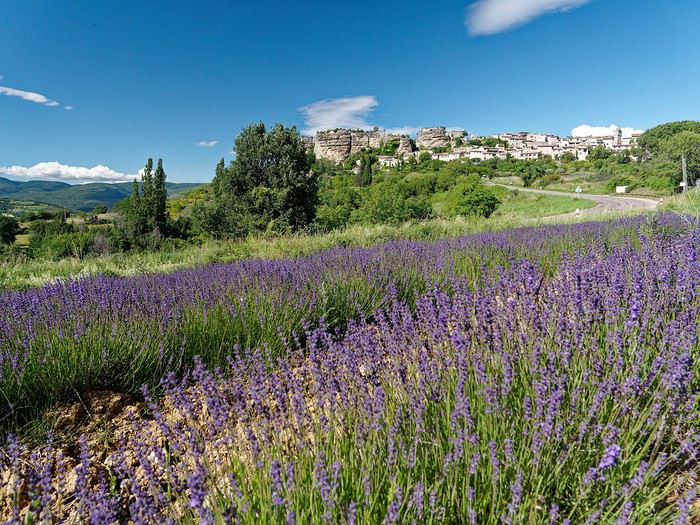
j'aurais dû revenir sur ce forum pour vous poster notre carnet de voyage à New-York en avril, et puis voilà, comme vous tous, nous sommes "cloués" ici, mais heureusement en bonne santé, et c'est bien là le principal !
Du coup nous n'avons pas utilisé nos congés d'avril car fortement mobilisés professionnellement pendant le confinement. Nous avons donc pu profiter d'une semaine de congés la semaine dernière (début juin) pour faire sauter la bulle des 100km et aller découvrir cette belle région du Luberon.
Alors embarquez avec moi, je vous amène au pays de la lavande (mais pas que !)
Flower power (Golfe du Morbihan) English translation pending
D'abord nous avons pensé que nous serions épargnés. La fabrique du monde aurait poursuivi sa besogne paisiblement, élaborant, jours intenses après nuits remplies, le devenir de l'humanité.
La montée en puissance s'est faite progressivement, un seul lit réservé au début, plus d'un tiers du service ensuite. Sans plus de personnel. Sans plus de matériel.
Envoyée spéciale dans une ville dépeuplée de ses habitants, immense privilège ou épée de Damoclès ? Immense privilège !
J'ai aimé aller et revenir dans un Paris fantomatique. Les trains étaient toujours à l'heure. Les affiches du métro parlaient d'un monde qui n'existait plus, présentaient des spectacles qui ne se tiendraient pas… et des pubs inutiles avant même d'avoir été essentielles. Coronavirus avait remplacé pickpocket dans les annonces sonores.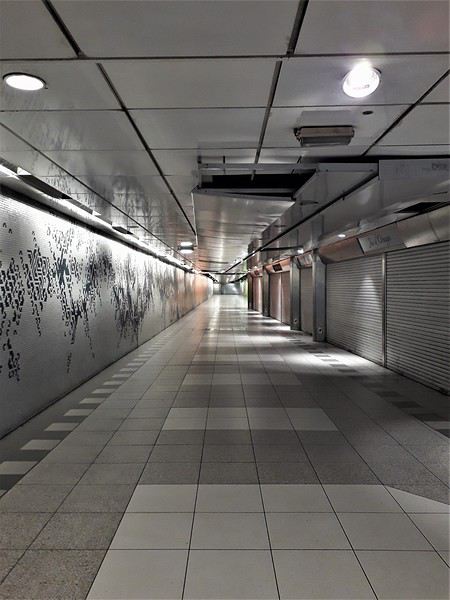
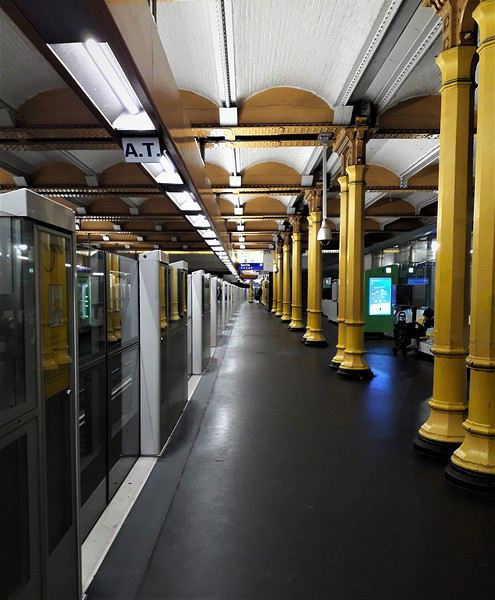
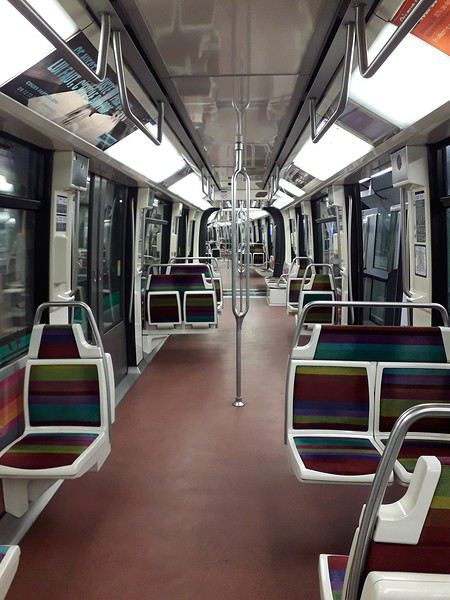
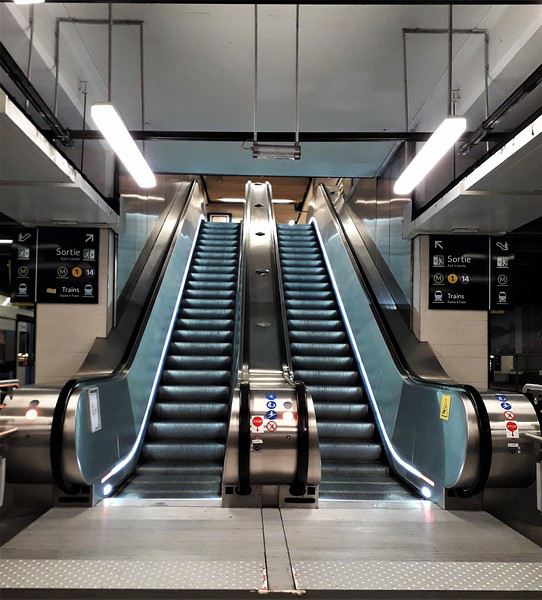
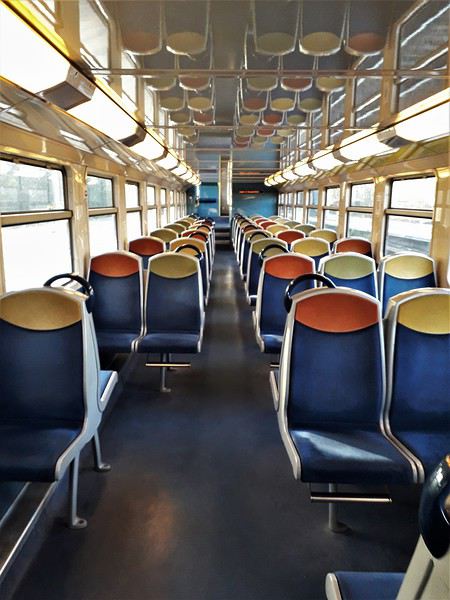 Moments irréels qui désapprennent toutes les certitudes, lieux familiers devenus méconnaissables qui lavent le regard et parfois l'émerveillent lorsque la rue offre des cadeaux inattendus : une minuscule boite rouge en forme de cœur qui détonne sur le trottoir gris. La foule qui ne se pressait pas ne l'avait pas piétinée.

Près de 3 mois ont passé embarqués dans un bateau qui tanguait sans savoir si et quand il arriverait au port… Près de 3 mois immergés dans l'inquiétude, l'incertitude, à chercher vainement le capitaine... mais trop de mains se pressaient sur la barre du gouvernail.
Cette folie qui a mis le monde à l'arrêt et la tête de certain.e.s à l'envers a imprimé dans ma mémoire une écœurante odeur d'alcool. La gueule de bois sans l'ivresse préalable.
... / ...
Alors, il faudra...
... Il faudra l'eau froide de l'Atlantique, des marches légères, l'odeur des genêts, le goût du large et des vues à perte de vue là où le ciel tombe dans la mer. Il faudra des chemins poudreux, parfois si étroits que les branches basses griffent les mollets et que les papillons s'emmêlent dans les cheveux. Un bout de GR, des sous bois aux racines saillantes avec l’océan à portée de main.
Un temps qui hésite entre soleil et pluie, des ciels de peintre en aplats de bleu soulignés de blanc et de gris fumé… des orages soudains.
Il faudra la force du granit, des villages ramassés autour de leurs églises bordées d'hortensias, les pavés inégaux des ruelles du centre ville, un passeur qui file vers une île… ce sera l'île d’Arz.
Et puis il faudra des fleurs ! Des fleurs sauvages ou cultivées, des empotées, des exubérantes, des rustiques. Des fleurs de toutes les couleurs, des tape à l'œil ou des petites fleurs de rien.
Des parterres odorants, bouquet de senteurs délicates ou d'odeurs fétides, des fleurs fanées, des justes écloses ou des déflorées. Des fleurs urbaines nichées dans les interstices du macadam, des belles des champs échevelées. Des mauvaises herbes. Des fleurs du mal. Un camaïeu de nuances pastels ou flamboyantes, un feu d'artifice d'arc en ciel.
Des fleurs soyeuses en couleurs comme des mots en couleurs… pour oublier, le temps d'une échappée belle, les fleurs de bitume, petits cercles blancs à deux ou trois pétales, pointillés rageurs, qui ont poussé en une nuit sur les trottoirs de Paris et les quais du métro.
Alors ce sera 8 jours dans le golfe du Morbihan aux alentours de Vannes et des marais de Séné.

Pari sur l'avenir, le train fut réservé alors que la limite des 100km était toujours en vigueur… elle sera supprimée 2 jours avant. (100km, c'est trop court pour ceux qui ... comme nous d'un aussi grand...)
Ici comme ailleurs la vie arrêtée a repris son cours avec des absurdités, des incohérences, du cynisme parfois... "Mesdames, messieurs, veuillez respecter la distance d'un mètre cinquante pour monter et descendre du train, mais une fois à bord vous aurez un voisin de siège puisque la promesse des 50% de places vendues a aussi été supprimée 2 jours avant !"
Envoyée spéciale dans une ville dépeuplée de ses habitants, immense privilège ou épée de Damoclès ? Immense privilège !
J'ai aimé aller et revenir dans un Paris fantomatique. Les trains étaient toujours à l'heure. Les affiches du métro parlaient d'un monde qui n'existait plus, présentaient des spectacles qui ne se tiendraient pas… et des pubs inutiles avant même d'avoir été essentielles. Coronavirus avait remplacé pickpocket dans les annonces sonores.
Moments irréels qui désapprennent toutes les certitudes, lieux familiers devenus méconnaissables qui lavent le regard et parfois l'émerveillent lorsque la rue offre des cadeaux inattendus : une minuscule boite rouge en forme de cœur qui détonne sur le trottoir gris. La foule qui ne se pressait pas ne l'avait pas piétinée.
Près de 3 mois ont passé embarqués dans un bateau qui tanguait sans savoir si et quand il arriverait au port… Près de 3 mois immergés dans l'inquiétude, l'incertitude, à chercher vainement le capitaine... mais trop de mains se pressaient sur la barre du gouvernail.
Cette folie qui a mis le monde à l'arrêt et la tête de certain.e.s à l'envers a imprimé dans ma mémoire une écœurante odeur d'alcool. La gueule de bois sans l'ivresse préalable.
... / ...
Alors, il faudra...
... Il faudra l'eau froide de l'Atlantique, des marches légères, l'odeur des genêts, le goût du large et des vues à perte de vue là où le ciel tombe dans la mer. Il faudra des chemins poudreux, parfois si étroits que les branches basses griffent les mollets et que les papillons s'emmêlent dans les cheveux. Un bout de GR, des sous bois aux racines saillantes avec l’océan à portée de main.
Un temps qui hésite entre soleil et pluie, des ciels de peintre en aplats de bleu soulignés de blanc et de gris fumé… des orages soudains.
Il faudra la force du granit, des villages ramassés autour de leurs églises bordées d'hortensias, les pavés inégaux des ruelles du centre ville, un passeur qui file vers une île… ce sera l'île d’Arz.
Et puis il faudra des fleurs ! Des fleurs sauvages ou cultivées, des empotées, des exubérantes, des rustiques. Des fleurs de toutes les couleurs, des tape à l'œil ou des petites fleurs de rien.
Des parterres odorants, bouquet de senteurs délicates ou d'odeurs fétides, des fleurs fanées, des justes écloses ou des déflorées. Des fleurs urbaines nichées dans les interstices du macadam, des belles des champs échevelées. Des mauvaises herbes. Des fleurs du mal. Un camaïeu de nuances pastels ou flamboyantes, un feu d'artifice d'arc en ciel.
Des fleurs soyeuses en couleurs comme des mots en couleurs… pour oublier, le temps d'une échappée belle, les fleurs de bitume, petits cercles blancs à deux ou trois pétales, pointillés rageurs, qui ont poussé en une nuit sur les trottoirs de Paris et les quais du métro.
Alors ce sera 8 jours dans le golfe du Morbihan aux alentours de Vannes et des marais de Séné.
Pari sur l'avenir, le train fut réservé alors que la limite des 100km était toujours en vigueur… elle sera supprimée 2 jours avant. (100km, c'est trop court pour ceux qui ... comme nous d'un aussi grand...)
Ici comme ailleurs la vie arrêtée a repris son cours avec des absurdités, des incohérences, du cynisme parfois... "Mesdames, messieurs, veuillez respecter la distance d'un mètre cinquante pour monter et descendre du train, mais une fois à bord vous aurez un voisin de siège puisque la promesse des 50% de places vendues a aussi été supprimée 2 jours avant !"