Results for "Sens+|+127+>+346"
71755 results found.
Our South Africa Trip Itinerary
Hi everyone,
I’m reaching out today to gather some great tips for the second part of our trip to South Africa, which will take place from 03/21 to 04/11. We don’t want to rush too much either. We’ll start in Cape Town (tickets already booked) since it seems like a good time to visit this region—except for the whales in Hermanus, which we won’t be seeing. Oh, and I almost forgot, we’re renting a car for both legs of the trip for more freedom.
The first part is planned like this:
- 03/21: Arrival in Cape Town, staying until 03/24 - 03/25: Visit to the Cape, including a stop in Simon’s Town - 2 nights in Stellenbosch from 03/26 to 03/28 - 3 nights in Knysna to explore the area from 03/28 to 03/31 - 03/31: Flight from Port Elizabeth to Durban, where we’ll spend one night in Umhlanga
After that, I’m a bit lost 🙂. Next, I was thinking of doing:
2 nights in St. Lucia 2 nights in Eswatini 4 nights in Kruger Park (2 nights in Skukuza and 2 nights in Balule to visit a private reserve) 1 night at Blyde Canyon 1 night somewhere to get closer to Johannesburg (Graskop?) since we’ll need to return the car by around 11:00 AM on 04/11.
So, does the second part make sense or not? I’ve done quite a bit of research, but I’m still a little lost . We can’t wait to be there, and your valuable advice would be very welcome. Thanks so much in advance, and have a great day! Luis
The first part is planned like this:
- 03/21: Arrival in Cape Town, staying until 03/24 - 03/25: Visit to the Cape, including a stop in Simon’s Town - 2 nights in Stellenbosch from 03/26 to 03/28 - 3 nights in Knysna to explore the area from 03/28 to 03/31 - 03/31: Flight from Port Elizabeth to Durban, where we’ll spend one night in Umhlanga
After that, I’m a bit lost 🙂. Next, I was thinking of doing:
2 nights in St. Lucia 2 nights in Eswatini 4 nights in Kruger Park (2 nights in Skukuza and 2 nights in Balule to visit a private reserve) 1 night at Blyde Canyon 1 night somewhere to get closer to Johannesburg (Graskop?) since we’ll need to return the car by around 11:00 AM on 04/11.
So, does the second part make sense or not? I’ve done quite a bit of research, but I’m still a little lost . We can’t wait to be there, and your valuable advice would be very welcome. Thanks so much in advance, and have a great day! Luis
Planning a family road trip from New York to Montreal
Hi there,
I’d like to plan a family road trip (2 adults, 2 kids aged 14 and 11) next summer, starting in New York and ending in Montreal.
Here’s my rough itinerary:
Arrival in New York: 4 nights
Train to Boston: 2 nights
Car rental, then off to Cape Cod: 2 nights
Head to Acadia Park: 2 nights
On to Quebec City: 2 nights
Tadoussac: 2 nights
Saguenay region/Lac Saint-Jean: 2 nights
Montreal: 2 nights
Departure from Montreal.
Could you share some ideas for places to stay, eat, visit, whale watching, lobster feasts, etc.?
Also, about the car rental: picking up in the US and dropping off in Canada—any tips?
Would it be easier to fly round-trip from Lyon to Montreal and drive to NY instead?
Thanks for your feedback!
Transport from São Vicente Airport to Mindelo and then ferry to Santo Antão
Hi everyone who loves Santo Antão in Cape Verde! 🙂
I’m arriving at São Vicente Airport in Cape Verde around 2:00 PM. Are there buses or *aluguer* that go to Mindelo, and is it possible to catch a ferry to Santo Antão right after, or is it better to leave the next day?
Thanks so much for your help
I’m arriving at São Vicente Airport in Cape Verde around 2:00 PM. Are there buses or *aluguer* that go to Mindelo, and is it possible to catch a ferry to Santo Antão right after, or is it better to leave the next day?
Thanks so much for your help
3-Week Itinerary in Nicaragua
Hi everyone!
It’s great to be back on the forum and reconnecting with fellow travelers... even though it’s true there’s a big gap in recent trip reports, making it tough to find up-to-date info, POST-COVID....
So, I’m jumping in... We (a couple in our forties—yikes, when did that happen?!) are heading there for 21 days in March. I’ve put together a rough itinerary based on what I’ve found here and elsewhere, and most importantly, our shared interests. We travel pretty low-key with backpacks, aren’t big on beaches or surfing, and prefer hiking, nature, and meaningful human connections (which means we don’t like to rush too much).
We love snorkeling/diving, but we’ve already seen some incredible spots around the world, and Corn Islands seem beautiful... but not necessarily *more* beautiful than what we’ve already experienced. Plus, the round-trip flight + boat was pretty far and expensive, so we’re probably skipping it for now.
Here’s where I’m at: Day 0: Arrive in Managua late at night → stay near the airport Day 1: Private taxi from the hotel to León. Explore León Day 2: Hike and surf Cerro Negro + El Hoyo, camp overnight Day 3: Return to León and explore more Day 4-5: Telica (probably stay near Managua on Day 5?) Day 6: Travel to San Carlos + El Castillo Day 7-10: El Castillo + Indio Maiz Day 11: Travel to Ometepe (this day looks like a real challenge... going around the north side of the lake is super long, and via the south and Costa Rica seems much easier, but I can’t figure out how to do it... any tips or ideas are welcome!!!) Day 12-17: Ometepe: volcano hikes, Charco Verde Reserve, waterfalls, scooter tour, and *pura vida* relaxation (this is the main reason we’re coming to Nicaragua, after all...) Day 18: Travel to Granada Day 19-21: Granada (stay near Managua airport on the 21st) Day 22: Return flight at 11:30 AM
What do you think? Thanks for your help!!
It’s great to be back on the forum and reconnecting with fellow travelers... even though it’s true there’s a big gap in recent trip reports, making it tough to find up-to-date info, POST-COVID....
So, I’m jumping in... We (a couple in our forties—yikes, when did that happen?!) are heading there for 21 days in March. I’ve put together a rough itinerary based on what I’ve found here and elsewhere, and most importantly, our shared interests. We travel pretty low-key with backpacks, aren’t big on beaches or surfing, and prefer hiking, nature, and meaningful human connections (which means we don’t like to rush too much).
We love snorkeling/diving, but we’ve already seen some incredible spots around the world, and Corn Islands seem beautiful... but not necessarily *more* beautiful than what we’ve already experienced. Plus, the round-trip flight + boat was pretty far and expensive, so we’re probably skipping it for now.
Here’s where I’m at: Day 0: Arrive in Managua late at night → stay near the airport Day 1: Private taxi from the hotel to León. Explore León Day 2: Hike and surf Cerro Negro + El Hoyo, camp overnight Day 3: Return to León and explore more Day 4-5: Telica (probably stay near Managua on Day 5?) Day 6: Travel to San Carlos + El Castillo Day 7-10: El Castillo + Indio Maiz Day 11: Travel to Ometepe (this day looks like a real challenge... going around the north side of the lake is super long, and via the south and Costa Rica seems much easier, but I can’t figure out how to do it... any tips or ideas are welcome!!!) Day 12-17: Ometepe: volcano hikes, Charco Verde Reserve, waterfalls, scooter tour, and *pura vida* relaxation (this is the main reason we’re coming to Nicaragua, after all...) Day 18: Travel to Granada Day 19-21: Granada (stay near Managua airport on the 21st) Day 22: Return flight at 11:30 AM
What do you think? Thanks for your help!!
Hiking step between Matsumoto and Tsumago
Hello,
I'm planning to travel from Matsumoto to Tsumago to hike to Magome. Is it reasonable to leave early in the morning from Matsumoto by train, stop in Narai for a stroll (knowing we'll have our big backpacks, I hope there's a luggage locker at the station), and then continue to Tsumago to do the hike to Magome?
Or is it better to stop and sleep halfway in Kiso-Fukushima? (I looked for accommodations in Narai but couldn't find any.)
Thanks in advance for your advice.
I'm planning to travel from Matsumoto to Tsumago to hike to Magome. Is it reasonable to leave early in the morning from Matsumoto by train, stop in Narai for a stroll (knowing we'll have our big backpacks, I hope there's a luggage locker at the station), and then continue to Tsumago to do the hike to Magome?
Or is it better to stop and sleep halfway in Kiso-Fukushima? (I looked for accommodations in Narai but couldn't find any.)
Thanks in advance for your advice.
Lake Chiew Lan in Khao Sok National Park
Hi,
I’m heading to Thailand (first time!) in a week. We planned to be in Khao Sok National Park on February 1st and 2nd.
I got a message yesterday saying it wouldn’t be possible to do any activities on Lake Chiew Lan as planned because of “weather conditions.” Despite all my research, I can’t find any info that supports this. Does anyone have recent updates? Is it really impossible to visit the lake, and if so, are there any alternatives?
They’re offering a walk to Bang Hua Rad waterfall instead. Any thoughts?
We’re really disappointed—the lake looked amazing 😢
Arriving at LAX at 1:05 PM: Is staying in Barstow doable or not?
Hello,
I’ve already gone through some threads dating back to 2010, but opinions are pretty mixed...
What’s the verdict in 2025?
- We’re arriving for a 15-day trip on Friday, June 13, theoretically at 1:05 PM (AF22).
- Rental car (Toyota RAV4) booked with Alamo ("requested" starting at 2:30 PM).
- Room reserved at the Best Western Desert Villa Inn in Barstow (check-in "6/7 PM" listed...) that same evening.
Does this seem reasonably doable to those familiar with the area, for a couple in their seventies, or would it be better to stop sooner (but where?)—even if it means extending the drive to Williams the next day? 😕...
Thanks for your advice!
Your recommendations for an authentic Japan itinerary
Hi! We’re traveling as a couple for 3 weeks in Japan in November. We’d love to visit Tokyo, Kyoto, Hiroshima, and Miyajima Island. Would anyone have a great itinerary to share? Thanks so much!
Karine First trip
Karine First trip
Santiago Airport Bus: Recent Experience Feedback
Hi there,
This topic has come up before, but I wanted to share a fresh experience from early 2025.
For those of you looking to take the bus to Santiago Airport, I recommend taking the Centropuerto bus from their departure point, which is located in the middle of Alameda, Santiago’s main avenue, just outside Line 1 of the Los Héroes metro station. If you board the bus anywhere else, it’ll most likely be full, and if you have luggage, that can be a hassle.
During daytime hours on weekdays, these buses run every 10 to 15 minutes. Plan for anywhere between 30 minutes to an hour to reach the airport from this spot, depending on the time and traffic.
The ticket costs 2000 CLP pesos, payable in cash in the local currency—about 2 € or $2 USD per person.
This topic has come up before, but I wanted to share a fresh experience from early 2025.
For those of you looking to take the bus to Santiago Airport, I recommend taking the Centropuerto bus from their departure point, which is located in the middle of Alameda, Santiago’s main avenue, just outside Line 1 of the Los Héroes metro station. If you board the bus anywhere else, it’ll most likely be full, and if you have luggage, that can be a hassle.
During daytime hours on weekdays, these buses run every 10 to 15 minutes. Plan for anywhere between 30 minutes to an hour to reach the airport from this spot, depending on the time and traffic.
The ticket costs 2000 CLP pesos, payable in cash in the local currency—about 2 € or $2 USD per person.
What’s your definition of a nature destination?
Hi,
I’m starting this thread after a digression that began in the India section and continued in a travel journal about Kerala.
The original topic was whether India is—or isn’t—a nature destination.
I’ll let you all discuss and share your own definition of a nature destination. 🙂
I’m starting this thread after a digression that began in the India section and continued in a travel journal about Kerala.
The original topic was whether India is—or isn’t—a nature destination.
I’ll let you all discuss and share your own definition of a nature destination. 🙂
Slow Travel or the Illusion of Authenticity
“Slow travel” is a concept that some tout as a philosophical revolution in travel. But on closer inspection, it’s nothing more than a marketing repackaging of an age-old practice.
This term is wrapped in an aura of intellectualism. It promises to reinvent the experience of travel by valuing slowness, contemplation, and cultural immersion.
The term “slow travel” claims to bring depth to travel, but it often relies on clichés.
Taking your time, meeting locals, avoiding quick visits—these practices have always existed and are nothing revolutionary.
Before the era of airplanes, high-speed trains, and express stays, traveling necessarily meant taking your time. Pilgrims, merchants, and explorers already practiced a form of “slow travel,” without hashtags or self-proclaimed spiritual guides.
Crossing lands on foot or by horse required total immersion in the landscapes, cultures, and unpredictability of the journey. Yet, no one attributed philosophical intentions to them: it was a necessity.
Slow travel, in its current version, may be less a philosophy than a reflection of the contradictions of an affluent class searching for meaning in a world they help overload.
So-called “slow” travel is presented as a privileged way to understand a culture, but this claim is debatable. A region never represents an entire country.
Immersing yourself in a community doesn’t guarantee a complete or more authentic understanding than any other way of traveling.
Slowness in itself doesn’t guarantee depth or ethics. You can immerse yourself in a place over a weekend, just as you can spend months in a country without grasping its subtleties.
By positioning itself as an antidote to “fast” tourism, slow travel fetishizes a temporality that only makes sense if it’s accompanied by real openness and an effort to integrate.
But this over-intellectualization often masks a desire to belong to a trend or a need to stand out socially.
Behind this posture sometimes lies a whim: the urge to reinvent one’s life elsewhere in an idealized form. But this quest for elsewhere remains fundamentally a way to escape or respond to unease, rather than a true commitment to the cultures visited.
When we talk about “encounters” while traveling, we often forget that these exchanges are facilitated by biased contexts. As a traveler, you’re seen as a temporary visitor, unattached, and that changes the dynamic.
Locals, whether curious or used to tourists, adopt a different stance than they would with a neighbor they see daily.
This interaction is also tinged with asymmetry: the traveler has the luxury of time and availability, while in daily life, personal concerns often take precedence over the desire to connect.
The flip side is that the openness displayed while traveling is often a facade. We boast about chatting with a fisherman or sharing a meal with a local family, but how many of these encounters lead to a real understanding of cultural differences or sincere reflection?
Once home, these moments become anecdotes, social trophies to show off, without fundamentally changing our relationship with others in our daily lives.
By imposing a definition, we push people to adapt their practices to fit an idealized model. This can lead to a paradoxical standardization: “slow travel” becomes a checklist of behaviors (meetings, immersion, slowness).
The “bobos” (bourgeois-bohemians), often in search of meaning in a world saturated with options, believe that giving a name to a practice grants it legitimacy or moral value. But this obsession with framing and theorizing travel only drains it of its spontaneity.
Someone who grew up at the crossroads of multiple cultures, on the other hand, doesn’t feel this need. For them, traveling isn’t a philosophical project but an intrinsic part of their life.
The very concept of “slow travel” can seem absurd: why glorify what’s simply natural?
Why try to turn into an ideology what should be a personal, intimate experience, free from semantic constraints?
Ultimately, this need for labeling, this frantic quest to name every gesture, reveals a society craving simplicity.
Travel, in its purest form, doesn’t need justification or slogans. It doesn’t need slowness or speed: it’s simply lived.
Perhaps the real challenge is to unlearn this Western habit of conceptualizing everything that should simply be felt.
For many, travel is a parenthesis, a temporary break from daily life. But if we reject this distinction between “home” and “elsewhere,” every human life becomes a continuous journey through varied environments.
From this perspective, “slow travel” loses all meaning, because living somewhere—whether for a week or five years—is part of the same experience of adaptation.
So, we ask the fans of marketing slogans: is travel a parenthesis or a journey?
“Slow travel” is often driven by a Western eco-bobo ideology, tinged with post-colonial guilt. This discourse promotes a supposedly virtuous way of traveling while forgetting that these practices remain a privilege.
Far from deconstructing power dynamics, it sometimes reinforces them by glorifying a different kind of consumption, still centered on comfort.
There’s also a condescending side to this rhetoric. By idealizing slowness, slow travel advocates imply that those who travel quickly or on a budget are less “authentic” in their approach.
Yet, isn’t that a form of contempt? Do those who leave for a well-deserved week after months of hard work deserve less consideration?
Concepts like “slow travel” or “sustainable tourism” seem hollow when reduced to marketing slogans or standardized behaviors. They confine travel to preconceived frameworks, stripping it of its spontaneous and unpredictable dimension.
Instead of categorizing, it would be more relevant to recognize the plurality of human experiences without trying to define them.
Slow travel doesn’t invent anything. It simply puts into words—and often slogans—what travel has always been for those who practice it with intention.
Maybe we should stop trying to theorize every movement and simply rediscover travel for what it is: a human experience, sometimes slow, sometimes fast, but always personal.
More info on our site
This term is wrapped in an aura of intellectualism. It promises to reinvent the experience of travel by valuing slowness, contemplation, and cultural immersion.
The term “slow travel” claims to bring depth to travel, but it often relies on clichés.
Taking your time, meeting locals, avoiding quick visits—these practices have always existed and are nothing revolutionary.
Before the era of airplanes, high-speed trains, and express stays, traveling necessarily meant taking your time. Pilgrims, merchants, and explorers already practiced a form of “slow travel,” without hashtags or self-proclaimed spiritual guides.
Crossing lands on foot or by horse required total immersion in the landscapes, cultures, and unpredictability of the journey. Yet, no one attributed philosophical intentions to them: it was a necessity.
Slow travel, in its current version, may be less a philosophy than a reflection of the contradictions of an affluent class searching for meaning in a world they help overload.
So-called “slow” travel is presented as a privileged way to understand a culture, but this claim is debatable. A region never represents an entire country.
Immersing yourself in a community doesn’t guarantee a complete or more authentic understanding than any other way of traveling.
Slowness in itself doesn’t guarantee depth or ethics. You can immerse yourself in a place over a weekend, just as you can spend months in a country without grasping its subtleties.
By positioning itself as an antidote to “fast” tourism, slow travel fetishizes a temporality that only makes sense if it’s accompanied by real openness and an effort to integrate.
But this over-intellectualization often masks a desire to belong to a trend or a need to stand out socially.
Behind this posture sometimes lies a whim: the urge to reinvent one’s life elsewhere in an idealized form. But this quest for elsewhere remains fundamentally a way to escape or respond to unease, rather than a true commitment to the cultures visited.
When we talk about “encounters” while traveling, we often forget that these exchanges are facilitated by biased contexts. As a traveler, you’re seen as a temporary visitor, unattached, and that changes the dynamic.
Locals, whether curious or used to tourists, adopt a different stance than they would with a neighbor they see daily.
This interaction is also tinged with asymmetry: the traveler has the luxury of time and availability, while in daily life, personal concerns often take precedence over the desire to connect.
The flip side is that the openness displayed while traveling is often a facade. We boast about chatting with a fisherman or sharing a meal with a local family, but how many of these encounters lead to a real understanding of cultural differences or sincere reflection?
Once home, these moments become anecdotes, social trophies to show off, without fundamentally changing our relationship with others in our daily lives.
By imposing a definition, we push people to adapt their practices to fit an idealized model. This can lead to a paradoxical standardization: “slow travel” becomes a checklist of behaviors (meetings, immersion, slowness).
The “bobos” (bourgeois-bohemians), often in search of meaning in a world saturated with options, believe that giving a name to a practice grants it legitimacy or moral value. But this obsession with framing and theorizing travel only drains it of its spontaneity.
Someone who grew up at the crossroads of multiple cultures, on the other hand, doesn’t feel this need. For them, traveling isn’t a philosophical project but an intrinsic part of their life.
The very concept of “slow travel” can seem absurd: why glorify what’s simply natural?
Why try to turn into an ideology what should be a personal, intimate experience, free from semantic constraints?
Ultimately, this need for labeling, this frantic quest to name every gesture, reveals a society craving simplicity.
Travel, in its purest form, doesn’t need justification or slogans. It doesn’t need slowness or speed: it’s simply lived.
Perhaps the real challenge is to unlearn this Western habit of conceptualizing everything that should simply be felt.
For many, travel is a parenthesis, a temporary break from daily life. But if we reject this distinction between “home” and “elsewhere,” every human life becomes a continuous journey through varied environments.
From this perspective, “slow travel” loses all meaning, because living somewhere—whether for a week or five years—is part of the same experience of adaptation.
So, we ask the fans of marketing slogans: is travel a parenthesis or a journey?
“Slow travel” is often driven by a Western eco-bobo ideology, tinged with post-colonial guilt. This discourse promotes a supposedly virtuous way of traveling while forgetting that these practices remain a privilege.
Far from deconstructing power dynamics, it sometimes reinforces them by glorifying a different kind of consumption, still centered on comfort.
There’s also a condescending side to this rhetoric. By idealizing slowness, slow travel advocates imply that those who travel quickly or on a budget are less “authentic” in their approach.
Yet, isn’t that a form of contempt? Do those who leave for a well-deserved week after months of hard work deserve less consideration?
Concepts like “slow travel” or “sustainable tourism” seem hollow when reduced to marketing slogans or standardized behaviors. They confine travel to preconceived frameworks, stripping it of its spontaneous and unpredictable dimension.
Instead of categorizing, it would be more relevant to recognize the plurality of human experiences without trying to define them.
Slow travel doesn’t invent anything. It simply puts into words—and often slogans—what travel has always been for those who practice it with intention.
Maybe we should stop trying to theorize every movement and simply rediscover travel for what it is: a human experience, sometimes slow, sometimes fast, but always personal.
More info on our site
Where to stay on the island of Syros in Greece?
Hi there.
I’m planning a 4-day trip to Syros at the end of July. Any great tips or recommendations for a place to stay on the island? We’re a family of 4 with two teens (13 and 15).
Thanks!
Tom
I’m planning a 4-day trip to Syros at the end of July. Any great tips or recommendations for a place to stay on the island? We’re a family of 4 with two teens (13 and 15).
Thanks!
Tom
Gravel bike route from Tafraout to M'haech Pass
Hi everyone, could someone give me info on the track that starts from Tafraout toward M’harch Pass and then continues to Mcissi to join the national road heading west to Alnif? I’m planning to go in April 2025 by gravel bike/MTB. Is it doable? Is there a lot of soft sand??? How many km???? Thanks for any tips, and happy end of the year to all! Best, Rv.
Layover luggage in Washington IAD
Hi, I have a flight from San Diego to Newark with a layover at Washington IAD (Dulles).
In Washington, do I need to collect my luggage or will it be transferred automatically?
Back on VoyageForum
Hello everyone.
It's to greet all the old-timers here with whom I had so many interactions when I used to visit this platform regularly and eagerly before it was shut down, much to our dismay.
I was a member under the name "Jaydev," but it seems I can't log in with that name anymore. Maybe I deleted the username, thinking VoyageForum wouldn't come back.
I'm so happy to be able to log in here again. Talking about Indian things—and in the language I love—lets me practice and chat with people who love the land where I was born.
From a visitor's perspective, I find it really interesting to interact with the local population. That's what gives meaning to the word "travel." Without it, traveling is essentially just "getting from one place to another."
Thanks, and see you soon.
Jaydev
I was a member under the name "Jaydev," but it seems I can't log in with that name anymore. Maybe I deleted the username, thinking VoyageForum wouldn't come back.
I'm so happy to be able to log in here again. Talking about Indian things—and in the language I love—lets me practice and chat with people who love the land where I was born.
From a visitor's perspective, I find it really interesting to interact with the local population. That's what gives meaning to the word "travel." Without it, traveling is essentially just "getting from one place to another."
Thanks, and see you soon.
Jaydev
Where to start planning an Antarctica excursion?
Hi everyone,
I’ve been thinking about an Antarctica trip for a while now and it really appeals to me, but I’m not sure how to start my research. First off, is it better to leave from Chile or Argentina (assuming we’re not departing from France)? Is it more reassuring to travel on a large ship or a medium-sized one? What aspects should I check (total number of days, number of excursions, well-known vs. lesser-known companies, local agencies, etc.)? What are the must-sees I shouldn’t miss, and what’s unnecessary? Thanks for sharing your experiences! Best, Dominique
I’ve been thinking about an Antarctica trip for a while now and it really appeals to me, but I’m not sure how to start my research. First off, is it better to leave from Chile or Argentina (assuming we’re not departing from France)? Is it more reassuring to travel on a large ship or a medium-sized one? What aspects should I check (total number of days, number of excursions, well-known vs. lesser-known companies, local agencies, etc.)? What are the must-sees I shouldn’t miss, and what’s unnecessary? Thanks for sharing your experiences! Best, Dominique
Sidi Ifni Hotel Suerte Loca: Avoid (Morocco)
Hotel La suerte loca in Sidi Ifni.
Move along quickly!
LIAR AND DISHONEST.
Not to mention the state of the rooms. That’ll come later.
I booked three nights on-site without a bathroom in room (No. 16). I had called the day before to check availability. The next day, they told me I couldn’t stay in that room on the third night but offered to move me to another room—even more run-down than this one—and without a bathroom. They claimed there had been a mistake and the room was already booked, which is completely false. I’ve been traveling for 20 years and can spot hoteliers’ tricks. The woman running the place checked all her online sites and her schedule before confirming the room was available. She was sure. Especially since they display the booking schedule in front of each room to avoid mistakes. So, a pure lie. For what reason?
For me, two options: either take the run-down room for cheaper without a bathroom or leave. Great customer service. I found another hotel, Safa, a bit further away, at the same price with breakfast—100 times more luxurious and comfortable than this place. Or just down on the beach, Hotel Aït Baamrane, same price or even negotiable, and still much more comfortable.
When I left in the morning, they barely said goodbye, not a word of apology, no gesture to make up for kicking me out. NOTHING, NADA!
The woman running the place, with her fake friendliness and hypocrisy, only cares about one thing: money.
Otherwise, the place could be great if it were properly maintained. Instead of repainting the balconies, they should replace the mattresses, which are completely wrecked. The only good thing about this hotel is its location above the sea.
Otherwise, Room No. 16 was recently repainted. Every time someone uses the water, there’s a huge noise from the pipes and vibrations. The walls are paper-thin (figuratively speaking)—when neighbors talked or coughed, it was like they were in the room with me.
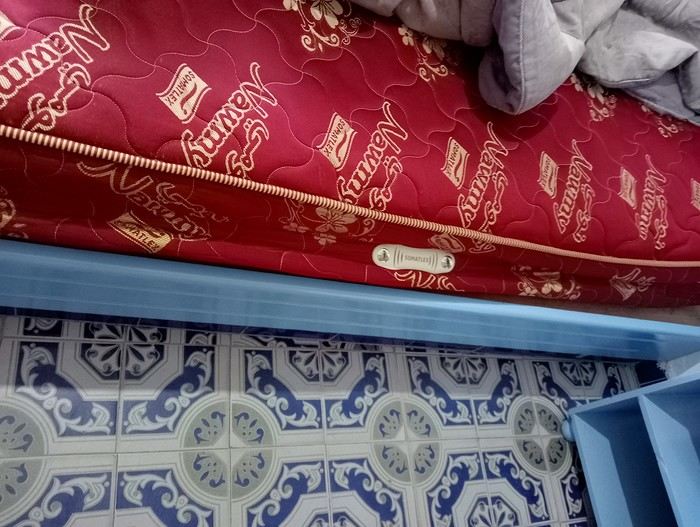
I had to wait to check in because of cleaning, but once inside, the bedside tables and the table were filthy (see photo). In the bathroom, there’s a stale smell of old urine and sewage due to the worn-out toilet pipes (see photo), with minimal lighting. The showerhead is disgustingly dirty. The gray duvet is dirty and very old, as are the blankets, which are dusty and grimy. The Wi-Fi worked in the room the first day but not the next.
And finally, the worst part: the mattress is completely wrecked and sagging. The springs dig into your body. Horrible! Instead of repainting, they’d do better to change the mattresses.
As for meals, the prices are outrageous. This hotel relies on its old popularity, but it’s not worth 190 dirhams for this room. I’d say it’s barely worth over 100 dirhams. Since I’ve been in Morocco, I’ve stayed in palaces for 130 dirhams with breakfast.
So, my advice: don’t trust the reviews and avoid this place. You’ll find much better at the same price, as mentioned above.

I booked three nights on-site without a bathroom in room (No. 16). I had called the day before to check availability. The next day, they told me I couldn’t stay in that room on the third night but offered to move me to another room—even more run-down than this one—and without a bathroom. They claimed there had been a mistake and the room was already booked, which is completely false. I’ve been traveling for 20 years and can spot hoteliers’ tricks. The woman running the place checked all her online sites and her schedule before confirming the room was available. She was sure. Especially since they display the booking schedule in front of each room to avoid mistakes. So, a pure lie. For what reason?
For me, two options: either take the run-down room for cheaper without a bathroom or leave. Great customer service. I found another hotel, Safa, a bit further away, at the same price with breakfast—100 times more luxurious and comfortable than this place. Or just down on the beach, Hotel Aït Baamrane, same price or even negotiable, and still much more comfortable.
When I left in the morning, they barely said goodbye, not a word of apology, no gesture to make up for kicking me out. NOTHING, NADA!
The woman running the place, with her fake friendliness and hypocrisy, only cares about one thing: money.
Otherwise, the place could be great if it were properly maintained. Instead of repainting the balconies, they should replace the mattresses, which are completely wrecked. The only good thing about this hotel is its location above the sea.
Otherwise, Room No. 16 was recently repainted. Every time someone uses the water, there’s a huge noise from the pipes and vibrations. The walls are paper-thin (figuratively speaking)—when neighbors talked or coughed, it was like they were in the room with me.
I had to wait to check in because of cleaning, but once inside, the bedside tables and the table were filthy (see photo). In the bathroom, there’s a stale smell of old urine and sewage due to the worn-out toilet pipes (see photo), with minimal lighting. The showerhead is disgustingly dirty. The gray duvet is dirty and very old, as are the blankets, which are dusty and grimy. The Wi-Fi worked in the room the first day but not the next.
And finally, the worst part: the mattress is completely wrecked and sagging. The springs dig into your body. Horrible! Instead of repainting, they’d do better to change the mattresses.
As for meals, the prices are outrageous. This hotel relies on its old popularity, but it’s not worth 190 dirhams for this room. I’d say it’s barely worth over 100 dirhams. Since I’ve been in Morocco, I’ve stayed in palaces for 130 dirhams with breakfast.
So, my advice: don’t trust the reviews and avoid this place. You’ll find much better at the same price, as mentioned above.
Visiting French Polynesia or other islands?
Hi,
When I hear our French friends talk about them, they’re the most beautiful islands in the world.
For those of you who’ve traveled extensively, is that really the case?
Are the prices for accommodation, even basic ones, justified? Isn’t a room in a family-run guesthouse at 150/200 € a bit much?
Are there other islands in Polynesia (non-French) that are just as "paradise-like" but more affordable?
I’d love to hear your thoughts.
Road from Allougoum to Akka Ighane (Morocco)
Hi, does anyone know the current condition of the track/road P1800 that goes from R111 just past Allougoum to Akka Ighane on P1743?
Google Maps says it's doable, but all the info I’ve gotten advises against it.
From Akka Ighane, at the junction with the road to Auguinane, it was even paved for the 10 km I covered two years ago.
But in Morocco, paved roads can suddenly end without warning 😏.
Two weeks in Bangkok: your off-the-beaten-path suggestions
Hello,
After a lot of searching, exchanging ideas, and thinking it over, I’ve decided to go back to my original plan of spending two weeks in Bangkok. From January 19th to February 2nd. I’ll also take a quick trip for one night/two days to Ayutthaya (and return to Bangkok, where I’ll have kept the apartment I booked), and possibly the same for Kanchanaburi, depending on how I feel once I’m there—whether I find something more interesting in Bangkok or nearby.
The key word is: taking my time to take photos, observe, taste, savor (in every sense of the word), and most importantly, not rushing.
Beyond the must-see tourist spots, I’d love to wander around the city and maybe within a 40 to 50 km radius for a day trip to discover unusual and lesser-known streets, houses, temples, markets, gardens, and more.
I’ll also be spending two weeks in Chiang Mai and two weeks in Nan.
I’m open to any suggestions. Thank you so much!
URGENT! No OTP - how to proceed without an IRCTC account? (India)
Hi there,
I need help creating my IRCTC account. I tried to create an account via the website (not the app), but I’m not receiving any OTP at my email address. It asks me to verify my OTP to confirm registration, but I’ve tried multiple emails and checked spam, trash, etc.—nothing. I’m not getting any OTP at all.
What should I do now?
I want to take the train from Delhi to Agra Cantt. What are my options without an IRCTC account? I have a trip from New Delhi to Agra and another from Agra to Jaipur.
FYI: I’d prefer to avoid the bus since it doesn’t seem to stop, and I don’t feel comfortable jumping off a moving bus. Too risky for my taste.
Thanks in advance for your help!
I need help creating my IRCTC account. I tried to create an account via the website (not the app), but I’m not receiving any OTP at my email address. It asks me to verify my OTP to confirm registration, but I’ve tried multiple emails and checked spam, trash, etc.—nothing. I’m not getting any OTP at all.
What should I do now?
I want to take the train from Delhi to Agra Cantt. What are my options without an IRCTC account? I have a trip from New Delhi to Agra and another from Agra to Jaipur.
FYI: I’d prefer to avoid the bus since it doesn’t seem to stop, and I don’t feel comfortable jumping off a moving bus. Too risky for my taste.
Thanks in advance for your help!
Northern Chile, Andean impressions.
Alright, this year, we're heading back to South America!
The initial plan was to retrace the route we imagined in the summer of 2020: a trip to northern Argentina starting from Córdoba.
Unfortunately, the flight to Córdoba no longer exists, and airfares to Javier Milei’s country are both outrageously priced and involve multiple layovers.
So, I tweaked Google Flights every which way and finally found a flight within my budget—departing from Clermont-Ferrand!
Not to Argentina, though...
Our transatlantic flight will cross the snow-capped Andes, landing in Santiago, Chile, with a return from Lima!
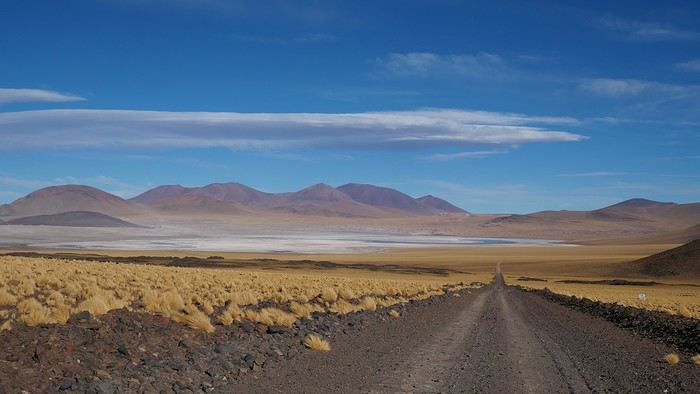
In between, two domestic flights and a big road trip loop starting from the coastal city of Arica to explore the treasures of northern Chile.
Our mode of transport: a pseudo 4x4 that won’t take us through sand dunes or devilish tracks but will let us tackle the entire secondary network, including unpaved main roads, while still being insured.
Is the suitcase packed with all-season clothes?
Are the driver’s license and passport ready?
Bank cards and a few euros too?
Off we go for just over 3 weeks of southern wanderings!
--/--
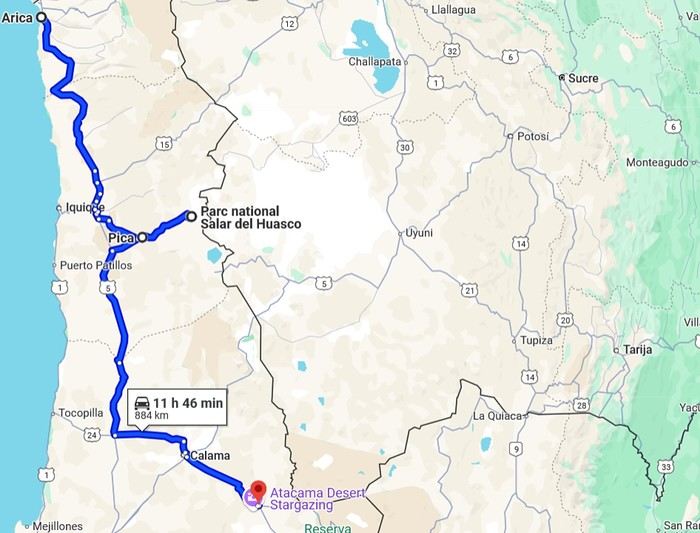
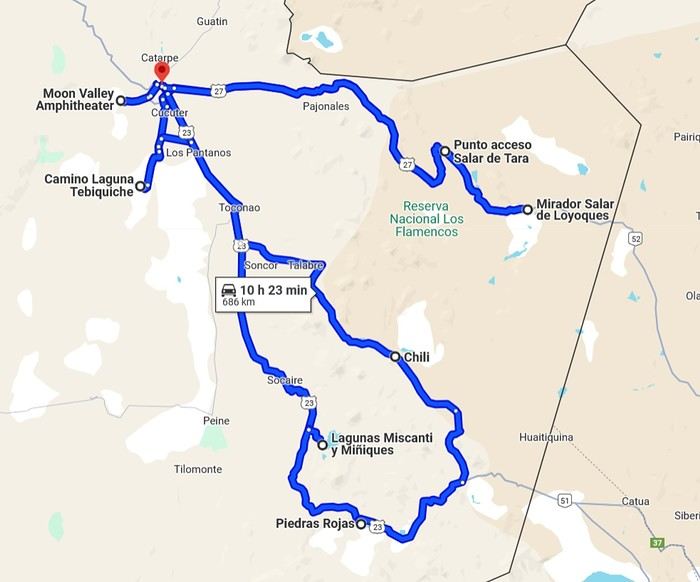
To keep all my esteemed readers on track, here are a few maps outlining the Arica-Arica loop!
1- From Arica to San Pedro de Atacama via Pica and the Salar de Huasco
 2- Around San Pedro
3- From San Pedro to Cariquima
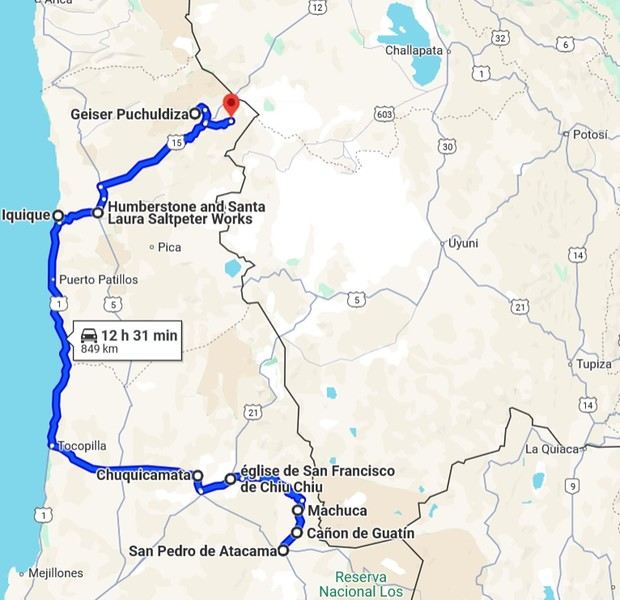
4- From Cariquima to Putre
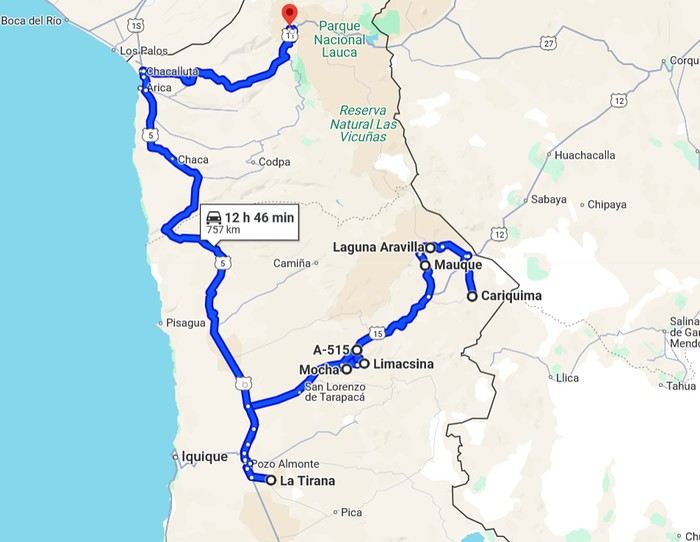
5 - From Putre to Arica
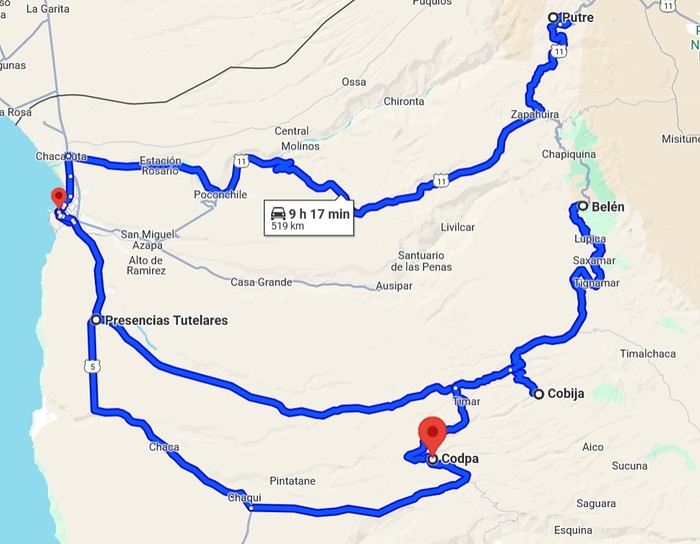
Gas stations in this part of Chile are located in Arica, Iquique, Pozo Almonte, Pica, Calama, and San Pedro de Atacama.
The initial plan was to retrace the route we imagined in the summer of 2020: a trip to northern Argentina starting from Córdoba.
Unfortunately, the flight to Córdoba no longer exists, and airfares to Javier Milei’s country are both outrageously priced and involve multiple layovers.
So, I tweaked Google Flights every which way and finally found a flight within my budget—departing from Clermont-Ferrand!
Not to Argentina, though...
Our transatlantic flight will cross the snow-capped Andes, landing in Santiago, Chile, with a return from Lima!
In between, two domestic flights and a big road trip loop starting from the coastal city of Arica to explore the treasures of northern Chile.
Our mode of transport: a pseudo 4x4 that won’t take us through sand dunes or devilish tracks but will let us tackle the entire secondary network, including unpaved main roads, while still being insured.
Is the suitcase packed with all-season clothes?
Are the driver’s license and passport ready?
Bank cards and a few euros too?
Off we go for just over 3 weeks of southern wanderings!
--/--
To keep all my esteemed readers on track, here are a few maps outlining the Arica-Arica loop!
1- From Arica to San Pedro de Atacama via Pica and the Salar de Huasco
2- Around San Pedro3- From San Pedro to Cariquima
4- From Cariquima to Putre
5 - From Putre to Arica
Gas stations in this part of Chile are located in Arica, Iquique, Pozo Almonte, Pica, Calama, and San Pedro de Atacama.
Visiting Bangkok and Chiang Mai during a short stay
Hello everyone,
My husband and I are planning a trip to Thailand from January 2 to 10. Departure from Brussels on January 1 – arriving in Bangkok at 6:00 AM on January 2. Departure from Bangkok on January 11 at 2:00 AM, arriving in Brussels at 1:25 PM the same day. For professional and personal reasons, we can’t extend the trip.
I don’t plan on just lounging on a beach in Phuket, so with 9 days on the ground, I know it’s short... But having done this before in Hong Kong and Shanghai, I know it’s doable, refreshing, and enjoyable. We did it with the kids and included a 2- or 3-day stay at Disneyland in each city. Basically, we spent 5-6 days in each city.
Anyway, I’m reaching out because I’ve heard and read so many conflicting opinions that my head is spinning.
Following the saying, "don’t bite off more than you can chew," I’m assuming I should keep it simple. So I’m torn between just Bangkok or Bangkok and Chiang Mai.
If I go with the second option, I’m debating whether to head straight to Chiang Mai on the day we arrive (but given the flight times, we’d lose pretty much the whole day) or spend two days in Bangkok first, then go to Chiang Mai for 3-4 days, and return to Bangkok.
Thanks for your advice!
My husband and I are planning a trip to Thailand from January 2 to 10. Departure from Brussels on January 1 – arriving in Bangkok at 6:00 AM on January 2. Departure from Bangkok on January 11 at 2:00 AM, arriving in Brussels at 1:25 PM the same day. For professional and personal reasons, we can’t extend the trip.
I don’t plan on just lounging on a beach in Phuket, so with 9 days on the ground, I know it’s short... But having done this before in Hong Kong and Shanghai, I know it’s doable, refreshing, and enjoyable. We did it with the kids and included a 2- or 3-day stay at Disneyland in each city. Basically, we spent 5-6 days in each city.
Anyway, I’m reaching out because I’ve heard and read so many conflicting opinions that my head is spinning.
Following the saying, "don’t bite off more than you can chew," I’m assuming I should keep it simple. So I’m torn between just Bangkok or Bangkok and Chiang Mai.
If I go with the second option, I’m debating whether to head straight to Chiang Mai on the day we arrive (but given the flight times, we’d lose pretty much the whole day) or spend two days in Bangkok first, then go to Chiang Mai for 3-4 days, and return to Bangkok.
Thanks for your advice!
Morocco, an encounter...
Hello everyone,
I’ve been to Morocco about fifteen times, but I’ve never posted a travel journal here on Voyage Forum. Why? I have no idea… Maybe because this section was so active, with lots of stories and photos. I thought sharing my adventures in *al Maghrib* wouldn’t be very original. Today, this space feels quieter, so what if I tried to give it a little life back, modestly? With some help…
This trip will be different. From the start of my relationship with Richard, I was determined to introduce him to *my* Morocco. But he was a bit reluctant… He’ll tell you about our 2022 meeting, and I’ll illustrate it with my photos, just like we did with our India travel journal.
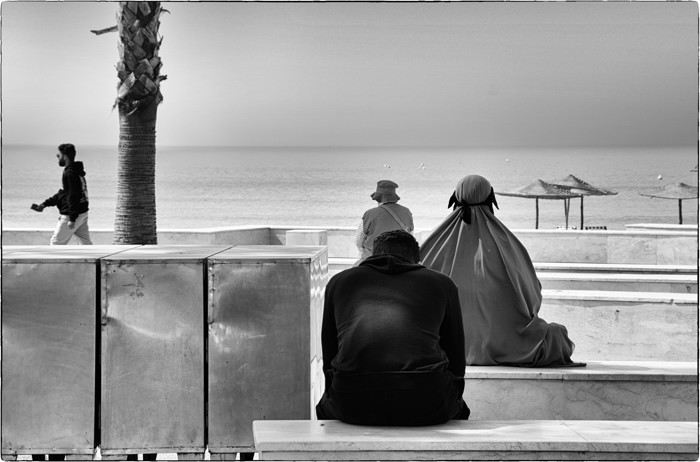
I’ve been to Morocco about fifteen times, but I’ve never posted a travel journal here on Voyage Forum. Why? I have no idea… Maybe because this section was so active, with lots of stories and photos. I thought sharing my adventures in *al Maghrib* wouldn’t be very original. Today, this space feels quieter, so what if I tried to give it a little life back, modestly? With some help…
This trip will be different. From the start of my relationship with Richard, I was determined to introduce him to *my* Morocco. But he was a bit reluctant… He’ll tell you about our 2022 meeting, and I’ll illustrate it with my photos, just like we did with our India travel journal.
Modification insurance with Edreams
Supposedly modification insurance = big scam, let me explain:Hello,
I’ve been an Edreams customer for decades, spending tens of thousands of euros with them. For this latest trip, we knew our departure date but weren’t sure about the exact return date. So, we booked tickets supposedly "Modifiable sans frais" (fee-free modifiable).
We left on September 3rd, and a week before the initially booked return date, we finalized our schedule. I went to my booking to make the change. And then... I found out that if you’ve already taken your outbound flight, you can no longer modify the return flight!!!!!!!
Like most people, I didn’t read the long, complicated, and tedious fine print in the terms and conditions—which I later took the time to go through. Here’s an excerpt: "Flexible Name Guarantee Our Superflex fare includes a Flexible Name Guarantee that allows customers to change the full name of one of the passengers on their flight tickets. This contractual guarantee takes effect at the time of booking and expires 24 hours before the start of the trip, determined by the date and time of departure of the first flight included in the booking."
In short, I paid an extra 500 € for this insurance (for 4 tickets) that’s absolutely useless.
In my opinion, when I book a modifiable ticket, it’s PRECISELY BECAUSE I KNEW I’D NEED TO CHANGE MY DATE ONCE I ARRIVED AT MY DESTINATION.
But I learned that this insurance stops 24 hours before departure.
So, if you’re thinking of changing your return dates after you’ve already taken your outbound flight, well, this insurance won’t work—and they make sure not to clearly explain that to you.
So, dear EDREAMS, thank you for being my booking portal for 15 years. I’ve traveled all over the world (74 countries visited—who can top that?), spent a fortune on your site, and I’m saying "Adios". On top of that, I’ll take care of your online reputation since it’s my job (digital marketing).
Hasta la vista
I’ve been an Edreams customer for decades, spending tens of thousands of euros with them. For this latest trip, we knew our departure date but weren’t sure about the exact return date. So, we booked tickets supposedly "Modifiable sans frais" (fee-free modifiable).
We left on September 3rd, and a week before the initially booked return date, we finalized our schedule. I went to my booking to make the change. And then... I found out that if you’ve already taken your outbound flight, you can no longer modify the return flight!!!!!!!
Like most people, I didn’t read the long, complicated, and tedious fine print in the terms and conditions—which I later took the time to go through. Here’s an excerpt: "Flexible Name Guarantee Our Superflex fare includes a Flexible Name Guarantee that allows customers to change the full name of one of the passengers on their flight tickets. This contractual guarantee takes effect at the time of booking and expires 24 hours before the start of the trip, determined by the date and time of departure of the first flight included in the booking."
In short, I paid an extra 500 € for this insurance (for 4 tickets) that’s absolutely useless.
In my opinion, when I book a modifiable ticket, it’s PRECISELY BECAUSE I KNEW I’D NEED TO CHANGE MY DATE ONCE I ARRIVED AT MY DESTINATION.
But I learned that this insurance stops 24 hours before departure.
So, if you’re thinking of changing your return dates after you’ve already taken your outbound flight, well, this insurance won’t work—and they make sure not to clearly explain that to you.
So, dear EDREAMS, thank you for being my booking portal for 15 years. I’ve traveled all over the world (74 countries visited—who can top that?), spent a fortune on your site, and I’m saying "Adios". On top of that, I’ll take care of your online reputation since it’s my job (digital marketing).
Hasta la vista
4x4 Expeditions in Southern Africa
Hi there,
Here’s a quick summary of six trips across Southern Africa, covering South Africa, Namibia, Botswana, Zimbabwe, and more. I traveled for a total of 23 months, over 100,000 km, and crossed 9 countries from South Africa to Tanzania. To do this, I bought an old Land Cruiser—a 1989 BJ 75 with a long chassis and a 3.4L turbo engine—which I converted into a bush camper set up for self-sufficiency in Africa: dual fuel tanks (235 L total) plus 2 x 20-liter jerry cans of diesel, 2 spare tires, a compressor, a toolbox with repair gear, a 50-liter water tank plus 2 x 30-liter and 2 x 10-liter jerry cans, a roof tent, multiple storage boxes, a sturdy roof rack, and even a paramotor. I also packed a first-aid kit and shipped the camper to South Africa by freight. My son joined me for part of the journey.
Key countries and highlights: South Africa in every direction, including its wildlife parks; in Namibia, the classics like Etosha, Fish River, Sossusvlei, Kaudum, but especially Damaraland and Kaokoland; in Botswana, a full loop of the Okavango, crossing the Makgadikgadi Pan, Moremi Park, the Linyanti River; and a tour of Zimbabwe with its national parks. During the last trip in 2020, due to COVID, we found refuge on a 250 km² Namibian farm with its own wildlife reserve. While crossing Damaraland and Kaokoland, we were completely self-sufficient, with supplies for over a month and 130 L of water.
In South Africa and Namibia, one issue that surprised us was the fences stretching for millions of kilometers along the tracks. Namibia is one and a half times the size of France but has a population of only about 2.5 million, mostly concentrated in a dozen small towns of 10,000 to 50,000 people—except for the capital, Windhoek (296,000). Paradoxically, compared to France, the space for freedom is extremely limited. Everything is private and requires payment. Even the Namib Desert is fenced... and you need a permit just to pick up a rock! For someone used to wild camping, it can get frustrating. Sometimes we ignored the rules, but the best solution is to ask a farmer (a real one, like a sheep or cattle rancher—not the ones with 3-meter electrified fences, which are lodges or private reserves) if you can camp on their land.
To truly enjoy freedom in Namibia, you need to venture into the northwest, along the Skeleton Coast, in Damaraland and Kaokoland. However, it’s essential to know your vehicle inside out, be a good mechanic, bring spare parts, and plan for potential breakdowns. Take care of your ride because a major issue out there can be a matter of survival. My motto: "Don’t break down, don’t break down, don’t break down..." Safari pros only venture into this region with two 4x4s. In Messum Crater, we met a couple waiting for rescue (thanks to a satellite device from their rental company) after their driveshaft broke. Keep in mind that in these areas, you’ll cover about 80 km in 8 hours.
Here are some of the issues we faced: a broken rear suspension leaf, several broken bolts on the front leaf springs, the spare tire mount breaking multiple times (replaced on the spot), a cracked water radiator in 1998 causing overheating and a seized valve stem in its guide, plus a bent rocker arm (field repair, valve adjustment, damaged head gasket, daily radiator refills, and a scratched cylinder—engine fully rebuilt upon return). Five roof rack mounts broke and were repaired at a technical high school in South Africa. The battery mount also broke (fixed with a steel plate found on the trail). The fuel filter clogged several times (changed or cleaned on the spot). A huge impact on the windshield from a piece of coal falling from a power plant supply truck (temporary repair with Araldite). The brake master cylinder failed in Marienfluss (repaired, seals replaced in Tsumeb). Multiple flat tires from acacia thorns. The rear door latch broke (homemade aluminum rod repair in Franschhoek). The voltmeter and ammeter failed (repaired on the spot). During the freight trip, despite locking the doors and having a partition between the front and back, someone managed to get in through the small side window, forced open the locks on two accessible storage boxes, and stole my tools (replaced later). A ball joint on the paramotor frame came loose mid-flight, damaging the wing and propeller (propeller shipped from France, homemade repair).
Health issues on the way to Tanzania: a painful sciatica and many sleepless nights (cortisone injection in Dodoma).
Kaokoland, Namibia—the northwest region: https://youtu.be/DzGepFsrnZs
Damaraland: https://youtu.be/DITQj8NvLZ4
Botswana: https://youtu.be/TEvDG0S62hg
Kaudom and Mohembo Parks: https://youtu.be/wq_Yf7jNLhw
Here’s a quick summary of six trips across Southern Africa, covering South Africa, Namibia, Botswana, Zimbabwe, and more. I traveled for a total of 23 months, over 100,000 km, and crossed 9 countries from South Africa to Tanzania. To do this, I bought an old Land Cruiser—a 1989 BJ 75 with a long chassis and a 3.4L turbo engine—which I converted into a bush camper set up for self-sufficiency in Africa: dual fuel tanks (235 L total) plus 2 x 20-liter jerry cans of diesel, 2 spare tires, a compressor, a toolbox with repair gear, a 50-liter water tank plus 2 x 30-liter and 2 x 10-liter jerry cans, a roof tent, multiple storage boxes, a sturdy roof rack, and even a paramotor. I also packed a first-aid kit and shipped the camper to South Africa by freight. My son joined me for part of the journey.
Key countries and highlights: South Africa in every direction, including its wildlife parks; in Namibia, the classics like Etosha, Fish River, Sossusvlei, Kaudum, but especially Damaraland and Kaokoland; in Botswana, a full loop of the Okavango, crossing the Makgadikgadi Pan, Moremi Park, the Linyanti River; and a tour of Zimbabwe with its national parks. During the last trip in 2020, due to COVID, we found refuge on a 250 km² Namibian farm with its own wildlife reserve. While crossing Damaraland and Kaokoland, we were completely self-sufficient, with supplies for over a month and 130 L of water.
In South Africa and Namibia, one issue that surprised us was the fences stretching for millions of kilometers along the tracks. Namibia is one and a half times the size of France but has a population of only about 2.5 million, mostly concentrated in a dozen small towns of 10,000 to 50,000 people—except for the capital, Windhoek (296,000). Paradoxically, compared to France, the space for freedom is extremely limited. Everything is private and requires payment. Even the Namib Desert is fenced... and you need a permit just to pick up a rock! For someone used to wild camping, it can get frustrating. Sometimes we ignored the rules, but the best solution is to ask a farmer (a real one, like a sheep or cattle rancher—not the ones with 3-meter electrified fences, which are lodges or private reserves) if you can camp on their land.
To truly enjoy freedom in Namibia, you need to venture into the northwest, along the Skeleton Coast, in Damaraland and Kaokoland. However, it’s essential to know your vehicle inside out, be a good mechanic, bring spare parts, and plan for potential breakdowns. Take care of your ride because a major issue out there can be a matter of survival. My motto: "Don’t break down, don’t break down, don’t break down..." Safari pros only venture into this region with two 4x4s. In Messum Crater, we met a couple waiting for rescue (thanks to a satellite device from their rental company) after their driveshaft broke. Keep in mind that in these areas, you’ll cover about 80 km in 8 hours.
Here are some of the issues we faced: a broken rear suspension leaf, several broken bolts on the front leaf springs, the spare tire mount breaking multiple times (replaced on the spot), a cracked water radiator in 1998 causing overheating and a seized valve stem in its guide, plus a bent rocker arm (field repair, valve adjustment, damaged head gasket, daily radiator refills, and a scratched cylinder—engine fully rebuilt upon return). Five roof rack mounts broke and were repaired at a technical high school in South Africa. The battery mount also broke (fixed with a steel plate found on the trail). The fuel filter clogged several times (changed or cleaned on the spot). A huge impact on the windshield from a piece of coal falling from a power plant supply truck (temporary repair with Araldite). The brake master cylinder failed in Marienfluss (repaired, seals replaced in Tsumeb). Multiple flat tires from acacia thorns. The rear door latch broke (homemade aluminum rod repair in Franschhoek). The voltmeter and ammeter failed (repaired on the spot). During the freight trip, despite locking the doors and having a partition between the front and back, someone managed to get in through the small side window, forced open the locks on two accessible storage boxes, and stole my tools (replaced later). A ball joint on the paramotor frame came loose mid-flight, damaging the wing and propeller (propeller shipped from France, homemade repair).
Health issues on the way to Tanzania: a painful sciatica and many sleepless nights (cortisone injection in Dodoma).
Kaokoland, Namibia—the northwest region: https://youtu.be/DzGepFsrnZs
Damaraland: https://youtu.be/DITQj8NvLZ4
Botswana: https://youtu.be/TEvDG0S62hg
Kaudom and Mohembo Parks: https://youtu.be/wq_Yf7jNLhw
Public transport between Bayahibe and Las Terrenas
Hi there,
We’re heading to the Dominican Republic for two weeks in January. We’d like to get from Bayahibe to Las Terrenas using public transport. Is it doable in a day? Thanks for your help!
Stopovers during the Costa Deliziosa cruise in May 2025
Hi everyone,
I’m so glad VOYAGE FORUM is back up—it’s such a lifesaver for us travelers!!
Next May, I’ll be going on a cruise on the COSTA DELIZIOSA with stopovers in SPLIT, DUBROVNIK, KOTOR, CORFU, KATAKOLON, and BARI.
Since the forum closed during COVID, all the discussions stopped at the same time. So, I’d love to hear from anyone who’s done this cruise to share some tips about the stopovers.
Thanks in advance for your help!
Weather in August in the western region of California (San Francisco, Lake Tahoe, Yosemite...)
Hi there,
We’re planning a road trip in August 2025 to the cities and places mentioned in the title. What’s the weather like, and especially how hot does it get? From what I’ve read, it’s less intense than the "eastern" part we did this year in 2024 (Los Angeles, Las Vegas, Death Valley, etc.). Can you confirm that for me?
Thanks for your tips!
We’re planning a road trip in August 2025 to the cities and places mentioned in the title. What’s the weather like, and especially how hot does it get? From what I’ve read, it’s less intense than the "eastern" part we did this year in 2024 (Los Angeles, Las Vegas, Death Valley, etc.). Can you confirm that for me?
Thanks for your tips!
Travel buddy for a beautiful one-month journey this winter
Hi there! I’d love to travel this winter for a month or a bit longer, preferably with good company.
How about Australia, Tasmania, the central or western USA with its amazing national parks and sights, Brazil, Argentina, Chile, Yunnan, or South Africa? Just a few ideas—if you're interested, we could chat more about it. The world’s waiting… *Tac Australia* "Oh no, not Australia again!" "Oh yes, that’s the game, my dear Lucette—no choice!"
Local transport or maybe renting a car. Accommodation in hostels or Airbnb with separate rooms. Ideally, I’d prefer a female travel buddy for good balance—someone who’s at least a little organized, easygoing, relaxed, cool, respectful, has a sense of humor, loves nature, and isn’t too into big cities. Feel free to reach out, even in private!
How about Australia, Tasmania, the central or western USA with its amazing national parks and sights, Brazil, Argentina, Chile, Yunnan, or South Africa? Just a few ideas—if you're interested, we could chat more about it. The world’s waiting… *Tac Australia* "Oh no, not Australia again!" "Oh yes, that’s the game, my dear Lucette—no choice!"
Local transport or maybe renting a car. Accommodation in hostels or Airbnb with separate rooms. Ideally, I’d prefer a female travel buddy for good balance—someone who’s at least a little organized, easygoing, relaxed, cool, respectful, has a sense of humor, loves nature, and isn’t too into big cities. Feel free to reach out, even in private!