Results for "Gris-Nez+|+127"
6460 results found.
Oman, at the edge of the sands and the horizon
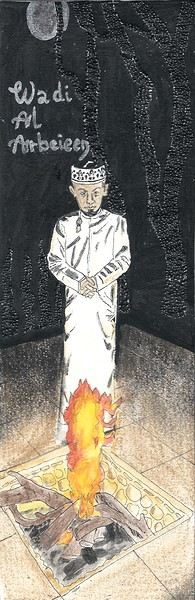
If I close my eyes and think of the Sultanate of Oman, I first smell a light scent of incense, feel the warmth of a sunbeam on my skin, before sand slips through my fingers. I taste the sweetness of a date, a real candy, then the flavor of coffee with a hint of cardamom and rosewater... I hear the desert wind whistling in my ears, the distant call of a muezzin, then the murmur of water. I open my eyes to see smiles, welcoming gestures, a turquoise sea, rocks ranging from ochre to purple, deep wadis where torrents burst forth, orange dunes, white sandy beaches where tiny crabs scurry at full speed. I see incredible oases emerging between arid mountains. I see abandoned villages that I’d dream were full of life, imposing fortresses overlooking valleys, and lively souks where offers are delicate and negotiation is a mutual courtesy.
All that, and so much more.
This is what I tried to capture in my illustrated travel journal, which I’ll fill in here and there with photos. I drew this journal “cold,” after my return (actually, I made it this summer, while our trip was last winter). It’s a pretty special format—I bought it in Japan without really knowing what I’d do with it. Well, it found its purpose! Below is a photo of this accordion-style journal: here, it’s only partially open, because when fully unfolded, it’s 5 meters long!
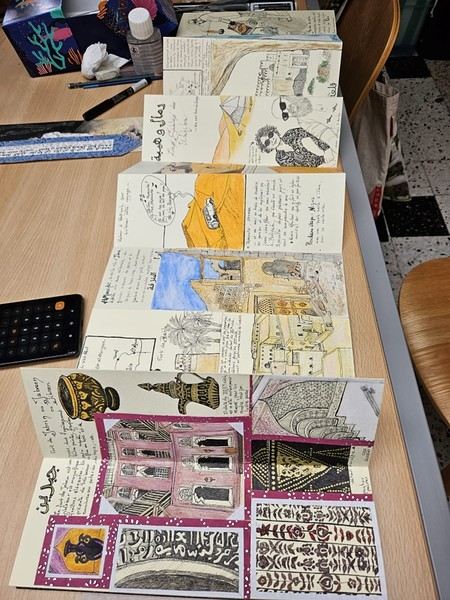
For drawing enthusiasts: The accordion format is both a constraint (each sheet is 9 cm x 27 cm) and a freedom (you can create a fresco). The paper is also a bit special: it doesn’t allow for fine lines, but it takes ink well (liner pen). However, everything has to be done almost in one go (with a very light pencil sketch) because it erases poorly. It absorbs too much water for coloring with markers or watercolors (unless you avoid soaking it), but it works well with oil pastels and their use with a brush and solvent. Since it’s yellowish, it allowed me to create contrasts even with white pastel.
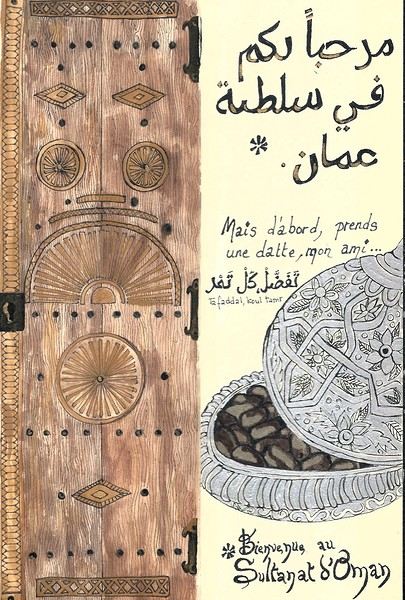 On the right, the "welcome marker"—those dates offered everywhere as a sign of hospitality. On the left, a tribute to those stunning doors worn by time, admired all over the old quarters, including the abandoned ones.
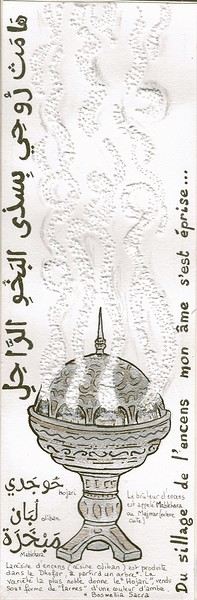
Oman is one of the world’s largest producers of frankincense resin. Incense burners are everywhere, from the simplest clay ones to the most precious handcrafted silver ones...
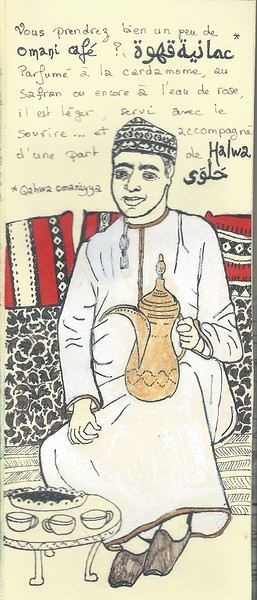 Hospitality will often lead you to accept a small coffee, an "Omani coffee," very light, subtly flavored with cardamom, maybe a touch of saffron, and occasionally rosewater.
Here, I’ve depicted a man in the common everyday attire of Omanis: the dishdasha, mostly white (during the week and daytime; colors are more common in the evening or on Fridays and Saturdays). While you’ll see some men dressed in Western clothes, they’re very few. The white dishdasha is truly the shared attire of all men. The dishdasha, which has no hood, is distinguished by a small pom-pom attached to the collar, the furakha, which is soaked in perfume. And believe me, Omanis go overboard with it! "It smells like the pom-pom" is an expression that’s now part of our shared language, my husband and I.
Another must of men’s attire is the kuma, a small round head covering, usually white with brightly colored patterns. The keffiyeh is also worn (but without the cord called an agal in Arab countries), and it’s mostly worn by those with roots in the desert, from what I understood.
And what about the women, you might ask? Some are veiled, some in full black (but not a burka—more like a chador + abaya), due to the influence of Saudi Arabia and the United Arab Emirates, whereas the traditional outfit used to be a layering of very colorful dresses. Most of the women we saw wore neutral clothing, a plain veil over their hair, but with their faces uncovered. We also saw many saris and colorful veils—don’t forget that 40% of the population consists of Indian, Nepalese, and Bangladeshi immigrants, who work a lot in tourism, hospitality, restaurants, services, and construction.
Just to clarify, as a tourist, there’s no pressure to wear a veil, and never any disapproving looks. Of course, you’ll save the mini shorts, plunging necklines, bare shoulders, and midriffs for the hotel terrace—but I’d say that’s the same for men and women, and with the sun being strong, it’s better for your skin too.
Here’s the introduction! In the next post, I’ll tell you about my itinerary, and we can dive in!
Travel Journal - 28 Days in China in August 2026
Hi everyone,
I’m sharing a little recap of this new 4-week trip to China—nothing fancy, just my experience.
We’re taking advantage of the extended visa exemption to return to China for the 4th time. I loved last summer’s trip so much that I’m a bit worried about being disappointed this year. Plus, I’ve had a few hiccups before this departure: my WeChat account got blocked, and I couldn’t recover it (luckily, Alipay still works fine); I couldn’t verify my 12306 account for weeks; Trip.com failed to book our second train; and I’ve got an injury that’ll slow me down during the trip... Ugh, I hate starting a trip with these kinds of issues. Then, oh surprise! Just before leaving, my 12306 account got verified! Super easy to use from that point on—I could book a few train tickets without fees.
We’re sticking with Free’s e-SIMs, which work great in China.
August 2–3
Anyway, on the morning of August 2nd, we took the RER to CDG. As usual, we couldn’t check in online. It’s always a bit frustrating, especially since we didn’t have any checked luggage. We flew with Air China. We arrived at the check-in counter at 9:50 AM, 2 hours and 40 minutes before the flight. The line for our check-in stretched 300 meters across the airport in both directions. What a joke!! We spent 1 hour and 45 minutes in that line just to reach the counter and get our boarding passes. By then, it was 11:35 AM, and boarding had already started at 11:20 AM. The screens showed a 25-minute walk to our gate—on the other side of the airport, of course—plus we had to go through passport control and security... Long story short, the plane didn’t leave without us 🙂 We boarded among the last passengers, and we took off at 12:30 PM. We’d flown Air China four times before, but this time, it felt *really* low-cost. The check-in chaos, the cramped seats (12 seats per row), no music by artists known outside China, mediocre food, and a boarding area at Beijing Airport with only 10 seats—worthy of Ryanair or EasyJet. And yet, the price was sky-high. Again, D.’s vacation requests were denied outside of July and August, so we’re traveling from August 2nd to 30th. We couldn’t have picked a worse time for inflated prices, and with the situation in Iran, we got hit with a 390 € fuel surcharge. I’ve never paid so much for flights—I felt like I’d bought business class, but nope, far from it!!
We landed in Beijing around 4:15 AM. It was 28°C with thick fog. We drove and drove and drove for 20 minutes, as usual in Beijing. Then we went through a first check, a second check, a third check, and waited for our connecting flight at 6:40 AM. A small Airbus A320, but way more space than in the Boeing 777 from the first flight. We landed in Kunming, Yunnan, around 10:15 AM in the rain.
We headed to the subway. You can’t pay at the machines with Alipay here either, so we set up the transport QR code directly in Alipay to scan at the subway gates. The process is a bit long the first time if you haven’t entered your info before, but once it’s done, it’s *so* much easier! We took Line 6 to the terminus for 6 yuan each.
We’d booked a hotel nearby, on the 16th floor. It’s actually studios on different floors of a huge residential building. The view’s pretty nice from here. We settled in quickly—back to those wooden beds, or rather, mattresses as hard as wood, which we *hadn’t* missed... Then we went out for our first bowl of noodles of the trip and wandered through the shopping streets of the old town.

It was crowded, and the weather was cool—around 19–20°C. We tried a local specialty: milk skin, thick, dried, then grilled with rose jam. Yeah... we won’t be having that again. The taste and texture of the milk skin... no thanks.

We saw a lot of wild mushroom hotpot too. It’s on our list for later. We also passed through the Jinma and Biji gates, where I played with reflections in puddles. I *love* doing that 🙂

At the end of the day, we headed to a temple advertised as open 24/7 on Amap. Of course, when we got there, it was closed. We’ll go back tomorrow. That was the first of many disappointments with Amap this trip—I hadn’t had that issue on previous visits.
We were exhausted after that sleepless flight. Night was falling, and we decided to grab a quick bite without much appetite. We shared a delicious vegetable fried rice for 12 yuan—we even left half of it. The portions are *huge*.
After a couple of small purchases, we headed back at 9 PM, wiped out, after walking 17 km between the airports and these first steps in Kunming. I expected to see quite a few Western travelers here, but we didn’t spot a single one. Instead, we met lots of curious Chinese people, many of them super friendly and helpful—almost *too* eager, like when they’d run to serve us as fast as possible. It’s a bit much, but it’s great to be back!
I’m sharing a little recap of this new 4-week trip to China—nothing fancy, just my experience.
We’re taking advantage of the extended visa exemption to return to China for the 4th time. I loved last summer’s trip so much that I’m a bit worried about being disappointed this year. Plus, I’ve had a few hiccups before this departure: my WeChat account got blocked, and I couldn’t recover it (luckily, Alipay still works fine); I couldn’t verify my 12306 account for weeks; Trip.com failed to book our second train; and I’ve got an injury that’ll slow me down during the trip... Ugh, I hate starting a trip with these kinds of issues. Then, oh surprise! Just before leaving, my 12306 account got verified! Super easy to use from that point on—I could book a few train tickets without fees.
We’re sticking with Free’s e-SIMs, which work great in China.
August 2–3
Anyway, on the morning of August 2nd, we took the RER to CDG. As usual, we couldn’t check in online. It’s always a bit frustrating, especially since we didn’t have any checked luggage. We flew with Air China. We arrived at the check-in counter at 9:50 AM, 2 hours and 40 minutes before the flight. The line for our check-in stretched 300 meters across the airport in both directions. What a joke!! We spent 1 hour and 45 minutes in that line just to reach the counter and get our boarding passes. By then, it was 11:35 AM, and boarding had already started at 11:20 AM. The screens showed a 25-minute walk to our gate—on the other side of the airport, of course—plus we had to go through passport control and security... Long story short, the plane didn’t leave without us 🙂 We boarded among the last passengers, and we took off at 12:30 PM. We’d flown Air China four times before, but this time, it felt *really* low-cost. The check-in chaos, the cramped seats (12 seats per row), no music by artists known outside China, mediocre food, and a boarding area at Beijing Airport with only 10 seats—worthy of Ryanair or EasyJet. And yet, the price was sky-high. Again, D.’s vacation requests were denied outside of July and August, so we’re traveling from August 2nd to 30th. We couldn’t have picked a worse time for inflated prices, and with the situation in Iran, we got hit with a 390 € fuel surcharge. I’ve never paid so much for flights—I felt like I’d bought business class, but nope, far from it!!
We landed in Beijing around 4:15 AM. It was 28°C with thick fog. We drove and drove and drove for 20 minutes, as usual in Beijing. Then we went through a first check, a second check, a third check, and waited for our connecting flight at 6:40 AM. A small Airbus A320, but way more space than in the Boeing 777 from the first flight. We landed in Kunming, Yunnan, around 10:15 AM in the rain.
We headed to the subway. You can’t pay at the machines with Alipay here either, so we set up the transport QR code directly in Alipay to scan at the subway gates. The process is a bit long the first time if you haven’t entered your info before, but once it’s done, it’s *so* much easier! We took Line 6 to the terminus for 6 yuan each.
We’d booked a hotel nearby, on the 16th floor. It’s actually studios on different floors of a huge residential building. The view’s pretty nice from here. We settled in quickly—back to those wooden beds, or rather, mattresses as hard as wood, which we *hadn’t* missed... Then we went out for our first bowl of noodles of the trip and wandered through the shopping streets of the old town.
It was crowded, and the weather was cool—around 19–20°C. We tried a local specialty: milk skin, thick, dried, then grilled with rose jam. Yeah... we won’t be having that again. The taste and texture of the milk skin... no thanks.
We saw a lot of wild mushroom hotpot too. It’s on our list for later. We also passed through the Jinma and Biji gates, where I played with reflections in puddles. I *love* doing that 🙂
At the end of the day, we headed to a temple advertised as open 24/7 on Amap. Of course, when we got there, it was closed. We’ll go back tomorrow. That was the first of many disappointments with Amap this trip—I hadn’t had that issue on previous visits.
We were exhausted after that sleepless flight. Night was falling, and we decided to grab a quick bite without much appetite. We shared a delicious vegetable fried rice for 12 yuan—we even left half of it. The portions are *huge*.
After a couple of small purchases, we headed back at 9 PM, wiped out, after walking 17 km between the airports and these first steps in Kunming. I expected to see quite a few Western travelers here, but we didn’t spot a single one. Instead, we met lots of curious Chinese people, many of them super friendly and helpful—almost *too* eager, like when they’d run to serve us as fast as possible. It’s a bit much, but it’s great to be back!
14 Days in Japan – September-October 2026
I had to leave Thailand as my 60-day visa was coming to an end, and this time I opted for a 14-day visit to Japan. I’d already spent 3 days in Tokyo a few years ago on a business trip, which left me with a great impression. Y, my Thai partner, had never been there. That’s why we chose a fairly classic itinerary, including a few castles and Kyoto among other things.
Before diving into the details of our trip, I’d like to recap the expenses we incurred. This will be useful for some of you, and it’ll help us prepare for our next trip to Japan.
I’ve categorized our expenses into 5 groups: - Hotels: 1150 € (breakfast included) - Transportation: 278 € (trains, buses) - Big expenses: 487 € (souvenirs and a few necessary items) - Excursions: 116 € (museum visits, temples, castles) - Daily expenses: 1125 € (meals, small purchases) Total = 3194 €, or 228 € per day on average. I’m excluding flights, as those depend on everyone’s arrangements (departure location, travel dates, etc.).
Jpeg below: apologies for “hotel” without a circumflex—my software isn’t French!

For hotels, we always chose decent but not luxurious places, well-located to let us walk to and from transportation hubs. We systematically avoided taxis, which are notoriously expensive in Japan. We’ve also gotten into the habit over several trips of traveling with minimal luggage: one duffel bag each (7-8 kg) plus the small carry-on allowed on planes (2-3 kg). This lets us travel with three sets of clothes (what we’re wearing plus two changes). We add a checked bag for the return trip to accommodate the things we buy along the way.
‘Transportation’ and ‘Big expenses’: I’ll give more details in the day-by-day account.
We didn’t do any extravagant excursions, like safaris or sports activities.
Meals and food make up the bulk of our daily expenses. We often ate at izakayas, which offer great value—between 2000 and 6000 yen for two (about 11-12 to 33-34 € for two, usually around 20-25 €). We didn’t hold back, but we also didn’t go to high-end restaurants.
More to come while I gather my photos: General Remarks.
Before diving into the details of our trip, I’d like to recap the expenses we incurred. This will be useful for some of you, and it’ll help us prepare for our next trip to Japan.
I’ve categorized our expenses into 5 groups: - Hotels: 1150 € (breakfast included) - Transportation: 278 € (trains, buses) - Big expenses: 487 € (souvenirs and a few necessary items) - Excursions: 116 € (museum visits, temples, castles) - Daily expenses: 1125 € (meals, small purchases) Total = 3194 €, or 228 € per day on average. I’m excluding flights, as those depend on everyone’s arrangements (departure location, travel dates, etc.).
Jpeg below: apologies for “hotel” without a circumflex—my software isn’t French!
For hotels, we always chose decent but not luxurious places, well-located to let us walk to and from transportation hubs. We systematically avoided taxis, which are notoriously expensive in Japan. We’ve also gotten into the habit over several trips of traveling with minimal luggage: one duffel bag each (7-8 kg) plus the small carry-on allowed on planes (2-3 kg). This lets us travel with three sets of clothes (what we’re wearing plus two changes). We add a checked bag for the return trip to accommodate the things we buy along the way.
‘Transportation’ and ‘Big expenses’: I’ll give more details in the day-by-day account.
We didn’t do any extravagant excursions, like safaris or sports activities.
Meals and food make up the bulk of our daily expenses. We often ate at izakayas, which offer great value—between 2000 and 6000 yen for two (about 11-12 to 33-34 € for two, usually around 20-25 €). We didn’t hold back, but we also didn’t go to high-end restaurants.
More to come while I gather my photos: General Remarks.
CARIBBEAN: The island of SAINT-MARTIN, a different perspective
 When it comes to the Caribbean island of Saint-Martin, it's customary to praise its coastline and dreamy beaches—and they certainly deserve it.
But in this story, I’d like to highlight other memories, aspects, and impressions for a slightly different change of scenery.
Enjoy the read—some text and, above all, lots of photos.
« Byenveni sou zile Sen Maten! » (Welcome to the island of Saint-Martin)
-- -- Full and luminous To avoid seeming too conventional at the start of this alternative take on Saint-Martin... here’s not a stunning sunrise over the sea but rather a moonrise—a less "typical" choice. And when you get to witness it, it’s a truly unique moment of contemplation. However, three conditions are essential for this spectacle: a full moon phase, a cloud-free horizon, and—most importantly—a moonrise at twilight. That early evening, all the conditions aligned—lucky us! Just above the sea, a strange glow gradually appeared. A huge moon was about to shine against a deep blue night sky.

What’s more, its light sparkled on the water’s surface—gorgeous! But so fleeting. We’re on the east coast of the island, by the wide stretch of light sand at Baie Orientale, Saint-Martin’s own. Now, just because I wanted to start with something a little different doesn’t mean we should overlook the bright sunrises you can see on this bay. They’re far more common than a beautiful full moonrise, but they also require two things: being an early riser and a clear horizon without misty clouds. Views to soak in without restraint...


Other memories of beautiful lights and lovely colors—a morning when the sun had a brief meet-up with the rain, creating a stunning rainbow.

And let’s talk about the moon again... On a clear night, a "blood moon," the result of a lunar eclipse that had turned our familiar satellite red.

-- --
A butterfly with golden wings! In the tropics, swarms of butterflies flutter everywhere, from flower to flower. They sip the sweet nectar from stamens and blooming corollas with delight.

Here, a monarch, one of the great migratory butterflies, taking its time to enjoy the pollen of this Ixora coccinea—or Japanese hydrangea, but let’s stick to Saint-Martin.

This one is an *Agraulis vanillae*, to be precise—and thanks to the internet for the ID. Photographing them isn’t always easy; these fearless butterflies often fly off before you can get a good focus, challenging both the framing eye and the autofocus! But on the island, I noticed some butterflies were much easier to shoot—those decorating a few murals. ;)


One of the graffiti artists behind several Saint-Martin murals has made it his signature. The talented Jimmy Sheik slips a little butterfly into each of his works, even if it’s not the main subject. It’s a nod to his home island, Guadeloupe, whose territory—with Basse-Terre and Grande-Terre—looks uncannily like a giant butterfly. In the photo above, a great initiative: turning this beach bungalow, abandoned after Hurricane Irma’s (2017) devastation, into a mural canvas—it’s a real success. Well done, artist!
To be continued >>>>>>
Great Divide Mountain Bike Route
Hello,
Following our trip on the Great Divide Mountain Bike Route this summer, we’re sharing our experience in this travel journal.
We’re Richard and Bernadette, both 64 years old, and we’re gravel bike-packing cyclists.
We’ve completed several gravel bike trips in France and neighboring countries, and Richard has also done some in South America.
We left on July 22, 2026, from Geneva to Calgary via Frankfurt with our bikes carefully packed in boxes, and we returned on October 8 from El Paso to Geneva via Chicago and Frankfurt.
The GDMBR is a mountain route that closely follows the Pacific/Atlantic continental divide, starting in Banff, Canada, and ending at the Mexican border in Antelope Wells, New Mexico. This crossing of the American West is one of the longest mountain biking routes in the world, winding through wild valleys, mountain ranges, and desert plateaus. It stretches about 4,400 km with a total elevation gain of around 60,000 m. The average altitude is 2,000 m, and the highest point reaches 3,600 m. The route is 80% off-pavement (gravel roads, dirt, and a few trail segments). It’s also known for the annual Tour Divide race, which brings together the best riders in the discipline every June and follows roughly the same route.
We prepared for this trip over several months, using a few websites and an older guidebook (the 2013 English edition).

With this, we were able to organize our journey with as much information as possible, a GPS track, and gear suited to the weather conditions, terrain, and sparse resupply points in remote areas.
Once we arrived in Banff, we picked up bear spray to handle a particular challenge: the wildlife we weren’t familiar with.

After landing in Calgary, we assembled and equipped our bikes at the airport. That first evening, we were welcomed by Mike, who invited us to his place when we were looking for a spot to pitch our tent. Then we made our way to Banff over two days, taking a fairly quiet road to Canmore and then a bike path.

A visit to Banff, a charming tourist town in the national park. Its famous Fairmont Hotel.

The starting point of the GDMBR at the arch of this hotel complex.

Here we are, immersed in the wilderness—just a few pedal strokes away from the town, the contrast is striking. Powerful rivers, vast landscapes, and our first encounter with a mule deer.

Spray Lake, our first basic campsite: no showers, dry toilets, no water fountain—we filter lake water. Most GDMBR campsites are like this.


We took the west side of the lake—a longer and wilder route. A few fallen trees blocked the path, forcing us to carry our bikes. But the stunning landscapes made it all worth it!

Our first single track through a forest marked by past wildfires.


Most campgrounds have tables and metal fire rings for safe campfires, which makes setting up camp much easier—especially nice after a long, tiring day! During this trip, we mostly slept in our tent, either in established campgrounds or wild bivouacs.
To be continued...
The GDMBR is a mountain route that closely follows the Pacific/Atlantic continental divide, starting in Banff, Canada, and ending at the Mexican border in Antelope Wells, New Mexico. This crossing of the American West is one of the longest mountain biking routes in the world, winding through wild valleys, mountain ranges, and desert plateaus. It stretches about 4,400 km with a total elevation gain of around 60,000 m. The average altitude is 2,000 m, and the highest point reaches 3,600 m. The route is 80% off-pavement (gravel roads, dirt, and a few trail segments). It’s also known for the annual Tour Divide race, which brings together the best riders in the discipline every June and follows roughly the same route.
We prepared for this trip over several months, using a few websites and an older guidebook (the 2013 English edition).
With this, we were able to organize our journey with as much information as possible, a GPS track, and gear suited to the weather conditions, terrain, and sparse resupply points in remote areas.
Once we arrived in Banff, we picked up bear spray to handle a particular challenge: the wildlife we weren’t familiar with.
After landing in Calgary, we assembled and equipped our bikes at the airport. That first evening, we were welcomed by Mike, who invited us to his place when we were looking for a spot to pitch our tent. Then we made our way to Banff over two days, taking a fairly quiet road to Canmore and then a bike path.
A visit to Banff, a charming tourist town in the national park. Its famous Fairmont Hotel.
The starting point of the GDMBR at the arch of this hotel complex.
Here we are, immersed in the wilderness—just a few pedal strokes away from the town, the contrast is striking. Powerful rivers, vast landscapes, and our first encounter with a mule deer.
Spray Lake, our first basic campsite: no showers, dry toilets, no water fountain—we filter lake water. Most GDMBR campsites are like this.
We took the west side of the lake—a longer and wilder route. A few fallen trees blocked the path, forcing us to carry our bikes. But the stunning landscapes made it all worth it!
Our first single track through a forest marked by past wildfires.
Most campgrounds have tables and metal fire rings for safe campfires, which makes setting up camp much easier—especially nice after a long, tiring day! During this trip, we mostly slept in our tent, either in established campgrounds or wild bivouacs.
To be continued...
Southern landscapes, northern wildlife: returning to South Africa
After a first trip in 2009 (already!) where we roughly did a circuit passing through Hazyview, a private reserve in Sabi Sands, St. Lucia and Isimangaliso, Hluhluwe, and the South African part of Kgalagadi Transfrontier Park, plus a quick stop in 2013 to visit Lesotho, we really wanted to come back to this country.
Why not the Cape region this time? But there was no way we’d return to this part of the world without going on a safari. Mountain Zebra or the Karoo seem more about landscapes than animals, and Addo doesn’t excite me much either... So, it’ll be Kruger.
Flight prices, schedules, and durations led us to book Paris-Cape Town, returning Johannesburg-Paris with British Airways, via Heathrow.
Now, we just had to figure out how to fit in a lot without driving too many kilometers or changing accommodations every day—at least in the Cape region. Here’s what we ended up with:
Arrival in Cape Town on Saturday, October 10 at 11 AM
2 nights in Hermanus
1 night in Franschhoek
2 nights in Mountceder in the Cederberg
3 nights in Hout Bay
Sunday: transition day—flight to Johannesburg, drive toward Kruger, overnight in Lydenburg.
Kruger: 1 night in Letaba, 2 in Satara, 1 in Lower Sabie.
Final night in Mbombela (formerly Nelspruit) before heading back to the airport for an early evening return flight.
For those who want to read the full story without interruptions, it’s here.
Friday, 10/9
A pretty stressful departure.
First, I woke up in the middle of the night convinced I’d swapped my first and last names during check-in 🤪... Couldn’t fall back asleep, even though I knew British Airways wouldn’t answer before 9 AM.
Well, for them, everything was fine... but then they started talking about ETA... an ETA for England 😮? ?? Yes, it’s new. Apparently, you don’t need one for an air-to-air transit... but you never know—better to have it just in case. No one could give me a clear answer that it wasn’t necessary. In the end, we didn’t get it... and we didn’t need it.
But here’s the thing: our flight ended up leaving Paris 45 minutes late (10 minutes due to a schedule change and 35 minutes of actual delay), so our 2-hour layover shrank to 1 hour and 15 minutes. That should be doable, right? The board showed our flight at Gate B—great, it’s right next door! But at Gate B, three employees were just there to tell everyone who showed up that security was at Gate A... and off we went, sprinting through the terminals, up and down endless escalators, a quick shuttle ride, security at Gate A ("You’re cutting it close!" Oh really? 😠), then almost the same route back—only to end up just a few dozen meters from where we started! 😠
Boarding was already well underway, and after all that running, we were hot and thirsty—but phew! We made it onto the plane!
Saturday, 10/10 On the other hand, nothing to complain about on the London-Cape Town flight—it arrived early!
I’d booked a (small) Suzuki S-Presso because it seemed to have a higher ground clearance than its competitors. Unfortunately, we ended up with a Tata Tiago (yes, it exists), which was lower (and also smaller, with an even more sluggish engine... we got to compare because in Johannesburg, we *did* get an S-Presso). Somehow, we managed to fit everything in the trunk ("Whatever you do, don’t leave anything visible!") and set off for our first accommodation in Hermanus, under glorious sunshine.
Nikki welcomed us warmly, explained what there was to see in the area, and advised us to book a restaurant for that evening.
After dropping off our bags, we headed straight to the "cliff path," just a 3-minute walk from our place. This stretch of coast is famous for its southern right whales from June to November. Let’s cut to the chase: yes, there were whales, but they were far away and very sleepy 😕. At best, we saw (photos taken at 600mm): A few ripples or a faint spout,

a bit of tail...

...or a head.

Too bad—the owner of our next place said she’d seen about thirty whales up close here in early September.
Without whales, the rock hyraxes (or dassies) were everywhere... and fun to watch.
The other local star (when there are no whales 😏)

Why not the Cape region this time? But there was no way we’d return to this part of the world without going on a safari. Mountain Zebra or the Karoo seem more about landscapes than animals, and Addo doesn’t excite me much either... So, it’ll be Kruger.
Flight prices, schedules, and durations led us to book Paris-Cape Town, returning Johannesburg-Paris with British Airways, via Heathrow.
Now, we just had to figure out how to fit in a lot without driving too many kilometers or changing accommodations every day—at least in the Cape region. Here’s what we ended up with:
Arrival in Cape Town on Saturday, October 10 at 11 AM
2 nights in Hermanus
1 night in Franschhoek
2 nights in Mountceder in the Cederberg
3 nights in Hout Bay
Sunday: transition day—flight to Johannesburg, drive toward Kruger, overnight in Lydenburg.
Kruger: 1 night in Letaba, 2 in Satara, 1 in Lower Sabie.
Final night in Mbombela (formerly Nelspruit) before heading back to the airport for an early evening return flight.
For those who want to read the full story without interruptions, it’s here.
Friday, 10/9
A pretty stressful departure.
First, I woke up in the middle of the night convinced I’d swapped my first and last names during check-in 🤪... Couldn’t fall back asleep, even though I knew British Airways wouldn’t answer before 9 AM.
Well, for them, everything was fine... but then they started talking about ETA... an ETA for England 😮? ?? Yes, it’s new. Apparently, you don’t need one for an air-to-air transit... but you never know—better to have it just in case. No one could give me a clear answer that it wasn’t necessary. In the end, we didn’t get it... and we didn’t need it.
But here’s the thing: our flight ended up leaving Paris 45 minutes late (10 minutes due to a schedule change and 35 minutes of actual delay), so our 2-hour layover shrank to 1 hour and 15 minutes. That should be doable, right? The board showed our flight at Gate B—great, it’s right next door! But at Gate B, three employees were just there to tell everyone who showed up that security was at Gate A... and off we went, sprinting through the terminals, up and down endless escalators, a quick shuttle ride, security at Gate A ("You’re cutting it close!" Oh really? 😠), then almost the same route back—only to end up just a few dozen meters from where we started! 😠
Boarding was already well underway, and after all that running, we were hot and thirsty—but phew! We made it onto the plane!
Saturday, 10/10 On the other hand, nothing to complain about on the London-Cape Town flight—it arrived early!
I’d booked a (small) Suzuki S-Presso because it seemed to have a higher ground clearance than its competitors. Unfortunately, we ended up with a Tata Tiago (yes, it exists), which was lower (and also smaller, with an even more sluggish engine... we got to compare because in Johannesburg, we *did* get an S-Presso). Somehow, we managed to fit everything in the trunk ("Whatever you do, don’t leave anything visible!") and set off for our first accommodation in Hermanus, under glorious sunshine.
Nikki welcomed us warmly, explained what there was to see in the area, and advised us to book a restaurant for that evening.
After dropping off our bags, we headed straight to the "cliff path," just a 3-minute walk from our place. This stretch of coast is famous for its southern right whales from June to November. Let’s cut to the chase: yes, there were whales, but they were far away and very sleepy 😕. At best, we saw (photos taken at 600mm): A few ripples or a faint spout,
a bit of tail...
...or a head.
Too bad—the owner of our next place said she’d seen about thirty whales up close here in early September.
Without whales, the rock hyraxes (or dassies) were everywhere... and fun to watch.
The other local star (when there are no whales 😏)
Retour de 13 jours au Sri Lanka en décembre 2016 avec 2 adolescents English translation pending
Bonjour,
Ci dessous le retour d'info sur un périple de 13 jours au SL avec 2 ados 15 & 16 ans.
Nous avons beaucoup utilisé ce forum pour réaliser ce voyage, nous faisons donc logiquement un retour d'info que l'on espèrera pratique pour les futurs chanceux propices au départ :)
De manière générale, prévoyez de vous lever tôt (perso entre 6 et 7h30 tous les jours) pour profiter de moins de monde, du soleil (souvent voilé après 13h) et de moins de chaleur.
Nous avons choisis un chauffeur via ce Forum que nous recommandons vivement : Shashi Khuma. Nous avons tout organisé avec lui via mail, il nous a conseillé des hotels/Ghest Houses et après avoir fait notre choix, il les a réservé pour nous (prix < booking !). Aucun versement d'acompte demandé, et Shashi était bien au RDV.Il sait être discret, avec une conduite très safe. Lorsque nos enfants voulaient se reposer, il nous déposait en ville pour se balader ou prendre un verre le soir, et il nous amenait les enfants 1h30 plus tard (sympa!). De plus, il a compris dés la 1ére journée que l'on voulait sortir des sentiers touristiques (lorsque cela était possible) et il ne nous a jamais emmené dans une boutique, plantation ou autre sans que nous l'ayons demandé... En bref, Shashi a été quelqu'un de précieux pour la réussite de ce voyage, de grande confiance, et vraiment attachant. Parle très bien Anglais. Ecoutez le sur Facebook : Shashi Khuma Sri Lankan driver Prix et contact par mail si vous voulez.
VOL : Compagnie OMAN AIR, prix/billet = 540 €, avec stop A/R à Mascate de 2h30 et 3h00. Vraiment bien, avion très récent, bon service, aucun retard..... impeccable. Arrivée à Colombo à 15h30, et départ direct pour Sirigiya (4h30 de trajet pour 135 km !!)
- Jour 2 à 4 : 3 nuits à Sirigiya (Nice Place Hotel, très bien positionné, chambres récentes vraiment bien, très propre (56 €/2pax/nuit/en B&B), diner avec buffet locale bon mais un peu cher pour là bas (9 €/pax). Visite de Sirigiya Rocks (4h / à faire le matin), Visite de Dambulla (3H /privilègier une après midi de pluie), Visite de Polonnaruwa (5 à 6h / privilègier le vélo/ à faire) Surprise de Shashi = Petite piste sableuse pour coucher de soleil sur Sirigiya Rock... génial Grimpette au 2ème rocher (en face à4 km). Vraiment à faire. Les ados ont presque préféré au Sirigiya Rock.... Beaucoup plus nature et beaucoup moins de monde.
- Jour 4/5 : 1 nuit à Kandy (trajet Sirigiya / Kandy = 4 h). Hotel River Side Villa (40€ en B&B / chambre simple, très propre, piscine, vue magnifique sur la rivière) Visite temple de la dent (1 h). Un peu déçu, très beau, mais restreint. Pas mal de monde. Il pleuvait. Verre au Helgas Folies (maison totalement folle dans les hauteurs de Kandy) en Tuk Tuk. Sympa et maison vraiment déconnectée... Globalement Kandy ne nous a pas charmer. Pour nous 1 jour suffisait.
jour 5 à 7 : Kandy vers Ella (trajet 3h30). Hotel Ella : Sky Green (53 €/nuit), chambre sans charme, simple, mais vue magnifique sur les montagnes. Bien pour Ella. - Durant le transport : Visite plantation GlennTea, Darambulla falls et Street foods dans Nuwera Eliya - Ballade Ella Rock (superbes, mais fatiguant). Ne pas manquer de déjeuner au restaurant Garden View (à 20 m des rails du train).... Super bon, très dépaysant, famille Sri Lankaise adorable et vraiment pas cher (22 € pour 5) - Ballade Little Adams peak. Superbe aussi mais totalement différent d'avec Ella Rock. Les 2 sont à faire.
Jour 7 : Trajet Ella/Tissamaharama = 1h15 de jungle train (génial) + 4h de voiture (route superbe) Nuit Tissa. Hotel Moon Beam Heaven (45 €/B&B), Super, propre, piscine. Top durant le trajet : - jungle train - Descente de Lipton Seat à pieds (vraiment magnifique plantation, paysage grandiose) - Diyaluma falls (chutes d'eau de 170m !). 10 mn de grimpette et baignade sous la chute d'eau seuls avec les singes... Super expérience. Shashi n'était pas chaud car la route est bien moins bonne que la route principale, mais vraiment cela vaut le coup... ne rallonge pas le temps de trajet pour Tissa. - Temple de Buduruwagala (Boudha de pierre) en fin de journée. Seuls. Très sereins. Bien
Jour 8 : Safari Yala + trajet vers Welligama (3h + arrêt sur plage Tangalle). Nuit Welligama : Jaga Bay Hotel (55 €/B&B). Shashi nous a eu 1 des 3 bungalow sur la plage. les enfants étaient dans une chambre. Très bien, mobilier simple, lumière crue ! mais endroit charmant et charmeur, piscine, nourriture très bonne et peu chère. - Safari Yala : Vraiment décevant. Ne vaut pas le temps passé (levé 4h45) ni le prix demandé (15.000 Rps tout compris). 3 éléphants perdus, des oiseaux de couleurs incroyables, crocodiles, phacochères, ... It's all ! - Dej et plage de Tangalle : vaut vraiment un arrêt baignade + dej
jour 9/10 : Welligama Jaga Bay Hotel - Surf le jour de Noel - Snorkelling à Polhena (bien, tortue, pleins de poisson multicolor...) Ados ravis - Réveillon sur la plage de Mirissa. Festif mais très (trop) touristique. Restau bof, mais bonne ambiance festive - Re surf - Excursion pour les baleines (on en avait jamais vu) : A fuir !! vu 3 ou 4 bout de baleines, mais plus de 20 boat peoples totalement chargés... - Ne manquez pas le restau Chief Akila Kitchen (3 km après la fin de la plage de Welligama (à droite en regardant la mer). Chercher sur les forums... endroit petit, planté sur la roche, vue incroyable. On commande le poisson et il arrive 20 mn après avec Akila en Tuk Tuk qui va ensuite le préparer.... compter 2h en tout mais cela vaut vraiment le coup, on est en famille. Nourriture extremement bonne (gouter également les pancakes chocolate :))
jour 11 : Welligama/Anawatuna (1h15) Hotel The Rocks (45€ B&B), pas mal. Calme, très bien placé. - Plongée bouteille pour les adultes. Bien mais visibilité limitée... Plage pour les ados.
Jour 12 : Welligama / Galle / Negombo (45mn + 3h) Hotel Negombo ??? (oublié le nom car trouvé à la dernière minute par Shashi car celui que nous avions choisis avait augmenté drastiquement ses prix... on a donc demandé à Shashi d'en trouver un autre). Aucun intérét de prendre un bel hotel vu l'heure du réveil prévu ! - Plage le matin. dej à Welligama juqu'à 15h - Visite Galle : Sympa, à faire. Une ville de bonne taille sur la mer. (2h mini) - Arrivée Negombo 20h. Diner à The Port Restaurant sur la plage (la dernière, glups). Très sympathique endroit, bon poisson et bonne musique... Sympa pour la fin.
- Jour 13 : retour.
En synthèse : Voyage enchanteur. Paysages vraiment grandioses. Sri Lankais incroyablement gentils. Nous avons eu zéro stress, aucune appréhension. Pas de regards mauvais. Météo vraiment clémente pour décembre (que deux 1/2 journée de pluie et 3 jours de gris moyen). A refaire, on resterai plus dans les terres et moins sur les plages (même si c'est sympa !) Voyage rythmé, mais les ados ont bien suivi (seule ma fille dormait en voiture). C'était un bon rythme pour nous. Chaque trajet était ponctué d'arrêts multiple et de visite, donc pas d'impression de long trajet (sauf 1er et dernier jour). Ne peut se faire qu'avec un chauffeur (vraiment une option à prendre en compte lorsque l'on a que 15 jours). Nos préférés : Diyaluma falls, 2ème rocher de Sirigiya, Lipton et Ella Rock, jungle train.... Les moins aimés : Les Baleines & Yala (mais nous avions fait la Tanzanie, donc...) Budget total : 6400 € tout inclus A votre disposition pour de plus amples infos, et on envie ceux qui y partent bientôt.... Antoine
Ma journée Indienne et Sri Lankaise à Paris avec Ganesha! English translation pending

Ma journée Sri Lankaise à Paris avec Ganesha ! Dimanche 05 Septembre 2004, pour la neuvième année consécutive, la communauté des Tamouls Sri Lankais de Paris se réunit au Temple de Sri Manicka Vinayakar Alayam.
Des cérémonies religieuses ( bain rituel du dieu à l’eau de rose, miel, lait… ) débuteront à 9 heures suivies d’un cortège et d’un défilé en l’honneur du dieu à la tête d’éléphant.
Avant mon départ pour cette journée magique, j’ai fais quelques recherches, je sais donc maintenant que Ganesha, est le fils de Shiva et de Parvati. Spécialement porteur de chance, Ganesh est invoqué avant de commencer un projet, partir en voyage, …
Concernant son aspect, on trouve essentiellement deux versions : - Le fils de Shiva est à son image, donc très beau. Il séduit toutes les femmes, ce qui lui fait oublier sa mission. Aussi est-il condamné par Parvati à avoir une tête d’éléphant et un gros ventre. - Des légendes parlent de sa décapitation, sa mère demande la renaissance de son fils, Shiva utilisa le premier animal passant à sa portée pour redonner une tête à son fils, ce fut un éléphant avec une seule défense…
Ayant potassé « un peu » le sujet, je me rends donc au Temple de la rue de Girard.
Ce n’est pas l’Inde, mais presque, une foule incroyable est là devant les portes de ce lieu de culte : la communauté Hindoue Parisienne, des Parisiens, des adultes, beaucoup d’enfants, des sarees multicolores, des fleurs, des ballons, des odeurs d’encens, musique à fond … ma journée de voyage commence très fort.
Hurtigruten: compte rendu 7ème croisière en Norvège English translation pending
Bonjour,
je viens de rentrer de mon 7ème voyage à bord de l'express-côtier en Norvège et j'ai commencé la mise en ligne de mes carnet de voyage et galerie photo. Pour le moment j'en suis au 4ème des 12 jours de l'aller-retour Bergen - Kirkenes... j'arrive aux Lofoten :)
extraits :
"jour 1 : Nous sommes le 17 mai, jour de la fête nationale norvégienne encore plus festive cette année car on y célèbre également le bicentenaire de La Constitution. Même si les défilés auxquels participe une bonne partie de la population ont lieu le matin, nous pouvons voir de nombreux norvégiennes et norvégiens revêtus de leurs bunads, habits traditionnels, depuis les bus qui nous amènent au port."
le grand pavois est hissé de la proue à la poupe du navire

jour 2 : " La Mer de Stad, réputée pour ses tempêtes aux vagues parfois monstrueuses, est dans un très « bon jour » ce matin alors que nous apercevons au loin vers le nord le Vestkapp, point le plus occidental de Norvège. Sera-t-il un jour créé, le tunnel maritime permettant d'éviter ce passage parfois dangereux ? En tout cas, aujourd'hui c'eut été dommage de passer sous terre. Au cours de mes 7 voyages, j'ai rarement doublé ce cap dans de si bonnes conditions et je me souviens notamment de mon premier passage à bord du MS Vesterålen en septembre 1999 alors que l'eau, censée tomber évidemment vers le bas, remontait en volutes de brouillard généré par le vent les cascades des falaises du rivage.
Vers 9:45, alors que nous achevons la traversée de la Mer de Stad et retrouvons l'abri des fjords, j'aperçois au nord un des phares que j'apprécie le plus sur la route de l'Hurtigruten, le Flåvær fyr."

3ème jour : "Effectivement, une demi-heure plus tard, le Kong Harald n'est plus très loin du Stokksund même si, encore à cette distance, on ne peut vraiment pas voir qu'il y a un passage tellement celui-ci est caché par les divers îlots constituant une partie des « piquets » du slalom. On a vraiment l'impression de foncer vers un mur sans aucune ouverture ; en voir un panorama ci-dessous. Alors que nous ne sommes plus qu'à 300 m de l'entrée du détroit, il n'y a pas encore grand monde sur la coursive extérieure, à l'avant du pont 5. J'ai longtemps cru, alors que nous nous rapprochions du détroit, que nous allions emprunter le « raccourci » vers lequel se dirige tout droit le navire mais quelques dizaines de mètres avant « la porte » d'entrée du slalom, le Kong Harald vire vers bâbord afin d'arrondir son futur virage dans un espace plus important que s'il avait emprunté le « raccourci » par lequel, je suis passé au moins 3 fois lors de mes précédents voyages. Hier, le 8 juin, le capitaine du MS Nordnorge a aussi opté pour cette route « arrondie ». Tout à l'heure, je regarderai quelle est l'option du capitaine du MS Trollfjord cet après-midi. Sur la galerie ci-dessus, je vous présente la route suivie par le Kong Harald lors de notre passage. Comme à chaque fois, nous sommes salués par quelques personnes sur le pont sous lequel passe le navire au milieu du détroit (atlas.no). En février 2004, lors de mon voyage à bord du MS Nordlys, le capitaine avait carrément opté de passer au large de l'île Stokkøya, craignant que la visibilité soit très compromise par une tempête de neige dans le Stokksund."

4ème jour : "7:01, "Le Cavalier" d'Hestmannøy est visible maintenant tout là-bas au nord alors qu'à l'horizon vers l'océan, les magnifiques montagnes de l'archipel de Træna (regardez les courbes de niveau de Trænstaven, une des montagnes ; voir aussi l'image satellite en cliquant sur « Flyfoto ») semblent posées sur l'horizon, directement sur la mer. Leur photo illustrait la couverture de la 7e édition en 1500 exemplaires en 2002 de la brochure Hurtigruten distribuée à bord. Træna est aussi connu pour son festival se déroulant notamment dans les grottes au flanc des montagnes (vidéos sur Arte - article de Telerama).Que j'aime l'esthétique de ces montagnes ! D'autant plus que même s'il fait très beau ce matin, la distance en trouble un peu la vision, comme un léger brouillard."

Cette fois-ci, j'ai également capté des panoramas que je vous présente en 1 800 px de large
je viens de rentrer de mon 7ème voyage à bord de l'express-côtier en Norvège et j'ai commencé la mise en ligne de mes carnet de voyage et galerie photo. Pour le moment j'en suis au 4ème des 12 jours de l'aller-retour Bergen - Kirkenes... j'arrive aux Lofoten :)
extraits :
"jour 1 : Nous sommes le 17 mai, jour de la fête nationale norvégienne encore plus festive cette année car on y célèbre également le bicentenaire de La Constitution. Même si les défilés auxquels participe une bonne partie de la population ont lieu le matin, nous pouvons voir de nombreux norvégiennes et norvégiens revêtus de leurs bunads, habits traditionnels, depuis les bus qui nous amènent au port."
le grand pavois est hissé de la proue à la poupe du navire
jour 2 : " La Mer de Stad, réputée pour ses tempêtes aux vagues parfois monstrueuses, est dans un très « bon jour » ce matin alors que nous apercevons au loin vers le nord le Vestkapp, point le plus occidental de Norvège. Sera-t-il un jour créé, le tunnel maritime permettant d'éviter ce passage parfois dangereux ? En tout cas, aujourd'hui c'eut été dommage de passer sous terre. Au cours de mes 7 voyages, j'ai rarement doublé ce cap dans de si bonnes conditions et je me souviens notamment de mon premier passage à bord du MS Vesterålen en septembre 1999 alors que l'eau, censée tomber évidemment vers le bas, remontait en volutes de brouillard généré par le vent les cascades des falaises du rivage.
Vers 9:45, alors que nous achevons la traversée de la Mer de Stad et retrouvons l'abri des fjords, j'aperçois au nord un des phares que j'apprécie le plus sur la route de l'Hurtigruten, le Flåvær fyr."
3ème jour : "Effectivement, une demi-heure plus tard, le Kong Harald n'est plus très loin du Stokksund même si, encore à cette distance, on ne peut vraiment pas voir qu'il y a un passage tellement celui-ci est caché par les divers îlots constituant une partie des « piquets » du slalom. On a vraiment l'impression de foncer vers un mur sans aucune ouverture ; en voir un panorama ci-dessous. Alors que nous ne sommes plus qu'à 300 m de l'entrée du détroit, il n'y a pas encore grand monde sur la coursive extérieure, à l'avant du pont 5. J'ai longtemps cru, alors que nous nous rapprochions du détroit, que nous allions emprunter le « raccourci » vers lequel se dirige tout droit le navire mais quelques dizaines de mètres avant « la porte » d'entrée du slalom, le Kong Harald vire vers bâbord afin d'arrondir son futur virage dans un espace plus important que s'il avait emprunté le « raccourci » par lequel, je suis passé au moins 3 fois lors de mes précédents voyages. Hier, le 8 juin, le capitaine du MS Nordnorge a aussi opté pour cette route « arrondie ». Tout à l'heure, je regarderai quelle est l'option du capitaine du MS Trollfjord cet après-midi. Sur la galerie ci-dessus, je vous présente la route suivie par le Kong Harald lors de notre passage. Comme à chaque fois, nous sommes salués par quelques personnes sur le pont sous lequel passe le navire au milieu du détroit (atlas.no). En février 2004, lors de mon voyage à bord du MS Nordlys, le capitaine avait carrément opté de passer au large de l'île Stokkøya, craignant que la visibilité soit très compromise par une tempête de neige dans le Stokksund."
4ème jour : "7:01, "Le Cavalier" d'Hestmannøy est visible maintenant tout là-bas au nord alors qu'à l'horizon vers l'océan, les magnifiques montagnes de l'archipel de Træna (regardez les courbes de niveau de Trænstaven, une des montagnes ; voir aussi l'image satellite en cliquant sur « Flyfoto ») semblent posées sur l'horizon, directement sur la mer. Leur photo illustrait la couverture de la 7e édition en 1500 exemplaires en 2002 de la brochure Hurtigruten distribuée à bord. Træna est aussi connu pour son festival se déroulant notamment dans les grottes au flanc des montagnes (vidéos sur Arte - article de Telerama).Que j'aime l'esthétique de ces montagnes ! D'autant plus que même s'il fait très beau ce matin, la distance en trouble un peu la vision, comme un léger brouillard."
Cette fois-ci, j'ai également capté des panoramas que je vous présente en 1 800 px de large
Londres et travelcard English translation pending
Salut tous,
Je pars à Londres du 15 au 19 janvier.
Je suis en train de me renseigner sur le métro.
Je pensais prendre une travelcard 3 jours mais j'ai l'impression qu'elle n'existe que pour les zones 1-6 du coup, elle est très cher (50 euros).
Mon hôtel se trouvant en zone 2, une carte travelcard 3 jours zone1-2 serait parfait. Est-ce que ça existe?
J'ai acheté le guide du routard donc niveau itinéraire, ça va mais si vous avez des adresses atypiques ou des lieux originaux, lâchez vous.
Merci d'avance.
Mon hôtel se trouvant en zone 2, une carte travelcard 3 jours zone1-2 serait parfait. Est-ce que ça existe?
J'ai acheté le guide du routard donc niveau itinéraire, ça va mais si vous avez des adresses atypiques ou des lieux originaux, lâchez vous.
Merci d'avance.