Results for "Maintenon+|+127"
108554 results found.
Roads and weather in Dolpo in autumn
Hi there,
I’d like to head to Upper Dolpo in September/October 2026.
Does anyone know the current state of the roads in the area?
Specifically for getting from Saldang to Dho Tarap.
Also, what do you think about the weather between September 20th and October 20th?
Any tips would be much appreciated.
I’ve already checked out the info on Martinpierre’s site—it’s super detailed about the region, but the details are a bit outdated.
Thanks in advance for your advice.
Thierry
Spitsbergen – A Night with the Walruses on Lågøya
Spitsbergen, 80° North latitude. A lost archipelago on the edge of the world, northeast of Greenland, the last lands before the pole. I’m aboard the *Grigoriy Mikheev*, a Russian ship from the Murmansk Polar Research Institute. Russian flag, Russian crew. Chartered by OceanWide Expeditions.
Last night, we were stuck in drifting pack ice in the long Hinlopen Strait. This incident led to an unforgettable barbecue and party on the ship’s foredeck, but we had to abandon our plan to head south and circle Spitsbergen. This summer, there’s too much ice in the strait, and it’s too thick. At dawn, the tide turned, allowing us to break free and head north again. The ship is now moving slowly through sea ice density that satellite maps estimate at around five-tenths. Our progress is punctuated by dull thuds: the ship’s bow constantly shoves and fractures enormous ice floes.
At breakfast, Tarik, our expedition leader, informs us that our program will be significantly altered. Since we can’t cross the strait, we’ll turn back and head north. To kick off our Plan B, Tarik plans a landing tonight on the small island of Låg (Lågøya), at 80°10' North. Last summer, he saw a large walrus colony there and hopes we’ll find them again. The weather is perfect—glorious sunshine—and walruses are truly addicted to sunbathing on the beaches.
We’ve now exited the strait and are sailing far from the coast. In case the walrus colony is there, we don’t want the ship’s approach to scare them into the water before we even see them. So, we scan the shore methodically with binoculars. We pass several bays, round a cape, and examine several shorelines littered with driftwood, but no walruses in sight. Several times, clusters of large rounded rocks trigger false alarms… but no, they’re just rocks…
Suddenly, Tarik spots them through his binoculars! On an isolated peninsula, our expedition leader’s highly trained eye has picked out, among those brown masses, the shape and white color of the enormous tusks of what he calls "the heavyweights of the Arctic!" Now, fifteen or twenty pairs of binoculars are pointed in the indicated direction… Sure enough, I see them now! They’re there, huge, sprawled in the sun on the beach. Without Tarik’s sharp eye, we might have missed them. They’re so tightly packed together that they really look like a mass of brown rocks. Only the white, saber-shaped tusks and the occasional furtive movements hint that they’re animals.
It’s 11 PM, and on the deck of the *Grigoriy Mikheev*, as you can imagine, excitement has ramped up several notches. Several of us have already rushed to our cabins to gear up, pulling on boots and life jackets in anticipation of a landing that promises to be absolutely amazing. Tarik reins in our enthusiasm a bit: Okay, so we were lucky to find them, but now we need to think about how to approach them. Not that they’re dangerous—at least not on land… Their enormous bulk and their pseudo-feet (flippers) only allow for very limited mobility. But when they feel threatened, their first instinct is to head for the water, where their perfect ease keeps them safe. So, the challenge will be not to scare them off, to avoid them bolting into the water in the first few seconds! That’s exactly what would happen if we arrived by Zodiac right in front of them.
So, Tarik decides we’ll make a wide detour to land on the other side of the peninsula where they are. From there, we’ll leave the Zodiacs on the beach and cross the peninsula on foot, about a kilometer and a half. That way, we’ll approach the herd from behind. This approach will also keep us downwind of them. There you go—with a few precautions, they shouldn’t hear us coming or catch our scent.
Everyone is geared up now and practically bursting with impatience… While the Zodiacs are being lowered into the water, Tarik and Delphine recap the approach rules: absolute silence, communication only by signs, no dragging feet on the rocks, watch your step, and strict coordination with slow movements.
Here we go… we’re off now! Spray flying from the Zodiac’s bow, icy air whipping our faces, gloves gripping the side ropes, freezing splashes, pure emotion… Ahh, I love this! We describe a wide curve offshore to round the peninsula. Ahead of us, the magnificent landscape of this intensely blue sea unfolds, with the hills of Lågøya and, in the distance, the ice-covered mountains of Nordaustlandet under the sun. It’s midnight now. In July, at 80 degrees North, the sun is just like midday.
This navigation takes us far from the walruses, on the other side of the cape. Easy landing on a shoreline of large pebbles covered in giant seaweed brought in by the currents. They look like long strips of plastic—sometimes translucent, sometimes white, beige, or orange. In places, there are huge tangled layers of it. Our boots sink into this material, which gives off a strong iodine smell. Unfortunately, there’s also some plastic waste—fishing floats and net debris. Seeing this here is crazy… A little farther on, in a cove, tides and storms have piled up numerous tree trunks from Siberia.
We begin crossing the peninsula on foot, staying close together. We’re walking on a nearly deserted polar tundra. We’re only ten degrees of latitude from the North Pole here. The violent winds and extreme temperatures that dominate this island for nine months of the year allow only a few rare plants to grow, close to the ground, between the rocks. In places, rocks are covered with large patches of black lichen.
Gérard, rifle slung over his shoulder, constantly scans the terrain. Tarik and Delphine are also very vigilant. We know no one ever lands here, and although this environment isn’t ideal for bears, you never know—better to be cautious. The terrain is mostly flat, but whenever a small rise blocks our view, Gérard moves ahead and only signals us to proceed when he’s sure there’s no "big man in fur" (tradition dictates we don’t name the polar bear).
After a few hundred meters, we find an enormous whale vertebra. Judging by the state of the bone, it’s likely a relic from the whaling era that ravaged this area in the 17th century and all over northern Spitsbergen. A little farther on, the remains of a grave catch our attention. The only human trace on this remote island, this burial is surely very old, also likely dating from the whalers’ time. But this whaler’s final resting place didn’t shelter him for long—there’s not much left, just a piece of skull and a few broken bones. Due to the permafrost, the body could only be buried a few dozen centimeters deep, between some planks held in place by large stones. This makeshift grave was probably ravaged by a bear shortly after the burial. Several stone blocks are overturned, the planks are broken open. We only linger for a minute to pay our respects to this whaler, whose poor remains now merge with the mineral landscape.
A slight rise bulges in the center of the peninsula, and here we are at the highest point. If our orientation is correct, we’re heading straight for the walrus colony. A moment of emotion… my heart’s pounding. Yes, they’re there, about three hundred meters ahead of us! They haven’t moved since we spotted them from the *Grigoriy Mikheev*’s deck. They’re sprawled in a heap, packed tightly together in the sun, on the shingle beach. The light breeze blowing in our faces confirms we’re on the right track—not to be sniffed out from afar by the big beasts.
By signs, Tarik tells us we’ll approach slowly, in stages, moving about thirty meters at a time, making as little noise as possible with our boots, then freezing completely for a minute or two, crouching down to let them forget us. This strategy proves excellent. We’re now less than a hundred meters away, and it doesn’t seem like our presence is perceived as a threat by the "heavyweights of the Arctic." At this distance, let’s not kid ourselves: we’re certainly spotted, but our way of approaching must seem reassuring—or at least manageable—since they’re only a few meters from the water and know they could dash into it in seconds if they felt the need.
We now advance in shorter stages—twenty meters at a time, then just ten, crouching, then freezing like statues, our breathing nearly held from emotion and concentration. We’re now thirty meters from the mastodons. Our presence must be starting to stress them because they’re moving more. While still sprawled against each other, some suddenly rear up on their flipper-feet, grunting and snorting like monstrous pigs. Their head shakes make their two enormous ivory sabers sway. They jab them into the fat of their neighbors, who in turn stir and emit irritated snorts.
At Tarik’s signal, we move a few more meters, "on velvet paws"… We’re right there now. I hold my breath, throat tight… Intense emotion, a fantastic spectacle—these enormous Arctic animals sprawled in the sun, with the magnificent backdrop of snow-covered mountains across the sound. I think to myself: *I’m here… this can’t be real!* It’s nearly 2 AM now, the air is crystal clear, and the Arctic sun bathes this scene in what might be the most beautiful light I’ve ever seen. We’re about fifteen meters away now. Tarik signals that we won’t go any closer. The walruses are still lying down, but occasionally, our close presence and the clicking of cameras trigger bouts of agitation that ripple through the herd, causing some jostling. They’re so tightly packed and tangled that it’s a bit hard to count them. In the end, we tally sixteen, plus one "little one," half-crushed in the general mass.
Seen from here, they’re truly impressive! The "sumo wrestlers of the Arctic!" According to Tarik, they must weigh about a ton—slightly more for the males than the females—and the "little one" must already be around 200 kg. When the weather’s nice like today, they love sprawling on the beaches to soak up the sun.
Walruses are marvels of Arctic adaptation. They can modify their blood circulation depending on thermal conditions. They withstand extreme cold by directing most of their circulation to vital organs (heart, lungs) and minimizing peripheral blood flow (skin and limbs) to prevent heat loss. Conversely, when they sunbathe, they direct most of their blood flow to the skin, turning themselves into true solar collectors.
At this latitude, there’s practically no difference in sunlight between day and night. Noon or midnight, the sun’s angle barely changes. Walruses make the most of these fair-weather phases by sprawling in the sun 23 hours out of 24… Enough to make siesta lovers dream, right? Twenty-three hours of lounging… and the twenty-fourth for eating!
And when we say "eating," what a feast! The proverb *"Who sleeps dines"* is fully justified here: when a walrus decides to feed, it gulps down between 50 and 60 kg of shellfish in an hour! Its food consists of large bivalve mollusks, which it tears from the seabed with its tusks and sucks up nonstop! A 50 kg meal certainly justifies a 23-hour nap for digestion, right? And speaking of digestion—it’s what the "big guys" in front of us are doing right now! You might wonder how we know this… Well, I’ll tell you: if you were here, downwind (or should I say *down the winds!*) of these marine giants, you’d have no doubt! Pfft… what flatulence! I can confirm that today’s scent is called *"Morsanus, from the North"* (*"Because I’m worth it!"*). Mmm, yeah… Tarik, you had a great idea putting us upwind… at least *they* can’t smell us, but we sure can!
But… heepp! Delphine discreetly signals to get our attention—she’s just spotted something: in the smooth water of the bay, a small V-shaped ripple runs along the beach, then turns toward the shore… So the colony wasn’t complete on the beach… Here’s an 800 kg bather stepping ashore now, right before our astonished eyes! She lifts her head and stays like that for a long moment, her enormous tusks half out of the water. She looks exhausted, resting a bit before coming out. Or more likely, she’s hesitating to climb onto the beach because she’s seen us… The shapeless head stays still for a moment, then violently snorts like a clogged drain! A misshapen head where you can’t make out anything that usually makes a head! No eyes, no ears, no mouth… A sort of monstrous cabbage! But the temptation to join the warmth of the "sunbathers" is too strong! Here’s our pachyderm bather climbing the few meters of the shore and sprawling right in the middle of her companions, who greet her with jostling, grunts, and tusk jabs! Then everything settles back into order—800 kg of fat and flesh added to the fifteen or so tons of local biomass. Welcome to the club!
It seems the walruses have gotten a bit used to us now. They’re moving and grunting much less. I realize it wasn’t obvious to approach them like this without scaring them into the water… It’s thanks to Tarik and Delphine’s advice that we managed it. It’s also, let’s be honest, because we’re all passionate here, and there’s been total discipline and cohesion from the start of this approach.
It’s past 2 AM now—time to head back… We’ll leave them to their wild world, to their life at the beginning of the world. We’re happy to have disturbed them as little as possible and not to have disrupted their nap too much. We leave stealthily, first backing up a few meters, then turning around and crossing the peninsula again, walking slowly, avoiding making noise with our boots as long as we’re still close.
We find the Zodiacs on the shoreline with the giant kelp. The sea is like a lake—easy boarding. We make another wide loop to round the cape, passing offshore. The sharp cold stings my cheeks and ears again—I put my hat back on. The cold—I hadn’t thought about it at all during our encounter with the walruses. In the Zodiac, with the engine noise, no one speaks. The faces and smiles are those of men and women who’ve just crossed an inner frontier—the one that separates dream from reality. But tonight, that frontier was porous, and the dream entered reality.
We return to the *Grigoriy Mikheev*, waiting at anchor. It’s past 3 AM, but I don’t feel any fatigue. A few minutes later, I’m in my bunk, rocked by a gentle swell and the hum of the engines. In the soft warmth of the blanket, a strange sleep overtakes me… A sleep filled with luminous, icy landscapes, with large beasts bearing saber-like tusks. Large beasts that sleep, snore, snort, grunt, and jostle in their sleep… in *my* sleep. An unforgettable memory. It was July 2004, in Spitsbergen.
Chris51.
Questions about Thailand's TM6 (TDAC)
Hi there,
Just a quick question about filling out the TM6 (TDAC) for Thailand. I'm going for 2 months and 3 weeks (I bought a round-trip ticket) and I'll arrive under the 60-day visa exemption since I didn't get a visa.
However, I bought an exit ticket to a neighboring country before the 60 days are up to avoid any hassle at Paris airport.
For the TM6, they ask for the return date—what should I put? My actual return date? The website doesn’t give me the option to upload my exit ticket from Thailand.
Thanks!
Losing your ID or passport right before a flight
Hi everyone.
I’m here to share a really reassuring experience about boarding a flight from France to Guadeloupe without an ID card or passport.
Yesterday, I met up with my friend at her place around 4:00 PM. She told me to leave my bag in my car while we ran an errand because “nothing ever happens here.”
When we got back at 8:00 PM, my car window was smashed, and my bag was stolen. In a panic about forgetting something for the trip, I’d left my whole life in that bag—ID card, passport, driver’s license, health insurance card—total meltdown. It was 8:00 PM, and our flight was at 10:00 AM the next day.
We’re on the plane right now, and I’ll tell you exactly what we did.
At 8:30 PM, we went to the police station. No one was there, but there was a number to call for night emergencies. They sent a team to take our statement. We explained that clothes weren’t the issue but that we had a flight the next day. They initially said they couldn’t file the theft report until the next morning. We pleaded a little, and they finally opened the station for us. They gave us the forms for reporting a stolen passport and ID card.
These documents are called either: *"Receipt for theft report"* *"Theft report"*
Even before we finished, we started researching online to see if this paperwork would be enough. The info we found on this forum (from 2014) and what was clearly stated on the Air Caraïbes website totally crushed us. It seemed like it was completely hopeless. Only one person said it depended on the mood of the staff we’d encounter at the airport.
Awful night, total despair.
We arrived at the airport at 6:30 AM for a 10:20 AM boarding. We went to the Air Caraïbes baggage drop-off way too early to talk to someone. We explained the problem to the first woman we saw.
She immediately reassured us that we’d be able to fly. Basically, if you have the police or gendarmerie document for the theft or loss, it’s 100% okay. No issues with that.
We had to fill out a first form swearing we were telling the truth about our checked baggage, then a second one for customs after our carry-on bags were inspected.
Didn’t report the theft or loss before arriving at the airport? No problem—there’s an office in the airport that handles that. Basically, we didn’t *have* to go to the police station.
The only really important thing is to arrive *very* early to have time to sort everything out. If you show up at customs or boarding without anything prepared beforehand, you’ll obviously be turned away.
If this post reassured or helped you, feel free to leave a comment so this forum ranks higher on Google. I wish I’d read something like this last night—I would’ve slept better. This morning, my alarm went off at 4:00 AM, and unlike usual, I had a *hard* time waking up, like I was heading to prison.
That’s it. Nico and Solène, 40 years old.
Bright red and a headache
Hello 🙂
I should be serving a warming drink to the participants in the discussion about gardens and parks that provide us with beautiful photos, I could mention the delicious buttery scent wafting from bakeries in the thread about returning to France, but my heart, its powerful pulse that nourishes my entire being, is elsewhere.
Dasht-e Lut, Yazd, Esfahan, Bam, Kerman, Qeshm, Hormuz—a melody, a prayer at the heart of desire.
A dream, an unattainable fantasy? No. Not anymore. A very serious Italian travel agency is organizing this trip for 6 people this winter. I’m signed up, I’m going, I’m living. Maybe.
"But you’re completely crazy!!!!"
I know... I know that every civilization, every society has a vital need to create scapegoats to define and justify itself, pathetically. And Iran is one of them, top of the list. I laugh or sigh, and it doesn’t bother me.
But that unchanging red, deep red and garnet, so beautiful in itself, in all the Western chancelleries repeats, whispers, shouts: don’t go, don’t go, don’t go, you’re putting yourself in danger and we can’t do anything for you. You’ll be turned into mere bargaining chips, into arguments for endless negotiations. Fear must be instilled, its power absolutely preserved, no concessions made to the enemy. The information (how many French hostages, real or fake, compared to the number of travelers?) is always lacking.
Traveling becomes a merciless confrontation between desire, the vital pulse, and anxiety, its ghosts.
Catherine
Have you heard of Avianca for a Cusco-La Paz flight?
CUSCO-LA PAZ FLIGHT
Hi, I’d like to fly from Cusco to LA PAZ (to save time… so I don’t want to deal with a canceled flight).
Any feedback on Avianca? (It’s the only direct flight I’ve found.)
Thanks
A little story about a layover in Istanbul.
Hi everyone,
Since it’s a hot topic, yet rarely shown, and since there’s quite a bit of criticism and prejudice around it—and since I’ve had three in ten days—I’m going to talk about layovers at Istanbul Airport, especially with Turkish Airlines. This is a common scenario for forum members planning trips to Central Asia, the Caucasus, but also Japan, China, Australia, Africa, and more.
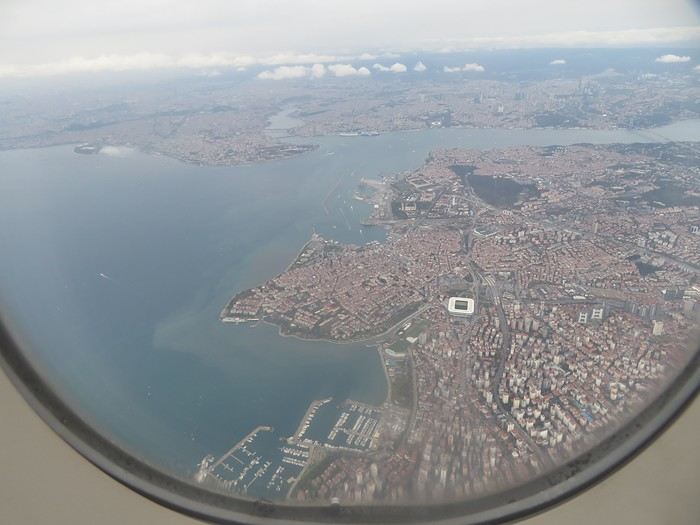
It all starts on a plane beginning its descent, knowing that the approach to Istanbul Airport is always quite long—about thirty minutes. Through the windows, if you’re lucky, you get a view of the city. You need to know a little to get your bearings, but here we’re on the side of Sabiha Gökçen Airport, south of Istanbul on the Asian side. You can spot the Bosphorus, the Golden Horn, and Fenerbahçe’s football stadium.

Landing over highways with three times four lanes, and then the airport tarmac for the taxi phase. This can take a while—sometimes nearly half an hour—but this morning, luck was on my side: barely more than 10 minutes. It’s rare now for Turkish Airlines planes to unload via pax buses, so we got a jet bridge. Avgeeks will immediately notice they’re not in Europe anymore but in another world: Pobeda, Belavia, and plenty of more exotic airlines. As the captain seriously put it in his final announcement after thanking the kids, it’s the “crossroads of the world.”
We suddenly step into a massive corridor, an endless, bright hall, usually deserted, and turn left or right—I think it’s always left for the flights I take, heading toward “transfers.” The walk is supposed to take a good ten minutes at worst. Watch out for airport vehicles—they come fast and don’t honk.
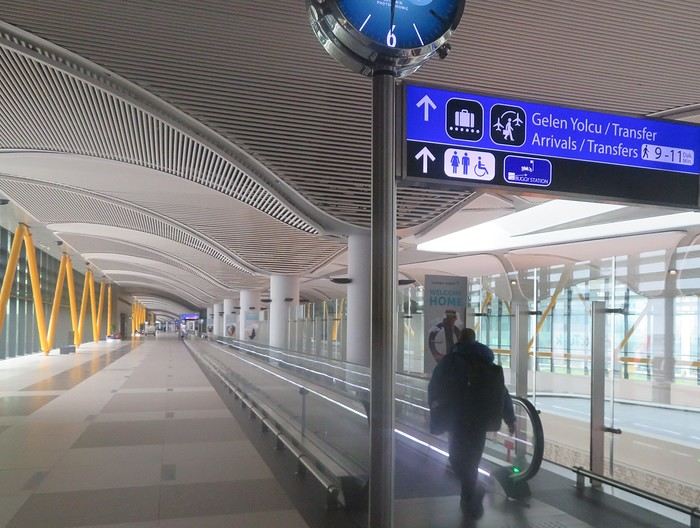
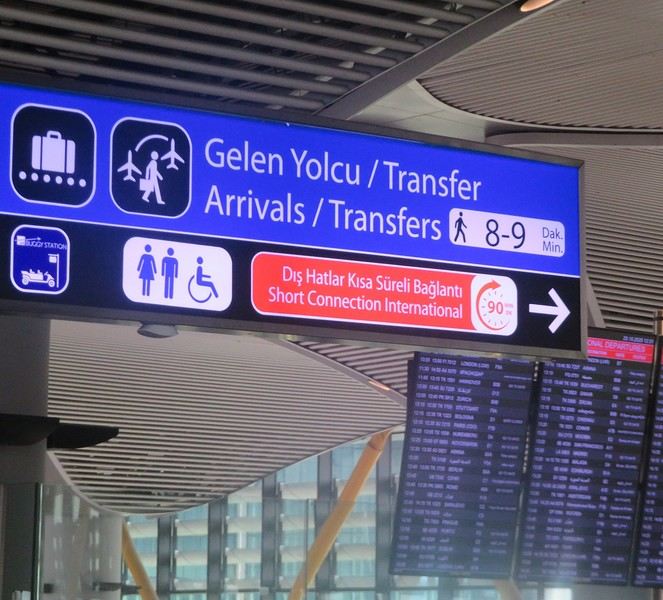
Here’s where it gets interesting: Istanbul has always had a bypass for short layovers, something you never hear about on forums. In the past, you had to bolt out of the jet bridge like a rocket and vaguely show your boarding pass to an attendant before sprinting. But now it’s institutionalized, and there’s signage that spares you from running all the way to the main security check. Until recently—at least the last time I did this—it even let you skip all formalities, dropping you like a wild dog into the departures area, which is spacious enough to stretch your legs!
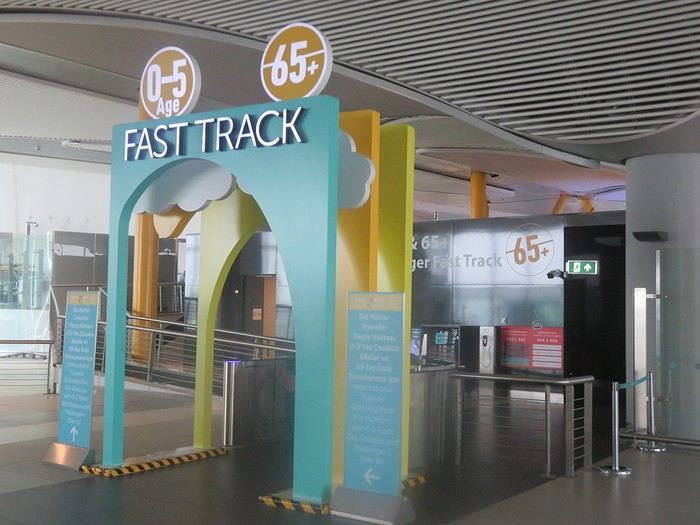
A heads-up for the young and the not-so-young: even without the bypass, if you’re under 5 (accompanied), over 65 (alone), you get fast track. That saves you a few hundred meters and possibly some waiting time, though I’m less sure about that. The entrance honestly looks like an amusement park, though.
So, not young enough, not old enough, I keep going. I pass by dozens of passport control booths (in blue) and reach the transfer security checkpoint (in red). There’s a fast track for Business and Gold passengers—in my case, I’m both—but since it’s at the wrong end for my direction, it wouldn’t even be worth it. It’d just be a frivolous sprint. None of this is crowded at all; the wait lasted about a minute. You have to take out your laptop at this checkpoint—not all of them—but you haven’t had to take out liquids for a while in Istanbul. A hallway, an escalator, and then—bam—you’re in the Dubai-esque hall. One look says it all. Everything sparkles, everything’s expensive. *Very* expensive. Just for show, I spot a sandwich for around 12 €, and some simits for about 4 € (it’s in TL, but that’s roughly the conversion).
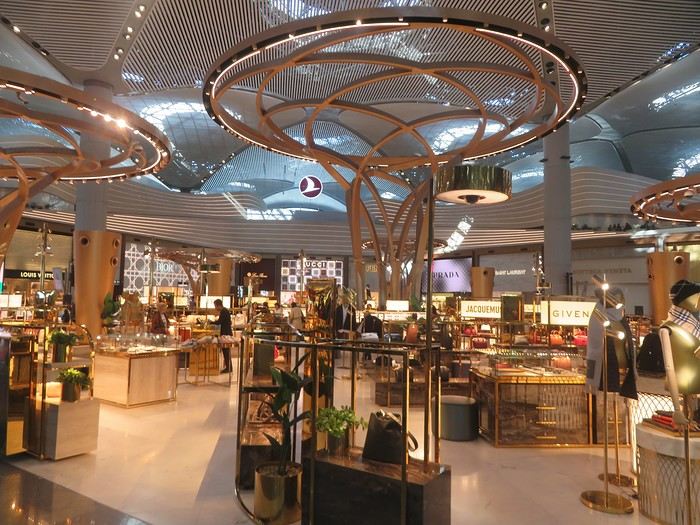
So, I head to the lounge—or one of the lounges—at Turkish Airlines, upstairs. Here too, there’s a priority entrance for families and people with reduced mobility, and an extra hundred meters for everyone else. A few of us seem to have had the same idea, and the twin lounges are under renovation for three months. One is for Business Class passengers, the other for Miles & Smiles and Gold members. They’re nearly identical. Needless to say, it’s packed—just as crowded in one as the other. There are *tons* of Business Class passengers on Turkish Airlines. I assume some other airlines’ passengers are mixed in, but not enough to explain the crowd. It’s as busy as Gare Montparnasse on a holiday departure day, and the 5 or 6 food counters, along with the salad and dessert buffets, are struggling to keep up. I didn’t dare ask to access the shower area, but I’ll admit the Wi-Fi works without the torturous maneuvers it required just a few months ago. Later, I’ll have to watch for the gate for my destination—Warsaw. With my usual luck, it’ll be in the F double-digits, the farthest ones, listed as 15 to 19 minutes away. That said, once you reach the end of that dead end, there’s plenty of quiet space with power outlets. Because here, there’s high demand for kilowatts.
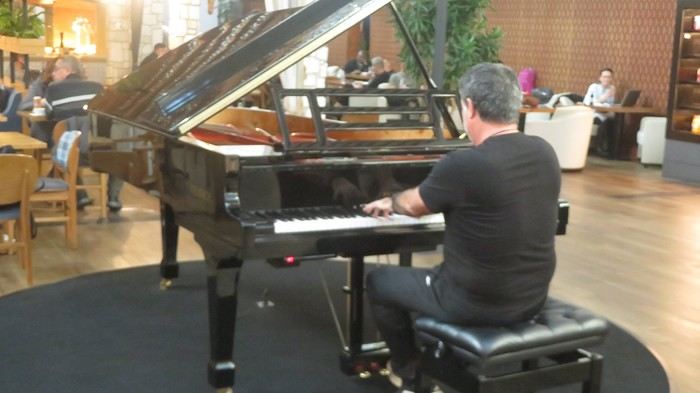
My reporter’s conscience doesn’t go so far as to guide me here—I’ve covered the free access up to the iGA lounge, which has a good reputation but costs nearly 100 € for three hours. Maybe another time, on a promo day—I’ll keep an eye on their site. The piano starts playing “Bésame Mucho,” so I’ll pause my story here.
Michel
Since it’s a hot topic, yet rarely shown, and since there’s quite a bit of criticism and prejudice around it—and since I’ve had three in ten days—I’m going to talk about layovers at Istanbul Airport, especially with Turkish Airlines. This is a common scenario for forum members planning trips to Central Asia, the Caucasus, but also Japan, China, Australia, Africa, and more.
It all starts on a plane beginning its descent, knowing that the approach to Istanbul Airport is always quite long—about thirty minutes. Through the windows, if you’re lucky, you get a view of the city. You need to know a little to get your bearings, but here we’re on the side of Sabiha Gökçen Airport, south of Istanbul on the Asian side. You can spot the Bosphorus, the Golden Horn, and Fenerbahçe’s football stadium.
Landing over highways with three times four lanes, and then the airport tarmac for the taxi phase. This can take a while—sometimes nearly half an hour—but this morning, luck was on my side: barely more than 10 minutes. It’s rare now for Turkish Airlines planes to unload via pax buses, so we got a jet bridge. Avgeeks will immediately notice they’re not in Europe anymore but in another world: Pobeda, Belavia, and plenty of more exotic airlines. As the captain seriously put it in his final announcement after thanking the kids, it’s the “crossroads of the world.”
We suddenly step into a massive corridor, an endless, bright hall, usually deserted, and turn left or right—I think it’s always left for the flights I take, heading toward “transfers.” The walk is supposed to take a good ten minutes at worst. Watch out for airport vehicles—they come fast and don’t honk.
Here’s where it gets interesting: Istanbul has always had a bypass for short layovers, something you never hear about on forums. In the past, you had to bolt out of the jet bridge like a rocket and vaguely show your boarding pass to an attendant before sprinting. But now it’s institutionalized, and there’s signage that spares you from running all the way to the main security check. Until recently—at least the last time I did this—it even let you skip all formalities, dropping you like a wild dog into the departures area, which is spacious enough to stretch your legs!
A heads-up for the young and the not-so-young: even without the bypass, if you’re under 5 (accompanied), over 65 (alone), you get fast track. That saves you a few hundred meters and possibly some waiting time, though I’m less sure about that. The entrance honestly looks like an amusement park, though.
So, not young enough, not old enough, I keep going. I pass by dozens of passport control booths (in blue) and reach the transfer security checkpoint (in red). There’s a fast track for Business and Gold passengers—in my case, I’m both—but since it’s at the wrong end for my direction, it wouldn’t even be worth it. It’d just be a frivolous sprint. None of this is crowded at all; the wait lasted about a minute. You have to take out your laptop at this checkpoint—not all of them—but you haven’t had to take out liquids for a while in Istanbul. A hallway, an escalator, and then—bam—you’re in the Dubai-esque hall. One look says it all. Everything sparkles, everything’s expensive. *Very* expensive. Just for show, I spot a sandwich for around 12 €, and some simits for about 4 € (it’s in TL, but that’s roughly the conversion).
So, I head to the lounge—or one of the lounges—at Turkish Airlines, upstairs. Here too, there’s a priority entrance for families and people with reduced mobility, and an extra hundred meters for everyone else. A few of us seem to have had the same idea, and the twin lounges are under renovation for three months. One is for Business Class passengers, the other for Miles & Smiles and Gold members. They’re nearly identical. Needless to say, it’s packed—just as crowded in one as the other. There are *tons* of Business Class passengers on Turkish Airlines. I assume some other airlines’ passengers are mixed in, but not enough to explain the crowd. It’s as busy as Gare Montparnasse on a holiday departure day, and the 5 or 6 food counters, along with the salad and dessert buffets, are struggling to keep up. I didn’t dare ask to access the shower area, but I’ll admit the Wi-Fi works without the torturous maneuvers it required just a few months ago. Later, I’ll have to watch for the gate for my destination—Warsaw. With my usual luck, it’ll be in the F double-digits, the farthest ones, listed as 15 to 19 minutes away. That said, once you reach the end of that dead end, there’s plenty of quiet space with power outlets. Because here, there’s high demand for kilowatts.
My reporter’s conscience doesn’t go so far as to guide me here—I’ve covered the free access up to the iGA lounge, which has a good reputation but costs nearly 100 € for three hours. Maybe another time, on a promo day—I’ll keep an eye on their site. The piano starts playing “Bésame Mucho,” so I’ll pause my story here.
Michel
A week in the Lofoten Islands with family in February: a few practical questions...
Hello,
We’re heading to the Lofoten Islands from February 17 to 24, 2026—my husband (a fishing enthusiast), our 7-year-old daughter, and me. The flight tickets are booked (arrival and departure from Evenes), the car is rented, and the itinerary is more or less set. I just have a few questions left and was hoping to get some advice/tips from your experiences.
We’ve planned two bases: Henningsvær and Nusfjord.
Originally, I had planned:
Arrival at Evenes at 2:30 PM, pick up the car, drive (3h) to the Lofoten Islands 4 nights in Henningsvær 3 nights in Nusfjord Drive to the airport (5h) and departure at 3:20 PM
Looking back and considering the unpredictable weather, I’m thinking that a 5-hour drive on the last day before returning the car and catching our flight might not be the best idea. So now, I’m considering spending 3 nights in Henningsvær, 3 nights in Nusfjord, and one last night on the way to the airport. What do you think? Would you have any villages to recommend along the route between the Lofoten Islands and Narvik where we could spend the night and maybe explore for our last 24 hours in Norway? A few practical questions: I’ve heard that most shops, restaurants, cafés, etc., will be closed since it’s the off-season, but on the other hand, I see that Henningsvær is a village that comes alive during the skrei fishing season. I was wondering if everything would be closed or if it would still be possible to visit shops, workshops, and galleries. As for skrei fishing, my husband would love to fish with locals for 2 or 3 days. I found some options online, but nothing’s open yet for February. Will it be possible to join skrei fishing with locals or certain organizations? One last question for now: should we bring our own snowshoes, or will it be possible to rent them there (including for kids)? Thanks in advance, and have a great day!
Safety in Chanthaburi - Trat and Ko Kood
Hi,
Does anyone know if it's still advised against traveling to Chanthaburi, Trat, Ko Chang, and Ko Kood?
On thailande.gouv, they recommend staying more than 10 km away from the borders with Cambodia.
I don’t know if that’s a good idea.
But on TripAdvisor, it seems to be discouraged.
Looking for recent info on the Tour de l'Aubrac and the Stevenson Trail
Hi,
I was wondering if this forum is still active. The last discussions seem to be from several years ago?...
If so, I’m looking for information on these hikes—the **Tour de l'Aubrac** in 8 days and the **Chemin de Stevenson** in 12 days...
Lists of accommodations with:
- Locations
- Prices
- Capacity (how many people they can host)
The stages— I’d like to do these routes with a group of 8 to 10 people. Thanks in advance... Jean-Claude BOULET Email: marcheur117@gmail.com Phone: 06 67 49 28 22 Residence: Royan 17, Charente-Maritime
The stages— I’d like to do these routes with a group of 8 to 10 people. Thanks in advance... Jean-Claude BOULET Email: marcheur117@gmail.com Phone: 06 67 49 28 22 Residence: Royan 17, Charente-Maritime
Which destination to choose in the Philippines after the earthquake?
Hi,
We’re heading to the Philippines in November and had planned to spend some time in Cebu, specifically Moalboal.
What’s the current situation with the roads after the earthquake?
Any risks of aftershocks?
Thanks for your advice!
Flight canceled due to strike with Ryanair: wait or rebook?
Hi everyone,
I have a Ryanair flight scheduled for 10/14 (outbound, returning on the 16th) from Charleroi in Belgium. A strike is confirmed, and the airport will be closed on the 14th. But Ryanair is still saying the flight is confirmed. I get that they’re trying to make us change and pay extra fees rather than wait for the free compensation.
If I make a new booking, can I still claim a refund for the first one?
Thanks in advance for your help—this is the first time I’ve faced this situation.
Can you get a 6-month visa for Madagascar?
Hi, is it possible to find out? How can I stay for 3 consecutive months in Madagascar, based on a fixed-date flight ticket? In short, how do I get a visa stamped at the airport??
Does anyone know if there’s maritime transport from the southern tip of Africa to a port in MADAGASCAR?
CHEAPER THAN A FLIGHT, see you soon, fellow traveler!!
Does anyone know if there’s maritime transport from the southern tip of Africa to a port in MADAGASCAR?
CHEAPER THAN A FLIGHT, see you soon, fellow traveler!!
Fly Play airline files for bankruptcy
Hi,
Icelandic airline Fly Play has ceased all operations with immediate effect. 400 employees were laid off this morning, all flights have of course been canceled, and thousands of passengers are left without solutions. It operated flights to several European countries and the USA, including France from Paris Charles de Gaulle :(
Icelandic airline Fly Play has ceased all operations with immediate effect. 400 employees were laid off this morning, all flights have of course been canceled, and thousands of passengers are left without solutions. It operated flights to several European countries and the USA, including France from Paris Charles de Gaulle :(
Traveling to Iraqi Kurdistan – is it safe?
Hi everyone, I’m married to a Kurd from Iraq, and we’re heading to Kurdistan in November with our two-and-a-half-year-old son. Even though I’m really excited about this trip and happy to go, I’m a bit nervous because as a European woman, I feel like there’s nothing to do and I have this image of a dangerous country… To put my mind at ease, I’d love to chat with other Europeans who’ve been there. Thanks! !
Can you hike without a guide in Northern Vietnam?
A message in a bottle:
For a three-week trip in November... is it possible to go hiking without a guide in northern Vietnam, getting around to the hiking sites by public transport, bikes, or on foot? And if so, which areas specifically?
Thanks to anyone who replies!8
Rainy season in South Korea
Hey everyone! 🙂
Just giving you the quick context: A group of friends and I are planning a trip to South Korea (Seoul/Busan) at the end of June/July next year. It falls right in the middle of the monsoon season, but we don’t really have other availability options.😕
I’d love to hear from people who’ve visited the country and these cities during this period—basically, is it not as bad as it sounds, or should we just cancel our tickets (we don’t mind the heat, it’s mostly the rain that scares us).
I know there are plenty of indoor activities, but do you think we’ll still manage to get a few sunny days, or will it be torrential rain for our entire 2-week trip?
The only other country we’ve visited during the rainy season is Brazil (in the northeast) around the same time, and honestly, aside from a few really annoying downpours, we had sunshine most of the time and it was awesome. That said, the climate is totally different, so I’m not sure how relevant the comparison is.
Thanks in advance to anyone who takes the time to read or reply to this post! 🙂
Road conditions from Taliouine to Tafraoute and then from Tafraoute to Foum Zguid
Hello my friends,
You can't imagine how happy I am to be back on my beloved site, loved by its traveling men and women!!!!!
I want to travel with my little family (by car, not 4x4) from Taliouine to Tafraoute—it's a route I haven't taken yet (I've already done the one via Igherm), and I don't know the condition of the R106 road. Then, once that's done, our destination will be Zagora via Foum Zguid. I don’t want to go to Tata; my wife can’t stand that city. (I don’t mind because there’s a little local bar that’s not bad ;))
If you have any info, especially about the road conditions in October, I’d really appreciate it.
Thanks so much, and I’m so happy to be back here.
Thanks so much, and I’m so happy to be back here.
Feedback on my Colorado - New Mexico - Arizona road trip
Hi everyone,
Let me introduce myself. I’m 45 and traveling with my husband and my daughter, who’ll be 17 soon. We’re used to road-trip-style vacations, in the US or elsewhere. This will be our 5th trip to the US. We’ve already visited several states: New York, Massachusetts, Rhode Island, Washington DC, Florida, Wyoming, South Dakota, California, Utah, Nevada, and Arizona. I’d like to plan another trip starting from Denver to Colorado and New Mexico, which we haven’t explored yet, with a stop in a part of Arizona we haven’t visited before. So, I’d love to hear your thoughts on this itinerary if you’re familiar with the area. We’ll be traveling in the summer of 2026—admittedly not the best time for this route, but it’s the only time we can all get away for long enough. I’m also tied to the dates for Cheyenne Frontier Days, which we want to attend at the start of the trip. Thanks in advance for your input!
Day 1: Departure from Frankfurt > Arrival in Denver around 3 PM. Night in Denver
Day 2: Denver > Cheyenne Quick visit to Denver Drive to Cheyenne in the late afternoon 2-hour drive Night in Cheyenne Day 3: Cheyenne Frontier Days Night in Cheyenne
Day 4: Cheyenne > Estes Park (Rocky Mountains) Frontier Days during the day. Departure in the late afternoon for Estes Park 2-hour drive Night in Estes Park
Day 5: Hiking in the Rocky Mountains Nights in Estes Park
Day 6: Estes Park > Glenwood Springs We’ll take the day to drive the scenic route and stop at various viewpoints. Night in Glenwood Springs
Day 7: Glenwood Springs Hiking the Hanging Lake Trail + relaxing in the hot springs Night in Glenwood Springs
Day 8: Glenwood Springs > Montrose Visit Colorado NM along the way 3.5-hour drive Night in Montrose
Day 9: Black Canyon Night in Montrose
Day 10: Montrose > Farmington Visit Durango (without taking the train), Ouray, or Silverton along the way? 3.5-hour drive Night in Farmington
Day 11: Farmington > Chinle Bisti Badlands until early afternoon 3-hour drive Night in Chinle
Day 12: Chinle > Sedona Canyon de Chelly in the morning 4-hour drive Night in Sedona
Day 13 - 14: Hiking in Sedona Nights in Sedona
Day 15: Sedona > Tucson Saguaro West Park 3.5-hour drive Night at a ranch in Tucson
Day 16 - 17: Tucson City visit in the morning + ranch activities in the afternoon Nights at a ranch in Tucson
Day 18: > Wilcox Chiricahua NP 1-hour drive Night in Wilcox
Day 19: Wilcox > Alamogordo White Sands in the late afternoon 4.5-hour drive Night in Alamogordo
Day 20: Alamogordo > Carlsbad White Sands in the morning Bat viewing in the evening at Carlsbad 4.5-hour drive Night in Carlsbad
Day 21: Carlsbad > Albuquerque Cave visit in the morning Quick stop in Roswell 4.25-hour drive Night in Albuquerque Day 22: Albuquerque > Santa Fe Visit Albuquerque 1-hour drive Night in Santa Fe
Day 23: Santa Fe Kasha Katuwe Tent Rocks in the morning Visit Santa Fe in the afternoon Night in Santa Fe
Day 24: Santa Fe Bandelier in the morning Visit Santa Fe in the afternoon Night in Santa Fe
Day 25: Santa Fe > Alamosa Taos Pueblo along the way Great Sand Dunes in the late afternoon Zapata Falls Night in Alamosa
Day 26: Alamosa > Denver 4-hour drive Departure around 7 PM
Looking forward to your suggestions, corrections, and feedback!
Looking for advice on GR53 route from Wissembourg to Rotterdam
Hi there.
I’ve hiked the GR trail mentioned in the title from Wissembourg all the way to Menton.
Now I’ve got the section from Wissembourg to Rotterdam left.
But I can’t find any maps for this route—I’m looking for someone who’s done this part of the trail.
Thanks in advance! 😊
Travelers are changing their habits as the climate deteriorates
Hi everyone.
Not sure if guidebooks, agencies, and other tour operators are keeping up by changing their visiting hours and offerings.
Personally, I see a promising opportunity here—jumping on this adaptation to extreme climates before others do, since they’re inevitably coming.
From my own travel experience, I’ve met a few guides so far who are starting to adjust, like in Egypt, Kenya, Senegal, and elsewhere.
They avoid crowds and the hottest hours by starting their tours around 6–7 AM, when it’s cooler.
Yeah, you’ve gotta wake up early, but the payoff is so worth it. 😴
If you’ve got any great tips like this, why not discuss them in this thread and share addresses or websites where the people in charge have realized climate change is real and are adapting? 😊
Transfer from Venice to Fusina port
Hi there,
I need to take the Explora I ship for a cruise departing from Venice (Fusina port) in mid-October.
We’re spending two days in Venice beforehand. How do we get to the ship? Is it easier to take the train back to Mestre and then a taxi? Are there taxis at Mestre station? Do we need to book in advance? Do you know of a reliable company?
Explora doesn’t offer a bus transfer and mentions a water taxi for 360 €!!!!
Thanks in advance for your help. Best regards, Claudine
Looking for people to interview
Hi there,
I’m looking for people to interview because I’d love to understand your travel desires to help refine my professional project. Just to clarify, the goal is simply to understand your aspirations/barriers, etc.—I’m not trying to sell anything.
The idea would be to chat for about 30 minutes to an hour over the phone, answering a few questions. I’m most interested in people who travel in France, love nature activities, prefer to avoid overly touristy paths, enjoy unique experiences, and are into local artisans and producers...
Does this sound like you? Feel free to message me. Just to be clear, I won’t share any details from our conversations.
Have a great evening, everyone.
Permanent Residency and eTA in Canada
Hello,
I’m a resident of France, and my husband and I have submitted an application for permanent residency in Canada after obtaining our CSQ. Our application is still being processed. My husband is the principal applicant.
I need to travel to Montreal alone for a few days soon for work-related reasons.
If we happen to receive confirmation of permanent residency in the meantime, could there be an issue with me crossing the border? I don’t want to activate the permanent residency—just enter as a tourist and make a quick round trip.
On the IRCC website, it says that dependents cannot arrive in Canada before the principal applicant. I understand this is because only the principal applicant can activate permanent residency by going through immigration.
However, does this also exclude temporary stays for dependents? Since my eTA should still be valid as long as the permanent residency isn’t activated, I should still be able to enter Canada as a tourist, right?
Thanks so much for your feedback!
Best regards,
Canada eTA refused
Hello everyone,
I’m going on a tourist trip to Canada (Quebec) on September 1st. I filled out an eTA application 10 days ago but made a mistake on my passport number. I submitted a new application and had to send a copy of my passport, which I did correctly (unfortunately, I didn’t take a screenshot as proof). The next day, my eTA was refused! I made a third application this past Saturday, August 16th, and they confirmed receipt, but it’s now Monday evening and I still haven’t heard anything! I’m starting to seriously panic. It’s absolutely impossible to get help from a real person online! The Canadian Embassy in Brussels doesn’t handle eTA applications at all! I don’t know what to do. Can anyone help me, please? Thanks in advance 😢
Looking for trekking buddies and tips
Hi there!
I’m looking for one or two (or more) people to climb the Maasai sacred mountain, Ol Doinyo volcano.
I already have a guide.
The dates are January 12, 13, and 14.
It’ll be a full moon, so it’ll be easier to see during the night ascent.
Good physical fitness is required.
Otherwise, to anyone who’s been there before—I’d love some tips!
Your tips for renting a car near Durrës
Hi,
I’m in Albania for 2 weeks, specifically in Durrës, with my daughter and her friend (both 14), and I was planning to mostly use public transport. But I’m worried it’ll limit our sightseeing and exploring around the country. I’d like to rent a car but I’m not sure how to go about it since I don’t speak the language, and English isn’t always enough to understand all the details and rules around renting a vehicle. Any advice would be greatly appreciated!
Thanks in advance,
Stéphanie
The Extraordinary Painted Houses Village of Tam Thanh near Hoi An
Not sure if I’ve already posted this, so here it is again!
https://hiddenhoian.com/travel/tam-thanh-mural-village/
Imagine a peaceful coastal fishing village completely transformed by artists who worked their magic on the walls of 100 residential houses. That’s the remarkable story of the Tam Thanh mural village in Quang Nam province. Once similar to many other coastal villages in the area, it now firmly stands out on the tourist map for day trips from Hoi An. In the summer of 2016, Tam Thanh was selected by a joint Korean-Vietnamese project called “Art For A Better Community.” The village was chosen to be their blank canvas, inspired by the success of mural villages in Korea. The project aimed to make Tam Thanh the first painted village of its kind in Vietnam. The team included five Korean artists and seven Vietnamese artists, along with local volunteers. Their goal was to show Vietnamese people that art could be part of everyday life, no matter their place in society. The effort began with about three weeks of wall washing, followed by painting the walls of over 100 residents’ homes. The project was a success, and the village came alive with the paintings. The entire village is now a breathtaking gallery just waiting to be explored. The murals capture the life and soul of the village, from young children playing to fishermen in the ocean. A mix of fantastic pieces offers stunning backdrops for photos. The painted art around the town hasn’t just had a visual impact—it’s also had a social one. The village was chosen not only for the layout of the houses but also to contribute to economic development opportunities in Tam Thanh. Tourists now visit the once-overlooked village, creating more income for locals and making it a successful “art for a cause” project. For example, one entrepreneurial resident who owned a small local café invested 000,000 VND (390 USD) in a sugarcane press a week before the paintings were completed. Sugarcane juice vendors then multiplied with the growth of tourism (5,000 VND - 0.20 USD). Walking down the village’s single street, it’s common to find locals selling refreshments and handmade crafts. In one house in particular, a tailor and his family are painted on an outer wall with incredible detail. The family started selling tote bags decorated by their young daughter. The price for the bags is 100,000 VND (4 USD). If you’re looking for a way to support the village’s economy, this is it. Since there’s no middleman here, you can be sure your money goes directly to the community. You can have lunch at a house with a terrace right by the beach at the edge of the village.
How to Get There Route No. 1: Cross the large Cua Đai bridge. Once you’ve crossed it, continue toward Duong 129/Duong Ven Bien. Stay on this road for 33 kilometers. Upside: this route has light traffic, no traffic lights, and no trucks or buses. It’s a great direct route to the village but offers little to see along the way. You’ll eventually reach a crossroads. Turn right toward Tam Ky town, while the left will take you toward the Tam Thanh mural village. Stay on Route 608 as it turns twice before reaching a bridge. Cross the bridge, and you’ll arrive at Thanh Nien Road. Finally, turn right to reach the village. This route takes about an hour. Use your best judgment. For reference, it costs about 5,000 VND (0.20 USD) to park a motorbike.
Route #2: Cross the large Cua Đai bridge. Once you’ve crossed it, continue toward Duong 129/Duong Ven Bien. Stay on this road for 12 kilometers, then turn left onto Route 613, where you’ll continue for 1.5 kilometers until you reach Thanh Nien Road. Finally, turn right and drive 23 kilometers to the painted village. For most of the trip, taking Thanh Nien Road will take you through a much more local part of the region. The journey takes about an hour and a half.
China 30-Day Visa Exemption
Hi there,
I’m a bit unsure—right now, the 30-day visa exemption ends on December 31, 2025. If I enter China on December 23, will I still get the full 30 days even though the exemption officially ends on the 31st? Is it the entry date that counts for the 30-day period?
Thanks for your input!
I’m a bit unsure—right now, the 30-day visa exemption ends on December 31, 2025. If I enter China on December 23, will I still get the full 30 days even though the exemption officially ends on the 31st? Is it the entry date that counts for the 30-day period?
Thanks for your input!
Which sections of the Camino del Cid are worth doing?
Hi there,
The full route from Burgos to (just before) Murcia is 1,300 km.
If you’ve done the whole thing, do you think the entire route is worth the trip, or can some sections be skipped?
Thanks.
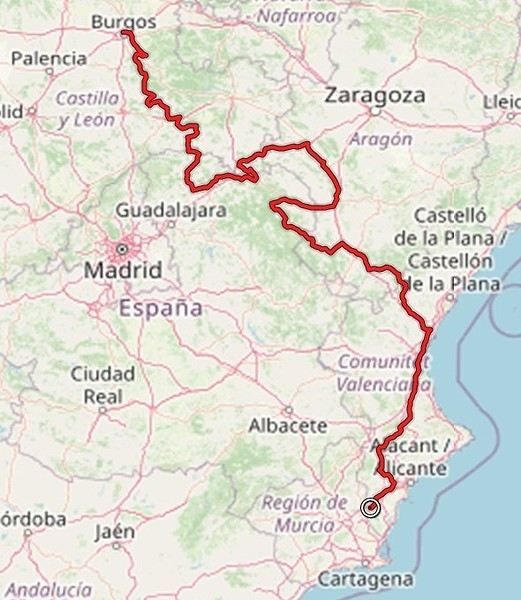
The full route from Burgos to (just before) Murcia is 1,300 km.
If you’ve done the whole thing, do you think the entire route is worth the trip, or can some sections be skipped?
Thanks.