Results for "Delta+|+55"
25813 results found.
Népal - Tibet: 1 mois été 2000 English translation pending
Salut à toutes et à tous. 😉
Je vous présente mon carnet de voyage Népal - Tibet.
Commencer par la dernière image !!!
@ + 😛
Je vous présente mon carnet de voyage Népal - Tibet.
Commencer par la dernière image !!!
@ + 😛
Expo Destins Croisés, Reza, Luxembourg English translation pending
Bonjour à tous les membres de VF (c'est ainsi qu'ils se nomment, apparemment...).
Tout d'abord merci François d'avoir ouvert ce topic.
Je voudrais ensuite parler de l'expo qui se déroule actuellement sur les grilles du Luxembourg à Paris (eh oui, encore et toujours, désolé pour les chanceux qui ne respirent pas le périph à longueur de journée). Elle est dans l'esprit de celles de La Terre Vue du Ciel (Yann Arthus Bertrand), et des Volcans et des Hommes. Cette fois-ci, c'est Reza, le célèbre photographe iranien, qui nous expose ses plus forts et ses plus beaux clichés, accompagnés de textes bouleversants.
Si vous avez un coup de bluz, n'y allez pas! Il faut avoir une dose très remplie de bonne humeur, de bonnes dispositions envers la vie. A chaque photo, cette dose est amputée de plusieurs unités. Dès la troisième photo (et le troisième texte qui va avec), on se sent l'envie de pleurer, ou de vomir. Mais, malgré cela, plus rien ne peut nous empêcher de continuer, tant son oeuvre toute entière est profondément humaine. Dans ses textes, dans ses cadrages, ses couleurs, le choix des portraits pris, des compositions des scènes, les regards des gens, tout transpire de sa propre personnalité, et on n'a qu'une phrase en tête: "j'aimerais bien le connaître, ce gars là!".
L'idée directrice de cette exposition, qui se nomme Destins Croisés, est qu'au delà des maux, des souffrances de tant de peuples, de tant de classes sociales, de tant d'enfants, de tant de cultures, de mers, de fleuves, la vie est la plus forte. Ces gens si malheureux trouvent encore le moyen d'être heureux, je ne sais pas comment ils font, et c'est montré avec beaucoup de pudeur, d'authenticité, de simplicité. Rien que d'écrire cela maintenant, j'en ai les larmes aux yeux en y repensant. Les gens que Reza montre, ce sont des gens qui n'ont plus rien, et qui trouvent encore la force de danser, de sourire, de jouer, de se débrouiller, de s'aimer, d'aimer. Ce sont ces photos là qui font le plus pleurer.
Devant les grilles du Luxembourg, en ce moment, rare sont ceux qui éclatent de rire, vraiment.
J'ai cru bon de parler de cette expo ici, dans ce Forum, parce que d'une part, je pense que ses membres, par ce qu'ils ont pu voir lors de leurs voyages, ont acquis une certaine sensibilité (où l'avaient et c'est pour cela qu'ils voyagent), et d'autre part parce que Reza est le type même du Globe Trotter qui a passé sa vie en voyages. Et ce n'était pas tous les jours les vacances, croyez le.
Après une expo comme celle-ci, on arête de raler, de se plaindre tout le temps, même un français. Ce n'est pas possible autrement!
Bon courage à ceux qui iront, et merci Reza!
Vaccins pour le Népal et le Tibet English translation pending
Hello à tous 🙂
Le départ prévu pour le 1er octobre se rapproche et toujours pas de réponse à la question que je me pose : dois-je suivre un traitement anti paludisme avant de partir ?
Certains guides de voyage disent "indispensable". D'autres, "pas nécessaire". Certains forums ou carnets de voyages que j'ai découvert sur le net varient également sur la question.
Alors je fais quoi moi?!!!!
Help !!!!
Bisous à tous 😉
Marie
Donne des conseils sur les Seychelles English translation pending
😉 salut a tous, je reviens des seychelles et je peux vous donner plein de conseils sur cette superbe destination et qui sais faire rever ceux qui veulent y aller ou tout simplement faire envie d'y aller.
Il y a moyen de le faire sans se ruiner, c'est une destination tres chere, mais en se debrouillant on peut reduire les frais de facon significative.
A bientot.
Gudule
Il y a moyen de le faire sans se ruiner, c'est une destination tres chere, mais en se debrouillant on peut reduire les frais de facon significative.
A bientot.
Gudule
Madagascar avec mon fils English translation pending
Bonjour a tous,
j'ai un petit garçon métis malagache, je l'elève seule mais garde un très bon contact avec sa famille patenelle.
Celle-ci me reclame de plus en plus d'amener mon fils a Mada pour le presenter au reste de la famille.
Bien entendu cela m'attire, mais je me pose beaucoup de questions!
mon fils à 2 ans, je pense attendre au moins ces 4 ans pour partir.
J'avais déjà inscris un message similaire mais la reponse obtenue diverge completement de l'avis dela famille, j'aurais donc besoin de plus d'avis!
je me soucis des maladies tels que le palu...
Tte sa famille est porteuse sene du palu ils me disent doc que mon fils doit être immunisé!?
D'autre part, ils me disent que le palu est bcp pluis présent dans les îles que sur tana la capiltale.
D'après eux le virus est casi absent sur les terres!?
Je pensais commencer par emmener mon fils en Afrique pour tester avec lui comme il supporte les grands voyages, sénegal, burkina ou mali?
LE PLUS INTERRESSANT POUR LUI?
J4ATTENDS VOS TEMOIGNAGES
D'avance merci
Anne
Les services d'immigration américains exagèrent English translation pending
Anecdote qui souligne les problèmes avec les services d'immigration aux USA.
Hier le vol American Airlines en provenance de Paris arrive à l'heure à Miami, la majorité des passagers continuent sur des correspondances à destination de l'Amérique Latine, disposant en général d'au moins deux heures pour effectuer ce transit international. Le contrôle des passeports a été tellement tatillon que la moitié des passagers n'ont pas pu avoir leur vol suivant. Ils devraient continuer cet après midi avec 24 h de retard !
Je n'ai jamais lancé d'appels au boycott, mais j'ai vraiment envie de dire à tous ceux qui veulent voyager utiliser autre chose que des services américains, parce que cela commence à atteindre le sommet de l'absurdité
What’s a great European travel idea for Christmas magic?
Hello! 👋
I’m new to this site and feeling a little desperate. 😢 My boyfriend’s birthday is in 4 days, and I wanted to surprise him with a New Year’s trip to London... except I just found out he’s already been there as a kid. Well, there goes my surprise! 😅
Since we both love Christmas and winter, I’m looking for a destination where we can really feel the holiday magic—with a budget of around 500 € for transport + accommodation for two (yes, I know, I might be asking for a Christmas miracle here 😇).
We’ve already been to Bucharest, Prague, Vienna, and Budapest, so I’d love to find something a little more offbeat, not too expensive, and with a beautiful Christmas atmosphere.
Please help me! 🙏 On social media, it’s always the same ultra-touristy cities... I’m sure there are hidden gems I haven’t discovered yet!
Please help me! 🙏 On social media, it’s always the same ultra-touristy cities... I’m sure there are hidden gems I haven’t discovered yet!
Taking the train to China: questions about the Central Asia route
Hi everyone,
I’m planning a family trip in a year. Our goal: traveling to China (and maybe Hong Kong) by train. I’m all set with the route up to eastern Turkey. However, I’m just starting my research for the rest of the journey—namely the Caucasus (no trains as far as I know, so buses and/or ferries), then Central Asia and China. So, I’d love to hear any info or tips (general and forward-looking at this stage) about the train route through Central Asia and China to reach the east coast. I’m particularly interested in details on: - How far in advance to book / any potential difficulties with reservations - Whether there are PASS systems (or equivalent) between countries and/or if some tickets allow stopovers, meaning you can hop on and off as you please - Day trains vs. night trains (the latter option lets you explore cities between two legs of the journey) - A rough idea of ticket costs ...
A huge thank you to anyone who can share some info or experiences. It’s also a great opportunity to chat about adventure after (way too) many years away from this forum.
Is Island Peak Hard? Fitness, Altitude and Climbing Skills
Island Peak in Nepal is often considered a suitable introduction to technical Himalayan climbing, but how difficult is it for someone attempting their first 6,000-meter summit?
For anyone wondering is island peak hard , I think it is important to look beyond the mountain's reputation as a trekking peak. Island Peak reaches 6,189 meters, and while much of the approach involves trekking, the final ascent introduces a different set of challenges. Climbers may need to use crampons, fixed ropes and an ascender while crossing glacier terrain and climbing a steep snow and ice section.
Physical fitness is important, but it is not the only factor. Acclimatization, endurance, confidence with climbing equipment and the ability to remain calm in cold, exposed conditions can all affect the experience. Summit day can also be long and tiring, particularly after several days of trekking at altitude.
I am curious about the experiences of people who have attempted Island Peak or climbed other Himalayan summits.
Is Island Peak manageable for a fit trekker with no previous technical climbing experience?
How much high-altitude trekking experience should someone have before attempting it?
Is the final headwall more challenging physically or mentally?
Would you recommend gaining basic crampon and fixed-rope experience before joining an expedition?
I came across this detailed explanation of Island Peak's difficulty, including its technical sections and preparation requirements: https://www.trekyaari.com/blogs/is-island-peak-hard-difficulty-honestly-explained I'd appreciate hearing from experienced trekkers and climbers. What preparation made the biggest difference to your climb, and what would you advise someone considering Island Peak for the first time?
Planning a trip using public transport in Mauritania
Hello. I'm planning a 15- to 18-day trip starting in mid-March 2027. Among my "finalist" destinations: Mauritania.
My plan: prioritize public transport and, when necessary, hire guides for day trips or multi-day excursions, hoping to team up with other travelers I meet along the way to share costs. After doing some research online and on the forum, I’d love to hear your thoughts on these questions: - In Jordan, are there enough solo travelers to make sharing excursions feasible? - I’m planning to organize my excursions on the spot—does that seem doable? - Beyond the Adrar region with Chinguetti, Ouadane, and Terjit, what other stops should I prioritize? The Banc d'Arguin National Park? The Diawling National Park, maybe with an exploration of the border region with Senegal (Bogué, Kaédi, etc.)? - I’ve been hitchhiking more and more on my trips lately (it’s gotten easier with age!), always adapting to local customs and the country’s situation. Do you think that’s possible in Mauritania? - If I could extend my trip by a few days, I might land in Dakar, visit Saint-Louis, and enter Mauritania via the southern border. Or, over 15–18 days, should I prioritize Dakar and Saint-Louis over exploring other Mauritanian regions that might be harder to reach by public transport? What do you think?
That’s about it... And of course, if you have any other advice or comments, I’m all ears. For the record, beyond Mauritania, which really appeals to me, I’m also looking at Guinea/Togo/Benin/Ghana/Senegal. Text
Two weeks under the Puglia sun
After a pretty disastrous weather-wise trip to Gran Canaria, we’re hoping this time the sun will shine in Puglia.
It’s not a sure thing, though—the weather’s been awful all over Europe in early May.
For those who’d like to (re)read the story without the digressions, it’s here.
Saturday, May 16: This time we’re flying out of Charleroi (Brussels South): the ticket prices, flight times, and proximity all worked for us. The airport (Ryanair) was recently renovated... but it’s still not very well organized. There are hardly any seats in the boarding areas, and... the restrooms cost money!!! The flight goes smoothly, though, and we land in Bari a little late.
We quickly pick up our rental car, a very local-looking Pandina (even more so than the Fiat 500 in this region), and hit the Italian roads... and their unique driving quirks (like the fact that the countless road signs along the streets and in towns are purely decorative 😏, and that Italian cars don’t have turn signals 😮... except for rental cars).
About an hour later, we arrive at our first accommodation, right in the middle of the countryside near Monopoli. The owner isn’t there, but they’ve left us a ton of info via messages and even turned on the space heater, which is a nice touch. We explore the property:
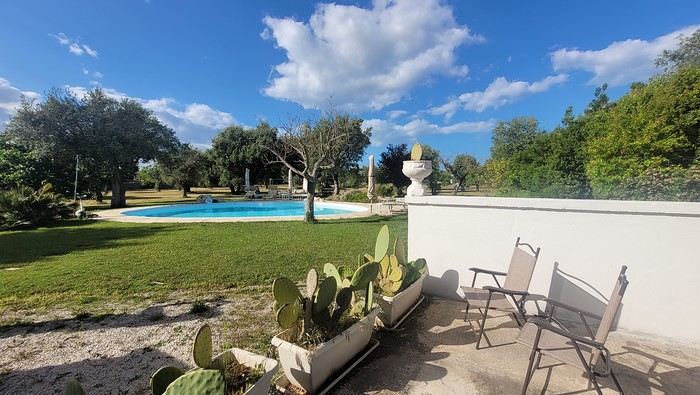
And the next morning before breakfast, its immediate surroundings:
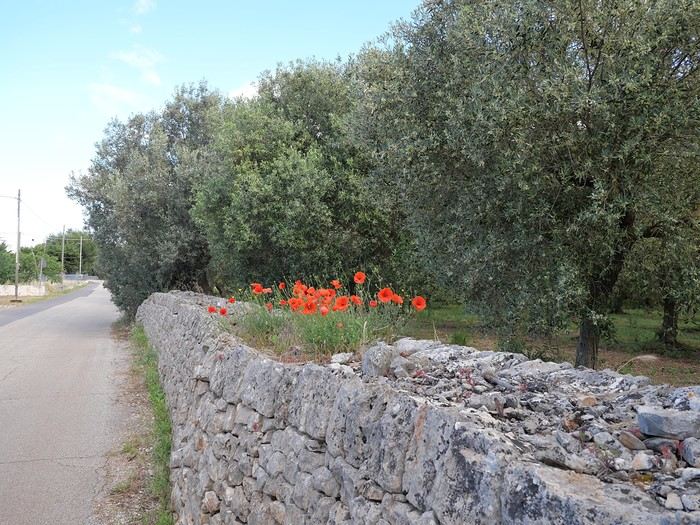
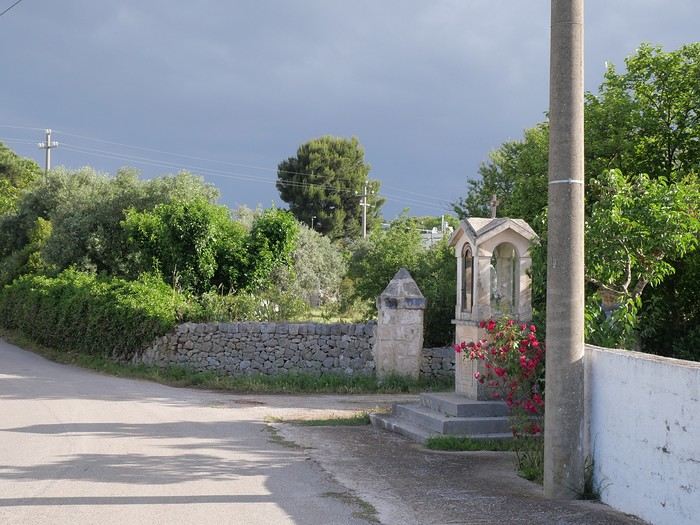
Sunday, May 17: After our "seaside" experience in Gran Canaria last weekend (packed with people and locals), we decide to start inland. After a hearty breakfast,
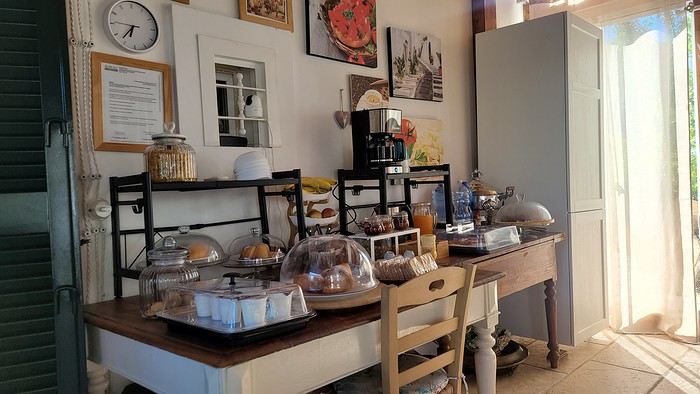
we head toward Alberobello, a super touristy village famous for its trulli—those stone houses with conical roofs. We easily find a free parking spot on a street near the Aia Piccola district, where some trulli are still lived in year-round.
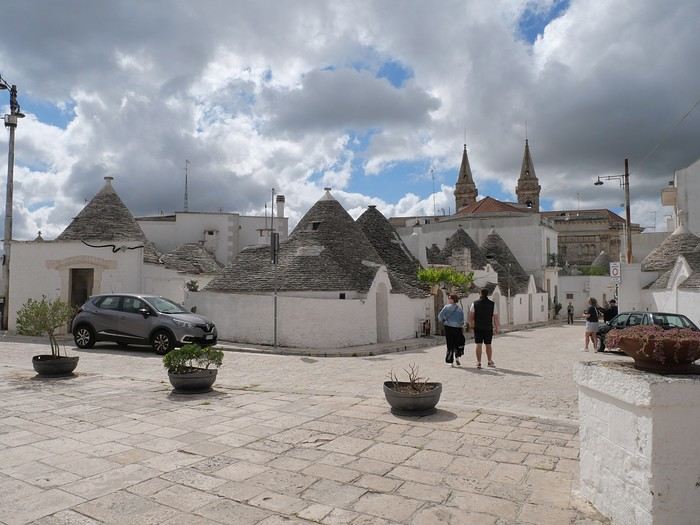
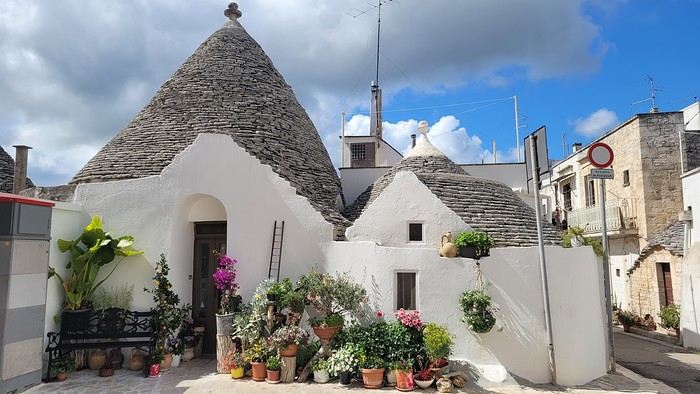
We almost immediately come across the Trullo Sovrano (the only two-story one), which you can visit (but we skip it—it’s opening time, and there’s already a line).
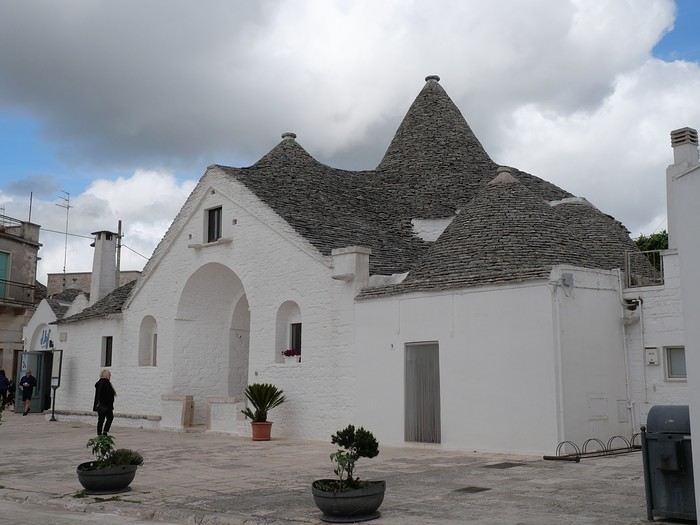
From there, we head down toward the Basilica of Cosma e Damiano... but we don’t go in because there’s a mass.
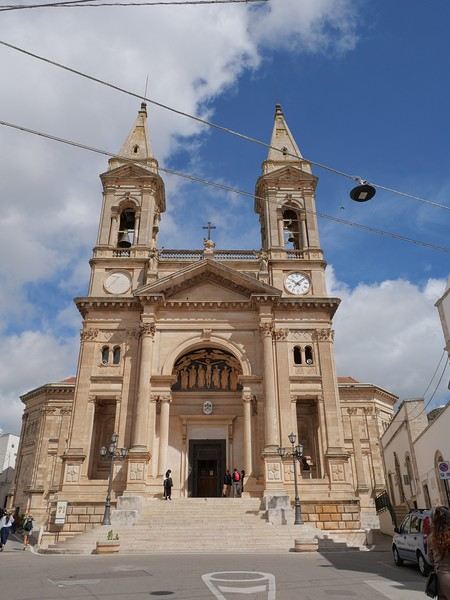
Now we’re on the main Piazza del Popolo, which connects the two districts of Alberobello: Rione Aia Piccola and Rione Monti, the more touristy one.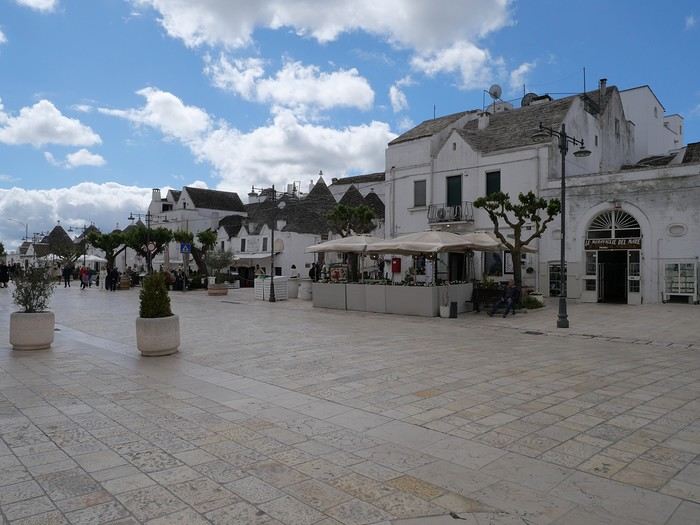
For those who’d like to (re)read the story without the digressions, it’s here.
Saturday, May 16: This time we’re flying out of Charleroi (Brussels South): the ticket prices, flight times, and proximity all worked for us. The airport (Ryanair) was recently renovated... but it’s still not very well organized. There are hardly any seats in the boarding areas, and... the restrooms cost money!!! The flight goes smoothly, though, and we land in Bari a little late.
We quickly pick up our rental car, a very local-looking Pandina (even more so than the Fiat 500 in this region), and hit the Italian roads... and their unique driving quirks (like the fact that the countless road signs along the streets and in towns are purely decorative 😏, and that Italian cars don’t have turn signals 😮... except for rental cars).
About an hour later, we arrive at our first accommodation, right in the middle of the countryside near Monopoli. The owner isn’t there, but they’ve left us a ton of info via messages and even turned on the space heater, which is a nice touch. We explore the property:
And the next morning before breakfast, its immediate surroundings:
Sunday, May 17: After our "seaside" experience in Gran Canaria last weekend (packed with people and locals), we decide to start inland. After a hearty breakfast,
we head toward Alberobello, a super touristy village famous for its trulli—those stone houses with conical roofs. We easily find a free parking spot on a street near the Aia Piccola district, where some trulli are still lived in year-round.
We almost immediately come across the Trullo Sovrano (the only two-story one), which you can visit (but we skip it—it’s opening time, and there’s already a line).
From there, we head down toward the Basilica of Cosma e Damiano... but we don’t go in because there’s a mass.
Now we’re on the main Piazza del Popolo, which connects the two districts of Alberobello: Rione Aia Piccola and Rione Monti, the more touristy one.
Trip feedback: Armenia with an 8-month-old baby
5 days in Armenia with an 8-month-old baby
Hi everyone,
I wanted to share our experience after a 5-day trip to Armenia with my wife and our 8-month-old baby.
It’s a destination that’s still relatively unknown, but it’s really worth the trip, especially if you enjoy cultural, spiritual, historical, and human-centered travel.
We were looking for a change of scenery but not too complicated with a baby—and easy to organize (even though our travel agency helped us a lot, thanks to them! 😊). In the end, Armenia was a wonderful surprise. It’s not a "postcard-perfect" destination. It’s a raw, mountainous, ancient country with real depth.
And most importantly: Armenians *love* children.
That’s probably what surprised us the most. In restaurants, waitresses, owners, or even other customers would naturally come over to play with our baby, hold them for a few minutes, smile at them, or keep them entertained while we ate. It wasn’t intrusive. It was very natural, very family-oriented. You can tell that children have a real place in society. For parents traveling with a baby, it’s honestly a pleasure.
Day 1 — Yerevan
We started with Yerevan, a pleasant capital that’s quite easy to explore with a child.
The city isn’t huge. You can stroll around Republic Square, visit cafés, discover markets, and walk at a relaxed pace.
With a baby, it’s pretty practical: you can easily take breaks, return to the hotel, or go back out in the evening. The vibe is laid-back, family-friendly, and we felt safe.
In the evening, Yerevan is very lively. The restaurants are welcoming, and almost everywhere, our baby drew smiles.
Day 2 — Etchmiadzin and Khor Virap
On the second day, we headed to Etchmiadzin, the spiritual heart of Armenia. It’s an important place for understanding the country and its Christian identity.
Then, we visited Khor Virap, facing Mount Ararat.
It’s probably one of the most striking places on the trip. The monastery, the plain, the distant Ararat—everything is visually and symbolically powerful.
With a baby, you just need to plan a relaxed pace, avoid rushing, and take your time.
Day 3 — Garni and Geghard
The third day was one of our favorites.
We visited the Temple of Garni, very different from the monasteries, with a stunning setting in the mountains.
Then we went to Geghard, a monastery partially carved into the rock.
The atmosphere is incredible. It’s quiet, mineral, almost timeless. Even if you’re not very religious, you feel something.
With a child, the visit goes well, but again, it’s best not to overload the day. The key is to keep a flexible pace.
Day 4 — Noravank
On the fourth day, we headed to Noravank.
The road itself is an experience: dry landscapes, mountains, red rocks, valleys. The monastery is surrounded by impressive cliffs.
It’s one of the most beautiful sites we saw in Armenia.
You really get the sense that Armenian monasteries were built in impossible places—between sky, stone, and mountain.
Along the way, you can also pass through the Areni region, known for its wine. With a baby, we mostly prioritized simple breaks, relaxed meals, and uncompressed travel times.
Day 5 — Lake Sevan and return to Yerevan
For the last day, we went to Lake Sevan.
The lake is vast, bright, and surrounded by mountains. The Sevanavank Monastery, up high, offers a beautiful view.
It’s a gentler stop, perfect for ending the trip.
Then we returned to Yerevan for a final dinner. Once again, the welcome in restaurants stood out. In Armenia, traveling with a baby isn’t seen as a hassle. On the contrary, people spontaneously come up to the child.
Our overall impression
In 5 days, you obviously don’t see all of Armenia. To reach Tatev, Dilijan, Haghpat, or Sanahin, you’d need more like 7 to 10 days.
But for a first visit, 5 days are enough to feel the essence: Yerevan, the major monasteries, Mount Ararat, the landscapes, the Christian history, and the Armenian hospitality.
What we loved most:
- the kindness of people toward our baby; - the very family-friendly atmosphere; - the monasteries in incredible landscapes; - the view of Mount Ararat from Khor Virap; - the atmosphere of Geghard; - the cliffs of Noravank; - the food; - the feeling of safety; - the fact that the country is still relatively untouched by mass tourism.
What to know when traveling with a baby:
- distances can be longer than expected; - some roads are mountainous; - avoid overloading the day; - it’s better to have a driver or a car; - plan for breaks, water, diapers, baby meals; - a stroller isn’t always practical on ancient sites; - a baby carrier can be very useful.
Recommended 5-day itinerary
For a first trip, I’d suggest:
Day 1: Yerevan Day 2: Etchmiadzin + Khor Virap Day 3: Garni + Geghard Day 4: Noravank + Areni Day 5: Sevan + return to Yerevan
It’s balanced, not too tiring, and gives a great first impression of the country.
Conclusion
Armenia is a wonderful destination with a baby, as long as you travel slowly and don’t try to see everything.
What touched us most, beyond the landscapes and monasteries, was the attitude toward children. There, you feel that babies are welcomed with real tenderness. In restaurants, people naturally helped us, played with our child, and gave us a few minutes to breathe.
That’s rare, and it makes a big difference in the travel experience.
Armenia isn’t a destination you consume quickly. It’s a country that you *feel*.
For those who love cultural, spiritual, historical, family, and human-centered travel, I highly recommend it.
June 2026 Theme Thread: Such a Beautiful Landscape
This is where we chat.
Low-travel suspension fork for a touring bike
Hi there,
I’m planning to build a new touring bike. I want to prioritize lightness. That said, I’m tempted by a suspension fork that could offer some comfort on rougher roads. The recent appearance of gravel suspension forks on the market might meet my needs—at least on paper. I’m particularly considering the RockShox Rudy Ultimate XPLR fork. Unlike MTB forks, its travel is short: either 30 mm or 40 mm. It weighs 1400 g, which is 400/500 g more than a steel fork.
Any thoughts or real-world feedback on this?
I’m also wondering about the durability of magnesium (lower leg) for long-distance bike touring. And what’s the impact of skipping the manufacturer-recommended maintenance every 50 and 200 hours? That’s bound to happen on a long trip unless you carry extra gear. More generally, how reliable are these kinds of forks?
Thanks in advance
How much time should we plan for a visit to Lisbon in autumn?
Hi everyone
We’re thinking of a getaway to Lisbon in October—how much time should we plan? Any great tips or must-see spots?
Thanks!
We’re thinking of a getaway to Lisbon in October—how much time should we plan? Any great tips or must-see spots?
Thanks!
Combined trip to the two islands: Mauritius and Réunion
Hi everyone, we’re planning a trip to Réunion for 6 nights and Mauritius for 7 nights in March 2027. I’m starting to look into it now. We’re not hikers, so I’d love to hear your thoughts!
Should we book flights and small hotels separately, or go for a flight-and-stay package? We don’t want to blow our budget (around 2800 € per person). Thanks! Gigi
Should we book flights and small hotels separately, or go for a flight-and-stay package? We don’t want to blow our budget (around 2800 € per person). Thanks! Gigi
Is there travel insurance for someone who's had a heart attack?
Hi there,
Does anyone know if there’s travel insurance for someone who’s had a heart attack?
I can’t find an insurer that covers a pre-existing condition, even if it’s stable.
Thanks so much!
Veneto: Dolomites and Opera
I'm starting a new travel journal in Italy.
It's about a month-long trip (from September 3, 2025, to October 4, 2025), or rather a part of it. This section matches the title: an opera festival in Verona (one evening) and the Dolomites in the Veneto region.
I'm posting the part of the trip I think will interest French-speaking readers the most (since this is where I saw the most French travelers).
Here’s a quick summary:
- Trip in September 2025
- Solo travel with camping (caravan)
- Small geographic area: besides Verona, the surroundings of the Marmolada massif and Cortina d'Ampezzo.
- Main but not exclusive activity: hiking.
Since I have limited internet access where I am now, I’ll be writing slowly. Here we go!
Day 1: Thursday, September 4, 2025
I arrived in Veneto under the sun and with warm weather. I drove to Verona and tried to find a spot at the campsite (Verona Village) located south of the city. Unfortunately, it was full. Booking on the website was mandatory, but when I tried to reserve a few days ago, the site never moved from the "reservation" step to the "payment" step (I don’t know why—it’s always like that in these cases). I found another solution over the phone; the drive from southern Verona to the northeast was a bit long, but I finally settled at the "Oro Verde" campsite. It’s an "agricampeggio" (farm camping or rural campsite) on the outskirts of the city, and its name (green gold) suggests they produce olives there. Since it wasn’t late, I biked to the Adige River, following the recommended route into the city.
Information for planning a trip to Laos
Hi there,
Does anyone know when I should buy flight tickets to Laos in July and return in August to get the best price?
Can you exchange euros in Laos?
Is it easy to get around Laos using public transportation?
Do I need to book accommodation in advance?
Can you go hiking without a guide?
Thanks in advance for your tips to help me prepare for my trip! Nolwenn
Where to stay to explore the Spanish Basque Country and Navarre?
Hello,
After a road trip in Quebec in 2025, we’re looking for a destination this year (around September 20th to October 10th) where we can settle in 2 or 3 spots and explore the area without having to drive 200 km every day to see something. I’ve had my eye on northeastern Spain for a while, and I thought of the Basque Country and its hinterland (Rioja? Navarre?) to avoid too many kilometers from Belgium. Bilbao and San Sebastián seem like must-sees, and beyond that, we love the vibe of small ports, medieval old towns (like Onati), hiking in beautiful landscapes, and cycling on greenways. I also spotted the Bardenas Reales, but it might be too far from a home base—unless we make it an extra stop... Based on this, can you recommend where it’d be interesting to set up base? Have a great evening, Claire
After a road trip in Quebec in 2025, we’re looking for a destination this year (around September 20th to October 10th) where we can settle in 2 or 3 spots and explore the area without having to drive 200 km every day to see something. I’ve had my eye on northeastern Spain for a while, and I thought of the Basque Country and its hinterland (Rioja? Navarre?) to avoid too many kilometers from Belgium. Bilbao and San Sebastián seem like must-sees, and beyond that, we love the vibe of small ports, medieval old towns (like Onati), hiking in beautiful landscapes, and cycling on greenways. I also spotted the Bardenas Reales, but it might be too far from a home base—unless we make it an extra stop... Based on this, can you recommend where it’d be interesting to set up base? Have a great evening, Claire
Traveling in France off-season: what to prioritize?
Hi everyone,
I’m thinking about planning several short trips in France outside peak tourist seasons, especially in spring and autumn.
The idea would be to prioritize:
- fewer crowds at tourist sites - more affordable accommodation prices - a more local atmosphere
However, I also have some concerns about:
- attractions or restaurants sometimes being closed - more unpredictable weather depending on the region - less frequent transportation in certain areas
For those of you who’ve traveled in France off-season before, what do you think were the main pros and cons? Are there any regions or specific times that are particularly worth prioritizing?
Thanks in advance for your experiences! 😊
Feedback on 10-day Tuscany itinerary with kids
Hi there,
I’ll be traveling to Tuscany with my family (my wife and two kids, aged 6 and 8) from April 26 to May 5. Here’s a rough draft of our potential itinerary—I’d love to hear your thoughts and suggestions so I can tweak and improve it. We haven’t finalized our accommodations yet, but they’ll likely be near Florence (2 nights), Lucca (2 nights), Monteriggioni (2 nights), Pienza, Montalcino, and Greve in Chianti.
- April 26: o Arrival in Florence around 12:00 PM - April 27: o Florence - April 28: o Florence – Pistoia – Lucca - April 29: o Lucca – Pisa – Lucca - April 30: o Lucca – Volterra – San Gimignano – Monteriggioni - May 1: o Monteriggioni – Siena – Monteriggioni - May 2: o Monteriggioni – Abbey of Santa Maria di Monte Oliveto – Baccoleno – Castelmuzio – Chapel of Madonna di Vitaleta (San Quirico d’Orcia) – Pienza - May 3: o Pienza – Montepulciano – Montichiello – Abbey of Sant’Antimo – Bagno Vignoni Thermal Baths – Montalcino - May 4: o Montalcino – Castellina in Chianti – Radda in Chianti – Badia a Coltibuono – Volpaia – Montefioralle – Greve in Chianti - May 5: o Greve in Chianti – Florence airport
Thanks for any insights! 😉
Feedback on a 2-week Thailand itinerary with kids
Hello!
After a long travel hiatus, we’re (finally) back on the road for some getaways! Now with two kids in tow, we’re heading to Thailand for two weeks next February (a destination that’s stood us up twice before but seems perfect for our first big family trip).
We’d have loved to stay longer, but two weeks is already a great start and will be plenty enjoyable.
Key points: - Experience Thailand, not just live our usual routine in Thailand - Avoid crowds as much as possible, even though February will be busy - Not big city fans, so Bangkok (BKK) will be kept to a minimum - Focus on nature, the sea, forests, waterfalls, hiking, kayaking...
At this stage, here’s the rough itinerary I’m considering: - Arrival at 7 AM + a day in BKK
- DEPART for SURAT THANI (BUS) - Transfer + Khao Sok (overnight on the lake / in the trees)
- RETURN to Ko Samui - Transfer to Koh Pha Ngan or Koh Tao (snorkeling)
- RETURN to Khao Lak. While there: * Visit Ao Phang Nga Park by kayak * Excursion to caves / Ko Khao Phing Kan (the "007 beach" lol) * ALTERNATIVE = SIMILAN ISLANDS
- RETURN to KRABI or Koh Phi Phi * Visit Koh Hong or Koh Yao Yai
* Flight from SURAT THANI to BKK - If time left in BKK: - Explore BKK: Wat Pho / floating market / Maeklong Railway Market / Chinatown... - Or a day trip to Ayutthaya - Or a day at Erawan Waterfall (Haew Suwat) - Day +1 = Return to France
Questions I’m pondering: - Is this too ambitious? I think it might be... but since we’d rather see as much as possible than just lounge on a beach... - How to get around on this route? Bus or rental vehicle (which I’d prefer to avoid) - Are there any inconsistencies in the plan I’ve outlined? - Should I adjust any connections or prioritize differently? - Krabi vs. Koh Phi Phi? - Koh Hong vs. Koh Yao Yai?
We’ve booked the first night (using some leftover backpacking perks), but nothing else—so open to all ideas!
If you know a local agency that can offer advice (for a fee), that could work too, since the options feel endless...
Thanks so much for reading this far, and even more if you’ve got tips or suggestions to share!! Best wishes ;)
Final Curtain for 2025: What If We Built the Future of VoyageForum Together?
Dear members, dear travelers,
The whole team sends you our best wishes for this new year. We hope you’ll have unexpected roads, light backpacks, and above all, that joy of sharing that keeps our community’s heart beating.
Independence comes at a cost (but it’s priceless)
The year that just ended was decisive. We made a strong choice: to keep VoyageForum and MyAtlas independent.
In concrete terms, this means:
Zero selling of your personal data. No invasive advertising. Content that belongs to travelers, not algorithms.
The reality of the numbers: why we need you To be completely transparent with you, running a platform like ours—covering hosting, data security, moderation, and the technical team that supports us—costs 10,000 € per month. The 2026 goal: The site in your pocket Your support will go toward a major priority you’ve often asked for: making VoyageForum and MyAtlas more mobile-friendly. We want to develop a seamless smartphone experience so you can check tips and share your stories more easily. To maintain this standard, we’ve invested a lot technically and personally. But today, to keep the adventure going in 2026 without compromise, we need you. How can you help? (The price of a coffee every two months) The most direct way to support us is to subscribe to the MyAtlas membership for 19 € per year. To do this, you’ll first need to create a MyAtlas account before subscribing. This isn’t just a subscription to a travel journal tool—it’s an act of support to keep VoyageForum’s infrastructure online, secure, and thriving. Today, we’re a community of 100,000 active members. If just 10% of you choose to support us through the MyAtlas membership, VoyageForum’s future isn’t just secure—we’ll finally be able to invest in what you’ve been missing most. Let’s co-build 2026 Beyond the financial aspect, we want 2026 to be the year of dialogue.
What features are you waiting for? What are your concerns or desires for the forum? Are you a pro (tech, tourism, content) and want to lend a hand?
Write to us at service@myatlas.com—we read everything. VoyageForum has existed by and for you for years. Thank you for being its pillars. Wishing you all wonderful end-of-year celebrations, The VoyageForum & MyAtlas Team
Photo credit: Yonhap - Santa Clauses on Mount Bukhansan, Seoul
Does the exchange office at Ivato buy ariary?
Hi there! I have to leave Ivato/Antananarivo on December 16th. I have a lot of ariary that I’d like to exchange for euros since I might not be coming back to Madagascar (after this 21st trip). I think the exchange office at Ivato also buys ariary back. If any of you have seen the rate for this buyback in advance, thanks a million!
Questions about planning a 3-week self-drive trip to Uganda with kids
Hi everyone!
We’re heading to Uganda next summer for three weeks with our two kids, who’ll be 7 and 9 years old. We’ve been to Southern Africa before but not East Africa, and after a trip to South Africa two years ago, the kids wanted to return to Africa, while we wanted to explore a new region while staying independent... Uganda’s been catching our eye for a while, and with Rwandair offering relatively attractive prices, we’re going for it!
We’ll be traveling in a 4x4 (self-drive) with roof tents. I don’t have any 4x4 driving experience, so it’ll be a first for me, but we’ll manage 😉 No great apes for us—kids need to be 15, and we don’t want to do that experience without them.
I don’t usually ask the forum much for trip planning, but this time, I’d love your thoughts and advice!
First question: Karamoja or not? At first glance, if we want to add it to a "classic" loop in the southwest, it doesn’t seem realistic—too packed, too much driving. We could consider doing the full loop via Kidepo and then heading down to Murchison, but I’m worried the trip might feel less varied and less kid-friendly. That said, the region looks stunning, and I’m struggling to accept not going at all... What do you think?
If we skip Karamoja, we’d do a loop: Murchison/Fort Portal/QENP/Bunyonyi/Mburo, which seems pretty comprehensive and would let us take our time, which is nice. A few random questions: - How much time should we plan for the Fort Portal area? I was thinking at least 3 days to visit Bigodi Swamp, walk around the craters, and maybe do a community walk (any thoughts on that?). - Between Murchison Falls and the Fort Portal area, is it worth breaking up the drive? I spotted Lake Albert Safari Lodge on the shores of Lake Albert—it’s not too expensive and looks nice. - I’d love to do some easy walks/hikes at the foot of the Rwenzori Mountains, ideally without a guide, but it doesn’t seem straightforward. Do you know if it’s possible to do nice walks independently? I’ve read about hikes in the hills near Kilembe but nothing very specific. Maybe staying somewhere at the foot of the mountains, like Ruboni Community Camp, would allow that. - Lake Mutanda looks really cool, and so does Lake Bunyonyi... Ideally, I’d like to see both, but won’t that feel repetitive? Is Lake Mutanda worth the detour?
Last practical question, since we don’t have experience with this: for the car with kids, would you recommend two tents (a bit more space) or a four-person tent?
I’ll stop here—already a lot of questions...
Thanks in advance for your feedback, and looking forward to exchanging ideas! Gabriel
Off we go on an adventure in Puglia!
Hey there, VF crew!
After wrapping up our travel journal on Java (link below), we’re now diving into our recent adventure in Puglia! Happy reading... Off we go on an adventure in Java (and a bit of Bali) | Travel journal > Indonesia | Voyage Forum
Day 1 - October 19
When you tell your friends and family you’re itching to escape to the other side of the planet to mingle with the Mongols, you can usually expect a barrage of questionable jokes and terrible puns. For this new adventure, it’s a different destination but the same old story—this time, we’re visiting the "pouilleux" (the "scruffy" ones). We’re taking off straight for Puglia! If you need a cheat sheet to remember where this oddly named place is on a world map, just think of it this way: Puglia is the maiden name on the ID card of the heel of the Italian boot! Personally, I prefer to remember it as the land of creamy burrata, the smell of focaccia fresh from the oven, orecchiette shaped by mamas, golden olive oil that shines like the sun (which beams down here 300 days a year), amaretto that makes you happy, and those famous trulli—those little hobbit-like dry-stone houses straight out of a movie set...
But I’ll stop spoiling the rest of our trip and focus on a factual rundown of this first Puglian day. So, are you joining us on this new adventure beyond our Gallic borders? Either way, Sasha (my youngest) and Luna (Flo’s daughter) didn’t need much convincing to stick with us and keep up the pace!
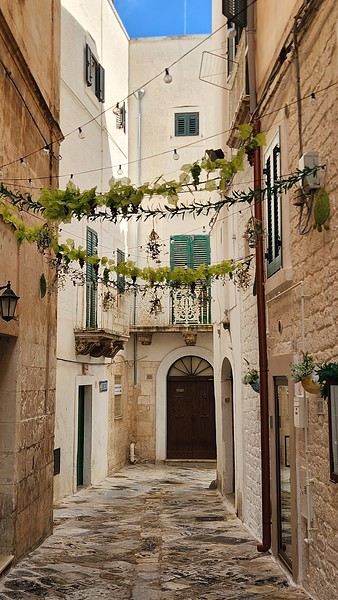
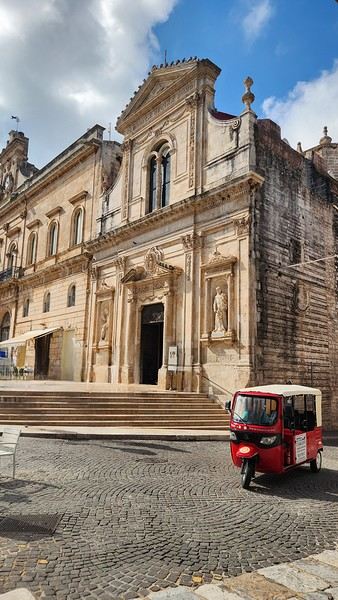
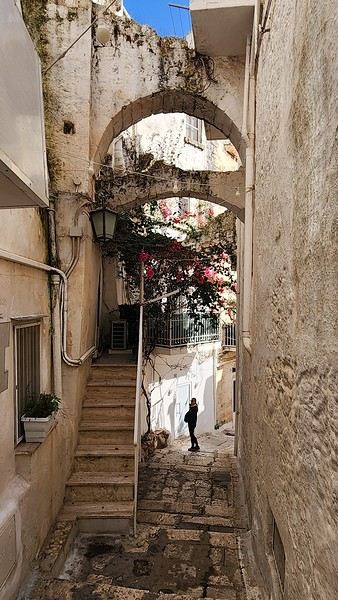
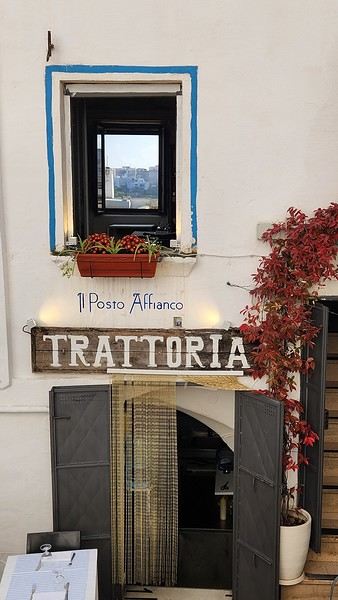
Our plane drops our little crew in Bari, the site of a famously tragic battle lost in 1991. But revenge is sweet! After renting a motorized carriage, we escape the landing zone and head to our military base of operations: Ostuni, a strategic little town where we’ll set up camp for the next four days. Why Ostuni? First, for its central location, which lets us explore a region packed with must-see gems. Second, for its vibe and beauty, which have earned it quite the reputation. Perched high on a hill, the *città bianca* (the "White City") lives up to its nickname. It literally dazzles visitors. The reason? The whitewashed facades of its houses, a testament to the region’s rich architectural heritage.
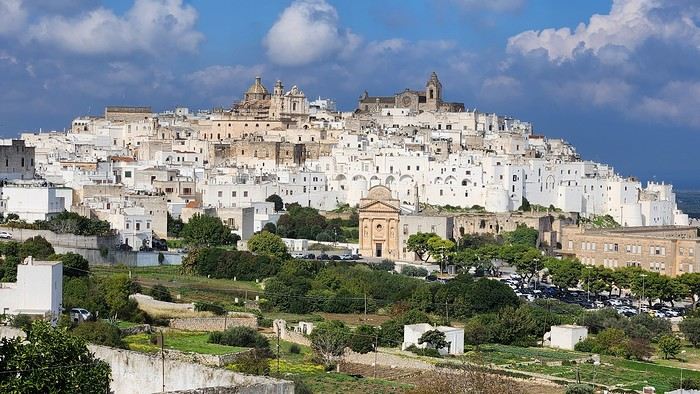
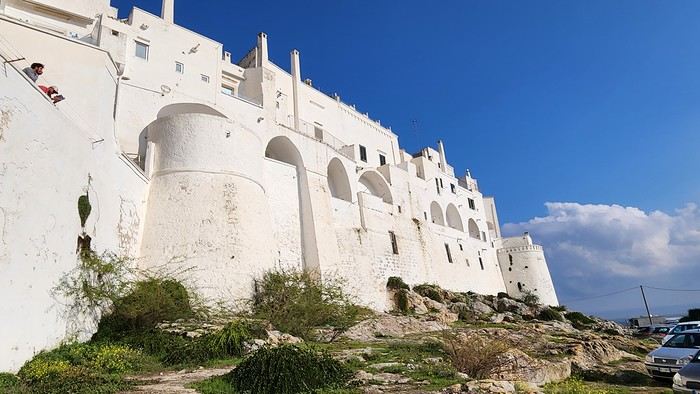
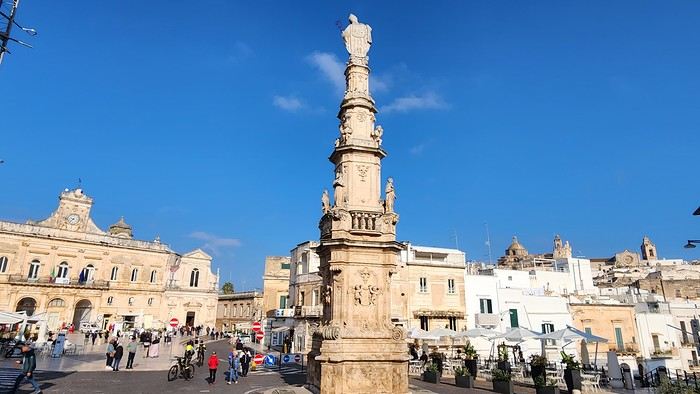
We arrived late last night, so only the two bravest soldiers volunteered to scout ahead at dawn, while the younger recruits stayed behind—for now. But not for long! After the first wave of streets and the next round of exploration, headquarters made the inevitable call to retreat. Reinforcements were needed! A few strategic errands, a breakfast ration, and our battalion marched in tight formation, flag held high, to conquer Ostuni the White! *Charge!* In my squadron leader’s memoirs, I’ll write that I didn’t expect Ostuni to put up such a fight. What I thought would take two hours to conquer turned into a humbling experience—we could only bow in respect to its beauty, its relentless charm. The alleys are whiter, more labyrinthine, narrower, and more photogenic than the last. *Veni, vidi, vici*—but what an entrance, my troops!
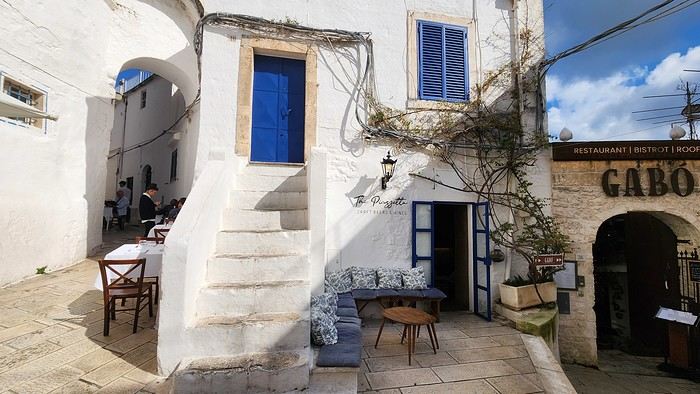
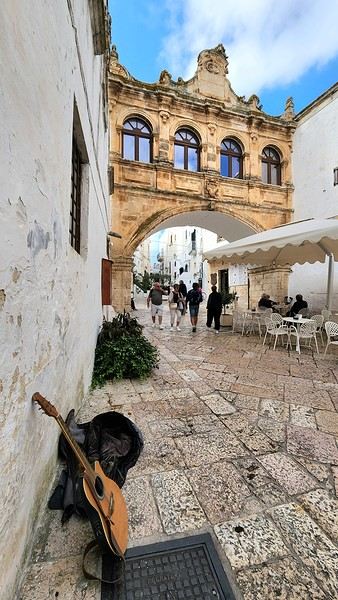
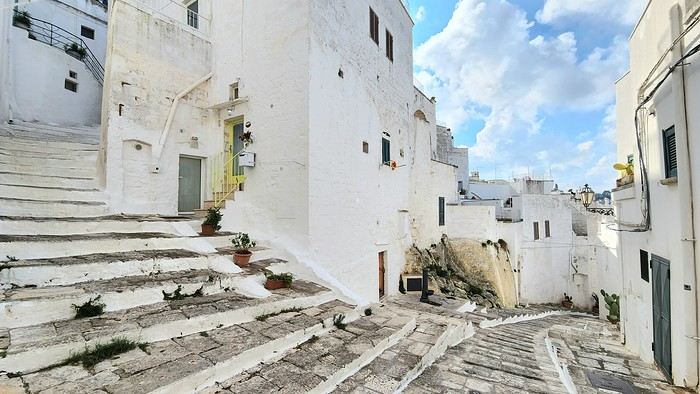
After wrapping up our travel journal on Java (link below), we’re now diving into our recent adventure in Puglia! Happy reading... Off we go on an adventure in Java (and a bit of Bali) | Travel journal > Indonesia | Voyage Forum
Day 1 - October 19
When you tell your friends and family you’re itching to escape to the other side of the planet to mingle with the Mongols, you can usually expect a barrage of questionable jokes and terrible puns. For this new adventure, it’s a different destination but the same old story—this time, we’re visiting the "pouilleux" (the "scruffy" ones). We’re taking off straight for Puglia! If you need a cheat sheet to remember where this oddly named place is on a world map, just think of it this way: Puglia is the maiden name on the ID card of the heel of the Italian boot! Personally, I prefer to remember it as the land of creamy burrata, the smell of focaccia fresh from the oven, orecchiette shaped by mamas, golden olive oil that shines like the sun (which beams down here 300 days a year), amaretto that makes you happy, and those famous trulli—those little hobbit-like dry-stone houses straight out of a movie set...
But I’ll stop spoiling the rest of our trip and focus on a factual rundown of this first Puglian day. So, are you joining us on this new adventure beyond our Gallic borders? Either way, Sasha (my youngest) and Luna (Flo’s daughter) didn’t need much convincing to stick with us and keep up the pace!
Our plane drops our little crew in Bari, the site of a famously tragic battle lost in 1991. But revenge is sweet! After renting a motorized carriage, we escape the landing zone and head to our military base of operations: Ostuni, a strategic little town where we’ll set up camp for the next four days. Why Ostuni? First, for its central location, which lets us explore a region packed with must-see gems. Second, for its vibe and beauty, which have earned it quite the reputation. Perched high on a hill, the *città bianca* (the "White City") lives up to its nickname. It literally dazzles visitors. The reason? The whitewashed facades of its houses, a testament to the region’s rich architectural heritage.
We arrived late last night, so only the two bravest soldiers volunteered to scout ahead at dawn, while the younger recruits stayed behind—for now. But not for long! After the first wave of streets and the next round of exploration, headquarters made the inevitable call to retreat. Reinforcements were needed! A few strategic errands, a breakfast ration, and our battalion marched in tight formation, flag held high, to conquer Ostuni the White! *Charge!* In my squadron leader’s memoirs, I’ll write that I didn’t expect Ostuni to put up such a fight. What I thought would take two hours to conquer turned into a humbling experience—we could only bow in respect to its beauty, its relentless charm. The alleys are whiter, more labyrinthine, narrower, and more photogenic than the last. *Veni, vidi, vici*—but what an entrance, my troops!
Group for Nepal Trek - Annapurna and Manaslu
Hello.
I’m a 56-year-old man who’s done several treks in Nepal and elsewhere. Also passionate about photography. I’m looking for one or more people to form a group for a trek in Nepal. The trek is the Annapurna and Manaslu circuit (24 days), including a stop at Tilicho Lake. I’ve got a great itinerary and the local company seems solid. The price is around $1600. I’ll be in Nepal from April 5 to May 12, 2026, so the trek would need to happen within those dates.
Daniel, Québec, Canada
The era of travel advice: between AI, free forums, and local expertise
The end of a golden age
For years, travel forums embodied the spirit of mutual aid on the web. Travelers generously shared their experiences, tips, and secret spots. This collective generosity seemed endless. But behind this altruistic facade lay a more complex reality.
The silent infiltration of forums Free travel forums have gradually become marketing hunting grounds. Under the guise of "experienced travelers," professionals in tourism, affiliates seeking commissions, or aspiring influencers testing monetization strategies now lurk.
These fake profiles master the community’s codes. They build credibility by answering dozens of basic questions before subtly slipping in their paid recommendations. A "favorite" hotel mentioned insistently, an "essential" guidebook systematically cited, an "extraordinary" local agency that keeps coming up in conversations.
New travelers can no longer tell the difference between selfless advice and disguised promotion. This informational pollution has gradually eroded the trust that gave these platforms their value.
The rise of paid Travel Planners Faced with this decline, a new profession has emerged: the independent Travel Planner. These professionals fully embrace their commercial status and charge for personalized advice.
The model is transparent: you pay for real expertise, tailor-made itineraries, and guaranteed availability. Some offer packages for 150-300 € to plan a two-week trip entirely. Others charge by the hour.
This professionalization marks a turning point. Travel advice is leaving the realm of volunteerism and entering the world of paid services. Paradoxically, this acknowledged monetization can restore a form of trust: you know what you’re paying for.
The irruption of artificial intelligence But now, a third option is emerging: generative AI. ChatGPT, Claude, Gemini, and others can now generate travel itineraries in seconds, for free, with no commercial agenda.
AI promises neutral, synthetic, endlessly customizable information. It compiles thousands of sources in real time, suggests alternatives, and adapts recommendations to your budget and time constraints. It doesn’t sell anything, earns no commissions, and has no hotels to promote.
But this apparent neutrality hides its own limitations. AI feeds on existing data, often from the same polluted forums or marketing content. It can invent restaurants that don’t exist, mix up tourist seasons, or ignore recent local realities. It has never walked a city’s streets, negotiated with a tuk-tuk driver, or felt the atmosphere of a neighborhood at nightfall.
The forgotten alternative: authentic local experts In this landscape saturated with dubious information, imperfect AI, and monetized services, one often-overlooked option remains: consulting real local professionals.
Not the agencies at the top of Google’s first page—often the most expensive and generic. But small local businesses, independent guides established for years, still-free municipal tourism offices, and cultural associations organizing themed tours.
These players offer what neither AI nor forums can: embodied, up-to-date, contextualized knowledge of the area. They know the newly opened restaurant, the museum temporarily closed for renovations, the impromptu weekend festival, or the alternative route to avoid construction.
Finding them takes extra effort. You have to search in the local language, look beyond the first page of results, check regional institutional websites, and join community Facebook groups. But this approach is often rewarded with free or low-cost advice of unmatched precision.
Toward an ecology of travel advice The future of travel advice likely won’t be binary but hybrid. AI can rough out itineraries, propose logistical options, and compare alternatives. Travel Planners can refine, personalize, and reassure anxious travelers. Local experts can enrich, correct, and ground advice in on-the-ground reality.
But for this ecosystem to work, we’ll need to develop new discernment. Learn to spot fake profiles on forums. Systematically verify AI suggestions. Assess the real value of a Travel Planner before paying. And, above all, rediscover the habit of contacting those who live there directly.
Travel has always been a school of discernment. It teaches us to distinguish the authentic from the fake, sincere advice from commercial manipulation. In the digital age, this skill becomes more crucial than ever.
Because ultimately, the real question isn’t which information source to prioritize, but how to cultivate our own ability to evaluate, cross-check, and ultimately make informed choices. The best travel guide may still be our critical thinking.
Photo credit: Arakis Travel
Actor Robert REDFORD has passed away.
Hello,
In 1985, the film "Out of Africa" was released, which inspired me to visit Kenya for the first time a year later. My passion for animals in their wild and natural habitat, and thus for safaris, was born while watching this film and appreciating Robert REDFORD’s acting.
Of course, the film’s director and Meryl STREEP also contributed greatly to this wonderful movie.....
In a way, I owe him this passion, and I thank him for it. Sometimes, during safaris, when we had our breakfasts in the middle of nature, in one reserve or another in Kenya or Tanzania, I often thought of him.
May he rest in peace, far from our world of madness. Thank you for EVERYTHING, Mr. REDFORD.
( In three weeks in Kenya, I think I’ll often be thinking of him....... )
...