Results for "Robert+|+127+>+349"
3354 results found.
Visiter Antalya (Turquie) English translation pending
Salut a tous! Je pars fin juin avec mes enfants en Turquie pres d 'Antalya pour 8 jours. Je fais appel a vos infos pour les centres d'interets locaux (historiques ou non), la ville d'Antalya vaut elle le détour, et des avis sur les excursions si possible en évitant le TO !
Merci par avance et bons voyages à tous😎
Amicalement, Robert.
Ile de Koh Tao en Thaïlande English translation pending
bonjour cherche infos sur cet ile
comment s y rendre depuis phuket;
merci
au revoir
ps:coucou marco
Laos, la guerre oubliée (livre) English translation pending
Bonjour à tous
Je viens de lire le livre de Cyril Payen (correspondant du Nouvel Obs, entre autres, pour l'Asie du sud-est) sur le sort des Hmong au Laos. Le livre s'appelle "Laos, la guerre oubliée" (ed. Robert Laffont). Le reportage sur les Hmong toujours pourchassés au fin fond de la jungle par les armées laotienne et vietnamienne, et abandonnés des Américains et des Français qu'ils avaient pourtant servis, vous tord les tripes. Pour voir le Laos, que j'aime pourtant, autrement.
Quand le guide de voyage remplace la rencontre avec les habitants du pays English translation pending
Routard, Lonely Planet, Petit Futé, … Quand le guide de voyage remplace la rencontre avec les habitants du pays. Par Sebastien Robert, Ignace Fabiani et Martin Tonglet* Cusco, Pérou, Février 2007. Assis sur les marches de la cathédrale dominant la place centrale de la ville, nous profitons de l’air frais et des premiers rayons du soleil. En cette heure matinale, la place est encore calme. Nos regards, curieux, se fixent sur un couple de touristes qui l’air un peu perdus et désemparés, semblent chercher leur itinéraire dans un guide de voyage. Visiblement agacés de ne pas se retrouver et en désaccord l’un avec l‘autre, ils s’arrachent le guide des mains et tentent de le tourner dans toutes les directions pour se repérer. N’y arrivant toujours pas, ils se lèvent, balayent la place du regard et se dirigent vers nous. - « Sorry, could you please help us, we’re a little lost ? » - « Euh… yes what can we do for you ? » - « Would you happen to know how to go from here to the Monumento Pachacuteq ? We’ve desperately been looking on the map that’s in our Lonely Planet, but we’re unable to see where we should go… » Fin de l’épisode. L’histoire se termine bien : grâce aux précieux renseignements que nous leur avons donné, ces deux touristes ont pus se rendre là où ils voulaient. Cependant après avoir vu cette scène se répéter maintes et maintes fois dans chaque lieu où nous avons voyagé, nous sommes amenés à nous poser quelques questions : - Pourquoi chercher dans un guide muet une information que tous les habitants de la ville connaissent ? Ne vaut-il pas mieux poser directement la question à quelqu’un ? - Quand ce couple – ou d’autres – se décide enfin à poser la question, pourquoi décident-ils de la poser à nous – des français – alors qu’il y a sur la place au moins une vingtaine de péruviens qui connaissent beaucoup mieux la ville, puisque c’est la leur ? En observant ce phénomène de plus près, nous nous apercevons que les guides de voyage ont pris une telle importance que bien souvent, ils remplacent le contact avec les êtres humains. Puisque la vérité sort de la bouche des guides de voyage, tout ce qui n’est pas écrit dans ces guides ne vaut pas la peine d’être vu ou vécu. Quand nous voulons connaître l’histoire ou la culture d’un pays, nous ouvrons notre guide. Quand nous voulons savoir où manger, où dormir, où sortir, … nous ouvrons notre guide. Quand nous voulons savoir quel quartier visiter, quelles rues arpenter, … nous ouvrons notre guide. Pourtant les premiers spécialistes d’une ville, d’un pays, ne sont-ils pas ses habitants ? Ne serait-ce pas plus enrichissant et envoûtant de découvrir l’histoire du Pérou en écoutant parler le vieux péruvien assis sur le banc à coté de nous ? Ne serait-ce pas plus savoureux et excitant de sortir manger et danser avec des habitants de Cusco qui connaissent parfaitement les lieux sympas pour sortir ? Ne serait-ce pas plus agréable et intéressant de se balader dans les rues d’un quartier avec un de ses habitants qui nous explique l’histoire et les spécificités de ce quartier, plutôt que de cheminer le nez dans notre guide ? Quand nous voyageons, chaque question, chaque problème que nous avons pourrait être l’occasion d’aller à la rencontre des habitants du pays que nous voulons découvrir. Cela pourrait être un prétexte pour entrer en conversation avec eux et vivre des moments d’échange et d’enrichissement mutuels. Malheureusement, bien trop souvent, en cherchant les réponses dans notre guide, nous tombons dans un mutisme triste et stérile. Il ne s’agit pas de dire que les guides de voyages sont mauvais en soi ou qu’il n’y a pas des moments où ils peuvent peut-être être utiles, mais juste de constater qu’ils finissent trop souvent par être des prétextes à la non-rencontre avec les habitants du pays. Or si nous ne voyageons pas pour rencontrer d’autres êtres humains, alors pourquoi voyageons-nous ? Pour voir des paysages, la nature, un petit village de montagne, les ruelles d’une vielle ville ? Tout cela est très beau bien sûr, mais après ? Au final, il semble bien que ce que nous retiendrons de nos voyages ce sont bien les Autres. Les autres qui nous donnent de leur temps, de leurs sourires, de leurs connaissances, … Dès que nous prenons le temps de s’écouter, de partager et de se laisser un peu bousculer par l’autre, nous nous apercevons que nous avons tant à apprendre les uns des autres. Finalement, c’est pour cela que nous voyageons, pour grandir. Les guides de voyages sont parfois perçus comme les « clés » du voyage. Espérons qu’ils ne soient pas des clés qui ferment les portes de notre rencontre avec les habitants des pays que nous prétendons découvrir… * Sebastien Robert, Ignace Fabiani et Martin Tonglet sont actuellement plongés dans une rencontre avec les habitants du continent Américain en voyageant de Montréal au Canada jusqu’à Buenos Aires en Argentine. Pour plus d’informations sur leur voyage peu ordinaire voir leur blog : http://descentedesameriques.over-blog.com
Livres à lire English translation pending
sidartha, herman hesse
veronicka decide de mourir, paulo cohelo
ramses1-5, christian jacque
sherlock holmes, sir arthur conan doyle
les trois mousquetaire et ses suite infinisables, dumas
fortune de france(la serie), robert merle
casanova storia della mia vita, casanova
j ai ici une serie de livre qui, je crois plairait a n importe qui. certain sont simple mais tous son mieux que dan brown, j adore la lecture et j incite les a lires. dans cette liste au moin un livre vous plaira forcement, meme si vous n avez meme jamais regarder un livre lol. il suffit de savoir lire pour se laisser emporter dans ces aventures. alors laisse vos serie de livres qui ous ont plus et je pourrais grandir ma biblioteque de ceux qui me plaisent.
j ai ici une serie de livre qui, je crois plairait a n importe qui. certain sont simple mais tous son mieux que dan brown, j adore la lecture et j incite les a lires. dans cette liste au moin un livre vous plaira forcement, meme si vous n avez meme jamais regarder un livre lol. il suffit de savoir lire pour se laisser emporter dans ces aventures. alors laisse vos serie de livres qui ous ont plus et je pourrais grandir ma biblioteque de ceux qui me plaisent.
Exposition et concert sur l'Inde à Lens (62) English translation pending
Lens se met a l heure de l indeexposition photos 'les yeux de l inde' photographie de didier Goupy
du 12/02 au 26/02 mediatheque robert Cousin :entree librecontes :mythes de l inde
mercredi 14/02 a 15h mediatheque robert Cousin:2 eurosconcert :Mukta et olly and the bollywood orchestra.
vendredi 16/02 a 20h30 centre A.DUMAS rue courbet :5euros50
pour infos nous y seront
reservation au 0321690830
Excursion à Saona English translation pending
nous serons à l'hotel Grand Paradise de Punta Cana en février ( 18 au 25). Est-ce que les départs pour la sortie à l'¸ile Saona est très loin de notre hotel ? devons prendre l'autobus avant et si oui; Combien de temps est le transport. Quel est le côut ( de cette balade?$ US)
merci 🙂
merci 🙂
Phuket le 23 décembre 2549 English translation pending
Sawade Krap
Apres notre repos du 14 decembre, nous avons pris la route direction Nonkai, 500 km et 10h00 de route.....Nous sommes arriver vers 20h00, donc il fesais deja noir......Nous avons ete acceuillis, comme des prince chez notre ami Robert, VoyageurAsie ou sa femme, cuisiniere hors pair nous a preparer un somptueux repas.....Le 16 matin, a notre reveille, grande emotion......Prendre un cafe au bord du mekong.....Ha le mekong, encore un des endroit magique de la Thaillande....C'est magnifique, et en plus de chez Robert on vois Vintiane en face, superbe.....La journee nous avons ete visiter le marcher local de nonkai et nous avons manger dans un petit resto sur le bord de mekong....Ensuite nous sommes rentrer chez Robert, le soir il nous a emmener dans un petit resto de village pour nous faire manger une sorte de fondue dont je ne me souviens plus du nom, mais s'etais exellent et tres conviviale, et puis nous avons teminer la soiree dans le Karaoke du village ou toute les filles sont laotiennes......On a passer une bonne soiree...Le landemain nous sommes rester tranquille.....Une fille tres jolie de Bangkok est arriver car elle avais rendez vous avec un fareng qu'elle n'avais encore jamais vu, le fareng est arriver.....Ca y est, ils sont fiancer.....Encore une de ces choses surprenante de la Thaillande...Apres nous avons ete a six chang mai ou j'ai ete chez le barbier....Evidemment, ici ils n'ont pas l'habitude des farengs, et evidement j'ai un bouc et un colier.....Je l'ai fais recommencer a deux reprises....Je ne vous parle pas du resultat, et lui qui etais si fiere de me montrer sont diplome.....Je lui ai donc fais un grand sourire en lui disans que s'etais parfait et suis partis acheter des lames de rasoirs....
Le 18 Robert nous a acompagner a Udon Tani, nous avions notre avion pour Bangkok a 8h10......Merci encore a Robert pour cet acceuil royal.....
Arriver a Bangkok a 9h05...Nous avons eu le temps de vistiter l'aeroport en long et en large puisque notre correspondence pour Phuket etais a 13h50.....Ils l'ont decorer pour Noel.....Nous en avons egalement profiter pour envoyer un colis en France.....Si vous pouvez eviter la poste de l'aeroport, faite le.....Desagreable et pas competant le personnel sur place.....
13h50, nous decollonsarriver a 14h40 a Phuket ou un chauffeur nous attend.....Nous avions reservez chez un ami d'Alban, car ici a Phuket tout est Full pour les fetes.....Nous arrivons dans notre hotel, chez Yves, un Francais vers 17h00 ou nous sommes acceuillis par une bonne petite pluie tropical.....Nous louons une motorBikes pour 200 bath la journee....Le soir nous allons visitez Patong ou nous mangeons....
Patong, pas mal de discotheques, surtout de bars a filles, comme a Pattaya, mais en plus propres et surtout plus cher....Et beaucoup de katoys, d'ailleurs y a meme la soi Katoys ici, mais il y a une bonne ambiance....
Le 19 au matin nous partons avec notre motorbikes en direction de la plage de Kamala que nous passons et nous arretons avant la plage de Surin, dans une monter a gauche ou quelque motos sont garer....Nous descendons un grand escalier tres pentus pour arriver dans une magnifique crique avec une eau limpide....Ca y est j'ai retrouver un Paradis.....
Le soir nous sommes retourner a Pattong ou Saskia s'est fais une copine qui travaille comme gogo dans un bar open, ou il y a une barre.....Sa copinne lui a demander de danser avec elle, et comme Saskia se debrouille pas mal, elles ont mis le feux......Sa s'est remplis a une vitesse folle....Les boss etais content et nous ont offert a boire.....Le landemain nous avons ete voir un show Cobra.....Divertissent.....Sans plus....Apres nous avons ete a l'attracive ouverture du Carrefour de Phuket....C'est un carrefour.....Le soir nous sommes rester discuter avec Yves...
Le 21 au soir nous sortons dans une discotheque, le Banana avec la serveuse de notre ressort, elle est vraiment tres sympa et tres jolies.....
Hier matin, Yves nous pretes sa moto et nous decidons d'aller voir l'aquarium de Phukket qui evidement est fermer.....Enfin nous avons fais une ballade de trois heures de moto.....Hier au soir Anita, la serveuse nous emmene dans un pub Thai avec petit orchestres, me revoila en Thaillande.....Deja, on arrive dans le pub avec nos bouteilles d'alcool, comique sa.....Par contre les soft, il faut les acheter sur place.....Dans ce pubjque des thais, pas de farengs.....Alors quand les Thais se lache, c'est a voir....Ils cries, saute dans tous les sens, vous attrape pour danser avec eux....Exellent....Hier soir pour la premierre fois, j'ai vu des larmes sortir d'une Thai....En fait s'etais la chanson de son Boys friend qui est mort d'un cancer, Deux trois personnes l'ont prise dans leur bras, on lui a tous fais Choc dee krap, et hop, elle pleurais en rigolan et en chantant....Puis la fete repars de plus belle en pensans a lui.....Ils ont une force.....Deconcertante......
Aujourd'hui nous allons a la plages.....
Nous avons decider de passer les fetes a Phuket........
David
Guédiguian "le voyage en Arménie" English translation pending
Sorti aujourd'hui dans les salles.
Quelqu'un l'a vu?
Quels sont les opinions et ressentis?
Société badjo (Indonésie) English translation pending
Un autre regard sur le monde
L'Occident à l'épreuve de la société badjo
Edition Audibert
Je vous recommande ce livre écrit par l'ethnologue et sociologue François-Robert Zacot (qui mène des recherches sur L'Asie du Sud Est et plus particulièrement sur les Badjos depuis 1976). Vous pouvez avoir un aperçu du livre ici.
A noter également un livre précédent du même auteur : Peuple nomade de la mer Les Badjos d'Indonésie Edition Maisonneuve & Larose
Je vous recommande ce livre écrit par l'ethnologue et sociologue François-Robert Zacot (qui mène des recherches sur L'Asie du Sud Est et plus particulièrement sur les Badjos depuis 1976). Vous pouvez avoir un aperçu du livre ici.
A noter également un livre précédent du même auteur : Peuple nomade de la mer Les Badjos d'Indonésie Edition Maisonneuve & Larose
Catalina ou Saona à partir de Punta Cana? English translation pending
bonjour
peux ton voir une des ses deux îles a partir de punta cana ci oui combien est le prix
si possible d'avoir quelque photo des deux îles svp merci
Test sur le Mamiya ZD digital English translation pending
es que quelqu'un a des tests ?? merci, ,

Documentaire "Voyage au Tibet interdit" dans "Explore" - 09/10/05 à 17h55 sur France 3 English translation pending
Tibet, Himalaya, Sikkim ... autant de noms qui évoquent le rêve et l'évasion.
Ne ratez donc pas l'émission "EXPLORE" le dimanche 9 octobre 2005 à, 17h55 sur FRANCE 3. Documentaire/film de Thierry Robert & Priscilla Telmon.
En 2004, Priscilla Telmon quitte Hanoi pour 5000 kilomètres d'aventure solitaire à travers l'Himalaya. Elle suit l'itinéraire de l'exploratrice Alexandra David-Neel, la première occidentale à pénétrer au Tibet interdit et gagner sa capitale Lhassa en 1924. Plus de 6 mois de marche, de découverte et de cheminement intérieur pour renouer avec le souffle, l’esprit des grandes expéditions passées et mesurer ce qui du Tibet d’aujourd’hui ressemble au pays des neiges qu’Alexandra a connu...
+
Transboréal le jeudi 8 décembre 2005 Le cycle de conférences Transboréal, en partenariat avec NATURE & découvertes, présente le 8 décembre à 20 heures « Du Vietnam à Calcutta sur les traces d’Alexandra David-Neel » Salles Pierre-Nicole (pièce A) – 270, rue Saint-Jacques – 75005 Paris Pour plus d'informations : http://www.transboreal.fr/
Ne ratez donc pas l'émission "EXPLORE" le dimanche 9 octobre 2005 à, 17h55 sur FRANCE 3. Documentaire/film de Thierry Robert & Priscilla Telmon.
En 2004, Priscilla Telmon quitte Hanoi pour 5000 kilomètres d'aventure solitaire à travers l'Himalaya. Elle suit l'itinéraire de l'exploratrice Alexandra David-Neel, la première occidentale à pénétrer au Tibet interdit et gagner sa capitale Lhassa en 1924. Plus de 6 mois de marche, de découverte et de cheminement intérieur pour renouer avec le souffle, l’esprit des grandes expéditions passées et mesurer ce qui du Tibet d’aujourd’hui ressemble au pays des neiges qu’Alexandra a connu...
+
Transboréal le jeudi 8 décembre 2005 Le cycle de conférences Transboréal, en partenariat avec NATURE & découvertes, présente le 8 décembre à 20 heures « Du Vietnam à Calcutta sur les traces d’Alexandra David-Neel » Salles Pierre-Nicole (pièce A) – 270, rue Saint-Jacques – 75005 Paris Pour plus d'informations : http://www.transboreal.fr/
Inondations sur les îles de Polynésie: destructions English translation pending
une forte houle a touché l'Ile de Raiatea et encore plus fortement BORA BORA dont le coin le plus joli qui est la POINTE MATIRA: une pension de famille ROBERT et TINA est bien amochée, quant au MOANA INTERCONTINENTAL il sera fermé au moins 4 mois car les bungalows pilotis ont été emportés.
les pontons du CLUB med aussi ont été détruits.
De retour du Costa Rica English translation pending
Bonjour à tous et à toutes,
Voici l'adresse d'un site que j'ai monté suite à un voyage de près d'un mois au Costa Rica en décembre et janvier dernier.
http://www3.sympatico.ca/caroline.robert/
En plus d'un échantillon de nos photos de voyage, vous pourrez y retrouver différentes listes d'endroits à visiter, et quelques conseils pour les voyageurs qui comptent s'y rendre...
Si ça peut vous rappeler des souvenirs, vous donner le goût d'y aller ou vous apporter des suggestions utiles pour un voyage prévu, j'en serai très heureuse !
http://www3.sympatico.ca/caroline.robert/
En plus d'un échantillon de nos photos de voyage, vous pourrez y retrouver différentes listes d'endroits à visiter, et quelques conseils pour les voyageurs qui comptent s'y rendre...
Si ça peut vous rappeler des souvenirs, vous donner le goût d'y aller ou vous apporter des suggestions utiles pour un voyage prévu, j'en serai très heureuse !
Le meilleur de la musique québecoise… English translation pending
Bonjour,
Si vous pouviez me citer le meilleur de la musique Quebecoise des années 50, 6070 et de Charlebois…en citant les artistes et les albums si possible…merci beaucoup d'avance😉
Si vous pouviez me citer le meilleur de la musique Quebecoise des années 50, 6070 et de Charlebois…en citant les artistes et les albums si possible…merci beaucoup d'avance😉
Ville de L'Outaouais English translation pending
Amis Quebecois Bonjours,
Je recherche une ville dont le nom prononcé ne comprends qu'une syllable dans l'Outaouais… Merci de votre aide😉
Je recherche une ville dont le nom prononcé ne comprends qu'une syllable dans l'Outaouais… Merci de votre aide😉
Prix des appareils photo numériques à Cuba? English translation pending
Bonjour,
Pourriez-vous me dire si les prix des appareils photo numériques sont plus bas à Cuba qu'en Europe?
Si oui, quel type d'écart?
Existe-t-il un site sur lequel je peux avoir une idée des prix pratiqués?
Merci pour votre réponse.
Robert
hondas2mil@hotmail.com
Pourriez-vous me dire si les prix des appareils photo numériques sont plus bas à Cuba qu'en Europe?
Si oui, quel type d'écart?
Existe-t-il un site sur lequel je peux avoir une idée des prix pratiqués?
Merci pour votre réponse.
Robert
hondas2mil@hotmail.com
Circuit en Turquie pour Pâques English translation pending
Quel type de circuit me conseillez-vous pour ne pas avoir trop de km à avaler en autocar. J'aimerais en particulier découvrir Istambul et la Cappadoce. si vous avez des expériences à partager, je suis preneur.
Merci
Robert🙂
Des livres à partager English translation pending
Ces derniers temps, j'accumule une série de livres lus que je voudrais vous offrir suivant les possiblilités. Comme je viens à Paris pour la phénoménale rencontre de VF, je pourrais peut-être vous en apporter quelques uns (ouille, le poids !!!..🤪....) Voici la liste :
Renaître en Inde/Guy Deleury
La reine des bandits/Mala Sen
40.000 km d'aventure/Robert Gaillard
Flas....ou le grand voyage/C.Duchaussois
Mille Soleils/D.Lapierre
Noces Indiennes/Sharon Maas
Taj/TN. Murari
Pour l'amour de Kali/Yanne Dimay
Il était minuit moins cinq à Bhopal/D.Lapierre
Le dernier soupir du Maure/Salman Rushdi
Cette nuit la liberté/D.Lapierre
L'Inde impudique des Maharajas/Vitold de Golish
Routes des Indes/E.M. Foster
L'inde fabuleuse d'aujourd'hui/Jacques Chegaray
La vie privée d'un prince indien/Mulk Raj Anand
Le riz et la mousson/Kamala Markandaya
Mandala(histoire d'une famille indienne/Pearl Buck
La mousson/Louis Bromfield
Si l'un de ces livres vous intéresse, n'hésitez pas à me contacter.
Marie
Renaître en Inde/Guy Deleury
La reine des bandits/Mala Sen
40.000 km d'aventure/Robert Gaillard
Flas....ou le grand voyage/C.Duchaussois
Mille Soleils/D.Lapierre
Noces Indiennes/Sharon Maas
Taj/TN. Murari
Pour l'amour de Kali/Yanne Dimay
Il était minuit moins cinq à Bhopal/D.Lapierre
Le dernier soupir du Maure/Salman Rushdi
Cette nuit la liberté/D.Lapierre
L'Inde impudique des Maharajas/Vitold de Golish
Routes des Indes/E.M. Foster
L'inde fabuleuse d'aujourd'hui/Jacques Chegaray
La vie privée d'un prince indien/Mulk Raj Anand
Le riz et la mousson/Kamala Markandaya
Mandala(histoire d'une famille indienne/Pearl Buck
La mousson/Louis Bromfield
Si l'un de ces livres vous intéresse, n'hésitez pas à me contacter.
Marie
Prix essence au Canada English translation pending
Petite question aux Québécois présents sur ce forum: quel est le prix actuel de l'essence au Canada ? Merci
Ramener une tortue du Maroc English translation pending
bonjour je vais aller au maroc on ma dit que je peut remmener une tortue... possible ou pas ???🙂
"Glory": an Animal Farm for Zimbabwe—and the world
"400 pages of verbal pyrotechnics and animal magic" — The Times
"Bulawayo leans into exaggeration and irony to tell hard truths. *Glory* is jam-packed with comedy and farce, poking fun at an autocratic regime while illustrating the absurdity and surreal nature of a police state." — The Guardian
The cruelty and savagery of Zimbabwe’s (and Africa’s in general) "powerful animals"
Zimbabwean author NoViolet Bulawayo has written a novel that illustrates better than any documentary the complexity of colonial legacy. In doing so, she revisits George Orwell’s Animal Farm. Her novel *Glory* is a political satire about Zimbabwe—and it’s brimming with humor.
For thirty years, Zimbabwe has been stagnating under Robert Mugabe’s presidency. Human rights violations, corruption, and international sanctions have kept the population mired in poverty and oppression, while the regime exploits the meager earnings of the economy. As the 2017 elections approach, a power struggle erupts over the succession of the very elderly Father of the Nation (Mugabe). On the streets, people hope for long-awaited reforms; the people feel their moment has come.
And indeed, the army ousts Mugabe and his wife—"with her Gucci heels" (p.32)—who was positioning herself for the presidency. Hopes are dashed, however. The generals install former vice-president Emmerson Mnangagwa in power; the regime merely changes faces, but the problems remain the same.
In the novel, the country is called "Jidada, with a -da and another -da" (p.1); there’s no mistaking that this fictional state is Zimbabwe.
For *Glory*, her second novel, NoViolet Bulawayo invents a whole series of codes whose strength lies precisely in how easy they are to decipher. Like George Orwell’s Animal Farm, the characters populating Bulawayo’s universe aren’t humans but horses, goats, or crocodiles with all-too-human traits. Mugabe and Mnangagwa are horses, the spiritual leader is a pig, the soldiers are all bloodthirsty dogs, while the populace consists of goats, chickens, donkeys, and cats. The shift to the animal world serves only to better grasp the laws of despotism—and to ridicule real-life models. On one hand, the animals are humanized: they tweet, torture, travel in private jets. On the other, their greed, stupidity, and brutality stem from their animal nature.
It’s the old trick of fable: dressing men in animal disguises to make them easier to recognize. That’s how Orwell, in Animal Farm, traced how the promise of liberation from the Russian Revolution turned into Stalinist terror. In his 1945 fable, George Orwell describes how the animals of a farm drive out their farmer to organize the exploitation themselves, collectively. For a time, they truly taste freedom, but a clique of pigs ends up taking control. The central figures of the Soviet story—Stalin, Trotsky, Molotov—were easily recognizable.
Yet Bulawayo departs sharply from Orwell. She’s less concerned with precision and the force of argument than with satirical exaggeration. The deposed president is a senile old man who believes he can control even the sun’s course. The new stallion in power is a greedy debaucher. His soldiers sniff respectfully at his tail and backside.
In Bulawayo’s *Glory*, things are more complicated, but her novel also tells of a failed, incomplete liberation. In the author’s Animal Farm, Jidada, the colonial exploiters are followed by new forms of oppression. Because the former liberators become tyrants themselves. And because global power dynamics persist in neocolonial structures.
Wouldn’t that be enough to fuel a deeply depressing narrative? No—Bulawayo turns it into a blazing satire, full of wit and uncompromising criticism of power, a thread running through contemporary (not just) Zimbabwean history. The old warhorses in NoViolet Bulawayo’s Jidada, who continue to act as pack leaders, are easily recognizable as caricatures of the longtime dictator Robert Mugabe and his successor, current president Emmerson Mnangagwa.
The plot kicks off in high gear with independence day festivities. From the crack of dawn, everyone waits on Jidada Square for the Old Horse, the Father of the Nation and former liberator, whose reign "was nearing all of—not one, not two, not three, but four solid decades" (p.1). Everywhere, the colors of the Jidada Party shine; everywhere, true supporters cheer. Even the scorching sun plays its part: "At this point the sun, upon seeing arrive the leader who was decreed by God himself to rule and rule and keep ruling, a leader who'd in turn decreed the very sun to head his cheerleading squad, took a deep, deep breath and thoroughly blazed to impress" (p.2).
Finally, the Old Horse’s luxury carriage approaches "with the slowness of a hearse" (p.2), and "hoping to catch a glimpse of the legendary Father of the Nation," which causes "the animals fell over themselves like intoxicated frogs" (p.2). The sovereign’s speech is delayed a moment longer: "what I really want is a nap," groans the Old Horse as he takes his seat with such care "like his backside was made of expensive porcelain" (p.6).
Meanwhile, Bulawayo parades his entourage: the president’s wife (who earns her doctorate at Jidada University faster than "you could say diss, for dissertation. Tholukuthi it was as easy as ordering from a KFC drive-through, or perhaps even easier being that it was cheaper than KFC; it in fact cost her nothing and the degree actually came with a zero-calorie Diet Coke and a purple straw" (p.41), and she’s now known as Dr Sweet Mother. The cabinet includes "the Minister of the Revolution, the Minister of Corruption, the Minister of Order, the Minister of Things, the Minister of Nothing, the Minister of Propaganda, the Minister of Homophobic Affairs, the Minister of Disinformation and the Minister of Looting" (p.9). And of course the vice-president, who will soon become interim president when the Old Horse finally kicks the bucket—and then settle in as the new long-term president, who in the novel is called Tuvius Delight Shasha, or "Tuvy" for short (p.253), none other than Emmerson Mnangagwa. It’s him Bulawayo reserves her most merciless character description for.
"New Dispensation" (p.109) is Tuvy’s slogan for Jidada, and he loves repeating it so much he even named his parrot after it ("So inspired was Tuvy by the realisation that he rechristened his new pet parrot with the name New Dispensation—tholukuthi the bird having been acquired explicitly for the purposes of tweeting eulogies and accordingly glorifying the Saviour throughout the airs and skies of the nation. Tuvy then went on to hire a lecturer in English from the University of Jidada to teach New Dispensation to say the phrase 'New Dispensation'" p.110). But Tuvy’s Zimbabwe remains a nation without free, fair, and credible elections ("#freefairncredibleelection" p.161), and the promised equal treatment applies only insofar as Zimbabweans now queue up without discrimination in endless lines—and everyone is as poor as the next in the "queuenation" (p.283). Except for the powerful. They can "yes, tholukuthi, her immeasurable riches theirs to take. And take they did—
just take—take—take—take—take—take—take—take—take—take—take—take—take—take—take—take—take—take—take—take—take—take—take—take—take—take—take" (p.249-250).
In short: Bulawayo brilliantly depicts how former independence fighters become exploiters themselves. And how the country threatens to suffocate under the weight of corruption and repression. But she also literally stages the polyphony with which the people oppose imposed obedience to the official line.
Controversial online discussions keep interrupting the narrative—dialogues and social threads (see photo below) that Bulawayo masterfully integrates. From a literary standpoint, it’s a brilliant idea. And it shows, above all, that the author’s sympathy—so likeable—goes to all those who refuse to let their dream of true freedom be stolen, not even by the corrupt elites of their own country.
In the book’s acknowledgments, the first tribute goes to "The Jidadas of the world, clamouring for freedom on many fronts—A luta continua." (p.401) This reflects the realization that, not only in Jidada-Zimbabwe but in many other corners of the world, the end of colonial domination is still far from meaning the freedom hoped for by the vast majority of people. But it also means, more broadly, that this freedom must be won "on many fronts" (see above), both domestically and geopolitically.
That’s precisely what *Glory* so vividly highlights: how complex the project behind the term "postcolonialism" really is. With *Glory*, Bulawayo also delivers a scathing critique of the persistence of colonial mindsets in the West.
In the novel, the murder of George Floyd, racist police violence, and white-supremacist ideology in Trump’s United States perfectly illustrate the persistence of racism. It’s especially in the final chapters that Bulawayo lets Jidada’s inhabitants explicitly and unflinchingly criticize a neocolonial world order:
"It was not lost on us how the West, which loved to 'save' Africa and announce every action to the whole world, did so with one limb while manipulating, looting and fleecing us with the rest of its limbs so that more money in fact poured out of the continent than trickled in." (p.376)
"It was no mistake that multinational corporations yearly reaped and shipped colossal profits from Africa back to their countries as had been the case during colonial times. Even the sticks and stones would tell you that the African earth at any given time howled and shook and heaved from the extraction of its precious minerals that rarely benefited its own miserable children." (p.376)
"(...) we vowed to wage yet another war for Africa's second Liberation from neocolonial oppression. From exploitation. From plunder. From Western dominion. From indignity. From Abuse. We wanted real freedom. We wanted greedy, thieving paws off our wealth. We wanted Justice. We wanted a new world; we wanted a brand-new world so much we didn't sleep a wink that night." (p.377)
The Jidadas of this world must fight two enemies: Western neocolonialism and the autocratic instrumentalization of that argument; the persistence of Western racism and the populist appropriation of that humiliation by tyrants from their own ranks. Neither of these obstacles to freedom diminishes the historical and current guilt of the other. But the path to postcolonial liberation must overcome all these forms of oppression. After all, the colonizers didn’t bequeath democracies to formerly dominated nations, but instability and the principles of oppression and exploitation—which the so-called liberators have also internalized. Yet the fact that a satirical novel can capture the complexity of historical relationships while remaining, despite all the darkness of the subject, hilarious—well, that’s truly astonishing.
Finally, *Glory* ties into a major trauma in Zimbabwe’s post-independence history: the so-called Gukurahundi massacres. Between 1983 and 1987, tens of thousands of civilians were murdered by Mugabe’s bloody henchmen, most of them Ndebele. The State Security Minister and head of secret services at the time? You guessed it—Emmerson Mnangagwa.
When *Glory* turns to the massacres, the novel’s tone shifts completely. The story is now told through the narrative of the goat called Destiny, who, like NoViolet Bulawayo herself, left her home country at 18 for the United States and only returned after 13 years. In the book, the city of Bulawayo becomes a village where Destiny retraces her family’s history—and learns that part of it was also brutally murdered during the massacres.
The abuse of power and life under a dictatorship, dispossession, and a fiercely proud awareness of the psychological wounds and emotional vulnerability of a uprooted and disenfranchised people who had to forge a new language—a new set of names—to express their lived experiences are at the heart of this wonderful Zimbabwean author’s literary work, NoViolet Bulawayo. Shortly after her studies, she was already writing short stories about postcolonial power dynamics in Africa. But her playful, masterful, and often unconventional approach to language also plays a key role in her work. With virtuosity, she shifts from cynical images of power-obsessed elites to compassionate descriptions of the people’s suffering, ending with a hopeful sermon on courage—the courage to break free from fear and thus gain the strength for change ("And every one of them understood that whatever they heard within those hearts was the new national anthem, tholukuthi an anthem that spoke of the kind of glory that burns eternal and glows with living light." p.400). This novel is a genuine pleasure to read. And it’s exceptional. Good, African...
Book info (original English and German translation):
NoViolet Bulawayo. Glory. Chatto & Windus, 2022. NoViolet Bulawayo. Glory. Suhrkamp, 2023.
Hery
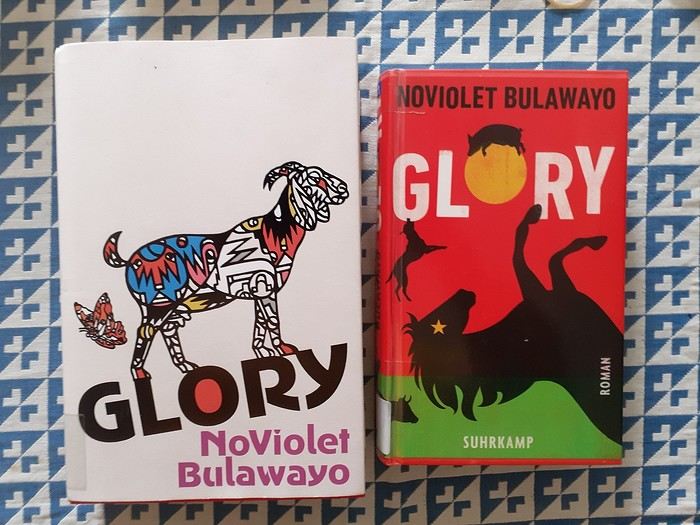 The books (in English, in German)
 Author NoViolet Bulawayo, Zimbabwe
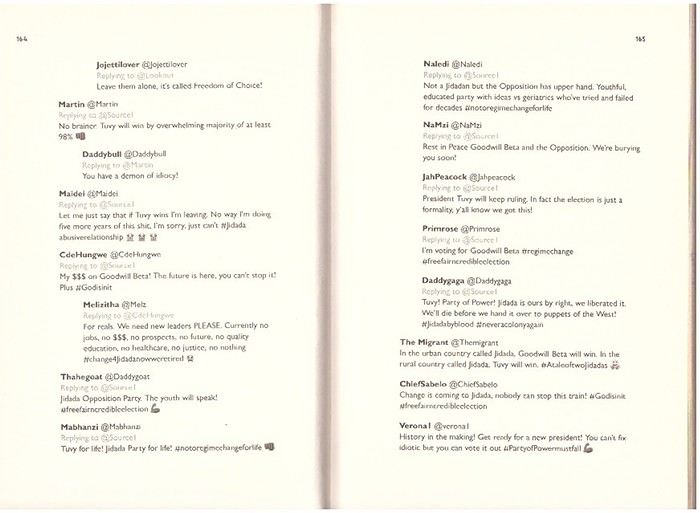 Threads (p.164-165)
"Bulawayo leans into exaggeration and irony to tell hard truths. *Glory* is jam-packed with comedy and farce, poking fun at an autocratic regime while illustrating the absurdity and surreal nature of a police state." — The Guardian
The cruelty and savagery of Zimbabwe’s (and Africa’s in general) "powerful animals"
Zimbabwean author NoViolet Bulawayo has written a novel that illustrates better than any documentary the complexity of colonial legacy. In doing so, she revisits George Orwell’s Animal Farm. Her novel *Glory* is a political satire about Zimbabwe—and it’s brimming with humor.
For thirty years, Zimbabwe has been stagnating under Robert Mugabe’s presidency. Human rights violations, corruption, and international sanctions have kept the population mired in poverty and oppression, while the regime exploits the meager earnings of the economy. As the 2017 elections approach, a power struggle erupts over the succession of the very elderly Father of the Nation (Mugabe). On the streets, people hope for long-awaited reforms; the people feel their moment has come.
And indeed, the army ousts Mugabe and his wife—"with her Gucci heels" (p.32)—who was positioning herself for the presidency. Hopes are dashed, however. The generals install former vice-president Emmerson Mnangagwa in power; the regime merely changes faces, but the problems remain the same.
In the novel, the country is called "Jidada, with a -da and another -da" (p.1); there’s no mistaking that this fictional state is Zimbabwe.
For *Glory*, her second novel, NoViolet Bulawayo invents a whole series of codes whose strength lies precisely in how easy they are to decipher. Like George Orwell’s Animal Farm, the characters populating Bulawayo’s universe aren’t humans but horses, goats, or crocodiles with all-too-human traits. Mugabe and Mnangagwa are horses, the spiritual leader is a pig, the soldiers are all bloodthirsty dogs, while the populace consists of goats, chickens, donkeys, and cats. The shift to the animal world serves only to better grasp the laws of despotism—and to ridicule real-life models. On one hand, the animals are humanized: they tweet, torture, travel in private jets. On the other, their greed, stupidity, and brutality stem from their animal nature.
It’s the old trick of fable: dressing men in animal disguises to make them easier to recognize. That’s how Orwell, in Animal Farm, traced how the promise of liberation from the Russian Revolution turned into Stalinist terror. In his 1945 fable, George Orwell describes how the animals of a farm drive out their farmer to organize the exploitation themselves, collectively. For a time, they truly taste freedom, but a clique of pigs ends up taking control. The central figures of the Soviet story—Stalin, Trotsky, Molotov—were easily recognizable.
Yet Bulawayo departs sharply from Orwell. She’s less concerned with precision and the force of argument than with satirical exaggeration. The deposed president is a senile old man who believes he can control even the sun’s course. The new stallion in power is a greedy debaucher. His soldiers sniff respectfully at his tail and backside.
In Bulawayo’s *Glory*, things are more complicated, but her novel also tells of a failed, incomplete liberation. In the author’s Animal Farm, Jidada, the colonial exploiters are followed by new forms of oppression. Because the former liberators become tyrants themselves. And because global power dynamics persist in neocolonial structures.
Wouldn’t that be enough to fuel a deeply depressing narrative? No—Bulawayo turns it into a blazing satire, full of wit and uncompromising criticism of power, a thread running through contemporary (not just) Zimbabwean history. The old warhorses in NoViolet Bulawayo’s Jidada, who continue to act as pack leaders, are easily recognizable as caricatures of the longtime dictator Robert Mugabe and his successor, current president Emmerson Mnangagwa.
The plot kicks off in high gear with independence day festivities. From the crack of dawn, everyone waits on Jidada Square for the Old Horse, the Father of the Nation and former liberator, whose reign "was nearing all of—not one, not two, not three, but four solid decades" (p.1). Everywhere, the colors of the Jidada Party shine; everywhere, true supporters cheer. Even the scorching sun plays its part: "At this point the sun, upon seeing arrive the leader who was decreed by God himself to rule and rule and keep ruling, a leader who'd in turn decreed the very sun to head his cheerleading squad, took a deep, deep breath and thoroughly blazed to impress" (p.2).
Finally, the Old Horse’s luxury carriage approaches "with the slowness of a hearse" (p.2), and "hoping to catch a glimpse of the legendary Father of the Nation," which causes "the animals fell over themselves like intoxicated frogs" (p.2). The sovereign’s speech is delayed a moment longer: "what I really want is a nap," groans the Old Horse as he takes his seat with such care "like his backside was made of expensive porcelain" (p.6).
Meanwhile, Bulawayo parades his entourage: the president’s wife (who earns her doctorate at Jidada University faster than "you could say diss, for dissertation. Tholukuthi it was as easy as ordering from a KFC drive-through, or perhaps even easier being that it was cheaper than KFC; it in fact cost her nothing and the degree actually came with a zero-calorie Diet Coke and a purple straw" (p.41), and she’s now known as Dr Sweet Mother. The cabinet includes "the Minister of the Revolution, the Minister of Corruption, the Minister of Order, the Minister of Things, the Minister of Nothing, the Minister of Propaganda, the Minister of Homophobic Affairs, the Minister of Disinformation and the Minister of Looting" (p.9). And of course the vice-president, who will soon become interim president when the Old Horse finally kicks the bucket—and then settle in as the new long-term president, who in the novel is called Tuvius Delight Shasha, or "Tuvy" for short (p.253), none other than Emmerson Mnangagwa. It’s him Bulawayo reserves her most merciless character description for.
"New Dispensation" (p.109) is Tuvy’s slogan for Jidada, and he loves repeating it so much he even named his parrot after it ("So inspired was Tuvy by the realisation that he rechristened his new pet parrot with the name New Dispensation—tholukuthi the bird having been acquired explicitly for the purposes of tweeting eulogies and accordingly glorifying the Saviour throughout the airs and skies of the nation. Tuvy then went on to hire a lecturer in English from the University of Jidada to teach New Dispensation to say the phrase 'New Dispensation'" p.110). But Tuvy’s Zimbabwe remains a nation without free, fair, and credible elections ("#freefairncredibleelection" p.161), and the promised equal treatment applies only insofar as Zimbabweans now queue up without discrimination in endless lines—and everyone is as poor as the next in the "queuenation" (p.283). Except for the powerful. They can "yes, tholukuthi, her immeasurable riches theirs to take. And take they did—
just take—take—take—take—take—take—take—take—take—take—take—take—take—take—take—take—take—take—take—take—take—take—take—take—take—take—take" (p.249-250).
In short: Bulawayo brilliantly depicts how former independence fighters become exploiters themselves. And how the country threatens to suffocate under the weight of corruption and repression. But she also literally stages the polyphony with which the people oppose imposed obedience to the official line.
Controversial online discussions keep interrupting the narrative—dialogues and social threads (see photo below) that Bulawayo masterfully integrates. From a literary standpoint, it’s a brilliant idea. And it shows, above all, that the author’s sympathy—so likeable—goes to all those who refuse to let their dream of true freedom be stolen, not even by the corrupt elites of their own country.
In the book’s acknowledgments, the first tribute goes to "The Jidadas of the world, clamouring for freedom on many fronts—A luta continua." (p.401) This reflects the realization that, not only in Jidada-Zimbabwe but in many other corners of the world, the end of colonial domination is still far from meaning the freedom hoped for by the vast majority of people. But it also means, more broadly, that this freedom must be won "on many fronts" (see above), both domestically and geopolitically.
That’s precisely what *Glory* so vividly highlights: how complex the project behind the term "postcolonialism" really is. With *Glory*, Bulawayo also delivers a scathing critique of the persistence of colonial mindsets in the West.
In the novel, the murder of George Floyd, racist police violence, and white-supremacist ideology in Trump’s United States perfectly illustrate the persistence of racism. It’s especially in the final chapters that Bulawayo lets Jidada’s inhabitants explicitly and unflinchingly criticize a neocolonial world order:
"It was not lost on us how the West, which loved to 'save' Africa and announce every action to the whole world, did so with one limb while manipulating, looting and fleecing us with the rest of its limbs so that more money in fact poured out of the continent than trickled in." (p.376)
"It was no mistake that multinational corporations yearly reaped and shipped colossal profits from Africa back to their countries as had been the case during colonial times. Even the sticks and stones would tell you that the African earth at any given time howled and shook and heaved from the extraction of its precious minerals that rarely benefited its own miserable children." (p.376)
"(...) we vowed to wage yet another war for Africa's second Liberation from neocolonial oppression. From exploitation. From plunder. From Western dominion. From indignity. From Abuse. We wanted real freedom. We wanted greedy, thieving paws off our wealth. We wanted Justice. We wanted a new world; we wanted a brand-new world so much we didn't sleep a wink that night." (p.377)
The Jidadas of this world must fight two enemies: Western neocolonialism and the autocratic instrumentalization of that argument; the persistence of Western racism and the populist appropriation of that humiliation by tyrants from their own ranks. Neither of these obstacles to freedom diminishes the historical and current guilt of the other. But the path to postcolonial liberation must overcome all these forms of oppression. After all, the colonizers didn’t bequeath democracies to formerly dominated nations, but instability and the principles of oppression and exploitation—which the so-called liberators have also internalized. Yet the fact that a satirical novel can capture the complexity of historical relationships while remaining, despite all the darkness of the subject, hilarious—well, that’s truly astonishing.
Finally, *Glory* ties into a major trauma in Zimbabwe’s post-independence history: the so-called Gukurahundi massacres. Between 1983 and 1987, tens of thousands of civilians were murdered by Mugabe’s bloody henchmen, most of them Ndebele. The State Security Minister and head of secret services at the time? You guessed it—Emmerson Mnangagwa.
When *Glory* turns to the massacres, the novel’s tone shifts completely. The story is now told through the narrative of the goat called Destiny, who, like NoViolet Bulawayo herself, left her home country at 18 for the United States and only returned after 13 years. In the book, the city of Bulawayo becomes a village where Destiny retraces her family’s history—and learns that part of it was also brutally murdered during the massacres.
The abuse of power and life under a dictatorship, dispossession, and a fiercely proud awareness of the psychological wounds and emotional vulnerability of a uprooted and disenfranchised people who had to forge a new language—a new set of names—to express their lived experiences are at the heart of this wonderful Zimbabwean author’s literary work, NoViolet Bulawayo. Shortly after her studies, she was already writing short stories about postcolonial power dynamics in Africa. But her playful, masterful, and often unconventional approach to language also plays a key role in her work. With virtuosity, she shifts from cynical images of power-obsessed elites to compassionate descriptions of the people’s suffering, ending with a hopeful sermon on courage—the courage to break free from fear and thus gain the strength for change ("And every one of them understood that whatever they heard within those hearts was the new national anthem, tholukuthi an anthem that spoke of the kind of glory that burns eternal and glows with living light." p.400). This novel is a genuine pleasure to read. And it’s exceptional. Good, African...
Book info (original English and German translation):
NoViolet Bulawayo. Glory. Chatto & Windus, 2022. NoViolet Bulawayo. Glory. Suhrkamp, 2023.
Hery
The books (in English, in German)
Author NoViolet Bulawayo, Zimbabwe
Threads (p.164-165)Travel companion for Sri Lanka
I'm looking for a travel companion (male or female) for a trip of about 2 to 3 weeks in Sri Lanka in early 2026—a country I haven’t visited yet. I’m passionate about travel, especially Southeast Asia.
My only non-negotiable is that the trip ends by mid-February at the latest, since I’ll then be heading to Thailand to spend 2 weeks with my daughter.
I’d like to explore the central, western, and southern regions, which enjoy better weather at that time of year.
Hope to connect soon and get to know each other better!
My only non-negotiable is that the trip ends by mid-February at the latest, since I’ll then be heading to Thailand to spend 2 weeks with my daughter.
I’d like to explore the central, western, and southern regions, which enjoy better weather at that time of year.
Hope to connect soon and get to know each other better!
Request for Information on Booking Cruises
Hello everyone,
What a great forum this is! Someone recommended it to me during my last cruise (my first one, too).
After that amazing trip in January this year, I’d love to go again.
But I’d like to know how to negotiate and which travel or booking agency to use to get the best prices. Normally, I book either in Switzerland (very expensive) or directly with MSC, but I’ve been told not to do that. So, I’m here to find the best way to book with MSC. As for dates, I’m pretty flexible, and my departure point—since I live in Switzerland—would be Genoa, Marseille, or somewhere near Rome.
Thanks in advance for all your future responses!
Best regards, Robert
What a great forum this is! Someone recommended it to me during my last cruise (my first one, too).
After that amazing trip in January this year, I’d love to go again.
But I’d like to know how to negotiate and which travel or booking agency to use to get the best prices. Normally, I book either in Switzerland (very expensive) or directly with MSC, but I’ve been told not to do that. So, I’m here to find the best way to book with MSC. As for dates, I’m pretty flexible, and my departure point—since I live in Switzerland—would be Genoa, Marseille, or somewhere near Rome.
Thanks in advance for all your future responses!
Best regards, Robert
September 2025 Photo Contest: I Signal, You Signal, We Signal – Get Your Signs Ready!
Hi there, 🙂
The point of this contest isn’t to photograph Mathilde or even to frantically click the "report" button on every post in a thread.
It’s to post **road signs**!
Whether they’re official or not...
Funny or serious...
Of all shapes, all colors, in all languages...
The rules are the same as usual—I’ll let you check out the previous contests for reference. 😛
Just a quick reminder:
- Max of 3 photos per person.
- One photo per post (preferably embedded 😉) with a caption and the photo number.
Submissions close on **Monday, September 22, 2025, at 11:59 PM Paris time**.
Voting starts on **Tuesday, September 23, 2025, at 11:59 PM** (and not a second before… 😇), Paris time, and ends on **Monday, September 29, 2025, at the same time** (still Paris time).
Results will be posted on **September 30, 2025**, sometime during the day!
Ready, set, snap!
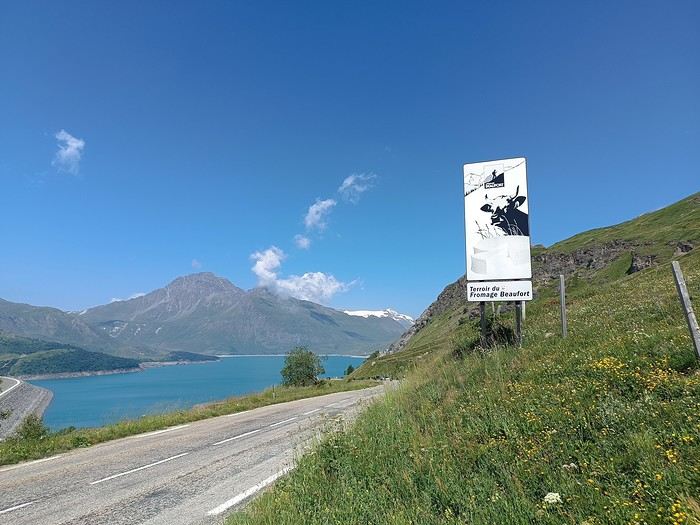
(To discuss, it’s here…)
The point of this contest isn’t to photograph Mathilde or even to frantically click the "report" button on every post in a thread.
It’s to post **road signs**!
Whether they’re official or not...
Funny or serious...
Of all shapes, all colors, in all languages...
The rules are the same as usual—I’ll let you check out the previous contests for reference. 😛
Just a quick reminder:
- Max of 3 photos per person.
- One photo per post (preferably embedded 😉) with a caption and the photo number.
Submissions close on **Monday, September 22, 2025, at 11:59 PM Paris time**.
Voting starts on **Tuesday, September 23, 2025, at 11:59 PM** (and not a second before… 😇), Paris time, and ends on **Monday, September 29, 2025, at the same time** (still Paris time).
Results will be posted on **September 30, 2025**, sometime during the day!
Ready, set, snap!
(To discuss, it’s here…)
Budapest: airport to city center route and which museums/exhibitions to see?
Hi there,
I’m heading to Budapest next February and I’d like to know what the safest way is to get from the airport to the city center. During my weekend, which museums or exhibitions can you recommend? Thanks!
Comment se rendre à Bâle en avion avec un vélo et coût? English translation pending
Bonjour, envisageons de faire Bale -Budapest en vélo.
Le plus simple pour se rendre à Bale nous paraît être l avion (idem pour le retour Budapest).
L aéroport le plus proche est pour nous Bordeaux.
Est ce que quelqu'un a déjà fait ce voyage en avion avec un vélo et pouvez vous nous donner le coût approximatif.
Merci et très belle journée
Hébergements le long de l'E6 pour la descente du Danube en tandem English translation pending
Bonjour aux cyclistes au long cours.
Nous envisageons, mon épouse et moi , une descente du Danube de Donaueschingen jusque Constanta. Nous serons en tandem, notre moyen de locomotion habituel. Vu notre âge vénérable, nous n'envisageons plus de camping , autre qu'exceptionnellement. Pas trop de difficultés d'hébergement jusqu'en Hongrie, mais ensuite en Serbie, Croatie et Roumanie cela s'avère apparemment plus difficile à trouver des hébergements répertoriés.
Si les cyclos qui ont déjà emprunté ce parcours peuvent me tuyauter sur les possibilités existantes dans ces pays, les meilleurs plans, les moins bons également, je serais preneur.
Merci d'avance pour tout ce que vous pourrez me conseiller.
Robert
Nous envisageons, mon épouse et moi , une descente du Danube de Donaueschingen jusque Constanta. Nous serons en tandem, notre moyen de locomotion habituel. Vu notre âge vénérable, nous n'envisageons plus de camping , autre qu'exceptionnellement. Pas trop de difficultés d'hébergement jusqu'en Hongrie, mais ensuite en Serbie, Croatie et Roumanie cela s'avère apparemment plus difficile à trouver des hébergements répertoriés.
Si les cyclos qui ont déjà emprunté ce parcours peuvent me tuyauter sur les possibilités existantes dans ces pays, les meilleurs plans, les moins bons également, je serais preneur.
Merci d'avance pour tout ce que vous pourrez me conseiller.
Robert
Concerts de musique classique à Parme et à Ravenne début juin 2020 English translation pending
Bonjour,
Nous serons à Parme du 04 au 06 juin et à Ravenne du 07 au 09 juin prochains et nous aimerions assister dans ces deux villes à un concert de musique classique mais nous ne trouvons rien...C'est peut-être trop tôt? qu'en pensez-vous? Sinon auriez-vous des suggestions à nous faire? Merci de nous aider.
Nous serons à Parme du 04 au 06 juin et à Ravenne du 07 au 09 juin prochains et nous aimerions assister dans ces deux villes à un concert de musique classique mais nous ne trouvons rien...C'est peut-être trop tôt? qu'en pensez-vous? Sinon auriez-vous des suggestions à nous faire? Merci de nous aider.