Results for "ferme+|+11+>+244"
105567 results found.
6 mois en Australie English translation pending
decouvrir et travailler
je vais partir de sydney et remonter petit a petit vers cairns et darwin mais egalement un petit sejour a alice springs et ses environs.
mon budget de depart n'est pas enorme et donc je compte bien travailler pas mal(hotellerie, ferme, reception, restaurants...........
je recherche des infos, des conseils sur les sites a voir sur des contacts pour des boulots....et tout ce qui peut améliorer mon quotidien.
si des personnes veulent faire un bout de chemin....
jérémy
je vais partir de sydney et remonter petit a petit vers cairns et darwin mais egalement un petit sejour a alice springs et ses environs.
mon budget de depart n'est pas enorme et donc je compte bien travailler pas mal(hotellerie, ferme, reception, restaurants...........
je recherche des infos, des conseils sur les sites a voir sur des contacts pour des boulots....et tout ce qui peut améliorer mon quotidien.
si des personnes veulent faire un bout de chemin....
jérémy
Sucre, Bolivia, San Felipe Neri (Bolivie) English translation pending
> SUCRE
>
> Convento de SAN FELIPE NERI
> 1795
>
>
>
> Pour s'imprégner de la Culture et de l'Histoire de SUCRE, il faut
> absolument visiter le CONVENTO de SAN FELIPE NERI.
>
> A priori fermé au public, car accueillant aujourd'hui une Ecole privée
> pour jeunes filles tenue par des Religieuses, on peut demander à visiter
> ce Couvent moyennant 8 Bolivianos (Frapper à la porte d'Entrée du Couvent
> Calle Nicolas Ortiz).
>
> Par ailleurs, la Visite ne se fait qu'en présence d'un Guide de
> l'Université ; et là, pour passer 2 Heures inoubliables, il faut demander
> Daniel DEL-GALDILLO, Etudiant en Tourisme et Théologie, ô combien
> passionné et érudit.
>
> Vous pourrez ainsi non seulement apprendre toute l'Histoire du Couvent,
> construit en 1795, mais encore multitudes de détails passionnants relatant
> la naissance de la Révolution, ainsi que les prémisces des mouvements
> indépendantistes nés à SUCRE.
>
> La visite est extrêmement enrichissante :
>
> Après la découverte de l'édifice lui-même, vous grimperez sur les toits de
> tuiles qui offrent une superbe vue de la Ville, escaladerez également les
> quelques raides marches menant aux 2 cloches abritées dans les tourelles.
> Là-haut, Daniel vous expliquera en détail l'Architecture de la Ville sous
> l'époque coloniale (3 patios par maison : 1 pour le Maître Espagnol, 1
> pour les Domestiques et 1 pour les Esclaves Indiens).
>
> Vous descendrez ensuite à la Sacristie et la Chapelle attenante, où les
> peintures représentant des tableaux bibliques sont nombreuses. Vous
> "plongerez" enfin dans la Crypte abritant les sépultures des Moines ayant
> médité dans le Couvent (1850 - 1910). Daniel vous émerveillera, très
> sincèrement, par ses connaissances en Théologie, en Histoire ... et par
> son sens de l'Humour, qui participe à un moment très enrichissant tout en
> restant ludique.
>
>
>
> Anecdotes ! :
>
> *Avant de devenir des Sièges, les bancs en pierre sur le toit
> servaient de lieux de pénitence, sur lesquels les Moines se faisaient face
> à face, à genoux.
>
> *Les 2 cloches en cuivre (dans les Tourelles) n'émettent pas le même
> son : l'une servait à la prière du matin, l'autre à celle du soir.
>
> *Les bancs placés à l'intérieur du Couvent, en Cèdre, sont d'époque
> et en parfait état ; ils ont 210 ans !
>
> *La Chapelle, de style Néo-Classique, ne sert plus
> qu'occasionnellement.
>
> *Dans la Crypte, 2 plaques commémoratives ont été retirées ; la
> raison en est que les tombes de ces deux moines, qui ont été enterrés avec
> leurs bijoux, ont été pillées.
>
> *La belle histoire du début des Mouvements Indépendantistes à Sucre :
>
> 2 Avocats, fils de Colons Espagnols, habitant en face du Couvent San
> Felipe Neri, faisaient tout pour aider la classe populaire, pauvre, de la
> cité, et notamment les Indiens. Les Colons, voyant de telles actions d'un
> très mauvais oeil, ont fait prisonniers les 2 avocats. C'est en apprenant
> ces emprisonnements que Tous les pauvres de la Région se sont rebellés,
> constituant ainsi le premier soulèvement indépendantiste de la Bolivie ..
>
>
What's the road condition like in Moremi?
Hi, I'm looking for information on the road conditions in Moremi. We're leaving in 15 days, and from what I've heard, the roads are pretty tough to drive on. Any advice?
Thanks
Maps of campsites with non-serviced pitches
Hi there,
We're finding it harder and harder to locate campsites with non-serviced pitches for tents, caravans, or motorhomes. To help fellow travelers, I’ve put together maps by region showing campsites with at least 50% non-serviced pitches. I’ve also mapped out farm campsites, which are often small, charming setups. You can find all these maps in the category here: https://lessoaydepicardie.fr/cartes-des-campings-traditionnels-en-france/. Click on the maps to visit the "Camping Traditionnel" site, which is a subdomain.
We're finding it harder and harder to locate campsites with non-serviced pitches for tents, caravans, or motorhomes. To help fellow travelers, I’ve put together maps by region showing campsites with at least 50% non-serviced pitches. I’ve also mapped out farm campsites, which are often small, charming setups. You can find all these maps in the category here: https://lessoaydepicardie.fr/cartes-des-campings-traditionnels-en-france/. Click on the maps to visit the "Camping Traditionnel" site, which is a subdomain.
Is the Banbasa border crossing open on weekends?
Hi,
Does anyone know if the Banbasa border crossing is open on weekends?
Thanks
Where to go scuba diving in Albania?
Hi everyone! 😊
I’m looking for a place in Albania to go scuba diving with my boyfriend. We’ve never done it before and we’d love to try this activity.
Thanks so much! 🌺🌺
What are the best snorkeling spots in Tuamotu?
hi
I wanted to know the best snorkeling spots in Tuamotu since I unfortunately don’t have enough time to do everything—I’ll have to pick and choose.
Thanks in advance for your help!
Choosing Packages on the "Renaissance" (CFC) - "Jewels of Vestlandet" Circuit
Hello,
We’ll be sailing on the Renaissance with CFC to southern Norway from July 4 to 11, 2026, departing from Dunkirk (the cruise was booked through "Planète Croisière").
When entering some personal details or pre-selecting options on the CFC website, I’m wondering about the "optional" categories for drinks and WiFi.
I’m actually a bit surprised by these extra charges, as we weren’t used to them on other cruises (Australis in Patagonia; Hurtigruten’s Coastal Express in Norway and Alaska; Rivages du Monde in the Arctic or on the Douro River; a Nile river cruise in Egypt), where we sometimes had access to basic drinks at meals and free WiFi when near land.
Anyway, for those who’ve already taken a CFC cruise on the Renaissance, could you share some advice? Specifically about the most basic drink package, called "Fraîcheur" (238 € for two), which doesn’t seem to be described anywhere. The "Premium" package seems excessive (490 € for two for the week) for light drinkers.
As for WiFi, it’s 10 € per day per person. While I find that price acceptable for parking our car in Dunkirk, it feels overpriced here (especially since it was free on the Nordlys "Coastal Express" just 3 or 4 years ago).
So, I’d love to hear from experienced cruisers who’ve been on this ship!
Looking forward to seeing the excursion prices, which should be available soon! 😐
Thanks in advance!
Thanks in advance!
5-day visit to Palawan: your thoughts on this itinerary
Hi there,
We’ve never visited Palawan before. This time, we’d like to spend a few days there.
We’ll be there from the evening of October 30th until the early morning of November 5th (our return flight is at 7:20 AM). We’re arriving in Puerto Princesa and leaving from there as well.
While ChatGPT gave us an itinerary suggestion, I’d still love to hear other opinions—don’t want to rely on it blindly.
Here’s ChatGPT’s proposal:
Saturday, October 31: Pearl farm + local waterfalls • 9:00 AM: Private car to Brook’s Point pearl farm (1.5–2 hour visit). • 1:00 PM: Local lunch + drive to Nagtabon Falls (1-hour jungle hike). • Overnight in Puerto Princesa. Sunday, November 1: Tabon Caves (Quezon) • 8:00 AM: Private car from PPS to Quezon (3 hours). • 11:00 AM–3:00 PM: Visit Tabon Caves (2–3 hour hike, unique archaeological site). • Return to PPS late afternoon or stay overnight in Quezon if you prefer. Monday, November 2: Puerto Princesa → Port Barton • 8:00 AM: Private car from PPS to Port Barton (3–4 hours). • Afternoon: Stroll around the village, small market, acclimatization. • Overnight in Port Barton. Tuesday, November 3: Private boat from Port Barton • 8:30 AM: Private boat for island hopping (snorkeling at Twin Reef / Fantastic Reef + peaceful Maxima Island). • Return by 4:00 PM. Wednesday, November 4: Hike in Port Barton + return to PPS • Morning: Hike to Pamuayan Falls or local jungle (1–2 hours). • 1:00 PM: Private car from Port Barton to PPS. • Overnight near the airport in PPS. Thursday, November 5: Flight from PPS to Dumaguete • Early morning flight from PPS to Dumaguete (direct or via Cebu, with plenty of buffer time).
What do you think? Where can we find trustworthy private drivers without getting ripped off? Any recommendations for typical hotels or guesthouses? Our flights are already booked—arriving in PPS at 6:30 PM and departing at 7:20 AM.
Thanks for your advice!
Here’s ChatGPT’s proposal:
Saturday, October 31: Pearl farm + local waterfalls • 9:00 AM: Private car to Brook’s Point pearl farm (1.5–2 hour visit). • 1:00 PM: Local lunch + drive to Nagtabon Falls (1-hour jungle hike). • Overnight in Puerto Princesa. Sunday, November 1: Tabon Caves (Quezon) • 8:00 AM: Private car from PPS to Quezon (3 hours). • 11:00 AM–3:00 PM: Visit Tabon Caves (2–3 hour hike, unique archaeological site). • Return to PPS late afternoon or stay overnight in Quezon if you prefer. Monday, November 2: Puerto Princesa → Port Barton • 8:00 AM: Private car from PPS to Port Barton (3–4 hours). • Afternoon: Stroll around the village, small market, acclimatization. • Overnight in Port Barton. Tuesday, November 3: Private boat from Port Barton • 8:30 AM: Private boat for island hopping (snorkeling at Twin Reef / Fantastic Reef + peaceful Maxima Island). • Return by 4:00 PM. Wednesday, November 4: Hike in Port Barton + return to PPS • Morning: Hike to Pamuayan Falls or local jungle (1–2 hours). • 1:00 PM: Private car from Port Barton to PPS. • Overnight near the airport in PPS. Thursday, November 5: Flight from PPS to Dumaguete • Early morning flight from PPS to Dumaguete (direct or via Cebu, with plenty of buffer time).
What do you think? Where can we find trustworthy private drivers without getting ripped off? Any recommendations for typical hotels or guesthouses? Our flights are already booked—arriving in PPS at 6:30 PM and departing at 7:20 AM.
Thanks for your advice!
Four days in Doha in January 2026
Hi everyone,
This short stay in Doha is part of a longer trip. It lets us break up a flight to the Seychelles.
Friday, January 16, The Corniche
Despite the adventures we had the day before (read about it here), we just can’t get up later than 8 a.m. Our minds are a bit clearer and a bit more positive after some sleep.
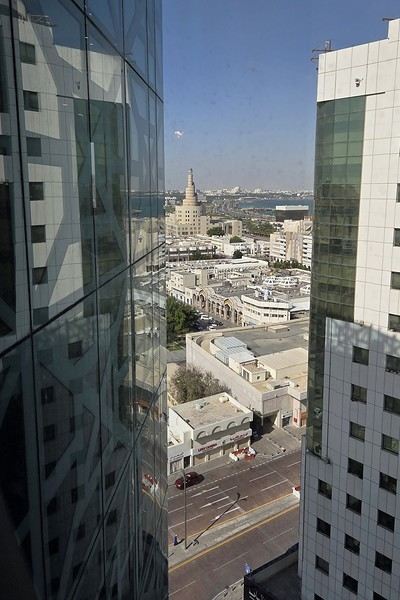
View of the Corniche from the 12th floor.
Breakfast is sumptuous—it really lifts our spirits.
On this Friday morning, almost everything is closed, so we head out to explore the Corniche, which is just a few hundred meters from our hotel in Old Doha.
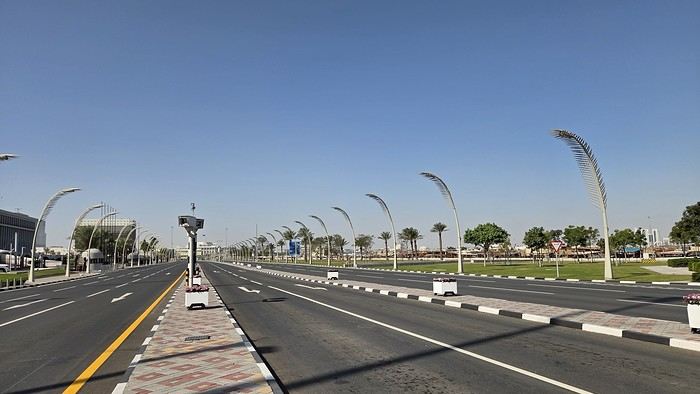
A marathon is happening today on the Corniche, so the road is closed and empty, making it easy to cross. The palm-shaped streetlights are gorgeous when they’re lit up at night.
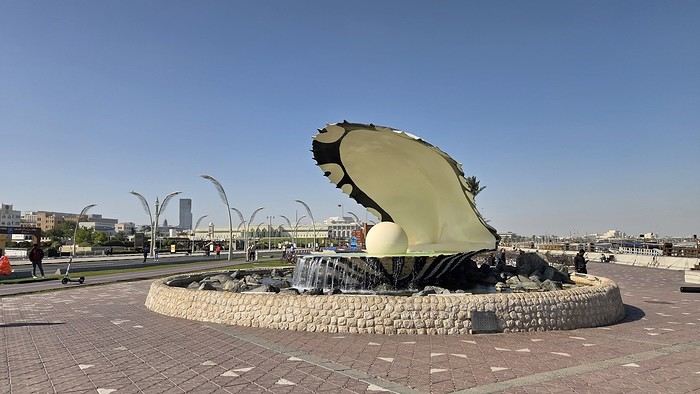
A little reminder of Qatar’s once-thriving pearl trade.
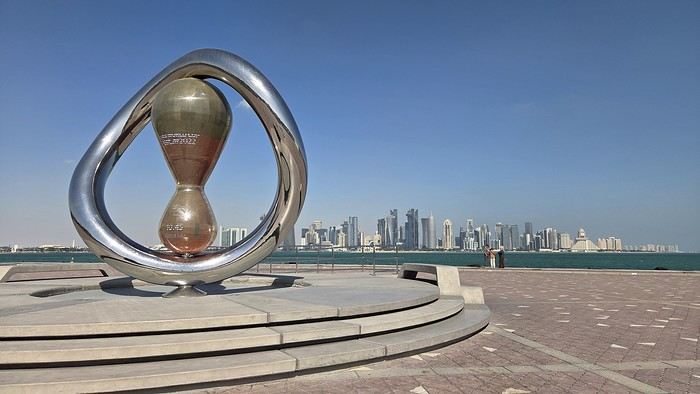
A memory of a much more recent past.
The sun is shining, but it’s not very warm—just 19°C at the hottest part of the day. Tough luck, last week it was 24°C.
The walk along the crescent-shaped Corniche is pretty long. From the old town to the modern center, where massive Dubai-style towers rise, it’s a 6 km promenade along the waterfront.
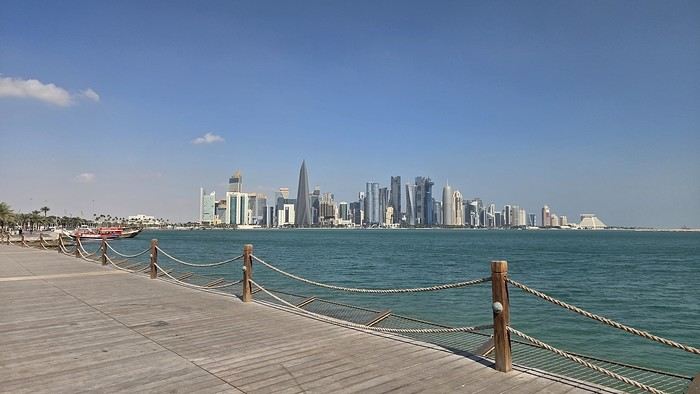
Many dhows are docked, waiting for tourists to take a little cruise in the bay, but visitors are scarce.
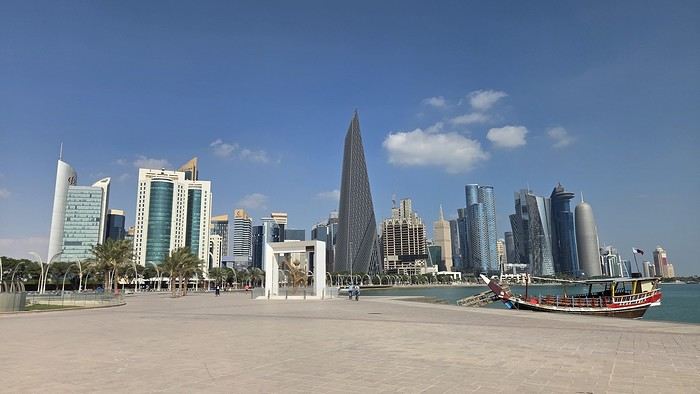
The skyscrapers are so stunning, you can’t help but admire them.
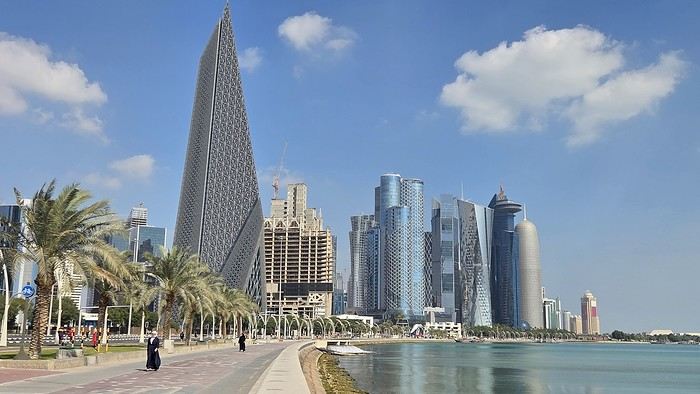
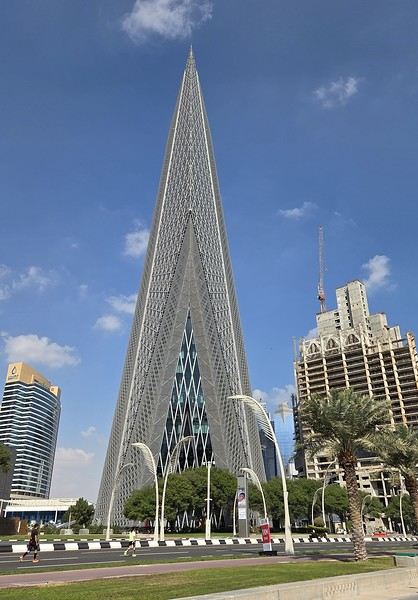
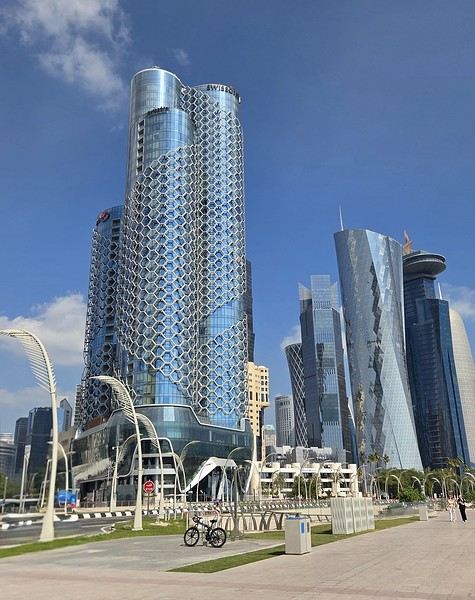
to be continued...
This short stay in Doha is part of a longer trip. It lets us break up a flight to the Seychelles.
Friday, January 16, The Corniche
Despite the adventures we had the day before (read about it here), we just can’t get up later than 8 a.m. Our minds are a bit clearer and a bit more positive after some sleep.
View of the Corniche from the 12th floor.
Breakfast is sumptuous—it really lifts our spirits.
On this Friday morning, almost everything is closed, so we head out to explore the Corniche, which is just a few hundred meters from our hotel in Old Doha.
A marathon is happening today on the Corniche, so the road is closed and empty, making it easy to cross. The palm-shaped streetlights are gorgeous when they’re lit up at night.
A little reminder of Qatar’s once-thriving pearl trade.
A memory of a much more recent past.
The sun is shining, but it’s not very warm—just 19°C at the hottest part of the day. Tough luck, last week it was 24°C.
The walk along the crescent-shaped Corniche is pretty long. From the old town to the modern center, where massive Dubai-style towers rise, it’s a 6 km promenade along the waterfront.
Many dhows are docked, waiting for tourists to take a little cruise in the bay, but visitors are scarce.
The skyscrapers are so stunning, you can’t help but admire them.
to be continued...
Cape region itinerary in July
Hi,
We’re looking at heading to South Africa this summer (early July) with our two kids (6 & 10 years old). Here’s a rough draft of our itinerary so far. What do you think? Is it better to skip Addo? (We can’t add any more days...). If so, should we spend more time on certain stops or add something else? (Cederberg?) Thanks in advance, Bruno
D1 Arrival at 10 AM, rest in Cape Town D2 Cape Town or Cape Peninsula D3 Cape Town or Cape Peninsula D4 Bonteboks National Park; overnight in Heidelberg D5 Botlierskop Game Drive; overnight near Mossel Bay D6 Garden Route; overnight in Plettenberg Bay D7 Bird of Eden and Robberg Nature Reserve; overnight in Plettenberg Bay D8 Tsitsikamma; overnight in Addo D9 Addo D10 Ostrich farm; overnight in Oudtshoorn D11 Buffelsdrift Game Lodge and caves; overnight in Oudtshoorn D12 Garden Route Game Lodge; overnight in Albertinia D13 De Hoop; overnight in De Hoop D14 Hermanus; overnight in Hermanus D15 Betty’s Bay and return to Cape Town D16 Cape Town; departure at 5 PM
We’re looking at heading to South Africa this summer (early July) with our two kids (6 & 10 years old). Here’s a rough draft of our itinerary so far. What do you think? Is it better to skip Addo? (We can’t add any more days...). If so, should we spend more time on certain stops or add something else? (Cederberg?) Thanks in advance, Bruno
D1 Arrival at 10 AM, rest in Cape Town D2 Cape Town or Cape Peninsula D3 Cape Town or Cape Peninsula D4 Bonteboks National Park; overnight in Heidelberg D5 Botlierskop Game Drive; overnight near Mossel Bay D6 Garden Route; overnight in Plettenberg Bay D7 Bird of Eden and Robberg Nature Reserve; overnight in Plettenberg Bay D8 Tsitsikamma; overnight in Addo D9 Addo D10 Ostrich farm; overnight in Oudtshoorn D11 Buffelsdrift Game Lodge and caves; overnight in Oudtshoorn D12 Garden Route Game Lodge; overnight in Albertinia D13 De Hoop; overnight in De Hoop D14 Hermanus; overnight in Hermanus D15 Betty’s Bay and return to Cape Town D16 Cape Town; departure at 5 PM
Guest houses in Srinagar
We’ll be in Srinagar for 4 days in mid-May 2026 during our backpacking trip as a couple. Do you have any nice places to recommend, and what about the houseboats on Dal Lake? Should we spend all our nights there, or just one night for practicality when getting around?
Thanks,
Rozenn
Colombia Road Trip: Itinerary and Safety
Hi everyone! So happy to be back on this forum—it’s packed with such useful info! 🙂 My husband and I are planning a 2.5-week self-drive trip to Colombia at the end of the year, including some domestic flights. My first question is: is it possible, easy, and safe to do a road trip in Colombia?
Below is our draft itinerary (with questions at each stop):
29/11: France → Colombia. Overnight in Bogotá. 30/11: Exploring Bogotá: La Candelaria and Montserrate. 01/12: Gold Museum (closed on Mondays). Drive to Zipaquirá (1.5 hrs) to visit the Salt Cathedral. Then drive to Villa de Leyva (3 hrs). Explore the town. Overnight in Villa de Leyva. 02/12: Return to Bogotá via Laguna de Guatavita (5 hrs). Is it worth the detour? Overnight in Bogotá. 03/12: Flight to Pereira. Drive to Salento. Overnight in Salento. 04/12: Cocora Valley (hike among the wax palms) followed by a drive around the area. Are there any waterfalls or other sights nearby? 05/12: Visit a coffee finca—any recommendations? Then explore the surroundings: Filandia, Manizales, waterfalls? Hot springs? Which ones? 06/12: Flight to Medellín. 07/12: Exploring Medellín: Centro, Plaza Botero, Comuna 13. How do you visit Comuna 13? Is it easy to get around Medellín? Metro? Buses? 08/12: Drive to Guatapé (2 hrs). Visit the town, stroll around the lake, then El Peñol. Overnight in Guatapé. 09/12: Return to Medellín. 10/12: Flight to Santa Marta. Drive to a hotel near Tayrona Park. 11/12: Tayrona—El Zaino entrance. 12/12: Tayrona—Palangana entrance, then Bahia Concha and Santa Marta. What do you think? 13/12: Drive to Minca (45 mins). Can we reach the village by car? Pozo Azul and Marinka waterfalls. Overnight in Minca (or back in Tayrona?). 14/12: Drive to Puerto Nao (5 hrs). Stop in Ciénaga on the way + boat tour in Nueva Venecia and/or Buena Vista? Not enough time? Overnight in Puerto Nao. 15/12: Exploring Cartagena: Centro, Getsemaní, the walls + La Boquilla if we have time. 16/12: La Boquilla (is it really worth it?) if we didn’t have time yesterday, then back to the beach. 17/12: Return to France.
So, what do you think? Is this doable, or should we tweak it? Thanks in advance for your invaluable feedback and tips! 🙂
Below is our draft itinerary (with questions at each stop):
29/11: France → Colombia. Overnight in Bogotá. 30/11: Exploring Bogotá: La Candelaria and Montserrate. 01/12: Gold Museum (closed on Mondays). Drive to Zipaquirá (1.5 hrs) to visit the Salt Cathedral. Then drive to Villa de Leyva (3 hrs). Explore the town. Overnight in Villa de Leyva. 02/12: Return to Bogotá via Laguna de Guatavita (5 hrs). Is it worth the detour? Overnight in Bogotá. 03/12: Flight to Pereira. Drive to Salento. Overnight in Salento. 04/12: Cocora Valley (hike among the wax palms) followed by a drive around the area. Are there any waterfalls or other sights nearby? 05/12: Visit a coffee finca—any recommendations? Then explore the surroundings: Filandia, Manizales, waterfalls? Hot springs? Which ones? 06/12: Flight to Medellín. 07/12: Exploring Medellín: Centro, Plaza Botero, Comuna 13. How do you visit Comuna 13? Is it easy to get around Medellín? Metro? Buses? 08/12: Drive to Guatapé (2 hrs). Visit the town, stroll around the lake, then El Peñol. Overnight in Guatapé. 09/12: Return to Medellín. 10/12: Flight to Santa Marta. Drive to a hotel near Tayrona Park. 11/12: Tayrona—El Zaino entrance. 12/12: Tayrona—Palangana entrance, then Bahia Concha and Santa Marta. What do you think? 13/12: Drive to Minca (45 mins). Can we reach the village by car? Pozo Azul and Marinka waterfalls. Overnight in Minca (or back in Tayrona?). 14/12: Drive to Puerto Nao (5 hrs). Stop in Ciénaga on the way + boat tour in Nueva Venecia and/or Buena Vista? Not enough time? Overnight in Puerto Nao. 15/12: Exploring Cartagena: Centro, Getsemaní, the walls + La Boquilla if we have time. 16/12: La Boquilla (is it really worth it?) if we didn’t have time yesterday, then back to the beach. 17/12: Return to France.
So, what do you think? Is this doable, or should we tweak it? Thanks in advance for your invaluable feedback and tips! 🙂
Where to buy alcohol in Chefchaouen and Merzouga?
Hi, I’d like to know where we can buy beer or wine in Chefchaouen and around Merzouga. We’ll be doing a circuit and staying at the Parador Hotel in Chefchaouen and in a bivouac in Merzouga.
Thanks for any info you can share!
Crossing the border from 4000 Islands (Laos) to Cambodia and ongoing conflict
Hi,
I’m arriving soon in southern Laos and the 4000 Islands, with plans to head to Cambodia next.
The latest news I got this morning (Paksé, La Boulange) isn’t great—the Cambodian border is also in a latent conflict with Laos for the same reasons as with Thailand...
So, what’s the best site to check for updates on the border opening? Since the situation isn’t stable right now and could change from one day to the next?
Thanks for your input.
So, what’s the best site to check for updates on the border opening? Since the situation isn’t stable right now and could change from one day to the next?
Thanks for your input.
Marrakech - Ouarzazate itinerary in February via the Tizi n'Tichka Pass
I'm planning to go to the Marrakech area in mid-February 2026 and I'd like to spend a few days in the Ouarzazate region, taking the Tizi n'Tichka Pass. I've heard that in winter this road can sometimes be closed due to snow.
Is it closed for long periods?
Where can I find information about the road conditions?
I tried downloading the MaRoute app on my smartphone, which was recommended by Dan49ch, but it's no longer available. Has it been replaced by another app?
Thanks and see you soon
Where can I find information about the road conditions?
I tried downloading the MaRoute app on my smartphone, which was recommended by Dan49ch, but it's no longer available. Has it been replaced by another app?
Thanks and see you soon
Malaysia travel plans: looking for tips and first-hand experiences
Hi everyone,
We’re planning a trip to Malaysia from March 16 to 31, 2026, and we’d love to hear your advice and experiences.
There are three of us girls, and we’d like to visit a few islands, but we’re not sure which ones to choose yet. Could you recommend:
The most beautiful islands to visit at this time of year (is it the right season?)
How to get there easily
Mistakes to avoid and essential info
Must-do activities and sights
Useful things to bring back
The budget to plan for
How long to stay in Kuala Lumpur and the city’s must-sees
Any tips you have—whether you’ve traveled in March or another time—will be super helpful for planning our trip. Thanks so much in advance! 🌴✈️
The most beautiful islands to visit at this time of year (is it the right season?)
How to get there easily
Mistakes to avoid and essential info
Must-do activities and sights
Useful things to bring back
The budget to plan for
How long to stay in Kuala Lumpur and the city’s must-sees
Any tips you have—whether you’ve traveled in March or another time—will be super helpful for planning our trip. Thanks so much in advance! 🌴✈️
Roads and weather in Dolpo in autumn
Hi there,
I’d like to head to Upper Dolpo in September/October 2026.
Does anyone know the current state of the roads in the area?
Specifically for getting from Saldang to Dho Tarap.
Also, what do you think about the weather between September 20th and October 20th?
Any tips would be much appreciated.
I’ve already checked out the info on Martinpierre’s site—it’s super detailed about the region, but the details are a bit outdated.
Thanks in advance for your advice.
Thierry
Questions about the new airport and access to Preah Vihear temple
Hi everyone,
I’m heading back to Cambodia in a few weeks and had a couple of questions:
1/ the new airport Does anyone have info on the average tuk-tuk fare? From the old one, we’d usually pay between $7 and $10. Are we looking at the same range? It seems a bit farther, so maybe a little pricier. If you’ve got a rough idea of the time (always better to budget extra), I’m guessing around an hour?
2/ access to Preah Vihear temple I haven’t been back in a few years, but I was thinking of revisiting it this year. Given the border troubles, is access still allowed at the moment?
Looking forward to hearing from you,
Mathieu
I’m heading back to Cambodia in a few weeks and had a couple of questions:
1/ the new airport Does anyone have info on the average tuk-tuk fare? From the old one, we’d usually pay between $7 and $10. Are we looking at the same range? It seems a bit farther, so maybe a little pricier. If you’ve got a rough idea of the time (always better to budget extra), I’m guessing around an hour?
2/ access to Preah Vihear temple I haven’t been back in a few years, but I was thinking of revisiting it this year. Given the border troubles, is access still allowed at the moment?
Looking forward to hearing from you,
Mathieu
Booking Timing for Campsites in Botswana
I’m just starting to plan our trip for late August 2026, but I’ve read multiple times that campsite bookings need to be made *way* in advance if we want to secure a spot—especially in the parks. Before I get too far into my road book, I’d love to get a sense of what “way in advance” actually means.
That leads to another question: what’s the best *channel* for making these reservations? Can I find a list of campsites online?
From what I’ve gathered, there aren’t any fenced campsites—is wild camping allowed?
I’ll admit, I’m short on time, and reading a few threads here has shown me how quick and helpful the experts are 😉.
We’re a group of 4 and plan to rent a 4x4. Rooftop tents seem like the better option given the wildlife (and, well, *people* roaming freely), especially compared to Namibia (which we visited in 2018).
Thanks in advance to everyone!
That leads to another question: what’s the best *channel* for making these reservations? Can I find a list of campsites online?
From what I’ve gathered, there aren’t any fenced campsites—is wild camping allowed?
I’ll admit, I’m short on time, and reading a few threads here has shown me how quick and helpful the experts are 😉.
We’re a group of 4 and plan to rent a 4x4. Rooftop tents seem like the better option given the wildlife (and, well, *people* roaming freely), especially compared to Namibia (which we visited in 2018).
Thanks in advance to everyone!
Accommodations on Warmshowers for a bike route from Orléans to Budapest
Good evening,
I’m planning a solo bike road trip along the EuroVelo 6, starting from Orléans all the way to Budapest, beginning May 1st, 2026!
Question: Have any of you used the Warmshowers site, and if so, I’d love to hear your thoughts on using this app—whether responses to hosting requests are generally satisfying, especially for the different countries I’ll be crossing!
Thanks in advance for your tips!
Philippe
Feedback on a 20-day Quebec road trip plan
Hi everyone,
I’m planning a trip to Quebec at the end of June/beginning of July 2026 for 20 days.
We’re a family of 4, with two kids aged 7 and 4 at that time.
I’ve already started drafting our itinerary but I’m open to all suggestions and ideas.
We plan to land in Montreal and stay a few days to recover from the trip.
Here’s my first draft of the itinerary:
-Day 1 to 4: Exploring Montreal:
-Day 5: Sucrerie de la Montagne in Rigaud.
-Day 6/7: Parc Omega (staying in Pods)
-Day 8-10: Saint-Alexis-des-Monts (staying at Pourvoirie du Lac Blanc)
-Day 9/10: Heading toward Lac Saint-Jean: I’m still looking for accommodation halfway to La Tuque. I’ve noticed Pourvoirie du Triton or Domaine Le Bostonnais.
-Day 10/11: Zoo Sauvage de Saint-Félicien: I’m also looking for accommodation near the lake for this stop + visiting Village historique de Val-Jalbert?
-Day 12-13-14: Stop in Sacré-Cœur at Ferme 5 Étoiles. (I also saw the Canopée Lit accommodations in the area—something to consider).
-Day 15-16: Tadoussac: Whale-watching excursion. Should we do it by Zodiac given my kids’ ages?
I’m also looking for accommodation in the area (Hotel Tadoussac is out of budget).
On the way back from Tadoussac to Quebec City, I’m considering an intermediate stop if there’s a spot worth the detour (Malbaie??).
-Day 17-18-19: Exploring Quebec City (Montmorency Falls / Old Town / Wendake).
-Day 20-21: Return to Montreal and flight home.
I’d love recommendations for activities for young kids along this route.
Thanks
Travel companion for Malaysia
Hi there,
This is my first post on this site. I’m planning a 3–4 week trip in July–August 2026 to Malaysia or Indonesia. I’m looking for 1–3 adults who’d be interested in joining the journey. I love traveling by adapting as much as possible to local life. I’m used to organizing the trip: itineraries, accommodations, transport, etc. In the past, I’ve worked in international medical assistance and I’m well-versed in travel medicine.
Sleeping in Terminal 1 at Barcelona Airport
Hi,
We’ll be arriving late at night and have a very early flight the next morning, so getting a hotel wouldn’t be worth it.
We’d like to know if there’s a nice spot in Terminal 1 where we can catch some sleep or at least get comfortable for a few hours.
Thanks to anyone who’s familiar with the terminal or has been in the same situation as us
Hitchhiking in the 70s-80s
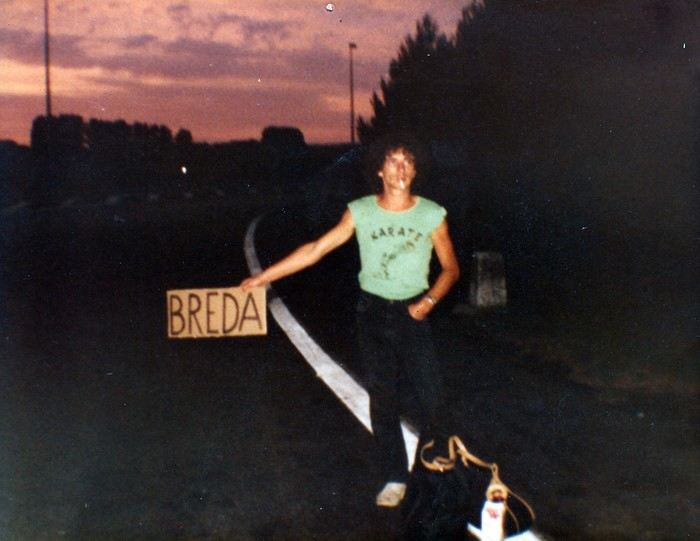
“Hey, your Marker... - My Marker? - The one you used to make hitchhiking signs.”
The marker in question is sitting proudly on the kitchen table. Marielle found it at the bottom of a moving box.
I’ve been meaning to tell the long story of my love affair with hitchhiking for years. Here we go.
To be honest, I’m not quite sure when it started. My earliest memory goes back to a fair with a bike race in my maternal grandparents’ village. I was with my cousin, my little sister, and three girl cousins. There were six of us, ages ranging from six or seven to thirteen or fourteen. Our parents stayed at the fair, and we’d had enough. So we decided to walk home. Only it was four kilometers away. So we hitchhiked. A guy driving an old car picked us all up and dropped us off at the farm. He probably found it amusing to see us thumbing a ride by the side of the road, but maybe it also worried him a bit. With everything you read in the papers...
Around fifteen or sixteen, I started hitchhiking regularly, alone or with a friend, to go to the nearby town. But it was especially when I started boarding school in Orléans that it became more regular. The first year, I’d leave Monday morning and come back Saturday noon by bus. It was an old, uncomfortable bus where we froze in winter. To make matters worse, I often got motion sickness if, as was too often the case, I ended up sitting in the back. In the spring, a high school friend suggested I hitchhike back. It meant a slight detour, but the advantage was taking only national roads.
So that’s how, from the end of tenth grade to twelfth grade, I’d thumb a ride every Saturday on the Pont de Bourgogne. Drivers were used to seeing young people hitchhiking, and it worked pretty well. Our biggest fear? Soldiers! At that time, military service was still mandatory, and on weekends, it wasn’t rare to see them competing with us. They’d keep their uniforms on to go home. That gave people confidence—with everything you read in the papers—and they’d rarely wait more than five minutes. We, with our long hair, were definitely less popular. From time to time, three big red-faced guys in a van coming back from a construction site would flip us off, yelling things like “go get a haircut, you bums!” Those were the good old days.
We still had a good laugh, though. Patrice, the friend I’d hitchhike back from school with on Saturdays, is a musician—I’d later discover he’s an excellent composer. A die-hard Beatles fan, he knows their repertoire by heart and spends his time singing at the top of his lungs while we thumb a ride. One Saturday late morning, we’d been waiting for a while at the exit of Châteauneuf-sur-Loire when a little lady came up to him and asked if he could please sing a little quieter: a baby was sleeping in the house. He put on the most sorry face: “Oh, sorry ma’am, we didn’t realize.” No sooner had the lady gone back inside than he started again. Luckily, a car stopped just then, sparing me the embarrassment of seeing the lady come back out.
Saturday was also the day when the cigarette pack was dangerously low. So before leaving, we’d go buy some “Parisiennes,” the “P4s” as we called them back then. They were slightly thinner cigarettes with a mix of tobacco scraps. Sometimes they tasted like light tobacco, sometimes like dark. Not great, but by the end of the week, our pocket money was gone. They were sold in small packs of four, hence the name P4. We’d only pay 20 centimes. On Saturdays, it was rare for the two of us to manage to scrape together 1.50 F to buy a whole pack of Gauloises...
The last twenty kilometers, I’d usually do alone, Patrice having reached his destination. From time to time, luck would smile on me: an acquaintance would just happen to pass by and stop. One January Saturday, at the exit of Gien, I ran into another guy from Argenton whom I knew a little. That day, the weather was nice, but the temperature was well below zero. It was around noon, and it was the off-peak hour. We were shivering, stamping our feet by the side of the road, when a Citroën “Tube” arrived: it was his father’s boss’s, a mason. They were both sitting in the front, but since they were obese, they had us climb onto the open back. Even though we huddled against the cab to shelter from the wind, the twenty kilometers felt very long, especially since we were only going sixty kilometers an hour. Our hands and cheeks were blue when we finally arrived.
The year I took my baccalaureate, a friend with a 2CV would take me Monday mornings with one or two others we’d pick up in nearby villages. We’d share the gas costs, but it was still cheaper than the bus. And in winter, the bus was my nightmare. You had to get up at five to catch it at six. Not enough sleep, and outside it was freezing or raining—or both. The 2CV was luxury. Plus, Philippe would pick me up at home. On the other hand, since I didn’t have class Saturday mornings—well, I did, but we only had PE the first two hours and nothing after—I’d skip class and slip out right after breakfast to thumb a ride at the Pont de Bourgogne.
Those three high school years were formative in this optional subject that was hitchhiking. Little by little, I learned the rules of the game. First, you shouldn’t walk along the road while thumbing. Cars go too fast and can’t stop easily. Accepting a ride that’s too short is also a no-go. The guy who offers to take you a little way but drops you off at some vague crossroads in the middle of nowhere? No thanks. You need to get dropped off in a town. If it’s a fairly big city, you often have to cross it from one end to the other, but it’s better. At the exit, you have to choose your spot well. Actually, you have to put yourself in the driver’s shoes: they need to see you early enough, not be going too fast, and be able to stop easily without risking an accident. So when leaving a city, it’s better not to go too far. It’s wiser to find a spot where cars go slowly and can stop easily. And preferably near a café. The café is for when you still have a few coins for a coffee and need to warm up. From time to time, you’d run into someone nice who’d make a detour to drop you off at a better spot to start again. Finally, if possible, avoid hitchhiking on Sundays. Cars are packed with whole families who, most of the time, aren’t going far. And then there’s the little worry of those people who rarely leave home: with everything you read in the papers...
During those high school years, it was only short trips, rarely exceeding a hundred kilometers. Later, I aimed bigger, and things were a bit different. In 1973-74, I crossed part of France for the first time on two or three occasions, coming back from the German border or returning to Bordeaux, where we lived briefly. Since there weren’t many highways back then, we took national roads. It was during these trips that I realized it was better to leave in the evening. As I said earlier, Sunday is to be avoided, but on weekdays, there’s another problem: if you leave in the morning, you only make short hops. First, it often takes longer to get going because drivers are people going to work nearby. Which brings us back to those who drop you off in a bad spot, far from everything. There, you have to know how to refuse. You thank the driver for stopping—oh, if only everyone could be like you—while explaining why you’d rather stay put. People don’t take offense, by the way. Those who pick up hitchhikers often hitchhiked themselves when they were in the military or before they had a car. In the late afternoon, you’d often run into salespeople or truckers, in other words, people who drive a lot. At that time, salespeople no longer had appointments and were more relaxed. They wanted to talk about something other than the merits of their products. On the radio, it was time for *Les Grosses Têtes*. You’d also quite often run into small business owners, professionals, or even hippies. The conversations were pleasant and often enriching. A little later in the evening, truckers would take over. They’d already driven a few hundred kilometers, and the depot or customs was still far away. So they’d gladly take a hitchhiker to stay awake at the wheel and chat. The radio with Max Ménier’s show *Les routiers sont sympas*, you’d eventually get tired of it. So a hitchhiker was a change. Others, who’d hit the road at midnight to be at their destination by morning, were nice and offered to let you lie down on the bunk while they drove. When you’d been hitchhiking since six in the evening, freezing in the wind between two vehicles, you weren’t unhappy to take a little nap.
Speaking of Max Ménier, he’d often make announcements for hitchhikers. One evening, I called him. It was getting late, and I still had quite a way to go. No luck: the show had ended for good the day before!
In short, it’s better not to rush, sleep in, and leave after lunch, or better yet, in the late afternoon. Obviously, I’m talking about when you have several hundred kilometers to cover. That’s when you have to play it pro.
First thing, especially at night, but it also applies in the middle of summer when the light is blinding: dress to be seen from far away. I’ll admit I have an advantage over most other hitchhikers: I’m small and don’t scare people. To balance that out, racist drivers often take me for an Arab and are less likely to pick me up, but overall, the balance tips in my favor. Back to the need to be seen: at night, I wear light-colored clothes. In headlights, you can see me from far away.
Second thing: travel light. Forget the big backpack with a frame. Drivers don’t always have room in the trunk or on the back seat, especially if it’s rained and the ground is wet. Plus, it forces them to get out of the car. If they’re nice enough to pick up a hitchhiker, you shouldn’t ask for too much either.
Third thing: bring a cardboard sign and a big marker—like the ones in the photo at the start of this post—to write the name of your destination. In the early 80s, I ran a tourist house in the Cher, but I lived in the Netherlands. In the off-season, it was only open on weekends. On Fridays, I’d leave Holland and return on Mondays. 1200 km round trip. On the way there, in Paris, I’d stand at Porte de la Chapelle. At that spot, the road is very wide, and drivers could stop easily. Obviously, on the sign, I didn’t write Eindhoven, which not everyone knows, and even less Amsterdam because of its seedy reputation. In that case, you’d expect to see a police car stop and two officers in kepis ask for your papers. So as a first destination, I’d write Compiègne. We were well out of Paris, and since it wasn’t too far, a trucker or salesperson was less reluctant to stop. Once past Compiègne, I’d take out my Lille sign. Once in Belgium, it wasn’t really necessary to use a sign anymore, since everyone was going in the same direction. Usually, the guy who picked me up at Porte de la Chapelle would say he wasn’t going far but could take me a little way. Before that, I’d still ask if there was a gas station on the highway where he could drop me off before exiting. While talking, the guy would realize he wasn’t dealing with a dangerous criminal. He’d pretend to check his watch, think for a moment, then say that actually, he was going to Belgium and could take me to the border or a little beyond. To leave Paris on the way back, I’d take the train to Melun, where it was easier to hitchhike than at Porte d’Italie.
Over all those years, I think I was pretty lucky. Or maybe philosophical enough not to imagine a car would stop after a few minutes. An hour’s wait was average. Sure, I sometimes waited three, four, or five hours. Most often at odd hours and in terrible weather. When it doesn’t work, it doesn’t work. But there’s always a moment when things pick up. Sure, when you’re soaked in freezing rain in the early morning after a sleepless night, you’re less philosophical than when I’m writing these lines comfortably at my computer, but it still holds true.
Earlier, I mentioned clothing and the importance of being well-rested before leaving. When you’ve eaten well and just gotten out of the shower, shaved, you’re in a better mood. And somehow, drivers sense it. Or at least, that’s the impression I’ve always had. It’s better to look in shape than disgusted at standing there, half-heartedly thumbing a ride. In short, when I’d start to get fed up with waiting, I’d go into the first café I saw for a coffee. Coming back out, I’d be refreshed, and most of the time, a car would stop within minutes. I’ve often said that when I stood by the side of the road thumbing a ride, I felt a bit like a gambler in front of a slot machine. It was a matter of giving luck a chance. And well, it worked out pretty well.
Then, there are countries where hitchhiking works really well and others where it’s harder. In the 70s-80s, it worked best in Germany and England. In the late afternoon, it wasn’t rare to be invited for tea. Well, that was in England. Tea meant being offered room and board. In Germany, they’d offer you coffee. Once there, they’d first show you the guest room and point out the bathroom before sitting you down in front of a big plate of cold cuts. In the evening, they’d go out in town, and the next morning, they’d usually drop you off at a good spot for hitchhiking. On the other hand, in Mediterranean and Scandinavian countries, you’d better be patient. In Spain or Italy, it’s better to take the train, which was dirt cheap back then. However, if you’re a couple traveling light, it’s already easier in most countries.
In 1982, I went on a trip around Turkey with my girlfriend. We only had two small bags, which was plenty. It was November-December, and we wore our warm, bulky clothes. Leaving Eindhoven at nine in the morning, we arrived in Graz, near the Yugoslav border, at eleven at night. 1300 km in a day! In just four or five vehicles. One to the German border, about fifty kilometers from Eindhoven, the second to Hagen in the Ruhr, the third to Salzburg, and the last to Graz at the Yugoslav border. Record broken. During the night crossing of Yugoslavia, we ran into a trucker close to retirement who lent us the truck’s bunk. So we arrived fresh and rested near Skopje the next morning. We continued to Thessaloniki in northern Greece before taking the train to Istanbul. In Turkey, we traveled a good part of the country by hitchhiking too. With truckers in old, overloaded, slow trucks that climbed hills at fifteen kilometers an hour, but also in cars where five or six people were already crammed in. And every time, we were invited for tea. Once, we were even picked up by a big shot in his Mercedes with a chauffeur. Until then, the average speed was around fifty kilometers an hour. There, we were going two hundred. On a national road, not a nice European highway.
I’ve also hitchhiked in Nepal, from Lumbini, Buddha’s birthplace, to a village on the way to Pokhara. It must have been midday. No bus until the next day. I gave it a try. A small truck overloaded with rice sacks, with two or three young people already perched on top, stopped. I rode on the roof of the cab. At fifty kilometers an hour when it was going well, with a breathtaking view. Coming back from India, I also crossed part of Iran by hitchhiking, from Tehran to the Turkish border. I did this trip with an Austrian I met at the hotel who, like me, had to watch his pennies. We gave it a shot. There was almost no traffic, but to our great surprise, the first car that passed in the area would always stop. They’d just ask for a modest contribution for gas, and it cost next to nothing.
Sometimes, you get scared too. After leaving Turkey in early December 82, we spent about two weeks in the southern Peloponnese harvesting olives. A few days before Christmas, we hitchhiked back to Holland. A girl picked us up in her little Fiat 500. We were driving on a mountain road, and that morning there was a bit of black ice. After crossing a pass, we saw the old Ford Taunus ahead of us at fifty meters start to skid. The driver let out a “heeee!” while grabbing my knees. I reflexively grabbed the wheel. Finally, the Taunus got back on track. And we didn’t swerve. But those few seconds felt very long.
In January 77, while I’d been living in Germany for a few months, I decided to spend a few days in Italy. By hitchhiking, of course. I left in the early afternoon, and by ten at night, I wasn’t far from Frankfurt. I saw a big Mercedes stop. The four or five young people crammed inside were listening to Schlager at full volume. Beer cans littered the floor. They didn’t have a precise destination, and as long as they were going south, that was fine with me. They’d finished their military service that very day and had clearly already celebrated their discharge. The driver was going 160, zigzagging dangerously from one side of the highway to the other. I should have realized he wasn’t entirely sober either. Luckily, there was almost no traffic. Finally, I managed to get dropped off at a gas station just before Frankfurt, relieved. I hope their trip didn’t end tragically.
Another time, coming back from Holland with my wife, we were picked up early in the morning near Senlis by two guys from Lille. They were going to work near Tours and could drop us off at Porte d’Italie. Apparently, they were coworkers but barely knew each other. The driver offered us a beer—at six in the morning, sure!—before opening another can for himself. He was clearly having trouble staying in the right lane. We politely declined, the passenger too. Everyone was tense. Luckily, it was rush hour on the ring road, and we were going slowly. When we got out of the car, the passenger said goodbye with the look of a guy being offered the condemned man’s rum and cigarette.
Finally, there are the annoying remarks from drivers who are either gay when you’re alone or turned on by the sight of your girlfriend when you’re a couple. In those cases, I’d get in the back so the guy wouldn’t feel too confident. And if the conversation got a little too suggestive, we’d deflect until we got dropped off.
And luckily, there are the times, not so rare after all, when you run into really nice people who invite you to eat and sleep at their place and drive you to a good spot the next morning. In Germany and England, that was common. And then there are the big strokes of luck, like during our trip to Turkey when we crossed most of Germany in one car, or that other time when some Germans drove me from the exit of Geneva all the way to the Costa Brava.
Going back to “with everything you read in the papers” and its variant “with everything you see on TV”—and now on the internet—it’s always left me perplexed. Personally, I’ve never heard of hitchhikers assaulting drivers, even if it may have happened. On the other hand, what was most common were hitchhikers being assaulted, especially girls. Anyway, even armed, it seems a bit stupid to assault the driver—wouldn’t that risk causing an accident?
Finally, since that time, I’ve occasionally wanted to hitchhike somewhere far away in France. Most often, too busy with work, it never happened, but the nostalgia hasn’t completely disappeared.
* * *
Other Hitchhikers
And then one day, I... settled down to become a driver myself. Ten years had passed, and you saw fewer and fewer hitchhikers. Or maybe I saw fewer because I had a regular job and wasn’t traveling the same way. And then I understood a few things.
Several times, I was tempted to pick up a hitchhiker, but they didn’t meet the required conditions. They were walking along the road instead of staying at the exit of the previous town. Hard to stop without risking an accident. Or the guy looked really scruffy. Or he was sulking, if not both. Then you think of that famous “with everything you read in the papers.” Not that I was scared, but unfortunately, the few hitchhikers I did pick up later were rarely interesting.
A few years ago, we picked up a young guy at the exit of a small town in Sologne. Not an easy spot for hitchhiking. Bad luck, he was a pretentious little jerk. He was barely 20 or 25 and talked like a bitter old man. He was a waiter in a restaurant. According to him, it was lucky he was there, otherwise the boss would have closed up shop long ago. You’d think he had thirty or forty years of professional experience behind him. As we approached Blois, he started ranting about Arabs, blaming them for all evils. And he laid it on thick. That morning, we were going to a teenager’s funeral who had just committed suicide, so he really got on our nerves, Mr. Know-It-All. Out of anger, I dropped him off next to a shopping center a few kilometers from downtown. Not nice, but it felt good.
Some time ago, we were driving around the Limousin on a Sunday to try out the used Twingo we’d just bought. We picked up a guy in his forties. A German who spoke French well. He started talking about the environment. He was a green Khmer. He got worked up all by himself with his pseudo-eco rant and, after a few kilometers, was almost yelling at us. As we were about to leave the main road for a small one, I dropped him off at a crossroads in the middle of nowhere. Normally, I would have made a little detour to take him to a better spot, but this time, I didn’t feel like doing the... eco-warrior a favor.
On the other hand, I’ve still done my good deed a few times. One June morning, coming back from Orléans, I saw a man in his sixties hitchhiking. The poor guy had had a rough time. He was from Montpellier and was coming back from Caen, where he’d been promised a job. Once there, they bluntly told him the position was already taken, and he had to go back. Except he didn’t have enough money left for the train. He’d spent the night hitchhiking without success. I could only take him as far as Lamotte-Beuvron, where I dropped him off near the fire station. Apparently, there was some vague shelter there or something, but it only opened a few hours later. In the meantime, he settled on the grass in a corner to sleep a little. While he was doing that, I quickly went to the train station to check the price of a ticket to Montpellier. It was within my means. Since he was sound asleep, I slipped the train ticket and 100 francs into his pocket. I couldn’t imagine him continuing to hitchhike all the way to Montpellier. And I bet he didn’t even have a piece of cardboard and a marker!
When we go to Brazil, we usually rent a small car. One day, we were coming back from Paracuru to Fortaleza when we saw a whole family hitchhiking. Two adults and two or three small children. Here near the equator, the sun sets very quickly, and it would soon be night. There was little traffic, and trucks wouldn’t stop because there was no room in the cab. As for the rich people driving big 4x4s, they wouldn’t stoop to picking up the lower classes. The only hope for this kind of family was usually a farmer or artisan who’d let them ride in the back of his pickup. Obviously, they were a bit surprised to see us. Everyone crammed in as best they could in the back of our little car. When we dropped them off, we got a whole string of “Deus lhes abençõe”—God bless you.
Still in Brazil, we were on the road from Barreirinhas to São Luís do Maranhão. About 150 km of deserted road with an isolated mud house here and there. A young woman flagged us down. She was very pregnant and had to get to the clinic twenty or thirty kilometers away to give birth. Someone was supposed to drive her, but the first signs of labor started earlier than expected, and the driver was unavailable. Even driving fast, we weren’t feeling great: it would be just our luck if she gave birth in the car!
Today, we’re in the age of smartphones and carpooling apps. Safety. With everything you see on TV... Three or four years ago, we signed up on a platform. Our first, and only, “client” was a little jerk who didn’t say a word the whole trip. No hello, no goodbye, and certainly no thank you. The next day, we found his Ray-Bans in the car. We didn’t run after him to give them back. Ha!
Bugs on VoyageForum
Hi,
Many of us have noticed that bugs have been making it difficult to navigate the forum lately.
I’ll let Kate and Ticapi explain the issue:
I went to your profile to check out the Thailand travel journal, and when I clicked on it, it brought me back here again. All week, I’ve been dealing with bugs like this—it’s really discouraging from continuing on VF.🙁
I had the same thing happen, and multiple times. For me, it was Montagnard’s latest journal that kept coming up no matter which discussion I clicked on.
Hopefully, a solution will be found soon.🙂
Many of us have noticed that bugs have been making it difficult to navigate the forum lately.
I’ll let Kate and Ticapi explain the issue:
I went to your profile to check out the Thailand travel journal, and when I clicked on it, it brought me back here again. All week, I’ve been dealing with bugs like this—it’s really discouraging from continuing on VF.🙁
I had the same thing happen, and multiple times. For me, it was Montagnard’s latest journal that kept coming up no matter which discussion I clicked on.
Hopefully, a solution will be found soon.🙂
Another side of my trip to Thailand: Villages, nature, countryside, mountains...
February 9th is a pivotal day during my trip to Thailand. Up until this date, my focus had been on cities, temples, and other urban landmarks. Starting February 10th, I’ll finally leave the city behind for the outskirts—one town, one life, farther from tourism, more real, more authentic... Then comes the bucolic surroundings of Chiang Mai, nature, the countryside, the mountains.
This morning, I head to visit the ethnographic museum. I’d been told about another one, but it’s permanently closed. I wonder if it’s the same one that might have changed its name and location.
I thoroughly enjoy visiting this museum. At first, I’m a bit annoyed because the place is packed with noisy school groups blocking the display cases without even showing the slightest interest. But soon, their chaperones manage to lead them into another room, giving me some peace. They maintain this distance throughout the tour, allowing me to explore the museum in complete tranquility. I really appreciate their tact.
I’m amazed by the absolutely stunning fabric displays and the countless everyday objects, especially the very old pottery. There’s so much beautiful basketry and intricately carved wood. The statues are also incredible... After seeing all of them, I no longer feel like buying any from the shops.
On my way back, not far from my hotel, I discover a rather unique place that only serves one drink, which they’ve made their specialty: egg coffee! A pretty surprising novelty. I have to try it.

At the bottom of the cup, they pour a layer of milk, topped with a layer of liquid coffee, followed by a layer of egg yolk, and finally a top layer that turns out to be a mix of coffee and cocoa powder. It’s a cold drink that, in the end, doesn’t have much flavor, and the price is pretty steep for such a small cup. You’re paying for the exclusivity!
Later in the day, I venture once again into small alleys, something I love doing when exploring a new city—no specific goal, just wandering east of the city, outside the walls.

I encounter very few tourists there and discover unsuspected little shops overflowing with lovely items, much cheaper than what you find in the heart of the tourist district. Then I wander through the floors of Warorot Market. I discover another kind of temple there: the temple of good deals. I love finding clothes that are really original for locals, not the flood of shirts and pants that tourists love but no Thai would ever buy, which invade the shops in the "Historic Square." I stop in my tracks in front of a stall with beautiful shirts featuring stunning geometric patterns in elegant color combinations and very short sleeves. Hmm, these would be perfect for showing off my biceps, one of which is adorned with the magnificent Ganesh tattoo I got last year in Bali. "When you’ve got nice things, you’ve got to show them off!" he said. 😜🙏💪 I pick out two for 380 baht and negotiate them down to 300. But the seller won’t go any lower. I understand I’ve reached the limit of her commercial possibilities. Just as I’m leaving the shop, happy with my purchase, my ever-helpful inner voice, Petite Voix, suggests: - You didn’t try them on because you were too lazy to take off the one you’re wearing and also because of the sweat, but you could just put one on over the one you’re wearing. It’s light enough that it won’t bother you.
I go back to the two sellers, who burst out laughing when I ask to try them on. - Oh no, it’s way too small for you! It’s a women’s shirt! - But they don’t look particularly feminine in style! And I chose XXL... I put the shirt on, and of course, it won’t close. Then I notice the buttons are on the wrong side. That’s why the sleeves seemed so short!!! They put the shirts back on the rack and refund me without any fuss, commenting amid total hilarity: - Well, thank goodness you tried it on just as you were leaving the shop!
Since I don’t want to walk too much before tomorrow’s first Big Outing with the driver, I end my stroll with a visit to two very pretty temples recommended by Joël.

I’d rather not post more temple photos. But these ones smell like village and countryside...


I’ve never seen anything like Wat Ket Karam, so extravagant...


And I end my day with two other lesser-known temples: Wat Noung Kham, simple and finally free of gold and glitter,

and Wat Dap Phai, where an intimate ceremony is taking place at the end of the day.
This morning, I head to visit the ethnographic museum. I’d been told about another one, but it’s permanently closed. I wonder if it’s the same one that might have changed its name and location.
I thoroughly enjoy visiting this museum. At first, I’m a bit annoyed because the place is packed with noisy school groups blocking the display cases without even showing the slightest interest. But soon, their chaperones manage to lead them into another room, giving me some peace. They maintain this distance throughout the tour, allowing me to explore the museum in complete tranquility. I really appreciate their tact.
I’m amazed by the absolutely stunning fabric displays and the countless everyday objects, especially the very old pottery. There’s so much beautiful basketry and intricately carved wood. The statues are also incredible... After seeing all of them, I no longer feel like buying any from the shops.
On my way back, not far from my hotel, I discover a rather unique place that only serves one drink, which they’ve made their specialty: egg coffee! A pretty surprising novelty. I have to try it.
At the bottom of the cup, they pour a layer of milk, topped with a layer of liquid coffee, followed by a layer of egg yolk, and finally a top layer that turns out to be a mix of coffee and cocoa powder. It’s a cold drink that, in the end, doesn’t have much flavor, and the price is pretty steep for such a small cup. You’re paying for the exclusivity!
Later in the day, I venture once again into small alleys, something I love doing when exploring a new city—no specific goal, just wandering east of the city, outside the walls.
I encounter very few tourists there and discover unsuspected little shops overflowing with lovely items, much cheaper than what you find in the heart of the tourist district. Then I wander through the floors of Warorot Market. I discover another kind of temple there: the temple of good deals. I love finding clothes that are really original for locals, not the flood of shirts and pants that tourists love but no Thai would ever buy, which invade the shops in the "Historic Square." I stop in my tracks in front of a stall with beautiful shirts featuring stunning geometric patterns in elegant color combinations and very short sleeves. Hmm, these would be perfect for showing off my biceps, one of which is adorned with the magnificent Ganesh tattoo I got last year in Bali. "When you’ve got nice things, you’ve got to show them off!" he said. 😜🙏💪 I pick out two for 380 baht and negotiate them down to 300. But the seller won’t go any lower. I understand I’ve reached the limit of her commercial possibilities. Just as I’m leaving the shop, happy with my purchase, my ever-helpful inner voice, Petite Voix, suggests: - You didn’t try them on because you were too lazy to take off the one you’re wearing and also because of the sweat, but you could just put one on over the one you’re wearing. It’s light enough that it won’t bother you.
I go back to the two sellers, who burst out laughing when I ask to try them on. - Oh no, it’s way too small for you! It’s a women’s shirt! - But they don’t look particularly feminine in style! And I chose XXL... I put the shirt on, and of course, it won’t close. Then I notice the buttons are on the wrong side. That’s why the sleeves seemed so short!!! They put the shirts back on the rack and refund me without any fuss, commenting amid total hilarity: - Well, thank goodness you tried it on just as you were leaving the shop!
Since I don’t want to walk too much before tomorrow’s first Big Outing with the driver, I end my stroll with a visit to two very pretty temples recommended by Joël.
I’d rather not post more temple photos. But these ones smell like village and countryside...
I’ve never seen anything like Wat Ket Karam, so extravagant...
And I end my day with two other lesser-known temples: Wat Noung Kham, simple and finally free of gold and glitter,
and Wat Dap Phai, where an intimate ceremony is taking place at the end of the day.
Swiss. Flight canceled due to weather. 5-day delay. Court orders compensation + damages
Hi,
I often see people here claiming that if a flight is canceled due to weather, the passenger isn’t entitled to any compensation. However, the airline is only exempt from compensating the passenger if—and **only if**—they offer re-routing “as soon as possible.”
Here’s what happened: A single booking with Swiss International Air Lines (a Lufthansa subsidiary) for Paris - Zurich operated by Swiss, then Zurich - Puerto Plata operated by Edelweiss Air (another subsidiary).
After arriving in Zurich, the airport was closed for a few hours due to weather, and all flights were canceled. So far, nothing unusual. But Swiss International Airlines really outdid themselves:
Meals and hotel (plus transport to and from): “Figure it out yourselves, but we’ll reimburse you.” No re-routing offered at the time of cancellation (which is **mandatory** at the **same time**), nor in the following days, even though possible re-routing options existed. Worse: After 2 days with no information from the airline, the passenger showed up at the airport to demand immediate re-routing (3 hours later) on a flight operated by the same airline that had canceled the original flight, even though the final destination was 6 hours by road from the originally planned airport (Punta Cana instead of Puerto Plata). The airline refused because there was only space left in business class—and thus, the passenger had to pay!!! It’s completely absurd!!! The passenger declined, so the airline refused the re-routing! No other re-routing options were offered. The next day, the passenger returned, and this time, they were offered—**for the following day**—the exact same re-routing that had been refused the day before (Zurich - Punta Cana)! The passenger accepted. Arrival at a destination 6 hours by road from the final airport. Complete silence from the airline about the transfer. The passenger had to figure it out alone! In the end, arrival at the final destination with a 5-day delay. When the passenger claimed reimbursement for their expenses (nearly 600 €) the day after arrival, it took a month and a half to get the money back.
Swiss didn’t even bother responding to the registered letter requesting compensation. The passenger only received two replies from the parent company (Lufthansa), responding on behalf of its subsidiary, stating that the request should be addressed to its other subsidiary.
The passenger turned to the justice conciliator (a mandatory step before taking the case to court). The airline went silent and didn’t respond to the conciliator, who then issued a report of failure to cooperate. The passenger took the case to the local court in Aulnay-sous-Bois and sent Swiss their “submissions.” The airline remained silent until less than 48 hours before the hearing. Then, over the phone, the airline’s lawyer verbally agreed to pay the 600 € owed but proposed a reduced settlement for the rest. The passenger refused. Then, 24 hours before the hearing, the passenger received Swiss’s “submissions,” confirming the previous day’s verbal proposals.
Finally, the hearing took place, and the judgment was received: 600 € in compensation, as provided by Articles 5 and 7 of EU Regulation 261/2004 + 500 € under Article 12 of the same regulation (additional compensation, given how badly Swiss handled things) + 200 € for legal costs (registered letters, preparing the particularly large case file). All the details of this case (correspondence, justice conciliator, passenger’s submissions, the airline’s submissions, the arguments presented in court, and the judgment) are available here: https://retardimportantavion.wordpress.com/2024/01/12/reacheminement-catastrophique-droit-indemnisation-meme-circonstances-extraordinaires-2/ In summary: -Just because a flight is canceled due to weather doesn’t mean the airline is automatically exempt from compensating the passenger. -In such cases, immediately look for possible re-routing options yourself (same airline or not), stop just before payment, and take screenshots. -Don’t always blindly believe what the airline tells you. -Don’t give up: the process is simple and free. But you must follow the templates provided on my website https://retardimportantavion.wordpress.com without deviating from them. Best regards,
Meals and hotel (plus transport to and from): “Figure it out yourselves, but we’ll reimburse you.” No re-routing offered at the time of cancellation (which is **mandatory** at the **same time**), nor in the following days, even though possible re-routing options existed. Worse: After 2 days with no information from the airline, the passenger showed up at the airport to demand immediate re-routing (3 hours later) on a flight operated by the same airline that had canceled the original flight, even though the final destination was 6 hours by road from the originally planned airport (Punta Cana instead of Puerto Plata). The airline refused because there was only space left in business class—and thus, the passenger had to pay!!! It’s completely absurd!!! The passenger declined, so the airline refused the re-routing! No other re-routing options were offered. The next day, the passenger returned, and this time, they were offered—**for the following day**—the exact same re-routing that had been refused the day before (Zurich - Punta Cana)! The passenger accepted. Arrival at a destination 6 hours by road from the final airport. Complete silence from the airline about the transfer. The passenger had to figure it out alone! In the end, arrival at the final destination with a 5-day delay. When the passenger claimed reimbursement for their expenses (nearly 600 €) the day after arrival, it took a month and a half to get the money back.
Swiss didn’t even bother responding to the registered letter requesting compensation. The passenger only received two replies from the parent company (Lufthansa), responding on behalf of its subsidiary, stating that the request should be addressed to its other subsidiary.
The passenger turned to the justice conciliator (a mandatory step before taking the case to court). The airline went silent and didn’t respond to the conciliator, who then issued a report of failure to cooperate. The passenger took the case to the local court in Aulnay-sous-Bois and sent Swiss their “submissions.” The airline remained silent until less than 48 hours before the hearing. Then, over the phone, the airline’s lawyer verbally agreed to pay the 600 € owed but proposed a reduced settlement for the rest. The passenger refused. Then, 24 hours before the hearing, the passenger received Swiss’s “submissions,” confirming the previous day’s verbal proposals.
Finally, the hearing took place, and the judgment was received: 600 € in compensation, as provided by Articles 5 and 7 of EU Regulation 261/2004 + 500 € under Article 12 of the same regulation (additional compensation, given how badly Swiss handled things) + 200 € for legal costs (registered letters, preparing the particularly large case file). All the details of this case (correspondence, justice conciliator, passenger’s submissions, the airline’s submissions, the arguments presented in court, and the judgment) are available here: https://retardimportantavion.wordpress.com/2024/01/12/reacheminement-catastrophique-droit-indemnisation-meme-circonstances-extraordinaires-2/ In summary: -Just because a flight is canceled due to weather doesn’t mean the airline is automatically exempt from compensating the passenger. -In such cases, immediately look for possible re-routing options yourself (same airline or not), stop just before payment, and take screenshots. -Don’t always blindly believe what the airline tells you. -Don’t give up: the process is simple and free. But you must follow the templates provided on my website https://retardimportantavion.wordpress.com without deviating from them. Best regards,
Should I plan 1 or 2 days to visit downtown Boston?
Hi there.
I’m heading to the US in September and stopping in Boston. I’ve got a baseball game booked for Sunday afternoon. Is Monday enough to soak up the highlights of the city, including Harvard?
Thanks for your tips!
I’m heading to the US in September and stopping in Boston. I’ve got a baseball game booked for Sunday afternoon. Is Monday enough to soak up the highlights of the city, including Harvard?
Thanks for your tips!
Hotel or guesthouse recommendations in Pondicherry
Hello there!
Any hotel or guesthouse you’d recommend in Pondicherry?
Arriving on October 5th for up to 15 days.