last edited Dec 11, 2019
Introduction to North Macedonia
Location Map of North Macedonia
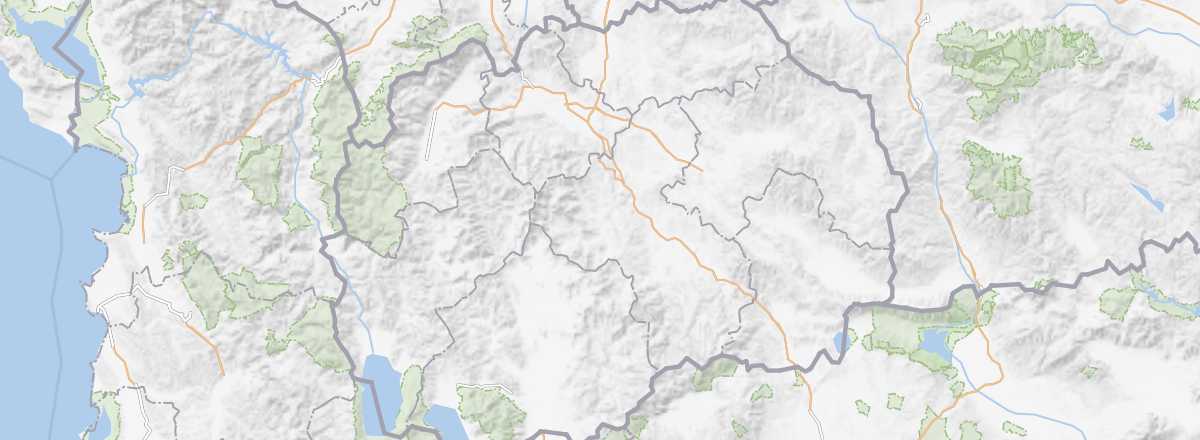 North Macedonia
Open the interactive map
North Macedonia
Open the interactive map
Quick Overview
North Macedonia is one of the states created from the former Yugoslavia in the 1990s. In 2018, after an agreement with its Greek neighbour—with whom it had a "dispute" over its name—the country decided to change its name, officially becoming the "Republic of North Macedonia" in 2019.
Key Facts
- Type of place: country.
- Location: in the Balkans, just above Greece.
- Latitude/longitude: 42.0' N, 21.26' E.
- Local time:
- Capital: Skopje.
- Nature of the state: parliamentary republic.
- Official language: Macedonian.
- Currency: Macedonian denar.
- Population: 2,118,945 inhabitants (2018).
- Area: 25,713 km².
- Density: 82 inhabitants/km².
- Highest point: Mount Korab (2,764 m).
- Lowest point:
- Coastline: no maritime access.
- Driving: on the right.
Tourism
With its mountains, preserved nature, and numerous traces of its past, North Macedonia has strong tourism potential that is just waiting to be developed.
For now, the destination remains somewhat "under the radar" (though growing rapidly), particularly among Western European travellers, with 707,000 foreign tourists in 2018. Of these, Turks were the most numerous (20% of arrivals), followed by Serbs and Greeks. Fewer than 10,000 French visitors travelled to North Macedonia in 2016.
Travel Essentials
- Destination:
- By air: France-Skopje.
- Entry requirements: valid passport or ID card.
- Currency to bring: euros.
- Exchange rate:
- Daily backpacker budget:
- Best for accommodation:
- Best for getting around:
- Risks:
- Best time for climate/crowds/prices:
- Interests (out of ): Nature ; Adventure /; Culture ; Relaxation/holidays /
Useful Addresses
Socio-Economic Statistics
- "Quality of life": 80/188 (2018 ranking)
- GDP per capita: $14,900 (2017)
- Average monthly income: ()
- Inflation: +1.4% (2017)
- "Official" unemployment: 22.4% (2017)
- Population below poverty line: 21.5% (2015)
- Life expectancy: 75.9 years (2018)
- Migration rate per 1,000 inhabitants: -0.5 (2017)
- Population growth: +0.19% (2018)
- Literacy rate: 97.8% (2015)
- Urban population: 58% (2018)
- Press freedom: 109/180 (2018 ranking)
- Political regime: hybrid regime (78/167 in 2018)
Sources: World Bank, Human Development Indicators, RSF, The Economist, The World Factbook