last edited Dec 11, 2019
Overview of India
Location Map of India
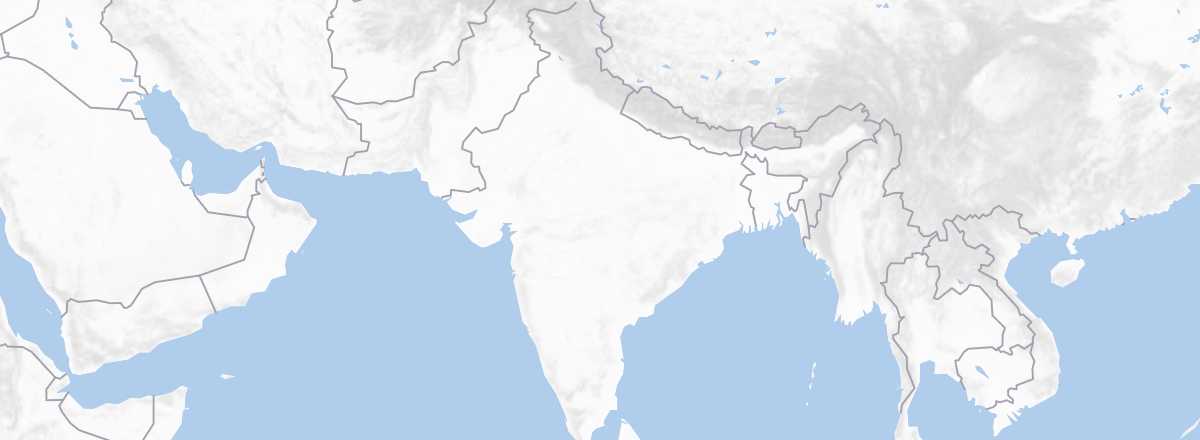 India
Open the interactive map
India
Open the interactive map
Quick Overview
The triangular Indian peninsula stretches nearly 3,200 km from north to south, from the towering peaks of the Himalayas to the tip of the Deccan washed by the Indian Ocean. Its width reaches 2,700 km from the deserts of Rajasthan to the small northeastern states bordering Myanmar. The country also boasts 7,500 km of coastline and is watered in the north by the Ganges, which rises in the Himalayas and flows 2,700 km into the Bay of Bengal near Kolkata.
India in Five Regions
- Northern India: At the heart of the Himalayas, this is the most interesting part of the country for trekking and mountain enthusiasts, with regions like Ladakh or Zanskar. It also offers numerous Buddhist sites and monasteries, as well as Amritsar, the Sikh capital, and Haridwar, one of Hinduism’s holy cities.
- Western India: With Rajasthan and Delhi, this is the most tourist-heavy region. Understandably so, given its cultural richness, including stunning cities (Jaipur, Jaisalmer, Pushkar, Udaipur...), temples, palaces, and fortresses. Elsewhere, other highlights include the Portuguese ruins of Diu, Palitana and its Jain temples, and, for nature lovers, the Thar Desert and the Rann of Kutch.
- Central India: This region is rich in history and religion. Beyond Mumbai, you’ll find "gems" like Agra and its famous Taj Mahal, Varanasi and its ghats, the Mughal city of Fatehpur Sikri, the breathtaking temples of Khajuraho, and the carved caves of Ajanta and Ellora. However, the landscapes here are generally less "spectacular" than elsewhere.
- East India: This isn’t the most touristy or easiest part of the country to travel in. Nevertheless, it offers a different side of India, off the beaten path. Expect beautiful Himalayan scenery, trekking opportunities, several national parks and nature reserves, and local cultures and traditions found nowhere else.
- South India: This part of the country is a well-rounded mix of tourist attractions, blending nature (the islands, the Backwaters, the Western Ghats and their hill stations), culture (here you’re deep in "temple India" and ancient ruins), and even relaxation with the many beaches along the coast.
Key Facts
- Type of place: country.
- Location: At the center of the Asian continent, forming a kind of boundary between the Middle East and Southeast Asia.
- Latitude/longitude: 22°00' N, 77°00' E.
- Local time:
- Capital: New Delhi
- Nature of the state: Federal parliamentary republic.
- Official languages: Hindi, English, plus 21 other locally recognized official languages.
- Currency: Indian rupee.
- Population: 1,296,834,042 inhabitants (2018).
- Area: 3,287,263 km²
- Density: 394 inhabitants/km².
- Highest point: Mt Kanchenjunga (8,598 m) in Sikkim.
- Lowest point: Kuttanad (-2.2 m).
- Coastline: 7,516 km.
- Driving: On the left.
Tourism
India remains unique in every way and never leaves visitors indifferent, no matter how many times you’ve been. Some even return again and again...
In 2018, 17.427 million visitors stayed in India. That’s a lot, but for a country so rich in tourism, it’s relatively few compared to other Asian destinations like Thailand, Indonesia, or Vietnam. Moreover, among recorded entries, Bangladeshis make up the largest group, though their visits are generally for reasons other than tourism. Among other countries, the United States, the United Kingdom, and Canada lead, while France, with 238,000 visitors, ranks 10th.
Travel Essentials
- Destination: For somewhat experienced travelers.
- By air: France-Delhi.
- Entry requirements: Visa + passport valid 6 months beyond the visa’s expiry date.
- Currency to bring:
- Exchange rate:
- Daily "backpacker" budget:
- Best for accommodation:
- Best for getting around:
- Risks:
- Best time for climate/crowds/prices:
- Interests (out of ): Nature ; Adventure ; Culture ; Relaxation /
Useful Addresses
Socio-Economic Statistics
- "Quality of life": 130/188 (rank in 2018)
- GDP per capita: $7,200 (2017)
- Average monthly income: ()
- Inflation: +3.6% (2017)
- "Official" unemployment: 8.5% (2017)
- Population below poverty line: 21.9% (2012)
- Life expectancy: 69.1 years (2018)
- Migration rate per 1,000 inhabitants: 0 (2017)
- Population growth: +1.14% (2018)
- Literacy rate: 71.2% (2015)
- Urban population: 34% (2018)
- Press freedom: 138/180 (rank in 2018)
- Political regime: Flawed democracy (41/167 in 2018)
Sources: World Bank, Human Development Indicators, RSF, The Economist, The World Factbook