last edited Dec 11, 2019
Introduction to Kyrgyzstan
Location Map of Kyrgyzstan
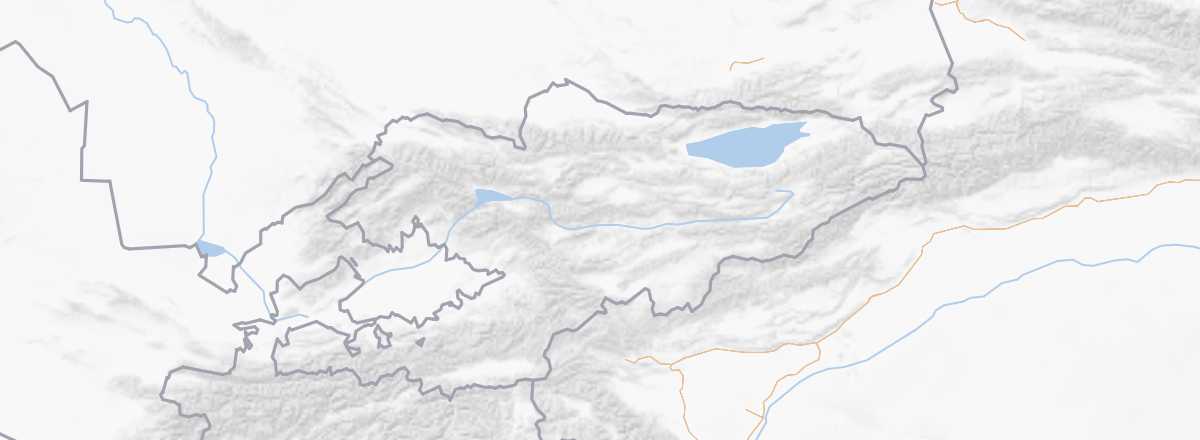 Kyrgyzstan
Open the interactive map
Kyrgyzstan
Open the interactive map
Quick Overview
Kyrgyzstan is a country of lakes, steppes, and mountains. Over half of its territory lies above 3,000 m in altitude, and 90% is above 1,000 m.
Key Facts
- Type of place: country.
- Location: In the heart of Central Asia, on the western border of China.
- Latitude/longitude: 42°52' N, 74°36' E.
- Local time:
- Capital: Bishkek.
- Nature of the state: Parliamentary republic.
- Official languages: Kyrgyz and Russian.
- Currency: Som.
- Population: 5,849,296 inhabitants (2018).
- Area: 198,500 km².
- Density: 29.5 inhabitants/km².
- Highest point: Pobeda Peak (7,439 m).
- Lowest point: Kara-Darya Valley (132 m).
- Coastline: 0 km; no maritime access.
- Driving: On the right.
Tourism
A high-altitude and mountainous country, Kyrgyzstan, like its neighbors, is an off-the-beaten-path "nature-adventure" destination. Local authorities have recognized this and are doing everything possible (starting with the elimination of visas) to develop tourism in the country. As a result, visitor numbers have increased, and in 2017, the destination welcomed 4.568 million visitors, though the majority still come from neighboring countries and Russia.
Travel Essentials
- Destination: For slightly experienced travelers.
- By air: France-Bishkek.
- Entry requirements: Passport.
- Currency to bring:
- Exchange rate:
- Daily budget for budget travelers:
- Best for accommodation:
- Best for getting around:
- Risks:
- Best period for climate/crowds/prices:
- Interests (out of ): Nature ; Adventure ; Culture ; Relaxation-holidays /
Useful Addresses
Socio-Economic Statistics
- "Quality of life": 122/188 (rank in 2018)
- GDP per capita: $3,700 (2017)
- Average monthly income: ()
- Inflation: +3.2% (2017)
- "Official" unemployment: 7.1% (2017)
- Population below the poverty line: 32.1% (2015)
- Life expectancy: 71.2 years (2017)
- Migration rate per 1,000 inhabitants: -5.1 (2017)
- Population growth: +1.02% (2018)
- Literacy rate: 99.5% (2015)
- Urban population: 36.4% (2018)
- Press freedom: 98/180 (rank in 2018)
- Political regime: Hybrid regime (98/167 in 2018)
Sources: World Bank, Human Development Indicators, RSF, The Economist, The World Factbook