last edited Dec 11, 2019
Introduction to Guinea-Bissau
Location Map of Guinea-Bissau
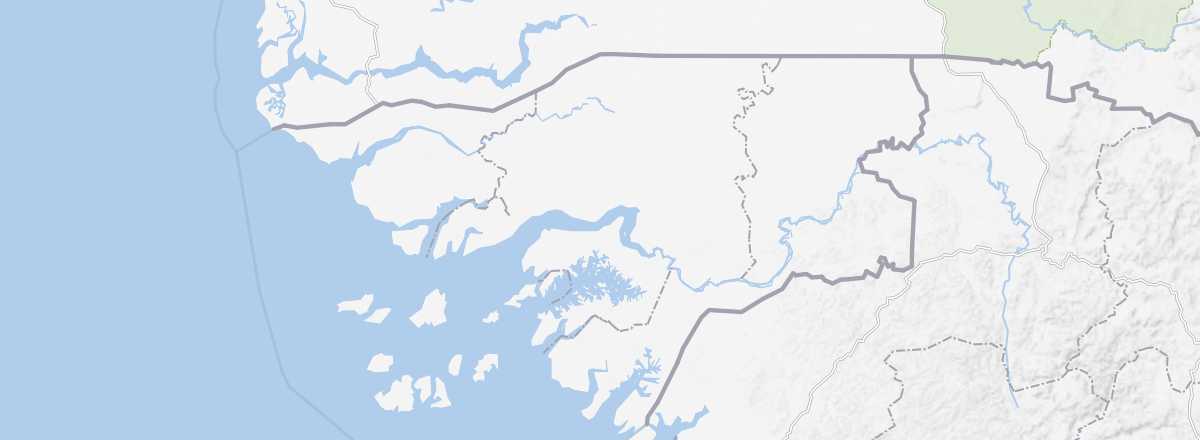 Guinea-Bissau
Open the interactive map
Guinea-Bissau
Open the interactive map
Quick overview
The former Portuguese Guinea is one of Africa's smallest countries. A series of plateaus and wooded hills dominate a coastal plain, invaded by mangroves, where several rivers flow and along which the country's few towns and villages have developed. Off the coast, the Bijagos Archipelago is home to around forty islands, flat and wooded, half of which are uninhabited.
Key facts
- Type of place: country.
- Latitude/longitude: 12°00' N, 15°00' W.
- Local time:
- Capital: Bissau.
- Nature of the state:
- Official language: Portuguese (and Creole as the language of communication).
- Currency: CFA franc.
- Population: 1,833,247 inhabitants (2016).
- Area: 36,125 km².
- Density: 51 inhabitants/km².
- Highest point: 300 m.
- Lowest point: sea level.
- Coastline: 350 km.
- Driving: on the right.
Tourism
This former Portuguese colony has never been a major tourist destination, suffering in particular from a lack of development of its heritage, even though the Bijagos Archipelago remains a popular spot for sport fishing enthusiasts. Only 44,000 foreign visitors discovered the destination in 2015.
Essentials for travel
- Destination: for slightly experienced travelers.
- By air: France-Bissau.
- Entry requirements: passport + visa + yellow fever vaccination.
- Currency to bring: euros.
- Exchange rate:
- Daily "backpacker" budget:
- Best for accommodation:
- Best for getting around:
- Risks:
- Best period for climate/crowds/prices:
- Interests (out of ): Nature / ; Adventure ; Culture ; Relaxation/holidays /
Useful addresses
Socio-economic statistics
- "Quality of life": 177/188 (rank in 2018)
- GDP per capita: $1,900 (2017)
- Average monthly income: ()
- Inflation: +1.1% (2017)
- "Official" unemployment: ()
- Population below the poverty line: 67% (2015)
- Life expectancy: 61.4 years (2018)
- Migration rate per 1,000 inhabitants: 0 (2017)
- Population growth: +2.48% (2018)
- Literacy rate: 59.9% (2015)
- Urban population: 43.4% (2018)
- Press freedom: 83/180 (rank in 2018)
- Political regime: authoritarian regime (157/167 in 2018)
Sources: World Bank, Human Development Indicators, RSF, The Economist, The World Factbook