last edited Dec 11, 2019
Introduction to Martinique
Location Map of Martinique
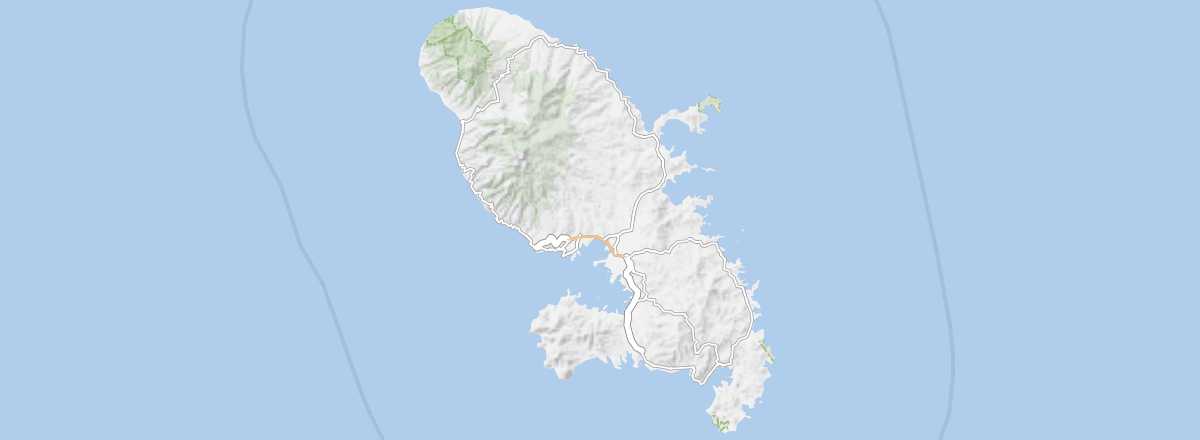 Martinique
Open the interactive map
Martinique
Open the interactive map
Overview
Martinique, nicknamed "the island of flowers", is part of the Lesser Antilles or "Windward Islands". It is a French department and an outermost region of France integrated into the European Union. Despite its small size—about 70 km long and 30 km wide—it is the third-largest island in the Lesser Antilles after Guadeloupe and Trinidad.
The terrain rises gradually from the coastline to the center and especially the northern part of the island, which is more mountainous, reaching 1,397 m at Montagne Pelée. The north is home to a lush tropical forest, while the south features sugarcane and banana fields that once brought wealth to Martinique. A central plain connects to the "mornes" (hills) and the small, steep valleys of the south. The most beautiful beaches and tourist areas are also found in the south.
The people of Martinique have diverse origins, and the population is young. Around 150,000 islanders also live in mainland France, on which Martinique heavily depends for resources.
Key facts
- Type of place: French overseas territory.
- Location: in the heart of the Caribbean, about 7,000 km from mainland France.
- Latitude/longitude: 14.40 N, 61.00 W.
- Local time:
- Prefecture: Fort-de-France
- Nature of territory: French department (972).
- Official language: while French is the official language, Martinican Creole is also widely spoken.
- Currency: euro.
- Population: 376,480 inhabitants (2016).
- Area: 1,128 km².
- Density: 334 inhabitants/km².
- Highest point: Montagne Pelée (1,397 m).
- Lowest point: sea level.
- Coastline: 350 km.
- Driving: on the right.
Tourism
Compared to many other Caribbean islands, Martinique receives only a modest number of visitors, around half a million each year (537,000 in 2018). Despite its attractions, the island primarily draws French visitors (roughly three-quarters of arrivals), often coming to see friends or family. Beyond this "affinity tourism," the island also welcomes its share of cruise passengers, like most destinations in the region (380,000 in 2015), as well as a contingent of Quebecers taking advantage of year-round direct flights from Montreal.
The reasons for this lukewarm appeal include the better value for money offered by destinations like Dominican Republic or Cuba, which are popular among French speakers. Additionally, without generalizing, the welcome (perceived or real) for visitors in the French Antilles is not always top-notch.
Travel essentials
- Destination: for beginner travelers.
- By air: Paris - Fort-de-France for 420 to 820 € round trip.
- Entry requirements: ID card or passport.
- Exchange rate:
- Backpacker daily budget: from 50 to 70 € per person.
- Accommodation: guesthouses or, occasionally, all-inclusive resorts.
- Getting around: primarily by rental car.
- Risks: low health risks and fairly low security risks.
- Best time for climate/crowds/prices: from April to late June, and secondarily from late November to early December.
- Interests (out of ): Nature ; Adventure ; Culture ; Relaxation/holidays .
Addresses in mainland France
- Martinique Tourism Office: 2 rue des Moulins, 75001 Paris. Tel: 01 44 77 86 00
Addresses in Belgium, Switzerland, and Quebec
- Belgium and Switzerland: check with the French representations in each country or the aforementioned websites.
- Quebec: Martinique Tourism Committee in Canada, 1010-1800 av McGill College, Montréal QC H3A 3J6. Tel.: (514) 844 8566.