last edited Dec 11, 2019
Health and Safety in Panama
Location Map of Panama
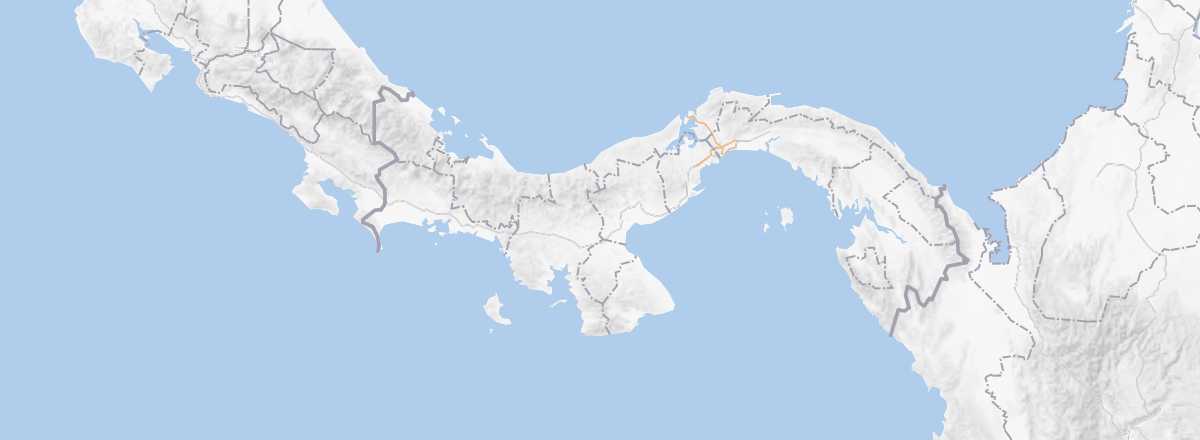 Panama
Open the interactive map
Panama
Open the interactive map
Official Recommendations
In France, both for individuals and professionals, the "travel advice" from the Ministry of Foreign Affairs regarding precautions for each country has legal value. A similar online travel advice system exists in several countries:
Health
As always, it's best to be up to date with your vaccinations, even if the country doesn't require any vaccines beyond theoretically yellow fever if you're arriving from a risk zone. Note that this same vaccine is recommended by some for any extended stay in the eastern part of the country (the Darién region).
Diseases
Panama (excluding the Colombian border area) doesn't pose major health problems, though dengue and chikungunya, spread by certain mosquitoes, are present at low altitudes as in many countries in this part of the world. As for malaria, it is indeed present in the province of Darién, requiring treatment, but is absent elsewhere except for a few spots on the Costa Rican border or in the San Blas, where opinions differ on the need for treatment.
So, it's best to protect yourself from mosquitoes and other such critters, including when walking in parks and reserves. The best approach is to use a good repellent, cover your arms and legs at dusk when they bite the most, and bring an impregnated mosquito net if you're sleeping in a place without air conditioning or airflow.
Hygiene
As often, good personal and especially food hygiene is necessary if you're not used to "eating local." So avoid tap water, which isn't always safe or well-tolerated by sensitive stomachs, and steer clear of dishes or foods that don't seem fresh—if only to avoid traveler's diarrhea.
Healthcare Facilities on Site
Safety
Crime and Delinquency
Panama isn't the safest country in the region, but it's far from the worst. In fact, it's about average and mainly requires doing your research to know where you're going and what the local situation is at the time.
Thus, a very large part of the territory doesn't pose real security problems. However, a city like Colón has a very bad reputation. Likewise, some neighborhoods in the capital are strongly advised against at night, and several cities in its periphery are similarly discouraged both day and night. And then, of course, there's the Darién, on the border with Colombia, which combines health and security risks with its share (real or partly imagined?) of traffickers and Colombian guerrillas, to the point that the area has been completely discouraged for years by the Ministry of Foreign Affairs.
In short, it's just a matter of knowing where you're going to avoid problems. That doesn't mean you shouldn't take the usual basic precautions for any trip, like not flaunting your wealth, not walking alone at night in isolated areas, opting for official taxis, etc. Likewise, a certain vigilance is also required in transport, bus stations, certain peripheral neighborhoods of cities, as well as on beaches or during nighttime outings. In case of aggression, it's also advisable not to resist and to always have "something" to give to your attackers. Finally, if you have a vehicle, it's highly recommended to use guarded parking lots and not to leave anything inside.
Also note that even though the country is a "lenient" tax haven and had a notorious drug-trafficking president in the person of Manuel Noriega, drug possession is severely punished by law, with penalties that can go up to several years in prison.
Scams and "Tourist" Harassment
Socio-Political Risks
Apart from the Darién and its specific situation for years, there are no particular problems, even if the capital can occasionally experience protests that are best avoided.
Climate and Nature
Natural risks are relatively limited compared to other countries in the region, even if you're still in a seismic zone or, during the rainy season (May to December), a road might be cut off due to flooding or landslides. In another area, also beware of sea currents that can locally be dangerous on the Pacific side. And of course, avoid going alone and under-equipped into nature, off the beaten track, at the risk of getting lost.
The Darién
This border region between Panama and Colombia, also called the Darién Gap, is a swamp and forest area about 160 km long and 50 km wide. It's not crossed by any road and requires taking a plane or boat to travel between the two countries. Beyond security concerns, the natural environment makes crossing it by land impossible—even if it has been done before, it was always in a specific context and organization, never lightly by irresponsible amateurs...
Animals
Beyond stray dogs that may carry rabies (vaccination useful for long stays in the countryside), be cautious—though the risk is low—of critters like scorpions, spiders, or even snakes, which you might encounter in tall grass, under rocks, or any other place they might like.
Foreign Consulates on Site
If you run into problems while traveling abroad, your country's consular services can help. Also note that if you're a citizen of the European Union and your country isn't represented, you can then turn to any other representation of an EU member state.
France
Consulate General: Plaza de Francia-Las Bovedas, San Felipe, AP 081607945, Panama City. Tel.: (507) 211 62 00.
Other Countries
- Belgium: Consulate General, Credicorp Plaza, Calle 50 - Piso 31, Oficina 31-A, Panama City. Tel.: (507) 301 14 38.
- Canada: Consulate General, Torres de Las Americas, Tower A, 11th floor, Punta Pacifica, Panama City. Tel.: (507) 294 25 00.
- Switzerland: Edificio Casa Blanca, Bella Vista, Calle 44 y Avenida Justo Arosemena, Panama City. Tel.: (507) 395 99 22.