last edited Dec 11, 2019
Climate and Weather in South Africa
Location Map of South Africa
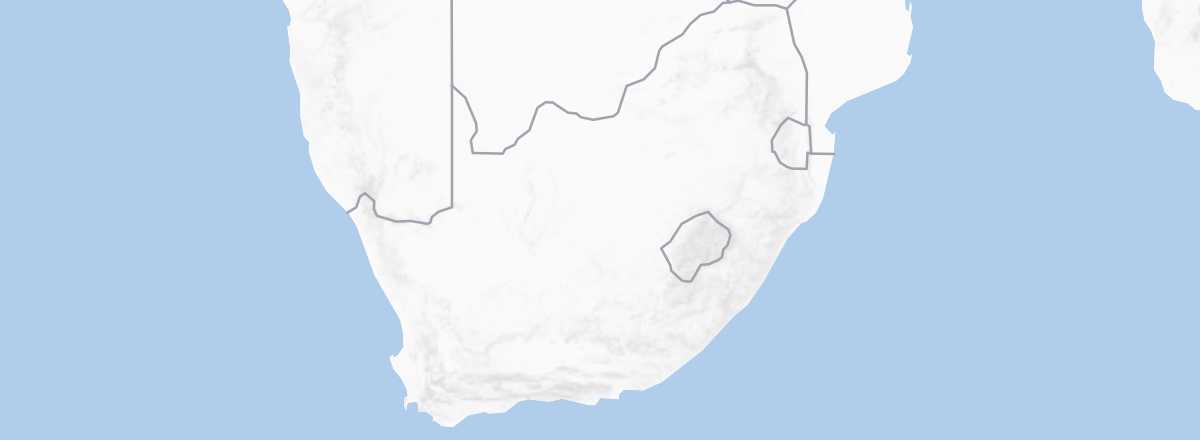 South Africa
Open the interactive map
South Africa
Open the interactive map
Climate Overview
South Africa has a temperate climate, largely thanks to its coastline, though conditions can vary significantly from one region to another or depending on altitude. Located in the Southern Hemisphere, the seasons are reversed compared to the north, with an austral summer from December to March (average temperatures range from 20 to over 30 °C depending on the area) and an austral winter from June to September (with locally sub-zero temperatures). Across the country, rainfall is not particularly heavy in terms of volume.
The Indian Ocean coastline (toward Mozambique) has a subtropical climate with frequent thunderstorms between late October and March and pleasant temperatures, averaging between 20 and 30 °C depending on the period. As you move toward Cape Town, this climate becomes more Mediterranean, with dry, hot, and windy summers and milder winters (between 15 and 20 °C), though some days can be quite cold. Rainfall is also lower in volume and reversed (more rain in winter). On the Atlantic coast, between Cape Town and Namibia, the further north you go, the more arid, dry, and hot the climate becomes.
Inland, conditions are somewhat different. Johannesburg (1,650 m) and the Transvaal region enjoy generally pleasant temperatures during the austral summer, with relatively heavy rainfall, though it tends to come in late-afternoon thunderstorms. Winter is dry and sunny, with very cool nights and snow in the highlands, such as in the Drakensberg, where temperatures drop with altitude. Further west or as you descend toward sea level, like in the Northern Cape province, summer days can be very hot, even scorching.
Best Time to Visit South Africa
There isn’t a single best time to visit South Africa, though the shoulder seasons (around April and September–October) offer a good compromise. It all depends on where you’re going (the country is vast) and what you plan to do.
For safaris, May to October is ideal, while October to November is better for birdwatching. For vegetation, particularly the floral displays around Cape Town, August to September (early spring) is the best time. For water sports, outdoor activities, or beach holidays—like around Durban—it’s primarily during the austral summer.
| Jan. | Feb. | Mar. | Apr. | May | Jun. | Jul. | Aug. | Sep. | Oct. | Nov. | Dec. | |
|---|---|---|---|---|---|---|---|---|---|---|---|---|
| Inland climate | ||||||||||||
| Coast (Durban) | ||||||||||||
| Coast (Cape Town) |
: very favorable | : favorable | : moderately favorable | : unfavorable.
Sea Temperatures Throughout the Year
The coast around Durban, the country’s main beach destination, is suitable for swimming almost year-round, unlike the Cape Town area, where the water is quite cool during the austral winter.
| Jan. | Feb. | Mar. | Apr. | May | Jun. | Jul. | Aug. | Sep. | Oct. | Nov. | Dec. | |
|---|---|---|---|---|---|---|---|---|---|---|---|---|
| Cape Town | 20 | 20 | 19 | 19 | 17 | 16 | 16 | 16 | 16 | 17 | 17 | 19 |
| Durban | 23 | 24 | 24 | 23 | 22 | 21 | 21 | 20 | 21 | 21 | 22 | 23 |