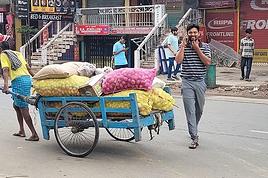
Savez vous s'il existe un risque d'attraper un petit ver (ou un gros :-))) ) ou autre chose si on mange des lugumes crus en les achetant dans les petits bazard ou dans la rue, en sachant qu'apres je les lave a l'eau mimerale ?
Les "petits vers" dans la salade, c'est pas grave, ça fait de la viande à bon marché, et ça n'a jamais tué personne. Ca ne peut gêner que les végétariens fondamentalistes (ou les jaïns) 😉. Il y en a dans les salades de mon jardin, preuve qu'elles ne sont pas traitées à la chimie.
Bref, les risques ne sont ni les vers de terre ni les asticots, mais les staphylo, et ceux-là tu ne les vois pas et l'eau minérale ne suffira pas pour les éliminer. Mais ce n'est pas une raison non plus pour se priver à 100 % de fruits et de légumes frais en voyage en Inde; pour courir le moins de risque possible le mieux consiste à ne manger que des légumes ou des fruits que l'on pèle ou que l'on épluche. Encore un truc à savoir : si jamais l'envie d'acheter des raisins te prenais, pourquoi pas, mais pour le coup laves-les consciencieusement car souvent les marchands les aspergent de je ne sais quoi pour les rendre brillants et attirer le chaland.
il existe un produit dans les superettes (je n'ai plus le nom en tête) en Inde au rayon légumes pour laver les fruits et légumes, mais je ne sais pas ce que ça vaut. Jamais eu de pb en 30 ans de pratique de l'Inde, mais j'ai peut-être eu de la chance. Tous mes fruits et légumes sont lavés plusieurs fois à l'eau filtrée, sans plus...
Sinon il y a le permanganate, mais beurk ! tout devient violet, pas très appétissant.
bon courage
non, le permanganate il en faut pas 10 litres, et tu laisses pas tremper tes légumes 3 heures dans l'eau permanganatée... -> aucune odeur, aucun goût, aucune couleur... Ça date, mais c'est efficace
Je ne saurais te répondre, c'est ma femme qui gérait ça... Il me semble que c'était des sachets, mais sû aucune couleur, aucun goût, aucune odeur particulière
les crudités et fruits crus sont à éviter en Inde,
y compris avec les mesures de précautions précédemment cités.
La seule qui vaille, c'est l'épluchage mais fais correctement (ce qui est rarement le cas)
Les risques sont infectieux bactériens et virals (germes digestifs surtout et non pas le staphylocoque comme cité par Stalingrad) mais aussi parasitaires (schistosomiases et les helminthes principalement)
Tu as le choix entre tout ça (c'est toutes les maladies qui peuvent s'attraper par l'eau)AnémieArsenicismeAscaridiaseBotulismeCampylobactérioseCholéraCryptosporidioseToxines cyanobactériellesDengueDracunculoseFluoroseLambliaseHépatitesInfection ankylostomeEncéphalite JaponaiseEmpoisonnement au plomb et arsenic (au Bangladesh)LégionelloseLeptospiroseFilariose lymphatiqueMalariaMéthémoglobinémieOnchocercosePolioTeigneGaleSchistosomiasesTrachomeTrichocéphaloseTyphoïde
I’m planning a trip to Japan next year and I have asthma...
I wanted to know about the regulations regarding Ventolin (Salbutamol) in Japan—is it considered a drug? Can I bring my inhaler with me, or do I need to buy a similar product in Japan?
I have two American cousins. The older one was born in Paris, and his sister was born in California. The latter is planning a trip to Paris this summer, but she recently fell ill, and American doctors don’t know what’s wrong. I had the idea of letting her take advantage of her trip to get treated here, avoiding the high healthcare costs of the American system in the process. The problem is, I can’t find anything online about this—just testimonials from French people who used to be American, but nothing for a simple tourist.
I’m traveling to Portugal with my family and I have a treatment that requires injections. How can I take a flight with these? They look like injectable pens.
Thanks
We’re planning a trip to the Philippines from April 22 to May 8, 2026. Flight from Geneva with a layover in Turkey and Manila. Our itinerary: Angeles – Busuanga – Palawan…
The Philippines are a dream destination, but is it possible to travel there safely? I’ve heard that checked luggage often gets lost, tap water isn’t safe to drink, and mosquitoes are everywhere.
For water, what’s the best solution to carry in a backpack? Is a filtering water bottle 100% reliable?
For mosquitoes, should we treat our clothes with repellent? Are you vaccinated against hepatitis A, malaria, or dengue? Or is there an oral treatment to take?
Hi there,
Does anyone know if there’s travel insurance for someone who’s had a heart attack?
I can’t find an insurer that covers a pre-existing condition, even if it’s stable.
Thanks so much!
Hi everyone, next month my wife, our 6-year-old daughter, and I are flying to Thailand. It’ll be a great chance to soak up some sun—something we’ve been missing lately here in France! But speaking of sun, I burn easily, and our daughter even more so. I was wondering what SPF to get for sunscreen and whether it’s better to buy it there or before we leave? Thanks for your tips!
Hello,
We’re planning to spend 3 months in Madagascar starting in mid-February.
Areas: Mahajanga, Tulear, Diego Suarez, and Sainte Marie—the order isn’t set yet. We’ll either drive for part of the trip or take flights.
We’ve heard all sorts of things about required vaccines and medications (is anti-malarial mandatory?). What’s the exact situation for travelers?
I’ll come back to you for other topics (like finding a reliable driver, among others).
Thank you.
Best wishes to you all,
Nicole
We're about to go on an organized trip to South Africa, including Kruger Park. We were told that Malarone should preferably be taken in the evening at the same time during a meal. But it's hard to know what time we'll have dinner, especially since I've read that in South Africa, dinner is usually around 6 PM.
I'd love to hear from people who've been on organized trips to this destination and could share their experience. We were thinking of taking Malarone around 7:30 PM, assuming dinner would be closer to 7 PM than 6 PM. Also, if the meal ends up being earlier or later than when we take the pill, would a cookie or a piece of bread be enough to take with Malarone?
I’m planning to set off on a "round-the-world" trip/long journey at the start of next year, lasting between 4.5 and 6 months. For now, the itinerary looks like this: South Korea (2 weeks) -> Japan (1 month) -> New Zealand (1 month) -> Argentina (1 month) -> United States (1 month).
I’m on medication (paroxetine 20 mg/day) and was hoping to bring enough for the entire trip so I wouldn’t have to find a doctor on the spot, deal with a molecule that might be slightly different from what’s available in France, or wonder if that’s even a possibility. Basically, it seemed simpler on paper...
But after looking into the regulations for each country, it’s suddenly way less simple . Many seem to only allow the amount corresponding to the length of your "stay" in the country... Which is a problem if I arrive in Korea with 4.5 months’ worth of medication, for example.
After all that, and even though I’ll obviously contact the relevant authorities in each country (fingers crossed for a response 😛), here’s my question:
Has anyone here had any experience with this? (Even if it’s a different medication or different countries, any input would be helpful!)
I’m trying to plan a trip to Dubai with my mom. I’ve seen that some of our medications require prior authorization (sleeping pills, codeine, anti-anxiety meds, etc.).
I’d love to hear from anyone who’s been in our situation. A friend of mine applied to bring her tramadol, but it was denied—though she needed high doses!
Has anyone here gone through this process? Do we *really* need a prescription in English?
We just found out my wife is pregnant, and we’ve planned a trip to the Barlavento Islands in Cape Verde this November.
We’d like to know if there’s a real risk of Zika contamination on those islands, because from what we’ve found online, the recorded cases are old and come from the Sotavento Islands.
We’re thinking about canceling our trip.
If you’ve recently traveled to Cape Verde or live there, do you have any thoughts on this?
hi, I’m looking for information about the possibility of returning to Thailand with a portable liquid oxygen system and whether it’s possible to recharge it in Thailand, especially in Chiang Mai. thanks
I’m starting a new discussion on this topic since there doesn’t seem to be a recent one.
I have several chronic conditions (including asthma and related ones), and I’m planning to travel for a year across different countries.
Generally, I understand it’s possible to travel with approved medications (which should be my case), but often with a limit of 3 months’ worth of treatment.
Since I’m going for 12 months, that means for three-quarters of my trip, I’d have more than 3 months’ worth of medication.
I plan to bring my prescriptions with the INN (International Nonproprietary Name), as well as the original packaging (even though it’s a nightmare, but from what I understand, it’s necessary). But I’m not sure if that’s enough...
Have any of you been in this situation before? How does it work at customs—do I need to declare everything that exceeds the 3-month limit? Do I need a letter from my doctors?
I'm currently in Bangkok: How can I find a good doctor for a consultation? It's for a friend who'd like a second medical opinion compared to what they got in their country of residence.
Any professionals you'd recommend? How much does it cost?
I’ve already visited quite a few countries across several continents, but I’m pretty new to Asia.
I’m planning a trip to Thailand in October or November, and I wanted to check about health precautions: malaria treatment, vaccinations (hepatitis A or others...).
I’ll mostly be in the northern region, around Chiang Mai, where I’ll spend a lot of time in nature and the mountains. Then I’ll head south to Phuket or Krabi and visit Khao Sok National Park. I’ll finish up in Bangkok, with a likely detour to Kanchanaburi.
From what I understand, for a stay of less than 60 days, I don’t need a visa (I’m a French national)? I just need to fill out the TDAC form 3 to 5 days before arrival?
Hi there,
I was wondering if anyone is heading to Cuba soon and could bring me some over-the-counter Sildenafil (viagra) tablets—available at Varadero Airport, among other places.
Hi there! So, I'm hesitating about taking a long trip. I'd like to go away for 2 to 3 months and travel across several continents. I’d love some advice. I often have unexplained allergies and need to follow a daily treatment for my diabetes (insulin). I think I can get authorization from my doctor to travel for 6 months with the treatment—is that correct? After those 6 months, is it possible (instead of bothering a relative to send the medication) to see a foreign doctor to get another 6-month travel authorization? How does it work at the airport? Do I need just one medication transport authorization, or do I have to request a new one in each country (once the treatment runs out) for both the flight and a DCI? Also, travel insurance doesn’t cover chronic illnesses, so will I have to pay for foreign consultations out of pocket? I’m not sure if I explained myself clearly. Oh, and just to repeat—travel insurance doesn’t cover chronic illnesses, so foreign consultations will be at my own expense? Thanks in advance for your help!
Hi everyone.
After years of traveling to the USA without any medical insurance subscriptions—and luckily never having any major health issues (though I did get a scorpion sting buried in the sand at CBSouth, 😇)—life has caught up with us, and we’re now being forced into "wisdom" and leaving our carefree days behind.
So, I’m looking for the best compromise for a 2-month health insurance plan.
I’ve read the discussions on this topic, but the most recent one is from last year, and I’d love your take on the current situation.
I’m familiar with the usual options like Europ Assistance and AXA, but I’ve just discovered Chapka and Heymondo (the latter seems interesting in terms of both price and coverage).
What do you think of these last two? How do they compare in terms of value for money against the bigger companies?
Hi,
We’ve planned a 3-week trip to Bali this summer with our 7-year-old daughter. The itinerary includes Sanur, Nusa Lembongan, Sidemen, Amed, and Ubud. The more time passes, the more we read about people getting sick—some with mild to severe traveler’s diarrhea, and many ending up in the hospital. We, as parents, have been through it in Egypt with pretty bad cases, but we’d really like to avoid that for our daughter. Even though there’s no zero risk, and we’ll be careful, can any of you reassure me? Not everyone got sick, right? I’d love to hear positive feedback from parents, but not just them 😊. Thanks in advance!
Hi there...
I’m traveling with a friend for a month in November.
We booked our round-trip tickets from Paris to Phnom Penh, and yes, I know—it was a mistake. We should’ve flown out of Laos, but here we are.
But is it doable to backpack through both countries in a relaxed way?
I’ve seen that the transport takes a while...
Thanks so much for your replies.
Hi there,
I’ve started looking into getting dental implants, possibly in Costa Rica or Mexico.
Do you have any clinics to recommend or ones I should avoid?
For the next steps, I need to choose between Cuba Medika or Medigo—these are agencies that help with medical procedures. Do you have any info on either of them?
Hi everyone, a question for those who’ve been lucky enough to visit Raja Ampat—should you consider preventive malaria treatment given its proximity to Papua? And how was the food hygiene situation?
Thanks for your feedback! !
For several years now, increased aggression has been observed in Cape fur seals.
At least 70 unprovoked attacks on humans.
It was recently confirmed that this is due to rabies.
The suspected origin is contamination in Namibia by jackals.
The contagion seems to be spreading.
Preventive vaccination (of the animals) is being considered.
Just a reminder:
Rabies affects all mammals.
Once symptoms appear—sometimes weeks or even months later—death is inevitable.
It’s the bite that transmits the disease.
There are so-called "furious" forms with aggression, but also forms without aggression.
In case of a bite, in addition to standard wound care, tetanus prevention… rabies prevention is essential.
Stay careful out there…
Seeing seals from a boat along the coast isn’t rare in these parts…
I need 2 dental implants and I'd like to get them done abroad (it's a question of price).
Thanks for helping me with my search (Turkey, Spain, Romania???)
Can you tell me if you're satisfied with the services provided by Dentist Miguel at Club Amigo in Holguin? I'd like to go there in mid-December. Is it worth the trip to get dental prosthetics done?
Thanks for getting back to me... Michelle from Quebec
Hello,
I’m looking for a dentist who can do a full lower-arch implant with a complete prosthesis. I’m in Quebec and available to travel to Cuba. Need full contact details. Thanks everyone!
My current plan is to get my teeth treated in Cuba, especially for dental implants.
Has anyone here had experience and could refer me to a good, affordable dentist?
I’d really appreciate it if you could give me an idea of the price for one implant, since I need at least 6 done.
Thanks so much!