Hello,
Je me demandais si certains d'entre vous, après des périples ou expériences à vélo , y compris loin à l' étranger , ont encore l'envie ou le goût des voyages en sac à dos, ou est-ce que ça leur paraît beaucoup plus fade et contraignant finalement, comparé à la liberté qu'on trouve dans les périples à vélo ? Est ce que vous emmenez votre velo a tous les coups sans hesitations?
Ca peut aussi dependre des pays, adaptés ou moins, du temps dispo etc
Pour ma part j'avais commencé par des voyages sac à dos puis plusieurs périples velo en France, Europe et quelques uns en Asie avec mon VTT personnel ou un vélo d'occasion acheté sur place. Au final il y a toujours des destinations qui m'intéressent, mais vient parfois se poser le problème d'amener à chaque fois mon vélo en soute d'avion et les risque de casses et autres aleas en terres inconnus. Pour ma part j'ai eu plusieurs fois de la casse plus ou moins importante en soute d avion, et d un autre côté se contenter d'un voyage en sac à dos et dépendre toujours des transports pour le moindre déplacement , de même pour l'hébergement , ça me motive toujours beaucoup moins de repartir comme ça . Donc le dilemme se pose parfois entre les deux choix ! Chacun ayant ses facilités et inconvénients .Plus physique et risqué pour le vélo bien sûr, mais plus libre et indépendant une fois arrivé sur place , et inversement pour le backpack
Bonne question.
Pour ce qui est des problèmes de casse lors du transport en soute du vélo, en avion, il y a une solution très simple : NE PAS PRENDRE L'AVION. Ca limite le choix des destinations, c'est sûr, mais quand on voit ce qu'annoncent les scientifiques sur le réchauffement climatique et qu'on regarde l'impact du transport aérien, il faut quand même commencer à se poser des questions et peut-être changer les (mauvaises) habitudes que nous avons prises. Ou bien continuer tout pareil, à fond, pour arriver bien vite dans le mur.
Je te rejoins tout à fait concernant le choix d'un voyage plus écologique ou moins nuisible à la planète , et je suis aussi dans cette démarche, donc en général je vise plutôt les voyages à vélo, avec des transports plutôt terrestres ou maritimes s'il y en a, même si rien n'est parfait là aussi . Et j'évite autant que possible l' avion, déjà que je n'aime pas spécialement ça . Je trouve que ça coupe totalement un voyage en morceaux et l'important est le chemin pour moi, plus que la destination . Après il reste bien sur l'option d'acheter un vélo d'occasion sur place, comme j'ai déjà fait en Asie. En tout cas les voyages tout sac à dos, ça n'a jamais été trop mon truc à la base, et quand on a goûté la liberté du vélo , on peut difficilement s'en passer après , à mon avis!
Bonne question.
Pour ce qui est des problèmes de casse lors du transport en soute du vélo, en avion, il y a une solution très simple : NE PAS PRENDRE L'AVION. Ca limite le choix des destinations, c'est sûr, mais quand on voit ce qu'annoncent les scientifiques sur le réchauffement climatique et qu'on regarde l'impact du transport aérien, il faut quand même commencer à se poser des questions et peut-être changer les (mauvaises) habitudes que nous avons prises. Ou bien continuer tout pareil, à fond, pour arriver bien vite dans le mur.
JM
Bonjour ,
Loin de moi l'idée de nier la responsabilité de l'aviation dans les modifications du climat mais il me semble qu'il faut quand même savoir que l'aviation mondiale n'est responsable que pour 4 à 6% des émission de gaz à effet de serre.
Sachant que 25% des vols sont du fret, il reste 75% du trafic lié directement au transport de personnes dont un peu plus de la moitié est lié au tourisme. Donc , en gros , moins de la moitié du traffic aérien mondial est lié au tourisme , j'en conclu donc que moins de 3% des émissions de gaz à effet de serre est lié au transport des touristes par avion, la responsabilité du tourisme aérien est par conséquent très faible.
(ces chiffres sont issus de sources fiables : Giec, DGAC, presse spécialisée)
Tout ça pour dire que si l'on veut réduire les modifications climatiques en cours il y a d'autres secteurs à privilégier.
Ceci étant je suis d'accord que nous devons tous avoir une attitude responsable vis a vis de l'environnement , notamment en prenant le train chaque fois que c'est possible (encore faut il qu'on y accepte nos vélo ...) surtout sur des transports de moins de 1000km ou l'avion est une abération .
Malheureusement nos gouvernements font tout pour que nous prenions l'avion (en remplaçant des TER par des cars diesels par exemple) à titre d'exemple un aller retour en avion Genève/Istanbul coute le meme prix qu'un Genève/Paris en 2eme classe.
Fin du hors sujet ...
Je voyage à vélo ou/et à pied amis pour moi ça n'a rien à voir, a pied c'est par les chemins ou dans des lieux ou le vélo n'est pas adapté . En fait, j'ai autant de plaisir quelque soit le moyen de déplacement .
l'aviation mondiale n'est responsable que pour 4 à 6% des émission de gaz à effet de serre.
peut-être, mais ces 5% sont émis par une minorité de privilégiés qui voyagent en avion. Pour cette fraction de la population mondiale, l'avion représente une part relativement importante des émissions de gaz à effet de serre, et ce serait assez cynique de demander au reste de la population de réduire fortement leur usage de voiture ou de chauffage ou de viande rouge pour compenser nos voyages en avion. Et puis, y a pas de miracle, c'est en économisant 5% par ci, 5% par là, qu'on pourra atteindre les objectifs, aucun poste à lui seul n'est suffisant.
Perso, après avoir boycotté l'avion pendant près de 20 ans, je m'autorise l'avion au plus 1 fois par an pour des destinations lointaines inaccessibles par voie terrestre pendant la durée de mes congés. En contrepartie, j'ai fortement réduit mes autres émissions de GES : appart chauffé à 14°C en hiver, déplacements train + vélo toute l'année (malgré les efforts de SNCF & autres Autorités Organisatrices de Transports pour NE PAS faciliter ce choix...), alimentation majoritairement locale bio et avec peu d'emballage, etc
A part ça, pour en revenir au sujet : j'ai dû revenir au mode piéton en 2017-2018 à cause des séquelles d'un accident. J'avoue que j'étais un peu frustrée, malgré un choix de destination pas trop mal adapté (Nord Caucase, avec 2-3 petits treks à pied). Du coup, j'ai décidé de repartir à vélo, avec pour le moment un vélo adapté à mon petit handicap (càd vélo couché)
J'ajoute que les 4-6% dus au transport aérien sont apparemment beaucoup plus nocifs car, relâchés plus haut dans l'atmosphère, ils contribuent plus activement au réchauffement.
Et vu l'essor du transport aérien pour le tourisme avec les compagnies low cost et l'engouement des classes moyennes pour les séjours courts genre week-end à Budapest A/R en avion, c'est loin d'être quelque chose à négliger.
Voilà. Je pense que j'ai commencé à bien digressé par rapport au post d'origine alors j'arrête et laisse s'exprimer ceux qui, comme l'initiateur du post, souhaitent témoigner de leur difficulté ou réticence à se déplacer à nouveau à pied après avoir pratiqué le vélo.
Donc le dilemme se pose parfois entre les deux choix ! Chacun ayant ses facilités et inconvénients .Plus physique et risqué pour le vélo bien sûr, mais plus libre et indépendant une fois arrivé sur place , et inversement pour le backpack
cette question n'a pas de sens car d'une part on ne peut pas se mettre à votre place.
Ensuite le voyage en "backpack" c'est le voyage un peu vide lui aussi dénué de sens bref c'est voyager pour voyager sans aucun intérêt en particulier.
De toute façon le Voyage de manière général et la façon de voyager il n 'y a plus vraiment d'évolution possible et ça finit par être répétitif.
Mais c'est un autre sujet.
En effet ça dépend beaucoup des gens , et de ce qu'on recherche dans le voyage . Ceux qui cherchent a voir le maximum de lieux et paysages , lieu de culture temple ou autre, en un minimum de temps , choisiront de préférence le sac à dos ou la valise, et les transports . Bref le voyage classique, des autoroutes touristiques pour être acheminé d'un point A à un point B et se balader dans les environs . Inversement ceux qui préfèrent le chemin en lui-même, le déplacement , pouvoir sortir des sentiers battus , choisir leur direction à tout instant s'arrêter où ils veulent , plutôt que seulement des lieux de destination a voir opteront à mon sens plus facilement pour le vélo ou autre moyen de déplacement autonome . C'est à chaque fois un autre type de voyage, et pour ma part ce que je recherche en priorité en voyage ou même en mode sédentaire, c'est la liberté et l'indépendance . Pouvoir camper ou bivouaquer, ou meme rejoindre la prochaine auberge, sans me retrouver en rade s il n y a pas de taxi ou transport local pour le rejoindre a pied. J'apprécie beaucoup moins d'être trimbaler de bus en train jusqu'au prochaine hôtel ou d'un aéroport à l'autre . C est en effet un type de voyage qui n'a pas toujours beaucoup de sens et d'intérêt à mon avis. En tout cas pour ceux qui préfèrent la nature et éviter le tourisme de masse, le velo est une des meilleures options , même si elle comporte aussi quelques difficultés ou plus d'exigence physique ou liés à la météo exetera.
- Voyager en bus train etc. a son interet, d'ailleurs même ceux qui voyagent au long cours, utilisent train/bus pour certaines portions dangereuses ou pénibles.
Pas grand monde n'a envie de sortir de Lima, Bangkok, New Delhi à vélo, je ne traverserai jamais Java à vélo
Si on aime visiter les grandes villes, leur culture, si l'aspect rural d'une région n'est pas ce qu'on recherche, l'ambiance d'un bus local en Inde est unique...qui conseillerai de visiter la région de Tokyo/Djakarta à vélo ?
Opposer transport en commun et vélo est vraiment étrange alors que c'est complémentaire
Disons que embarquer un velo et bagages en transports, pas seulement en avion, n est pas toujours facile ni autorisé partout. Bien que faisable souvent. J ai aussi pris des trains, bus, ferrys, voitures et taxi avec velo. Mais c est un peu "hard" des fois. Raison pourquoi j ai un velo pliant pour certains periples, en plus de mon vtt de voyage, pour faciliter certains embarquements.
L avion reste a mon sens le plus risqué et qui peut etre le plus grand frein a emmener son velo. Bien que toujours possible, je l ai encore fait l an dernier pour le vietnam du nord au sud. J ai aussi traversé tokyo a vtt, en effet c est pas le plus agreable, mais faisable!
Le vietnam du Nord au Sud, la traversée de Tokyo ... Asie du Sud-Est et Japon, tout ça en avion.
Heureusement, tu écris être complètement d'accord avec la nécessaire prise conscience des enjeux environnementaux et les conséquences à tirer sur nos habitudes actuelles.
Ouf ! qu'est-ce que ce serait sinon ?
Meme si je ne suis pas parfait, comme personne d ailleurs, je pense que tu ne critique pas la bonne personne concernant l'écologie , le choix de voyage plus écolo ;). D'abord parce que je vis au japon depuis 3 ou 4 ans plus ou moins, ayant rencontré ma compagne sur place en cours de voyage a velo en 2014, donc voyager a velo sur place ne me demande plus d avion en principe. Et le vietnam reste relativement proche comparé a la france. Mais bien sur, ca reste polluant. De plus, j ai arreté totalement la voiture en 2016, j ai revendu la mienne en france, pour ne me deplacer au quotidien qu å vtt, ou velo pliant, ou associé au train ou autre. J envisage aussi serieusement de me trouver un petit voilier habitable pour voyager, avec velo a bord, apres deja plusieurs annees d experiences et de navigations passées (le vent reste plus ecolo en principe!) . . Et pour mes rares deplacements en avion , j envisage de m en passer completement .Je n ai pas non plus de gamins (futurs pollueurs en puissance, sur une planete surpeuplée). Etc. Bref, Non pas que je suis sans defaut, personne ne l est ou tres rare, mais ton message et critique serait un message plus approprié pour ceux et celles qui voyagent tous azimuts chaque année autour du monde avec des tonnes d'avion, de bagnoles, camions, roadtrip, de l'Amérique à l'Australie , en passant par l'Asie, la Nouvelle-Zélande de l'Europe exetera , ce que pour ma part je n'ai pas fait et ne compte pas faire
Comme dit plus haut il y a le vélo pliant comme alternative, qui en plus passe en bagage classique. Mais aussi si tu te sens à l'aise avec la conduite, se déplacer en scooter ou moto, en asie est vraiment top.
Pour ma part, je n'apprécie pas de dépendre d'horaires fixes et de passer des journées dans les transports
"Il ne pris jamais de risques et il mourrût sain et sauf"
Pour ma part l'alternative du vélo pliant citée par 2roues2yeux me convient. Je ne me déplace plus qu'avec mon pliant (brompton) y compris pour les voyages en Europe, en mode intermodal: vélo + train, bus, bateau, parfois avion.
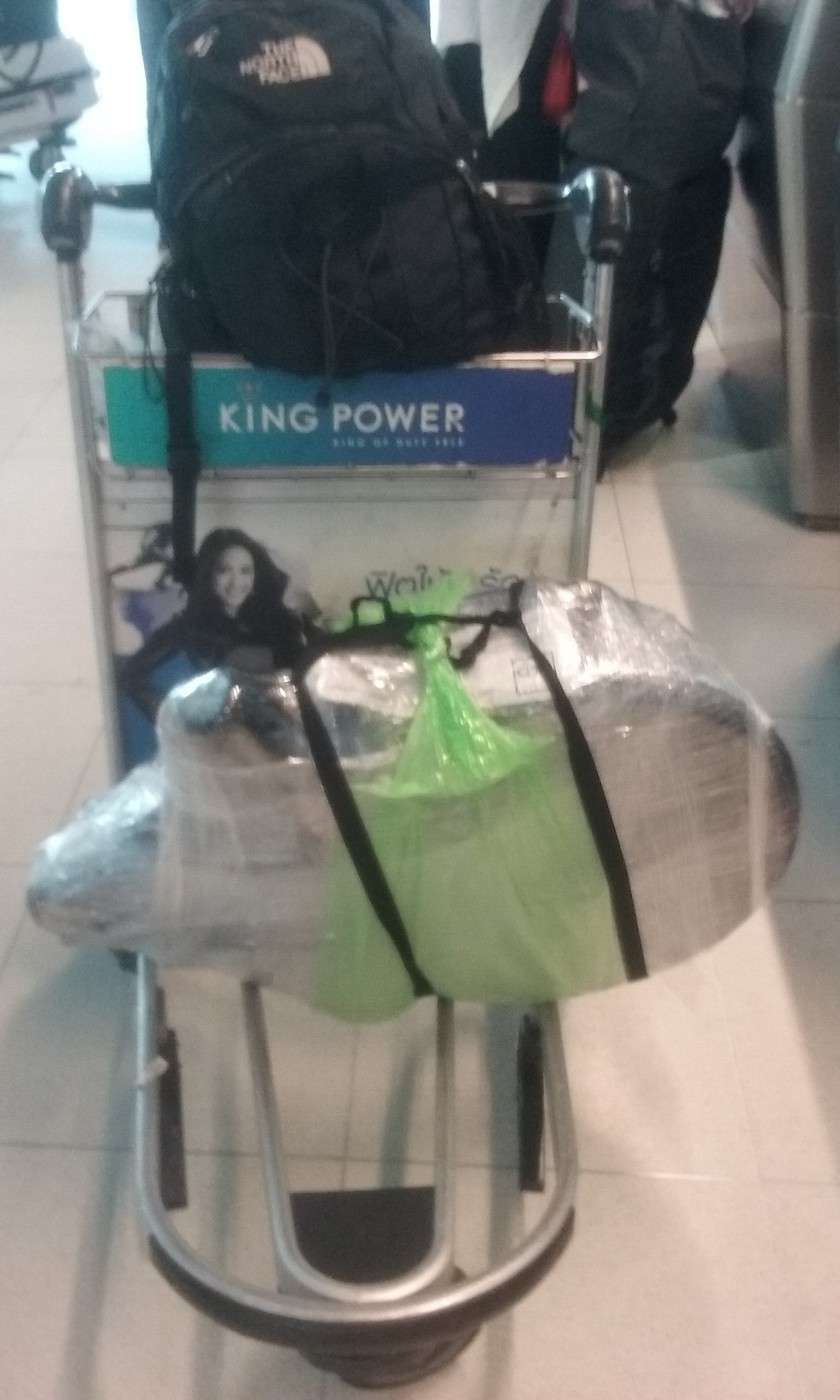
En effet le vélo pliant est un compromis intéressant que j'ai déjà pas mal testé, pour ma part en Asie . Même si il faut aussi le protéger assez sérieusement en soute avion , si on en prend un, et je n'ai pas encore défini la meilleure solution pour le protéger de manière très sûr jusque-là . J ai utilisé soit des morceaux de cartons pour protéger les parties fragiles et un grand plastique transparent scotché autour du vélo . Sinon il y a l'option de faire une sorte de carton compact, le vélo pliée dedans, peut-être avec un carton à vélo classique récupéré à l'aéroport , que l'on découpe aux dimensions du vélo plié. Il me semble que le mettre dans une grande valise complique les choses , surtout si on ne roule pas à vélo avec cette valise, et si on ne compte pas revenir à l'aéroport d'arrivee dans le pays . Sinon ce que j'ai aussi expérimenté, c'est de plier le vélo dans sa housse, couverture opaque, et d'ajouter à l'intérieur des morceaux de carton ou des tubes en carton dans le sens de la longueur , pour diminuer les risques de chocs latéraux . Pour l'instant j'ai un vélo pliant Tern , roues 20 pouces , donc un peu moins compact qu un brompton, mais aussi largement moins cher, donc moins de pression s'il y a des dommages ou autre . Je pense aussi que le matériel pour changer des pièces du vélo, réparer, revient moins cher et plus facile qu un brompton , dont les pièces sont plus spécifiques avec des roues 16 pouces etc
Pour ma part j'ai un dahon speed P8, j'intercale des affaires dans les espaces, tongs pour proteger le dérailleur par exemple, et je le fais filmer. Apres plusieurs vols je n'ai jamais eu de dégats.
En théorie je suis un peu au delà des dimensions du bagage en soute mais c'est toujours passé sans supplément
"Il ne pris jamais de risques et il mourrût sain et sauf"
Ton dahon 20 pouces , tu le mets plié dans une housse vélo adaptée ou dans un carton ? Pour le Vietnam j'avais protégé dérailleur, manettes de frein et autres, avec du carton plié et j'avais emballer le tout dans du plastique transparent large , enroulé autour du vélo , . Mais finalement c'était pas si facile à retrouver au moment du départ. Donc sûrement s'il y a une prochaine fois , j opterai pour une simple housse de vélo 20 pouces et protéger à l'intérieur avec du carton, des affaires, même si la housse n'est pas transparente , donc il y a peut-être plus de risques pour que le velo soit identifiable et y faire plus attention . Au pire on peut ajouter scotché sur la housse un sigle vélo et un mot " bicycle be careful" and co
Je protege un peu avec les moyens du bord et je le fais filmer. Et je rajoute des sangles pour qu'il soit facile à saisir. Ma théorie est que si les manutentionnaires ont de bonnes prises il y a moins de risques pour le vélo, je ne sais pas si ma reflexion est bonne mais pour l'instant jamais de casse, que ce soit sur le pliant ou le velo en carton.
Un gars qui prenait en charge mon vélo dans un carton à Carcassonne , m'a confirmé que les sangles étaient bien pratiques pour lui.
"Il ne pris jamais de risques et il mourrût sain et sauf"
Merci pour l'info et ta démarche . J ai a peu près fait le même emballage pour amener mon vélo pliant du nord au sud du Vietnam , assez protegé, derailleur etc, mais j'ai quand même eu le pédalier un peu enfoncé vers l'avant. je trouve que c'est quand même assez risqué avec du plastique et quelques légères protections, mais peut-être que tu as plus de chance que moi . Pour l'instant je suis assez maudit 😉 j'ai toujours eu des chocs ou des écrasements plus important en amenant un vélo en avion , donc je pense que si j'en ramenait un en avion un de ces jours, je protégerai au maximum, peut-être avec ma housse vélo opaque , qui a aussi une sangle, mais en protégeant au maximum à l'intérieur avec des bouts de carton , scotch et peut-être même des tubes en carton placés dans le sens transversal et autres, pour encaisser les chocs s il y en a. Dans tous les cas j'essaie d'éviter au maximum l'avion et je pense d'ailleurs que vélo et avion ne sont pas du tout adaptés dans le même mode de voyage ni d etat d'esprit on va dire!
Je pars faire le GR 20 (sud-nord) en laissant ma moto à Conca. J'aimerais savoir siil y a un risque de vandalisation de ma GS au départ, je vais essayer de…
J'ai envie de m'extirper de Paris pendant les vacances de février pour aller marcher et découvrir l'Écosse qu'on me vante depuis quelques temps. Puis-je en 7 à…
En mai prochain, je voudrais terminer "mon" chemin de Saint Jacques en marchant de Burgos à Santiago. J'habite près de Martigues. J'ai regardé ce que je…
Je compte partir un mois environ de Perpignan, et je voudrais économiser au max. Je pensais faire Perpignan-Barcelone en covoiturage. Ensuite de Barcelone je…
Hi,
We’re planning to do the 4-day trek from Mestia to Ushguli without an agency. The descriptions mention that there are accommodations at each stop, but we can’t find any details about them. Has anyone got info or feedback on this route?
We're planning to trek in Peru and Bolivia and would love to find some local agencies.
If you know any, could you share details on prices and, of course, the names of the agencies?
Which trek would you recommend?
Elocine
I'm heading out on a fully self-sufficient trek in Morocco (10 days) from Imilchil to Aghbalou.
Can I find screw-on gas canisters (Coleman, Primus) in Marrakech (any addresses?) or in villages between Imilchil and Aghbalou?
If not, are Butagaz canisters for camping gas (small 230g size) available?
Thanks in advance for your tips!
Hello, I’d like to embark on a little trip in my home country, Switzerland. I’ll start walking from La Cure, heading toward Le Noirmont first, then I’ll improvise my route—but it’ll probably follow the French border... at least as far as Lac de Joux.
I’ll decide day by day how much farther to go after that. My goal is to stay in nature as much as possible, wander around for as long as I can, and restock food in villages or towns along the way.
I’m thinking of mostly camping, but we’ll see if I end up in a hotel or another campsite depending on my route.
I’d love to reach La Chaux-de-Fonds on foot... maybe even Delémont.
The whole thing should take about a week, give or take.
I’ll be bringing my dog, and I’m preparing for this as soon as I’m ready.
Any tips to make sure everything goes smoothly for us? Things I should know—or avoid? What about shepherds with their flocks of sheep? And isn’t hunting season open right now?
I’m not sure if what I’m planning is even doable, which is why I’m asking around.
This’ll be my first time doing something like this—wandering in nature *and* with a dog. I’m really excited for this adventure... and I need it. Thanks!
We’re really keen on ecosystems and want to hike in "natural" ancient forests—not planted woods or areas heavily degraded by human activity. Travel guides (like Lonely Planet) don’t provide much info on this. Could you point us to the most interesting spots?
Thanks in advance for your tips.
We wish you happy holidays and a fantastic 2026, full of discoveries!
Claire and Albert
Hi, this might not be the right section, but I’d like to know if it’s possible to start mountaineering with another person without necessarily hiring a guide. We’ve done quite a bit of hiking but not mountaineering—we’ll just do a half-day glacier course. After that, we were thinking of starting with La Grande Motte and the Pointe de la Traversière, which were recommended to us. Honestly, for things like roping up and knots, I’ll learn at home with lots of videos and a book.
I’d love to know if anyone has done treks in the Rwenzori Mountains and how much it costs on average, what the infrastructure is like, the landscapes, and safety in the area. Thanks so much! I’m really looking forward to your replies.
We’re leaving in 9 days for a two-week trip to Madeira, mainly to hike.
From my research, I’ve found that since last year, access to most trails—and systematically for the most popular ones—is now paid. You have to pay an access fee of 4.50 € per person per classified hike in 2026, and even 10.50 € for the most iconic hike: Pico Arieiro to Pico Ruivo. When paying, you also have to choose a day and a 30-minute time slot for your start time. Of course, this reservation is neither changeable nor refundable, even if the weather that day is terrible.
Personally, given the massive influx of tourists to the island in recent years, I don’t mind paying a fee to help maintain the trails. Similarly, setting a limit on the number of people who can hike them per day is certainly preferable to preserve this priceless heritage.
However, what’s much less fair is that in reality, most of the available spots are reserved: 1/ for Madeira residents (which is normal); 2/ for "economic operators" (meaning local tour operators). For example, if you’re a non-resident (independent tourist), no booking is possible for the Pico Arieiro hike for an early morning start before September! So, unfortunately, we’ll have to skip this hike.
It’s the same issue for Ponta de São Lourenço, the 25 Fontes, Pico Ruivo... in short, all the most popular hikes. Oh well, we’ll skip those too!
So my question is: which hikes do you recommend where we won’t face the huge crowds that the others get? And where we can book the day before for the next day, taking the weather into account?
Finally, a quick accommodation question: we’ve booked the first week in Funchal, but I haven’t decided yet for the second week. Do you have any advice on where to stay in the south or north, preferably avoiding overly concrete-heavy and touristy spots?
I’m reposting about the logistics for Samaria Gorge.
I’d love to get recent info, especially about whether it’s possible to park my car in Omalos, do the hike, and then catch a bus back to my vehicle.
In theory, it’s doable, but when you check the KTEL website, there aren’t any feasible schedules listed. If anyone has recently organized this with reliable, verified details, I’d really appreciate it. Thanks in advance!
Hi there,
We’re flying from Montreal to Lyon this August to go hiking in the French Alps. We’ve rented a car and will be staying at campgrounds. We’re planning to do day hikes and want to stay a few days in one spot, do a few hikes, then move on to our next camping spot. Could you share your favorite spots or any recommendations for places to spend a few days with great hikes?
A few details:
We arrive in early August and leave in early September.
We’re looking for day hikes (or shorter), moderate difficulty, with a cumulative elevation gain of no more than 1000m, and of course, beautiful scenery!
We’d prefer not to drive too much—maybe it’s best not to head too far south and deal with unnecessary heat?
Along the same lines, if you know of any great campgrounds where we can start our hike directly without needing the car, we’d love to hear your suggestions!
Hi there,
I’m planning to go hiking on this island and would like to know the best time to do it. I visited for a few days in November 2018—not for hiking but just to explore—and the weather wasn’t great, especially in the mountains. So, is a star-shaped itinerary doable if I rent a car and maybe use two different accommodations?
I’m not planning to join an organized group—just traveling with one other person and organizing things ourselves—unless you’d recommend a local agency or guide. Finally, even though I’ll be getting maps, a topo guide, and a GPS, I’d really appreciate your top hiking recommendations.
Thanks so much for your tips!
I’m planning to do the Mercantour crossing following the Randoxygène route in mid-July.
I’m used to hiking in the mountains, but I sometimes get vertigo, for example on ridges with drops on both sides. I wanted to check if there are any T4 or T3-T4 sections and find out if there are any very exposed passages—and if so, where—so I can plan an alternative route.
Can anyone give me some info on this?
Thanks!
I’m planning a trip around Cap Corse and the AGRIATES in 2026, from May 8th to 15th (there are still 2 spots left, by the way! Just DM me if you're interested).
I’d love to know which hikes are worth prioritizing in the AGRIATES. We’ll be staying in SALECCIA for two days as our base—what should we focus on from there?
A round trip to IGNHU beach? Any other suggestions?
For Ostricano, I think it’s too far for a round trip...
Thanks for your tips!
Have a great day,
Anie, Toulouse
I’d like to get some info about the GR10 Pyrenees traverse. I need help planning the daily stages and accommodations—my wife isn’t an experienced hiker but walks a lot, so I’d like to schedule shorter walking days and thus a longer overall trip in terms of number of days.
Could anyone give me some help and advice?
Best regards,
New to this forum, I’m planning a pretty big project for 2028.
I’m heading to Nepal to do a trek from Kathmandu all the way to Everest Base Camp (a cool 5,300 m 😄).
This trek is a bit special because even though I’ll be part of a group, I’m going solo (so far, no problem—I’m used to it). But it’s my first real trek, and it’s also a humanitarian one: once I reach base camp, I’ll stay an extra week to help clean up the waste left by tens of thousands of climbers! Since I’m originally from South America, from two countries that share the Andes, I have a deep respect for mountains—they fascinate me. So Everest… it’s kind of the trip of a lifetime!
So, a little question for those who’ve done treks to Everest before… any tips for good mental preparation (I’m already working on the physical side)?
Hi there, I’m planning the Annapurna Circuit for March 2027 and I’m looking for a local agency with a local guide—preferably French-speaking—to arrange this trek for us. Any suggestions? Thanks
Hello!
We’re spending a few days in Toraja country at the end of May. We’d love to do a day trek—taking our time—on a route that’s stunning in terms of scenery, but not a level 5 in difficulty!
Any suggestions you can share, please?
Thanks in advance
I’d like to do the Mare a Mare Sud in May over 4 days. I’ve found quite a few places to stay along the route, but I’m stuck on the start and finish.
I’ll be arriving by plane on Sunday evening and would like to start pretty early on Monday morning. Ideally, accommodation right at the trailhead (Alzu di Gallina) would be amazing, but I can’t find anything. Any tips?
Also, for the transfer from Figari Airport to Porto Vecchio or Alzu di Gallina?
At the end, I’d like to pick up a rental car—any advice on that too?
I’m traveling solo by plane to Catania in May and plan to hike the northern side of Etna, starting from Linguaglossa where I’ll arrive by bus. After that, I’d love some info on how to get up to Piano Provenzana (shuttles or hitchhiking), since it seems there’s no public transport except in the summer. Can you sleep there in a free or cheap refuge, or camp? And how far up can you go without having to hire a guide? Thanks in advance. Bernard.
Hi everyone,
I’m heading to Morocco in August and we’ll start with a stop in Chefchaouen (we’re driving).
My question: can anyone suggest a 5-to-7-day loop hiking route from Chefchaouen in Talassemtane Park, ideally passing by the God’s Bridge? Or a paper guidebook that covers a few options?
We prefer wild camping and guesthouses.
Thanks in advance
Hi there, for those who’ve been recently—is it possible to find other solo travelers in March on the island to share transport or room costs? It doesn’t seem easy to travel on a budget.
If you have any recommendations for simple lodgings or places with dorms, I’d love to hear them.
For those who’ve done multi-day treks while moving around: do you need to bring your own sleeping bag? I’d love to hear about itineraries you’ve done without a guide, just with a map and GPS.
Thanks, and have a great day!
Hi everyone!
We’re planning a 15-day road trip to Scotland this summer, specifically to explore and hike on Lewis and Harris—places we’ve never been before. We’ve visited other islands on previous road trips in Scotland (we usually go in April for a week). This would be our first time in Scotland in the summer and for 15 days. We’re looking at late August to early September.
I’m currently drafting the itinerary. We’d be crossing from Ullapool and were thinking of spending 3 nights on Harris and 4 nights on Lewis.
Does that sound balanced to you? Is it better to keep the same accommodation on Harris and the same on Lewis to explore the area? I’d love to hear about any past experiences you’ve had on these islands.
Thanks!
Hi there, I’m trying to leave for 15 days very soon to São Vicente. I’m either looking to join an agency or figure things out on my own to go hiking on one of these islands or both. From what I’ve seen, it’s not easy to organize with local transport, so it gets expensive. Can I use the services of a small local agency? I’m looking for the simplest way to hike for several days. Also, how do you get from São Vicente to São Nicolau? Thanks in advance and have a great day!
Aichatou
I’ve been wanting to do this for several years, and this year’s the one. Next September, I’ll be trekking in Tusheti (Georgia), from Omalo to Shatili.
Of course, I won’t be renting a vehicle that’d just sit unused. No problem getting to Pshaveli, but from there to Omalo, it’s a dirt road (still the case?)
There must be some form of public transport since there are so many guesthouses, and not all travelers come in a 4x4.
If any of you have been to Omalo, could you confirm that these shared transports exist and how often they run?
we’re planning a trip to Yellowstone and hoping to do a three-day backcountry hike if we get a permit.
if any of you have done this before, could you let me know if it’s possible to find water along the way? And if we can transport it, are we allowed to use a stove?
Hello,
I’ll be in Nepal from March 6th to 29th (we’re flying into Kathmandu via Varanasi and leaving via Delhi).
I’m a bit confused about the regulations requiring a guide.
My wife and I (we’re 63 and 64) aren’t experienced trekkers—we’re more used to walking on terrain with very moderate elevation changes. I’m looking for fairly easy hikes, possibly day trips.
Here are my questions:
- Does the Poon Hill trek from Pokhara require a guide, or is it better to go through a local agency? (I’ve seen a lot of them offering 4-day packages)
- I’d like to do a few multi-day hikes around Jomsom (Kagbeni, Mukitinath, Lupra, Marpha)... Do you need a guide for those, and can you find accommodations easily without booking in advance?
Last question—I’m really hesitant to lug around a sleeping bag or down jacket during our 6 weeks in India. Can you easily find these kinds of items at reasonable prices in Pokhara?
Thanks in advance for any tips you can share!
Yann
I’m a 56-year-old man who’s done several treks in Nepal and elsewhere. Also passionate about photography.
I’m looking for one or more people to form a group for a trek in Nepal. The trek is the Annapurna and Manaslu circuit (24 days), including a stop at Tilicho Lake. I’ve got a great itinerary and the local company seems solid. The price is around $1600.
I’ll be in Nepal from April 5 to May 12, 2026, so the trek would need to happen within those dates.