Je vais recevoir une forte somme d'argent en Chine (plus de 60 000 rmb) en cash. Si je comprends bien les diverses infos lues sur le net, il est interdit de sortir du pays, pour un citoyen français, plus de 20 000 rmb en cash. Cet argent sera légal, avec un papier prouvant que les taxes (20% je crois) ont été payées.
Je ne vois pas beaucoup de solutions pour moi (sachant qu'il me sera compliqué d'ouvrir un compte en Chine). Je ne suis ni résident, ni travaillant en Chine, je serai juste un touriste qui vais y passer un mois. En dehors de confier le cash à une connaissance de confiance qui se débrouillera pour me le virer sur mon compte en France, connaissez-vous d'autres moyens ?
Autre chose, est-il autorisé de se déplacer en Chine avec une telle somme (trains, avions, bus...) ?
Il n'y a pas de problème pour se déplacer avec une telle somme en Chine. Le principal risque, c'est de perdre son argent.
Pour le reste, je n'ai que des suppositions...
Tu devrais en tout cas te renseigner auprès d'organismes légaux (douane, services consulaires) pour avoir une réponse claire et officielle.
Même si tu arrives à quitter la Chine avec une telle somme, il doit logiquement falloir la déclarer aux douanes en arrivant en France (avec ce que cela peut engendrer, ensuite, de démarches administratives).
Il est évidemment peu courant, et suspect, d'avoir sur soi une telle somme (près de 8000 euros, c'est ça ?) en liquide de retour de voyage. Si tu es allé en Chine en tant que touriste avec un visa de tourisme, tu n'es pas censé y avoir fait du commerce. Tu flirtes donc avec la légalité, même si cet argent est "propre".
Tu peux prendre le parti de ne rien déclarer évidemment... en prenant le risque de payer cher en cas de contrôle.
La plus grosse coupure chiloise étant le billet de 100 RMB (environ 13 Euro) ça nous fait ... 600 billets de 100 RMB
Qu'est-ce que cela représente comme volume ?
Aucune idée 😛
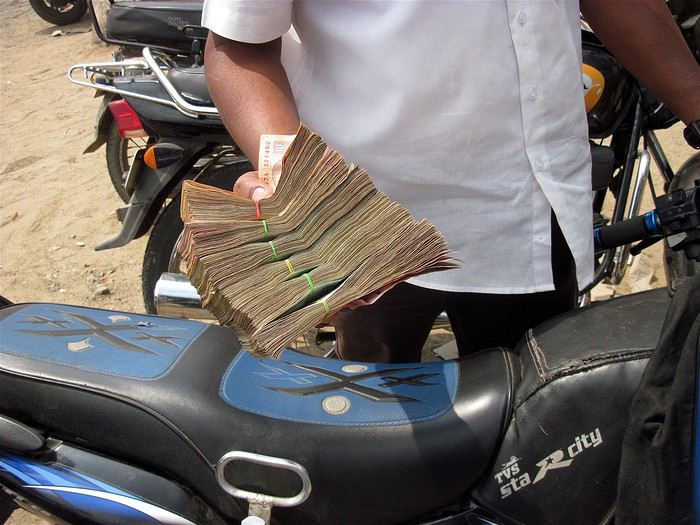
Peut être ce genre d'encombrement (comme ici en Inde), non ?
ou moins ?
Ce serait bien que tu nous fasses une photo de ton pactole qu'on puisse se rendre compte de ce que cela donne 😛
"Nous ne sommes plus une communauté d'être humains qui se parlent mais un conglomérat de grappes de consommateurs en niches, séparés les uns des autres par des obsessions diverses et innombrables. Nous sommes de l'ère de la désintégration." Marc Moulin (1942-2008) in Humoeurs
J'ai manipulé des RMB par dizaines de milliers, en déplacement professionnel à l'époque où la carte bancaire était peu acceptée dans les villes moyennes chinoises.
La plus grosse coupure chiloise étant le billet de 100 RMB (environ 13 Euro) ça nous fait... 600 billetsde 100 RMB
Qu'est-ce que cela représente comme volume ?
Aucune idée 😛
Google Image + liasse 100 billets pourra te donner des idées
Peut être ce genre d'encombrement (comme ici en Inde), non ?
Moins que cela, parce que ce seront probablement des billets neufs.
Voici plutôt à quoi cela ressemblerait
Changer en euros l'excédent par rapport à la limite de 20 kRMB ?
Il n'y a probablement guère que dans un grand aéroport que les guichets de change peuvent avoir ce genre de montant en devises.
Il serait plus pratique de convertir dans une autre monnaie. Chaque citoyen Chinois peut convertir l'équivalent de US$50,000 par année. Pour les étrangers je ne sais pas. Dans tous les cas, pour un tel montant, ils faut commander les devises d'avance.
Bonjour Kujila et merci de ta réponse. Le fait de pouvoir se balader légalement intramuros avec cette somme me rassure.
Pour la France, il faut déclarer à partir de 10 000 euros. Si l'on ne peut pas quitter la Chine avec plus de 20 000 rmb, on peut sortir avec l'équivalent de 10 000 $ en devises étrangères. Mais cela oblige à une double déclaration en Chine (banque chinoise + bureau de "vérification"). Et de toute manière, pour moi, il semble compliqué de changer une telle somme en Euros (il y a également des limites).
Salut Ragamuffin. Oui, c'est assez énorme, plus que sur la photo je pense. Je cherche une solution légale, car si je suis pris, ils confisquent le surplus, mais également les 20 000, + d'autres problèmes j'imagine...
J'ai l'impression que pour changer une grosse somme en cash, il y a également des limites assez drastiques. Oui, les 20 000 je les aurai sur moi, mais après. Et comme il faut des papiers et autorisations au-delà de 5000 dollars, puis 10 000, (ou équivalent en euros), je n'aurai pas le temps de mettre tout ça en règle.
C'est une avancée ça...Et si je donnais le cash à une connaissance chinoise, pourrait-elle le déposer sur son compte chinois et me le virer sur mon compte en France ? Je suis chez La Poste. J'imagine qu'il y aura des frais conséquents, mais de toute manière, à un moment ou un autre j'aurai à payer des frais.
"Nous ne sommes plus une communauté d'être humains qui se parlent mais un conglomérat de grappes de consommateurs en niches, séparés les uns des autres par des obsessions diverses et innombrables. Nous sommes de l'ère de la désintégration." Marc Moulin (1942-2008) in Humoeurs
J'avais sorti 20 000 Yuans sans problème (sur moi et dans deux enveloppes dans deux sacs ; les douaniers n'avaient rien fouillé).
Ne peux-tu changer ces yuans avec des étrangers ou des Chinois (voire la personne/l'organisme qui t'a donné cette somme) possédant des devises étrangères pour obtenir des liasses plus petites ? (Euros, dollars, livres, etc.)
Une autre solution : tu t'achètes des biens de valeur pour 40 000 yuans et tu transportes le reste avec toi (certains des produits ci-dessous sont moins chers en Chine qu'en France et tu les trouveras facilement dans les grands magasins chinois ; éventuellement, tu envoies le surplus en France par la poste) :
- tu refais ta garde-robe (Adidas ? Lacoste ? Levi's ?) ;
- tu t'équipes pour le voyage (Chaussures Merrell ? doudounes North face ? sacs à dos Deuter ? Etc.) ;
- équipements électroniques (appareil photo ? tablette ? téléphone ? Etc.) ;
- produits de luxe (Chanel ? Hermès ? Louis Vuitton ? Etc.) ;
- joaillerie (bague en or pour ta future épouse ? collier de perles pour ta mère ? Etc.) ;
- lainages et soieries (châles en cachemire ? tapis de soie ? Etc.).
Merci Burnaby pour cette idée. Il est peut-être plus simple et plus rapide d'acheter un douanier :)
Changer avec l'organisme n'est pas possible, j'ai déjà demandé.
La solution de confier cet argent à une connaissance chinoise (qui effectuerait un transfert par la suite) me semble la plus simple...Quelqu'un a-t-il une idée du montant des taxes qui seront appliquées ?
Autre chose : je repars du terminal 2 de l'aéroport de Pékin. Il y a-t-il un scanner (pour les gros bagages) avant d'atteindre les comptoirs du check in ? J'ai un vol direct.
Une amie chinoise, vivant en France, me dit (mais elle n'en est pas bien certaine) qu'elle peut me passer sa carte bancaire, et qu'avec ça (et sans ses papiers), je peux déposer le cash en Chine sur son compte à sa banque...
Quelqu'un en saurait-il plus ? il y aurait-il des limites à ne pas dépasser (en terme de montant) ?
Je dois sortir de Chine dans une semaine pour pour tamponner mon visa F 6 mois, mais avec une durée max de 1 mois a chaque séjour... J'avais lu sur le forum,…
Voilà, j'ai 2 passeports: un Francais et un Anglais. Je souhaite savoir si cela pose un probleme de partir de France avec un passport FR et d'arriver a Hong…
Je vais bientôt partir pour la Thailande avec Air China et j'aurais une escale d'un peu moins de 10 heures à Pékin à l'aller et au retour. Je me demandais si…
Une question existentielle à 2 jours de mon départ de Chine, après trois ans de bons et loyaux services... Quelle somme peut-on sortir de Chine? Et faut-il…
Je suis actuellement au Vietnam et je rentre en France le 03/04 avec la compagnie China Eastern en faisant Ho Chi Minh/Shanghai et Shanghai Ho chi Minh. Les…
Hi there,
My girlfriend (23) and I (24) are heading to Japan for the first time from October 20th to November 6th. Here’s our itinerary:
6 nights in Tokyo
1 night in Hakone (ryokan already booked)
4 nights in Kyoto (hotel already booked)
2 nights in Osaka
4 nights back in Tokyo
I’d like to book hotels for Tokyo (both stays) and Osaka, but I’ve gotten so many different recommendations.
I’ve read that Shinjuku is the place to be for its huge hub, accessibility, and things to do, but I’ve also heard about Shibuya, Asakusa, and Ueno.
I’ve looked at hotels, and first off, I’m surprised by the prices compared to what I’ve seen on forums (I guess inflation’s hit here too… and maybe I’m late to the booking game?). I’m feeling a bit overwhelmed with all the options.
For our first stay in Tokyo, I’d prefer a hotel (not a residence or Airbnb) since we’ll be arriving at night, and it’s our first time in Japan. It’d be great to have a place with a reception, staff who speak at least a little English, and can give us some guidance. For the second stay, we could consider other options if it’s better.
Budget-wise, we can go up to 150–180 € per night, but if we can save some money to spend elsewhere, that’d be amazing!
I’m open to all recommendations, hotel suggestions, or any other tips for Tokyo (first stay), Osaka, and Tokyo (second stay).
Hi there,
I’d like to do this cycling route over 2 or 3 days. I’m struggling to figure out and find a (good) bike rental that lets me start in Onomichi and drop off in Imabari. Can anyone help with great tips for rentals and accommodations along the route? How do I get back to Onomichi afterward?
We’re flying to China in a few days for a four-week trip—our first time in this fascinating country! 🇨🇳
We’ll be sharing our adventure live on our travel journal, with photos and daily updates. Our itinerary, though classic, will let us discover the wonders of this vast country:
I’m starting to look at neighborhoods in Seoul, and I’m leaning toward staying in a hotel in Insa-Dong—I’ve spotted one really close to Unhyeongung.
Is this a good area—nice and convenient for exploring the city?
Otherwise, I’ve also found another hotel in Yongsan-Gu, right near the station of the same name. Is that station useful for getting around Seoul?
Since I’ll be in South Korea for nearly two months, I plan to spend at least a week in Seoul to recover from jet lag (it takes me a while to adjust...). So, I’d love a neighborhood that’s pleasant and a hotel not too far from a subway station.
Hi there,
I’m getting ready for a classic tourist trip to China in May 2026.
The "Terres Lointaines" itinerary looks good to me, and the price is interesting.
Has anyone traveled with them before? Any feedback?
Is there a better option?
Thanks so much for sharing your experiences on this!
Michel
I just booked my hotel in Seoul—it’ll be near Unhyeongung, on Samil-Daero 30-Gil—and I’m wondering if there’s public transport from the airport to this address (bus or subway)? If not, what’s the taxi fare? I read it’s around 50 or 60 €.
I’m traveling to Japan with a young adult with autism (ASD) from July 28 to August 8, following a pretty classic route: Osaka, Hiroshima, Kyoto, and Tokyo. I’m looking for a schedule of the most spectacular fireworks displays during that time. So far, the dates for the major *hanabi* events aren’t available online yet. If anyone has them, I’d really appreciate it if you could share!
We’ll be doing a self-drive trip using public transport in May 2026.
On Day 6, we’ll arrive in Hakone by train from Tokyo in late morning. We’ll spend the night in Hakone before heading to Kyoto.
The main goal of this stop is clearly the view (no hiking) of Mount Fuji, not so much exploring Hakone, where the sights seem limited.
I’ve read on the forum that the view is great from Gotemba, but it also takes a good hour by bus to get there. And, apart from that view, there’s nothing else to see in Gotemba!
So, I’m not sure what to choose. Any thoughts? Or alternatives to suggest?
Maybe some spots in Hakone or Gotemba for a great view?
Hi everyone, I’m Julien!
This summer, from late June to late July, I’m planning a one-month solo trip to Japan—my first time!
I’d love to hear your thoughts and advice on the itinerary I’ve put together to explore this amazing country.
Here are the routes I’m considering:
**Option 1: More mountain and nature-focused**
Tokyo: 8 nights, with day trips to Nikko and maybe the Izu Peninsula
Kawaguchiko (Lake Kawaguchi/Mt. Fuji): 1 night. The place looks stunning, but I’m worried Mt. Fuji might not be visible due to the weather
Kyoto: 6–7 nights (including a trip to Nara)
Osaka: 1–2 nights, where I’d like to drop off my things to make the Kumano Kodo easier
Kumano Kodo: 3 nights—an experience I haven’t seen much elsewhere, but I thought it sounded really interesting
Hiroshima: 2 nights
Miyajima: 1 night
Takayama: 3 days
Kanazawa: 3 days (From what I understand, the Osaka–Takayama–Kanazawa–Tokyo route is convenient for transport)
Tokyo: 1 night (return)
**Option 2: More varied but a bit vague in parts**
Tokyo: 8 nights
Kyoto: 7 nights (+ Nara)
Osaka: 2 nights
Kobe + Himeji: just passing through—I’m not sure if it’s worth a night
Naoshima: 1 night—still pretty unclear for me
Takamatsu: 2 nights. An interesting city, but I’m not sure how long to stay
Shimanami Kaido: biking from Imabari to Onomichi, then heading to Hiroshima
Hiroshima: 2 nights
Miyajima: 1 night
Kyushu road trip (Aso + onsens + Fukuoka): 5 nights (also pretty vague—I could fly from Fukuoka back to Tokyo)
Tokyo: 1 night
**Option 3: More balanced/simplified**
Tokyo: 8 nights
Kawaguchiko: 1 night
Kyoto: 7 nights (+ Nara)
Osaka: 2 nights
Koya-san: 1 night
Kumano Kodo: 3 nights
Takayama: 3 nights
Kanazawa: 3 nights
Tokyo: 1 night
A few key points:
I haven’t made any reservations yet, except for the flight tickets.
I know my plans are too packed and will need to be adjusted.
I’m specifically looking for advice on which stops to cut or shorten.
Hello everyone,
Like Cedric13600, I’ve booked a flight ticket for 30 days / 29 nights in September 2026, from Beijing to Shanghai. We’re a couple in our sixties who love independent road trips.
I’d like to draw inspiration from the following private itinerary suggested by a travel agency:
Day 1: Arrival in Beijing
Day 2 to 4: Beijing
Day 5: Datong
Day 6 & 7: Pingyao
Day 8 to 10: Xi'an
Day 11: Luoyang
Day 12: Dengfeng
flight
Day 13 & 14: Chongqing
flight
Day 15 & 16: Lijiang
Day 17: Dali
Day 18: Kunming
Day 19: Jianshui
Day 20 & 21: Yuanyang
Day 22: Travel via Guilin
Day 23 & 24: Yangshuo
Day 25: Guilin
Day 26 & 27: Zhangjiajie
flight
Day 28 & 29: Shanghai
Day 30: Departure from Shanghai
But to do this itinerary independently:
1. This schedule seems very ambitious to me—what do you think?
2. If it’s too packed, what would you remove as a priority?
Thanks so much in advance for your help.
I’m planning a 5-week trip between Yunnan and Sichuan from mid-October to the end of November 2026:
Arriving in Kunming, I’ll do a loop in the far south of Yunnan via Thonghai, Jhiansu, Zhemi, Yuanyang, Nafa, Jinping, Mengzi, and Shilin (visiting markets, villages, and hiking), then head to northern Yunnan/southern Sichuan on the same theme (passing through Kunming again) via Dongchuan, Huize, Qiaojia, Puge, Xichang, Lanba, Butuo, Huolie, Dimo, Riha, Niuniuba, Meigu, Mabian, and Leshan, before arriving in Chengdu (where I’ll take my return flight to Paris).
This would be a trip with a strong ethnic/rural focus. Since I’ve never traveled in China, I’d love to hear your thoughts on doing this solo. Are there public transport options in the region? What tips do you have for traveling through this area as smoothly and enjoyably as possible? I’ve done quite a bit of backpacking in the mountains of northern Vietnam and really enjoyed using local motorbike drivers. Is something like that available in this region (through local tourist agencies or hotels)?
What should I be cautious about? Are local tourist agencies (or hotels) offering tours and guides reliable? If you know of any specialized sites sharing tips or experiences, or names of local agencies, hotels, etc., please don’t hesitate to share them! :)
In short, all your advice (on any topic that comes to mind!) is very welcome.
Thanks so much!
While researching South Korea, I came across the term "templestay," which refers to a Korean program that lets you stay in a traditional temple to discover Buddhism and Korean culture by living like the temple residents and doing activities like making lanterns.
A templestay isn’t just for foreign tourists—on the booking site, I saw that some temples are more geared toward foreigners, with English-speaking monks.
I was wondering if it’s still worth it, especially in temples where the monks don’t speak English?
I'm 69 years old and heading to China, where most tourist sites are free or discounted for me. However, trip.com either refuses to let me book because the sites are free or doesn’t apply the discount. Does WeChat apply this discount if I book through them? How can I just reserve without paying and pay on-site? Is that possible?
I’d love to get some feedback on our 30-day / 29-night itinerary in China. We’ll be there in September as a family with two kids (6 and 10 years old).
Do you think I should cut a few nights between Wulingyuan (Avatar Mountain) and Yangshuo? I’ve planned 15 nights total there.
We’ll be on a round-the-world trip starting May 2026 and will need to do schoolwork with the kids. Hoping to fit it in during train rides!!
Ever since I started planning this China itinerary, I’ve been discovering completely mind-blowing places I’d never heard of before—30 days feels way too short for China!!!
Here’s our itinerary:
Beijing - 4 nights
Forbidden City
Great Wall of China
Temple of Heaven
Xi’an - 3 nights
Terracotta Army
Muslim Quarter & Great Mosque
Chengdu - 3 nights
Zoo - Research Base of Giant Panda Breeding
Wenshu Yuan Temple
Hi there,
We just got back from a 2-week trip to China as a couple, and before we left, the budget was the hardest thing to picture concretely. We found plenty of info on visas, apps, transport, and itineraries, but way fewer detailed breakdowns of what you *actually* spend on the ground.
So, we took the time to share our real budget for 14 days. In our case, we spent around 1,800 € per person, with a big chunk of that going toward round-trip flights at about 600 € per person. We were also pretty surprised by how affordable China can be once you’re there—transport is often cheap, and a lot of everyday expenses stay reasonable.
The trickiest part, in the end, was figuring out how to pay while you’re there, since it’s not always obvious if you’re not prepared. But once everything’s set up and you get the hang of it, it’s really smooth.
If this can help other travelers get a better idea before they go, we’ve broken it all down here:
https://aventures-sans-mesaventure.com/budget-2-semaines-de-voyage-en-chine/
Hi everyone,
I’ve been planning several itineraries for a trip to Japan with my wife but would love your insights before we start booking!
In short, we want to go during Golden Week, see late-blooming cherry trees, and have the freedom to get around with a rental car.
Here’s the plan:
18-day itinerary in Japan (April 25 → May 12)
Goal: freedom, late cherry blossoms, culture & nature
---
Days 1–3: Tokyo (April 25–27)
Arrival and adjustment (no car needed yet).
Neighborhoods to visit: Shinjuku, Asakusa, Meiji Jingu, Shibuya, Odaiba.
Suggested activities: Ghibli Museum, Sumida River cruise, izakaya meals.
Late cherry blossoms (yaezakura) possible at Shinjuku Gyoen.
Pick up the rental car on the morning of April 27.
---
Days 4–5: Mount Fuji & Hakone (April 27–28)
Route: Tokyo → Kawaguchiko/Hakone (~2 h).
Activities:
Lake Kawaguchi, Chureito Pagoda (Fuji views + late cherry blossoms)
Onsen baths, Hakone Open-Air Museum.
Stay: ryokan with onsen and views of Mount Fuji.
Activities:
Preserved old town, sake breweries, UNESCO village of Shirakawa-go.
Stay: traditional minshuku (thatched-roof house).
Cherry blossoms are finishing at this altitude — beautiful mountain/nature contrasts.
---
Days 8–10: Kyoto & Nara (May 1–3)
Route: Takayama → Kyoto (~4 h 30).
Activities in Kyoto:
Fushimi Inari (red torii gates), Golden Pavilion, Arashiyama, Gion (geisha district).
Day trip to Nara:
Free-roaming deer in Nara Park, Todai-ji Temple, Kasuga Taisha Shrine.
Stay: Kyoto (3 nights).
---
Day 11: Osaka or Himeji (May 4)
Route: Kyoto → Osaka (~1 h) or Himeji (~1 h 30).
Option 1: Osaka → modern vibe, street food, castle.
Option 2: Himeji → stunning UNESCO-listed castle.
Stay: Osaka.
---
Days 12–13: Kanazawa (May 5–6)
Route: Osaka → Kanazawa (~4 h 30).
hi! Is it easy to use for paying for all the small purchases at the markets? INSTALLATION AND USE WITHOUT ISSUES—do you also need a VPN for China?
Secondly, for using phone and internet, I have Orange—is it reliable, or should I go with Airalo instead?
The info I found on the forum is a bit outdated, so I’m asking again!
1) What budget should I plan for 15 days, given that hotels with breakfast, transfers, and transport are already paid for? I know it depends on the person, but I’d love a rough idea. For meals, we’re thinking simple street food or small local restaurants.
2) I’ve heard that credit cards (we each have a Revolut + 1 Visa Premier) aren’t widely used and that it’s better to have cash. Can you confirm?
3) Are foreign credit cards still not accepted at bank ATMs? Still 7-Eleven or the Post Office? And what about American Express?
I'm planning a 19-day itinerary in Japan this summer.
For a first trip, Kyoto seems like a must. For the rest, I'm torn between:
- Matsumoto, Takayama, Kanazawa for 5 to 6 days
- Kyoto 4 days
- Nara 2 days
- Koyasan 1 day
- Hakone/Mount Fuji 2 to 3 days
- Tokyo 3 days
Or dedicating the first 6 days to Kyushu.
Maybe there’s less traditional Japan in Kyushu compared to the Japanese Alps?
Maybe Kyushu is less crowded?
Thanks for your thoughts!
We’re planning a 17-day trip to South Korea in October 2026 with my husband and our daughters, who’ll be 9 years old.
I’d love to get your thoughts on our draft itinerary.
First, some key details:
1/ Jeju Island is a must for us. I’ve personally dreamed of going there for years after reading a novel about it.
2/ Our girls are used to road-trip style travel since they were born, so this kind of trip won’t be an issue for them.
3/ We plan to travel by train, except on Jeju where we’ll rent a car (we already have an international driver’s permit).
Itinerary:
Seoul: 1 arrival day at 10 AM + 4 full days
Gyeongju: 2 days
Busan: 3 days
Jeju: 4 days
Seoul: 2 days
I’ll be in Hong Kong from December 31 to January 3, 2027.
Any recommendations for things to see or do?
I’ll be staying in the Kowloon district.
I’d love to visit Lantau Island—what’s the best way to get there? And would you recommend buying a skip-the-line ticket for the cable car? Also, is there an entry fee for the Big Buddha?
I’m heading to Taiwan soon and would love some up-to-date info on Wi-Fi.
From what I’ve gathered, Taiwan offers it for free, but I’ve heard it’s not secure since it’s not protected by a "password." Since I’ve been traveling outside the EU for years without a local SIM card, I only use Wi-Fi in hotels, restaurants, and cafés. For me, that’s more than enough. So, my question is: Do these places secure their Wi-Fi with a "password"? If not, does buying a SIM card or eSIM seem like the only alternative?
Also, if any of you have recommendations for budget-friendly hotels in the main "cities," I’d love to hear them!
We’re planning a trip to China for two at the beginning of April and want to spend 2 nights in the Longji Rice Terraces—either in Dazhai, Tiantouzhaï, or Ping'an. I’ve seen that most of the hotels are made of bamboo, and you can hear every little noise. Since my husband is a very light sleeper, he’d really like to be sure he’ll get a good night’s rest. Can you recommend any quiet, well-soundproofed hotels in the area?
I’m reaching out to you because I’m planning our next big trip (Japan is really tempting us for the autumn!) and I have to admit, I’m feeling a bit overwhelmed.
My husband and I have always loved traveling, and at 75, we have no intention of stopping... But I find that everything’s getting so complicated. I try to be "modern" by booking online, but as soon as there’s a problem, we hit a wall.
A friend nearly missed her departure last year because of a visa issue that wasn’t explained properly on a website... and no one to call for help, just automated messages.
It makes me a little nervous to be alone in front of a screen so far away, especially since at our age, we like knowing there’s real support if our health takes a turn while we’re there.
Anyway, I’m tired of seeing my file passed from one person to another without ever having the same contact... Do you know of any small, trustworthy agencies or people who still work the "old-fashioned" way and really look after their clients? I love my independence, but I need a real face behind my project.
Thanks in advance for your advice, and I look forward to reading your replies,
Catherine
I’m planning our trip to Japan from March 21 to April 11, 2026. We’re planning to travel by plane for long distances (Okinawa) and by train for the rest. I’d like to know if renting a car is easy and, most importantly, if driving with road signs written in Japanese isn’t too complicated. For trains, are there any tips to save money?
hi everyone, and first of all, I wish you all a happy new year and good health!
This coming October or November, we’re planning our first trip to Japan. The only downside is we’ll only have two weeks off.
For this first visit, I’m thinking of sticking to the Kyoto and Osaka area… saving Tokyo for another trip. Do you think that’s a good choice for a first-time visit?
I’ve put together a little itinerary below to get some feedback from those in the know. I’m only counting the days we’re actually there, not travel days.
Day 1: Kyoto
Ginkaku-ji – Philosopher’s Path with stops at a few shrines
temples Eikan-dō and Nanzen-ji
visit to the Samurai Ninja Museum in the late afternoon
Day 2: Kyoto
Fushimi Inari (allow 4 hours for the hike through the park)
visit to Sanjūsangen-dō temple
Shōseien garden
participate in a tea ceremony
Day 3: Kyoto
Kiyomizu-dera temple
stroll through the historic district up to Kennin-ji temple
visit Kennin-ji temple
Yasaka-jinja shrine and Gion district in the late afternoon
return to the hotel via Pontochō Street
Day 4: Kyoto
visit Kinkaku-ji and Nijō Castle
visit the Imperial Palace gardens
end the day in the shopping streets (Shibkyogoku and Teramachi, among others)
Day 5: Kyoto
Arashiyama area
Togetsukyo Bridge, walk along the river, visit the Bamboo Forest
explore the area up to Otagi Nenbutsu-ji temple
Day 6: Kyoto
hike from Kibune to Kurama
Day 7: Kyoto
day trip to Nara (full day)
Day 8:
stroll around Kyoto before heading to Osaka
Day 9: Osaka
Katsuo-ji temple, then head to Minoh Falls and hike back via the Minoh Trail
end the day in the Osaka Castle area
Day 10: Osaka
Himeji Castle and an afternoon in Osaka
Day 11: Osaka
Osaka and return to the airport in the late afternoon for the flight home
Do you think this itinerary is doable? Are some days too relaxed or too packed?
I was thinking of adding a trip to Lake Biwa and Uji, but in that case, I’d have to cut some things. Are those places worth dropping some of the planned spots? And if so, which ones would you recommend cutting or shortening?
Thanks in advance—I’m all ears for both positive and negative feedback!
stephane
Hi there,
I’m planning a trip to Japan in April/May.
I’ll start my journey in Tokyo for 3 to 4 days.
I’d love your advice on accommodation, transportation, an itinerary, and whether a guide would be useful.
I’m traveling solo and could use a little reassurance.
Before I forget... how do payments work?
Hi there,
I’m looking for someone who could help me organize a trip to Japan for my niece and her son. I’ve seen that French-speaking guides are expensive, and the same goes for going through a tour operator.
Airline, local transportation, hotels, etc.
Thanks for your replies!
Betsyl