Jusqu'au 5 juin 2009 et depuis environ 50-60 jours, les différents peuples du nord de l'Amazonie péruvienne bloquaient la route Belaunde, à hauteur de la curva del diablo, entre Corral Quemado et Bagua Grande (ville aussi appelée Utcubamba) ; département d'Amazonas. Cette route est l'axe vital connectant la côte péruvienne et l'Amazonie. Accessoirement, c'est aussi l'axe suivit par l'oléoduc nord péruvien.
Ce blocage a une raison, le Décret Législatif 1090 qui met en vigueur la loi Ley Forestal y de Fauna Silvestre. En substance :
Le DL 1090 réduit considérablement la définition de Patrimoine Forestier, laissant ainsi environ 45 millions d'hectares (a peu près 60% de la forêt péruvienne) en dehors du régime forestier, c'est-à-dire pouvant être exploités. De plus, il avalise la Ley de la Selva (Loi 840) qui permet l'acquisition des ressources forestières par le biais de concessions d'initiatives privées et pour une durée pouvant atteindre jusqu'à 40 ans. La superficie concessionnée peut atteindre 40 000 hectares.
Ce décret fait parti d'un paquet de dispositions légales émises par le Pouvoir Exécutif dans le cadre des facultés qui lui sont octroyées pour mettre en application le Traité de Libre Commerce (TLC) avec les Etats Unis.
Ce décret a été reconnu inconstitutionnel par la "Commission de Constitution du Congrès" mais peu importe pour Alan Garcia, l'actuel président du Pérou qui a déjà concessionné une partie des terres concernées à des entreprises d'hydrocarbures canadiennes et chiliennes principalement.
Après avoir fait abstraction de la démocratie en se moquant de la commission constitutionnelle, il restait encore un obstacle a éliminé : les populations natives composées principalement d'Aguarunas et de Huambisas, ethnies appartenant au groupe ethnolinguistique Jivaro, qui bloquaient la route.
Cet obstacle a été éliminé le 5 juin 2009, journée mondiale de l'environnement ; journée foutaise si la preuve en était encore nécessaire.
A 5h du matin, la police a chargé les manifestants tirant à balles réelles sur des centaines de natifs depuis la terre et les airs (hélicoptères). Des tireurs d'élites ont pris position pour éliminer les leaders. Certains prisonniers ont été tabassés, parfois jusqu'à la mort.
Juste après les évènements, le courant a été coupé et les différentes radios réduites au silence dans la ville de Chachapoyas, capitale du département d'Amazonas. La police a empêché le transfert de médicaments ainsi que d'eau et de nourriture. Cette attitude ne vient que confirmer le totalitarisme dont le gouvernement péruvien a fait preuve lors de ces derniers jours. Aucune nouvelle n'a pu filtrer. Toutefois, cela était sans compter sur internet.
Ajouté à tout ce massacre, l'injustice du mensonge: les télévisions, la presse et les radios nationales font état de 25 policier tués et de 9 natifs tués. Je reprendrais l'expression de mes amis péruviens: Estos periodistas son basuras.
La propagande étant à son apogée, les 25 policiers tués ne font pas de doute. Mais... 9 natifs morts est un chiffre que l'on ne peut prendre au sérieux. Pour les faits:
La police disposait de blindés, d'hélicoptères, de mitraillettes, de gilets barres balles, ... Les natifs : d'arcs, de lances, de flèches, de machettes et de quelques pétoires. De plus, les hôpitaux de Bagua Chica et de Bagua Grande n'ont pu recevoir la totalité des morts et des blessés par faute de capacité d'accueil. Nombres de blessés ont été transportés jusqu'à Chiclayo, d'autres ont été soignés sur la place centrale de la ville de Bagua Chica.
Des civils ont aussi été tués par les balles perdues tirées depuis hélicoptères.
Des témoignages de civils rapportent la présence de fosses communes et d'effectifs de la police chargeant les morts dans les hélicoptères et les jetant dans les proches rios Utcubamba et Marañon.
Les chiffres non officiels rapportent plus de 180 morts et plus de 300 disparus. Les disparus.... triste tradition Latino Américaine.
A l’heure actuelle, le couvre feu a été décrété dans les villes de Bagua Chica et de Jaen. L’interdiction de se réunir, de manifester, a été décrétée à Chachapoyas. De même, la police et les services de renseignement ont carte blanche pour pénétrer chez les particuliers s’ils soupçonnent que ces derniers cachent des natifs.
J'avais joins à mon premier message quelques photos des évènements. Ces photos étant pour la plupart d'une rare violence, je suppose que cela a motivé sa suppression. J'espère que ce nouveau texte sera accepté par la modération. Informer sur les pays visités, ce n'est pas que donner les horaires de bus...
Si vous voulez voir des photos et des vidéos de ces évènements aller sur : www.youtube.com et taper les mots clés "Bagua Peru".
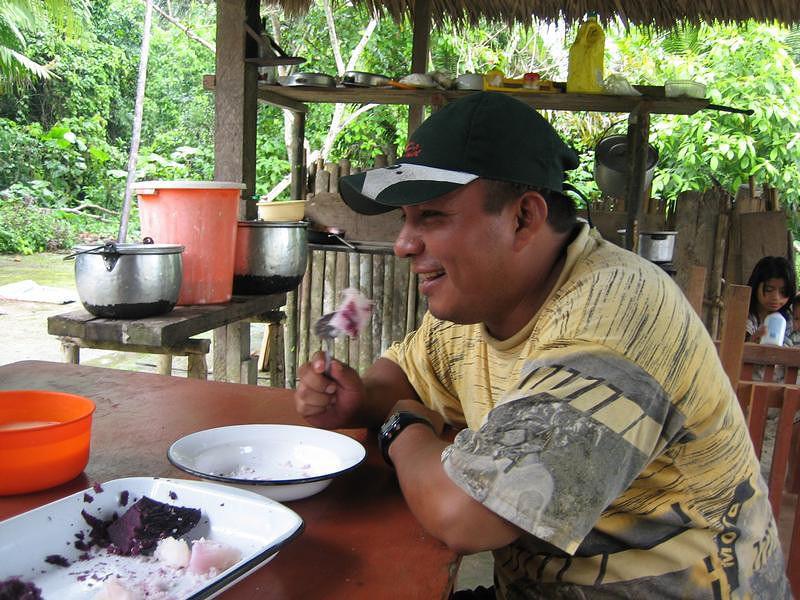
Je re-posterai juste une photo prise il y a quelques temps. C'est celle d'Edwin Montenegro, leader Huambisa, porte parole de l'organisation régionale des peuples indigènes de l'Amazonie et ami.
Il est aujourd'hui porté disparu.
Auto-réponse pour préciser que la situation s'est renforcé et que les natifs bloquent maintenant la route Yurimaguas-Tarapoto.
Aujourd'hui, 11 juin, a été décrété un paro nacional et des effectifs militaires ainsi que des hélicoptères ont pris position dans la ville de Jaen pour réprimer tout débordement.
Ne pas oublier ces massacres et dénoncer les excés de ce gouvernement fait parti de notre devoir.
Pour info, le gouvernement d'Alan Garcia avait déjà fait supprimer le CIRA (Certificat de non existence de restes archéologiques) pour les entreprises minières. Le CIRA était une autorisation permettant aux entreprises (construction de route, de lignes électriques, pétrolières, minières, ...) de creuser après que les archéologues aient donné leur autorisation. C'était une mesure permettant de protéger le patrimoine culturel. Elle a été suprimée pour les entreprises minières qui n'ont plus l'obligation de le demander.
C'est à dire que ce gouvernement a fait supprimer dans un premier temps tout ce qui touchait aux problèmes liés au patrimoine et maintenant, tout ce qui touche à l'attribution des terres. Autrement dit, il ouvre petit à petit un boulevard pour les entreprises privées en supprimant tous les possibles obstacles.
Quand est ce que les dirigeants Péruviens comprendront que le futur de ce pays est dans ses vestiges archéologiques et son incroyable patrimoine naturel et non dans les exploitations miniéres......
Quel malheurs pour ceux qui a travers la lutte pour le respect de leur territoire et de leur culture lutte aussi finalement pour toute la planéte.......
je suis attérée...naîve à pleurer....;sentiment de culpabilité quelque part....j'aime tant ce pays et ses 'natifs'....je ne voulais surement pas voir !
que d'autres horreurs nous cache-t-on .....
j'ai manifesté pour les droits du Tibet....à quoi cela sert il ?
et pour ce drame...
et pour tous les autres...
qu'on ne me parle plus de journée écolo :des brassements de bras inutiles ds des bureaux cossus, des diatribles inutiles...des capitalistes qui rigolent ..;et qui tuent !
au moins , cela servira peut etre que pour les prochaines elections, les gens se lo mire a 2 veces!
entre la bolivie et l'equateur, ils doivent se sentir un peu isolé..
allez peruviens! rejoingnez ceux qui refusent les multinationales americaines ..
MAIS QUELLE HORREUR!!!!
Je viens de découvrir la vidéo de cette barbarie, de ce carnage!!! comment des êtres (que l'on ne peut qualifier d'humains et même pas de sauvages )peuvent se comporter de la sorte!!!! que pouvons-nous y faire???? bien sûr que j'ai signé la pétition, bien sûr que je vais en parler autour de moi...ce sera ma contribution, bien dérisoire.....
Est-il encore possible de visiter ce pays??? on me dit que c'est sublime... notre périple en Amérique latine en 2010 passe par cet endroit.. est-ce prudent??? espérons que d'ici là, la situation s'améliore, que les Hommes redeviennent Humains...
J'ai appris ça avec effroi en écoutant Mermet...
2009 et toujours la même rengaine qui revient, à un moment ou un autre, à un endroit ou un autre...
Merci de le faire savoir ici, sur Vf, comme tu le fais. Forza.
"Quand le bûcheron entra dans la forêt, les arbres regardèrent la hache.
L'un d'eux dit aux autres: "ne soyons pas inquiets, le manche est des nôtres". D'après Pierre Marchand.
De toute façon c'est partout pareil, que ça soit dans l'Amazonie, à Madagascar ou en Afrique Centrale, on rase les derniers sanctuaires naturels pour y batir des mines ou implanter des terrains d'agriculture.
Et ce n'est pas quelques indigènes qui vont stopper la sacro-sainte croissance économique mondiale !
Bonjour,
Les 2 principaux décrets posant problèmes (1090 sur le Patrimoine Forestier et le 1064 sur la transformation des terres en zones agricoles pour biocarburants principalement) ont été suspendus pour 90 jours. Mais bon, la Ley de la Selva avait déjà été suspendue suite à de nombreuses mobilisations natives mais cela n'a pas empêché qu'elle soit validée via le DL 1090 justement. En fait, c'est toujours pareil, ils suspendent juste pour que les évènements se calment mais ces décrets n'ont pas été annulés et sont déjà en application. La blague, c'est qu'ils les suspendent pour négocier avec les natifs mais l'AIDESEP (http://www.aidesep.org.pe/) est exclue de la table des négociations.
D'une manière générale, le présent est malheureusement perdu pour tous ces peuples et le futur est plus que mal barré.
Tristes Tropiques...
Merci pour ton temoignage Zitoune !
Les manifestations a Iquitos se sont passees dans le plus grand calme mais avec aussi un tres fort encadrement policier et militaire qui laisse supposer que des renforts ont ete appeles.
Il faut calmer les masses ... jusqu'a quand cela fonctionnera t-il avec de telles blagues ?
D, abord merci pour toute cette information ; les médias sont bien silencieux.
Dans ton article tu parles de concessions faites à des entreprises d'hydrocarbure canadiennes. Sais-tu lesquelles ? Ou puis-je valider cette info ? est-ce que le lien entre les actions du gouvernement péruvien et ces entreprises est vérifiable ? Je demande car peut-être que d'ici, on peut faire des pressions publiques...
Bonjour,
Il s'agit essentiellement de corporations Canadiennes-US. Tu as par exemple la Newmont, la Barrick, Perenco (eux sont français-anglais), ...Il y en a plusieurs et leurs concessions ne sont pas un secret. Il suffit d'aller sur le site internet de ces compagnies, dans la section Amérique du sud et de regarder les gisements en exploitations et ceux en prospections.
Tu as une liste des entreprises minières au Pérou ici : http://mineriadelperu.com/compmineras.html#bookmark21
Il suffit de regarder celles qui travaillent en Amazonie et de retracer toutes leurs ramifications internationales. La plupart appartiennent aux mêmes corporations Canadiennes-US, ce ne sont que des filliales.
A cela, il faut ajouter les entreprises d'hydrocarbures (autre liste ici : http://mineriadelperu.com/empreelectricas.html#bookmark2).
Une liste des entreprises qui sont en prospections ici : http://mineriadelperu.com/empreexplorando.html
Bref, la liste est longue, très longue.
Comme par hasard, une forte augmentation de l'exploration minière et d'hydrocarbures a eu lieu au début du mandat d'Alan Garcia.
Pour ce qui est du lien entre ces entreprises et le gouvernement péruvien, oui, c'est facilement vérifiable puisque on est au Pérou et c'est le gouvernement péruvien qui accorde les concessions.
Bonjour
Nous sommes a Arequipa et des representants de defense de la Selva
invitaient les gens a signer la petition et a diffuser sur internet la realite
de la situation au Perou .
On pouvait afficher des temoignages de soutien sur les grilles de la cathedrale.
Il semble que certains jeunes etudiants et une partie de la population
prennent conscience de la gravite et de l urgence de regler ce probleme ....
Donc aidez les en signant la petition .....
C B
Signer la pétition, je ne suis pas sûr que cela serve à grand chose....
Pour la personne qui se posait des questions pour son voyage en 2010 : pas de problème. A vrai dire, il n'y a plus de problème depuis le 6 juin... La police a fait le ménage le 5 juin et on passe normalement par Bagua.
Juste pour faire remonter ce post et indiquer que la situation c'est durcie du côté de Tarapoto-Yurimaguas. Les natifs se regroupent et bloquent totalement la route. Le point positif, c'est qu'après le massacre de Bagua, le gouvernement marche sur des oeufs et je ne pense pas qu'ils comettent les mêmes folies que celles du 5 juin. Les natifs sont donc en position de force.
Pour ceux que cela intéresse:
Ce lundi 15 juin, le premier ministre Yehude Simon c'est rendu en Amazonie, dans le département d'Ucayali, pour arriver à un accord avec les Apus.
La réunion a débouché sur l'abrogation des décrets 1090 et 1064. C'est une première victoire. Maintenant, reste à voir s'ils ne vont pas contourner le problème en faisant voter d'autres lois qui noieront le poisson et feront passer la pilule en catimini.
Pour le moment, différentes réunions sont prévues avec des représentants des communautés natives et du gouvernement pour discuter et mettre en place des politiques de développement dont les natifs seront parti prenantes ainsi que pour discuter des modifications à apporter à l'ensemble des autres décrets qui touchent à ce problème (7 en plus des deux sus mentionnés me semble-t-il).
Du coup, les blocages ont été levés et la situation s'est stabilisée et revient à la normale petit à petit.
Reste à savoir si nous sommes face à une vrai volonté de changer la condition des natifs, de les considérer, ou bien s'il s'agit juste d'un écran de fumée. De ce côté là, les natifs sont vigilants, ils n'ont plus confiance, et sont en position de force. L'Etat péruvien marche sur des œufs et il est fort probable que d'ici peu le premier ministre mette son poste à disposition. Ils sont d'ailleurs en train de contre attaquer, de se dédouaner, et on commence à entendre que les évènements du 5 juin ainsi que les différentes mobilisations ont été mise en œuvre par des intérêts étrangers "pour déstabiliser la démocratie". Plusieurs pays sont dans le colimateur ainsi que plusieurs ONG.
Il rest pour le moment une interrogation : Quand saurons nous la vérité sur les disparus?
Où cela en est-il aujourd'hui?
Et qu'en est-il des disparus ?...
"Quand le bûcheron entra dans la forêt, les arbres regardèrent la hache.
L'un d'eux dit aux autres: "ne soyons pas inquiets, le manche est des nôtres". D'après Pierre Marchand.
Bonjour,
J'aimerais avoir votre avis.
Je pars jeudi au Pérou, je dois aller en Amazonie pour y effectuer un stage . Je ne peux donc pas annuler ni changer ma destination . Je voyage seule . Je dois traverser le pays. Je pars de lima pour aller à Jaen et ensuite à Bagua pour y rester dormir et ensuite en taxi je vais à Santa maria de nieva. Est ce du suicide, dangereux ou c'est faisable?
J'avoue j'ai très peur.
merci de votre aide
salut
PÉROU - Le nouveau visage de l'oppression
Pérou : le Congrès supprime les décrets à l'origine du conflit en ...
Pérou • Le Premier ministre démissionne
Pérou-Amazonie: Deux décrets annulés
RESPUESTA A PARLAMENTARIO BOLIVIANO
Bonjour,
Non, ne t'en fais pas, la situation est rentrée dans l'ordre. Il n'y a plus de blocage de route et le couvre feu a été levé à Bagua Chica.
Pourquoi vas-tu à Jaen? Pour aller à Santa Maria de Nieva, tu n'as pas besoin de te rendre à Jaen.
De Lima, tu prends un bus pour Bagua Grande. De Bagua Grande une voiture ou un combi pour Bagua Chica (30-45 min). De Bagua Chica, tu as des voitures qui partent tôt le matin pour Santa Maria de Nieva (comptes 8-9h).
Si ce n'est pas indiscret, que vas-tu faire à Nieva? Restes-tu à Nieva ou bien te rends-tu sur le Santiago ou le Cenepa. Dans ce cas, dans quell(s) communauté(s) dois-tu te rendre?
Bonjour
Ci-joint le lien des dernieres nouvelles parues sur le "monde" ici en France, je suis triste pour ce peuple et aussi que l'occident reste réservé.
Me marie en juin et nous avons prévu comme voyage de noce 14 jrs au perou. aucune agence ne peu nous proposer des voyage ou circuits a ces dates, (on se…
Voyager à petits prix › Pérou / Chili / Argentine · 7 replies
Holà! Après plusieurs mois de préparatifs, nous avons atteint le stade du stress pré départ! ;) On part en couple, le 10 octobre, destination Pérou, Chili,…
Amérique du Sud › Argentine / Chili / Pérou · 4 replies
Parce que voyager c’est aussi s’entre-aider je pense pouvoir compter sur la belle communauté de voyageur pour pouvoir préparer au mieux mon voyage. Je…
Pour ceux qui sont deja allés au Pérou, je voudrais savoir votre top 5 des choses à voir... Je vous invite a faire aussi le top 5 des choses qui vous ont…
Une amie et moi faisons un trip en Amerique du sud. Nous arriverons au Perou par la Bolivie. Nous avons environ 3 semaines (rien n'est fixé à l'avance et tout…
Hi,
My wife and I are heading to Brazil from November 6th to December 2nd. We’ll be stopping in São Paulo, Paraty, Ilha Grande, Rio, and Salvador de Bahia.
Could you recommend some nice, non-luxury places to stay in each of these spots?
Also, any suggestions for places to visit would be great.
Thanks in advance for your help!
Marc
Hi there.
I already posted a message asking for advice about our upcoming trip to Chile.
Details: Getting around by bus or train.
Starting from Valparaiso, heading north, passing through cities and places to visit, then returning to Santiago via a different route.
Avoid the beaches...
Thanks
Hello,
my wife and I will be in Cusco for a week in March 2027.
I’d like to organize the visit to the site on our own, combining the Sacred Valley and Machu Picchu.
We’d leave Cusco on Day 1 to arrive at the site in the morning, then stay in Aguas Calientes or Ollantaytambo, and on Day 2 return to Cusco while visiting the Sacred Valley.
Is this doable?
Looking forward to hearing from you.
Cédric.
Hi everyone,
We’re planning 40 days in Uruguay and Argentina in February and March, trying to avoid as much rain as possible.
We’re thinking of starting in Buenos Aires, then heading to Bariloche, and from there flying to Córdoba, Mendoza, or Salta. Maybe by bus or renting a car to explore each region.
Do you have any suggestions or tips for us? We love picturesque, historic cities and landscapes. As seasoned travelers, we’re used to planning our trips ourselves.
Thanks in advance!
Hello,
We’re spending 3 weeks in Rio between February 20 and March 15, 2027, to visit our son and daughter-in-law. We’re thinking of one or two "escapes" from Rio—3-day trips to get away from the city (so not too far, max 3–4 hours by car or bus). We’re all ears for suggestions! We love beautiful nature and authentic experiences, not so much the touristy spots... even though those spots are often in beautiful places, we’d rather avoid them.
Thanks for your insights!
Catherine
Hello,
we’re arriving in Fortaleza on February 14, 2027, and planning to rent a car to drive to João Pessoa in two stages. We’ll leave from there on the 20th or 21st to head to Rio. Our questions:
- Which stop between Fortaleza and João Pessoa would be the most enjoyable?
- How long does it take to drive from Fortaleza to João Pessoa?
- Are there any easy hikes (no guide needed) around João Pessoa?
Thanks for all your replies—I’m hoping for lots!
Catherine
Hi there,
I’m planning a trip with my partner (no kids this time—thanks, Grandma!) for two weeks to celebrate her 40th birthday. I’ve been thinking about Chile. We’re looking at leaving around September 18, 2027, starting in the south and returning in early April.
Here’s what I had in mind:
8 nights in a van in the Lake District and the start of the Carretera Austral (up to the Chaitén area). We’re set to arrive in Puerto Montt around 2:00 PM. We don’t want to go too far south since we’re planning to explore the heart of Patagonia (Chile and Argentina) with the kids when they’re older. The idea is to spend 3 nights discovering the lakes (up to Cochamó) and 3 nights in Pumalín Park. I’ve also added two transition nights.
7 nights in the Atacama to experience another side of Chile (San Pedro), taking a domestic flight from Puerto Montt to Calama in the early afternoon. We’ll depart for France in the early evening from Santiago.
IMPORTANT NOTICE for those planning to take a bus to another city, state, or destination from Salvador!
Starting January 20, 2026, the intercity bus station Rodoviária is changing its address!
The Rodoviária is leaving the Iguatemi area and will now be located in ÁGUAS CLARAS (about twenty kilometers from downtown Salvador).
A brand-new station (the most modern in Brazil) has just been set up there, accessible by car/taxi/Uber/metro.
Allow for much more transfer time (especially during rush hours), so leave early if you're heading to Chapada Diamantina or other Brazilian cities by bus.
Remember, there are also private transfers (even French-speaking ones) that can take you directly from your hotel in Salvador to your hotel in Chapada. Sure, it’ll be more expensive, but you’ll save on transfer time and comfort.
Tropical greetings from Salvador,
@ivanbahiaguide
Loyal member of the French-Speaking Brazil Forums for over 15 years already 😊 🇧🇷
Hello,
We’re thinking of spending 1 month in Chile, maybe doing a loop?
From 12/23 to 01/22.
What are the must-see sights, given we’re more interested in the country’s cultural side than the beaches?
Thanks
Hi everyone,
We're planning a trip to southern Chile in November. Here's our tentative itinerary:
Day 1: Arrival in Santiago, then a flight the next day to Balmaceda where we'll pick up a rental car to reach Coyhaique.
Day 3: Walk in the Coyhaique National Reserve, then continue to Puerto Chacabuco. Return to Coyhaique for the second night.
Day 4: Drive to Villa Cerro Castillo for a hike in the national park. Continue to Puerto Tranquilo and stay there for 3 nights.
Day 5: Boat tour on Laguna San Rafael.
Day 6: Day trip to Monte San Valentin Glacier.
Day 7: Excursion to the Marble Chapels, then drive to Puerto Guadal. We'll stay there for 3 nights.
Day 8: Walk along Lago Carrera and return to Puerto Guadal.
Day 9: Rio Baker Valley and, if possible, a glacier excursion.
Day 10: Drive to Cochrane and hike in Tamango National Reserve. We'll stay 2 nights in Cochrane.
Day 11: Walk in the Chacabuco Valley.
Day 12: Drive to Caleta Tortel. We'll stay there for 2 nights.
Day 13: Cruise in the Rio Baker delta.
Day 14: Return to Cochrane.
Day 15: Return to Balmaceda in two stages.
Day 16: Continue the return journey.
Day 17: Return the rental car and head back to Santiago.
After this, we're also planning to explore northern Santiago. I'll post about that part once I have a clearer idea of the route.
What do you think of this itinerary? Is it doable in 17 days?
Thanks in advance for your tips and recommendations.
martine
Hi everyone! So happy to be back on this forum—it’s packed with such useful info! 🙂 My husband and I are planning a 2.5-week self-drive trip to Colombia at the end of the year, including some domestic flights. My first question is: is it possible, easy, and safe to do a road trip in Colombia?
Below is our draft itinerary (with questions at each stop):
29/11: France → Colombia. Overnight in Bogotá.
30/11: Exploring Bogotá: La Candelaria and Montserrate.
01/12: Gold Museum (closed on Mondays). Drive to Zipaquirá (1.5 hrs) to visit the Salt Cathedral. Then drive to Villa de Leyva (3 hrs). Explore the town. Overnight in Villa de Leyva.
02/12: Return to Bogotá via Laguna de Guatavita (5 hrs). Is it worth the detour? Overnight in Bogotá.
03/12: Flight to Pereira. Drive to Salento. Overnight in Salento.
04/12: Cocora Valley (hike among the wax palms) followed by a drive around the area. Are there any waterfalls or other sights nearby?
05/12: Visit a coffee finca—any recommendations? Then explore the surroundings: Filandia, Manizales, waterfalls? Hot springs? Which ones?
06/12: Flight to Medellín.
07/12: Exploring Medellín: Centro, Plaza Botero, Comuna 13. How do you visit Comuna 13? Is it easy to get around Medellín? Metro? Buses?
08/12: Drive to Guatapé (2 hrs). Visit the town, stroll around the lake, then El Peñol. Overnight in Guatapé.
09/12: Return to Medellín.
10/12: Flight to Santa Marta. Drive to a hotel near Tayrona Park.
11/12: Tayrona—El Zaino entrance.
12/12: Tayrona—Palangana entrance, then Bahia Concha and Santa Marta. What do you think?
13/12: Drive to Minca (45 mins). Can we reach the village by car? Pozo Azul and Marinka waterfalls. Overnight in Minca (or back in Tayrona?).
14/12: Drive to Puerto Nao (5 hrs). Stop in Ciénaga on the way + boat tour in Nueva Venecia and/or Buena Vista? Not enough time? Overnight in Puerto Nao.
15/12: Exploring Cartagena: Centro, Getsemaní, the walls + La Boquilla if we have time.
16/12: La Boquilla (is it really worth it?) if we didn’t have time yesterday, then back to the beach.
17/12: Return to France.
So, what do you think? Is this doable, or should we tweak it? Thanks in advance for your invaluable feedback and tips! 🙂
Hi there, I’ll be in Brazil from December 10th to the end of February.
I’ve sketched out a rough itinerary but I’m not sure how to arrange it—considering the climate, year-end holidays, and Carnival.
Basically, I’m thinking of the Amazon, the Northeast coast with Lençóis Maranhenses National Park (but skipping Chapada Diamantina),
Ouro Preto, Paraty, and Ilha Grande—but no Rio visit.
Is this doable in 3 months?
Which direction should I take for this itinerary?
Thanks in advance!
Hi everyone, does anyone know the agency Ventura Travel Agency (not ventura travel)? After lots of research and quotes, it’s the only one offering Uyuni at a reasonable price while meeting all the criteria: transfer to the border, private-room accommodation, and a very fair rate. Other agencies or guides either offer shared rooms, no border transfer, or prices that are way too high. But I’d love to hear some reviews about this agency. Thanks in advance!
Hi everyone,
We're planning a trip to Chile to visit the Atacama Desert and then head toward Putre, Lauca, Salar de Surire, etc.
Which would be the better time to go, April or November?
Is an SUV enough?
Looking forward to your tips!
Hi everyone, French travelers in Chile—what credit cards do you use for your various car rentals in the country? I’m traveling in September and was planning to switch my regular debit card (a VISA PREMIER in deferred debit mode) for the deposit guarantee.
My rentals are with Figal in Punta Arenas, Econautos in Arica, and Chilean Rent a Car in Temuco, and all of them want the deposit on a credit card. For me, deferred debit *should* work, but I’ve read comments saying the opposite.
How’s it actually working on the ground with these rental companies right now? Will a deferred debit card work, or not at all?
In France, banks don’t issue credit cards, right—or am I mistaken?
Hi everyone, is it still possible to travel in Ecuador outside the Amazon region? If so, do you have a reliable agency to recommend? All your recent experiences from the past few months would be greatly appreciated. Thanks so much
Hi,
We’re heading to Buenos Aires for 3 days in November and would like to do a guided tour of a few neighborhoods. There are "free" tours, but none in French. Does anyone have a guide to recommend so we can really get to know the city beyond just the architecture?
Thanks
Hi there,
I’m desperately looking for info on the schedules and routes of (shared) boats to visit the islands of Lake Titicaca.
From what I’ve found, there’s a *combi* (bus) that leaves from Puno to go to Llachon. Where do you catch it? What are the schedules and frequency? Does it take about 1 hour?
Then in Llachon, you can take a boat to Amantani (45 min). Same question—where do you check for frequency and schedule?
After that, from Amantani, boats go to Taquile and then Uros. Do you have enough time to visit the islands between two boats? Frequency and schedule?
The goal is to do this tour independently (no agency) over 2 days. Thanks for any tips you might have!
I just got back from a trip to Bolivia and wow—what a wake-up call. It’s not the easiest country, but it’s absolutely stunning.
I started with Isla del Sol, perfect for easing into the altitude at a relaxed pace. Try to stay in the northern part of the island—it’s quieter and the views are insane. And the trout there? Unreal. Quick tip: bring cash in small bills; they almost never have change, and cards are rarely accepted.
Next up, La Paz. The city’s pretty wild, built in every direction. I did a few hikes in the area, including the famous Charquini Lagoon (the blue lake) at over 5,000 m—let’s just say I struggled 😅 but it was so beautiful it was totally worth it.
After that, I headed to Sajama. It’s cool, especially for the hot springs, and I stayed in Tomarapi. But honestly, if you’re short on time, you can skip it without too many regrets.
The highlight of the trip: the Salar. I did it starting from Tupiza, and I *highly* recommend going Tupiza → Uyuni. Way less crowded at the start and the landscapes are super varied. For the tour, I used SplitYourGuide to find a group, and it worked out great. Super handy for splitting costs and meeting people.
I wrapped up in Sucre—this city is gorgeous, all white, with such a chill vibe. And the salteñas + ice cream? Next level 😋
Bottom line: Bolivia’s a bit rough around the edges, sometimes exhausting (shoutout to the altitude), but it’s 1000% worth it.
If you’ve got questions or need tips, I’m happy to help!
Martin
I was planning to go to Réunion and stay in half-board accommodation with non-professionals, but it seems that’s not really the custom there—or maybe my budget isn’t big enough.
So, since I’ve already traveled around Ecuador and Peru, I’m now looking at Argentina, especially for its mountains (like the ones in Réunion that tempted me, even though—frustratingly—I could only admire them from below).
I plan to get around by bus and don’t know in advance where I’ll sleep, so I won’t book ahead. If I like a place, I might stay for several days.
I know that in Chile, it’s easy to find half-board accommodation, but what about in Argentina?
I’d like to stay with locals in half-board without it being a professional setup. I’m not sure if this is common practice there. It’s up to me to find someone willing to host me.
What do you think?
What would be a fair price (keeping in mind that 40 to 50 € is the max I can spend on accommodation, breakfast, and dinner)?
Hi everyone,
We’re heading to Patagonia for three weeks in November, starting from Coyhaique in Chile.
We won’t have a car, and I’m struggling to find information about transportation options for a few parts of the itinerary we’d like to do:
1) From Perito Moreno (the town, near Los Antiguos), we’d like to travel down Ruta 40 to visit Perito Moreno National Park and then cross into Chile via the Paso Roballos (at the latitude of Bajo Caracoles) to reach the road to Cochrane. Without a car, it seems we’ll need to use private agencies to get to the national park—do you have any recommendations or suggestions? Also, does anyone know if it’s possible to cross into Chile via Paso Roballos (from Bajo Caracoles) without a rental car? That is, without having to go all the way down to El Chaltén or back up toward Perito Moreno/Los Antiguos, etc.?
2) The second stretch that seems a bit tricky (though still easier, in theory) is from Caleta Tortel to Villa O’Higgins on the Chilean side. Do we have to go back through Cochrane, or are there ways to get directly from Tortel to Villa O’Higgins?
3) Finally, we’d like to hike into Argentina (El Chaltén) from O’Higgins. Any recommendations for this? Do we need to go through an agency? What’s the estimated duration of the trek?
As you’ve probably gathered, we want to visit some off-the-beaten-path spots but don’t have a car, so we’re looking for the best possible compromises.
Thanks so much in advance for all your suggestions!
Thomas
Hi,
we’re planning a round trip from San Pedro de Atacama, Chile, to Salta, Argentina, in two months. On the way there, we’ll take the northern route via Susques, Route 27, then 52. But for the return, we were thinking of taking the southern route via San Antonio de los Cobres, Route 51, then 23. Is it similar to the northern route in terms of road surface? How busy is it, and are there gas stations? Basically, should we be worried about doing it in an SUV that’s supposedly 4x4 but has regular road tires and no second spare wheel, obviously...
I’ve seen that we can stop over in San Antonio de los Cobres.
Thanks for your feedback.
Raf.
Hi,
we’ll be in Calama at the end of March 2026, and I’m looking for a reliable car rental there for a 7-day road trip to Salta, Argentina. But I’m struggling with the car rental agencies in Calama because the reviews can be scary. I saw Gyg, which has great ratings, but I’m a bit wary (5/5 from 59 reviews—either the guy’s amazing or it’s fake...), but I can’t find any recent reviews on VF in general.
For Punta Arenas, I booked with Dachelet and didn’t have any issues with email exchanges.
Thanks in advance.
Raf.
I’m planning the trip of my dreams for next November—Chile!
I’d love to get your thoughts on my potential itinerary. I know it’s a big investment in terms of both time and money, so every bit of feedback, suggestion, or info helps immensely. Thank you in advance!!
1-Flight to Santiago
2-Explore Santiago
3-Explore Santiago
4-Bus from STG to Valpo (2h) + visit Valparaíso + night in Viña
5-Visit Valparaíso + bus back to STG (2h)
6-Flight to Calama + bus to San Pedro + explore and acclimate in San Pedro + car rental in the afternoon (+Chaxa?)
7-(Very early) Valle del Arcoíris + Laguna Cejar + Valle de la Luna
Good evening,
We’d love to go in November to enjoy some beautiful beaches for about two weeks, preferably around Bahia, as November/December seems like a great time.
We’ve already traveled to Brazil several times and know the south of Rio as well as the region between São Luís and Fortaleza, and Chapada Diamantina...
What advice would you give us: the south with Itaparica, Morro de São Paulo, Boipeba, Barra Grande—or all four? Or maybe the north?
Thanks in advance for your help
Hi everyone, it’s been a while since I last posted!
First time in South America for me, my wife, and our 7-year-old son. I’ve put together this itinerary and would love to hear your thoughts:
Bogotá 28/07 – 30/07: Arrival. Which neighborhood and outings would you recommend?
Flight to
2 Filandia 30/07 – 03/08: (255 €). Waterfalls and horseback riding,
Cocora Valley,
Hiking,
Nearby villages.
Flight to
3 Tayrona 03/08 – 07/08: Hotel La Casablanca
Hike with Tierra Nevada and the Kogui village (any feedback?). Return by inner tube for the little one.
Short night hike.
Second hike to La Piscina, etc., return by 🐎.
4 Cartagena 07/08 – 10/08: Air-conditioned bus.
Staying in Getsemaní? Mangroves & the Castle, exploring the city.
5 Bogotá 10/08 – 12/08
Feel free to share your feedback!
Have a great day!
Hi,
During an upcoming trip to Peru, we’ll have one day to explore around Arequipa (excluding Colca Canyon) with a car and driver.
We’ve got a few options:
- Toro Muerto petroglyphs and dinosaur footprints at Querulpa
- Ruta del Sillar and Quebrada de Culebrillas