Hello friends
Imagine waking up before dawn to total silence, crisp cold air, and a sky so clear that the Milky Way feels close enough to touch.
You take a deep breath, click your shoes into your pedals, and look down. Spreading out thousands of meters below you, bathed in the soft golden glow of the rising African sun, are the vast, endless plains of Tanzania.
Then, you release your brakes.
Riding Mount Kilimanjaro isn't a story of extreme danger or terrifying drops. It is a story of pure, unforgettable freedom . It is the feeling of accomplishment when you realize that you—on your own two wheels, supported by an incredible local crew—just tackled the highest free-standing mountain on Earth.
Here is what the journey actually feels like:Day 1: Entering the Enchanted Jungle 🌿
Your ride begins at the gates of the rainforest. The air is warm and rich with the scent of damp earth and tropical leaves. You're spinning comfortably up winding singletrack under a dense green canopy. Blue monkeys chatter in the trees above, and every turn reveals moss-covered roots, gentle gully berms, and loamy dirt that grips your tires like glue. It feels like riding through a real-life fairytale forest.Day 2 & 3: Riding above the Clouds ☁️
As you break out of the jungle into the open heather and moorlands, the world completely opens up. Suddenly, you are pedaling above the cloud line. You look to your side and see vast white seas of clouds drifting below, with the jagged peak of Mount Meru poking through in the distance.
The pace here is slow, steady, and deeply peaceful. Pole pole (slowly, slowly)—as the local Tanzanian guides warmly remind you. It's not a race; it's a rhythm. You pedal, take in the breathtaking vistas, share laughs with your support team at lunch stops, and watch the landscape shift from giant flowering lobelias to dramatic volcanic formations.Day 4: Touch the Roof of Africa 🌅
Reaching the high camps and the summit zone is a feeling that stays with you forever. Standing with your bike at the summit—or high up on the mountain's shoulder—is a moment of pure emotion. Standing on top of Africa with your trusty rig, looking out over the entire continent, is a memory that no race medal or weekend trail ride can ever match.The Descent: 3,800 Vertical Meters of Pure Bliss 🚀
And then comes the reward you worked for.
Dropping down from the alpine desert back to the rainforest is hands-down the longest, most exhilarating continuous descent in Africa. You float over black volcanic dust, carve through open mountain ridges, and flow down smooth forest singletrack. With every kilometer dropped, warm air returns, your smile gets wider, and the arm pump feels like a badge of honor."Can I actually do this?"
YES.
You don't need to be a professional racer or a daredevil. If you enjoy long weekend rides, technical singletrack, and a good day in the mountains, this ride is within your reach. With proper acclimatization days, expert local guides carrying the heavy gear, and a relaxed, steady pace, it is an achievable, deeply rewarding journey.
It's more than just a bike ride—it's an expedition of a lifetime that connects you with nature, local culture, and the pure passion of mountain biking.
New discussions · East and Southern Africa
New discussions posted in forum sections, sorted by first message.
Showing 1–10 of 10 discussions.
Many threads here are in French, the community’s main language. English translations are added over time.
Après un premier voyage en 2009 (déjà !) où, en gros nous avions effectué un circuit passant par Hazyview, une réserve privée de Sabi sands, Santa Lucia et l’Isimanglio, Hluhluwe et le KTP partie Afrique du Sud puis un passage éclair en 2013 pour nous rendre au Lesotho, nous avions envie de revenir dans ce pays.
Pourquoi pas la région du Cap cette fois mais pas question de revenir dans cette partie du monde sans faire de safari. Mountain Zebra ou le Karoo me paraissent plus paysages qu’animaux et Addo ne m’emballe pas plus que ça... Ce sera donc le Kruger.
Les tarifs, horaires et durées de vol nous conduisent à un Paris-Le Cap, retour Johannesburg-Paris avec British Airways, donc via Heathrow.
Reste à mouliner tout ça pour caser pas mal de choses, sans toutefois faire trop de km ni changer d’hébergement tous les jours, du moins dans la région du Cap. Ce qui, au final donnera :
Arrivée au Cap samedi 10 octobre à 11h
2 nuits à Hermanus
1 nuit à Franschoek
2 nuits à Mountceder dans le Cederberg
3 nuits à Hout Bay
Le dimanche, journée de transition : vol pour Johannesburg, route en direction du Kruger, nuit à Lydenburg.
Kruger : 1 nuit à Letaba, 2 à Satara, 1 à Lower Sabie.
Dernière nuit à Mbombela (anciennement Nelspruit) avant le retour vers l’aéroport pour un vol retour en début de soirée.
Vendredi 9/10
Départ plutôt stressant.
Déjà, je me suis réveillée au milieu de la nuit, persuadée d’avoir inversé mon nom et mon prénom lors de l’enregistrement 🤪.... Pas moyen de me rendormir, même si je sais bien que British Airways ne me répondra pas avant 9h.
Bon, pour eux, tout est bon ... mais voilà qu’ils me parlent d’ETA ... un ETA pour l’Angleterre 😮 ? ?? Oui, c’est récent. A priori, ils n’en faut pas pour un transit air-air ... mais on ne sait jamais, il vaut mieux l’avoir quand même. Personne n’est fichu de me dire de manière claire et nette que ce n’est pas nécessaire. Au final, on ne le prendra pas ... et on n’en aura pas besoin.
Oui mais voilà, notre avion part finalement de Paris avec 45 minutes de retard (10’ de changement d’horaire et 35 ‘ de retard au décollage) et nos 2 heures de transit se réduisent à 1h15. Ça devrait le faire, non ? Le tableau indique notre vol Porte B : super, c’est juste à côté ! Mais porte B, 3 employés sont là, juste pour dire à tous ceux qui se présentent que la sécurité doit se faire porte A ... et c’est parti pour une course le long des allées, des escalators interminables qui montent et qui descendent, un petit tour en navette, la sécurité porte A (« vous allez être justes ! » Ah bon ? 😠) puis quasiment le même trajet en sens inverse pour finalement nous retrouver à quelques dizaines de mètres de notre point de départ ! 😠
L’embarquement est déjà bien avancé, d’avoir couru on a chaud on a soif mais ouf ! Ça y est, on est dans l’avion !
Samedi 10/10 Par contre, rien à redire sur ce vol Londres-Le Cap qui arrive ... en avance !
J’ai réservé une (petite) Suzuki S-presso parce qu’elle paraît avoir une garde au sol plus élevée que ses consoeurs. Malheureusement, nous héritons d’une Tata Tiago (si, si ça existe), plus basse (et aussi plus petite et au moteur encore plus poussif ...oui, on a pu comparer car à Johannesburg, nous avons bien eu une S-presso). Tant bien que mal, tout rentre dans le coffre (« surtout, ne laissez rien d’apparent ! ») et c’est parti pour notre premier hébergement à Hermanus, sous un soleil radieux.
Nikki nous accueille chaleureusement, nous explique ce qu’il y a à voir dans le coin et nous conseille de réserver un resto pour ce soir.
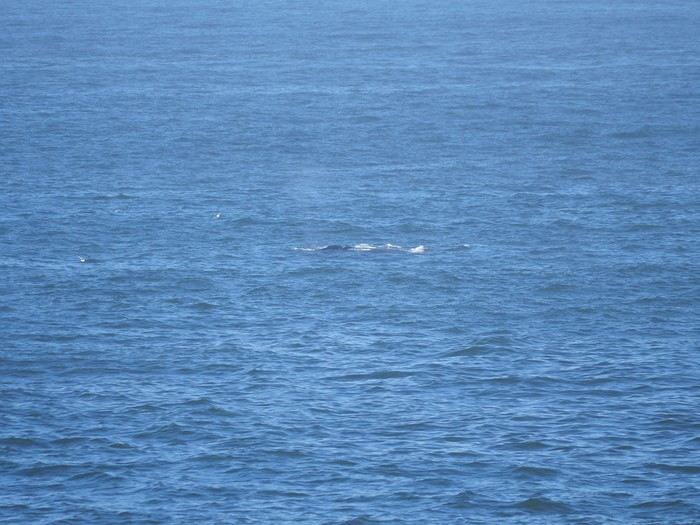
Une fois les bagages déposés, nous filons sur le « cliff path » à 3 minutes du logement. Cette partie de la côte est réputée pour la présence des baleines franches de juin à novembre. Tuons le suspense tout de suite : des baleines, il y en a mais elles sont très loin et très endormies 😕. Au mieux, nous verrons (photos prises au 600 mm): Quelques remous ou un vague panache,
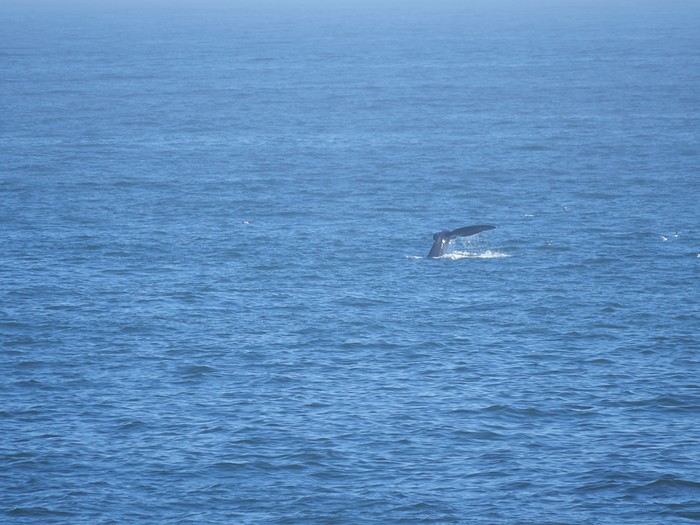
un bout de queue ...
... ou de tête .
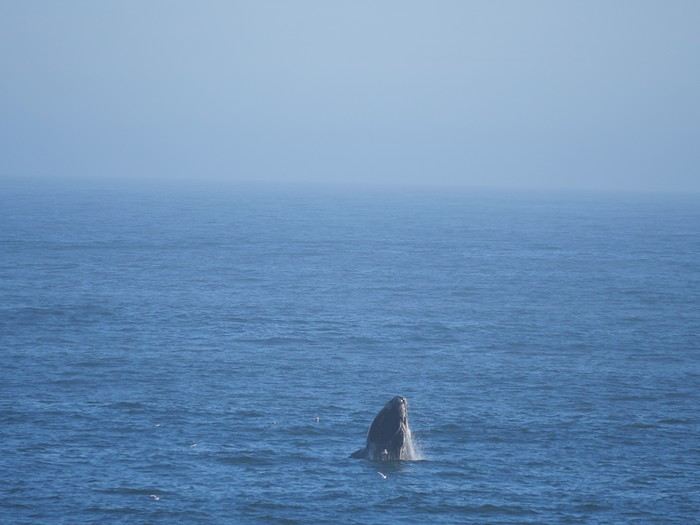
Dommage, la propriétaire de notre hébergement suivant nous dira en avoir vu ici une bonne trentaine très proches début septembre.
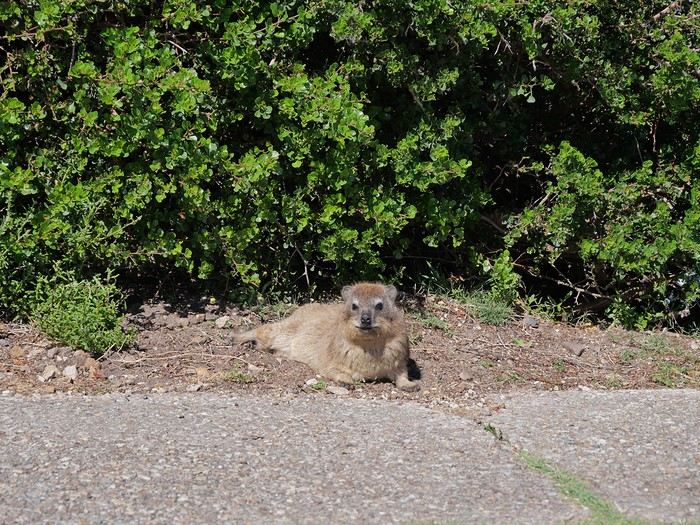
A défaut de baleines, les damans (ou dassies) sont légion ... et rigolos à regarder.
L'autre star locale (quand il n'y a pas de baleine 😏)
Pourquoi pas la région du Cap cette fois mais pas question de revenir dans cette partie du monde sans faire de safari. Mountain Zebra ou le Karoo me paraissent plus paysages qu’animaux et Addo ne m’emballe pas plus que ça... Ce sera donc le Kruger.
Les tarifs, horaires et durées de vol nous conduisent à un Paris-Le Cap, retour Johannesburg-Paris avec British Airways, donc via Heathrow.
Reste à mouliner tout ça pour caser pas mal de choses, sans toutefois faire trop de km ni changer d’hébergement tous les jours, du moins dans la région du Cap. Ce qui, au final donnera :
Arrivée au Cap samedi 10 octobre à 11h
2 nuits à Hermanus
1 nuit à Franschoek
2 nuits à Mountceder dans le Cederberg
3 nuits à Hout Bay
Le dimanche, journée de transition : vol pour Johannesburg, route en direction du Kruger, nuit à Lydenburg.
Kruger : 1 nuit à Letaba, 2 à Satara, 1 à Lower Sabie.
Dernière nuit à Mbombela (anciennement Nelspruit) avant le retour vers l’aéroport pour un vol retour en début de soirée.
Vendredi 9/10
Départ plutôt stressant.
Déjà, je me suis réveillée au milieu de la nuit, persuadée d’avoir inversé mon nom et mon prénom lors de l’enregistrement 🤪.... Pas moyen de me rendormir, même si je sais bien que British Airways ne me répondra pas avant 9h.
Bon, pour eux, tout est bon ... mais voilà qu’ils me parlent d’ETA ... un ETA pour l’Angleterre 😮 ? ?? Oui, c’est récent. A priori, ils n’en faut pas pour un transit air-air ... mais on ne sait jamais, il vaut mieux l’avoir quand même. Personne n’est fichu de me dire de manière claire et nette que ce n’est pas nécessaire. Au final, on ne le prendra pas ... et on n’en aura pas besoin.
Oui mais voilà, notre avion part finalement de Paris avec 45 minutes de retard (10’ de changement d’horaire et 35 ‘ de retard au décollage) et nos 2 heures de transit se réduisent à 1h15. Ça devrait le faire, non ? Le tableau indique notre vol Porte B : super, c’est juste à côté ! Mais porte B, 3 employés sont là, juste pour dire à tous ceux qui se présentent que la sécurité doit se faire porte A ... et c’est parti pour une course le long des allées, des escalators interminables qui montent et qui descendent, un petit tour en navette, la sécurité porte A (« vous allez être justes ! » Ah bon ? 😠) puis quasiment le même trajet en sens inverse pour finalement nous retrouver à quelques dizaines de mètres de notre point de départ ! 😠
L’embarquement est déjà bien avancé, d’avoir couru on a chaud on a soif mais ouf ! Ça y est, on est dans l’avion !
Samedi 10/10 Par contre, rien à redire sur ce vol Londres-Le Cap qui arrive ... en avance !
J’ai réservé une (petite) Suzuki S-presso parce qu’elle paraît avoir une garde au sol plus élevée que ses consoeurs. Malheureusement, nous héritons d’une Tata Tiago (si, si ça existe), plus basse (et aussi plus petite et au moteur encore plus poussif ...oui, on a pu comparer car à Johannesburg, nous avons bien eu une S-presso). Tant bien que mal, tout rentre dans le coffre (« surtout, ne laissez rien d’apparent ! ») et c’est parti pour notre premier hébergement à Hermanus, sous un soleil radieux.
Nikki nous accueille chaleureusement, nous explique ce qu’il y a à voir dans le coin et nous conseille de réserver un resto pour ce soir.
Une fois les bagages déposés, nous filons sur le « cliff path » à 3 minutes du logement. Cette partie de la côte est réputée pour la présence des baleines franches de juin à novembre. Tuons le suspense tout de suite : des baleines, il y en a mais elles sont très loin et très endormies 😕. Au mieux, nous verrons (photos prises au 600 mm): Quelques remous ou un vague panache,
un bout de queue ...
... ou de tête .
Dommage, la propriétaire de notre hébergement suivant nous dira en avoir vu ici une bonne trentaine très proches début septembre.
A défaut de baleines, les damans (ou dassies) sont légion ... et rigolos à regarder.
L'autre star locale (quand il n'y a pas de baleine 😏)
Hi everyone!
I’m planning the Cape Town part of our trip and would love to hike up Table Mountain via Platterklip Gorge and take the cable car back down.
Is it safe to hike this trail in early January without a guide (there are 4 of us: 3 adults and a teen)?
If a guide is highly recommended, do you know a good one?
If we end up taking the cable car both ways, is it safe to hike the summit without a guide (Mc Lear's Beacon trail)?
Same question for Lion’s Head: with or without a guide?
We’re used to hiking technical trails (Réunion Island), so my question is more about the risk of mugging on these trails.
Thanks for your feedback!
Malijp
Hi,
The Wild Card gives access to many parks in South Africa. Since the card is cheaper if you choose the "couple" option, I was wondering what they mean by "couple." Is it simply 2 people, with no family ties, or is it the "official" couple as many people understand it? In my case, I’ll be traveling with 2 buddies. Since there’ll be 3 of us, we could take 1 couple card and 1 individual one.
Thanks in advance
Hi there, my wife and I are likely going to spend a week volunteering at the in Bela Bela, near Hatfield, during the third week of May 2027. After that, we’d like to rent a car and spend a week in Kruger Park. What do you think about the timing and the type of vehicle? Also, which spots are best for accommodation so we can experience the park’s different sides? Thanks.
I’d like to visit Namibia by car and camping around February 8 to March 2, 2027.
Right now, I’m planning a route that covers all the main spots (desert, national parks, dunes, etc.).
My dates are flexible by a few days.
About me: I’m 63, in great shape, and I’ve always traveled solo or in groups.
Namibia forever—or our 4th trip to this stunning country.
A few surprises this year: brown hyenas, lots of rhinos, and a desert that was almost lush with oases.
From Okonjima to the Ongava Reserve, through Damaraland, the incredible lights of Spitzkoppe, the dunes of Sossusvlei with water, the nearly green NamibRand Reserve, and ending in the Kalahari. That’s the hearty journey we just completed between August 26 and September 14, my wife and I, with 3,500 km of tracks in this amazing Namibia.
We’re regulars and totally crazy about stays in Southern and South Africa, and we’ve returned to Namibia for the 4th time. Not sure this will be the last!
We’ll present two parts.
The first part is a video showcasing our trip, hosted on our travel channel: https://www.youtube.com/@lolodetoul54
Namibia 2026 video: https://www.youtube.com/watch?v=Db9StdkERPs&t=4404s
The second part will recount the journey day by day once my wife finishes sorting through our thousands of photos from our two cameras and our smartphones. So many photos! Gone are the days of film when we shot sparingly. Today, it’s a photographic feast.
Our Namibia 2026 journey: We decided to switch things up by doing a counterclockwise loop around Namibia. Okay, it’s not a groundbreaking choice since you start with more wildlife-focused areas and end with landscape regions.
Our itinerary:
Frankfurt-Windhoek with Discover Airlines, direct flight, then 18 nights:
- Okonjima: 2 nights
- Mushara, east of Etosha: 2 nights
- Okaukuejo in Etosha: 1 night
- Ongava: 2 nights
- Damaraland at Grootberg: 2 nights
- Damaraland at Spitzkoppe: 2 nights
- Namib: 1 night
- Sossusvlei: 2 nights
- NamibRand: 3 nights
- Kalahari: 2 nights
Then back from Windhoek to Frankfurt.
Very soon, I’ll share this Namibian journey day by day. Patience!
For wildlife photography lovers, I’ll remind you about the 29th International Festival of Wildlife and Nature Photography in Montier-en-Der (52) from November 19 to 22: https://www.photo-montier.org/
For wildlife photography lovers, I’ll remind you about the 29th International Festival of Wildlife and Nature Photography in Montier-en-Der (52) from November 19 to 22: https://www.photo-montier.org/
When you think of traveling in Tanzania, you often picture high-altitude treks and 4x4 safaris. However, for those who prefer exploring on two wheels, the country’s vast network of dirt tracks, volcanic terrain, and diverse ecosystems make it one of Africa’s most rewarding cycling destinations.
Whether you prefer challenging alpine climbs, fast gravel trails, or coastal rides, here’s a look at what makes cycling in northern Tanzania so exceptional, along with some of the region’s best routes:
1. Climbing Mount Kilimanjaro by bike (Kilema route) Terrain: Singletracks through humid rainforest, gravel paths in the moorland zone, and alpine desert scree. * The experience: For experienced mountain bikers seeking a high-altitude challenge, the Kilema route is the official bike-accessible path on Kilimanjaro. The trail winds through lush rainforest before reaching the open heathlands near Horombo. Higher up, crossing the alpine desert toward Kibo demands endless bike carries and pushes, but descending through the forest canopy remains an unforgettable experience.
2. The full 360° loop around Kilimanjaro’s base Terrain: Red clay earth, two-track trails, rolling gravel, and volcanic paths (total loop of about 360 km). The experience: Circling Kilimanjaro lets you admire its landscapes from every angle. The route meanders through Chagga farmlands, coffee plantations, dense forests, and the open Maasai plains of the western side (like the West Kili area). It offers stunning views of Kibo and Mount Meru while passing through local villages.
3. From Kilimanjaro to Lake Natron (descent into the Great Rift Valley) Terrain: Technical gravel, dry riverbeds (wadis), unstable volcanic rock, and acacia scrub. The experience: This route takes cyclists from the fertile high slopes of Kilimanjaro to the dramatic, arid scenery of the Great Rift Valley. As you approach Lake Natron, the active volcano Ol Doinyo Lengai (“Mountain of God”) dominates the horizon. The final stretch across the Rift floor leads to the saline, serene shores of Lake Natron, a prime breeding ground for large colonies of lesser flamingos.
4. Wildlife zones and corridors Terrain: Packed dirt tracks, animal trails, and undulating bush paths. The experience: Pedaling through the northern circuit’s wild buffer zones and Wildlife Management Areas (WMAs) offers an authentic off-the-beaten-path cycling safari. Riding through acacia woodlands often provides sightings of savanna wildlife like giraffes, zebras, and antelopes in their natural habitat.
5. Coast to coast: From Kilimanjaro to Zanzibar Terrain: Varied surfaces—from highland dirt tracks to coastal asphalt and sandy island trails. The experience: Combining the cool mountain air of Kilimanjaro with the tropical Indian Ocean coastline, this long-distance route transitions from mountainous foothills to rural towns before ending at the coast for a boat crossing to Zanzibar. There, you can cycle along white-sand beaches lined with palm trees and through the historic heart of Stone Town.
Practical tips for cycling in Tanzania
Bike choice: A sturdy hardtail MTB, full-suspension MTB, or gravel bike with ample clearance (tires at least 2.0 inches) is ideal for tackling loose rocks, sandy patches, and corrugated tracks. Mid-drive e-MTBs are also popular for handling steep climbs. Navigation: Using offline mapping apps (like Maps.me) alongside pre-downloaded GPX route files is essential for navigating rural tracks where mobile signal may be nonexistent. Best time to go: The dry seasons—June to October and December to March—offer the best trail conditions, firmer ground, and clear mountain views.
Tanzania delivers the perfect mix of technical riding, impressive elevation, and cultural immersion right alongside local communities. Don’t hesitate to ask if you have questions about trail conditions or gear to bring!
Hello,
It seems to me that the yellow fever vaccination certificate is no longer mandatory to enter Uganda (if you're coming from a country exempt from this disease).
https://www.healthytravel.ch/fr/news?post=19366
Best to you all,
Have a great weekend!
Hello,
To read:
📋 Yes, travel insurance is now mandatory in the ETA application. Since October 6, 2026, the official Kenyan ETA portal directly includes a step to subscribe to mandatory government travel insurance for travelers required to obtain an ETA, even if you already have your own medical and repatriation insurance. This insurance adds an official extra cost of $44 plus payment fees of $8, totaling $52 on top of the ETA. The ETA application cannot be completed without paying for this insurance on the portal.
In the end, Kenya followed the Tanzanian "model".....!!
One more piece of good news.... Regards.
Puma2A
Recommended for you
 One-month road trip in Namibia
 In MIKUMI and SELOUS, Southern Tanzania (June 2024)
 From Ol Pejeta to Tsavo West (Kenya)
 Cape Town and Kruger: 12 days in February with teens
 The Waterberg
 The Pearl of Africa - July-August 2026
 South Africa in safari mode: February/March 2026
 A Few Days in Turkmenistan from Uzbekistan
Previous
Page 1 of 1
Next