Hi everyone,
After a break of a few years, I’m heading back to Madagascar this October. I’d like to travel from Diego to Maroantsetra via Cap Masoala as much as possible by bike—it’s my favorite way to travel. My questions: for the return trip to Diego once I’m in Maroantsetra, is there a possibility to take a flight, since the road option only starts much further south than Tamatave? Or where can I rent or buy a decent bike between Diego and Cap Masoala? For this bike trip, I’m open to any info—I love traveling rough. Someone might even want to join me on this adventure.
After that, I’d also like info on the northeast part (Mozambique Channel side) of Diego, which I’d like to explore by bike as well.
Thanks, and feel free to share any tips—just skip the paternalistic safety advice.
Laurent
I’ll be in Antalaha in October and need to get to Maroantsetra.
I’ve heard it’s possible by boat, but I can’t find any info about it.
So I’m wondering if I’ll have to arrange something with local fishing boats or something else, and whether it’s a risky trip since the sea can get rough on Madagascar’s east coast.
Has anyone done this before, or just know anything about it?
What do you think?
We’ve just returned from a trip with our 8- and 12-year-old sons, our eyes full of memories.
We went to Analalava, a village that’s hard to reach by dirt road in the dry season and impossible during the rainy season. The upside is that there are few motorized vehicles—it’s really off the beaten path.
Located at the mouth of a huge river, you have to travel 60 km by speedboat from Antsohihy to get there.
This was our first trip of this kind as a family—pretty adventurous, with plenty of questions and even some worries from my wife (bugs, safety, amenities, etc.).
We joined a friend who’s staying there, so we weren’t completely in the dark. I’ll give you the highlights without going into too much detail.
After arriving in Tana, we spent the night at a "high-end" hotel (La Ribaudière) for 56 € a night in a mini-suite with all the European comforts, then we left early the next morning.
We decided to hire a car and a guide for the trip from Tana, with a stop at Ankarafantsika Park. The guide accompanied us all the way to Antsohihy.
Leaving Tana, we got our first shock driving through the city, then we crossed stunning high plateaus toward Majunga (RN4). We zigzagged between potholes, zebu-drawn carts, broken-down trucks, and *taxi-brousses*. We passed through countless villages, honking all the way—pedestrians just have to watch out. Rice fields and tropical greenery filled every valley, water didn’t seem scarce. Then came the savanna and bushfires everywhere!
After a full day of travel and a few stops, we arrived in Andranofasika, the village at the park entrance. We thought the agency (Look Gazy) had booked us a room at the Blue Lodge, but there was a mix-up—no reservation, no space. So we headed to the park, which has about ten bungalows. It was amazing: right in the jungle with all the ambient sounds. Geckos in the room became our friends, frogs in the toilet, and HUGE spiders under the terrace roof—they didn’t budge. Comfort was still there, though.
We did three park circuits in one day with a guide. It’s a bit pricey, but it’s an excellent introduction. We saw lemurs (makis), birds, snakes, crocodiles, and fishing eagles—maybe we were just lucky!
On the third day, we headed to Antsohihy through more savanna and bushfires. The town was lively, but the Hotel Anaïs was a serious downgrade! Loud music late into the night, then dogs barking and howling for the rest of it. Bucket showers and squat toilets.
The guide left us here.
- Quick tip: guides charge by the day, excluding fuel, and the empty return trip is on you. When I got the quote, they offered 3 days of guiding, 2 days of return trips (about 700 km), plus fuel for 600 €! I turned it down—it wasn’t worth it. By the day plus fuel, it cost us 400 €.
The next day, we took the speedboat (I’d call it an uncomfortable, noisy, slow raft!) for the 60 km river trip through the mangroves.
- Tip: bring an umbrella to shield yourself from the sun, and maybe use your airplane earplugs!
It was a long, peaceful river—absolutely stunning. We were diving even deeper into the African vibe.
We arrived in Analalava at dusk. The sunsets over the nearby islands were incredible. It was 6:30 PM—back home, it stays light until 10 PM, so we’d have to get up early to make the most of the days. Here, it’s winter: "almost cool" at night (20–22°C) and 30–32°C in the shade during the day.
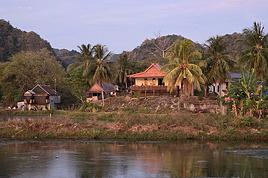
A friend found us a bungalow to rent next to his (which he rents year-round). It’s solidly built with a palm-leaf roof, sheltered by huge mango trees. The bucket-and-squat toilets are outside, electricity comes and goes (when the neighborhood isn’t blacked out), and the view of the sea and islands is breathtaking (15,000 Ariary/day). Sometimes, the last pair of sifakas (that weren’t eaten 😕) passes by!
A woman comes every day to fill the water bucket from the well and takes any laundry we want washed—for a few Ariary. It’s her livelihood, and she’s happy to have the work, though I feel bad seeing her make endless trips with buckets on her head. She charges 100 Ars per bucket or per piece of laundry.
And there we were, deep in Africa, 8,000 km from our comfort zone. Surrounded by chickens, ducks, goats, and zebus roaming semi-freely. My wife was a bit overwhelmed by the "bathroom" at first, but she got used to it.
The plan: *mora mora* (take it easy), fishing, walks around Analalava, island expeditions, and—most importantly to me—the Bay of Morambe.
My friend on-site just got his own pirogue, built locally with an outboard motor—total luxury! He’s a great hunter-fisherman, so we ate amazing, ultra-fresh seafood during our stay, expertly prepared by his partner.
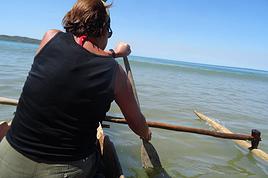
But the pirogue that was supposed to take us to the islands (Nosy Lava, Ilane, and Fao) came with challenges. Though it’s called *Freedom*, it wasn’t that simple. July is windy—the *Varataz* (trade winds) blows every morning and usually shifts in the afternoon. Pirogues without keels can’t sail against the wind and don’t handle strong gusts well. You can’t reef the sail, and there’s a risk of capsizing despite the float—it’s intense.
A local joined us to sail, and we waited for the right day. Fishermen weren’t going out because the wind was strong and didn’t shift.
Then one morning, after a windless night, we set off for Ilane—a tiny island with coconut trees and fine sand, like playing *Survivor*. We ate the day’s catch and coconuts; the kids were in heaven, and so were we. :) Though small, you can walk around the island in 20 minutes. It’s home to fishermen and littered with turtle skeletons :(
The return was more chaotic—like boat people at 4 AM in the waves before the strong wind picked up. We took the shortest route to shore and then hugged the coast with the motor. I wasn’t feeling great about it!
For Morambe, we negotiated a private speedboat (350,000 Ars/day + fuel). A full day’s navigation to get there—paradise, no other word for it. I hope it stays that way! I won’t say more. Getting there is an adventure in itself!
Originally, I just wanted to cross the Bay of Narinda by boat and reach Morambe on foot by crossing the peninsula, but the return wasn’t guaranteed. There’s little info about the place, and we didn’t know what to expect.
After two or three weeks soaking in the vibe, we were ready for the Malagasy return trip. We’d taken the speedboat too many times and wanted to leave Analalava by 4x4—some people make the trip to Antsohihy, but it’s not regular. No luck: the 4x4 was stuck in Antsohihy the day we left. So we took the speedboat again, then hopped straight onto a night *taxi-brousse* to Tana, leaving a buffer day just in case. The trip went smoothly, with music and a screen playing music videos all night—you just have to deal with it!
We arrived in Tana without any issues and had a day to explore the Analakelly market and buy some souvenirs. My wife splurged on a beautiful piece of Malagasy stone jewelry on Jewelry Street, right near the hotel (still La Ribaudière). She blew the budget!
Finally, a taxi took us to the airport, taking shortcuts to avoid traffic and giving us a mini tour for a good price: 40,000 Ars. We left him a bag of clothes.
This trip will leave us with unforgettable memories—and a few frustrations. We couldn’t enjoy the marine life because the water was murky from the constant wind during our stay—*maloutre*, as they say, even at Morambe and the islands. The failed 4x4 return was a bummer, too. We also wanted to do a big hike on the Narinda Peninsula, but it would’ve required more prep. Otherwise, no mosquito issues (fewer than in France!), no major digestive problems or other ailments. Safety? Didn’t see any issues, and we didn’t take unnecessary risks.
We’ve set the bar high for our next trips!
Hi everyone.
We’ve been feeling like there’s a big drop in activity on our forum...
Probably due to the current situation... Have any of you canceled or postponed your upcoming trips?
The forum is also facing competition from social media like Facebook and others, which play a big role in the political situation but are pretty limited when it comes to planning an individual trip.
The mandatory ads for new members on the forum are also a major turn-off that should be removed.
As for the current situation, I’m in Nosy Be, and there’s no problem here. I’d love to hear your thoughts on the future. I feel like this crisis is different this time and could lead to real change. Hope I’m not wrong!
Thanks for your replies!
I was caught off guard when the Malagasy consulate in Scandinavia informed me they don’t issue entry visas for Madagascar—what’s the point of a consulate, I wonder! They advised me to apply at the Malagasy embassy in London. So, I started filling out the online form, but the price for the visa made me do a double-take: nearly 200 €!
But apparently, you can also get it on arrival! Has anyone tried this before? I’d love to know if the process takes a long time (I’ll be landing in Nosy Be, exhausted after nearly 15 hours of travel), what the cost is, and—since corruption isn’t just a word—whether you absolutely have to grease the palm of the official(s). This is because I almost took the next flight back when I arrived in a country I won’t name. Even though all my documents were in order—passport, visa, vaccinations, hotel reservation—the immigration officer initially refused to stamp my passport. I later found out I was supposed to slip at least $10 into the document when presenting it...
Thanks!
/d
Just back from a week on Nosy Boraha, better known as Île Sainte-Marie. Mostly on Île aux Nattes, actually, at the very south of the island—literally just a few hundred meters from Sainte-Marie’s airport. Far east of Madagascar, and if you keep going straight, you’ll hit Australia.
We flew in through that airport to avoid a long, rough road trip before and after Tamatave, plus a boat ride that could be short or long (boat time was inversely proportional to the bus ride to the port for the Sainte-Marie ferry). No issues with Tsaradia—departures and returns were on time, service was impeccable, and the ATR plane was smooth. Too bad the prices are so high. We managed a change due to a delayed Kenya Airways flight.
First, we stayed in the northern half, on the west coast of the island, at Natiora Green Lodge. The place is absolutely stunning—a little cove opening onto a small bay dotted with rocky outcrops under lush vegetation. The bungalows are practically on the beach, in a gorgeous, forested setting alive with birdsong. It’s the perfect spot for a pirate crew and just begs for daydreaming. No reef barrier, so it gets deep pretty quickly, but the rocks have healthy coral and plenty of small fish. Great snorkeling—we even saw a turtle. Really, really nice. The only downside is that it’s a bit far from the island’s center and kinda isolated, so eating anywhere but the hotel or going for a walk without a rental car or tuk-tuk is tricky. Not impossible, but harder than if you’re somewhere livelier.
Next, we moved to Île aux Nattes at Baboo Village, which overlooks the channel between Nosy Boraha and Nosy Nato. The bungalows are right on the water, nicely and simply decorated, with a restaurant and terrace right next door. You get to the hotel directly by pirogue from Sainte-Marie’s "embarcadère"—it takes 2-3 minutes, or a little longer if the motor’s acting up. The owner is super friendly and welcoming, with a relaxed, "family/friendly" vibe. There are often a few lemurs in the hotel’s park, adding life to the place, and the vegetation is beautiful once again. The path that circles the island starts right at the hotel entrance, making it easy to reach the island’s dock and the different beaches on the west, east, or even south. Several restaurants are within walking distance, and nothing’s far by pirogue anyway. You can also find the island’s "center" with a few small shops for basic supplies or a meal at a hotely. Since there’s no electricity on the island, the generator at the hotel runs from 6 PM to 10 PM, but you can charge your phone anytime by leaving it at reception. Kayaks are free to use and great for exploring—the whole island is doable, even if you’re not an expert. Just take your time. The upside of Île aux Nattes and Sainte-Marie’s east coast is the reef barrier and lagoon (unlike the west side), which means those gorgeous water colors, accessible coral, and shallow swimming spots. The only downside of Baboo for me, since I love snorkeling, is its location right on the channel. Personally, I prefer the south side of Île aux Nattes (near the Aurora) or the east side (like Kintana) for the lagoon views and easier snorkeling (though my wife didn’t agree). But as I said, those spots are still super easy to reach from Baboo. The west side’s okay, but I like it less—except for the view of Madagascar and the sunset. Again, totally subjective.
On Sainte-Marie, we didn’t try any restaurants other than Natiora’s. Not a ton of options, but it was fine. We weren’t fans of Chez Nono in Baie d’Ampanihy—overpriced for the tiny portions. Sure, the crab was good, but there was so little of it for the price. A bit of a rip-off, since crabs are everywhere and can’t cost much for Nono.
On Île aux Nattes, there are plenty of little restaurants. We tried three—Chez Adelaide, La Buvette, and Coco Sud—and every time, we had fish or seafood, and it was always good and generous, with great achards. Prices were very reasonable.
Of course, we soaked up the time, the light, the beauty of the place, the sounds, the smells... just chilling in full *tranquillou billou* mode.
We also did some activities. Snorkeling—I’ll come back to it. In 2019, I thought it was a disaster, with no nice spots and really disappointing. This year, I jumped in everywhere I could and tested spots I’d spotted on Maps or during my last trip. And it was *really* good. Mostly on Île aux Nattes: the south side near the sacred islet, west in front of Kintana, west north of the channel (especially the sand islets), and on Sainte-Marie at Natiora’s rocks. Lots of healthy coral and plenty of fish typical of the area. If you’re into big fish, this isn’t the place, but if you love coral and little critters, it’s awesome. Snorkeling outside the reef was disappointing again, and diving was too. Unless you get lucky, it’s not worth it, in my opinion.
The tour of Île aux Nattes with a meal included was great—perfect for taking breaks whenever you find a pretty spot to snorkel or just relax on a nice beach.
A trip to the sand islets was also really fun. You can’t stay long because it gets super hot, and you’re at the mercy of the tides. There’s a good flock of terns that probably nest there. The coral reefs on the east side of the islet are gorgeous. Really, really nice. Plus, the islets themselves are just stunning.
We chose to go to Ampanihy via the lagoon, hugging the shore—it’s beautiful, with amazing colors, a wilder coastline than the west, and views of seaweed farms. It’s a long trip, though, and at Ampanihy, there’s a pretty beach (but there are tons elsewhere) and a nice mangrove. Maybe it’s better to go by road to the bay and take a boat to explore the lagoon and stop somewhere without going all the way to Ampanihy, saving yourself 2 hours of boat time round-trip. Once there, you can take a little pirogue tour to the beach and through the mangrove. The way we did it, the trip wasn’t essential. As I said, Chez Nono was disappointing—bring a picnic or try Chez Samson instead.
Of course, we visited the pirate cemetery, a place I love even though there’s not much left to see—just a few graves, unfortunately, and some vandalism. The site is still magical, though, and you can let your thoughts drift with La Buse and William Kidd, who passed through here.
We organized all our outings with Crépin, who runs two small boats with his brother. We met him totally by chance, but we don’t regret it. We could adjust the trips based on what we wanted—where to stop or which spot to visit next—and Crépin handled the meals. Prices were super affordable for a full day. I can share his number if you want. We didn’t try anyone else, but I’m sure there are other great operators—I just can’t compare or recommend.
Good prep for anyone looking for an alternative to Nosy Be. Way fewer activities, sure, but also way fewer people and a really nice vibe on Sainte-Marie in general, and Île aux Nattes in particular. The beaches are more beautiful than Nosy Be’s, and there’s a reef and lagoon (it *is* the pirate island, after all). And in whale season, well, the whales.
Hi, is it possible to find out? How can I stay for 3 consecutive months in Madagascar, based on a fixed-date flight ticket? In short, how do I get a visa stamped at the airport??
Does anyone know if there’s maritime transport from the southern tip of Africa to a port in MADAGASCAR?
CHEAPER THAN A FLIGHT, see you soon, fellow traveler!!
I’d like to explore the northeast of Madagascar, using bush taxis, boats, and my own two feet.
I already have an ideal itinerary in mind, but I’d love to know if it’s doable at a relaxed pace in one month. The goal, of course, is to avoid being constantly focused on time and days and to travel spontaneously.
I’m aware that the roads are rough and there are a lot of unexpected delays, which isn’t a problem in itself. I just struggle to estimate the *time* it takes to get between stops.
Potential itinerary:
Tana – Sainte Marie Island (4 days) – Maroantsetra (3 days) – Masoala Park (8-day trek?) – Antalaha – Marojejy Park (3 days) – Ambilobe – Nosy Be (5 days) – Tana
The days listed are just rough averages. Cities don’t interest me, and I don’t plan to visit Tana.
I’d really appreciate any info or tips from you all! 😊
hi, does anyone have any recent info on the condition of this RN6 route? roadworks? maintenance?
and of course, about the two river crossings at Gué between Ambanja and Ambilobe on the Ifatsy and Mahavavy rivers (at the entrance to Ambilobe)
condition of the ferries, possible start of work on the bridges (with the addition of Bailey bridges)
any info after the rainy season, meaning after April 2025
thanks
Hello,
My partner, who is Malagasy, would like to visit France (ideally in mid-August) and therefore apply for a short-stay visa (90 days).
I’ve heard that many applications are refused even when all the required documents are submitted, which is why I’m here—to get advice and guidance to be "almost" sure the application will be accepted.
I have a lot of questions, and your help would be invaluable to us.
She is 27 years old, has a passport with her current occupation listed as self-employed (she owns a "taxi-brousse" truck) and thus has a statistical card, a business license, and annual tax certificates. She started her business at the beginning of this year.
As for me, I am an adult with a disability. I receive disability benefits until May 2026. I’m in the process of professional reintegration and will start a job in a few days, likely on a fixed-term contract (CDD).
Here are my questions about the supporting documents to provide:
-Purpose of the trip/stay
Flight ticket reservation (round-trip) (the ticket should only be purchased once the visa is approved). Letter of commitment to return, written on plain paper. Any other document demonstrating potential family, economic, or material ties in the country of residence.
Confirmation of a booked organized trip or any other document outlining the planned itinerary.
I’ve been told that for the flight reservation, my partner just needs to go to Air Madagascar in Antananarivo and pay around 50,000 ariary to get this reservation. Given that the French short-stay visa takes between 15 to 45 days (I might be wrong) to be processed and approved, I wonder if the reservation will still be valid if the visa is approved late.
For the letter of commitment to return, I assume two sentences are enough, and what matters most are the documents proving ties to the country of residence (her economic activity). Do you think that will be sufficient?
And for the planned itinerary, since this isn’t an organized trip, what document could work? A handwritten letter explaining a few planned visits?
-Proof of residence in the country of origin
For employees: original work certificate, original leave certificate, last 3 payslips (or bank statements). For retirees: pensioner’s card and last 3 pension statements. For traders or entrepreneurs: professional registration, professional card, and recent bank statements.
For liberal professions: professional registration, professional card, and recent bank statements. For unemployed applicants and students: sponsorship letter and copies of the sponsor’s financial documents.
For this point, she can justify her self-employed status with the statistical card, business license, and annual tax certificates. As for bank statements, she deposits her earnings in cash into her bank account—will this be an issue during the application review?
-Financial resources
Bank account statements (last 3 months). Last 3 payslips or pension statements. Foreign currency allocation certificate, whose origin must be demonstrated (recent bank statement, savings account), issued by local banks or exchange offices (minimum 32.50 € per day if staying with a private individual or 65 € per day if staying in a hotel) or presentation of an international bank card with supporting account statement.
I need help with this point because I don’t fully understand what she needs to provide as a self-employed individual, especially since she doesn’t earn 32.50 € per day. I can obviously transfer money to cover this. So, overall, what documents should be provided for this section?
-Accommodation
Confirmed hotel reservation with the hotel’s phone number and reservation number / payment confirmation for stays longer than 1 month or original hosting attestation.
For this point, do I just need to write a handwritten letter stating that I will be hosting her? Then scan it and email it to her? Is that all?
-Travel medical insurance
Insurance certificate: must specify the amount and scope of coverage (30,000 € coverage / medical expenses and repatriation).
For this, I’ll opt for AXA Schengen insurance (low-cost). Any advice is still welcome...
I have one last question about the following point:
The short-stay visa allows you to stay for a maximum of 90 days for a continuous stay or multiple stays within the Schengen area over a 180-day period.
If we decide to leave the Schengen area during the stay (to visit the United Kingdom, for example), will the 90-day visa be paused and resume once we return to the Schengen area? And if so, can we plan a return ticket beyond the 3 months by justifying an exit/entry?
Thank you in advance for all your advice and suggestions. I may have forgotten some important points—feel free to let me know.
Can you tell me how long (on average...) the Tana to Tamatave trip takes with local minibus transport?
Which reliable company do you recommend for booking?
Hi there,
We’re thinking of doing the train journey from Fianarantsoa to Manakara again. Is the train still running? After that, we’re planning to go from Manakara to Fort Dauphin by 4x4. Thanks for any tips you can share!
Hello,
After over 40 years of traveling, I’ve never used a driver-guide before.
Given my age, this time I’d like to avoid being squeezed into a bush taxi. I’ve never rented a 4x4 but usually go for sedans.
So, for my upcoming trip to Madagascar, I decided to hire a 4x4 with a driver. I contacted about ten agencies and guides listed in the GR, LP, and travel forums. The quotes I got for 20 days range from 6000 € to 1300 €, with or without fuel included. Most ask for either a full bank transfer upfront or a mobile wallet payment (30%, etc.) from France.
Personally, I’d prefer to see the vehicle and the driver before making any payment.
Also, I’d rather pay at the end of my trip.
Is it possible to find a provider in Tana upon arrival for around 50 or 60 € per day, including fuel, with short notice, some flexibility in my itinerary, and without being forced to accept the dictates of agencies or drivers recommended on certain forums?
Thanks for your replies.
Hello fellow travelers,
I’m planning my trip to Madagascar for next March and I’m looking for info on how to get a visa and its cost for 13 days in Mada.
I’ve read that you can get the visa directly at Ivato, but what’s the price for the length of my stay?
Also, can you pay in euros?
Thanks for your tips and advice—they’re always welcome and super helpful.
Hi everyone,
I’m planning my trip to Madagascar for the fall and starting to think about getting my visa. After reading through different posts, I’m a bit unsure about the best way to go about it. Is it better to apply for an e-visa (and if so, which official website?) or just queue up on arrival? It seems there are "unofficial"—and therefore fraudulent—sites out there, and that you’ll have to queue either way (which I’m not thrilled about since I’m arriving at 11 PM). What do you think?
Hi there, we’re planning a trip to Nosy Be next summer and we’ve come across Neos Air, which offers direct flights from Rome and Milan. It looks really appealing, but how reliable are they, especially in terms of punctuality—particularly for evening departures?
Hi fellow travelers,
Can you tell me if it's possible to exchange money at Ivato or if it's better to do it at banks in Tana?
Which banks are the most "reliable"?
Regarding ATMs, what's the maximum amount you can withdraw in one go?
Thanks for your tips!
Hi everyone,
My friend and I are heading to Madagascar in March, and we were wondering if it’s possible to bring some cash and top up once we’re there (specifically in Tana).
Is it worth exchanging money if euros are accepted everywhere?
Thanks for your always super helpful tips on VF!
I just got back from an unforgettable road trip in Madagascar where I drove down the legendary RN7. It connects Tana (the capital) to Tulear.
Since we were traveling as a group of girls, we decided to go with a guide. I’d never done an “organized” trip before, but I have to say we loved this first tailor-made travel experience.
From the highlands of the Red Island
down to the west coast, by the Mozambique Channel.
Vast landscapes as far as the eye can see
Human encounters
Discovering ancestral artisanal know-how
Sunsets over the ochre mountains
Intense, precious moments with my friends
We loved the mountains, visits to artisans, and the parties too ;-)
We used local guides to show us specific spots (like Isalo National Park, where we were able to bivouac)
Hi there,
How do you get from Tamatave or Foulpointe to Sainte Marie Island? We’re heading to Madagascar from July 16 to 29, 2025.
How many days should we stay to explore the area?
What’s there to do in Tamatave, Foulpointe, or Sainte Marie Island?
What should we visit?
Thanks everyone!
Hi,
I’m taking the Cotisse bus soon to go to Antsohihy, so the route is Tana-Majunga with a stop at Antanambaza.
How long does it take to get to Antanambaza? Should I leave at 6:30 PM or 7:00 AM?
Considering I’ll probably need to find a hotel while waiting for a *taxi be* to Antsohihy, I’d rather not arrive in the middle of the night.
And since I’m asking—does anyone have a hotel recommendation in Antanambaza?
Also, can you find a seat on a *taxi be* mid-route?
I'm heading to Nosy Be (Madagascar) this coming October. This is my very first visit to this part of the Indian Ocean. I'd like to know if it's better to bring my bank card and withdraw cash from ATMs there, or if it would be preferable to bring cash in euros or dollars and exchange it for the local currency upon arrival.
Thanks!
/D
Hi there, I’m looking for info on whether it’s feasible to travel the Pangalanes Canal by boat from Toamasina to Manakara. I know the canal is poorly maintained with some sections that aren’t navigable. This is my 5th trip to Madagascar. Thanks for any tips!
Hi everyone,
We’re heading to Madagascar for a month at the end of June with the family. Our itinerary takes us to the East: Tana, Andasibe, Pangalanes, Tamatave, Mahambo, Sainte Marie; then up North to Sambava, Vohemar, and finishing in Diego Suarez.
One question that’s been on our minds a lot is about money and payments. We’ve seen some discussions on this forum, but they didn’t answer all our questions.
We have two Visa credit cards from two different banks. The banks are aware of our trip and shouldn’t block the cards. One card is from the Caisse d’Épargne, which has international options that avoid fees. We’ll likely use this card as our primary, and the second one will be a backup (since the fees are higher for that one).
We’ve heard that few shops and hotels accept card payments—is that accurate?
Several hotels seem to accept wire transfers to a Euro account, as some have asked for a deposit that way. The exchange rate offered is often poor, though (e.g., 1 € = 4,500 Ar)—is this negotiable?
Of course, we’ll bring some Euros in cash to exchange, but we don’t want to carry too much money on us. If we exchange Euros at a bank, is the wait long?
Once the cash runs out, we’ll need to withdraw from ATMs, but we’ve heard it can be a challenge—ATMs max out at 400,000 Ar, and the wait at the counter can be very long if we need more. Have you observed the same?
Is there also a way to pay using smartphone apps? Someone mentioned TapTap Send or Sendwave, and I’ve also seen the Orange Money app. Is one or more of these options reliable and widely used? I imagine this could be useful for many payments and help avoid burning through the cash we withdraw too quickly.
Hi everyone,
Everything’s in the title: what are the options for getting from M. to M.?
By *boutre* (traditional sailboat), I know, if you’re not in a hurry.
Is there a coastal track between Mahajanga and the Tsingy? Meaning, can you reach Bekopaka by track without going back through Tana?
Thanks.
hey everyone,
I’m planning a trip in July: I’d like to take a minibus from Tana to Mahajanga, then continue on to Antsohihy and Narinda Bay, take time to explore the area (Nosy Lava), and then head back down to Mahajanga if possible by boutre or, if not, by the track if it exists. Just to clarify, I’ve got a bike and all the time in the world.
Has anyone done this or have any info?
Thanks in advance!!