★ 2 · last edited Jun 11, 2020
Aosta
Contributionsversion #2created Jun 11, 2020Report this pageLatest contributions in this guideContributors to this guide
Location verified location
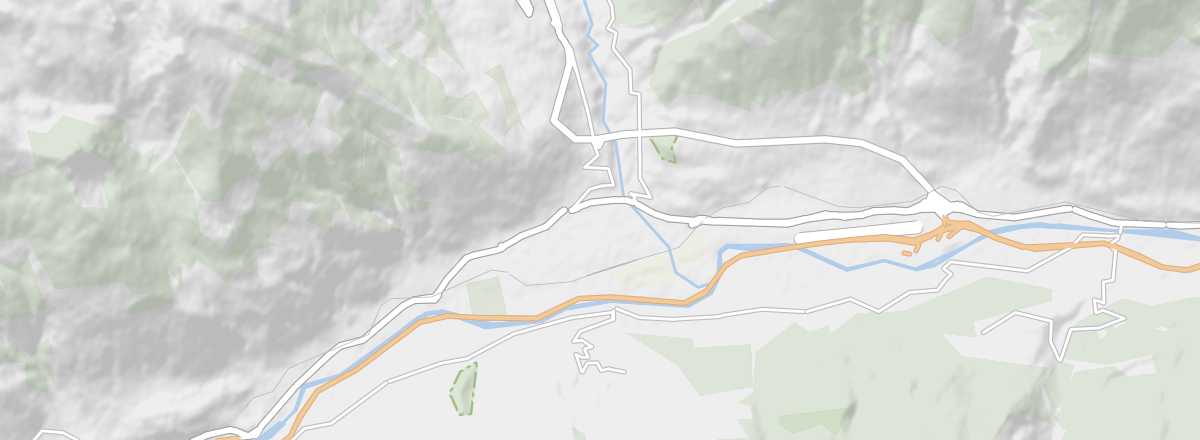 Aosta
Open the interactive map
Aosta
Open the interactive map
Nestled among the mountains, this small regional capital boasts Roman (theatre, walls...) and medieval (collegiate church, cathedral...) heritage. It’s also a gateway to France and Switzerland.
Overview of Aosta
Nestled among the mountains, this small regional capital boasts Roman (theatre, walls...) and medieval (collegiate church, cathedral...) heritage. It’s also a gateway to France and Switzerland.
Key facts
- Type de lieu: small town.
- Intérêt touristique: (worth seeing).
- Localisation:
- Distances:
- Heure locale: .
- Population: 34,964 inhabitants (2019).
- Area: 21 km²
- Altitude: from 583 to 2,607 m.
- Website: www.aostalife.it/
History of Aosta
What to see in Aosta
Aosta Cathedral
Built during the medieval period, the cathedral was renovated in the 19th century, giving it its neoclassical façade. Its interior is quite charming, and it also houses the cathedral treasury museum in its ambulatory.
Built during the medieval period, the cathedral was renovated in the 19th century, giving it its neoclassical façade. Its interior is quite charming, and it also houses the cathedral treasury museum in its ambulatory.
Saint-Ours Collegiate Church
This church dates from the 10th century and is an important testament to the history of sacred art in the Aosta Valley. Its interior, cloister, and priory are well worth a visit.
This church dates from the 10th century and is an important testament to the history of sacred art in the Aosta Valley. Its interior, cloister, and priory are well worth a visit.
Roman Monuments of Aosta
Aosta's history dates back to Roman times. From this ancient era, you can still see the theatre (the main monument) and the amphitheatre, the Arch of Augustus, the Praetorian Gate, the remains of a villa, a necropolis, and the remnants of the walls and towers that once encircled the city.
Aosta's history dates back to Roman times. From this ancient era, you can still see the theatre (the main monument) and the amphitheatre, the Arch of Augustus, the Praetorian Gate, the remains of a villa, a necropolis, and the remnants of the walls and towers that once encircled the city.
Archaeological Museum of the Aosta Valley
This museum is located on an excavation site. Its collections focus on the region's prehistory and Roman era.
This museum is located on an excavation site. Its collections focus on the region's prehistory and Roman era.
What to do in Aosta
Climate and weather in Aosta
Transport
Getting there
Getting around
Accommodation
Food
Useful addresses
Nearby
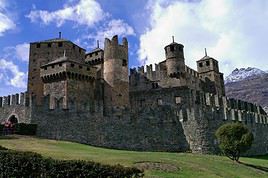
Fénis Castle
Located in the municipality of the same name, this medieval castle is the best-known—and one of the prettiest—of the many in the Aosta Valley.
Located in the municipality of the same name, this medieval castle is the best-known—and one of the prettiest—of the many in the Aosta Valley.
Saint-Pierre Castle
With its perched appearance, this 12th-century fortress is one of the most representative in the region.
With its perched appearance, this 12th-century fortress is one of the most representative in the region.
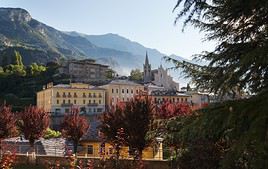
Châtillon
A large town at the foot of the mountains, featuring several churches and small castles (including Ussel Castle).
A large town at the foot of the mountains, featuring several churches and small castles (including Ussel Castle).
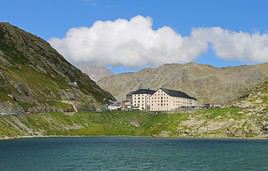
Great St Bernard Pass
One of the highest passes in the Alps (between Switzerland and Italy), highly popular with cyclists and lovers of stunning landscapes and hikes. The pass is also famous for its hospice at the summit and, above all, the St Bernard rescue dogs.
One of the highest passes in the Alps (between Switzerland and Italy), highly popular with cyclists and lovers of stunning landscapes and hikes. The pass is also famous for its hospice at the summit and, above all, the St Bernard rescue dogs.
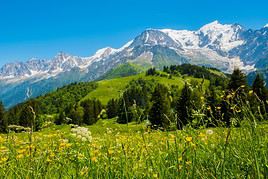
Mont Blanc Massif
This massif towering over Chamonix is a major tourist destination and hub for outdoor sports (hiking, mountaineering, skiing). Notable sites include the Aiguille du Midi (accessible by cable car), the Vallée Blanche, the Argentière Glacier, and the Mer de Glace, not to mention Mont Blanc itself, standing at 4,809 metres.
This massif towering over Chamonix is a major tourist destination and hub for outdoor sports (hiking, mountaineering, skiing). Notable sites include the Aiguille du Midi (accessible by cable car), the Vallée Blanche, the Argentière Glacier, and the Mer de Glace, not to mention Mont Blanc itself, standing at 4,809 metres.
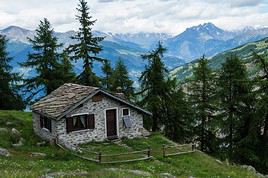
Gran Paradiso National Park
Located in Piedmont and the Aosta Valley, this is Italy's oldest national park. Amid stunning mountain landscapes, you can enjoy hiking, mountaineering, or skiing.
Located in Piedmont and the Aosta Valley, this is Italy's oldest national park. Amid stunning mountain landscapes, you can enjoy hiking, mountaineering, or skiing.
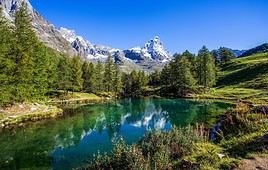
Aosta Valley
This valley gives the region its name. Beyond the mountain, lake, and glacier landscapes that surround it and offer hiking opportunities, the area boasts many charming villages and, above all, around a hundred medieval castles, including the most famous ones: Fénis, Verrès, and Saint-Pierre.
This valley gives the region its name. Beyond the mountain, lake, and glacier landscapes that surround it and offer hiking opportunities, the area boasts many charming villages and, above all, around a hundred medieval castles, including the most famous ones: Fénis, Verrès, and Saint-Pierre.
Further reading
Worth a look / Other
Saint-Ours Collegiate Church
★★ This church dates from the 10th century and is an important testament to the history of sacred art in the Aosta Valley. Its interior…
Roman Monuments of Aosta
★★ Aosta's history dates back to Roman times. From this ancient era, you can still see the theatre (the main monument) and the amphitheatre…
Aosta Cathedral
★ Built during the medieval period, the cathedral was renovated in the 19th century, giving it its neoclassical façade. Its interior is quite…
Archaeological Museum of the Aosta Valley
★ This museum is located on an excavation site. Its collections focus on the region's prehistory and Roman era.
Saint-Martin de Corléans
★ This is a megalithic site spanning five millennia of history.