last edited May 22, 2026
Money, Budget, and Shopping in Mauritius
Location Map of Mauritius
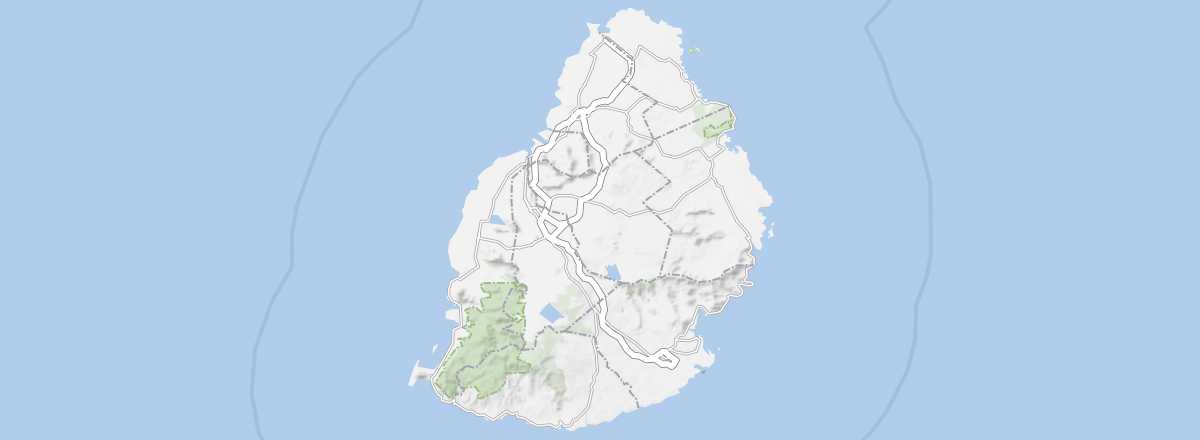 Mauritius
Open the interactive map
Money
Currency
- Currency: Mauritian rupee (100 cents).
- Banknotes: 25, 50, 100, 200, 500, 1000 and 2000 Rs.
- Coins: 5, 20, 50 cents + 1, 5, 10 and 20 Rs.
- Exchange:
Exchange
There’s no problem exchanging money in Mauritius. Exchange bureaus are easy to find at the airports of Mauritius and Rodrigues, in most banks, some hotels and all-inclusive resorts, as well as in many tourist spots. ATMs are also widely available across the country, and most major banks have them. Generally, banks are open weekdays from 9:00 AM to 3:30 PM (until 5:00 PM on Fridays).
Which currency to bring
If you live in the Eurozone, it’s obvious to bring euros, including small denominations. These can always be useful as a means of payment in many situations once you’re there. Otherwise, major foreign currencies can be exchanged without difficulty in Mauritius.
Payment methods
Generally, it’s best to always have cash and small change on hand to cover daily expenses and small purchases. Card payments, however, can be used for hotels, vehicle rentals, and in many shops in tourist areas.
Note that in tourist zones—and almost everywhere else—you can also pay directly for purchases in euros. This is always an option, even convenient if you’re running low on rupees, but it requires knowing the current exchange rate.
Returning home
Since the Mauritian rupee isn’t convertible abroad, there’s no point in bringing any home.
So, plan to spend everything or exchange any remaining rupees back into euros before leaving, even if the rates for such transactions aren’t always the best. In any case, especially if the amount is significant, keep your previous exchange receipts to prove the origin of the money you want to exchange.
Budget
Even though the island has a reputation for luxury and all-inclusive resorts, it’s possible to travel independently in Mauritius on a reasonable budget. That said, it would be a shame to stay on a "super-tight budget" while in Mauritius...
On average, budget around 40 € to 50 € per day per person as a backpacker traveling as a couple, using public transport, eating at markets or small restaurants, and staying in guesthouses or budget hotels. However, for more convenience and activities, it’s better to plan for 60 € to 70 € per day to truly enjoy the experience.
For those choosing the all-inclusive option, costs will depend on the activities, excursions, and services you want. While the selection is generally wide and high-quality, prices tend to be more European than Mauritian...
What can be expensive
- Flights to get there from Europe and, proportionally, from Réunion. The same applies if you plan to visit Rodrigues.
- Staying for an extended period in the main beach resorts.
- Some water activities (diving, boat trips, etc.).
- Peak season (November–January and, to a lesser extent, August).
What can be affordable
- Local meals, transport, and accommodations.
- Traveling off-season.
- The all-inclusive option, as long as all expenses during your stay are outside what the hotel offers.
Price range
- Double room in a backpacker hotel: around 25 € to 30 €.
- Double room in a mid-range hotel (non-all-inclusive): at least double that.
- Snacks or meals in a local restaurant: 10 € to 12 €.
- Meals in a tourist restaurant: budget around 20 € on average.
- Budget car rental: around 30 € to 40 € per day for agency rentals, and roughly the same for a private vehicle with a driver.
- Bus: 1 € to 2 € per hour for local buses and 4 € to 5 € for express/comfort lines.
- Urban taxi: 0.5 € to 1 € per kilometer if you negotiate (no meter).
- Hotel taxis: expect to pay about double.
Bargaining and tips
Bargaining
While bargaining isn’t necessarily a part of Mauritian society, you can always negotiate when buying souvenirs at markets, hiring a guide, renting a vehicle, or taking a taxi without a meter. You can also bargain for some water activities, especially if you’re in a group.
Tips
Since wages are low for many in the country, tips are especially appreciated and common, particularly in tourist areas, even if they aren’t "mandatory." It’s customary to leave about 10% of the bill at restaurants if service isn’t included, round up for a taxi driver, give around 1 € for a service, and 2 € per day for hotel housekeeping. For guides, it depends on the quality of the service provided.
In any case, while you can be generous, there’s no need to leave disproportionately large tips like those you might leave in Europe or North America. The amount of a tip, wherever you are, should reflect the service provided and the local cost of living. This holds true even if some recipients might pressure you for more.
Shopping and souvenirs
While Mauritius isn’t a top shopping destination, it can still interest visitors with its duty-free offerings. The following are tax-free: electronics, watches, phones, glasses, leather clothing, and jewelry. There are also many interesting markets in Mauritius, particularly in Port Louis.