last edited Sep 21, 2026
Getting Around Cambodia
Location Map of Cambodia
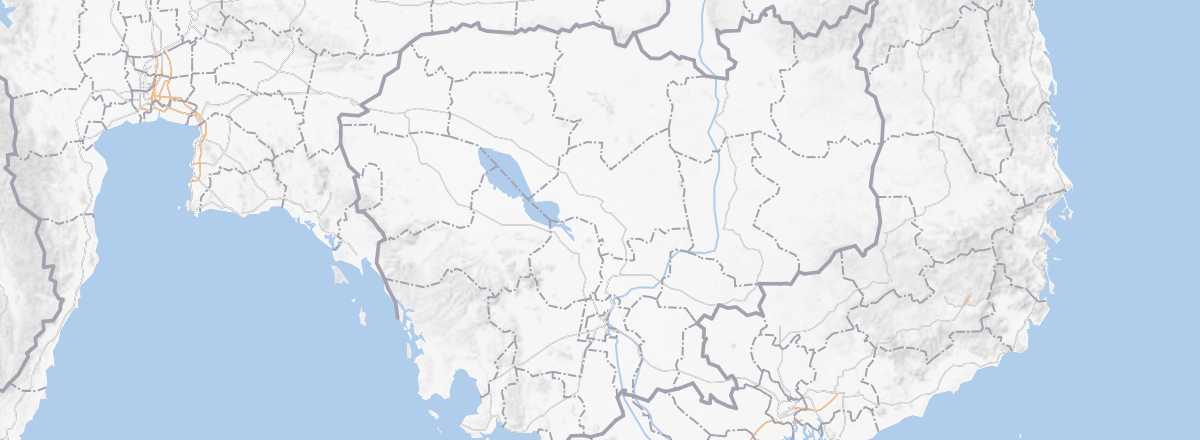 Cambodia
Open the interactive map
Cambodia
Open the interactive map
Road Network and Traffic
As in many countries in the region, Cambodia's road network is in good condition on major routes connecting the main cities, including a toll highway between Phnom Penh and Sihanoukville, but less so elsewhere. Some tracks and secondary roads can turn into real mud pits during the rainy season.
However, more than the condition of the roads, it's what's on them and how people drive that remains the real challenge. Driving here is less about following signs and more about anticipating what other vehicles, pedestrians, or animals might do. A few key principles apply, the main ones being that "the bigger vehicle always has the right of way" and that honking to signal your presence is essential. Best to be aware of this...
Car Rental
While it's theoretically possible to rent a self-drive car in Cambodia, no tourists do it—and it's even discouraged. Between the need for a local license, the difficulty of finding the few rental agencies that offer it (with hefty deposits), and safety concerns, it's not worth it. In Cambodia, you rent a car with a driver.
In practice, the range of rental vehicles is now quite broad. From compact cars to minibuses, agencies offer a good selection. What's more, the extra cost of a driver isn't usually too high (don't forget the tip at the end of the trip), and it makes daily life much easier—not just on the road. Prices remain affordable: around 40 €–50 per day for a small city car and 80 €–100 for larger vehicles.
Buses and Shared Vehicles
Cambodia's bus and minibus network is extensive, affordable, efficient, and covers almost everywhere. It's the preferred mode of transport for locals and most travelers for long distances or trips between cities and regions.
There are roughly three types of vehicles: first, "classic" buses, some of which are quite comfortable with air conditioning and onboard Wi-Fi. These are the safest and most practical for long trips, though you'll also find so-called Sleeper Buses (overnight buses), which are top-of-the-range with bunk-style seats and amenities for longer journeys. Then there are the 15-seater minibuses, which are faster than the big buses but have a more "sporty" driving style.
For all categories, prices remain reasonable, as does the value for money. Expect around 3 € per 100 km for basic buses and roughly double for premium options—or more for Sleeper Buses.
Two Wheels
Motorcycles and Scooters
While not as ubiquitous as in Vietnam, scooters and small motorcycles are a popular way to get around Cambodia. They're ideal for exploring cities and their surroundings, though you can also plan a full trip across the country.
Rental prices aren't excessive: around 8 €–12 per day, depending on the model, or about 30 € per week. However, watch out for traffic, theft (opt for guarded parking), and rental insurance.
By Bicycle
Exploring Cambodia by bike is a viable option. The country's mostly flat terrain, welcoming population, buses that can carry your bike, and the chance to avoid main roads make it an appealing experience, whether on a mountain bike or gravel bike. Just be cautious of traffic on the roads.
You can also rent a bike for short trips—along the coast, in cities, or especially for exploring the Angkor site, which is well-suited for cycling. Rental options are plentiful, from basic to electric bikes, including mountain and gravel bikes, with prices ranging from 5 € (or less) to 10 € per day.
Hitchhiking
As in many countries, hitchhiking isn't ideal due to potential risks and the low cost of transport for tourists. What's more, hitchhiking is usually paid and seen as a last resort when public transport isn't available.
Trains
After a period without a rail network, Cambodia has restored a line between Sihanoukville and Phnom Penh (roughly 6 hours for $10–12), followed by another section connecting the capital to neighboring Thailand, via Battambang (similar duration and price) and Poipet at the border.
More than just a mode of transport, the train here is a picturesque and budget-friendly experience, offering stunning landscapes. The Royal Railway carriages are fairly comfortable but not fast, with limited schedules.
Boats
Cambodia has around 2,000 km of navigable waterways. For a long time, these were the main way to travel between (some) cities and villages—until the road network improved, reducing the importance of boats for getting around. Still, you can cruise along the water, though regular services are dwindling, and the experience is now mostly tourist-focused.
You can sail on the Mekong, notably between the capital and Kratie, on Tonlé Sap Lake, or especially on the well-known route between Siem Reap and Battambang, enjoying scenic views over 6–8 hours for $25–30. Another option is Phnom Penh–Siem Reap (around $35–40 for 5–6 hours), though many now prefer the road. You can also reach some islands from Sihanoukville or even access neighboring Vietnam via the Mekong.
There are plenty of options—except at the end of the dry season, when water levels may not allow these trips. For visitors, though, it's more of a tourist activity than a practical way to travel.
Domestic Flights
Given the country's size, domestic flights are rare and limited to routes like Sihanoukville–Siem Reap and Phnom Penh–Siem Reap, serving the Angkor temples, the coast, and the capital.
In Town
Getting around Cambodian cities is simple and very affordable. The most popular urban transport for tourists is the tuk-tuk. A big advantage: most have apps (like Grab) for booking and knowing the fare upfront. Otherwise, negotiate before getting in. It’s cheap—$2–3 for a ride in the city center.
Alternatively, there are taxis and ride-hailing services, also with apps, for roughly double the tuk-tuk price. For those who prefer, moto-taxis are even cheaper. There’s also an urban bus network in Phnom Penh, though tourists rarely use it, and bikes or scooters—especially in Siem Reap, which also lets you visit the Angkor ruins.
What to Choose for Getting Around?
While a car with a driver is ideal for freedom, Cambodia is small enough to explore easily by bus at a low cost. You can add some biking or scootering to explore around cities or visit Angkor, and tuk-tuks for urban trips.
Distances Between Cities
Distances (km) between the main cities and tourist sites in Cambodia:
| Angkor/S.R | Battam. | K. Cham | K. Thom | Kampot | Kratie | Ph. Penh | Poipet | Sihanouk. | |
|---|---|---|---|---|---|---|---|---|---|
| Angkor/Siem Reap | xxx | 320 | |||||||
| Battambang | xxx | 300 | |||||||
| Kampong Cham | xxx | 130 | |||||||
| Kampong Thom | xxx | 200 | |||||||
| Kampot | xxx | 145 | |||||||
| Kratie | xxx | 270 | |||||||
| Phnom Penh | 320 | 300 | 130 | 200 | 145 | 270 | xxx | 410 | 220 |
| Poipet | 410 | xxx | |||||||
| Sihanoukville | 220 | xxx |