last edited Dec 11, 2019
Getting Around Sweden
Location Map of Sweden
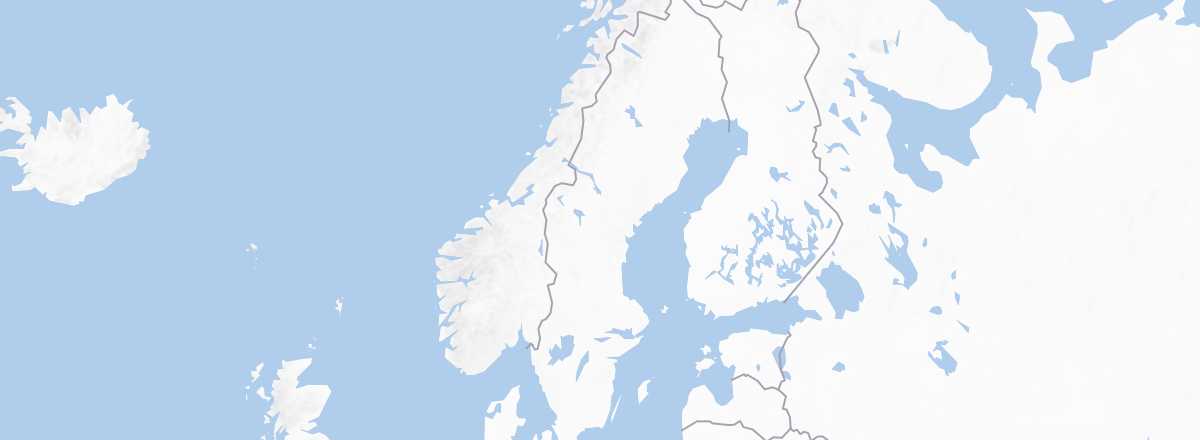 Sweden
Open the interactive map
Sweden
Open the interactive map
Road Network, Traffic
There’s no problem getting around Sweden by road, though winter driving does require some precautions. The road and motorway network (toll-free) is well maintained, even if officially three-quarters of the roads are not paved; these are mostly secondary roads, particularly in the northern part of the country. Note that the further north you go, the more you’ll need to watch out for reindeer and other animals on the roadside.
Driving rules are broadly similar to those in France, with a few local specifics due to the climate. Seat belts are always mandatory, the legal blood alcohol limit is no more than 0.2 g/l. You must drive with dipped headlights on at all times throughout the year, and from December 1 to March 31, winter tyres are required. Speed limits are generally 50 km/h in towns, 70, 90, or 100 km/h on roads, and 110 or 120 km/h on expressways or motorways. Speed cameras are very common and not always clearly signposted.
Also note that entering Stockholm and Gothenburg is subject to a charge on weekdays from 6:00 AM to 6:30 PM for vehicles (around 1 €), as are the Motala and Sundsvall viaducts.
Car, Camper Van
Personal Vehicle
Rental
Buses
While Sweden’s bus network is fairly dense and comfortable, it often serves as a complement to the rail system when a city lacks train service. However, it remains a viable option if you want to venture off the beaten path, especially since buses are generally cheaper than trains—though frequencies can be somewhat limited.
Several companies operate in the sector, with Swebus being the largest, covering over 180 destinations nationwide. With them, no need to book in advance—you can buy your ticket directly on the bus. Another relatively new company with a good number of routes is Bus4You.
Two Wheels
Motorcycle
Bicycle
Hitchhiking
Trains
Sweden’s rail network is well developed, with 13,000 km of tracks extending all the way to the far north. It connects all major cities, and where there’s no rail line, buses usually take over. Internationally, the network extends to Norway (Oslo, Trondheim, Narvik), Finland, Denmark via the Øresund Bridge, and even to Poland and Germany via train ferries.
Depending on the route, you’ll find high-speed trains, slower regional services, and sleeper trains for the longest journeys. You can travel in first or second class, with reservations mandatory on major lines. While several operators manage the network, the state-owned SJ dominates the market. Among the most scenic routes—beyond the tourist train Inlandsbanan—the line from Kiruna to Narvik (Norway) stands out for its mountain landscapes.
When it comes to fares, there are plenty of offers and discounts, and Sweden is also part of the InterRail pass system. As with French trains, prices can vary significantly for the same route depending on the time or day. At best, with flexibility, you can expect to pay around 4 to 5 € per 100 km. Despite this, trains (combined with buses) remain the best way to get around for those without their own transport.
Boats
Domestic Flights
Given the country’s size, Sweden has developed a fairly extensive domestic flight network, though like in many countries, it’s heavily centred on the capital, often requiring a stopover in Stockholm to travel between provincial cities. Several airlines operate domestic routes:
- Direktflyg: A very small airline with just one route, Östersund-Umeå, which may soon disappear.
- Höga Kusten Flyg: A small local airline operating flights between its base in Örnsköldsvik (in the north) and Stockholm-Arlanda.
- Kullaflyg: Offers a few regular flights between its base in Helsingborg and Stockholm or four or five other cities in the country.
- Malmö Aviation: One of Sweden’s main airlines, with a small European network and a strong domestic presence (around a dozen airports), some routes of which are subcontracted to other carriers. Its base is Malmö.
- NextJet: The country’s leading regional airline, operating flights within Scandinavia and to around fifteen Swedish airports. Its base is Stockholm-Arlanda.
- Scandinavian Airlines: SAS is the national carrier for Sweden, Norway, and Denmark. While it operates many international flights, it also serves domestic routes, particularly between Stockholm-Arlanda and around a dozen Swedish cities.
- Sparrow Aviation: A relatively new airline with two or three domestic routes.
- Sverigeflyg: A consortium of seven small local airlines offering domestic flights.
As with trains, fares can vary significantly depending on the day or time. On the busiest routes from the capital (Malmö, Gothenburg, etc.), you can sometimes find flights for around 60–70 € one way with some flexibility. In short, flying can be a practical option for certain trips.
In Towns
Taxis
Other Means
Urban buses:
Metro: Stockholm is the only city with a metro system.
Tram: Gothenburg, Norrköping, and Stockholm all have tram networks.
On Foot or by Bike
While walking is easy, Swedish cities are also well suited for cycling, with numerous bike lanes and plenty of rental options. Many urban attractions and tourist sites are easily accessible by bike. Given the climate, cycling is most enjoyable from roughly April to October.
What to Choose for Getting Around?
As always, having your own vehicle is ideal for travelling at your own pace, especially off the beaten path and in the northern part of the country, where public transport is limited. Otherwise, the "train + bus" combination still allows you to get around relatively easily across most of the country.
Distances Between Cities
Distances (km) between the main cities in the country:
| Göte. | Jonkop. | Karlsk. | Kiruna | Lulea | Malmö | Norrk. | Osters. | Stockh. | Umea | Uppsa. | |
|---|---|---|---|---|---|---|---|---|---|---|---|
| Göteborg | 470 | ||||||||||
| Jönköping | 325 | ||||||||||
| Karlskrona | 490 | ||||||||||
| Kiruna | 1235 | ||||||||||
| Luleå | 900 | ||||||||||
| Malmö | 615 | ||||||||||
| Norrköping | 165 | ||||||||||
| Östersund | 560 | ||||||||||
| Stockholm | 470 | 325 | 490 | 1235 | 900 | 615 | 165 | 560 | 640 | 70 | |
| Umeå | 640 | ||||||||||
| Uppsala | 70 |