last edited Dec 11, 2019
Getting Around the Bahamas
Location Map of Bahamas
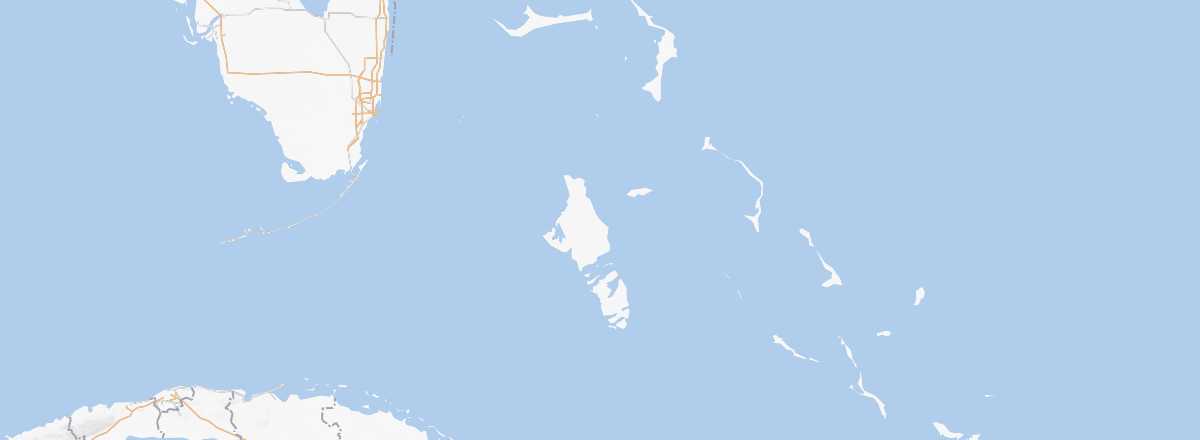 Bahamas
Open the interactive map
Bahamas
Open the interactive map
On the Islands
The islands vary in size, and with often limited but good road networks, transportation options are equally varied.
Car Rental
The widest selection of vehicle rental agencies—including international brands—is found in the capital, on New Providence, and on Grand Bahama Island. Elsewhere, options are more local and hit-or-miss. Note that on some islands, you can rent "golf carts" for getting around at a lower cost (around $40–60 USD per day) compared to more "traditional" vehicles (starting at around $60 USD/day).
Driving is on the left in the Bahamas, and you must be at least 25 years old and, in principle, hold an international driver’s license to rent. That said, given the size of most islands, the limited road networks, the prices, and the traffic jams in Nassau, renting a car may not always be essential. Especially since there’s no multi-island rental package available.
Minibuses
Only the islands of Nassau and Freeport have a public bus system called jitneys. These are shared minibuses that can carry up to a dozen passengers and operate throughout the day (from 6:00 AM to 7:00 PM). Widely used by locals, they’re plentiful, practical, and very affordable—the ideal way to get around on a budget. Expect to pay around $1.25 USD for every 10 or 15 kilometers.
Taxis
Two Wheels
You can rent a scooter (helmet required) in most tourist areas and hotels, though prices are often high—starting at $10–12 USD per hour at minimum and up to $100 USD per day. However, you might find cheaper local rental options.
The same goes for bicycles, which can be rented for $12–15 USD for a half-day or around $20 USD for a full day.
Hitchhiking
Hitchhiking is always an option.
Water Shuttles
Some small shuttles, some operated by major hotels for their guests, connect different points on the same island. This is the case, for example, between Paradise Island and downtown Nassau.
Between the Islands
Travel within the archipelago can be done by air or sea. While connections between tourist islands are fairly frequent, this isn’t always the case for others. Additionally, many routes outside the capital require a mandatory stopover in Nassau. This has led to the availability of private or chartered transport options, which can also be cost-effective if traveling in a group.
By Air
The Bahamas has around sixty airports and many small local carriers offering regular or on-demand inter-island flights, typically with small planes seating no more than 20 passengers. While domestic flights are usually short, they can be quite expensive (especially compared to Europe). It often costs over $100 USD for flights lasting just fifteen minutes, and there are no multi-flight passes available.
The main airlines, most based in Nassau:
- Air Charter Bahamas: Offers on-demand flights only, as the name suggests.
- Bahamasair: The national carrier. In addition to international routes, it serves around fifteen Bahamian airports.
- Cherokee Air: A small charter airline based in Abaco, operating domestic flights and routes to Florida.
- Flamingo Air: Based in both Freeport and Nassau, offering various domestic routes and charters to/from Florida on small aircraft.
- Golden Wings Charter: Similar to Cherokee Air, operating from Nassau.
- LeAair: Operates four or five regular flights and others on demand.
- Performance Air: Serves four or five local routes and specializes in regional charters.
- Pineapple Air: Connects around ten Bahamian islands, with Nassau as its base, and offers charters in the Caribbean.
- Sky Bahamas: Serves around ten destinations in addition to Florida (Fort Lauderdale).
- Southern Air Charter: Offers scheduled and charter flights from Nassau to around twenty Bahamian islands (and neighboring countries).
- Stella Maris: Provides on-demand flights to/from the resort of the same name on Long Island.
- Western Air: One of the largest local airlines. Based in Andros, it serves half a dozen local airports and other destinations in the Caribbean or Florida via charters.
By Boat
Options include more or less fast ferries, the famous "mailboats" (supply cargo ships), and all kinds of boats that can be chartered or hired.
Ferries
Several companies, some of which also serve Florida. Frequencies vary depending on the route.
- Acklins Free Ferry: Connects to the small island of Acklins.
- Alburys Ferry Service: Serves Abaco.
- Bahamas Ferries: The main ferry company, with routes from Nassau to Abacos, Eleuthera, Andros, and Great Exuma, among others.
- Green Turtle Ferry: A small company serving Abaco.
- Pinder's Ferry: Operates routes between Grand Bahama and Little Abaco.
Mailboats
Mailboat Company: Horseshoe Drive, Mailboat House, PO Box SS 19049, Nassau. Tel.: +1 242 502 2628. Open weekdays 8:00 AM to 4:00 PM, and Saturday mornings until 1:00 PM.
Mailboats are government vessels used to supply the archipelago (and originally to deliver mail). They travel between the various islands at their own pace, with more or less regular frequencies (often limited), and are used by many Bahamians for travel. Comfort is quite basic, and journeys can be long, but they remain economical compared to ferries and flights—costing roughly $5–7 USD per hour at sea. They’re a great way to travel between islands if you have time, plan your trips around their schedules, and don’t mind basic comfort.
Charters and Hire
Choosing Your Transport
It all depends on your trip, its duration, location, and, of course, your budget. For island-hopping, boats—especially mailboats—are a good option, though they require time due to limited frequencies between some islands. The advantage is that they’re always significantly cheaper than flying.
For getting around within the islands, jitneys (shared minibuses) can be a good choice where available. Otherwise, scooters or even "golf carts" are solid alternatives.
Distances Between Islands
Distances (km) between the main islands or archipelagos of the Bahamas, measured between their principal towns:
| Abacos | Andros | Bimini | Eleuth. | Exuma | G. Bahama | Inagua | New Prov. | S. Salvador | |
|---|---|---|---|---|---|---|---|---|---|
| Abacos | |||||||||
| Andros | |||||||||
| Bimini | |||||||||
| Eleuthera | |||||||||
| Exuma | |||||||||
| Grand Bahama | |||||||||
| Inagua | |||||||||
| New Providence | |||||||||
| San Salvador |