last edited Dec 26, 2019
History of the Dominican Republic
Location Map of Dominican Republic
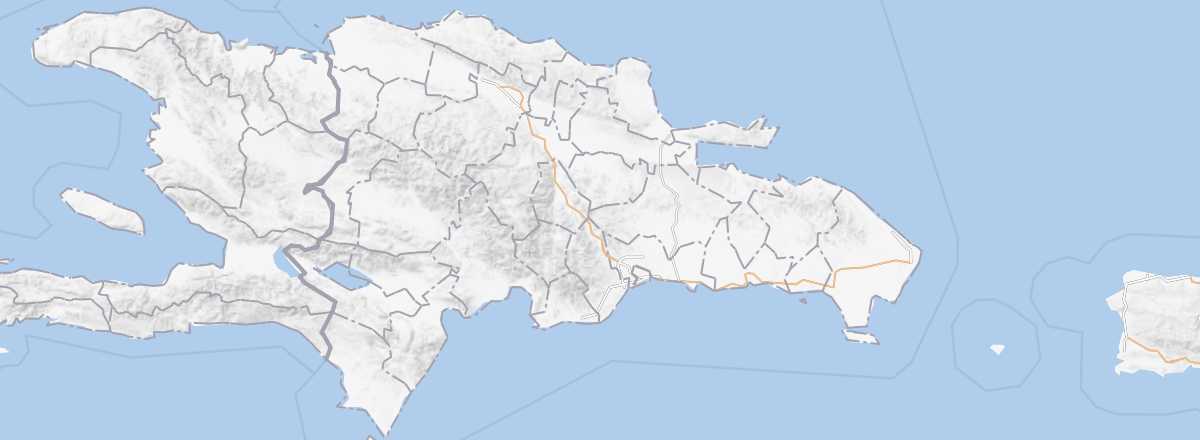 Dominican Republic
Open the interactive map
History of the Dominican Republic

Key Dates
- 1492: Discovery by Christopher Columbus of the island of Hispaniola, then inhabited by Taíno Indians, who were enslaved and decimated by epidemics shortly after the Spanish conquest.
- 1496: Founding of Santo Domingo de Guzmán, the first city in the Americas.
- Early 16th century: Massive arrival of African slaves to replace the indigenous people in mines and plantations.
- 1697: With the Treaty of Ryswick, the island of Hispaniola is divided between France, which occupies the west (present-day Haiti), and Spain, which retains the eastern part (Santo Domingo).
- 1791: Beginning of the Haitian Revolution led by Toussaint Louverture, which culminates in 1804 with the world's first free Black republic. Meanwhile, the Spanish part is ceded to France by treaty in 1795.
- 1802: With the Saint-Domingue expedition, Napoleon Bonaparte attempts in vain to reinstate slavery, abolished in 1793, and regain control of the territory.
- 1804: Birth of the Republic of Haiti in the west; the east remains under French occupation until the population expels the French army in 1809.
- 1809-1821: Santo Domingo reverts to Spanish rule until its population revolts again, and this part of the island becomes independent... for two years.
- 1822-1844: Reunification of the island by the Haitians, who invade the eastern part in 1822.
- 1844-1861: Due to numerous "socio-cultural" differences with their occupiers, Dominicans expel the Haitians and proclaim the republic.
- 1861: Facing pressure from its Haitian neighbor, the government turns back to Spain until a new independence is restored in 1868 after an uprising against the ruling power and its Spanish ally.
- Late 19th to early 20th century: Facing persistent and growing chaos and anarchy in the country, the United States intervenes, first establishing a protectorate over the country in 1906, then occupying it militarily from 1916 to 1924.
- 1930-1961: Dictatorship of General Rafael Trujillo, supported by the Americans, who is assassinated in 1961. During his presidency, 20,000 to 30,000 Haitian migrants are massacred in 1937 to "whiten the race" ("Parsley Massacre").
- 1963-1966: After a brief democratic interlude, several military coups weaken the country. Fearing a turn toward the USSR, the Americans occupy Santo Domingo between 1965 and 1966.
- 1966-1978: A former associate of Trujillo, Joaquín Balaguer, is elected head of the country. While the economy develops with American aid, the population endures twelve years of political repression.
- 1986-1996: After losing two elections to the center-left, Joaquín Balaguer is re-elected president for three terms. Slightly more "democratic" than before, he implements several economic reforms, some more beneficial to the country than others.
- 1985-2000: Tourism development on the island, but also massive economic emigration of Dominicans, particularly to the United States via the nearby island of Puerto Rico.
- 2003-2004: Several scandals and a local financial crisis undermine the Dominican economy and the population's standard of living.
- 2012: Newly elected President Danilo Medina commits to further developing tourism (and thus the country's economy) with the goal of doubling visitor numbers within 10 years.