last edited Aug 14, 2020
History of Ireland
Location Map of Ireland
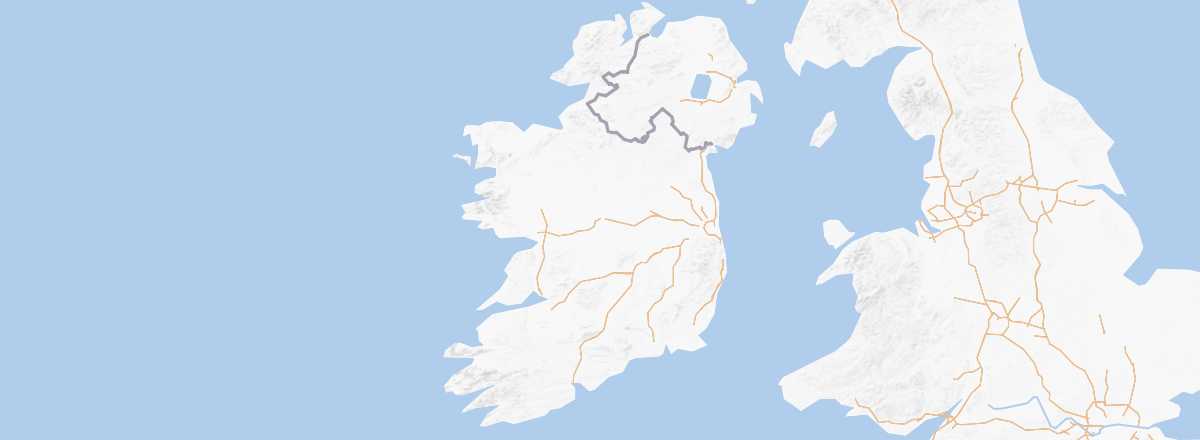 Ireland
Open the interactive map
History of Ireland

Key Dates
- 6th century BCE: Already long inhabited, the island saw the Celtic populations (the Gaels) gain increasing cultural and economic importance. At the time, the island was divided into several small kingdoms.
- Mid-5th century: The evangelisation of pagan Ireland was carried out by Saint Patrick.
- 6th-7th century: Cultural and religious development, notably with the creation of numerous abbeys across Europe by Irish Catholic monks.
- 8th to mid-11th century: Ireland suffered multiple raids and then invasions by the Vikings, who settled in the country and established various small kingdoms, often in conflict.
- 1171: The arrival of the English, who took advantage of local divisions to invade the island. Four years later, under the reign of Henry II, Ireland came under English sovereignty.
- Early 14th century: Like much of Europe, Ireland was affected by famine (1315-1317) and the plague (1348), which significantly limited its population.
- 1541: In a context of recurring rebellions, the Kingdom of Ireland was united with the Kingdom of England.
- Late 16th century: The religious reform imposed by the English power provoked a revolt among the population, who were attached to Catholicism. This was followed by the confiscation of lands for the benefit of English settlers.
- 1594-1603: Nine Years' War between Gaelic clan chiefs and the English power, which ultimately prevailed.
- 17th century: The entire century saw (in vain) multiple conflicts and rebellions between the native Irish population, increasingly discriminated against, and the British settlers supported by London.
- 1796-1798: A new Irish revolt led to the short-lived Republic of Connaught.
- Early 19th century: After the repression, England chose the path of "integration" for Ireland, with a stronger union between the two countries.
- 1845-1852: A great famine plunged the island into misery and drove tens of thousands of Irish people to emigrate, particularly to the United States.
- Late 19th century: The first autonomist/independence movements in Ireland were created.
- 1905: The creation of the independence movement Sinn Féin.
- 1916: The Easter Rising of 1916 proclaimed the Republic before being harshly repressed by the English. However, Sinn Féin emerged strengthened from the conflict and won the 1918 general elections.
- 1919-1921: A new uprising and the War of Independence against the British.
- 1921: After three years of struggle, Ireland gained its independence with the status of a British dominion. However, it was deprived of six counties in Ulster, where Protestants were in the majority and which, though autonomous, remained under English control.
- 1922-1923: Following political disagreements, a civil war broke out within nationalist movements between those advocating compromise with England and those pushing for total independence for Ireland.
- 1930s: A return to calm, economic improvements, and a distancing from England for the new republic, which remained neutral during the Second World War.
- 1937: A new Irish constitution. The country officially took the name of Éire.
- 1948: Éire left the Commonwealth and became the Republic of Ireland.
- 1969: Agitation among the politically underrepresented Catholics in Northern Ireland. British intervention and administrative management of the province by London three years later.
- 1970s-1980s: These two decades saw the Northern Ireland conflict led by the IRA reach its peak, before the peace process began in the 1990s and 2000s.
- 1973: Ireland joined the Common Market.
- 1990s: Strong economic development of the Republic of Ireland, then known as the "Celtic Tiger".
- 1995: By referendum, Ireland became one of the last European countries to legalise divorce.
- 2002: On January 1st, the Euro became the official currency in Ireland.
- 2005: The IRA officially renounced armed struggle in Ulster. Two years later, Catholics and Protestants shared power in Northern Ireland.
- 2008: After a decade of prosperity, the country was severely affected by the 2008 economic crisis, to the point of being placed under the supervision of the IMF and the EU between 2010 and 2013.