
Note that Northern Ireland is covered separately.
Travel guide · Ireland
Note that Northern Ireland is covered separately.
Ireland (the island) is made up of the Republic of Ireland ( Éire in Gaelic) in the south and Northern Ireland (sometimes incorrectly also called Ulster ) in the north. The former is independent (and predominantly Catholic), while the latter is part of Great…
Parc national de Ballycroy, Irlande · © VoyageForum With just over 60% of its population living in urban areas (which is quite low by European standards), Ireland boasts vast spaces where nature dominates in all its splendor, with mountain ranges,…
Ireland, like the British Isles in general, has never been known for its climate. While it’s fairly mild—not too hot in summer or too cold in winter, with small temperature ranges—the weather is above all changeable and especially rainy year-round, with rain every two or three days depending on the season. The west coast (Galway) is less sheltered and wetter than the east (Dublin). In any case, it’s usually showers or drizzle rather than big storms.
Climatically, the period from late April to mid-October is the best. You can expect daytime temperatures of 15–20°C and, crucially, less rain in spring, which is also the sunniest time of year. That said, Ireland’s climate isn’t an insurmountable obstacle to visiting the country.
| Jan. | Feb. | Mar. | Apr. | May | Jun. | Jul. | Aug. | Sep. | Oct. | Nov. | Dec. | |
|---|---|---|---|---|---|---|---|---|---|---|---|---|
| Climate |
: very favourable | : favourable | : moderately favourable | : unfavourable.
As you might expect, sea temperatures in Ireland aren’t particularly high either. The bravest swimmers might take a dip in the heart of summer.
| Jan. | Feb. | Mar. | Apr. | May | Jun. | Jul. | Aug. | Sep. | Oct. | Nov. | Dec. | |
|---|---|---|---|---|---|---|---|---|---|---|---|---|
| South Coast | 10 | 10 | 10 | 10 | 11 | 13 | 15 | 16 | 15 | 13 | 12 | 11 |
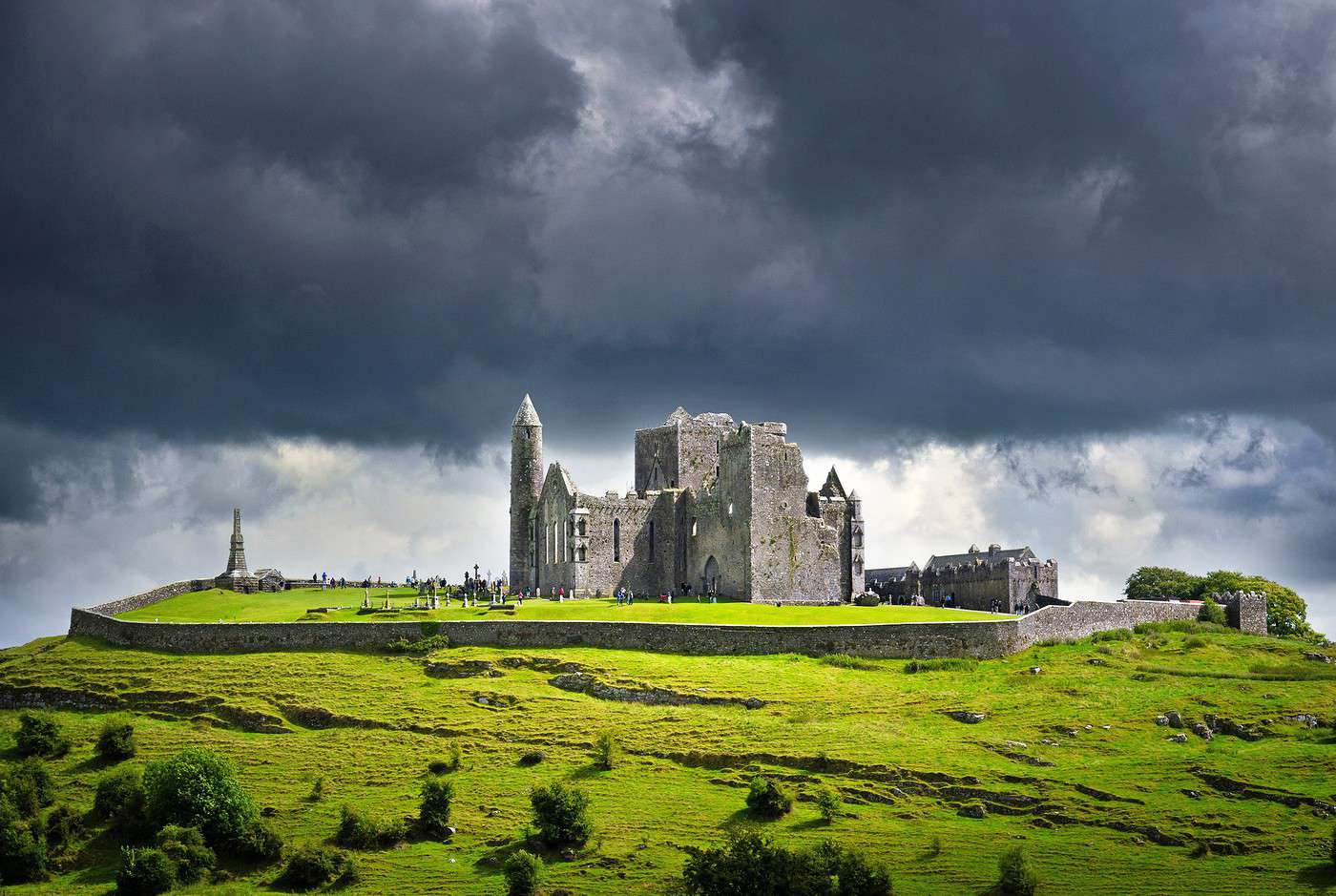
Cashel, Irlande · © VoyageForum 6th century BCE: Already long inhabited, the island saw the Celtic populations (the Gaels) gain increasing cultural and economic importance. At the time, the island was divided into several small kingdoms. Mid-5th…
English and Irish Gaelic are the country’s two official languages. While English is spoken everywhere and by everyone, Irish Gaelic is used by around 40% of the population, mainly on the west coast. That said, bilingual signage can be found almost everywhere.
A few local words and expressions useful to know when traveling:
Ireland has two sites inscribed on the UNESCO World Heritage list: Brú na Bóinne ★ (1993) Though not widely known to the public, it is one of Europe’s most significant megalithic sites. It is a UNESCO World Heritage Site. Skellig Michael ★★ (1996) A small,…
La Shannon, Irlande · © VoyageForum Canals and rivers: Travelling along Ireland’s waterways primarily means enjoying river tourism aboard small houseboats. The most popular route is the Shannon-Erne canal , linking these two rivers across both…
Though sometimes a bit "idealised and full of clichés", Ireland is still a beautiful "nature destination" by European standards. Both in the countryside and along the coast, its landscapes often captivate visitors and give the country all its charm.
With its historical heritage spanning from prehistory (the Bru na Boinne site, among others) to the present day, including numerous castles, abbeys, monasteries, and old urban districts, Ireland has plenty to delight "old stone" enthusiasts. Beyond that, it’s also—and above all—the specifically Irish culture and traditions (music, sports, etc.) that attract many visitors.
Aside from the festive atmosphere of a city like Dublin or during certain events, Ireland offers a peaceful setting for rest in the countryside or by the sea.
Ireland is a very easy destination for independent travel, perfect for beginner travellers, and poses no problems.
There are hardly any—or very few—package tours offered by tour operators, but rather a good selection of à la carte services.
Finding the best time to visit means balancing climate conditions with crowds and the most attractive prices for travel and on-site expenses.
Climatically, the period from late April to mid-October is ideal. You can expect daytime temperatures of 15–20°C and, crucially, less rain in spring, which is also the sunniest time of year. However, this is also peak tourist season—especially in July and August—as well as during spring holidays and long weekends, which draw large crowds, particularly in Dublin. In short, the best approach is to travel between late April and early October, avoiding school holidays and long weekends. That means focusing on May–June and September–early October.
| Jan. | Feb. | Mar. | Apr. | May | Jun. | Jul. | Aug. | Sep. | Oct. | Nov. | Dec. | |
|---|---|---|---|---|---|---|---|---|---|---|---|---|
| Climate | ||||||||||||
| Avoid crowds | ||||||||||||
| Low prices |
: very favorable | : favorable | : moderately favorable | : unfavorable.
Ireland has around fifteen commercial airports. Three (Dublin, Cork, and Shannon) handle truly international traffic beyond a few seasonal flights and/or services to neighbouring Great Britain. Unsurprisingly, Dublin Airport sees the most passengers, with 21…
There are 443 km of shared border between the Republic of Ireland and Northern Ireland . The land crossing points are numerous and hassle-free. Additionally, given the long "shared history" between Ireland and the United Kingdom, to which Northern Ireland is…
With nearly 100,000 kilometres, including 1,200 km of expressways, Ireland's road network is quite extensive for the size of the island. However, it can get congested near major urban areas. Rural roads are sometimes in mediocre condition, narrower and…
While Ireland has a fairly substantial tourist accommodation offering, it primarily revolves around B&Bs, youth hostels, and, to a lesser extent, campsites. The hotel range in Ireland is relatively limited. "Classic" hotels are not very numerous, and they may…
For tourist travel purposes.
A valid passport or national identity card is sufficient for an official stay of less than 3 months.
Note that Ireland is not part of the Schengen Area and border controls are in place. Additionally, identity documents must remain valid throughout the visitor's entry and stay.
The same applies to Canadians, Swiss nationals, citizens of the European Union, and a few other nationalities.
No special requirements for vehicles already circulating within the European Economic Area.
Consulate General: 4 rue Rude, 75116 Paris. Tel.: 01 44 17 67 00.
Provincial Consulates:
Currency: Euro (100 cents). Banknotes: 5, 10, 20, 50, 100, 200 and 500 €. Coins: 1, 2, 5, 10, 20 and 50 cents + 1 and 2 €. Exchange: It was in 2002 that the Republic of Ireland adopted the euro, replacing the Irish pound. As for Northern Ireland , it still…
In France, both for individuals and professionals, the "travel advice" from the Ministry of Foreign Affairs regarding precautions for each country has legal value. A similar online travel advice system exists in several countries: Foreign Affairs Belgium…
Given the changeable climate in all seasons, it's best to pack light clothing, some warmer layers, and above all, something to protect yourself from rain and wind. Also bring good shoes for walking in nature, waterproof gear if you plan to camp, and midge repellent in summer.
International dialling code: (00 +) 353.
As in the rest of Europe, the internet is well developed, and Wi-Fi is widely available in many accommodations, bars, restaurants, and other public places.
Local time: .
Ireland, like Great Britain, is on GMT. This means it is one hour behind France all year round.
230 V (50 Hz) with "British" plugs (officially type G), which will require an adapter for "French" and "North American" plugs.
In urban areas, most shops open weekdays from 9:00 AM to 5:30/6:00 PM (later for supermarkets). There is often an extended evening opening until 8:00 PM one day a week, which varies from town to town (often Thursday), as does Sunday opening policy. For services (post offices, banks, etc.), hours are roughly 9:00 AM to 4:30/5:30 PM on weekdays, with some larger branches sometimes open Saturday mornings.
Beyond the main tourist offices in large cities, there are also many information points in small towns and some villages in Ireland.
Something wrong or out of date? Report this page