last edited Dec 11, 2019
Introduction to Uganda
Location Map of Uganda
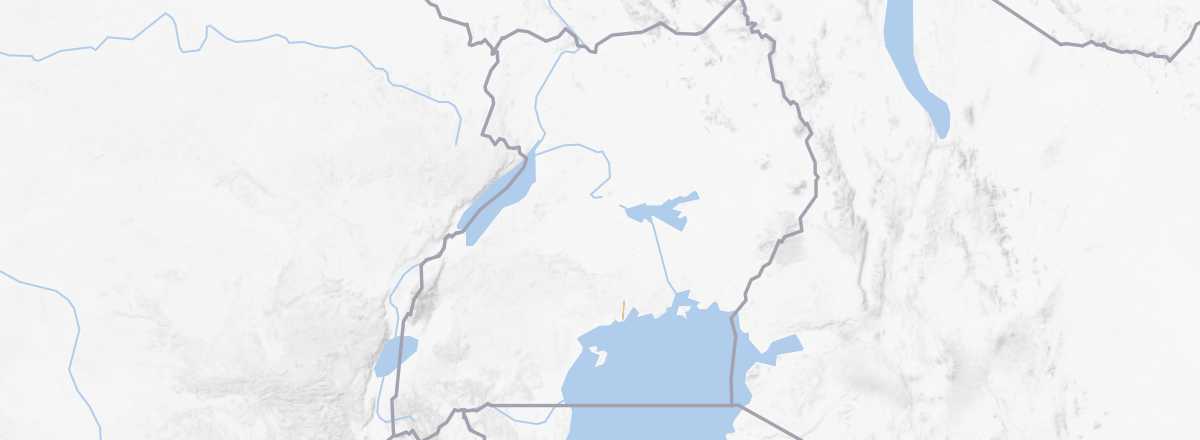 Uganda
Open the interactive map
Uganda
Open the interactive map
Quick Overview
Located on the equator in the Great Lakes region (including Lake Victoria), Uganda is one of Africa's smallest countries. Made up of a vast plateau at an altitude of around 1,000 m and covered with semi-desert savannahs in the north, it nonetheless boasts some of Africa's highest mountains along its eastern (Mt Elgon: 4,321 m) and southwestern borders (Ruwenzori: 5,110 m). It is also in Uganda that the Nile begins.
Key Facts
- Type of place: country.
- Location: at the heart of the African Great Lakes; west of Kenya.
- Latitude/longitude: 0°19' N, 32°35' E.
- Local time:
- Capital: Kampala
- Nature of the state: republic.
- Official languages: English and Swahili
- Currency: Ugandan shilling.
- Population: 40,853,749 inhabitants (2018).
- Area: 241,550 km².
- Density: 169 inhabitants/km².
- Highest point: Mount Ruwenzori (5,110 m).
- Lowest point: Lake Albert (621 m).
- Lakeshore:
- Driving: on the left.
Tourism
With nearly 2 million visitors (1.85 million in 2018), Uganda is still one of Africa's off-the-beaten-path destinations for many, especially the French-speaking public. That said, with its numerous national parks, the source of the Nile, and especially its mountain gorillas, Uganda has plenty to attract the most adventurous—and it’s no surprise that visitor numbers have doubled in just a few years.
Travel Essentials
- Destination:
- By air: France–Kampala.
- Entry requirements: passport valid for at least 6 months after the planned return date + e-visa.
- Currency to bring:
- Exchange rate:
- Daily backpacker budget:
- Best for accommodation:
- Best for getting around:
- Risks:
- Best time for climate/crowds/prices:
- Interests (out of ): Nature / ; Adventure ; Culture ; Relaxation/holidays /
Useful Addresses
Socio-Economic Statistics
- "Quality of life": 162/188 (2018 ranking)
- GDP per capita: $2,400 (2017)
- Average monthly income: ()
- Inflation: +5.6% (2017)
- "Official" unemployment: 9.4% (2014)
- Population below the poverty line: 19.7% (2013)
- Life expectancy: 56.3 years (2018)
- Migration rate per 1,000 inhabitants: -0.7 (2017)
- Population growth: +3.18% (2018)
- Literacy rate: 78.4% (2015)
- Urban population: 23.8% (2018)
- Press freedom: 117/180 (2018 ranking)
- Political regime: hybrid regime (96/167 in 2018)
Sources: World Bank, Human Development Indicators, RSF, The Economist, The World Factbook