last edited Dec 11, 2019
Overview of Cyprus
Location Map of Cyprus
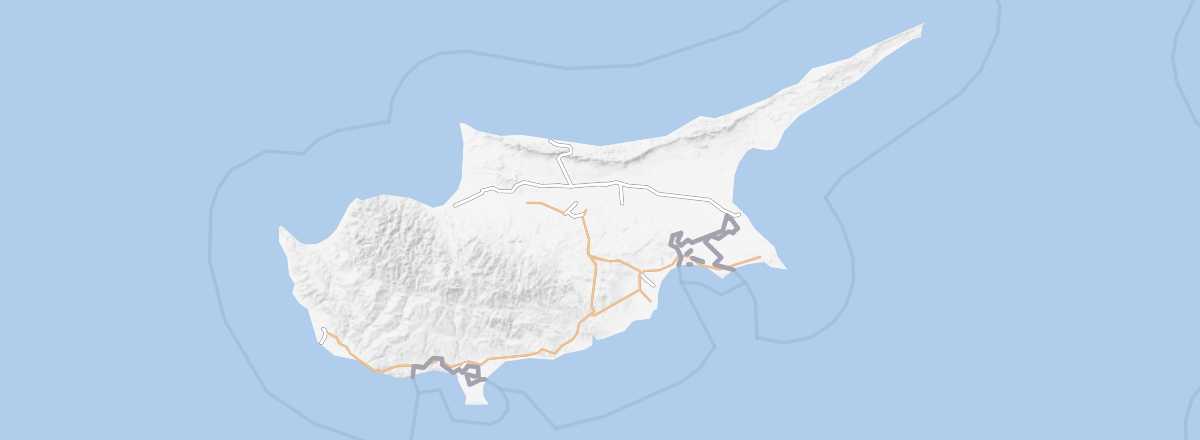 Cyprus
Open the interactive map
Cyprus
Open the interactive map
Quick Overview
Located at the eastern edge of the Mediterranean, near the Turkish and Syrian coasts, the island has two mountain ranges: the Kyrenia range in the north and the Troodos range in the south. The highest point is Mount Olympus (1,952 m), surrounding a central plain that is the Nicosia region.
Politically, the island has been divided for over forty years, with the independent southern part being the Republic of Cyprus (a member of the European Union) with a Greek population, and the northern part under Turkish influence called the Turkish Republic of Northern Cyprus, which is not recognized by the international community. Between the two lies a demarcation line known as the "Green Line", controlled by the UN.
The southern part remains by far the most populated (about 80% of the population), the largest (64% of the territory), and the wealthiest. Although Cyprus experienced a recession a few years ago that led, as often happens, to austerity policies, with a drop in living standards and precarity for part of the population, certain sectors like tourism are doing relatively well. This could also be bolstered by the Cypriot merchant marine—or rather, the flag of convenience leasing—as well as the tax advantages of the Republic, which remains more or less a hub for both legal and illegal capital circulating in the region...
Key Facts
- Type of place: country.
- Location: in the eastern Mediterranean, a few dozen kilometers from the southern coasts of Turkey.
- Latitude/longitude: 35.00' N, 33.00' E.
- Local time:
- Capital: Nicosia
- Nature of the state: parliamentary republic.
- Official language: Greek (and Turkish in Northern Cyprus).
- Currency: euros.
- Population: 1,237,088 inhabitants (2018).
- Area: 9,251 km².
- Density: 133 inhabitants/km².
- Highest point: Mount Olympus (1,952 m).
- Lowest point: sea level.
- Coastline:
- Driving: on the left.
Tourism
Thanks to its beaches and its ties with England, Cyprus has long been a favored holiday destination for the British (nearly one in two tourists is English), though nowadays Russia, Scandinavia, Germany, and Israel also contribute their share of visitors. In total, the destination now welcomes around 4 million people (3.939 million in 2018), which is impressive given the small size of the Republic of Cyprus, with the sector accounting for 15% of Cyprus’s GDP. It’s worth noting that while certain nationalities are well represented, the French are still relatively few in number (42,000 in 2016), though the troubles in North Africa have recently tended to "benefit" the destination.
Nevertheless, tourism in Cyprus is still heavily concentrated in coastal areas, particularly around Paphos in the west, and especially during the summer months. This results in crowds and higher prices at certain times of the year and/or in certain places, which you might want to consider if you're looking to save some money.
Travel Essentials
- Destination: for beginner travelers.
- By air: France-Larnaca for 200 € to 350 € round trip.
- Entry requirements: ID card or passport.
- Currency to bring: euros.
- Exchange rate:
- Backpacker daily budget: from 45 € to 60 € per person.
- Accommodation:
- Getting around: bus or car, depending on the type of stay planned.
- Risks: very low in terms of health and safety.
- Best time for climate/crowds/prices: from April to June and September-October.
- Interests (out of ): Nature ; Adventure ; Culture ; Relaxation-holidays .
Addresses in France
Tourist Office: 23 rue Galilée, 75116 Paris. Tel.: 01 42 61 42 49.
Addresses in Belgium, Switzerland, and Quebec
Socio-Economic Statistics
- "Quality of life": 32/188 (rank in 2018)
- GDP per capita: $37,200 (2018)
- Average monthly income: ()
- Inflation: +0.7% (2017)
- "Official" unemployment: 11.1% (2017)
- Population below the poverty line: ()
- Life expectancy: 79 years (2018)
- Migration rate per 1,000 inhabitants: +8.7 (2017)
- Population growth: +1.27% (2018)
- Literacy rate: 99.1% (2015)
- Urban population: 66.8% (2018)
- Press freedom: 25/180 (rank in 2018)
- Political regime: flawed democracy (35/167 in 2018)
Sources: World Bank, Human Development Indicators, RSF, The Economist, The World Factbook