last edited Dec 11, 2019
Overview of Italy
Location Map of Italy
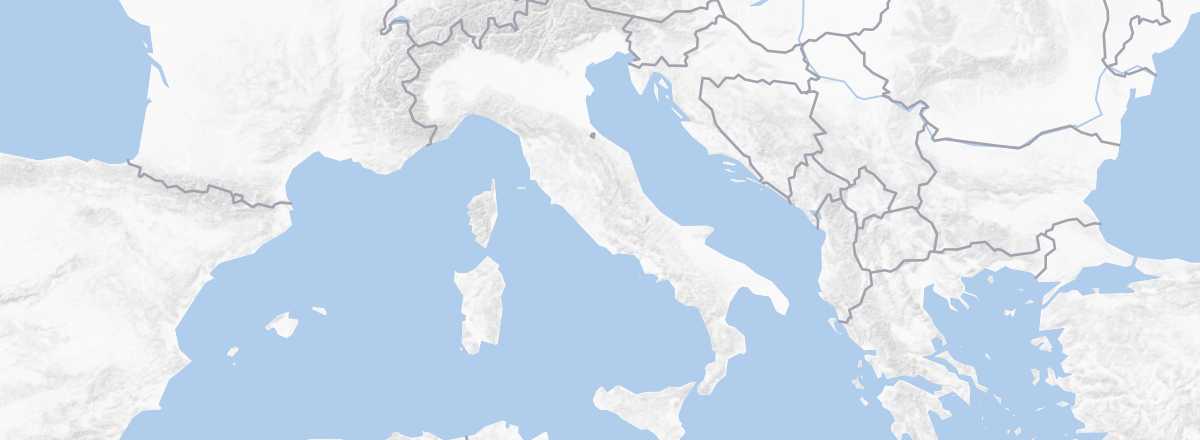 Italy
Open the interactive map
Quick Overview
Italy in Six Tourist Regions
- Central Italy: With Rome, Florence, Pisa, Siena, and Tuscany as a whole, this region boasts some of the country’s most beautiful cities and remarkable sites. Additionally, central Italy offers several natural spaces perfect for swimming or outdoor activities.
- Northeast Italy: While many focus on the must-see Venice, the region also features other highlights, such as the Dolomites with their stunning landscapes, charming cities like Bologna and Verona, and Adriatic seaside resorts for a relaxing holiday.
- Northwest Italy: Here, nature lovers can enjoy the Aosta Valley at the foot of Mont Blanc. The Lake District (Como, Maggiore, etc.), along with the coastline—especially the famous Cinque Terre—offers breathtaking scenery and relaxation. The cities (Genoa, Milan, Turin, etc.) also provide rich heritage worth exploring.
- Southern Italy: Naples and its bay, Capri, the Amalfi Coast, Vesuvius, Pompeii—southern Italy is home to some of the country’s most iconic tourist sites. While the Naples area attracts crowds, other parts remain quiet, revealing an Italy far from the hustle and bustle.
- Sardinia: Though not Italy’s most visited region, Sardinia has carved out its niche thanks to its beach tourism. Its sometimes-deserted beaches and stunning coastline are its main draws, complemented by a distinct local culture and traditions.
- Sicily: The largest island in the Mediterranean, Sicily is a crossroads of history. Greeks, Arabs, Byzantines, and others have left their mark, visible in its rich heritage. Add to that beautiful landscapes, volcanoes (including Etna), remarkable islands, and an appealing coastline, and Sicily becomes a well-rounded destination for all types of travelers.
Also...
- San Marino: This micro-state, entirely enclaved within Italy, is the world’s oldest republic. Visitors come mainly out of curiosity or to explore its small medieval heritage.
- Vatican: The world’s smallest state, nestled in the heart of Rome, is entirely UNESCO-listed. St. Peter’s Square and its Basilica, as well as the Vatican Museums, are must-sees for any visit.
Key Facts
- Type of place: country.
- Location:
- Latitude/longitude: 41°54' N, 12°29' E.
- Local time:
- Capital: Rome.
- Nature of the state: parliamentary republic.
- Official language: Italian, plus around ten languages (including French in Aosta) recognized locally as "co-official."
- Currency: euro.
- Population: 62,246,674 inhabitants (2018).
- Area: 301,336 km².
- Density: 206 inhabitants/km².
- Highest point: Mont Blanc (4,808 m).
- Lowest point: Jolanda di Savoia (-3 m).
- Coastline:
- Driving: on the right.
Tourism
Though beach tourism is slightly less developed here than in Spain or France, Italy can rely on its stunning coastal and mountain landscapes, and above all, its incredible cultural heritage, to remain one of the world’s top tourist destinations.
Over 60 million people visit Italy each year (62.146 million in 2018), with Germans making up the largest group (20%), far ahead of Americans, French (4.332 million in 2015), Chinese, British, and Swiss.
Travel Essentials
- Destination: for beginner travelers.
- By air:
- Entry requirements: ID card or passport.
- Currency to bring: euros.
- Exchange rate:
- Daily "backpacker" budget:
- Best for accommodation:
- Best for getting around:
- Risks:
- Best time for climate/crowds/prices:
- Interests (out of ): Nature / ; Adventure ; Culture ; Relaxation
Useful Addresses
Socio-Economic Statistics
- "Quality of life": 28/188 (rank in 2018)
- GDP per capita: $38,200 (2018)
- Average monthly income: ()
- Inflation: +1.3% (2017)
- "Official" unemployment: 11.3% (2017)
- Population below poverty line: 29.9% (2012)
- Life expectancy: 82.4 years (2018)
- Migration rate per 1,000 inhabitants: +3.7 (2017)
- Population growth: +0.16% (2018)
- Literacy rate: 99.2% (2015)
- Urban population: 70.4% (2018)
- Press freedom: 46/180 (rank in 2018)
- Political regime: flawed democracy (33/167 in 2018)
Sources: World Bank, Human Development Indicators, RSF, The Economist, The World Factbook