last edited Dec 11, 2019
Overview of Kenya
Location Map of Kenya
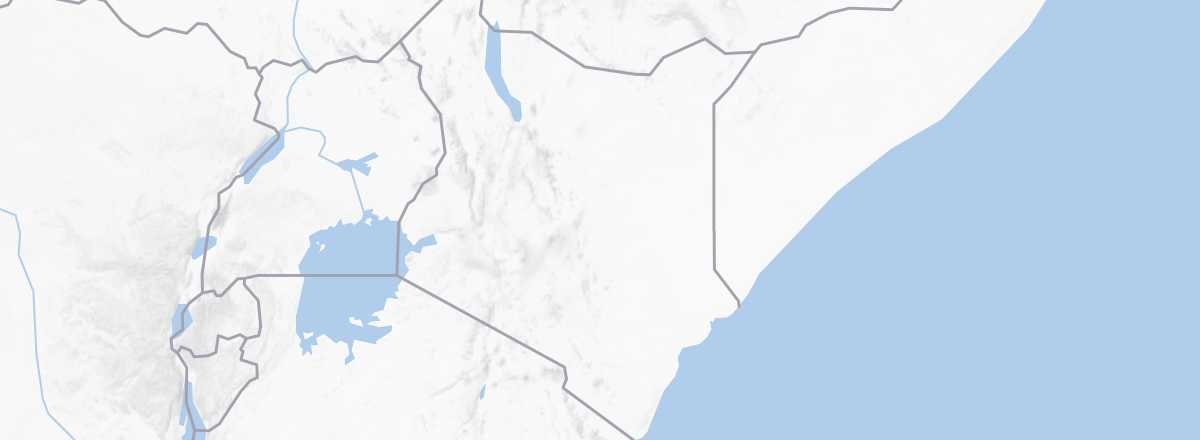 Kenya
Open the interactive map
Kenya
Open the interactive map
Quick Overview
Like neighboring Tanzania, Kenya is renowned for its magnificent parks teeming with wildlife. Similar to it, the country consists of a central high plateau that is home to the capital Nairobi. This plateau is largely bordered to the west by high mountains (Mount Kenya and others) formed by the geological structure of the Great Rift Valley, which also accounts for the presence of several lakes, and to the east by a coastal savanna plain facing the Indian Ocean. The north is a desert region. Kenya is one of the eleven countries straddling the equator.
In terms of population, the country comprises 70 tribal groups from three different ethnicities, with a majority of Kikuyus (20% of the population), though the Maasai, who represent only 2%, remain the most well-known outside its borders. Additionally, there are small European, Indian, and Arab minorities along the coast.
Traditionally agricultural (75% of Kenyans live outside cities) and known for its tea, coffee, and cut flower production, Kenya also derives resources from livestock farming, a small amount from its subsoil, and tourism, though this sector has seen a decline in recent years.
Key Facts
- Type of place: country.
- Location: along the Indian Ocean, above Tanzania.
- Latitude/longitude: 1.00' N, 38.00' E
- Local time:
- Capital: Nairobi.
- Nature of the state: presidential republic.
- Official language: Swahili and English.
- Currency: Kenyan shilling.
- Population: 48,397,527 inhabitants (2018).
- Area: 582,650 km².
- Density: 83 inhabitants/km².
- Highest point: Mount Kenya (5,199 m).
- Lowest point: sea level.
- Coastline: 536 km.
- Driving: on the left.
Tourism
With its parks and beaches, tourism has always been a significant sector for Kenya, representing its second-largest source of wealth after agriculture, accounting for 11% of its GDP and nearly 10% of employment.
Unfortunately, for some time now, the country has faced numerous security issues (which is not new in itself), including in coastal areas like Lamu and Malindi, traditionally popular with tourists, which have suffered several attacks by Somali Islamist group Al-Shabaab.
As a result, visitor numbers have stagnated—if not declined—among travelers who, particularly for safaris, are now turning to neighboring Tanzania or Southern Africa. Currently, Kenya welcomes around 1.5 million visitors per year (1.475 million in 2018), including roughly 20,000 French nationals.
Travel Essentials
- Destination: for somewhat experienced travelers.
- By air: France-Nairobi for 500 to 750 € round trip.
- Entry requirements: passport valid for 6 months beyond the end of your stay + e-visa.
- Currency to bring: euros and, secondarily, US dollars.
- Exchange rate:
- Backpacker daily budget: around 30 to 40 € per person for daily expenses + 100/120 € per day for safari.
- Accommodation: guesthouses or "safari with tented nights" packages.
- Getting around: car with driver or, alternatively, buses.
- Risks: moderate health risks and moderate to locally high security risks.
- Best time for climate/crowds/prices: March and September-October are ideal, though ultimately only the rainy seasons (April-May and November) can be truly problematic.
- Interests (out of ): Nature ; Adventure ; Culture ; Relaxation/Holidays
Useful Addresses
- Tourist Office: online only.
Socio-Economic Statistics
- "Quality of life": 142/188 (2018 ranking)
- GDP per capita: $3,500 (2017)
- Average monthly income: $107 (2014)
- Inflation: +8% (2017)
- "Official" unemployment: 40% (2013)
- Population below the poverty line: 36.1% (2016)
- Life expectancy: 64.6 years (2018)
- Migration rate per 1,000 inhabitants: -0.2% (2017)
- Population growth: +1.57% (2018)
- Literacy rate: 78% (2015)
- Urban population: 27% (2018)
- Press freedom: 96/180 (2018 ranking)
- Political regime: hybrid regime (98/167 in 2018)
Sources: World Bank, Human Development Indicators, RSF, The Economist, The World Factbook