last edited Dec 11, 2019
Overview of Mauritius
Location Map of Mauritius
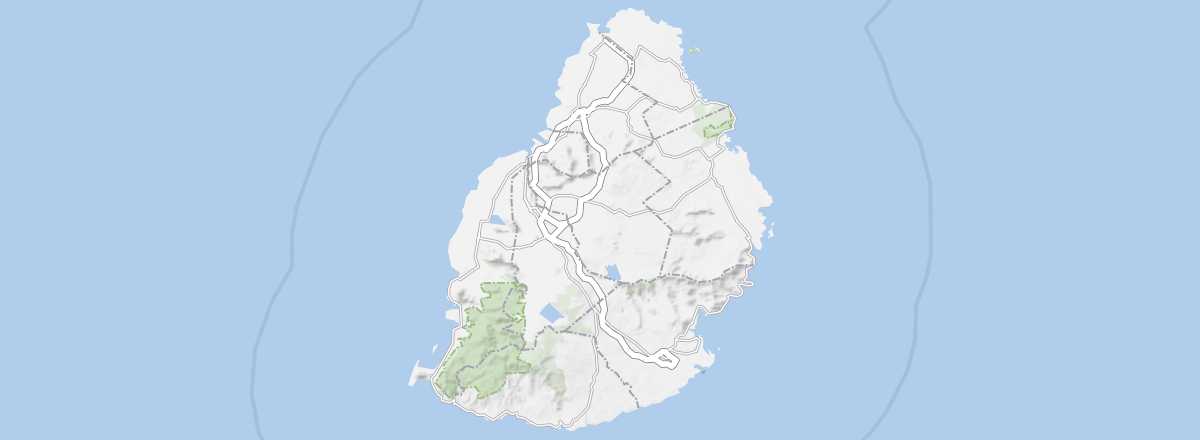 Mauritius
Open the interactive map
Mauritius
Open the interactive map
Quick Overview
Mauritius, or more precisely the Republic of Mauritius, consists of the island of Mauritius, which represents nine-tenths of the territory, and several small islands and islets, the main and best-known of which is Rodrigues (560 km east of Mauritius).
Mauritius is part of the Mascareignes like Réunion. It is also a volcanic land, 60 kilometres long by 40 wide, formed by a central plateau dominated by three low-altitude mountain ranges (Mont Piton: 828 m). A large part of the island is surrounded by a coral reef.
The island has been influenced by various waves of immigration and colonisation. Today, Indians from India or "Indo-Mauritians" (Hindu or Muslim) are largely in the majority (70%) ahead of whites, mixed-race people, and Chinese. Mauritius has a high population density with over 650 inhabitants/km². Sugar cane, tea, and tourism are the country's main resources.
Key Facts
- Type of place: country.
- Location: in the Indian Ocean, about 250 km east of Réunion.
- Latitude/longitude: 20.17' S, 57.33' E.
- Local time:
- Capital: Port Louis.
- Nature of the state: parliamentary democracy.
- Official language: there is no official language, although English is unofficially recognised as such.
- Currency: Mauritian rupee.
- Population: 1,364,283 inhabitants (2018).
- Area: 2,040 km².
- Density: 682 inhabitants/km².
- Highest point: Mont Piton (828 m).
- Lowest point: sea level.
- Coastline: 177 km.
- Driving: on the left.
Tourism
For several decades, Mauritius has been by far the leading tourist destination in the Indian Ocean, with over a million visitors each year (1.399 million in 2018), mainly fans of "all-inclusive" packages. In contrast, independent travellers are relatively few, even fewer in the "backpacker" category, which is not particularly appreciated by the authorities.
It should be noted that in Mauritius, most visitors are concentrated in beach resorts (mainly in the northern region) and rarely venture outside them except for a few excursions. So, in a way, outside these areas, you will encounter few tourists and discover other facets of the country.
In terms of visitor numbers, travellers from metropolitan France (244,000 in 2014) and Réunion (139,000) are by far the most numerous, ahead of South Africans (9%), British (9%), Indians (5%), Germans (5%), and Italians (4%). Mauritius welcomes the most visitors at the end of the year and in August, although in terms of climate, prices, and crowds, April to mid-July and September to October are ideal in every way.
Travel Essentials
- Destination: for beginner travellers.
- By air: France to Port Louis for 850 to 1,250 €.
- Entry requirements: passport + return ticket.
- Currency to bring: Euros.
- Exchange rate:
- Daily backpacker budget: 25 to 35 € per person.
- Accommodation: mid-range hotels (or all-inclusive) and guesthouses in Rodrigues.
- Getting around: buses and chartered taxis, occasionally scooters.
- Risks: very low health risks and fairly low security risks.
- Best time for climate/crowds/prices: May to mid-July and September to October.
- Interests (out of ): Nature ; Adventure ; Culture ; Relaxation/Holidays .
Addresses in France
- Tourist Office: no public representation; see online.
- Air Mauritius: 23 rue de la Paix; 75002 Paris. Tel.: 0 890 710 315
Addresses in Belgium, Switzerland, and Quebec
- Tourist Office: no public representations; see online.
Socio-Economic Statistics
- "Quality of life": 65/188 (rank in 2018)
- GDP per capita: $22,300 (2017)
- Average monthly income: $715 (2012)
- Inflation: +3.7% (2017)
- "Official" unemployment: 7.1% (2017)
- Population below the poverty line:
- Life expectancy: 76 years (2018)
- Migration rate per 1,000 inhabitants: 0 (2017)
- Population growth: +0.57% (2018)
- Literacy rate: 90.6% (2016)
- Urban population: 40.8% (2018)
- Press freedom: 56/180 (rank in 2018)
- Political regime: democratic regime (17/167 in 2018)
Sources: World Bank, Human Development Indicators, RSF, The Economist, The World Factbook