last edited Dec 11, 2019
Overview of the Philippines
Location Map of Philippines
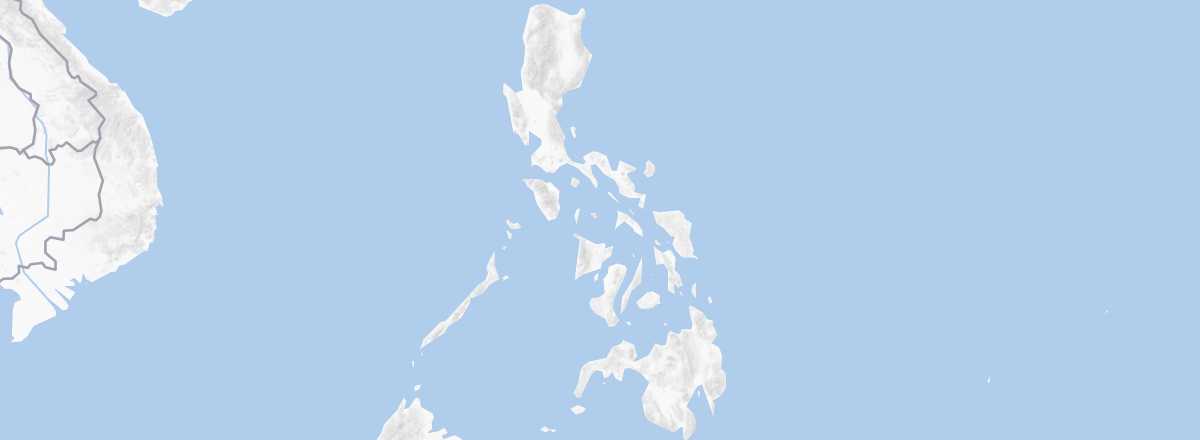 Philippines
Open the interactive map
Quick Overview
The Philippines consists of over 7,000 often forested, mountainous (under 2,954 m) and volcanic islands stretching over 1,700 kilometres towards the equator. Out of these, eleven islands account for 95% of the territory, only 2,000 are inhabited, and 2,500 don’t even have names.
The archipelago is divided into three main zones: Luzon, the Visayas and Mindanao. Luzon is the main island in the north, where the capital, Manila, is located. The Visayas are the central group of islands, characterised by tropical beaches amidst warm seas. Mindanao is the southern island, home to a significant Muslim minority traditionally in rebellion against the government.
Key Facts
- Type of place: country.
- Location: off the coast of Vietnam, between the Pacific Ocean and the South China Sea.
- Latitude/longitude: 13°00' N, 122°00' E.
- Local time:
- Capital: Manila.
- Nature of the state: parliamentary democracy.
- Official languages: Filipino, English
- Currency: Philippine peso.
- Population: 105,893,381 inhabitants (2018).
- Area: 300,400 km².
- Density: 352 inhabitants/km².
- Highest point: Mount Apo (2,954 m) on the island of Mindanao.
- Lowest point: sea level.
- Coastline: 36,300 km.
- Driving: on the right.
Tourism
Once largely overlooked by European tourists, the archipelago is now gaining popularity for its colonial heritage, local cultures, lush nature, and above all, stunning beaches and world-renowned diving spots.
In 2018, 7.129 million people visited the Philippines (twice as many as in 2010), with Koreans, Americans, and Chinese making up over half of all arrivals. As for the French, four times fewer than Canadians, 45,000 visited the Philippines in 2016—a respectable number for a destination that had long been almost entirely off the radar.
Travel Essentials
- Destination: for slightly experienced travellers.
- By air: France-Manila.
- Entry requirements: no visa for stays under 30 days, but a passport valid for at least 6 months beyond the planned arrival date, plus a return or onward ticket.
- Currency to bring:
- Exchange rate:
- Daily "backpacker" budget:
- Best for accommodation:
- Best for getting around:
- Risks:
- Best time for climate/crowds/prices:
- Interests (out of ): Nature ; Adventure ; Culture / ; Relaxation/Holidays
Useful Addresses
Socio-Economic Statistics
- "Quality of life": 113/188 (2018 ranking)
- GDP per capita: $8,400 (2017)
- Average monthly income: ()
- Inflation: +2.9% (2017)
- "Official" unemployment: 5.7% (2017)
- Population below the poverty line: 21.6% (2017)
- Life expectancy: 69.6 years (2018)
- Migration rate per 1,000 inhabitants: -2 (2017)
- Population growth: +1.55% (2018)
- Literacy rate: 96.3% (2015)
- Urban population: 46.9% (2018)
- Press freedom: 133/180 (2018 ranking)
- Political regime: flawed democracy (53/167 in 2018)
Sources: World Bank, Human Development Indicators, RSF, The Economist, The World Factbook