last edited Dec 11, 2019
Overview of Baja California
Location Map of Baja California
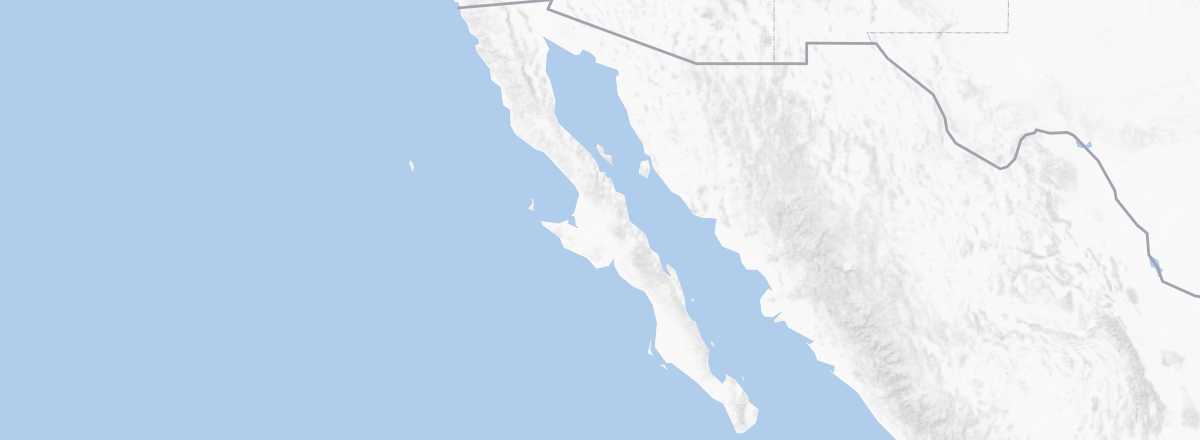 Baja California
Open the interactive map
Quick Overview
Extending from California, the endless peninsula of Baja California stretches over 1,200 km, with a width of 40 to 320 km, between the Pacific Ocean and the Sea of Cortés. Sparsely populated, it offers remarkable landscapes, a mix of deserts, mountains, volcanoes, and desolate coastlines. Administratively, it consists of two states: Baja California and Baja California Sur. Together, they represent barely 7% of the country's area for about 3% of its population, with the latter concentrated overwhelmingly in the urban areas of Tijuana and Mexicali.
Key Facts
- Type of place: tourist region.
- Location: It is the long peninsula bordering the USA, running along the Pacific.
- Main cities: Cabo San Lucas, Ensenada, La Paz, Mexicali, Tijuana...
- Population: 4,028,000 inhabitants (2013).
- Area: 145,435 km².
- Density: 27 inhabitants/km².
- Highest point: Sierra de la Laguna (2,080 m).
- Lowest point: Laguna Salada (-10 m).
- Coastline:
Tourism
For several years, ecotourism has developed in Baja California, particularly at its southern tip in the Los Cabos region. In contrast, the entire U.S. border area is dedicated to festive or shopping tourism for an American audience. This is where Tijuana, the world's most visited border city, is located. Traditionally, the region receives almost exclusively American or Canadian tourists and very few Europeans.
Travel Essentials
- Destination: For beginner travelers.
- By air: France-
- Backpacker daily budget: 40 to 50 € per person.
- Accommodation: Mid-range hotels (or all-inclusive if you only want beachside relaxation).
- Getting around: Car (buses as a secondary option).
- Risks: Low in terms of health and safety.
- Best time for climate/crowds/prices: October to May, avoiding Christmas/January and Easter.
- Interests (out of ): Nature ; Adventure ; Culture ; Relaxation/Holidays .
Precautions
Health
Safety
Outside of Tijuana and its surroundings, where you should take basic precautions, the rest of the peninsula is among the safest areas. In fact, Baja California is considered by many to be the "quietest" place in Mexico in terms of safety. That said, while the risk of bad encounters is low, you must still account for nature. A large part of the territory is uninhabited and desert-like. Additionally, it is a seismic zone.